No products in the cart.
Return To Shop
MEN: How Much Vitamin D Do Men Need Through a UK Winter?
Quick Answer
A UK man needs 10 micrograms of vitamin D a day, which is 400 IU. From October to March the NHS advises everyone to consider a daily 10 microgram supplement, because winter sunlight in the UK is too weak for the skin to make enough. Do not take more than 100 micrograms a day.
That 10 microgram figure was set by the government’s Scientific Advisory Committee on Nutrition in 2016 for everyone aged 4 and over, all year round.[3] The figure a supplement label measures against is different: the nutrient reference value, or NRV, for vitamin D is 5 micrograms, so 10 micrograms prints as 200% NRV.[5]
Key points:
- From about late March or early April to the end of September, most people can make the vitamin D they need from sunlight.[2]
- 18% of UK adults aged 19 to 64 had low vitamin D status across 2019 to 2023, and the share was highest from January to March.[4]
- Men with dark skin, men who are rarely outdoors and men who cover most of their skin are advised to consider a supplement all year.[2]
- Food carries little of it: a 140g fillet of baked salmon has about 10.2 micrograms, an egg about 1.6 micrograms.[8]
Jump to: Ways to cover it, compared | The daily figures | What changes the amount
Supplements are foods, not medicines. They are designed to support normal health and nutrient status alongside a balanced lifestyle, not to diagnose, treat, prevent, or cure any medical condition.
Disclosure: MenTools publishes this article and sells MenTools One-A-Day Multivitamin.
How we evaluate: We assess nutrient form, dose versus NRV, authorised health claims, and male-specific design. Full sources are listed in the references below.
Seven Ways a Man Covers Vitamin D Through Winter, Compared
There are seven realistic ways to reach 10 micrograms a day between October and March. Each one has a real limitation, ours included, and the right choice depends on your skin, your week and what is already in your cupboard.[2]
| Option | Vitamin D a day | Form | Suits a man who | Watch-out |
|---|---|---|---|---|
| Winter sunlight | Little or none from October to March | Made in the skin from UVB light | Is planning for April to September, not for winter | UK winter sunlight carries too little UVB, so a lunchtime walk in December does not cover the gap |
| Oily fish twice a week | About 2.9 micrograms a day averaged over the week | Food vitamin D3 | Already eats salmon, mackerel or sardines | Two 140g portions of baked salmon carry about 20.4 micrograms in total, which spread over seven days falls well short of 10 a day |
| Eggs and fortified foods | Typically 1 to 4 micrograms on a given day | Food vitamin D3, plus added D in some cereals and spreads | Has eggs, fortified cereal or spread most days | Fortification varies by brand, so the number on your pack is the one that counts, and it rarely reaches 10 on its own |
| Plain vitamin D tablet | 10 micrograms, matching the NHS advice | D3, from lanolin or lichen, or D2 | Eats well and wants the one nutrient the NHS asks about in winter | Covers vitamin D and nothing else, and D3 from lanolin comes from sheep’s wool, which matters if you are vegan |
| Standard men’s multivitamin | Varies; read the vitamin D line | Usually D3, sometimes D2 | Has an inconsistent diet and wants a fixed daily floor | 100% NRV is 5 micrograms, half the NHS figure, so a label at 100% NRV does not cover the winter advice on its own |
| MenTools One-A-Day | 25 micrograms (1,000 IU), 500% NRV | D3 from lichen, alongside vitamin K2 (MK-7) | Wants one vegan, iron-free capsule that clears the winter figure without a second tub | 2.5 times the NHS figure, which is more than most men need from April to September, it costs about 50p a day, more than a plain vitamin D tablet, and we cite no human trial comparing lichen D3 with lanolin D3 |
| High-dose tablet, 100 micrograms | 100 micrograms (4,000 IU) | Usually D3 | Has been advised by a doctor to take this amount | Already sits at the NHS daily maximum, so any multivitamin or fortified food on top takes you over it |
Read the watch-out column first. A common vitamin D mistake in winter is not taking nothing, it is a multivitamin, a separate D tablet and a high-dose spray from the gym, with nobody adding up the total.[2][8][10]
The Daily Vitamin D Figures for a Man, Side by Side
Different bodies publish different numbers, which is why the question feels harder than it is. They are not contradicting each other. Each one answers a slightly different question, and most of the gap comes from how much sunlight each body assumes you get.[6]
| Source | Figure for a man | What the number is | Suits a man who wants |
|---|---|---|---|
| UK government, SACN 2016 | 10 micrograms a day | Reference nutrient intake for everyone aged 4 and over, all year round | The UK answer to the question in the title |
| NHS winter advice | 10 micrograms a day | The supplement everyone should consider from October to March | A plain rule for the dark months |
| Food label NRV | 5 micrograms a day | The reference value every percentage on a UK supplement label is measured against | To read a label, where 200% NRV means 10 micrograms |
| EFSA | 15 micrograms a day | Adequate intake for adults, set assuming little or no vitamin D made in the skin | A figure for a man who gets almost no sun at all |
| US NIH, age 19 to 70 | 15 micrograms (600 IU) a day | Recommended dietary allowance for adult men | To make sense of US labels and articles |
| US NIH, over 70 | 20 micrograms (800 IU) a day | Recommended dietary allowance for men over 70 | A figure for an older father or grandfather |
| NHS maximum | 100 micrograms (4,000 IU) a day | The most to take in a day, because more could be harmful | A ceiling for everything in the cupboard combined |
The sources for that table are SACN, the NHS, the food labelling regulation, the European Food Safety Authority and the US National Institutes of Health.[2][3][5][6][7] For a UK man the working range is simple: 10 micrograms a day through winter, and never more than 100 micrograms from everything combined.
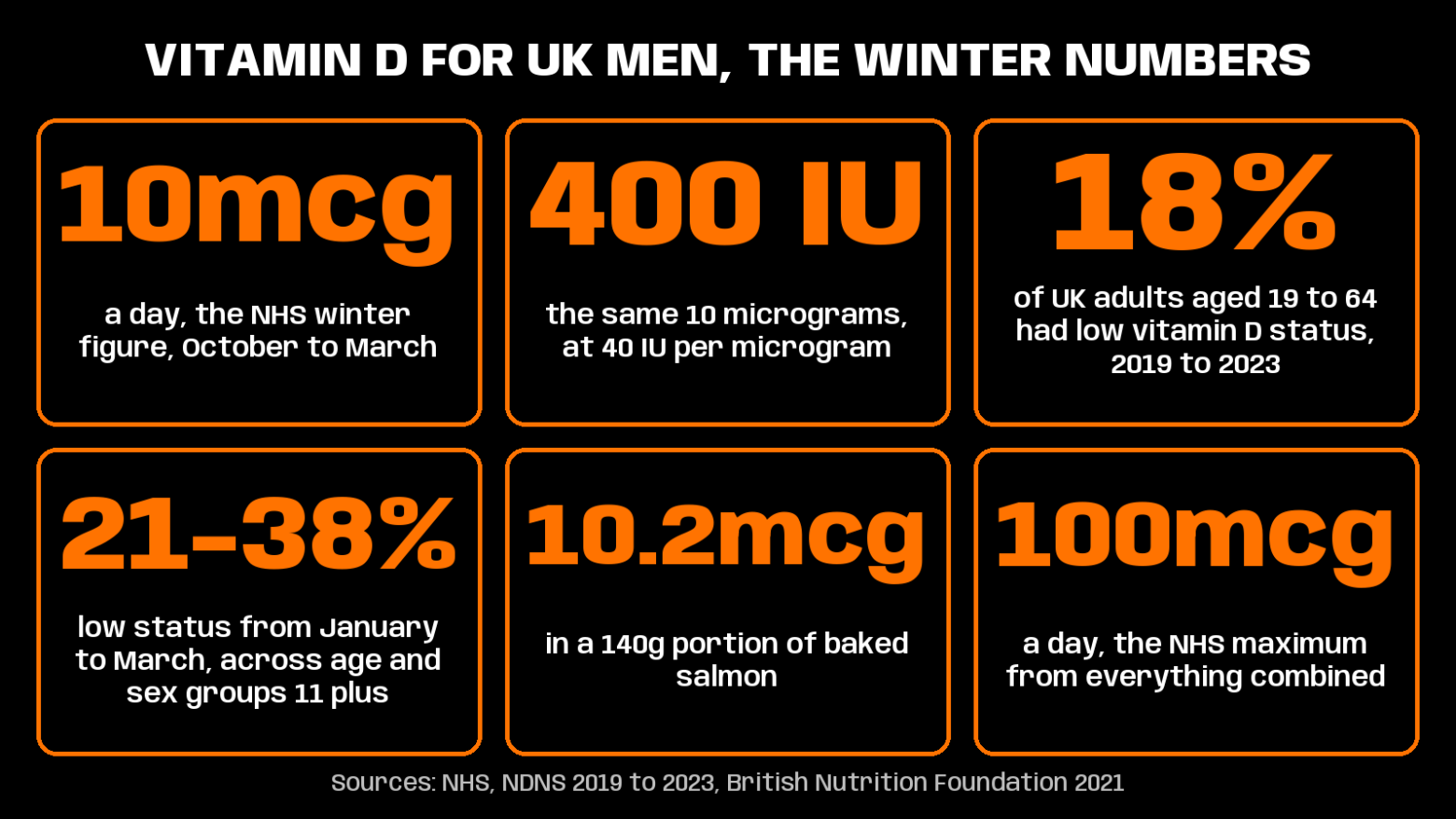
Six numbers that answer most vitamin D questions for a UK man.
What Changes How Much Vitamin D a Man Needs
Why does a UK winter matter so much for vitamin D?
Because the body makes vitamin D in the skin from UVB light, and in the UK sunlight containing UVB is limited through the winter months.[4] That is why government advice is to take a daily 10 microgram supplement between October and March, while from about late March or early April to the end of September most people can make what they need outdoors.[2][4]
The survey data follows the calendar. In the National Diet and Nutrition Survey for 2019 to 2023, vitamin D status was lowest from January to March and highest from July to September in every group, and the share with low status in January to March ran from 21% to 38% across the age and sex groups aged 11 and over.[4] A University of Cambridge summary of the same survey puts the figure for adults aged 19 to 64 at 31% in winter.[11]
Are men more likely than women to be low on vitamin D?
Slightly, on the latest figures. The survey found 18% of adults aged 19 to 64 had low status, defined as a blood level of 25-hydroxyvitamin D below 25 nmol per litre, and the share appeared marginally greater in men, by 3 percentage points.[4]
None of that tells you your own level. It does explain why the NHS advice is written for everyone rather than for a list of groups, and why a man who works indoors through the daylight hours should read it as being about him.[2]
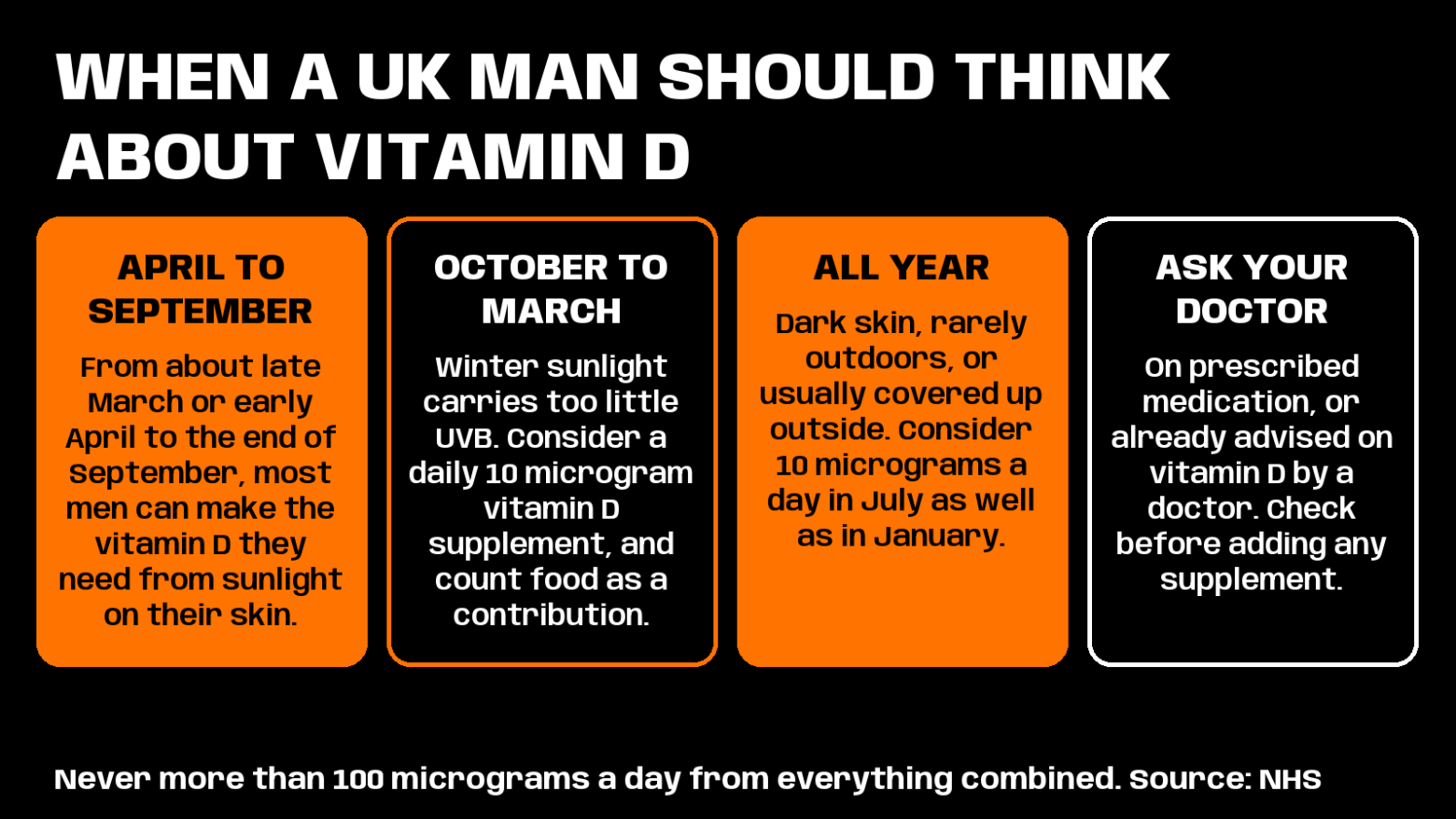
Your skin and your calendar decide this, not the tub.
Who should take vitamin D all year, not just in winter?
The NHS advises considering a daily supplement all year if you have dark skin, for example if you have an African, African-Caribbean or South Asian background, because you may not make enough vitamin D from sunlight even in summer.[2] The same advice applies if you are not often outdoors, or if you usually wear clothes that cover most of your skin when you are.
For a man with dark skin that changes the maths. It is 10 micrograms a day in July as well as in January, and food is unlikely to cover it on its own in either month.[2][8]
Can a man get 10 micrograms of vitamin D from food?
Rarely, day after day. Using British Nutrition Foundation figures, a 140g portion of baked salmon carries about 10.2 micrograms, grilled mackerel 11.9 micrograms and canned sardines 4.6 micrograms, while 90g of roast pork has 0.9 micrograms and a 100g stir-fried chicken breast 0.2 micrograms.[8]
Build a good week around that. Two salmon fillets, scrambled eggs four mornings, a daily 30g bowl of fortified bran flakes and 10g of fortified spread on your toast comes to roughly 7 micrograms a day, still short of 10.[8] Food is worth doing, but in winter it is a contribution, not a plan.
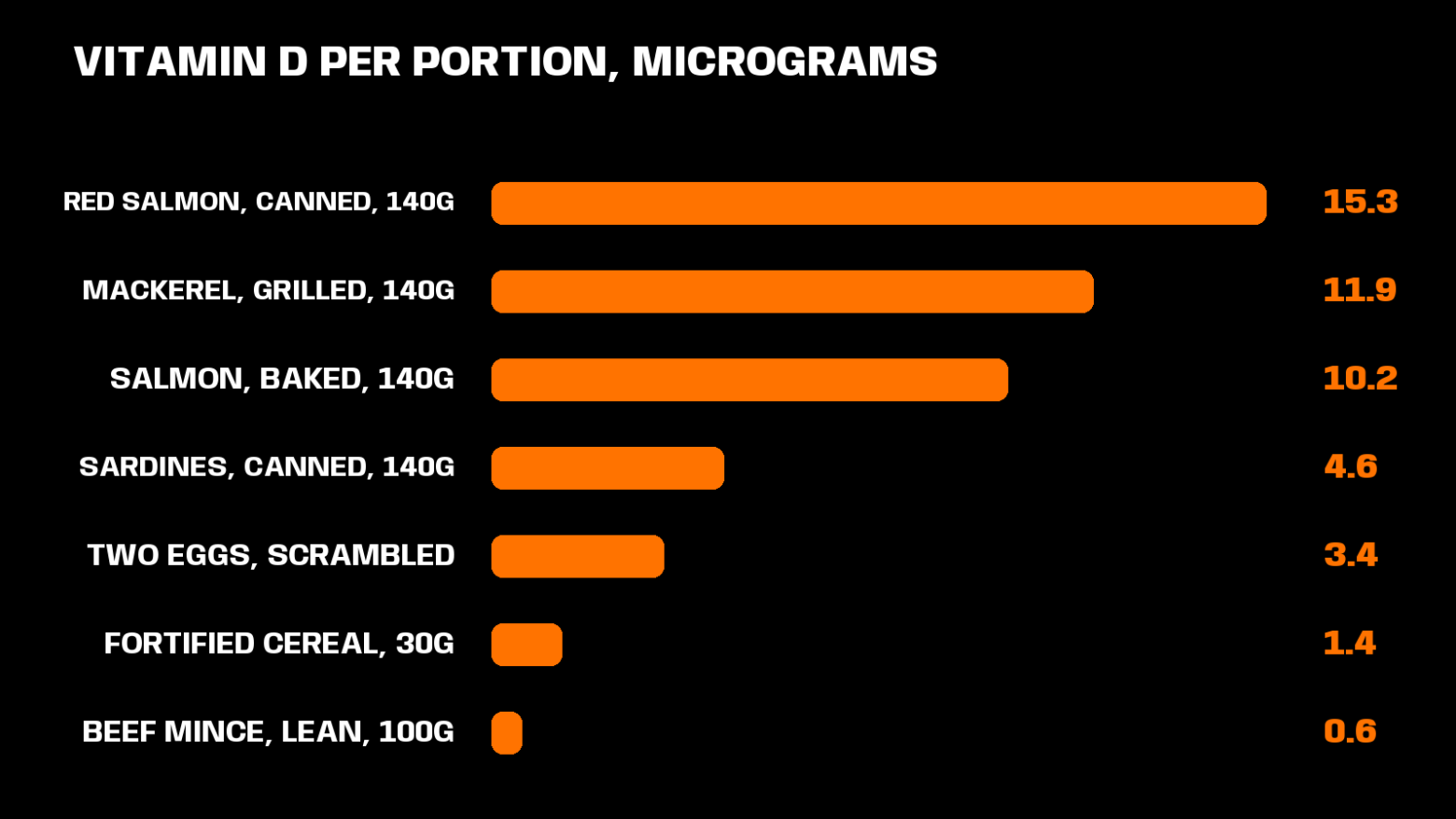
Oily fish carries the vitamin D. Most of the plate does not.
Does it matter whether a supplement uses D2 or D3?
Less than labels suggest, if you take it daily. A 2012 meta-analysis of randomised trials found vitamin D3 more efficacious than D2 at raising blood levels of 25-hydroxyvitamin D overall, but the advantage was significant when the dose was given as a single large bolus and was lost with daily supplementation.[9]
The source matters more to some men than the form. D3 can be made from lanolin, which comes from sheep’s wool, or from lichen, while D2 is made from fungal sources such as yeast, so a vegan man should read where the vitamin D comes from as well as how much there is.[7][10]
How much vitamin D is too much for a man?
More than 100 micrograms (4,000 IU) a day. The NHS says taking too many vitamin D supplements over a long period can cause too much calcium to build up in the body, which can weaken the bones and damage the kidneys and the heart.[2]
One microgram of vitamin D equals 40 IU, which is the conversion to use when a label prints one unit and an article quotes the other.[2] The risk sits in the supplement cupboard rather than on the plate, because food carries so little of it.
To check a label before you buy, The Health Improvers have a free UK supplement label checklist that walks through the units, the %NRV, the serving size and the warnings.
What Vitamin D Can and Cannot Legally Be Said to Do
In Great Britain, health claims on food supplements must come from the GB Nutrition and Health Claims Register, which holds the authorised wording and the conditions of use for each claim.[1] A product has to contain a significant amount of the nutrient to use them, and the claims cannot be reworded or stretched.
Three of the authorised claims mention vitamin D, and they are written exactly like this:
- Vitamin D and vitamin K contribute to the maintenance of normal bones.
- Vitamin D contributes to normal muscle function.
- Vitamin D, vitamin C, selenium and zinc contribute to the normal function of the immune system.
MenTools One-A-Day carries 11 authorised health claims in total, each of which appears in the register in the exact wording below.[1] This is the full list of what the product is allowed to say it does:
- Pantothenic acid contributes to normal mental performance.
- Zinc and iodine contribute to normal cognitive function.
- Zinc contributes to the maintenance of normal testosterone levels.
- Vitamins B2, B3, B6, B12, vitamin C and magnesium contribute to the reduction of tiredness and fatigue.
- Magnesium contributes to normal psychological function.
- Vitamin D and vitamin K contribute to the maintenance of normal bones.
- Vitamin D contributes to normal muscle function.
- Vitamin D, vitamin C, selenium and zinc contribute to the normal function of the immune system.
- Selenium contributes to normal spermatogenesis.
- Vitamin C, vitamin E and selenium contribute to the protection of cells from oxidative stress.
- Biotin contributes to the maintenance of normal hair and skin.
None of those lines says that more vitamin D is better. Each one describes vitamin D doing its normal job in a man who already gets enough, and a winter pack that promises more than that has left the register behind.
FAQ
How much vitamin D does a man need in a UK winter?
10 micrograms a day, which is 400 IU. The NHS advises that everyone should consider taking a daily 10 microgram vitamin D supplement during autumn and winter, because UK sunlight from October to March does not carry enough UVB for the skin to make it.[2][4]
When should I start taking vitamin D in the UK?
Government advice covers October to March. From about late March or early April to the end of September, the NHS says most people can make the vitamin D they need from sunlight on their skin.[2][4]
Is 25 micrograms (1,000 IU) of vitamin D a day too much for a man?
No. It is above the 10 microgram UK figure but well under the NHS maximum of 100 micrograms (4,000 IU) a day. Add up every product you take, including any multivitamin, against that 100 microgram figure.[2]
Should men with darker skin take vitamin D all year?
The NHS advises considering a daily supplement all year if you have dark skin, for example if you have an African, African-Caribbean or South Asian background, because you may not make enough vitamin D from sunlight even in summer. The same applies if you are not often outdoors or usually cover most of your skin.[2]
Can a man get enough vitamin D from food in winter?
It is hard. A 140g portion of baked salmon carries about 10.2 micrograms, but two boiled eggs carry about 3.2 micrograms and a 30g bowl of fortified bran flakes about 1.4 micrograms. Two portions of salmon a week average out at under 3 micrograms a day.[8]
What can vitamin D legally be said to do for a man?
Three authorised claims mention vitamin D. Vitamin D and vitamin K contribute to the maintenance of normal bones. Vitamin D contributes to normal muscle function. Vitamin D, vitamin C, selenium and zinc contribute to the normal function of the immune system.[1]
I am on TRT or prescription medication. Can I take vitamin D?
If you are on TRT or any prescribed medication, speak with your prescribing doctor before adding any supplement. MenTools products are nutritional supplements designed to support general health and normal nutrient status, not medicines and not a replacement for medical treatment.
Are food supplements medicines?
No. Food supplements are foods in law, not medicines. They are designed to support normal health and nutrient status alongside a balanced lifestyle, not to diagnose, treat, prevent, or cure any medical condition.
Final Recommendation
From October to March, take 10 micrograms of vitamin D a day, and count food as a contribution rather than the plan. If you have dark skin, are rarely outdoors or cover most of your skin, keep taking it through the summer as well.[2]
Whatever you take, read the vitamin D line in micrograms rather than the NRV percentage, and add every product together against the 100 microgram maximum.[2][5] A plain 10 microgram tablet does the job the NHS describes, and for many men that is the right answer.
MenTools One-A-Day is one option for winter and it has its own limitations. Its 25 micrograms of lichen-sourced D3 is more than the NHS figure, it costs more per day than a plain vitamin D tablet, and you are paying for zinc, magnesium and B-vitamins you may already get from food.[10] For how it compares with other brands, read our guide to choosing a men’s multivitamin.
Options For Men to Take Action
A lot of men go into winter with vitamin D coming from three places at once: a multivitamin, a 1,000 IU tablet bought in a two-for-one, and a spray from the gym. None of the labels talk to each other, and half of them print IU while the others print micrograms.
MenTools One-A-Day is built as the simple version: one capsule per day that is high in vitamin D, with D3 from lichen, chelated minerals, active B-vitamin forms and no iron, in a vegan capsule. The nutrition archive covers the oily fish and eggs that do part of the work, and the MenTools challenges handle the daily habit side, from getting outdoors in daylight to cooking at home, that no capsule can do for you.
How you can do this today: line up every product you take, find the vitamin D line on each panel, convert any IU to micrograms by dividing by 40, and add them together. If the total is under 10 for winter, add one; if it is over 100, drop one.
Wins on cost: one capsule that clears the winter figure replaces a multivitamin plus a separate vitamin D tub, and you stop paying twice for the same nutrient.
Wins on time: the figures are done. Ten micrograms from October to March, one hundred as the ceiling, and nothing else to research.
Wins on practicality: one fixed dose is easy to add up when you travel, train or change your diet, because you always know what is already in.
Getting vitamin D right through a UK winter is less about finding more of it and more about knowing your total, and a man who knows his total has one less thing to second-guess between October and March.
Last updated: 2026-10-16 v1.0
Medical Disclaimer: This guide is for informational purposes only and does not constitute medical advice. Always speak with your doctor or another qualified healthcare professional before starting any new supplement or programme if you have medical conditions or take prescription medication.
Supplement Notice: Food supplements should not be used as a substitute for a varied and balanced diet and a healthy lifestyle. Do not exceed the stated recommended daily dose. Keep out of reach of children.
References
- [1] Department of Health and Social Care. Great Britain nutrition and health claims (NHC) register. GOV.UK. https://www.gov.uk/government/publications/great-britain-nutrition-and-health-claims-nhc-register
- [2] NHS. Vitamins and minerals, Vitamin D. NHS. https://www.nhs.uk/conditions/vitamins-and-minerals/vitamin-d/
- [3] Scientific Advisory Committee on Nutrition. SACN vitamin D and health report. GOV.UK, 2016. https://www.gov.uk/government/publications/sacn-vitamin-d-and-health-report
- [4] Office for Health Improvement and Disparities. National Diet and Nutrition Survey 2019 to 2023: report. GOV.UK, 2025. https://www.gov.uk/government/statistics/national-diet-and-nutrition-survey-2019-to-2023/national-diet-and-nutrition-survey-2019-to-2023-report
- [5] Regulation (EU) No 1169/2011 on the provision of food information to consumers, Annex XIII, nutrient reference values. legislation.gov.uk. https://www.legislation.gov.uk/eur/2011/1169/annex/XIII
- [6] EFSA Panel on Dietetic Products, Nutrition and Allergies. Dietary reference values for vitamin D. EFSA Journal 2016;14(10):4547. https://www.efsa.europa.eu/en/efsajournal/pub/4547
- [7] National Institutes of Health, Office of Dietary Supplements. Vitamin D: Fact Sheet for Health Professionals. https://ods.od.nih.gov/factsheets/VitaminD-HealthProfessional/
- [8] British Nutrition Foundation. Vital vitamin D! Vitamin D content of foods, 2021, from McCance and Widdowson’s The Composition of Foods. https://www.nutrition.org.uk/media/5oejocv1/vitalv-3.pdf
- [9] Tripkovic L, Lambert H, Hart K, et al. Comparison of vitamin D2 and vitamin D3 supplementation in raising serum 25-hydroxyvitamin D status: a systematic review and meta-analysis. Am J Clin Nutr 2012;95(6):1357-64. https://pmc.ncbi.nlm.nih.gov/articles/PMC3349454/
- [10] MenTools. One-A-Day Multivitamin, product page and ingredient panel. https://www.mentools.co/product/one-a-day-multi-vitamin/
- [11] University of Cambridge, Epidemiology Unit. NDNS 2019 to 2023 findings. Blog, 12 June 2025. https://www.epi.ims.cam.ac.uk/blog/2025/06/12/ndns-2019-2023-dietary-deficiencies/