No products in the cart.
Return To Shop
MEN: What Does a Men’s Multivitamin Actually Do?
Quick Answer
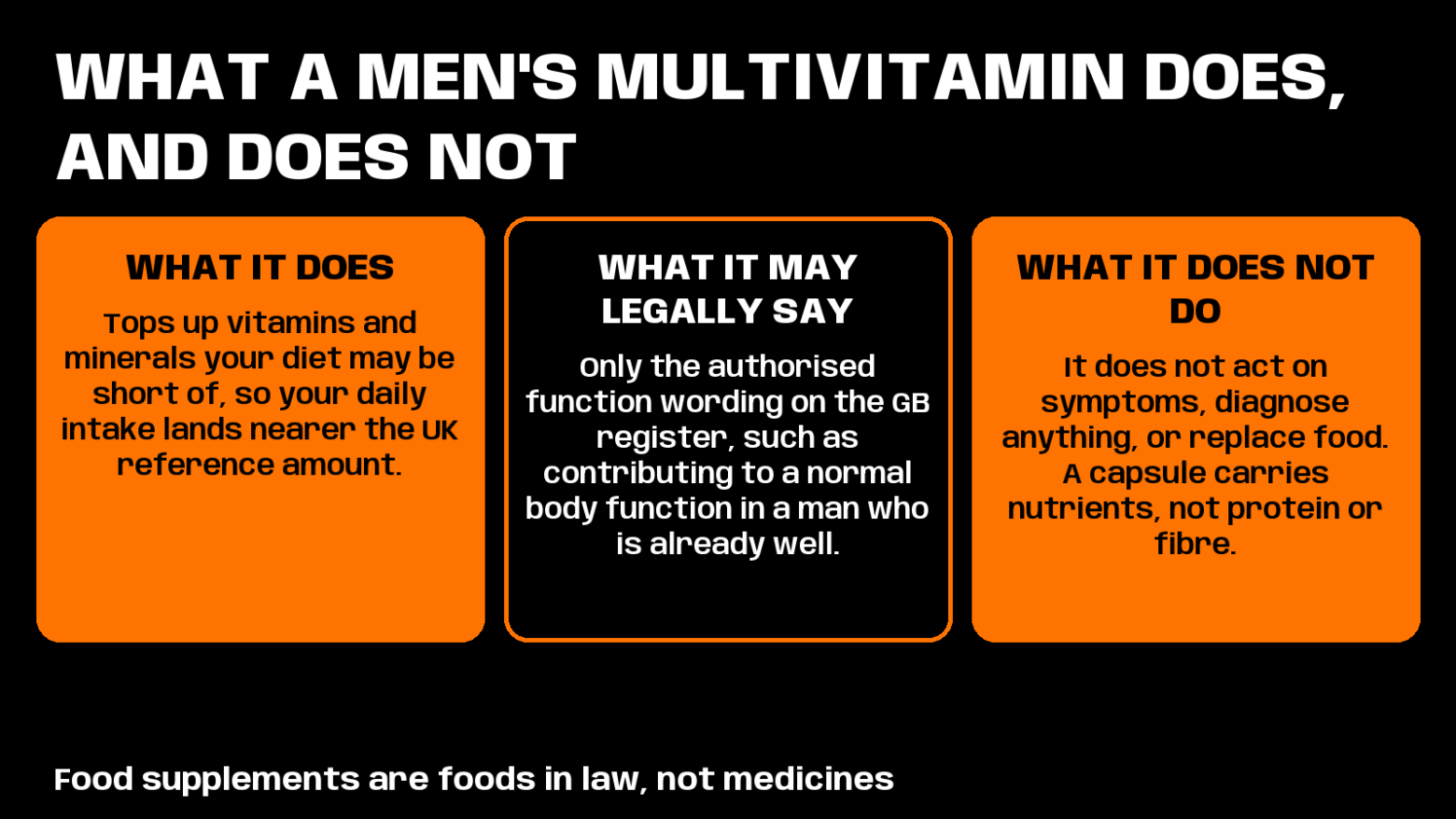
A men’s multivitamin does one job. It tops up vitamins and minerals your diet may be short of, so your daily intake sits nearer the reference amount. In UK law it is a food and not a medicine, so it may only carry authorised nutrient function claims. It does not act on symptoms, and it does not replace eating properly.
Those authorised claims all describe a contribution to a normal body function in someone who is already well.[1] The NHS position is that most people should get the nutrients they need from a varied and balanced diet, with vitamin D the standing exception through autumn and winter.[2][3]
Key points:
- A multivitamin narrows nutrient gaps. It does not diagnose, treat or manage anything.
- UK men aged 19 to 64 need 9.5mg of zinc, 300mg of magnesium and 75 micrograms of selenium a day.[4]
- Vitamin D is the one nutrient with standing UK supplement advice behind it, at 10 micrograms a day.[3]
- Men aged 19 and over need 8.7mg of iron a day and can usually get it from food, so an iron-free formula suits most men.[5]
Jump to: What each nutrient does | The real answer | What a label can legally claim
Supplements are foods, not medicines. They are designed to support normal health and nutrient status alongside a balanced lifestyle, not to diagnose, treat, prevent, or cure any medical condition.
Disclosure: MenTools publishes this article and sells MenTools One-A-Day Multivitamin.
How we evaluate: We assess mineral form quality, dose versus NRV, authorised health claims, and male-specific design. Full sources are listed in the references below.
What Each Nutrient in a Men’s Multivitamin Actually Does
This is the whole answer in one table. Each row gives the function wording that nutrient is legally allowed to carry in Great Britain, the amount a UK man aged 19 to 64 needs, and the honest watch-out that goes with it.[1]
| Nutrient | Authorised function wording | Amount for men 19 to 64 | Where it comes from in food | Watch-out | Best for |
|---|---|---|---|---|---|
| Vitamin D | Vitamin D contributes to normal muscle function. | 10 micrograms a day, equal to 400 IU | Oily fish, egg yolks, fortified spreads, and sunlight from late March to September | The NHS advises not taking more than 100 micrograms a day | Every man through a UK autumn and winter |
| Vitamin K | Vitamin D and vitamin K contribute to the maintenance of normal bones. | About 1 microgram per kilogram of body weight a day | Green leafy vegetables, vegetable oils, cereal grains | There is not enough evidence on high doses, and 1mg or less a day is unlikely to cause harm | Men who eat few green vegetables |
| Zinc | Zinc contributes to the maintenance of normal testosterone levels. | About 9.5mg a day | Meat, shellfish, dairy foods, bread | High doses reduce how much copper the body absorbs, and the NHS says not to take more than 25mg a day from supplements unless a doctor advises it | Men eating little meat, shellfish or dairy |
| Magnesium | Magnesium contributes to normal psychological function. | 300mg a day | Spinach, nuts, wholemeal bread | More than 400mg from supplements over a short period can cause diarrhoea | Men who eat few nuts, greens or wholegrains |
| Selenium | Selenium contributes to normal spermatogenesis. | 75 micrograms a day | Brazil nuts, meat, fish, eggs | Too much causes selenosis, and 350 micrograms or less a day from supplements is unlikely to cause harm | Men who eat little meat, fish or nuts |
| Iodine | Zinc and iodine contribute to normal cognitive function. | 140 micrograms a day | Sea fish, shellfish, milk and dairy foods | High doses over long periods can change how the thyroid gland works | Men on a strict vegan diet with no fish, eggs or dairy |
| B2, B3, B6 and B12 | Vitamins B2, B3, B6, B12, vitamin C and magnesium contribute to the reduction of tiredness and fatigue. | 1.3mg B2, 16.5mg B3, 1.4mg B6, 1.5 micrograms B12 | Meat, fish, dairy foods, eggs, fortified cereals | B12 is not found naturally in fruit, vegetables or grains, so vegans are the group most likely to fall short | Men eating little or no animal food |
| Vitamin C | Vitamin D, vitamin C, selenium and zinc contribute to the normal function of the immune system. | 40mg a day | Citrus fruit, peppers, broccoli, potatoes | More than 1,000mg a day can cause stomach pain, diarrhoea and flatulence | Men who eat very little fruit and veg |
| Vitamin E | Vitamin C, vitamin E and selenium contribute to the protection of cells from oxidative stress. | 4mg a day | Plant oils, nuts, seeds, wheatgerm | There is not enough evidence on daily high doses, and 540mg or less a day is unlikely to cause harm | Rarely a gap on a normal UK diet |
| Iron, usually left out | Carries no claim in an iron-free formulation, which is what MenTools One-A-Day is | 8.7mg a day for men aged 19 and over | Red meat, beans, nuts, fortified cereals | Side effects of doses over 20mg include constipation, nausea and stomach pain | Men a doctor has told to take it, which is not most men |
Every figure in that table comes from NHS guidance for UK adults.[2][3][4][5][6][7] Read down the watch-out column before you read anything on the front of a pack.
The two halves of the answer, side by side.
The Real Answer
What does a multivitamin do in the body?
It delivers a measured amount of each vitamin and mineral so your total daily intake lands nearer the reference amount. Nothing more exotic than that is going on.
Those nutrients are then used in the ordinary business of a working body. The reason a label may only say a nutrient contributes to a normal function is that this is what the evidence supports, at normal intakes, in a person who is already well.[1]
Does a multivitamin do anything if your diet is already good?
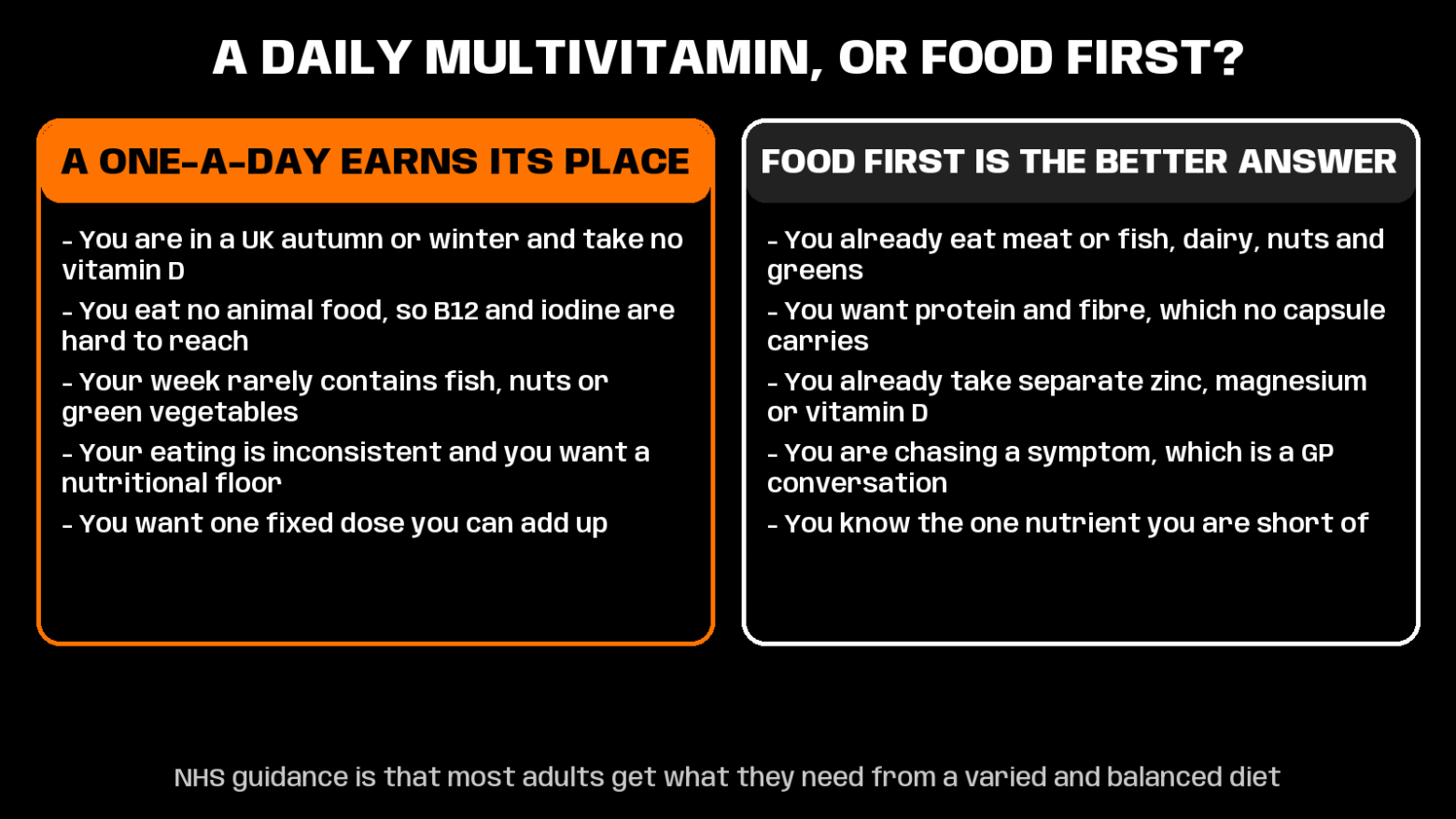
Less than you might hope. The NHS position is that most people should be able to get all the nutrients they need by having a varied and balanced diet.[2]
The honest case for taking one is a week that does not look like that. The National Diet and Nutrition Survey is the ongoing UK programme that tracks what adults actually eat and where intakes fall short, and it is the right place to check whether the gap you are trying to cover is a real one.[8]
Which nutrient is the exception?
Vitamin D. From late March to the end of September most people can make what they need from sunlight on their skin, but through autumn and winter the sun in the UK is not strong enough.[3]
The NHS advises that everyone should consider taking a daily supplement containing 10 micrograms of vitamin D during the autumn and winter, because it is difficult to get enough from food alone.[3] Ten micrograms is 400 IU, which is the unit some labels use.[3] The Scientific Advisory Committee on Nutrition set out the evidence behind that advice in its vitamin D and health report.[9]
A multivitamin is a sensible floor in some weeks and pointless in others.
What does a multivitamin not do?
It does not act on symptoms. Under GB law a food supplement may carry authorised nutrient function claims and nothing about diagnosing, treating, preventing or curing a condition.[1]
It also does not replace food. A capsule delivers a short list of isolated nutrients, while a meal delivers those plus protein, fibre and everything else the survey data measures that a tablet has no way of carrying.[8] And it does not give you more of anything simply because the number on the label is larger, which is why the upper levels in the table matter.
Is one multivitamin better value than separate nutrients?
It depends on whether you know which nutrient you are short of. If you do not, a single one-a-day at around the reference amount is the simpler way to cover the common gaps without stacking doses you cannot add up.
If you do know, a single-nutrient product lets you set the amount precisely, and that is a fair reason to buy one. The risk with running both is drifting past the published upper levels without noticing, which is easy to do when a multivitamin and a separate zinc or magnesium tub both sit in the cupboard.[4]

The six numbers a UK man can check his own label against.
What a Label Can and Cannot Legally Claim
In Great Britain, health claims on food supplements must come from the GB Nutrition and Health Claims Register, which holds the authorised wording and the conditions of use for each claim.[1] A brand cannot write its own version of a claim, and neither can we.
MenTools One-A-Day carries 11 authorised health claims, each of which appears in the register in the exact wording below.[1] This is the full list of what the product is allowed to say it does:
- Pantothenic acid contributes to normal mental performance.
- Zinc and iodine contribute to normal cognitive function.
- Zinc contributes to the maintenance of normal testosterone levels.
- Vitamins B2, B3, B6, B12, vitamin C and magnesium contribute to the reduction of tiredness and fatigue.
- Magnesium contributes to normal psychological function.
- Vitamin D and vitamin K contribute to the maintenance of normal bones.
- Vitamin D contributes to normal muscle function.
- Vitamin D, vitamin C, selenium and zinc contribute to the normal function of the immune system.
- Selenium contributes to normal spermatogenesis.
- Vitamin C, vitamin E and selenium contribute to the protection of cells from oxidative stress.
- Biotin contributes to the maintenance of normal hair and skin.
Read what that wording does and does not say. Every line describes a contribution to a normal function, at a normal intake, in a man who is already well.
So when a product page tells you a supplement will raise a hormone, lift a mood or stop you getting ill, it has left the register behind. That is the single most useful filter you have when two packs look the same.
FAQ
What does a multivitamin do, in one sentence?
It tops up vitamins and minerals your diet may be short of, so your daily intake sits nearer the reference amount, and it may only carry authorised nutrient function claims while doing so.[1]
Will I notice anything when I start taking one?
That is not something a supplement label is allowed to tell you, and it is not something we will tell you either. A multivitamin addresses nutrient intake, which is not a sensation. If something about how you feel is bothering you, that is a conversation for a GP rather than a capsule.
Do I still need to eat well if I take a multivitamin?
Yes. The NHS position is that most people should get the nutrients they need from a varied and balanced diet, and a supplement is an addition to that rather than a swap for it.[2]
Why do men’s multivitamins usually leave out iron?
Men aged 19 and over need 8.7mg of iron a day, and the NHS position is that you should be able to get all of it from your daily diet.[5] Side effects of high doses over 20mg include constipation, nausea and stomach pain, so leaving it out is the standard choice for a general men’s formula.[5]
Can you take too much of a vitamin or mineral?
Yes. The NHS advises not taking more than 100 micrograms of vitamin D a day.[3] High doses of zinc reduce how much copper the body absorbs, and more than 400mg of supplemental magnesium over a short period can cause diarrhoea.[4] More than 1,000mg of vitamin C a day can cause stomach pain and diarrhoea.[6]
I am on TRT or prescription medication. Can I take a multivitamin?
If you are on TRT or any prescribed medication, speak with your prescribing doctor before adding any supplement. MenTools products are nutritional supplements designed to support general health and normal nutrient status, not medicines and not a replacement for medical treatment.
Are food supplements medicines?
No. Food supplements are foods in law, not medicines. They are designed to support normal health and nutrient status alongside a balanced lifestyle, not to diagnose, treat, prevent, or cure any medical condition.
Final Recommendation
Decide what you are actually buying before you buy anything. If your week already contains meat or fish, dairy or fortified alternatives, nuts and green vegetables, a multivitamin is a small insurance policy and you should treat it as one rather than as a lever.
If your week does not look like that, or you eat no animal food, a one-a-day sitting at around the reference amount is a reasonable floor while you fix the diet underneath it. Check the vitamin D figure first, since that is the one nutrient the NHS actively advises a UK adult to consider supplementing through autumn and winter.[3]
MenTools One-A-Day is one option in that category and it has its own limitations. It is one fixed formula rather than a tailored one, it costs more per day than a supermarket tablet, and it is iron-free, which is right for most men but wrong for a man whose doctor has told him otherwise. Whichever product you land on, add up everything else you take before you start.
Options For Men to Take Action
Most men end up with three half-used tubs in a cupboard, bought at different times for different reasons, none of which add up to a plan. The gap is rarely effort. It is that nobody explains what the label means, so every purchase starts from scratch.
MenTools One-A-Day is built as the simple version of this: one capsule per day, chelated minerals, active B-vitamin forms, iron-free, at 100% NRV of key vitamins and minerals. If you want the wider reading on food and nutrition for men first, the nutrition archive covers what sits around the capsule, and the MenTools challenges handle the daily habit side that no supplement can touch.
How you can do this today: take the pack you already own, find the ingredients panel, and read it against the figures in the table above. That takes about two minutes and tells you whether the tub is doing anything for you.
Wins on cost: one considered one-a-day replaces the scattergun habit of buying separate zinc, magnesium and vitamin D tubs that between them cost more and overlap badly.
Wins on time: the reading is done. You are checking a label against fixed NHS figures instead of researching forms and upper levels every time you restock.
Wins on practicality: one capsule a day travels, survives a work trip, and does not need a pill organiser or a morning ritual to keep up with.
Consistency is what makes any of this count, and a format you will actually keep taking beats a formula you abandon in March.
Last updated: 2026-09-25 v1.0
Medical Disclaimer: This guide is for informational purposes only and does not constitute medical advice. Always speak with your doctor or another qualified healthcare professional before starting any new supplement or programme if you have medical conditions or take prescription medication.
Supplement Notice: Food supplements should not be used as a substitute for a varied and balanced diet and a healthy lifestyle. Do not exceed the stated recommended daily dose. Keep out of reach of children.
References
- [1] Department of Health and Social Care. Great Britain nutrition and health claims (NHC) register. GOV.UK. https://www.gov.uk/government/publications/great-britain-nutrition-and-health-claims-nhc-register
- [2] NHS. Vitamins and minerals. NHS. https://www.nhs.uk/conditions/vitamins-and-minerals/
- [3] NHS. Vitamins and minerals, Vitamin D. NHS. https://www.nhs.uk/conditions/vitamins-and-minerals/vitamin-d/
- [4] NHS. Vitamins and minerals, Others, including magnesium, selenium and zinc. NHS. https://www.nhs.uk/conditions/vitamins-and-minerals/others/
- [5] NHS. Vitamins and minerals, Iron. NHS. https://www.nhs.uk/conditions/vitamins-and-minerals/iron/
- [6] NHS. Vitamins and minerals, Vitamin C. NHS. https://www.nhs.uk/conditions/vitamins-and-minerals/vitamin-c/
- [7] NHS. Vitamins and minerals, B vitamins and folic acid. NHS. https://www.nhs.uk/conditions/vitamins-and-minerals/vitamin-b/
- [8] Office for Health Improvement and Disparities. National Diet and Nutrition Survey. GOV.UK. https://www.gov.uk/government/collections/national-diet-and-nutrition-survey
- [9] Scientific Advisory Committee on Nutrition. SACN vitamin D and health report. GOV.UK. https://www.gov.uk/government/publications/sacn-vitamin-d-and-health-report