
MEN: 9 Habits of a Great Dad (Backed by Science)
Quick Answer
Great dads are built from consistent habits, not perfect moments: show up and be present, lead with warmth, set clear and steady boundaries, play, read and talk with them, model the man you want them to become, look after your own mental health, back up their mother, and be reliable. Pick one to work on, not all nine.
**Jump to:** How we chose these 9 | FAQ | Options for men
Disclosure: MenTools publishes this article and may feature MenTools products.
How we evaluate: Each habit is assessed on real-world use, evidence, cost and time, and how well it suits men. Every habit including the MenTools option carries an honest limitation. Full sources are in the references below.
The 9 Habits at a Glance
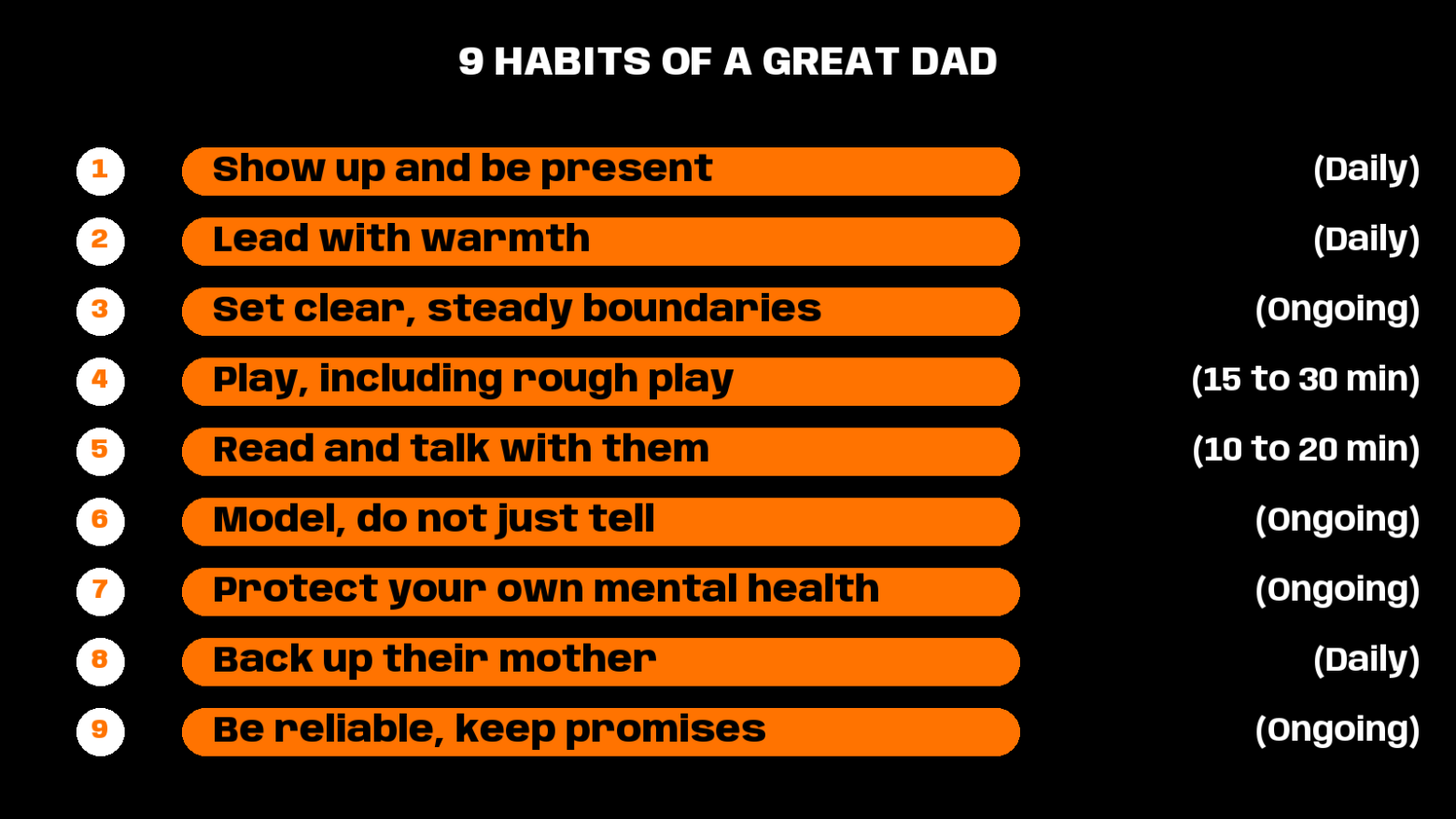
The 9 habits of a great dad at a glance, and the effort each one takes.
| Habit | Best for | Effort |
|---|---|---|
| Show up and be present | Long-hours and busy dads | Daily |
| Lead with warmth | Dads raised on stoicism | Daily |
| Set clear, steady boundaries | Chaotic or inconsistent homes | Ongoing |
| Play, including rough play | Bonding with young kids | 15 to 30 min |
| Read and talk with them | Building language and closeness | 10 to 20 min |
| Model, do not just tell | Kids who copy everything | Ongoing |
| Protect your own mental health | Stressed or low dads | Ongoing |
| Back up their mother | Co-parenting under strain | Daily |
| Be reliable, keep promises | Rebuilding or keeping trust | Ongoing |
How We Chose These 9
We picked habits that are simple, backed by real research on fathers, and realistic for a working dad. Each had to pass three tests: does the evidence support it, can you do it on a normal day, and does it actually shape how a child turns out rather than just look good. This matters because the research is now clear that involved fathers make a measurable difference. A systematic review of longitudinal studies found that active, engaged fathering is linked to fewer behavioural problems in boys, less psychological difficulty in girls, and better cognitive development overall [1]. Every habit below carries an honest watch-out, because none of them makes you a perfect dad, and no dad is.
1. Show Up and Be Present
The single biggest thing a father does is be there, consistently and with attention. Not perfectly, not constantly, but reliably present in a child’s ordinary days.
What it is: Regular, engaged time with your child, doing homework, meals, the school run, bedtime, with your attention actually on them rather than half on a screen.
Best for: Long-hours dads, and men who assume providing financially is the main job.
Standout: The evidence on father involvement is consistent: children with engaged fathers show fewer behavioural problems, better cognitive development and stronger social skills than those without [1]. Both the amount and the quality of that involvement matter, so short bursts of real attention beat hours in the same room distracted.
Watch-out: Presence is not about guilt or being available every waking minute, which is impossible and unhealthy. It is about consistency, and a smaller amount of focused, warm time reliably given beats a rare grand day out.
2. Lead With Warmth
A father’s warmth, affection, praise and physical closeness, is one of the strongest predictors of how well his children do. Many men were raised to think warmth is a mother’s job. The research says otherwise.
What it is: Openly affectionate fathering: hugs, praise, saying you love them, showing interest in their world, and being emotionally available rather than only the disciplinarian.
Best for: Dads who grew up with distant or stoic fathers and default to the same.
Standout: Evolutionary anthropologist Dr Anna Machin, author of The Life of Dad, describes the father’s bond this way: “while mum’s attachment is based on affection and nurture, dad’s is based on these too but has an added element of challenge” [4]. Warmth is the foundation, and the challenge only works when it sits on top of it.
Watch-out: Warmth without any structure tips into permissiveness, which the research links to poorer outcomes. The goal is warmth and boundaries together, not choosing one, which is exactly habit three.
3. Set Clear, Steady Boundaries
Kids need to know where the lines are and that they will hold. Firm, fair, consistent boundaries, delivered with warmth, give children security and teach self-control.
What it is: Clear rules and expectations, calmly and consistently enforced, with the reasons explained rather than just “because I said so.”
Best for: Homes that are chaotic, inconsistent, or where discipline swings between soft and harsh.
Standout: Decades of research since psychologist Diana Baumrind’s work point to the authoritative style, high warmth combined with clear, firm structure, as producing the best outcomes across cultures: higher self-esteem, better social skills and stronger achievement than permissive or harsh styles [5]. Consistency is what makes boundaries work.
Watch-out: Firm is not the same as harsh, and harsh or shaming discipline backfires. Boundaries only build security when they are predictable and paired with warmth, so losing your temper and moving the goalposts undoes the benefit.
4. Play, Including Rough Play
Fathers tend to play differently, more physical, more unpredictable, and that play is not just fun, it builds a child’s confidence, risk-judgement and emotional control.
What it is: Getting on the floor, wrestling, chasing, play-fighting and roughhousing with clear limits, as well as ordinary games and imaginative play.
Best for: Bonding with younger children, and dads who feel awkward with quieter play.
Standout: Machin describes rough-and-tumble play as “vital in helping dad and baby build a quick and deep bond,” and links it to learning to coordinate with someone, read how they feel, and handle risk and physical challenge [4]. Research backs this up, with high-quality father-child rough play associated with lower aggression and better emotion regulation in children [3].
Watch-out: The quality matters more than the intensity. Play that has no limits, or where the adult does not stay in gentle control, has been linked to worse emotion regulation, so keep it safe, responsive and stop the moment it stops being fun.
5. Read and Talk With Them
Talking and reading with your children, from babyhood up, is one of the most powerful and underused things a dad can do, and fathers bring something distinct to it.
What it is: Reading together, telling stories, and having real back-and-forth conversations, asking questions and following their answers rather than just talking at them.
Best for: Building language, closeness and curiosity, especially in the early years.
Standout: Fathers tend to use more questions, richer vocabulary and more references to the wider world when they read and talk with children, which stretches language and thinking [2]. Yet only around 55 percent of fathers report reading to their child weekly [6], which makes it a rare habit with an outsized payoff for the dads who build it.
Watch-out: It is the interaction that counts, not performance, so you do not need funny voices or a big vocabulary. A short, engaged five minutes beats a long session where nobody is really listening, and screens do not replace a back-and-forth conversation.
6. Model the Man You Want Them to Become
Children learn far more from what you do than what you say. How you treat their mother, handle stress, own mistakes and speak about others is the real curriculum.
What it is: Deliberately modelling the behaviour you want to see, apologising when you are wrong, managing your temper, being honest, showing respect, because your kids are always watching.
Best for: Every dad, and especially those who catch themselves saying “do as I say, not as I do.”
Standout: Positive father engagement is associated with stronger self-control, better stress tolerance and greater social competence in children [1]. A large part of that is modelling, children absorb a father’s way of handling life, for better or worse, long before they can articulate it.
Watch-out: You will not model it perfectly, and pretending to be flawless teaches nothing. Owning a mistake in front of your kids, calmly and without drama, is itself one of the most valuable things you can model.
7. Protect Your Own Mental Health
You cannot pour from an empty cup. A father’s mental health directly shapes his children’s, which makes looking after your own head part of the job, not a distraction from it.
What it is: Taking your own stress, mood and wellbeing seriously, sleeping, moving, talking to someone, and getting help early rather than pushing through in silence.
Best for: Stressed, exhausted or low dads, and new fathers in the demanding first year.
Standout: Paternal depression is more common than most men realise, with meta-analyses putting it at around 8 to 10 percent of fathers in the postnatal period [7]. A landmark study found that when fathers were depressed in the weeks after birth, their children had roughly double the risk of behavioural and emotional problems by age three, independent of the mother’s mental health [8]. Looking after yourself is looking after them.
Watch-out: This is not about being relentlessly positive or hiding struggle from your family. It is about acting on it, and if low mood, anger or hopelessness persist, that is a reason to see a doctor, not a personal failing.
8. Back Up Their Mother
How you treat your children’s mother, whether you are together or not, shapes their sense of security more than almost anything. Kids read the temperature of the adults around them.
What it is: Supporting and respecting your co-parent, presenting a united front on the big things, and keeping conflict away from the children.
Best for: Co-parenting under strain, and separated or divorced dads.
Standout: Research on fathers consistently finds that high parental conflict harms children, while a supportive, low-conflict co-parenting relationship protects their emotional development [8]. A child who sees their parents treat each other with respect, together or apart, learns what a healthy relationship looks like.
Watch-out: Backing each other up does not mean staying in a toxic relationship or never disagreeing. It means shielding the kids from adult conflict, disagreeing privately, and never using a child as a messenger or a weapon.
9. Be Reliable and Keep Your Promises
Trust is built in small, repeated moments: you said you would be there, and you were. To a child, a kept promise is proof they matter, and a broken one lands hard.
What it is: Doing what you say you will, turning up when you said you would, and keeping routines steady so your child can count on you.
Best for: Rebuilding trust after a rough patch, and busy dads who over-promise.
Standout: Machin describes the father as the parent who “underpins the child’s entry into the larger world outside the family” [4], and a child only steps out confidently from a base they trust. Reliability is what turns all the other habits into that secure base, because none of them count for much if they only happen when it is convenient.
Watch-out: Do not over-promise to please them in the moment, because a promise you cannot keep does more damage than one you never made. Better to promise less and deliver every time.
Why Is It Hard for Men to Be the Dad They Want to Be?
Many men had distant or absent fathers, so they have no template for warmth, play or emotional presence and are improvising. Add long working hours, financial pressure, little support and a culture that still frames dads as backup rather than core, and it is easy to default to provider-only mode. It is rarely a lack of love. More often it is a lack of the specific, learnable habits that turn love into the kind of fathering a child actually feels.
Does It Matter How Old My Kids Are to Start?
No. These habits pay off at any age, though they look different across childhood. With babies and toddlers it is presence, warmth, play and reading. With older children and teenagers it is reliability, modelling, real conversation and boundaries that flex as they grow. Machin’s research even suggests fathers become especially important through the adolescent years, so it is never too late to become a more present dad.
FAQ
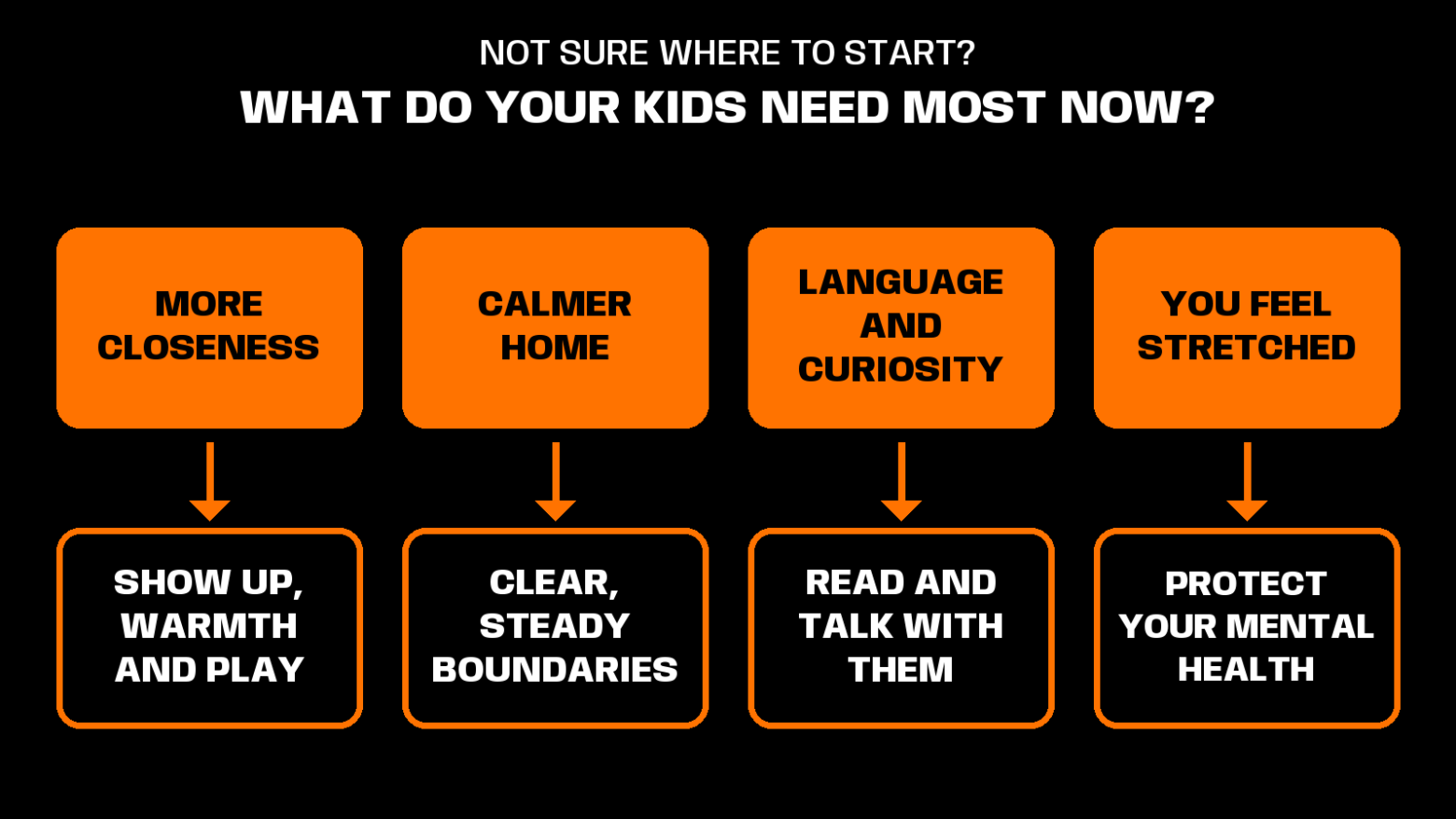
Not sure where to start? Pick the habit by what your kids need most right now.
What is the most important habit of a good father?
Showing up, consistently and with real attention. The research on father involvement links engaged fathering to fewer behavioural problems and better cognitive and social development. It is not about being perfect or always available, it is about reliably being present in your child’s ordinary days, which matters far more than the occasional big day out.
Is it too late to be a better dad if my kids are older?
No. These habits work at any age, they just change shape. With older kids and teens it is reliability, honest conversation, modelling and boundaries that flex as they grow. Research suggests fathers matter a great deal through adolescence in particular, so a more present, warmer dad makes a real difference even to grown children.
Does rough-and-tumble play actually help, or is it just messing about?
It genuinely helps, when it is good quality. High-quality father-child rough play is linked to lower aggression and better emotion regulation, because children learn to read others, handle risk and stay in control while excited. The key is staying gently in charge and keeping it safe and fun, play with no limits does not carry the same benefit.
How does my own mental health affect my kids?
Directly. Around 8 to 10 percent of fathers experience depression in the postnatal period, and when they do, their children have about double the risk of behavioural and emotional problems by age three. Looking after your own head, through sleep, exercise, talking and getting help early, is part of being a good dad, not separate from it.
I did not have a good father myself. Can I still be a good dad?
Yes, and many great fathers are exactly that. Not having a template makes it harder, but every habit here is learnable rather than inherited. Start with warmth and presence, model the man you want your kids to become, and be reliable. You are not doomed to repeat what you grew up with.
How long before these habits make a difference?
Warmth, play and presence build closeness quickly, often within days. The deeper benefits, security, self-control, resilience, build over months and years of consistency. The point is not a fast result, it is becoming the kind of dad your child can count on, day in and day out, which is what actually shapes how they grow up.
Final Recommendation
If you do nothing else, show up consistently and lead with warmth, those two carry the most weight. Add steady boundaries, real play, and reading and talking together, then protect your own mental health and back up their mother. Being a great dad is not about getting it right every time, it is a handful of proven habits repeated until they are simply who you are as a father. Pick one and start this week.
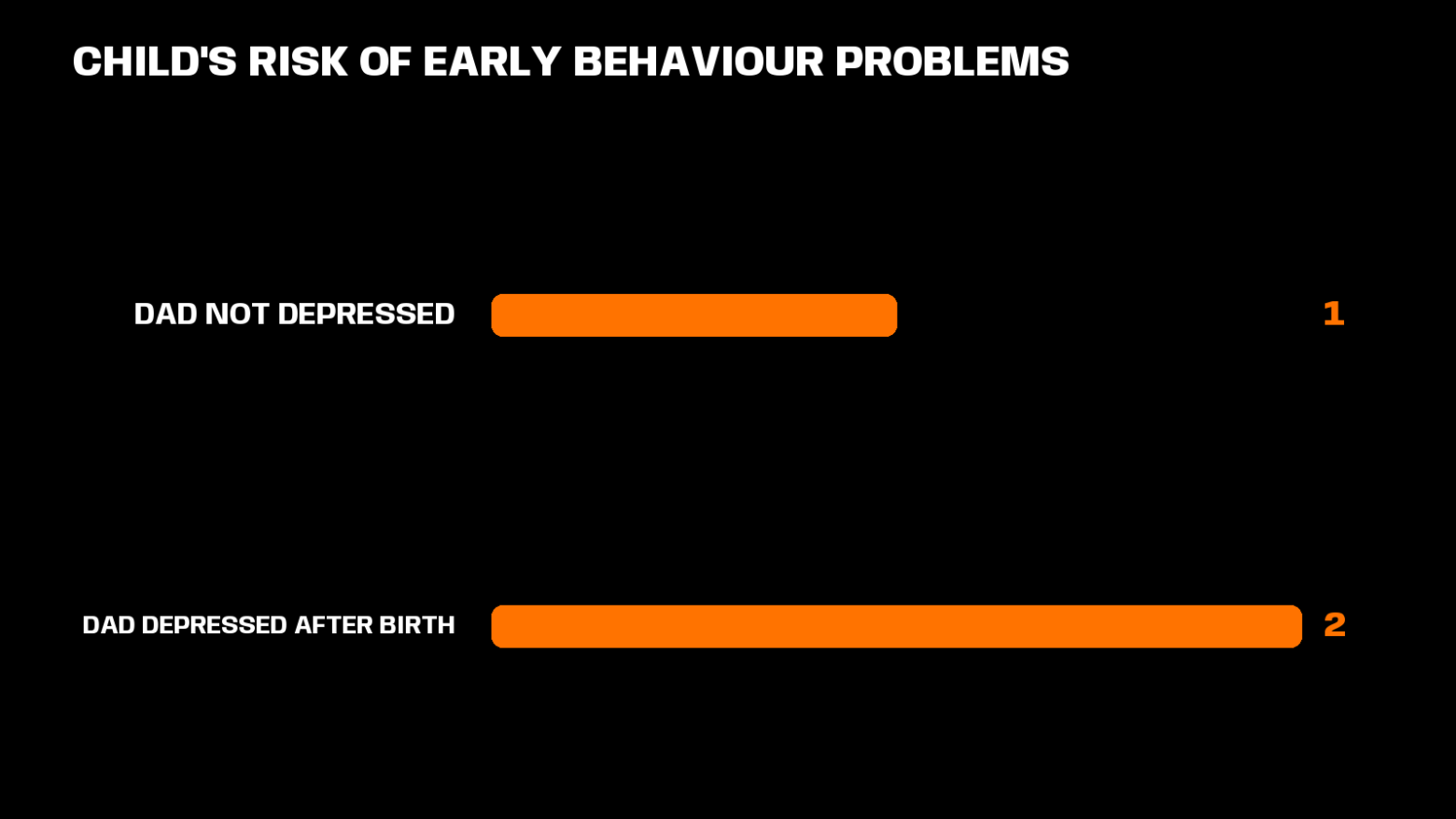
Why a dad’s own mental health matters: untreated postnatal depression roughly doubles a child’s risk of early behavioural problems.
Options for Men to Take Action
Most dads do not lack love or good intentions. They lack a system. The bedtime story slips, the temper frays after a bad day, the promise gets broken because work ran late, and another month passes on autopilot. Scattered good intentions and willpower alone do not hold up against long hours and tiredness.
The MenTools app is built to run exactly this kind of set of habits as one system, with daily actions, reminders, streaks and an AI coach, so being present, reading together and keeping your promises become check-ins instead of things you meant to do. Men tend to keep the habits they can actually see progress on.
How you can do this today: pick one habit from this list, set it as a daily action tonight, and log day one before you sleep.
Wins on cost: one app replaces a habit tracker, a reminders app and a stack of half-read parenting books.
Wins on time: the habits and the tracking are set up in minutes, with no research or planning to do yourself.
Wins on practicality: it lives on your phone and fits a working dad’s day, so it survives long hours, shift work and busy weeks.
Being a good dad is easier when the rest of your life is steady too, and a big part of that is a strong relationship with your co-parent. For more tools built for men, see the MenTools fatherhood hub. Small habits, repeated, are what turn a good intention into the kind of father a child feels lucky to have. If you are struggling with your mental health, speak to your doctor as well.
Last updated: 2026-07-29 v1.0
Disclaimer: This guide is for informational purposes only and does not constitute medical or psychological advice. Speak with a qualified professional before making significant changes if you have a medical or mental health condition.
References
- [1] Sarkadi A, Kristiansson R, Oberklaid F, Bremberg S. Fathers’ involvement and children’s developmental outcomes: a systematic review of longitudinal studies. Acta Paediatrica, 2008. Link
- [2] Cabrera NJ et al. Father involvement and cognitive development in early and middle childhood: a systematic review. Frontiers in Psychology, 2019. Link
- [3] Flanders JL et al. Rough-and-tumble play and the development of physical aggression and emotion regulation: a five-year follow-up study. Journal of Family Violence, 2010. Link
- [4] Machin A. The Life of Dad: the making of a modern father (interview). DaddiLife. Link
- [5] Baumrind D. Parenting styles and child outcomes (authoritative parenting). Developmental Psychology teaching reference. Link
- [6] Duursma E, Pan BA, Raikes H. Predictors and outcomes of low-income fathers’ reading with their toddlers. Early Childhood Research Quarterly, 2008. Link
- [7] Rao WW et al. Prevalence of prenatal and postpartum depression in fathers: a comprehensive meta-analysis of observational surveys. Journal of Affective Disorders, 2020. Link
- [8] Ramchandani P, Stein A, Evans J, O’Connor TG. Paternal depression in the postnatal period and child development: a prospective population study. The Lancet, 2005. Link