No products in the cart.
Return To Shop
MEN: 10 Books Every Man Should Read in 2026
Quick Answer
The ten books every man should read in 2026 span discipline, stoicism, purpose, money, relationships, focus and health, from Atomic Habits and Meditations to The Psychology of Money and Deep Work. Each one earns its place on a single big idea. Read one properly before you buy the next.
**Jump to:** How we chose these 10 | FAQ | Options for men
Disclosure: MenTools publishes this article and may feature MenTools products.
How we evaluate: Each habit is assessed on real-world use, evidence, cost and time, and how well it suits men. Every habit including the MenTools option carries an honest limitation. Full sources are in the references below.
The 10 Books at a Glance
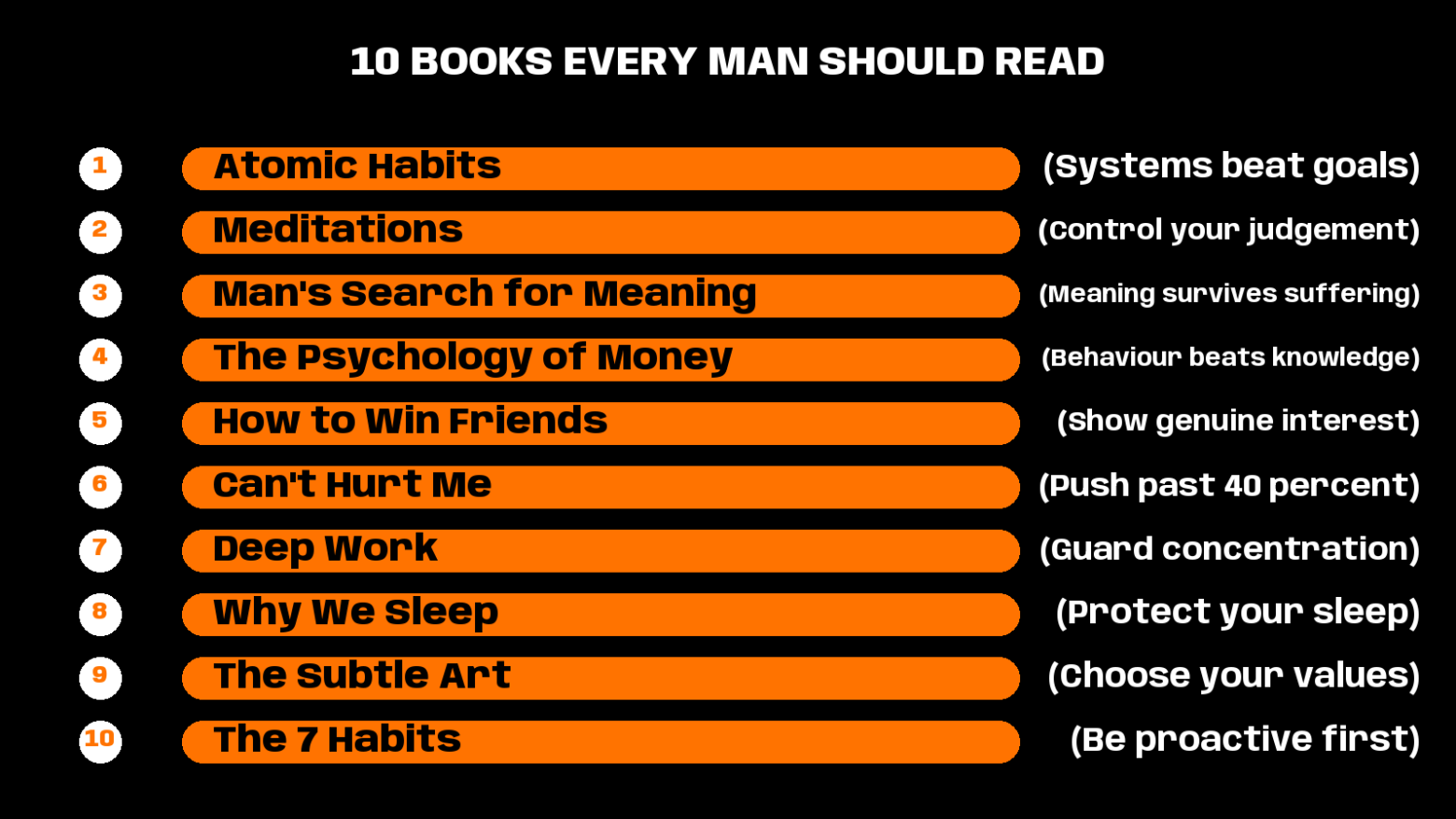
The 10 books at a glance, and the one idea each delivers.
| Book | Best for | Core idea |
|---|---|---|
| Atomic Habits | Building habits | Systems beat goals |
| Meditations | A steadier mind | Control your judgement |
| Man’s Search for Meaning | Finding purpose | Meaning survives suffering |
| The Psychology of Money | Handling money | Behaviour beats knowledge |
| How to Win Friends and Influence People | Relationships | Show genuine interest |
| Can’t Hurt Me | Mental toughness | Push past 40 percent |
| Deep Work | Focus | Guard deep concentration |
| Why We Sleep | Health | Protect your sleep |
| The Subtle Art of Not Giving a F*ck | Priorities | Choose your values |
| The 7 Habits of Highly Effective People | Effectiveness | Be proactive first |
How We Chose These 10
We picked books that are real, widely read, and useful to a working man who wants to change something specific, not just feel busy. Each title had to carry one clear idea he could act on, cover a different area of life, and hold up to scrutiny rather than hype. The habit is worth the effort: a Yale study of 3,635 older adults found that people who read books for around thirty minutes a day were 20 percent less likely to die over the twelve-year follow-up than non-readers, an advantage worth close to 23 months of life [2]. In a University of Sussex study, just six minutes of reading cut stress levels by up to 68 percent, faster than a walk or a cup of tea [1]. And reading is a habit high performers keep on purpose, with researcher Thomas Corley finding that 88 percent of wealthy people in his study read for self-education at least thirty minutes a day, against 2 percent of those struggling [3]. Every book below carries an honest watch-out, because none of them is right for every man.
1. Atomic Habits by James Clear
The most practical book on this list, and the best place to start if you want change that sticks rather than a motivational buzz that fades by Friday.
What it is: A step-by-step system for building good habits and breaking bad ones by shrinking them down and shaping your environment, from one of the most-sold non-fiction authors of the decade.
Best for: Any man who knows what to do but cannot make himself do it consistently.
Standout: Clear reframes willpower as design. As he puts it, “You do not rise to the level of your goals. You fall to the level of your systems” [4]. The book has sold more than 30 million copies worldwide, and its strength is turning that one line into small, repeatable actions. One honest way to run those actions daily, alongside a paper tracker or a wall calendar, is the MenTools app, which turns habits into check-ins and streaks so you can see the system working.
Watch-out: It is light on the deeper why. If your problem is motivation or meaning rather than mechanics, pair it with a book like Man’s Search for Meaning, because tiny systems only help once you know what you are building towards.
2. Meditations by Marcus Aurelius
A 1,900-year-old private journal that reads like the calmest man you know talking you off a ledge, and the entry point to Stoicism for most men.
What it is: The personal notes of a Roman emperor, written to himself and never intended for publication, on how to stay level, do your duty and not be ruled by anger, fear or other people’s opinions.
Best for: Men who overreact, stew on things, or let other people’s behaviour set their mood.
Standout: The core Stoic move is simple and it runs through the whole book: you do not control events, only your judgement of them. Marcus wrote it while running an empire and fighting wars, which is why it lands harder than a modern self-help pep talk. It costs almost nothing second-hand and you can read one page a morning.
Watch-out: It is fragmented and repetitive by design, because it was a diary, not a structured argument. Translation matters a great deal, so a clunky free version can put you off. Pick a modern, readable translation or it will feel like homework.
3. Man’s Search for Meaning by Viktor Frankl
The book to read when you have money, health and comfort and still feel flat, because it is about why you get up at all.
What it is: Part memoir of Frankl’s survival in Nazi concentration camps, part introduction to his school of psychology, which holds that the primary human drive is the search for meaning.
Best for: Men drifting without purpose, or facing a hard stretch they cannot change their way out of.
Standout: Frankl’s central claim comes from the worst place imaginable and is hard to argue with: “Everything can be taken from a man but one thing, the last of the human freedoms, to choose one’s attitude in any given set of circumstances, to choose one’s own way” [5]. More than 16 million copies have sold in English, and its power is that meaning, not comfort, is what carries men through suffering.
Watch-out: The second half, on his therapy method, is denser and more clinical than the memoir, and some men lose momentum there. Read it for the argument, not as a treatment manual, and do not expect a step-by-step plan.
4. The Psychology of Money by Morgan Housel
The money book for men who find personal finance boring, because it is about behaviour and character, not spreadsheets and stock tips.
What it is: Nineteen short stories on how people actually think about money, covering greed, patience, ego, luck and the quiet power of leaving your investments alone.
Best for: Men who earn reasonably but never seem to keep or grow it, and anyone who panics or gambles with money.
Standout: Housel’s opening argument resets the whole topic: “Doing well with money isn’t necessarily about what you know. It’s about how you behave” [6]. The book has sold several million copies, and its edge is showing that ordinary patience beats clever forecasting almost every time.
Watch-out: It is a mindset book, not a how-to. You will finish it calmer and wiser about money but with no budget template, fund picks or tax guidance, so pair it with a practical UK finance guide.
5. How to Win Friends and Influence People by Dale Carnegie
Published in 1936 and still the clearest manual on getting on with people, which is a skill most men are never actually taught.
What it is: A set of plain principles for handling people well, from remembering names and listening properly to admitting when you are wrong and letting the other man feel the idea was his.
Best for: Men who are competent but abrasive, awkward in conversation, or stuck because they cannot bring people with them.
Standout: Carnegie’s core lesson is that influence starts with interest in others, not performance: “You can make more friends in two months by becoming interested in other people than you can in two years by trying to get other people interested in you” [10]. It has sold more than 30 million copies and stayed in print for nearly ninety years for a reason.
Watch-out: Some of the examples are dated, and read cynically the advice can sound like manipulation. Used honestly it is about genuine respect, but a man looking for shortcuts will misuse it and come across as fake.
6. Can’t Hurt Me by David Goggins
The rawest book on the list, and the one to read when you have gone soft and you know it.
What it is: The memoir of a former US Navy SEAL and ultra-endurance athlete who overcame poverty, abuse and obesity, built around practical challenges for hardening your mind.
Best for: Men who quit early, avoid discomfort, and want a direct kick rather than gentle encouragement.
Standout: Goggins argues that when your mind says you are finished, you are usually only 40 percent done, which he calls the 40 percent rule [7]. The book has sold several million copies, and its value is teaching you to keep going when the easy option is to stop. For a calmer, structured take on the same muscle, the MenTools guide to The Power of Self-Discipline covers the discipline angle without the extremes.
Watch-out: It is one man’s extreme story, not a balanced training plan, and the relentless intensity can tip into overtraining or burnout if you copy it literally. Take the mindset, not the exact mileage.
7. Deep Work by Cal Newport
The focus book for the age of the phone, and essential reading for any man whose attention feels shredded.
What it is: A case and a method for doing concentrated, high-value work without distraction, and for treating focus as a trainable skill rather than a mood.
Best for: Men in knowledge work who feel busy all day yet produce little that matters.
Standout: Newport defines the target precisely as “professional activities performed in a state of distraction-free concentration that push your cognitive capabilities to their limit” [8]. The argument that follows is that this ability is becoming both rarer and more valuable, so the men who protect it get ahead.
Watch-out: Some of the routines suit an academic more than a man with young kids, back-to-back meetings or shift work. Take the principle of protected focus blocks and scale the extreme scheduling to fit a real life.
8. Why We Sleep by Matthew Walker
The health book most likely to change a daily habit, because it makes the case that sleep is the foundation everything else sits on.
What it is: A neuroscientist’s tour of what sleep does for the brain and body, and what happens to memory, mood, immunity and hormones when you keep cutting it short.
Best for: Men who wear short sleep as a badge, feel wired and tired, or run on caffeine and willpower.
Standout: Walker’s blunt summary is that “the shorter your sleep, the shorter your life span”, and he argues most adults need seven to nine hours a night for the body to function properly [9]. Reading it tends to move sleep up a man’s priority list fast.
Watch-out: The book has been criticised by some scientists for overstating a few claims and figures, so treat the scariest specifics as motivation rather than gospel. The core message, that protecting sleep matters, is solid.
9. The Subtle Art of Not Giving a F*ck by Mark Manson
The blunt antidote to feel-good self-help, for men worn out by the pressure to be positive about everything.
What it is: A counterintuitive argument that a good life comes from choosing a small number of things to care about and letting the rest go, not from caring about more.
Best for: Men spread thin, chasing everyone’s approval, or measuring themselves against everything at once.
Standout: Manson’s point is that your energy is finite, so the skill is choosing your values deliberately and picking good problems to solve rather than trying to avoid problems altogether. It became one of the best-selling self-help books of the last decade by saying that out loud.
Watch-out: The swearing and shock tone wear thin for some readers, and skimmed carelessly the message can read as an excuse for apathy. Read closely it is the opposite, a call to care hard about the few things that count.
10. The 7 Habits of Highly Effective People by Stephen Covey
The most complete personal-effectiveness framework on the list, and the one to read once the quick wins have run out.
What it is: A principle-based system built on seven habits, moving a man from dependence to independence and then to working well with others, rather than offering quick productivity tricks.
Best for: Men who want a durable operating model for work and family, not another life hack.
Standout: The habit most men take away is the second, “begin with the end in mind”, which means defining what a successful life and role actually look like before you get lost in daily busyness. It has stayed a fixture of leadership reading for decades because the principles do not date.
Watch-out: It is dense, corporate in places, and asks real effort, so it is a poor first book for a man new to the genre. Come to it after something lighter like Atomic Habits, or it can feel like a management textbook.
How Many Books Should a Man Read a Year?
There is no fixed number, but consistency beats volume. Aim for around thirty minutes a day, which lands most men at roughly twelve to twenty books a year, and that is more than enough to change how you think and act. In Thomas Corley’s research, 88 percent of wealthy people read for self-education for at least thirty minutes daily, against 2 percent of those struggling financially [3]. The point is the daily habit, not a Goodreads scoreboard.
Do Audiobooks Count as Reading?
For most non-fiction on this list, yes. A 2016 study by Beth Rogowsky and colleagues found no significant difference in comprehension between reading, listening, and doing both together, tested immediately and two weeks later [11]. So an audiobook on your commute genuinely counts as taking in the ideas. The exceptions are dense or technical material, and anything you listen to while driving or doing chores, where split attention lowers how much you retain.
FAQ
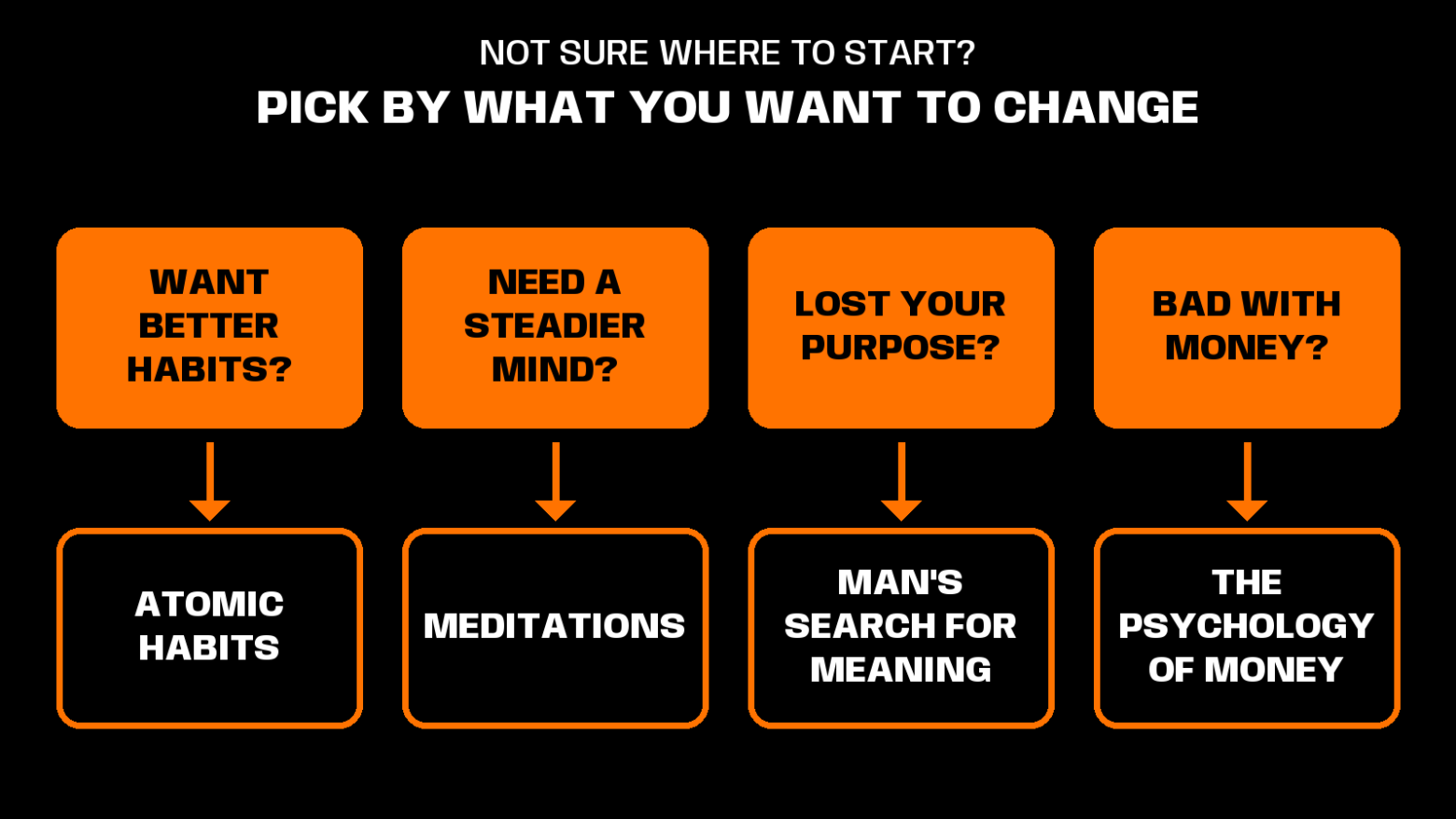
Not sure where to start? Pick by what you want to change.
What is the single best book for a man to start with?
Atomic Habits, if you want practical change. It is easy to read, its systems idea applies to every other area of life, and it gives you a way to act the same week. If your problem is meaning rather than mechanics, start with Man’s Search for Meaning instead.
How do these books actually make a difference?
Only if you apply one idea at a time. Reading itself helps, with six minutes cutting stress by up to 68 percent in one University of Sussex study [1], but the change comes from acting. Pick a single takeaway per book, use it for a fortnight, then move on. Ten books skimmed and forgotten beat nothing, but one book applied beats ten skimmed.
Are these books only for young men?
No. The themes, habits, purpose, money, relationships, focus, discipline and sleep, matter at every age, and several authors wrote their best work later in life. A man in his fifties gets as much from Meditations or The Psychology of Money as a man in his twenties, often more, because the lessons land against real experience.
How long will it take to read all ten?
At thirty minutes a day, most men finish the list in six to nine months. Some, like Meditations or The Subtle Art, are short. Others, like The 7 Habits or Why We Sleep, are denser and slower. There is no prize for speed, and rereading the one that hit hardest is time well spent.
Should I buy them or borrow them?
Borrow first to see which ones you connect with, then buy the two or three you will reread and mark up. Libraries and second-hand copies make the whole list cheap. Owning the keepers matters because the value of these books is in returning to them, not reading them once.
Do I have to read them in order?
No. The order above is by theme, not priority. Pick the book that matches the problem in front of you right now, whether that is focus, money, discipline or purpose, and start there. Momentum from one relevant book pulls you into the next far better than forcing a set sequence.
Final Recommendation
If you read only three this year, make them Atomic Habits for the how, Man’s Search for Meaning for the why, and The Psychology of Money for the money, and you will have covered behaviour, purpose and finances. Add Meditations for a steadier head and Why We Sleep to protect the foundation. The rest you can pick up as life throws the relevant problem at you. Reading is not the win. Acting on one idea from each book is.
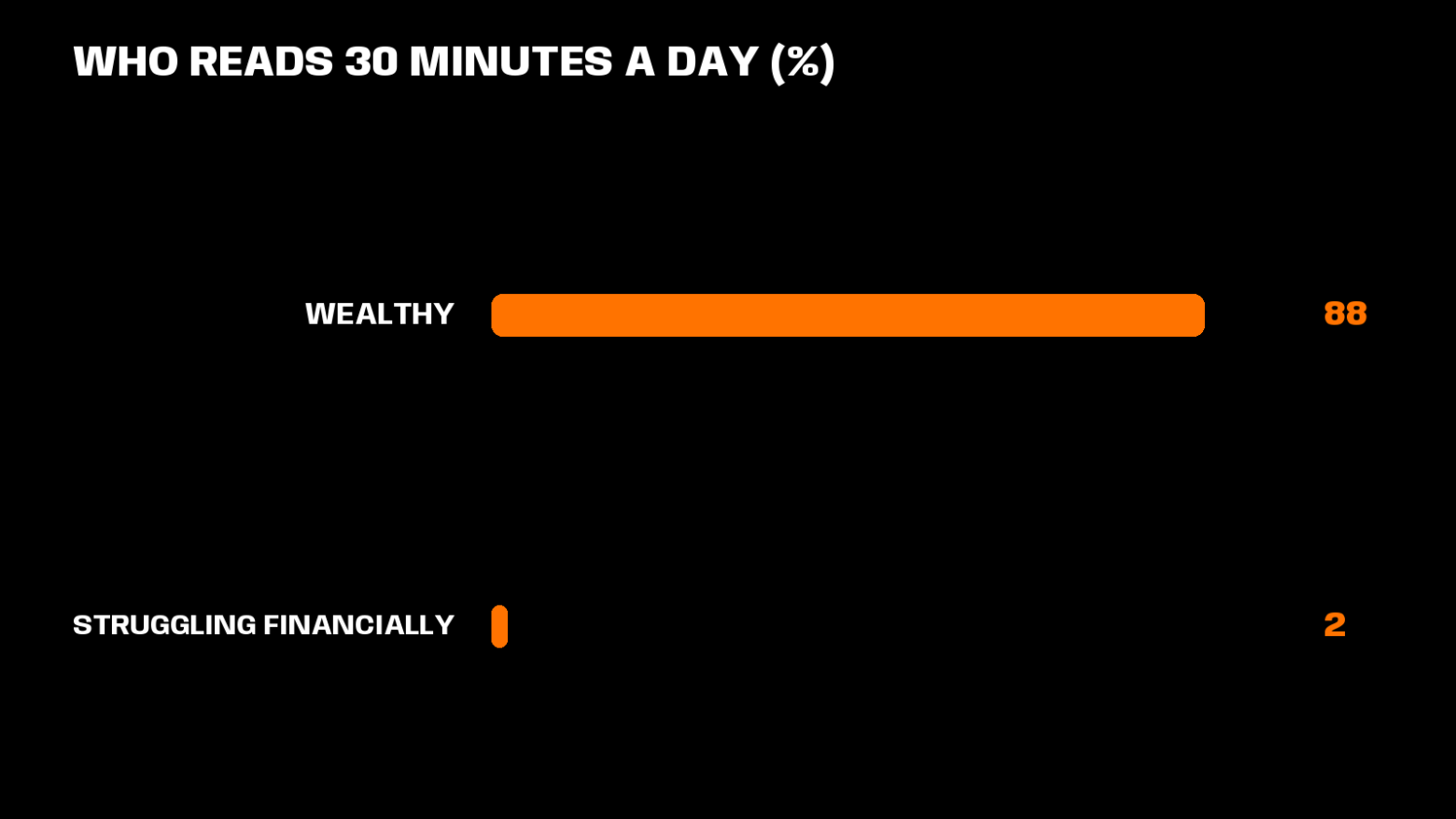
The reading gap: 88 percent of wealthy people read daily, against 2 percent of those struggling.
Options for Men to Take Action
Most men do not fail at self-improvement because they lack the right books. They fail because the ideas stay on the page. You finish a great chapter, nod along, then close the cover and nothing in your week actually changes. Reading without a system to apply it is where good intentions quietly die.
The MenTools app is built to fix exactly that gap, turning the ideas in books like these into daily actions, streaks, reminders and an AI coach, so a habit from Atomic Habits or a discipline challenge in the spirit of Can’t Hurt Me becomes a check-in instead of a good intention. Men who track what they read tend to keep the ideas they can actually see themselves doing.
How you can do this today: finish this list’s first book, pick one idea from it, and set it as a daily action in the app before you go to bed.
Wins on cost: one app replaces a habit tracker, a reading journal and a stack of separate reminder tools, and libraries keep the books themselves close to free.
Wins on time: the actions and tracking take minutes to set up, with no planning or research to do yourself.
Wins on practicality: it lives on your phone and fits a working man’s day, so it survives travel, early starts and busy weeks.
For the wider picture and more tools built for men, see the MenTools mindset hub. Read one book properly, apply one idea, track it until it sticks, and repeat. That is how a shelf of good books turns into a different year.
Last updated: 2026-07-28 v1.0
Disclaimer: This guide is for informational purposes only and does not constitute medical or psychological advice. Speak with a qualified professional before making significant changes if you have a medical or mental health condition.
References
- [1] Medical News Today. Five ways reading can improve health and well-being (University of Sussex, Dr David Lewis, 2009, 68 percent stress reduction). Link
- [2] Bavishi A, Slade MD, Levy BR. A chapter a day: association of book reading with longevity. Social Science and Medicine, 2016 (PubMed). Link
- [3] CNBC. Tom Corley: these 3 habits can almost guarantee you will be successful (88 percent of wealthy read 30 minutes a day). Link
- [4] James Clear. Quote and book facts for Atomic Habits (systems over goals; 30 million-plus copies). Link
- [5] The Marginalian (Maria Popova). Viktor Frankl on the human search for meaning (the last of the human freedoms). Link
- [6] Morgan Housel. The Psychology of Money, author page (doing well with money is about how you behave). Link
- [7] Goodreads. Can’t Hurt Me by David Goggins (the 40 percent rule). Link
- [8] Cal Newport. Deep Work, official book page (definition of deep work). Link
- [9] Simon and Schuster. Why We Sleep by Matthew Walker (the shorter your sleep, the shorter your life span; seven to nine hours). Link
- [10] Goodreads. How to Win Friends and Influence People by Dale Carnegie (make more friends in two months). Link
- [11] Rogowsky BA, Calhoun BM, Tallal P. Does modality matter? The effects of reading, listening, and dual modality on comprehension. SAGE Open, 2016. Link