
MEN: How to Build Mental Toughness: 7 Habits for Men
Quick Answer
Mental toughness for men is built, not born. It comes from a few daily habits done under mild stress: choose one hard thing, reframe the story you tell yourself, guard your sleep, train your body, and hold one long-term goal. Consistency beats intensity. Small reps, repeated, are what harden the mind in 2026 and beyond.
Jump to: How we chose these 7 | FAQ | Options for men
Disclosure: MenTools publishes this article and may feature MenTools products.
How we evaluate: Each habit is assessed on real-world use, evidence, cost and time, and how well it suits men. Every habit including the MenTools option carries an honest limitation. Full sources are in the references below.
The 7 Habits at a Glance
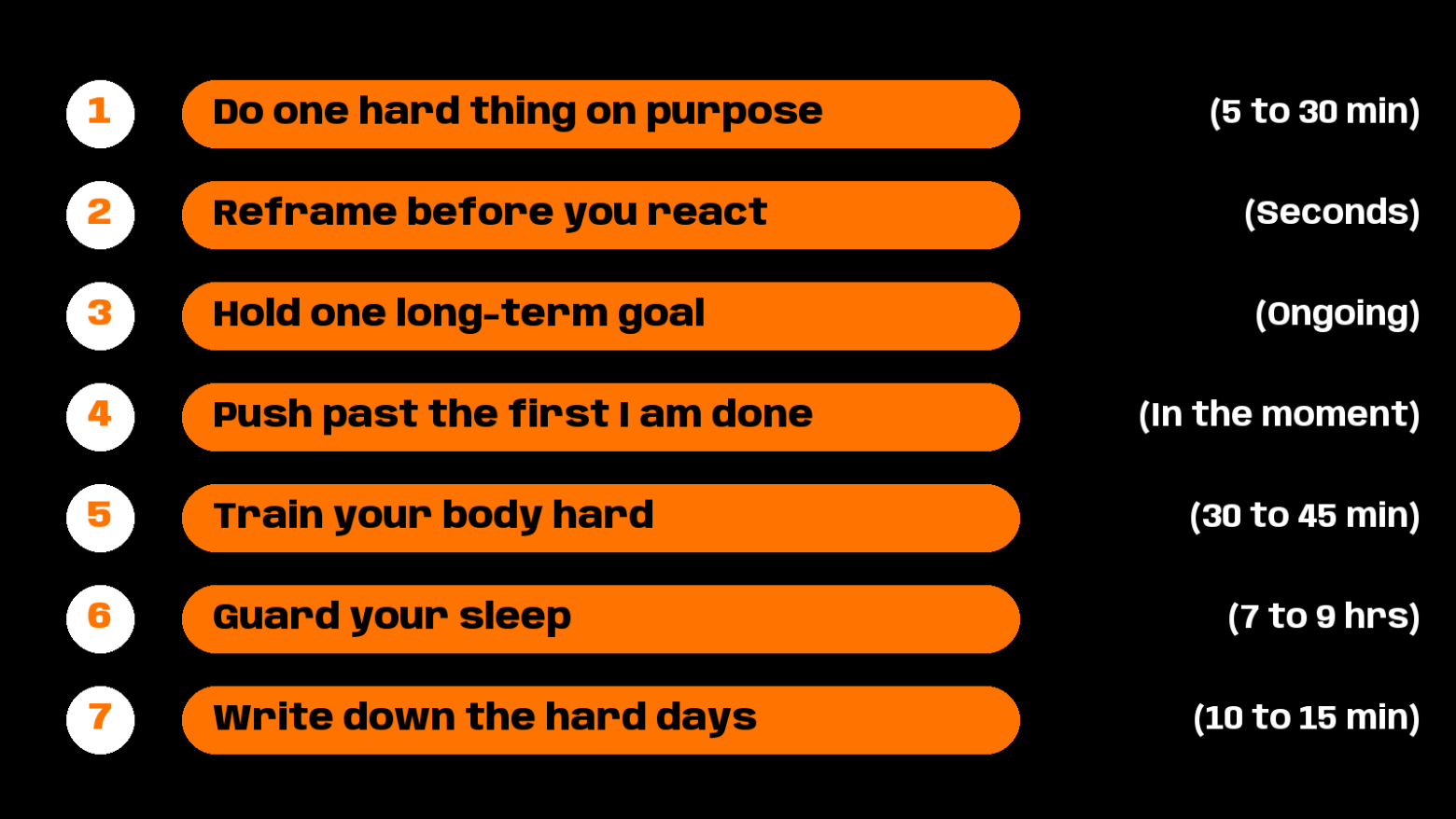
The 7 habits that build mental toughness, and roughly what each one costs you in time.
| Habit | Best for | Time | Watch-out |
|---|---|---|---|
| Do one hard thing on purpose | Building stress tolerance | 5 to 30 min | Not about pointless suffering |
| Reframe before you react | Staying calm under pressure | Seconds | Do not use it to bury real problems |
| Hold one long-term goal | Direction and follow-through | Ongoing | Can tip into stubbornness |
| Push past the first “I am done” | Endurance and effort | In the moment | Ignoring real pain is dangerous |
| Train your body hard | Resilience and mood | 30 to 45 min | Not a fix for clinical depression |
| Guard your sleep | Emotional control | 7 to 9 hrs | Cannot be toughed out long term |
| Write down the hard days | Processing stress | 10 to 15 min | Feels worse before it feels better |
How We Chose These 7
We picked habits that are simple, backed by research, and realistic for a working man with real pressure on him. Each one had to pass three tests: does the evidence support it, can a busy man actually do it, and does it still work on a bad day. Mental toughness is not a personality you are handed at birth, it is a trainable skill, and the science is clear that it responds to practice. A meta-analysis of 37 studies covering 1,837 people found that structured exposure to controlled stress reliably lowered anxiety and improved performance under pressure [3]. Every habit below carries an honest watch-out, because no habit is right for every man in every situation.
1. Do One Hard Thing on Purpose Every Day
Pick one uncomfortable thing each day and do it voluntarily. This is deliberate discomfort, and it is the fastest way to widen the gap between a challenge and your panic response.
What it is: A single chosen hardship you would rather avoid, done on purpose. A cold finish to your shower, a hard set at the gym, a difficult conversation, or a task you have been dodging.
Best for: Men who feel rattled by stress and want a calmer baseline under pressure.
Standout: Controlled exposure to stress is one of the few interventions with strong evidence behind it. In a meta-analysis of 37 studies representing 1,837 participants, stress inoculation training reduced performance anxiety and state anxiety while improving performance under pressure, across trainee groups and settings [3].
Watch-out: This is not about pointless suffering or proving something to an audience. The point is a small, chosen dose of discomfort you recover from, not grinding yourself down or confusing exhaustion with progress.
2. Reframe the Story Before You React
Change the meaning you attach to a hard moment before you respond to it. This is cognitive reappraisal, and it is the single most studied tool for staying level when things go wrong.
What it is: Catching the automatic story (“this is a disaster”) and deliberately choosing a more useful one (“this is hard, and I can handle hard”).
Best for: Men who lose their head in the heat of the moment and regret it later.
Standout: Reappraisal changes the body, not just the mood. A systematic review and meta-analysis of stress reappraisal interventions found they measurably lowered the physiological stress response, including cardiovascular reactivity, compared with control conditions [4].
Watch-out: Reframing is not denial. Do not use it to paper over a genuine problem that needs action, an apology, or a change. A calmer story is meant to help you deal with reality, not dodge it.
3. Commit to One Long-Term Goal and Hold It
Pick one goal that matters and refuse to quit on it. This is grit, and decades of research rank it above talent for predicting who finishes what they start.
What it is: A single long-term aim you care about deeply, pursued with steady effort across months and years, not a fresh resolution every fortnight.
Best for: Men who start strong on everything and finish almost nothing.
Standout: In a study of more than 11,000 West Point cadets across nine entering classes, grit was a better predictor of making it through the brutal “Beast Barracks” training than physical fitness or cognitive ability [1]. As psychologist Angela Duckworth, who built the modern research on the trait, puts it, “Grit is passion and perseverance for very long-term goals” [2].
Watch-out: Grit can curdle into stubbornness. Holding a goal is a strength, refusing to change a broken strategy is not. Duckworth herself found grit does not predict every kind of success, so keep the goal and question the method.
4. Push Past the First “I Am Done”
When your mind says stop, treat it as data, not a verdict. Your first urge to quit almost always arrives long before your real limit.
What it is: The habit of pausing at the first wave of “I cannot do this”, checking whether it is genuine, and taking a few more reps, minutes or breaths when it is not.
Best for: Men who cave early on effort, whether that is a run, a workload or a hard week.
Standout: The popular “40 percent rule”, the idea that you have more left when you feel finished, is a motivational heuristic rather than a measured constant, so treat the exact number with caution. What is real is that perceived effort and true capacity come apart. In a controlled trial of 34 endurance athletes, a placebo increased physiological output without any rise in how hard the effort felt, showing the mind sets the brake well before the body has to [5].
Watch-out: This only applies to discomfort, not injury. Sharp pain, chest pain or dizziness is a real signal to stop. Pushing through genuine warning signs is not toughness, it is a hospital visit.
5. Train Your Body Hard and Often
Put your body under regular physical load. A trained body is the cheapest, most reliable way to build a mind that copes with stress.
What it is: Consistent, challenging exercise most weeks, whether that is lifting, running, or hard bodyweight sessions. The load matters more than the style.
Best for: Men who feel flat, anxious or foggy and want a broad resilience boost.
Standout: Physical training protects mental health at scale. A meta-analysis of prospective studies in the American Journal of Psychiatry found that men and women with higher physical activity had roughly 17 percent lower odds of developing depression than the least active, independent of age and region [6].
Watch-out: Exercise is protective, not a cure. If you are dealing with clinical depression or anxiety, training helps but does not replace proper treatment. And more is not always better, since chronic overtraining raises stress rather than lowering it.
6. Guard Your Sleep Like It Is Training
Protect seven to nine hours of sleep as seriously as any workout. Nothing wrecks self-control and composure faster than being tired.
What it is: A consistent sleep window, a dark cool room, and a hard rule that you do not sacrifice sleep to prove you can run on empty.
Best for: Men who are short-tempered, reactive or making poor decisions under fatigue.
Standout: Sleep is the foundation of emotional control. In brain-imaging research by Matthew Walker and colleagues, a single night of sleep deprivation made the amygdala, the brain’s threat centre, about 60 percent more reactive to negative images, while its calming link to the rational prefrontal cortex broke down [7].
Watch-out: You cannot tough out chronic sleep loss, and treating it as weakness is how men wreck their health for years. Quality counts too, so a broken eight hours is not the same as a solid seven.
7. Write Down the Hard Days to Process Them
Put the hard stuff on paper instead of carrying it in your head. A few minutes of honest writing turns a churning problem into something you can actually look at.
What it is: Short, private writing about what is stressing you and why. Ten to fifteen minutes, most days, with no audience and no editing.
Best for: Men who bottle things up until they leak out as anger, drinking or shutdown.
Standout: The evidence base here is deep. Reviewing more than 200 studies on expressive writing, researchers found it was linked to stronger immune function, lower blood pressure, and fewer visits to the doctor in the months that followed [8]. Making it a system is what keeps it going, and in the MenTools app we see men who tie a journal prompt to a daily check-in stick with it far longer than those relying on memory and motivation.
Watch-out: The first sessions can feel worse, not better, because you are turning towards hard feelings instead of away from them. That dip is normal and short, but writing is not a substitute for therapy if you are genuinely struggling.
What Actually Builds Mental Toughness in Men?
Repeated, recovered exposure to manageable stress is what builds mental toughness, not a single dramatic feat. The mind adapts the way muscle does: load it a little more than is comfortable, recover, repeat. This is why the habits above work as a set. Deliberate discomfort and hard training supply the stress, sleep and writing supply the recovery, and grit and reframing keep you in the game. The West Point research is the clearest proof that effort over time beats raw talent for finishing hard things [1].
Can You Train Mental Toughness or Are You Born With It?
You can train it, and most of it is trained rather than inherited. Grit is only weakly related to talent and rises with deliberate practice and a goal worth chasing [1]. Stress tolerance responds to structured exposure [3], and emotional control improves with better sleep [7] and reappraisal [4]. As Duckworth writes, “Enthusiasm is common. Endurance is rare” [2]. Toughness is the endurance, and endurance is built.
FAQ
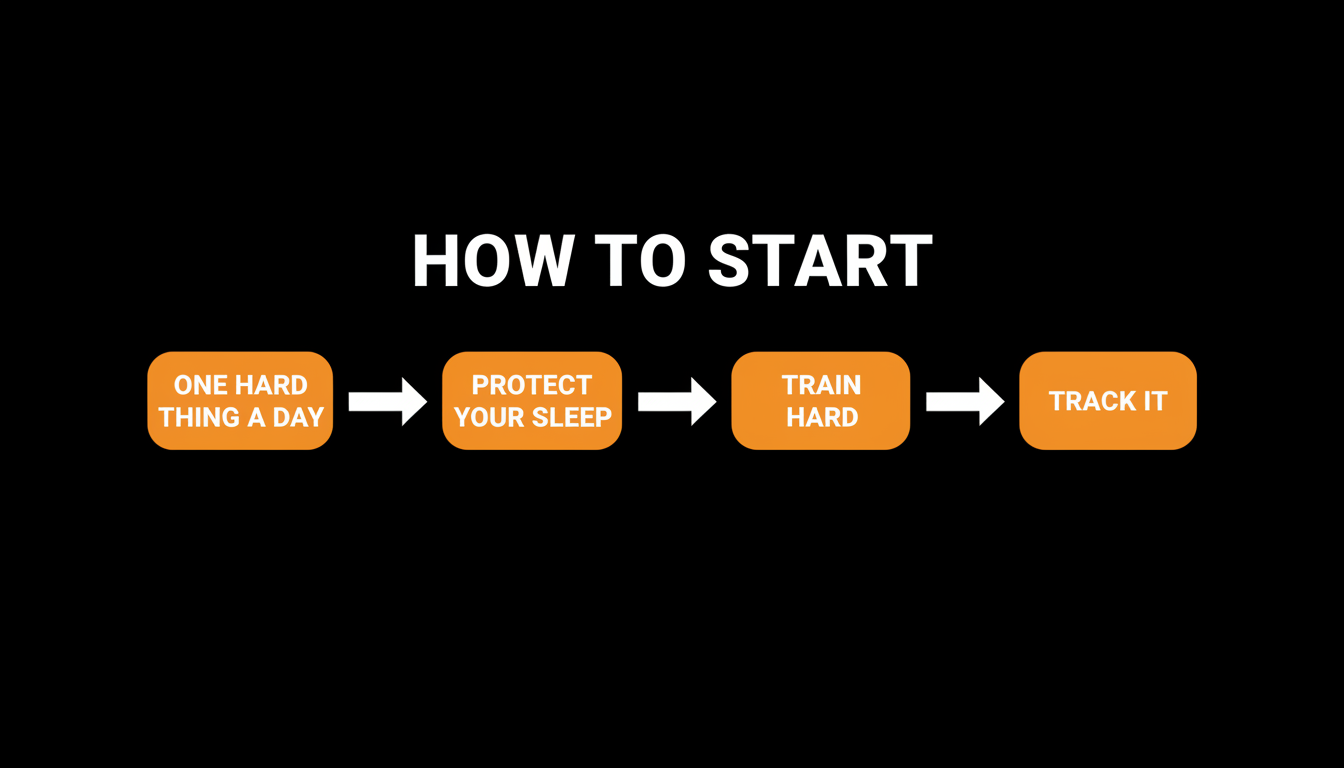
Not sure where to start? Follow the flow to your first habit.
How long does it take to build mental toughness?
There is no fixed number, but expect meaningful change in weeks and durable change in months. Toughness is a skill that strengthens with repetition, so the honest answer is that it grows for as long as you keep training it. Start with one habit and hold it before adding the next.
Is mental toughness the same as suppressing your emotions?
No, and confusing the two is a common trap for men. Suppression bottles feelings up until they leak out badly. Toughness means feeling the stress, reframing it, and acting well anyway. Reappraisal lowers the physiological stress response, whereas bottling things up tends to raise it over time [4].
What is the fastest way for a man to get mentally tougher?
Add a single dose of deliberate discomfort every day and recover from it. Controlled exposure to stress has strong evidence behind it for lowering anxiety and lifting performance under pressure [3]. Pair it with protected sleep so your brain can actually consolidate the adaptation.
Do cold showers actually build mental toughness?
They can, but mostly as a convenient daily dose of chosen discomfort rather than anything magic about cold itself. The value is in voluntarily doing something uncomfortable and following through, which is the same mechanism as any deliberate discomfort. Skip it if you have a heart condition without medical advice.
Can mental toughness be taken too far?
Yes. Pushed past sense it becomes stubbornness, ignored injury, or refusing help you need. Grit does not predict every kind of success, and Duckworth’s own work warns against holding a goal while ignoring a broken method [2]. Real toughness includes knowing when to stop, rest or change course.
What is the difference between mental toughness and resilience?
They overlap heavily. Resilience is bouncing back after a setback, while mental toughness is staying effective while the pressure is still on. Both are trainable, both rest on sleep, reframing and recovered stress exposure, and building one tends to build the other.
Final Recommendation
If you do nothing else, start with one hard thing a day and protect your sleep. Those two give you the stress and the recovery that everything else depends on. Add hard training, a single long-term goal, and a short writing habit as the first two stick. Track it from day one so it survives the weeks when motivation drops. Mental toughness for men is built the boring way, through small reps repeated on the days you least feel like it.
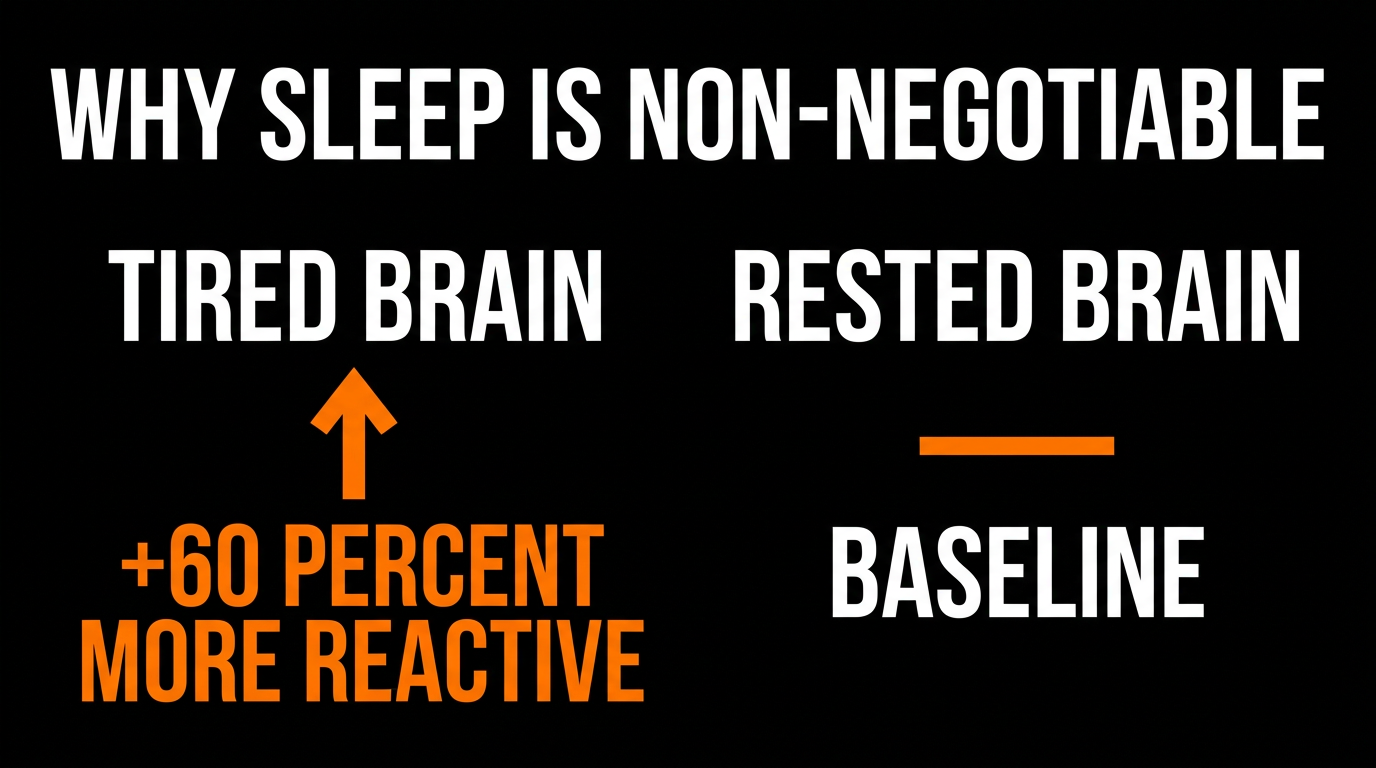
Why sleep is non-negotiable: one bad night makes the brain’s threat centre about 60 percent more reactive.
Options for Men to Take Action
Most men do not lack the will to be tougher. They lack a system. The habits live in their head, there is no way to keep score, and by week two the whole thing has quietly fallen apart under a busy life. Scattered notes, a couple of half-used apps and pure willpower do not hold up when work and family pull hard.
The MenTools app is built to run exactly this kind of training as one system, with daily challenges, a journal, habit tracking, streaks and an AI coach, so deliberate discomfort, writing and a long-term goal become check-ins instead of good intentions.
How you can do this today: pick one hard thing, set your sleep window tonight, and log day one.
Wins on cost: one app replaces a habit tracker, a journal and a stack of separate reminder tools.
Wins on time: the training and the tracking are set up in minutes, with no research or planning to do yourself.
Wins on practicality: it lives on your phone and fits a working man’s week, so it survives travel, early starts and hard patches.
For the wider picture on building a stronger head, see the MenTools mindset hub. Small daily reps, tracked and repeated, are what turn a hard week into a harder mind.
Last updated: 2026-07-23 v1.0
Disclaimer: This guide is for informational purposes only and does not constitute medical or psychological advice. Speak with a qualified professional before making significant changes if you have a medical or mental health condition.
References
- [1] Duckworth AL et al. Cognitive and noncognitive predictors of success. Proceedings of the National Academy of Sciences, 2019. Link
- [2] Duckworth A. Grit: The Power of Passion and Perseverance. Scribner, 2016. Link
- [3] Saunders T, Driskell JE, Johnston JH, Salas E. The effect of stress inoculation training on anxiety and performance. Journal of Occupational Health Psychology, 1996. Link
- [4] The efficacy of stress reappraisal interventions on stress responsivity: a meta-analysis and systematic review of existing evidence. PLOS One, 2019. Link
- [5] Increasing effort without noticing: a randomised controlled pilot study about the ergogenic placebo effect in endurance athletes. PLOS One, 2018. Link
- [6] Schuch FB et al. Physical activity and incident depression: a meta-analysis of prospective cohort studies. American Journal of Psychiatry, 2018. Link
- [7] Yoo SS, Gujar N, Hu P, Jolesz FA, Walker MP. The human emotional brain without sleep, a prefrontal amygdala disconnect. Current Biology, 2007. Link
- [8] Baikie KA, Wilhelm K. Emotional and physical health benefits of expressive writing. Advances in Psychiatric Treatment, 2005. Link