
MEN: Self-Discipline for Men: 7 Proven Ways to Build It
Quick Answer
Self-discipline for men is built by designing better systems, not by summoning more willpower. The men who stay disciplined in 2026 shape their environment, use if-then plans, track their progress and start small, so the right action becomes the default. Below are seven proven ways to build it, each with an honest watch-out.
**Jump to:** How we chose these 7 | FAQ | Options for men
Disclosure: MenTools publishes this article and may feature MenTools products.
How we evaluate: Each habit is assessed on real-world use, evidence, cost and time, and how well it suits men. Every habit including the MenTools option carries an honest limitation. Full sources are in the references below.
The 7 Ways at a Glance
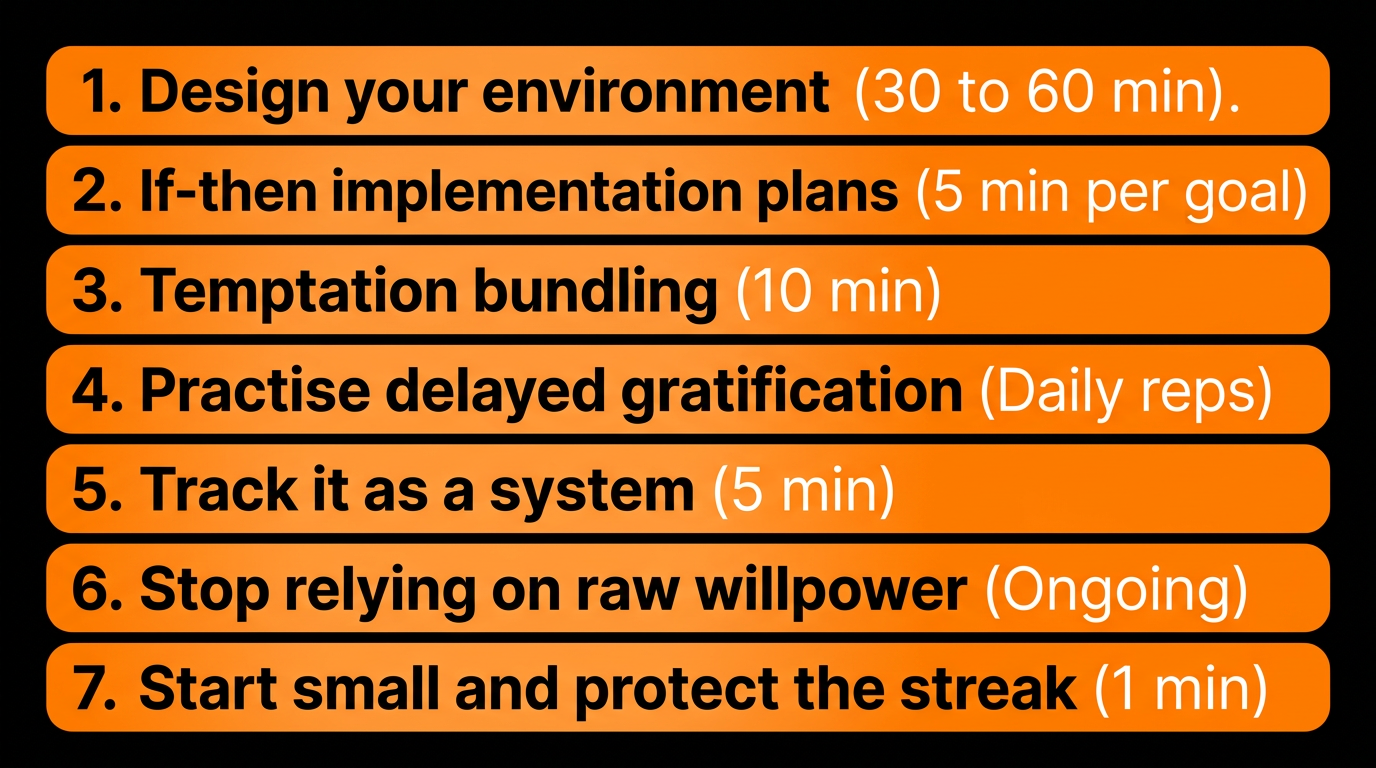
Seven ways to build self-discipline for men, and where each one fits.
| Way to build discipline | Best for | Time to set up | Watch-out |
|---|---|---|---|
| Design your environment | Men who cave to easy temptation | 30 to 60 min | One-off effort, needs redoing when life changes |
| If-then implementation plans | Men who forget or hesitate in the moment | 5 min per goal | Only as good as the trigger you pick |
| Temptation bundling | Men who dread the boring but important task | 10 min | Effect fades if the reward gets stale |
| Practise delayed gratification | Men who act on every impulse | Daily reps | Slow to build, easy to skip |
| Track it as a system | Men who start strong then fade | 5 min | A tracker you ignore does nothing |
| Stop relying on raw willpower | Men who burn out by evening | Ongoing | Removing decisions takes planning |
| Start small and protect the streak | Men who quit after one bad day | 1 min | Feels too easy, so many men skip it |
How We Chose These 7
We chose methods that are backed by peer-reviewed research, that a working man can actually run alongside a job and responsibilities, and that keep working when motivation is low. Each one had to pass three tests: does the evidence support it, can it be done without heroic effort, and does it still hold on a bad day. High self-control is worth the work. In a study of two large samples, men and women who scored higher on trait self-control had better grades, fewer impulse-control problems, healthier relationships and less binge eating and alcohol misuse, and the researchers found no downside to having more of it [1]. Every method below carries an honest watch-out, because none of them works for everyone.
1. Design Your Environment So Discipline Is the Default
Change your surroundings before you try to change yourself. The most disciplined men do not out-muscle temptation, they arrange their homes, phones and desks so the tempting option is harder to reach and the good option is the easy one. This is the single highest-leverage move because it works even when your motivation is flat.
What it is: Removing friction from the behaviour you want and adding friction to the one you do not, for example deleting an app, leaving the biscuits out of the house, or laying your kit out the night before.
Best for: Men who know what to do but keep caving to whatever is closest to hand.
Standout: Research by Angela Duckworth and colleagues found that people with strong self-control succeed less by grinding through temptation and more by using situational strategies that stop the temptation reaching them in the first place [5]. The pull of proximity is real. In a workplace study, office staff ate far more chocolate when a dish sat on their desk than when the same sweets were placed two metres away [6].
Watch-out: Environment design is a one-off effort that has to be redone whenever your routine changes, such as a new job, a house move or a holiday. Set it and forget it does not last.
2. Turn Goals Into If-Then Plans
Decide in advance exactly when, where and how you will act. An if-then plan (called an implementation intention) takes the decision out of the heat of the moment: “If it is 7am, then I train,” or “If I open my laptop, then I write for 20 minutes before email.” You are pre-loading the choice so you do not have to negotiate with yourself later.
What it is: A single sentence linking a specific trigger to a specific action, written down and rehearsed until it fires automatically.
Best for: Men who mean well but hesitate, forget, or talk themselves out of it when the moment arrives.
Standout: A meta-analysis of 94 independent tests found that forming implementation intentions had a medium-to-large effect on goal attainment, with an effect size of d equals 0.65 [3]. That matters because intention alone is weak. The same body of research shows goal intentions on their own explain only about a quarter of the difference in whether people follow through [3].
Watch-out: The plan is only as good as the trigger you choose. Vague cues like “when I get a chance” do nothing. The trigger has to be a concrete, unmissable moment.
3. Bundle Temptation With the Task You Avoid
Pair something you want with something you should do. Temptation bundling means only letting yourself have the tempting thing (a box-set, a podcast, a favourite coffee) while you do the discipline task. The task borrows the pull of the reward, so you stop dreading it and start looking forward to it.
What it is: Linking an instant pleasure to a delayed-payoff behaviour, so the two only happen together.
Best for: Men who put off the boring but important task, especially training, admin or study.
Standout: In a field experiment led by behavioural scientist Katherine Milkman, people who could only listen to tempting audio novels at the gym visited 51 percent more often than a control group at the start of the programme [4]. Afterwards, 61 percent chose to pay for gym-only access to the audiobooks, a sign they valued the commitment device [4].
Watch-out: The effect fades if the reward goes stale or if you cheat and enjoy the treat elsewhere. Keep the reward genuinely enjoyable and genuinely restricted, or the bundle breaks.
4. Practise Delayed Gratification in Small Reps
Treat willpower as a skill you rehearse, not a trait you are born with. Delaying gratification is the core muscle of self-discipline, and it strengthens with small daily reps: waiting ten minutes before the snack, finishing the task before the scroll, or sitting with the urge instead of obeying it. Each rep makes the next choice easier.
What it is: Deliberately choosing the larger later reward over the smaller immediate one, in low-stakes moments, until it becomes your habit.
Best for: Men who act on impulse and regret it, from spending to snacking to doomscrolling.
Standout: In Walter Mischel’s marshmallow research, children were tracked for more than 40 years, and those who could wait as preschoolers went on to show better life outcomes on a range of measures [9]. Mischel argued the ability itself can be learned. As he put it, “If you don’t know how to delay gratification, you don’t have a choice. If you do know how, you have a choice” [2].
Watch-out: This one is slow. There is no quick win, and because the reps are small it is easy to skip them and tell yourself they do not count. They do.
5. Track It and Make It a System
Turn discipline into something you record, not something you hope to remember. What gets measured gets managed, and a visible record of your streak keeps you honest on the days motivation disappears. A notebook, a wall chart or an app all work. The point is that the progress is real, physical and in front of you.
What it is: A simple daily record of whether you did the thing, reviewed often enough to keep you accountable.
Best for: Men who start a new regime with energy then quietly fade after a week or two.
Standout: A meta-analysis of 138 studies with 19,951 participants found that monitoring your progress reliably improved goal attainment, and the effect was stronger when the progress was physically recorded and made public rather than just kept in your head [7]. In the MenTools app, the men who keep a streak alive are almost always the ones who log day one and check in daily, rather than the ones who trust their memory. Paper trackers and other habit apps do the same job.
Watch-out: A tracker only works if you actually look at it. Buried in a drawer or lost among other phone apps, it becomes one more thing you ignore. Put it where you cannot miss it.
6. Stop Relying on Raw Willpower
Build discipline that does not depend on how you feel. For years the popular idea was that willpower is a fuel tank that empties as the day goes on. Large, careful studies have since failed to confirm that, so the smarter approach is to lean on habits, rules and environment rather than gritting your teeth. Save your effort for the few decisions that truly need it.
What it is: Replacing in-the-moment willpower with pre-made decisions, fixed routines and removed choices, so discipline runs on autopilot.
Best for: Men who start the day strong then crumble by the evening when they are tired and worn down.
Standout: Willpower is the reason 27 percent of adults gave for not making the changes they wanted, according to an American Psychological Association survey [9]. Yet large preregistered studies across dozens of laboratories have found the classic willpower-as-a-depleting-tank effect to be near zero, which is why researchers now stress systems over sheer effort [8].
Watch-out: Removing decisions in advance takes planning, and planning is itself a discipline. The payoff is real, but it is front-loaded, so you do the thinking once so you do not have to fight yourself daily.
7. Start Small and Protect the Streak
Make the first rep so small you cannot fail, then guard the chain. Most men quit not because the goal is wrong but because they started too big and missed a day. A two-minute version you never skip beats an hour-long version you abandon. Once the streak exists, protecting it becomes its own motivation.
What it is: Shrinking the habit to a version you can do on your worst day, then keeping the daily chain unbroken.
Best for: Men who go all-in, miss once, feel like a failure and quit the whole thing.
Standout: The trait-self-control research shows that men who score high do not white-knuckle their way through life, they build steady routines that run with little effort, which is exactly what a small, repeatable habit becomes over time [1]. Recording each small win compounds the effect, because visible progress is one of the strongest drivers of follow-through [7].
Watch-out: A tiny habit feels almost pointless, so many men skip it thinking it is too easy to matter. That is the trap. The size is the point, because it is what makes the streak survive a bad week.
What Is the Fastest Way to Build Self-Discipline?
The fastest way to build self-discipline is to change your environment first, because it works immediately and does not rely on motivation. Remove the biggest temptation from easy reach, then add one if-then plan for the habit you care about most. Those two moves give the quickest, most reliable gain, and everything else builds on the foundation they create.
Is Self-Discipline Genetic or Learned?
Self-discipline is partly inherited but largely learned, which is why it can be trained at any age. Some men start with a naturally longer fuse, yet the research on implementation intentions, self-monitoring and situational strategies shows that the behaviours that create discipline can be taught and strengthened deliberately [3][5]. Your starting point is not your ceiling, so treat discipline as a skill you practise, not a gift you were or were not given.
FAQ
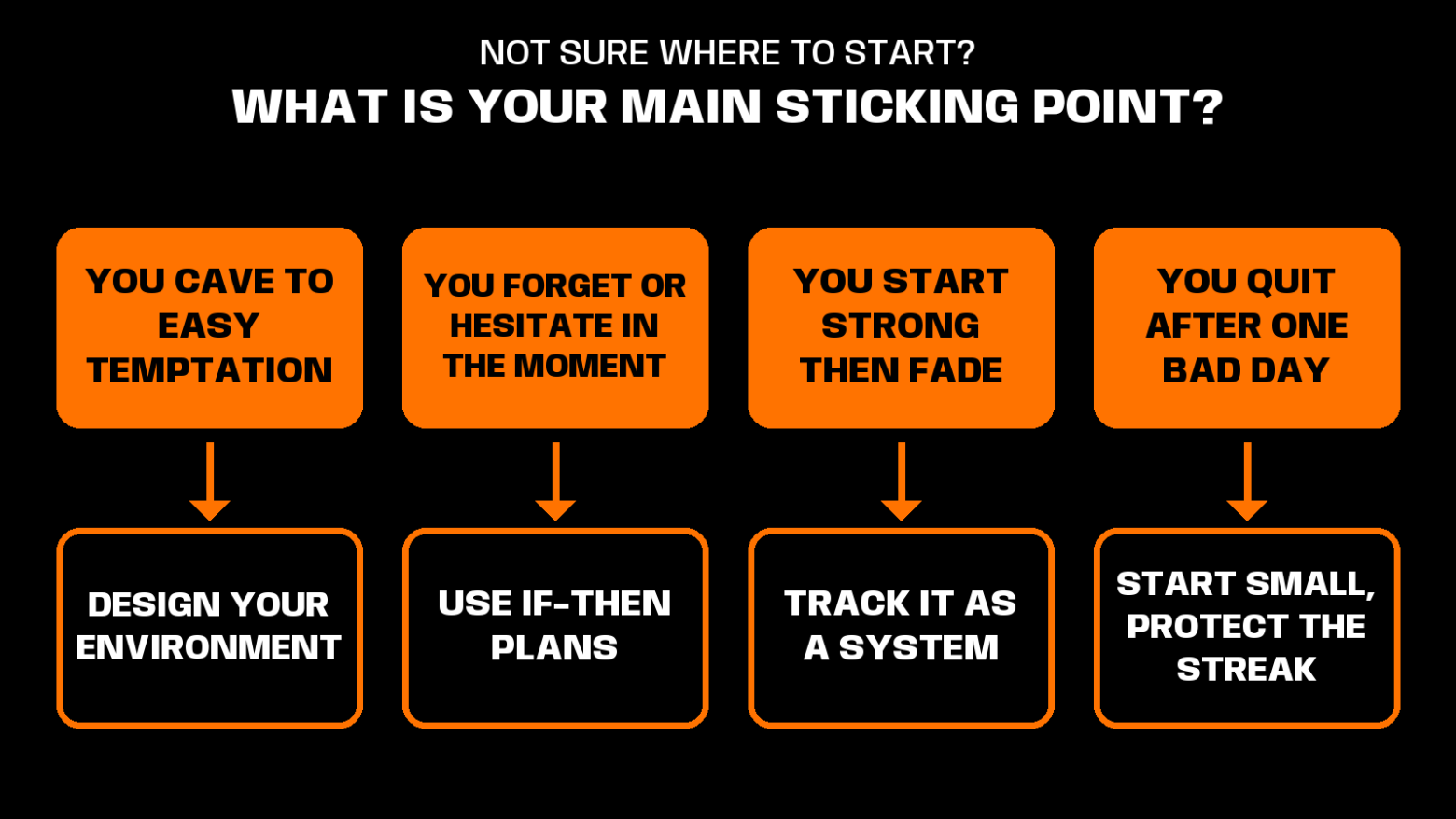
Not sure where to start? Follow the flow to your first method.
How long does it take to build self-discipline?
There is no fixed number, but expect weeks, not days. Environment changes help immediately, while habits that need to feel automatic take longer. The men who succeed track progress from day one, because monitoring reliably improves follow-through and carries you through the slow early stretch before the habit sticks.
Can you build self-discipline if you have none?
Yes. Self-discipline is largely learned, not fixed at birth. Start with one tiny habit and one environment change rather than a full overhaul. Small, repeatable wins build the evidence that you can follow through, and that belief is what makes the next choice easier.
Does self-discipline run out during the day?
Not in the simple way the old willpower-as-a-tank idea claimed. Large studies across many laboratories failed to confirm that effect. Decisions do get harder when you are tired, so the fix is to rely on habits, rules and a prepared environment rather than in-the-moment effort.
What is the difference between self-discipline and motivation?
Motivation is the feeling that makes you want to act, and it comes and goes. Self-discipline is the system that makes you act whether or not the feeling is there. Motivation starts things, discipline finishes them, which is why systems beat feelings for anything that matters over the long term.
Are cold showers or 5am starts necessary for discipline?
No. They can be useful daily wins, but they are not the source of discipline and skipping them costs you nothing. What matters is a repeatable system, a tracked habit and an environment that makes the right choice easy. Pick practices you can actually sustain, not ones that just look hard.
What is the best app to build self-discipline as a man?
The best app is one that turns discipline into a daily, tracked system with reminders and streaks, since self-monitoring is one of the most evidence-backed methods. The MenTools app is built for exactly this, though a paper tracker or another habit app can work too. The tool matters less than using it every day.
Final Recommendation
If you do one thing, redesign your environment so the tempting option is harder and the good option is easy. Add a single if-then plan for the habit that matters most, then track it daily from day one. Start smaller than feels sensible and protect the streak. Self-discipline for men is built on systems that hold when motivation does not, so build the system first and let the discipline follow.
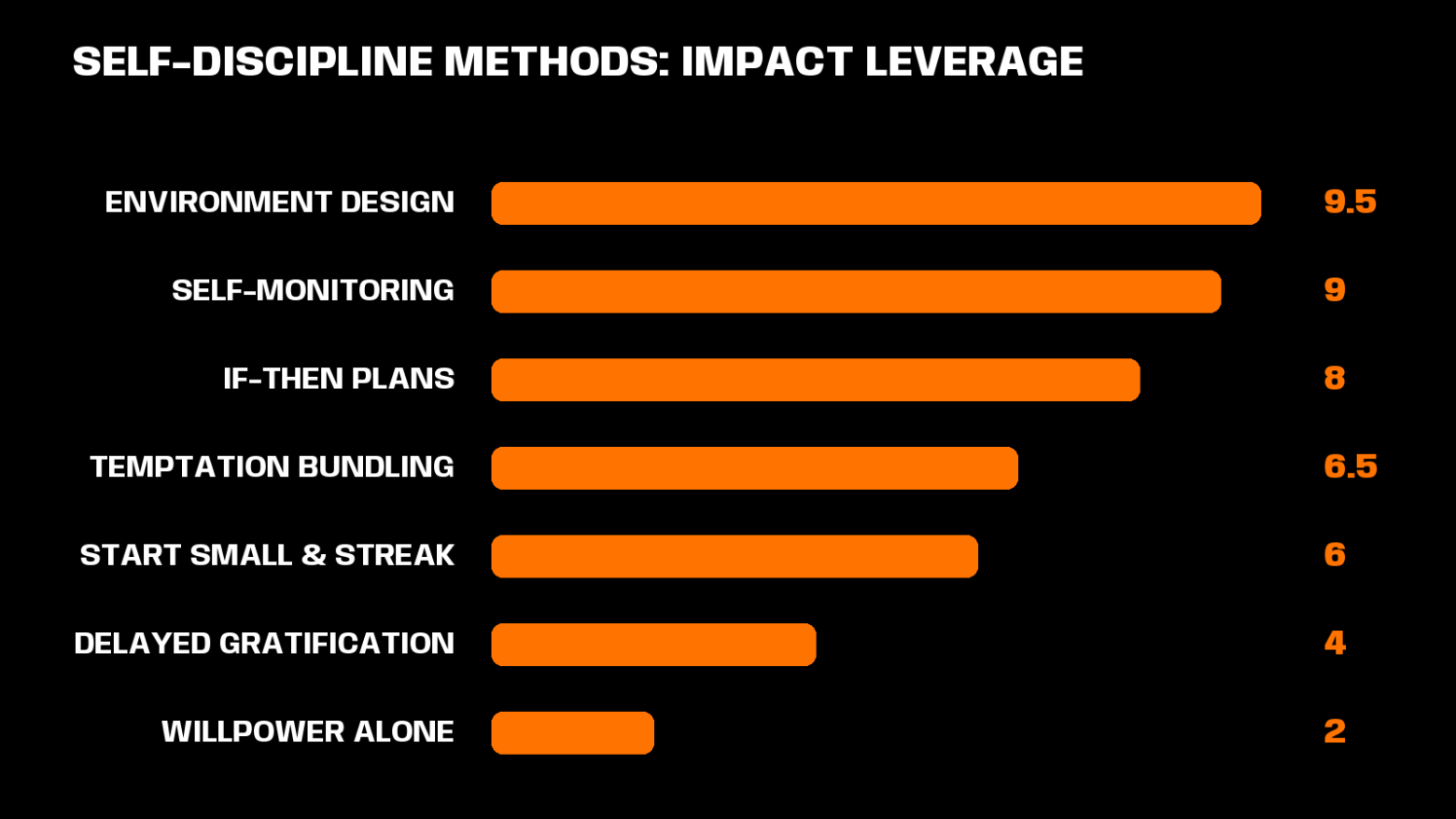
Where each method earns its place, from highest-leverage to slow-burn.
Options for Men to Take Action
Most men do not lack discipline because they lack ideas. They lack a system. The plan lives in their head, the tracking never happens, and week two arrives with nothing keeping score. Scattered notes, three half-used apps and pure willpower do not hold when a bad day hits.
The MenTools app is built to run all seven methods above as one system, with daily challenges, if-then style routines, streaks, reminders, a journal and an AI coach, so building discipline becomes a set of check-ins instead of a daily fight with yourself.
How you can do this today: pick one habit, shrink it to a two-minute version, set your trigger, and log day one tonight.
Wins on cost: one app replaces a separate habit tracker, a journal and a stack of reminder tools.
Wins on time: the routines and tracking are set up in minutes, with no research or system-building to do yourself.
Wins on practicality: it lives on your phone and fits a working man’s week, so it survives travel, early starts and busy stretches.
For more ways to strengthen the mental side of discipline, see the MenTools mindset hub. Small daily reps, tracked and repeated, are what turn a decision today into a disciplined life.
Last updated: 2026-07-21 v1.0
Disclaimer: This guide is for informational purposes only and does not constitute medical or psychological advice. Speak with a qualified professional before making significant changes if you have a medical or mental health condition.
References
- [1] Tangney JP, Baumeister RF, Boone AL. High self-control predicts good adjustment, less pathology, better grades, and interpersonal success. Journal of Personality, 2004. Link
- [2] Mischel W. The Marshmallow Test: Mastering Self-Control. The Long Now Foundation talk, 2016. Link
- [3] Gollwitzer PM, Sheeran P. Implementation intentions and goal achievement: a meta-analysis of effects and processes. Advances in Experimental Social Psychology, 2006. Link
- [4] Milkman KL, Minson JA, Volpp KGM. Holding the Hunger Games hostage at the gym: an evaluation of temptation bundling. Management Science, 2014. Link
- [5] Duckworth AL, Gendler TS, Gross JJ. Situational strategies for self-control. Perspectives on Psychological Science, 2016. Link
- [6] Wansink B, Painter JE, Lee YK. The office candy dish: proximity’s influence on estimated and actual consumption. International Journal of Obesity, 2006. Link
- [7] Harkin B, Webb TL, Chang BPI, Prestwich A, Conner M, Kellar I, Benn Y, Sheeran P. Does monitoring goal progress promote goal attainment? A meta-analysis of the experimental evidence. Psychological Bulletin, 2016. Link
- [8] Self-control and limited willpower: current status of ego depletion theory and research. Current Opinion in Psychology, 2024. Link
- [9] American Psychological Association. What you need to know about willpower: the psychological science of self-control. Link