
MEN: Confidence vs Arrogance: What’s the Difference for Men?
Quick Answer
Confidence is a settled belief in what you can do, built on evidence. Arrogance is a claim of superiority over other people, built on comparison. The difference is not the volume, it is the reference point. A confident man measures himself against the task. An arrogant man measures himself against everyone else in the room.
**Jump to:** Both at a glance | FAQ | Options for men
Disclosure: MenTools publishes this article and may feature MenTools products.
How we evaluate: Each option is assessed on real-world use, evidence, cost and time, and how well it suits men. Every option including the MenTools option carries an honest limitation. Full sources are in the references below.
Confidence vs Arrogance at a Glance
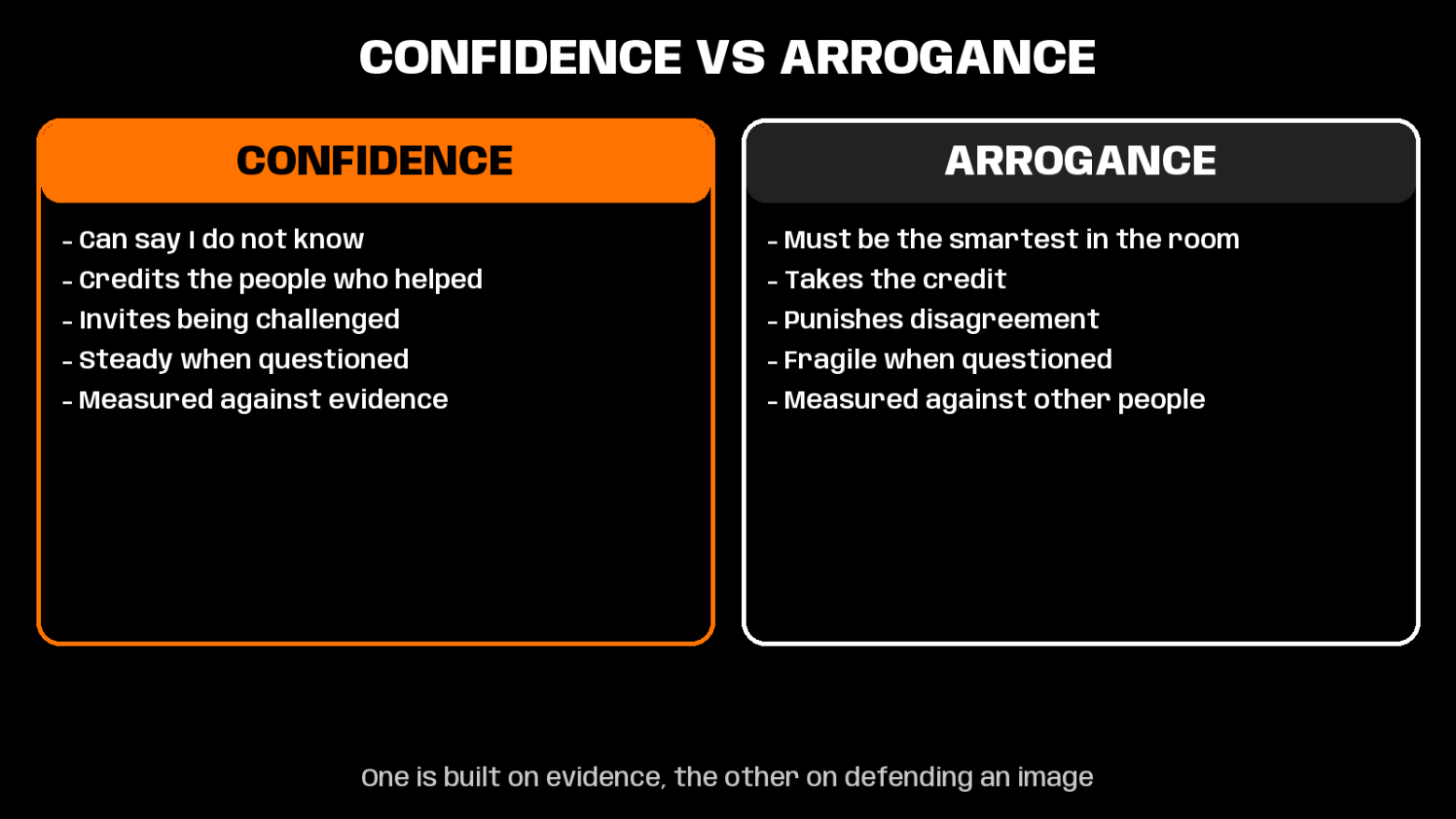
Seven tells, and which trait each one actually points to.
| Trait | What it rests on | Standout | Watch-out | Needs an audience |
|---|---|---|---|---|
| Confidence | Evidence of what you have done | Survives being wrong | Can be misread as arrogance | No |
| Arrogance | Comparison with other people | Buys status quickly | Collapses when tested | Yes |
How We Chose the Criteria
We compared the two on seven things that show up in real life rather than in a personality quiz, because most men do not need a label, they need to know which one they are running. Every criterion had to be something another person could observe in you within a month, not something you decide about yourself in private.
Those seven are what each trait rests on, whether it needs an audience, how it handles being wrong, how it treats other men, whether it improves the actual work, how stable it is under pressure, and whether it can be built deliberately. Both carry honest limitations below, because confidence has real costs too and pretending otherwise would be the same mistake in a different jumper.
1. Confidence: What It Actually Is
Confidence is the belief that you can handle a specific thing, based on evidence that you have handled it or something like it before. It does not require you to be better than anyone else, and it does not need to be announced. It suits any man who wants his self-assessment to stay accurate when the situation changes.
What it is: A working estimate of your own capability that is tied to a task. It goes up when you deliver and it goes down when you do not, which is exactly what a useful signal should do.
What it looks like in a man: He says what he can do, says plainly what he cannot, and does not need the other person to agree before he is comfortable.
Standout: It has a proper mechanism behind it. Albert Bandura, whose self-efficacy theory sits under most modern confidence research, held that mastery experiences are the strongest of the four sources of belief in your own ability, “because they provide the most authentic evidence of whether one can muster whatever it takes to succeed” [1]. In other words, confidence is downstream of doing the thing, not upstream of it.
Watch-out: It is quiet, so it is regularly mistaken for arrogance by people who only see the calm and not the work behind it, and it is regularly beaten in the room by louder men with less behind them. Confidence also does nothing for you outside its own domain. Being genuinely good at your trade tells you very little about whether you can hold a difficult conversation at home.
2. Arrogance: What It Actually Is
Arrogance is a claim of superiority over other people that has to be maintained. It is not a stronger dose of confidence, it is a different mechanism, and the research is unusually clear on this. Reviewing the evidence in Current Directions in Psychological Science, Brummelman, Thomaes and Sedikides concluded that narcissism differs markedly from self-esteem in its phenotype, its consequences, its development and its origins [10]. It runs on comparison and on other people’s reactions rather than on evidence.
What it is: An inflated sense of self held in place by comparing yourself favourably with others, and defended when that comparison is threatened.
What it looks like in a man: He needs the room to register it. He interrupts, he corrects, he steers stories back to himself, and he becomes noticeably sharper when someone else is praised.
Standout: It genuinely works in the short term, which is why it is so common. In six studies published in the Journal of Personality and Social Psychology, Cameron Anderson and colleagues found that overconfidence led to higher social status in both short-term and longer-term groups, because it produces a behavioural signature that makes a man look competent to others [2]. Bluffing is not stupid. It is rewarded.
Watch-out: It is a claim rather than a capability, so it has to be renewed constantly, and it makes the man holding it worse at seeing himself. Eddie Brummelman of the University of Amsterdam puts the cost plainly. “Narcissists feel superior to others but aren’t necessarily satisfied with themselves” [3]. It buys the room and charges you your own accuracy.
Where Does Each One Come From?
They have different roots, which is the strongest single argument that they are not the same trait at different volumes. Confidence and self-esteem grow out of being valued. Arrogance and narcissism grow out of being told you are better than other people. Same parents, different message, different adult.
The evidence here is unusually direct. Brummelman and colleagues followed 565 children aged seven to twelve and their parents across four six-month waves, published in the Proceedings of the National Academy of Sciences. Narcissism was predicted by parental overvaluation, meaning parents seeing their child as more special and more entitled than others, and not by a lack of parental warmth. Self-esteem was predicted by warmth, meaning parents expressing affection and appreciation [4].
That matters for grown men because it tells you which lever to pull. If arrogance were simply too much confidence, the fix would be to want less. It is not, so the fix is not modesty. The fix is moving your reference point off other people and back onto the work.
Which One Survives Being Wrong?
Confidence, comfortably, because it was built on evidence and can absorb new evidence. Arrogance cannot, because admitting the gap would dismantle the claim it rests on. This is the single most reliable tell available to you, and it shows up within minutes of a man being contradicted with something true.
The gap it creates is measurable. In their 1999 Journal of Personality and Social Psychology paper, Justin Kruger and David Dunning found that participants scoring in the bottom quartile on tests of humour, grammar and logic, whose actual average was the 12th percentile, estimated their own performance at the 62nd percentile [5]. That is a 50 point gap between how good they were and how good they thought they were, and the least skilled had the largest gap.
| Criteria | Confidence | Arrogance | Which one is it |
|---|---|---|---|
| What it rests on | Evidence of past performance | Comparison with other people | The reference point tells you |
| Needs an audience | No, works alone | Yes, requires witnesses | Arrogance |
| Handles being wrong | Updates and moves on | Defends or attacks | Confidence |
| Treats other men | Can praise a rival honestly | Competes with everyone | Confidence |
| Effect on the actual work | Improves it over time | Leaves it unchanged | Confidence |
| Stability under pressure | Dips, recovers, stays honest | Escalates to protect the claim | Confidence |
| Can be built deliberately | Yes, through mastery | Not something to build | Confidence |
Does Arrogance Actually Work?
Partly, and being honest about that is the only way this comparison stays useful. Arrogance reliably wins status, it is not always punished when exposed, and it gets men promoted. What it does not do is make them good at the job once they are there. Those are two separate outcomes and most advice on this topic quietly merges them.
The exposure finding is the uncomfortable one. Jessica Kennedy, Cameron Anderson and Don Moore ran three experiments in which a person’s overconfidence was revealed to their group by showing everyone their real performance. Group members did not demote them and still viewed them positively, leading the authors to conclude that the status benefits of overconfidence outweighed the possible status costs [6]. Being caught is not the mechanism that catches up with arrogant men.
The performance finding is the one that does. Emily Grijalva and colleagues, in a meta-analysis of narcissism and leadership in Personnel Psychology, found narcissism predicted leadership emergence but had no relationship with leadership effectiveness. More telling, self-reported effectiveness was positively related to narcissism while supervisor, subordinate and peer ratings were not [7]. Arrogant men rate themselves as better leaders. The people who work for them do not agree.
How Can Other Men Tell the Difference?
By watching what you do when someone else is good, not by listening to what you say about yourself. Confidence can name another man’s strength without flinching. Arrogance cannot, because another man being good is a threat to a claim built on being better. This is visible from the outside long before it is visible from the inside.
Organisational researchers have measured this precisely. Bradley Owens, Michael Johnson and Terence Mitchell, drawing on eight lab and field samples in Organization Science, defined expressed humility as an interpersonal characteristic showing “(a) a manifested willingness to view oneself accurately, (b) a displayed appreciation of others’ strengths and contributions and (c) teachability” [8]. Notice that none of those three require thinking less of yourself. They require seeing accurately, crediting others and staying open to being taught.
Their work also found that expressed humility can compensate for lower general mental ability in individual performance [8]. A man who can be taught outperforms his own raw ability. A man who cannot be taught is capped at whatever he already knows, which is the real, slow cost of arrogance.
Am I Confident or Arrogant? The Honest Test
Almost certainly you are less sure than you think, and that is not an insult, it is the base rate. The test is not how you feel about yourself, because arrogance feels like confidence from the inside. The test is whether other people’s view of you matches your own, and the only way to know that is to ask them.
The gap is well documented. Organisational psychologist Tasha Eurich, whose research programme covered four years and nearly 5,000 participants, reports that while roughly 95 percent of people believe they are self-aware, only around 10 to 15 percent actually meet the criteria. She writes that “when we see ourselves clearly, we are more confident and more creative” [9].
Three questions do most of the work, and you answer them with evidence rather than instinct. When were you last genuinely wrong in front of someone, and what did you actually do in the next ten seconds. Can you name a man in your circle who is better than you at something that matters to you, without adding a qualifier. And if you removed every audience, would you still want the thing you say you want.
How to Build the Real Thing
You build confidence by accumulating evidence, in that order, not the other way round. Pick something narrow, do it repeatedly, and let your self-assessment follow the results. This is slower than the alternative and it is the only version that holds when someone finally tests it.
Bandura’s ordering of the four sources is the practical instruction. Mastery experiences come first, then watching people like you succeed, then encouragement from others, then managing your own physical state [1]. Most men try to run that list backwards, starting with the pep talk. Start with a small, real, repeated win instead, and keep a record of it so the evidence exists outside your memory.
Two more things make it stick. Keep one domain where you are objectively measured, because a number you cannot argue with is the fastest cure for both self-doubt and self-inflation. And keep at least one person who will tell you the truth, because self-assessment without external feedback drifts in whichever direction is more comfortable. For the wider set of behaviours this sits inside, see our guide to how a man can become more confident.
You Are Confident If, You Are Arrogant If
You are confident if you can say “I do not know” without it costing you anything, if you can praise a rival and mean it, if your self-assessment moves when the results move, and if you would still do the work with nobody watching. Those are the four that hold up.
You are arrogant if being contradicted feels like being attacked, if other men’s success reads as a subtraction from yours, if you rate yourself higher than the people who see your work do, or if the version of you in the room is noticeably different from the version alone. None of that makes you a bad man. It makes you a man running a system that will cap him, and it is fixable by moving the reference point.
FAQ
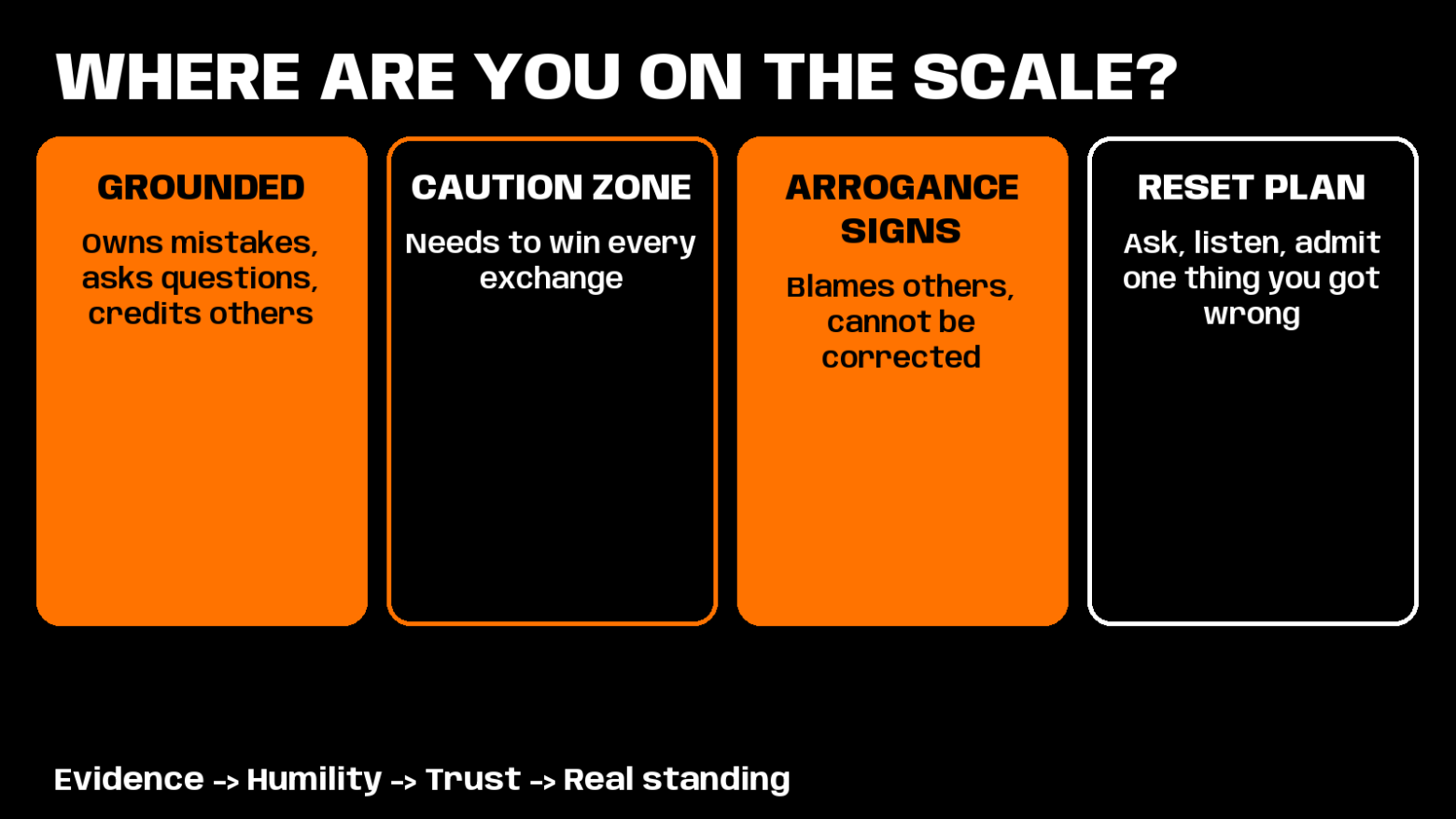
Match the fix to the sticking point you actually have, not the one that sounds better.
Can you be confident and arrogant at the same time?
Yes, and it is common. A man can hold genuine, earned confidence in his trade and be arrogant about everything he has not tested. The two are separate mechanisms rather than opposite ends of one scale, so competence in one area gives you no protection in another. Most arrogance sits in the areas a man has never had measured.
Is arrogance just insecurity in disguise?
Not always, and the research does not support treating it as a rule. Narcissism and low self-esteem are distinct, and the developmental evidence shows arrogance often grows from being told you are superior rather than from feeling worthless. Some arrogant men are covering something. Others were simply overvalued and never corrected.
How do I stop coming across as arrogant when I am just confident?
Change the ratio rather than the volume. Ask more questions than you answer in the first ten minutes, credit someone else by name early, and state your limits out loud once. Confidence that names its own boundaries almost never reads as arrogance, because arrogance never does that.
Do women read confidence and arrogance differently to men?
The signal that separates them is the same for everyone, which is how you behave when you are wrong or when someone else is good. What differs is tolerance, not detection. Most people identify the difference quickly and simply choose whether to say anything, which is why arrogant men often get very little direct feedback.
Is quiet confidence better than loud confidence?
Neither volume is the point, though quiet is harder to fake. Loud confidence backed by real evidence is fine and often necessary in work that requires persuading people. Loud confidence with nothing behind it is arrogance with better delivery. Judge it by what happens when the claim is tested, not by the decibels.
How long does it take to build real confidence?
Longer than a mindset shift and shorter than most men fear, because it moves with evidence rather than with time. Pick one narrow area, produce a repeatable result, and you will usually feel the change within four to eight weeks. Confidence across several areas takes years, because each one needs its own evidence.
Final Recommendation
Stop trying to dial confidence up or arrogance down, because they are not the same dial. Move your reference point off other men and onto the work, then go and gather evidence in one narrow area until your self-assessment is boring and accurate. Keep one person who will contradict you and one measure you cannot argue with. That combination produces the version other men trust, and it is the only version still standing when someone tests it.
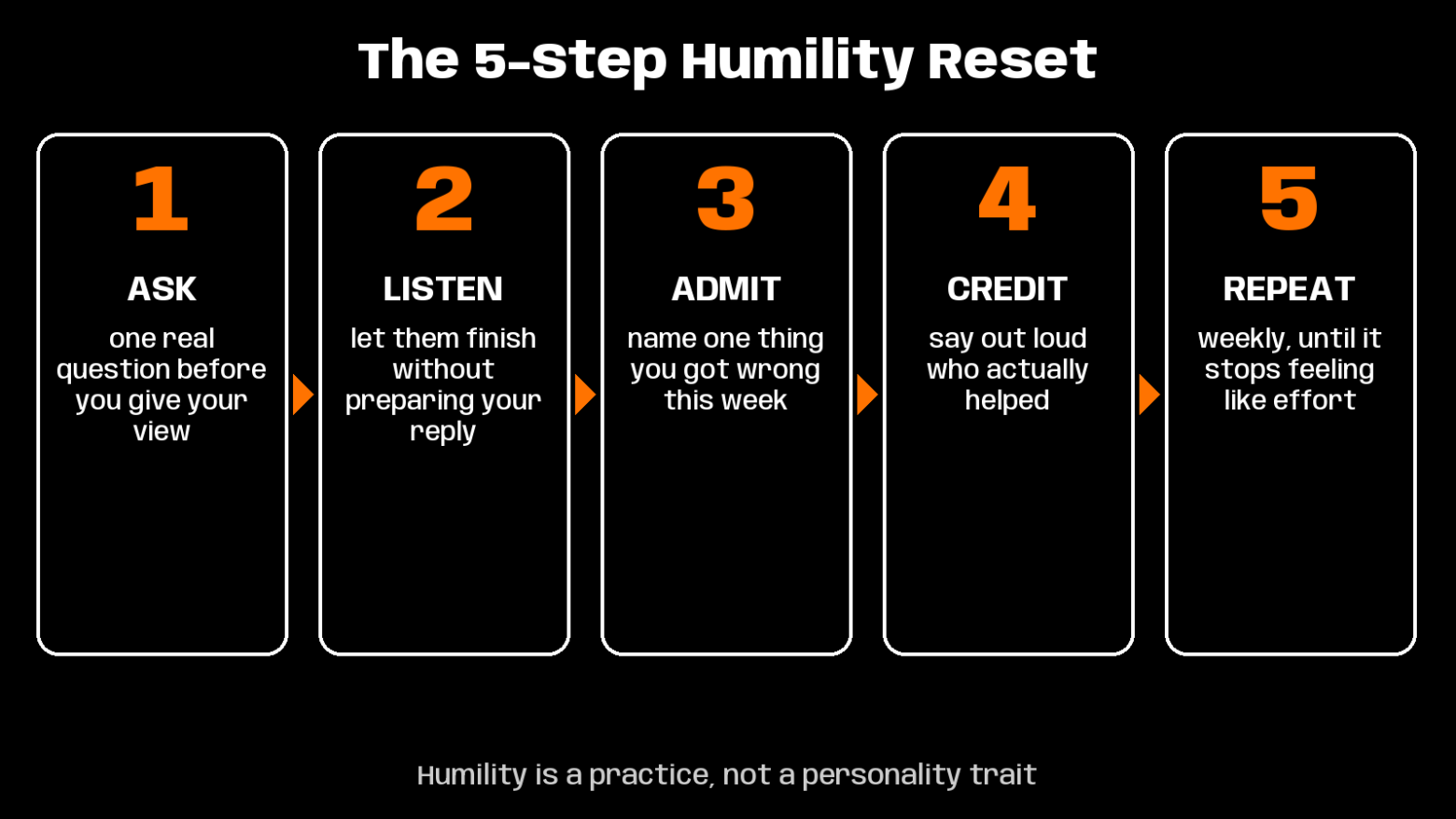
The self-assessment gap: bottom-quartile performers scored at the 12th percentile and rated themselves at the 62nd.
Options for Men to Take Action
Most men do not stay stuck here because they picked the wrong word for what they have. They stay stuck because there is no evidence trail. Nothing recorded, nothing measured, nobody contradicting them, so the self-assessment drifts quietly in whichever direction feels better that week. Knowing the difference between confidence and arrogance is worth very little without something that keeps you honest.
The MenTools app is built to be that evidence trail rather than another motivational feed, with daily actions, chosen difficulty levels, reminders at the moment they matter, streaks and progress tracking, and an AI coach for the weeks you talk yourself out of it. Men tend to trust the version of themselves they can see the receipts for.
How you can do this today: pick the one area you want real confidence in, set it as a daily action, and log day one tonight so the evidence starts existing outside your head.
Wins on cost: one subscription replaces a habit tracker, a journal app and a shelf of confidence books.
Wins on time: the structure, levels and tracking are already built, so there is nothing to design before you start.
Wins on practicality: it works around shift patterns, travel and family, which is where a rigid programme usually fails first.
Watch-out: it is a tracking and consistency tool, not therapy and not a substitute for honest people around you. If your issue is a deeper pattern rather than a missing habit, this supports that work rather than replacing it.
Confidence holds far better when the underlying habit of showing up is already there, which is why our guide to self-discipline for men is worth reading alongside this one. If you want the specific behaviours rather than the distinction, our guide to confidence habits for men covers what to actually do daily, and our guide to mental toughness for men covers holding it under pressure. The reps are also easier to keep when the basics underneath them are covered, which is why a simple daily foundation like the MenTools One a Day multivitamin can support the steady energy those daily reps depend on. For more built for men, see the MenTools confidence hub. One month of evidence will settle this question better than another year of wondering which one you are.
Last updated: 2026-08-20 v1.0
Disclaimer: This guide is for informational purposes only and does not constitute medical or psychological advice. Speak with a qualified professional before making significant changes if you have a medical or mental health condition.
References
- [1] Bandura A. Self-efficacy, the theory at the heart of human agency. American Psychological Association. Link
- [2] Anderson C, Brion S, Moore DA, Kennedy JA. A status-enhancement account of overconfidence. Journal of Personality and Social Psychology, 2012. Link
- [3] Brummelman E. Narcissists not necessarily satisfied with themselves. Association for Psychological Science, reported by ScienceDaily, February 2016. Link
- [4] Brummelman E, Thomaes S, Nelemans SA, Orobio de Castro B, Overbeek G, Bushman BJ. Origins of narcissism in children. Proceedings of the National Academy of Sciences, 2015. Link
- [5] Kruger J, Dunning D. Unskilled and unaware of it, how difficulties in recognizing one’s own incompetence lead to inflated self-assessments. Journal of Personality and Social Psychology, 1999. Link
- [6] Kennedy JA, Anderson C, Moore DA. When overconfidence is revealed to others, testing the status-enhancement theory of overconfidence. Organizational Behavior and Human Decision Processes, 2013. Link
- [7] Grijalva E, Harms PD, Newman DA, Gaddis BH, Fraley RC. Narcissism and leadership, a meta-analytic review of linear and nonlinear relationships. Personnel Psychology, 2015. Link
- [8] Owens BP, Johnson MD, Mitchell TR. Expressed humility in organizations, implications for performance, teams, and leadership. Organization Science, 2013. Link
- [9] Eurich T. What self-awareness really is (and how to cultivate it). Harvard Business Review, January 2018. Link
- [10] Brummelman E, Thomaes S, Sedikides C. Separating narcissism from self-esteem. Current Directions in Psychological Science, 2016. Link