No products in the cart.
Return To Shop
MEN: Is Confidence Something You Build or Something You Fake?
Quick Answer
You build it, but faking the right things helps you get there. Acting more boldly, reframing nerves as excitement and dropping hiding habits all have research support [1][2][3]. Faking the inside does not: the power pose hormone effect failed to replicate [4], and affirmations can backfire [5]. Doing the thing is one of the sources of real self-belief [6].
**Jump to:** At a glance | Built or faked? | Power posing | Affirmations | Acting confident | What to tell yourself | Hiding your nerves | Does it fool others? | How to build it | FAQ | Options for men
Disclosure: MenTools publishes this article and may feature MenTools products.
How we evaluate: Each step is assessed on real-world use, evidence, cost and time, and how well it suits men. Every step including the MenTools option carries an honest limitation. Full sources are in the references below.
Build or Fake Confidence? At a Glance
Most “fake it” tactics fall into two groups. The ones that change what you do, such as acting out the behaviour or naming your nerves differently, have decent evidence behind them. The ones that try to change how you feel from the inside, such as a two-minute pose or a slogan, mostly do not. The table gives the short answer for each.
| Tactic | Fake or build? | Does it work? | What the evidence shows |
|---|---|---|---|
| Two-minute power pose for hormones | Fake | No | 200 people, no significant effect on testosterone or cortisol [4] |
| Not slumping | Fake | Partly | Effects came from avoiding contractive postures (g = 0.45, 8 studies), not from expansive ones (g = 0.06) [7] |
| Repeating “I’m a lovable person” | Fake | Backfires for some | People low in self-esteem felt worse after repeating it [5] |
| Acting extraverted for a week | Fake the behaviour | Yes, with a cost | Positive affect and authenticity rose overall, but more introverted people felt more tired [3] |
| Saying “I am excited” before a big moment | Reframe | Yes | People who reappraised anxiety as excitement felt more excited and performed better [1] |
| Talking to yourself by name | Reframe | Yes | Better performance and less distress in speaking and first-impression tasks, in a paper of seven studies with 585 people [8] |
| Dropping your hiding habits | Build | Yes | Partners reacted more positively to people who cut their safety behaviours [2] |
| Doing the thing repeatedly | Build | Yes, the base layer | Performance accomplishments are one of four sources of self-efficacy [6] |
Is Confidence Built or Faked?
Confidence is built, and the most useful kind of faking is really early building. Psychologist Albert Bandura proposed that belief in your own ability comes from four sources: “performance accomplishments, vicarious experience, verbal persuasion, and physiological states” [6]. Two of those are things you do or watch others do, one is someone telling you that you can, and one is how your body feels.
Bandura also wrote that “The more dependable the experiential sources, the greater are the changes in perceived self-efficacy” [6]. In plain terms, proof you have earned yourself moves the needle more than a pep talk. That is why a man who has given ten presentations feels different from one who has read ten articles about presenting.
His model also explains why avoidance keeps you stuck. Sticking with activities that feel threatening but are fairly safe produces, “through experiences of mastery, further enhancement of self-efficacy and corresponding reductions in defensive behavior” [6]. You do not wait for confidence before you act. You act in small, survivable doses, and the confidence follows.
So the honest answer to “fake it till you make it” is half right. Faking the outside, by doing the behaviour before you feel ready, is how the building starts. Faking the inside, by trying to talk or pose yourself into a feeling with no action behind it, is where the advice breaks down.
Does Power Posing Actually Work?
Not the way it was sold. The 2010 study claimed that two one-minute poses raised testosterone and lowered cortisol [9], but a 2015 replication with 200 people “found no significant effect of power posing on hormonal levels” [4]. The original lead author later wrote, “I do not believe that ‘power pose’ effects are real” [10].
The original study reported that high-power posers showed “elevations in testosterone, decreases in cortisol” and more risk taking [9]. Its first author, Dana Carney, later described the sample as 42 people and wrote that “The sample size is tiny” and “The data are flimsy” [10]. That is an unusually frank statement from an author about her own famous finding.
The replication by Eva Ranehill and colleagues used 200 people, 102 of them men, and held the poses for 3 minutes rather than 1 [4]. They “failed to confirm an effect of power posing on testosterone” and found no significant effect on their risk-taking measure [4]. One thing did move: people reported stronger feelings of power, a modest effect on a self-report scale (Cohen’s d = 0.344) [4].
A 2022 review identified 73 studies with 7,038 participants and meta-analysed 48 of them, which refines the picture [7]. Expansive and contractive postures did produce robust differences in mood and behaviour, but the effect was “driven by the absence of contractive motor displays” rather than the presence of expansive ones [7]. Against a neutral posture, expansive poses made no significant difference (g = 0.06) [7].
The practical read is simple. Do not bother with a superhero stance in the toilets before a meeting. Do stop collapsing into yourself, because a slumped, shrunken posture is the part that seems to cost you. Our guide to confidence habits for men covers posture as one habit among nine.
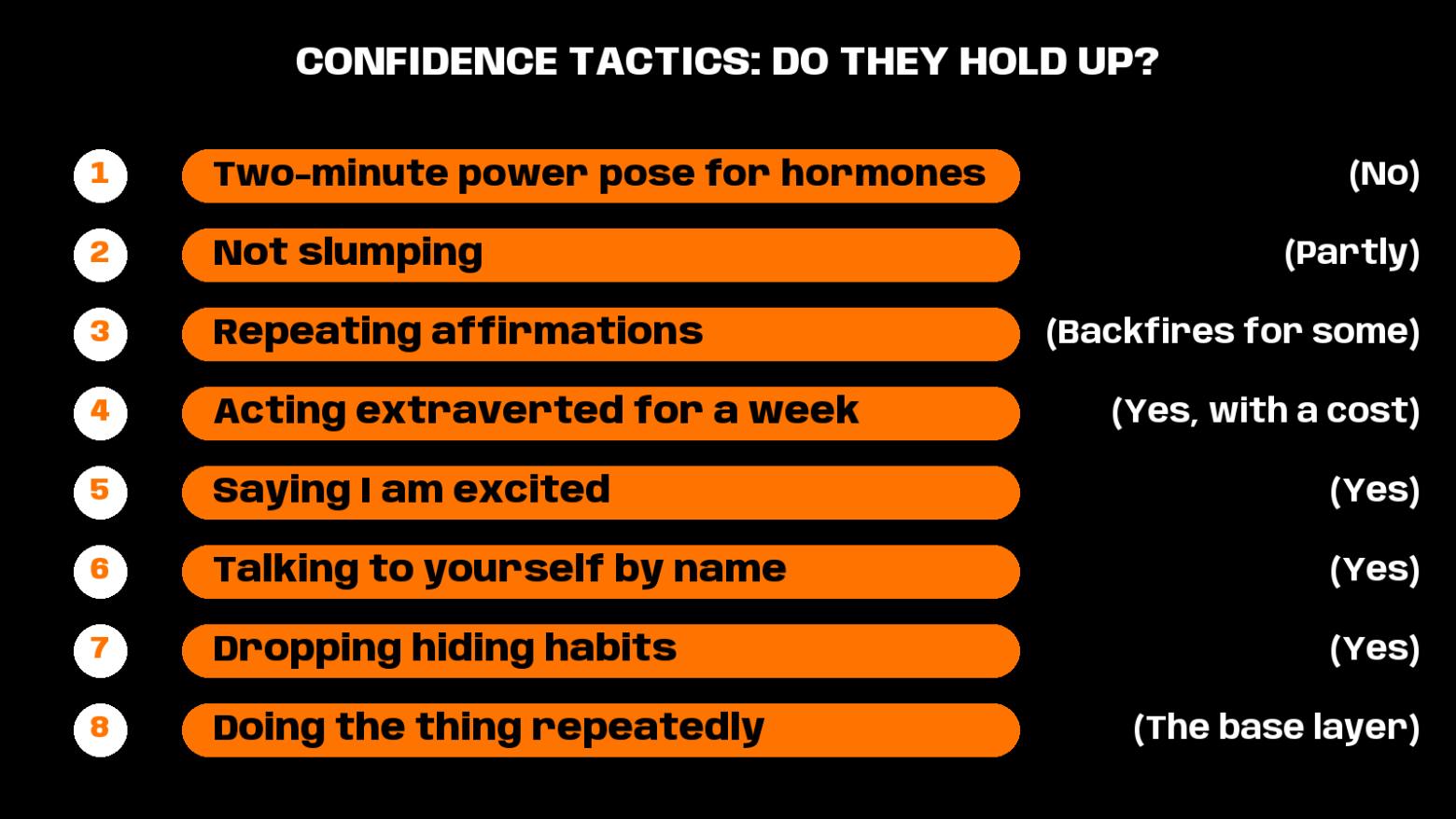
Which confidence tactics hold up, from fake to built.
Do Affirmations Help You Fake Confidence?
They can make things worse for the men who need them most. In two experiments, people with low self-esteem who repeated “I’m a lovable person” felt worse than those who did not repeat it [5]. People with high self-esteem felt better, “but to a limited degree” [5]. A slogan that clashes with what you believe tends to remind you of the gap.
The authors of that study started from a survey showing that people often use positive self-statements and believe they work [5]. Their conclusion was blunt: “Repeating positive self-statements may benefit certain people, but backfire for the very people who ‘need’ them the most” [5]. The abstract does not give sample sizes, so treat this as a strong warning rather than a precise estimate.
The wider self-esteem research points the same way. A major review found that efforts to boost the self-esteem of pupils “have not been shown to improve academic performance and may sometimes be counterproductive” [11]. The same review found that modest correlations do not show that high self-esteem leads to good performance, and that “high self-esteem is partly the result of good school performance” [11].
That does not mean words are useless. It means the words need to be believable and tied to action. “I have done hard things before and I have prepared for this” is a statement you can check. “I am the most confident man in the room” is not, and your brain knows it.
Can Acting Confident Make You Feel Confident?
Yes, within limits. In a randomised trial, 147 people were told either to act extraverted, meaning bold and agentic, for a week in everyday life or to follow a sham task [3]. There was “a positive overall effect of the acting extraverted intervention on PA and authenticity” [3], where PA means positive affect. Acting the part changed how people felt.
The cost matters as much as the benefit. The same trial found that “more introverted participants had weaker PA increases, experienced increased NA and tiredness, and decreased feelings of authenticity” [3], where NA means negative affect. A naturally quiet man who forces a loud persona all week may feel drained and fake rather than confident.
The better version is to act the behaviour the situation needs, not to play a different person. Speak first in the meeting, hold the eye contact, make the call you have been putting off. Those are actions, and actions feed the performance accomplishments that open Bandura’s list of sources [6].
Our article on confidence vs arrogance covers where acting bold tips into acting superior. The line is roughly this: confidence is willing to be wrong in front of people, and arrogance cannot afford to be.
What Should You Say to Yourself Before a Big Moment?
Say “I am excited”, and talk to yourself by name. Across studies of karaoke singing, public speaking and maths, people who reappraised their anxious arousal as excitement “feel more excited and perform better” than people who tried to calm down [1]. Separately, using your own name or “you” instead of “I” improved performance under social stress [8].
The excitement trick fits how nerves feel: anxiety and excitement are both states of high arousal, and the study points to this match, which it calls arousal congruency. Alison Wood Brooks found that “an overwhelming majority of people believe trying to calm down is the best way to cope with pre-performance anxiety” [1]. Saying “I am excited” out loud, or reading a simple “get excited” message, helped people adopt an opportunity mindset rather than a threat mindset [1].
Ethan Kross and colleagues ran seven studies with 585 people in total [8]. Compared with first-person self-talk, the non-first-person group performed better in a first-impressions task and a public speaking task, as judged by objective raters, and showed less distress [8]. A meta-analysis within the paper found the effects were not moderated by trait social anxiety [8], so it helped socially anxious people as well.
Sport points the same way. A meta-analysis of 32 studies with 62 effect sizes found self-talk interventions improved task performance with “a positive moderate effect size (ES = .48)” [12]. Self-talk helped most on novel tasks and on tasks needing fine motor control, and instructional cues beat motivational ones on fine tasks [12]. Tell yourself what to do, not how great you are.
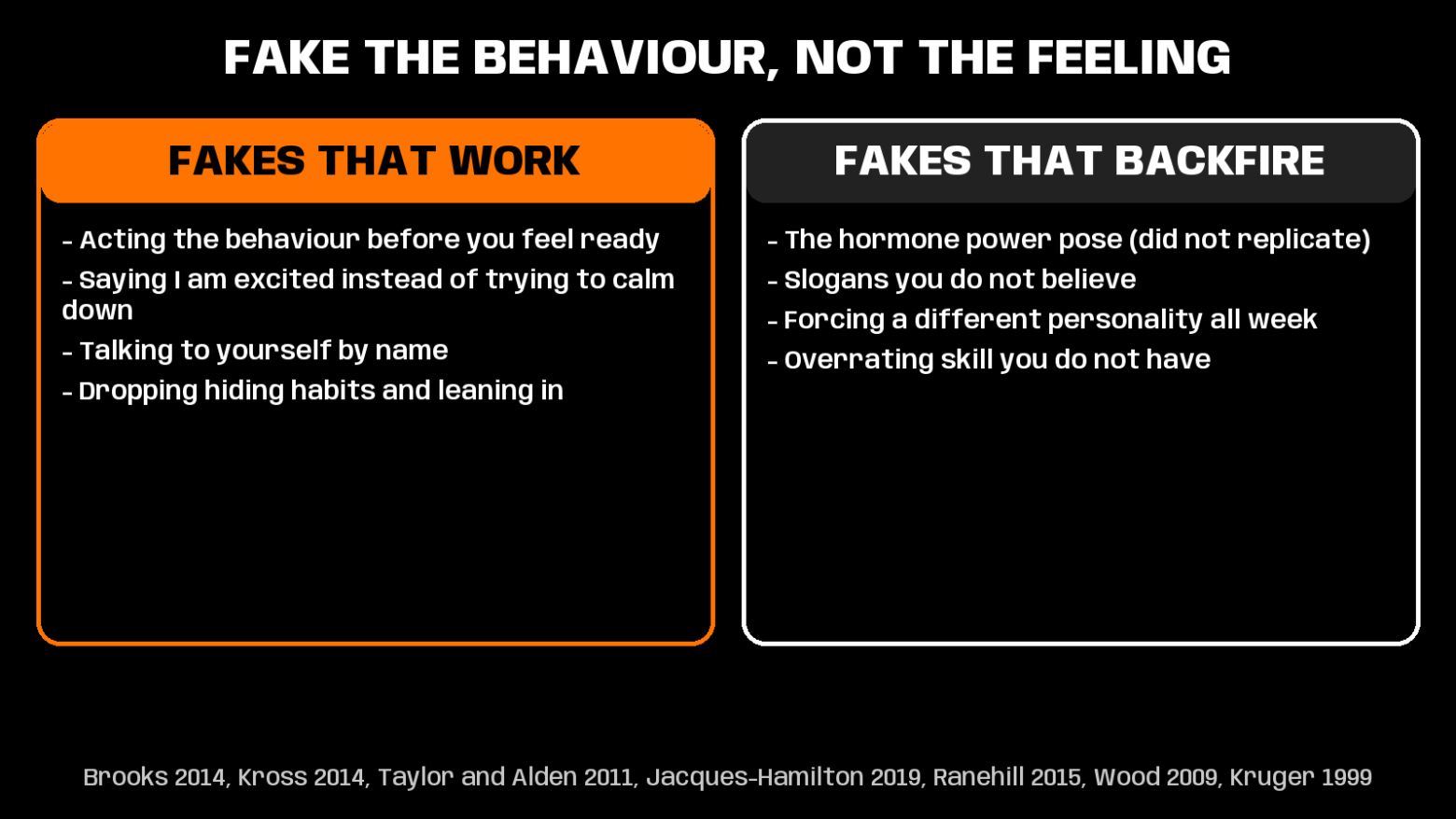
Fake the behaviour, not the feeling.
Why Does Hiding Your Nerves Backfire?
Because the hiding is what other people notice. In a study of 80 people diagnosed with generalised social anxiety disorder, those told to drop their usual “safety behaviours” before a second conversation saw greater gains in both perceived and actual positive outcomes than an exposure-only group [2]. Their partners reacted better because they showed “a greater increase in social approach behavior” [2].
Safety behaviours are the small habits people use to get through a scary moment unnoticed: rehearsing every sentence, avoiding eye contact, gripping a drink, keeping answers short. They feel like faking confidence. In practice they make you look closed and keep you watching yourself instead of the other person.
The study is worth reading closely. Participants rated the conversation better mainly because they judged their anxiety as less visible, while their partners responded to something different, the extra approach behaviour [2]. As the authors put it, “different sources of social information accounted for participant versus partner interpersonal judgments” [2]. You judge yourself on how nervous you feel. Other people judge you on whether you lean in.
This is the clearest case of “fake it” being bad advice. Trying to hide your nerves works against you. Acting engaged, with the nerves still there, is what lands.
Does Faked Confidence Fool Other People?
Often, at first. In the first three of six studies, “overconfidence leads to higher social status” in groups, and a fourth found it made people “appear competent to others” [13]. But confidence with no skill underneath is easy to misjudge: people in the bottom quartile on tests placed themselves in the 62nd percentile when they scored in the 12th [14].
The status finding helps explain why bluffing is tempting. The researchers suggest people may so often believe they are better than others because it helps them gain status [13]. Short term, the man who speaks with certainty often gets listened to.
The longer run is less kind. In the self-esteem review, “Narcissists are charming at first but tend to alienate others eventually” [11], and people high in self-esteem who claimed to make better impressions were mostly disconfirmed by objective measures [11]. In the competence research, “improving the skills of participants” helped them recognise the limits of their ability [14].
So if you fake anything, fake the willingness to try, not the skill. Confidence that outruns your competence wins the first meeting and loses the third. Confidence that matches it, because you did the work, holds.
How Do You Build Confidence That Lasts?
Build confidence by collecting proof. Pick one situation that makes you nervous, act before you feel ready, reframe the nerves, drop the hiding habits and repeat until the situation is ordinary. Steps 2 to 4 draw on the studies above, while the first and last steps and the order are our own advice. You can use it for presenting, training, dating or a hard conversation at work.
**Step 1: pick one situation, not your whole personality.** Choose a specific moment, such as speaking first in the Monday meeting. Bandura names “performance accomplishments” as one of four sources of self-efficacy [6], and those come from one task at a time. “Be more confident” is not a task.
**Step 2: act before you feel ready.** Do the behaviour in a small, survivable dose. Acting extraverted for a week raised positive affect overall [3], but if you are naturally quiet, watch for the extra tiredness more introverted people reported [3].
**Step 3: say “I am excited” and use your name.** Reframing anxiety as excitement improved performance [1], and non-first-person self-talk reduced distress [8]. Keep the content instructional, such as “slow down, look up”, which beat motivational cues on fine tasks [12].
**Step 4: drop one hiding habit.** Name the safety behaviour you use most and leave it out next time. People who cut theirs got more positive reactions from the person they were talking to [2]. Stand normally rather than shrinking, since contractive posture is the part with the effect [7].
**Step 5: log the win and repeat.** Write down what you did, not how you felt. Bandura wrote that the more dependable the experiential sources, the greater the change in self-efficacy [6]. Repeat the same situation until it bores you, then pick a harder one.
For a wider view of where confidence comes from and how long it takes, our guide on how a man can become more confident goes deeper.
FAQ
Is “fake it till you make it” good advice?
Half of it is. Acting extraverted for a week raised positive affect overall in a randomised trial [3], and reappraising nerves as excitement improved performance [1]. Faking the feeling with slogans can backfire for people low in self-esteem [5]. Fake the action, not the inner state.
Does standing like a superhero before a meeting help?
Not for your hormones. A 200-person replication found no significant effect of power posing on testosterone or cortisol [4]. A meta-analysis found expansive poses made no significant difference against a neutral posture, while slumped, contractive postures did have an effect [7]. Stand normally and avoid shrinking.
Why do I feel like a fraud when I act confident?
It may be a fit problem, not a confidence problem. In the acting-extraverted trial, more introverted people felt less authentic and more tired [3]. Act the specific behaviour the moment needs, such as speaking up once, rather than playing a louder version of yourself all day.
Can you have high self-esteem and still lack confidence in a skill?
Yes. The self-esteem review found that high self-esteem is partly the result of good school performance [11], and laboratory studies have generally failed to show it causes good task performance, apart from helping people persist after failure [11]. Skill confidence comes from doing that skill, and performance accomplishments are the first of Bandura’s four sources [6].
Does confidence come before competence?
Mostly the other way round. Persistence with fairly safe but threatening activities builds self-efficacy “through experiences of mastery” [6]. People who lacked skill overestimated themselves, scoring in the 12th percentile while placing themselves in the 62nd [14]. Build the skill, and well-placed confidence follows.
How long does it take to build real confidence?
The studies cited here do not give a timeline for confidence itself. The acting-extraverted trial ran for one week [3], and self-talk helped most on novel tasks [12], so these tools may matter most when a situation is new. Lasting confidence in a situation grows with each repeat, so count the repeats rather than the days.
Final Recommendation
Build confidence, and fake only the behaviour that builds it. The hormone claims for power posing did not replicate [4][10], and slogans can backfire [5]. Acting more boldly, calling nerves excitement, talking to yourself by name and dropping your hiding habits all have evidence behind them [3][1][8][2].
If your sticking point is the minutes before a big moment, use the reframe and the self-talk. If it is a whole area of life where you feel out of your depth, the answer is repetition and skill, one situation at a time. If anxiety is stopping you from working or seeing people, speak to your GP.
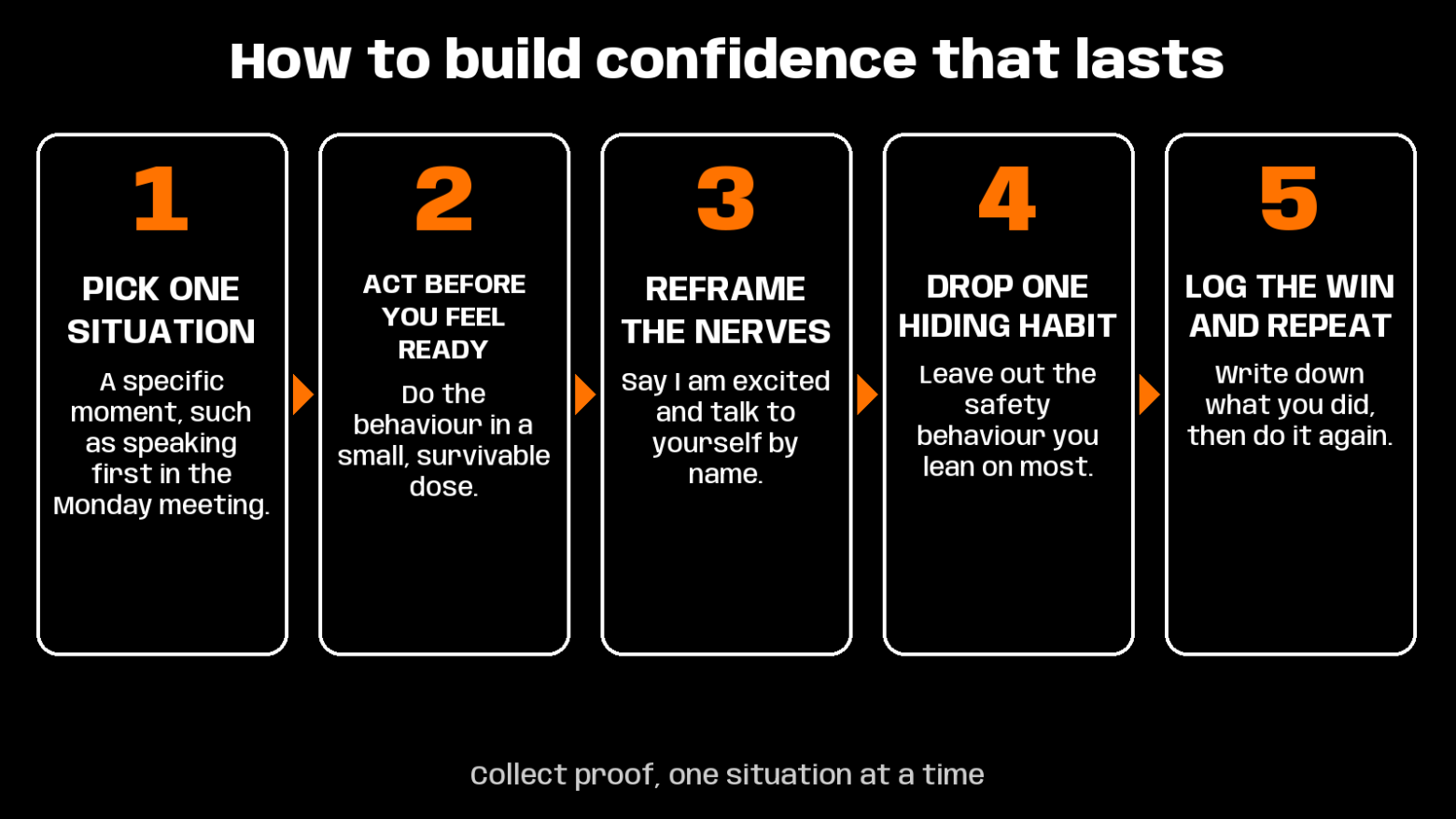
Five steps from faking the behaviour to owning the confidence.
Options for Men to Take Action
Most men know they should push themselves into the uncomfortable moments, but with no system the plan stays a good intention and the evidence never piles up.
The MenTools app runs challenges across mindset, fitness, nutrition and money, with levels you choose, daily actions, streak and progress tracking, journals and an AI coach. For this guide, its job is to turn “be more confident” into one daily action you can tick off, so the proof builds without you having to remember to build it.
How you can do this today: pick one small uncomfortable action, add it as a daily action at the easiest level and log what you did in the journal each day for two weeks.
Wins on cost: one subscription brings challenges, tracking, journals and an AI coach together, instead of paying for separate apps.
Wins on time: the challenges are already built, so you spend your time on the action rather than on designing a plan.
Wins on practicality: you choose your level, so the first dose can be small enough to do on a bad day.
Watch-out: none of the studies in this guide tested the MenTools app, so treat it as a structure for repetition, not a confidence treatment. If anxiety is severe or lasting, speak to your GP.
Hard days land better when the basics are covered, so a one a day multivitamin may help cover the simple daily foundation. For more on this topic, the MenTools confidence hub collects every guide in one place. Do the rep, then log it.
Last updated: 2026-11-12 v1.0
Disclaimer: This guide is for informational purposes only and does not constitute medical or psychological advice. Speak with a qualified professional before making significant changes if you have a medical or mental health condition.
References
- [1] Brooks AW. Get excited: reappraising pre-performance anxiety as excitement. Journal of Experimental Psychology: General, 2014;143(3):1144-1158. Link
- [2] Taylor CT, Alden LE. To see ourselves as others see us: an experimental integration of the intra and interpersonal consequences of self-protection in social anxiety disorder. Journal of Abnormal Psychology, 2011;120(1):129-141. Link
- [3] Jacques-Hamilton R, Sun J, Smillie LD. Costs and benefits of acting extraverted: a randomized controlled trial. Journal of Experimental Psychology: General, 2019;148(9):1538-1556. Link
- [4] Ranehill E, Dreber A, Johannesson M, Leiberg S, Sul S, Weber RA. Assessing the robustness of power posing: no effect on hormones and risk tolerance in a large sample of men and women. Psychological Science, 2015;26(5):653-656. Link
- [5] Wood JV, Perunovic WQE, Lee JW. Positive self-statements: power for some, peril for others. Psychological Science, 2009;20(7):860-866. Link
- [6] Bandura A. Self-efficacy: toward a unifying theory of behavioral change. Psychological Review, 1977;84(2):191-215. Link
- [7] Elkjaer E, Mikkelsen MB, Michalak J, Mennin DS, O’Toole MS. Expansive and contractive postures and movement: a systematic review and meta-analysis of the effect of motor displays on affective and behavioral responses. Perspectives on Psychological Science, 2022;17(1):276-304. Link
- [8] Kross E, Bruehlman-Senecal E, Park J, Burson A, Dougherty A, Shablack H, Bremner R, Moser J, Ayduk O. Self-talk as a regulatory mechanism: how you do it matters. Journal of Personality and Social Psychology, 2014;106(2):304-324. Link
- [9] Carney DR, Cuddy AJC, Yap AJ. Power posing: brief nonverbal displays affect neuroendocrine levels and risk tolerance. Psychological Science, 2010;21(10):1363-1368. Link
- [10] Carney DR. My position on ‘Power Poses’. Statement on the author’s Berkeley Haas faculty page, 2016. Link
- [11] Baumeister RF, Campbell JD, Krueger JI, Vohs KD. Does high self-esteem cause better performance, interpersonal success, happiness, or healthier lifestyles? Psychological Science in the Public Interest, 2003;4(1):1-44. Link
- [12] Hatzigeorgiadis A, Zourbanos N, Galanis E, Theodorakis Y. Self-talk and sports performance: a meta-analysis. Perspectives on Psychological Science, 2011;6(4):348-356. Link
- [13] Anderson C, Brion S, Moore DA, Kennedy JA. A status-enhancement account of overconfidence. Journal of Personality and Social Psychology, 2012;103(4):718-735. Link
- [14] Kruger J, Dunning D. Unskilled and unaware of it: how difficulties in recognizing one’s own incompetence lead to inflated self-assessments. Journal of Personality and Social Psychology, 1999;77(6):1121-1134. Link