No products in the cart.
Return To Shop
MEN: Can AI Actually Coach You Through a Habit Change? (2026)
Quick Answer
Yes, partly. In trials, chatbot coaches nudged small gains, such as 735 more steps a day [1], but many people stop using apps quickly [2][3], and the repetition that forms a habit is still yours [4][5]. Use AI for planning, prompts and reflection, and keep a human or real accountability for the hard parts.
**Jump to:** At a glance | What it does | The evidence | Why people quit | AI vs a human | Where it goes wrong | How long a habit takes | How to use it | FAQ | Options for men
Disclosure: MenTools publishes this article and may feature MenTools products.
How we evaluate: Each step is assessed on real-world use, evidence, cost and time, and how well it suits men. Every step including the MenTools option carries an honest limitation. Full sources are in the references below.
Can AI Coach You Through a Habit Change? At a Glance
AI coaching helps with the thinking around a habit, such as planning, prompts and talking through setbacks, but it cannot do the repetition for you. The evidence is early, mixed and mostly not about men specifically. The table gives the short answers first, with the evidence behind each one.
| Question | Short answer | What the evidence shows |
|---|---|---|
| What does an AI coach do? | Plans, prompts and reflection in chat | “Practical Guidance” is one of three topics making up nearly 80% of ChatGPT conversations [6] |
| Does it work in trials? | Small gains on some behaviours | Pooled effect sizes were SMD = 0.28 for steps (6 studies), 0.59 for fruit and veg and 0.44 for sleep duration (3 studies) [1] |
| How strong is that evidence? | Early and mostly low quality | 14 of the 19 trials (74%) were rated low quality [1] |
| Do people keep using it? | Often not | Median 30-day retention across 93 mental health apps was 3.3% [2] |
| Does it beat human experts? | Only on exams | An AI health model scored 88% against 71% for experts on a fitness exam, but rated slightly lower on sleep case studies [7] |
| Does it replace a human coach? | Not tested in these sources | Human support is argued to improve adherence, in a viewpoint paper [8] |
| Who builds the habit? | You, by repeating it | An average of 66 days to plateau [4], and 18 to 254 days to reach 95% of automaticity [5] |
| Is it safe for mental health? | Not on its own | Language models encouraged delusional thinking in therapy tests [9] |
What Does an AI Coach Actually Do?
An AI coach is a chatbot that helps you set a goal, break it into steps, send prompts and talk through setbacks. It handles the planning and the reminding, not the behaviour itself. “Practical Guidance” is one of the three most common ChatGPT topics [6], though that paper does not say how many people use chatbots for habit goals.
According to an analysis of ChatGPT conversations, non-work messages grew from 53% to more than 70% of all usage, and “Practical Guidance,” “Seeking Information” and “Writing” together account for nearly 80% of conversations [6]. That tells you what people ask for. It does not tell you whether the advice changes behaviour.
Not every coaching chatbot works the same way. In a review of 9 studies, over half (56%) used a constrained, rule-based chatbot, while the rest used unconstrained chatbots that resemble human conversation [10]. A trial’s “AI coach” may therefore be a scripted menu, which is a different product from an open chat with a language model.
Text matters too. A 2023 meta-analysis found that text-based and AI chatbots were more effective than speech or voice chatbots for promoting fruit and vegetable consumption [1]. For a man who wants a short daily check-in he can type in a minute, that is a useful detail.
What Does the Evidence Say About AI Coaching and Habits?
The evidence shows small to moderate gains on some behaviours, but it is early and mostly low quality. A 2023 meta-analysis of 19 trials found significant effects of chatbots on daily steps (SMD = 0.28, 6 studies), fruit and vegetable consumption (SMD = 0.59) and sleep duration (SMD = 0.44, 3 studies) [1].
Those effect sizes equated to about 735 extra steps a day, 1 extra serving of fruit and vegetables a day and 45 extra minutes of sleep a night [1]. The 19 trials included 11 randomised trials, and 14 of them (74%) had a low-quality rating [1]. Counting randomised trials only, the steps effect shrank to SMD = 0.18 across 4 studies and only approached significance (p = 0.06) [1]. Sample sizes ranged from 25 to 958 people, with mean ages from 9 to 71 years, so the results are not specific to men [1].
The authors concluded that “chatbot interventions are effective across populations and age groups, with varying intervention durations and components” [1]. That is a fair summary of the average, but averages hide the weak trials. Inside the trials, retention was high, with a median of 90.6% [1], which matters for the next section.
A second review, covering 15 AI chatbot studies [11], took a more careful line. It found that 20% (3/15) of studies reported an improvement in diet, a per-outcome count and not an overall success rate, and warned that “the reported results need to be interpreted with caution because of the moderate to high risk of internal validity, insufficient description of AI techniques, and limitation for generalizability” [11]. Its participants were a mix, including smokers, patients with obesity and the general population [11].
A third review of 9 studies, 4 of them randomised trials and 5 quasi-experimental [10], was even more guarded. Its authors wrote that “Chatbots may improve physical activity, but we were not able to make definitive conclusions regarding the efficacy of chatbot interventions on physical activity, diet, and weight management/loss” [10]. They also noted that outcomes were reported inconsistently across the studies [10].
One trial shows why the details matter. In an 8 week trial of 274 insurees of a Swiss health insurance company, daily cash incentives increased step-goal achievement by 8.1%, and, after adjusting for covariates and missing data, action planning increased it by 5.8% only in the group without incentives [12]. Coping planning and self-monitoring prompts did not affect physical activity, and the authors concluded that planning interventions and prompts “require revision before they can be included in future versions of the app” [12].
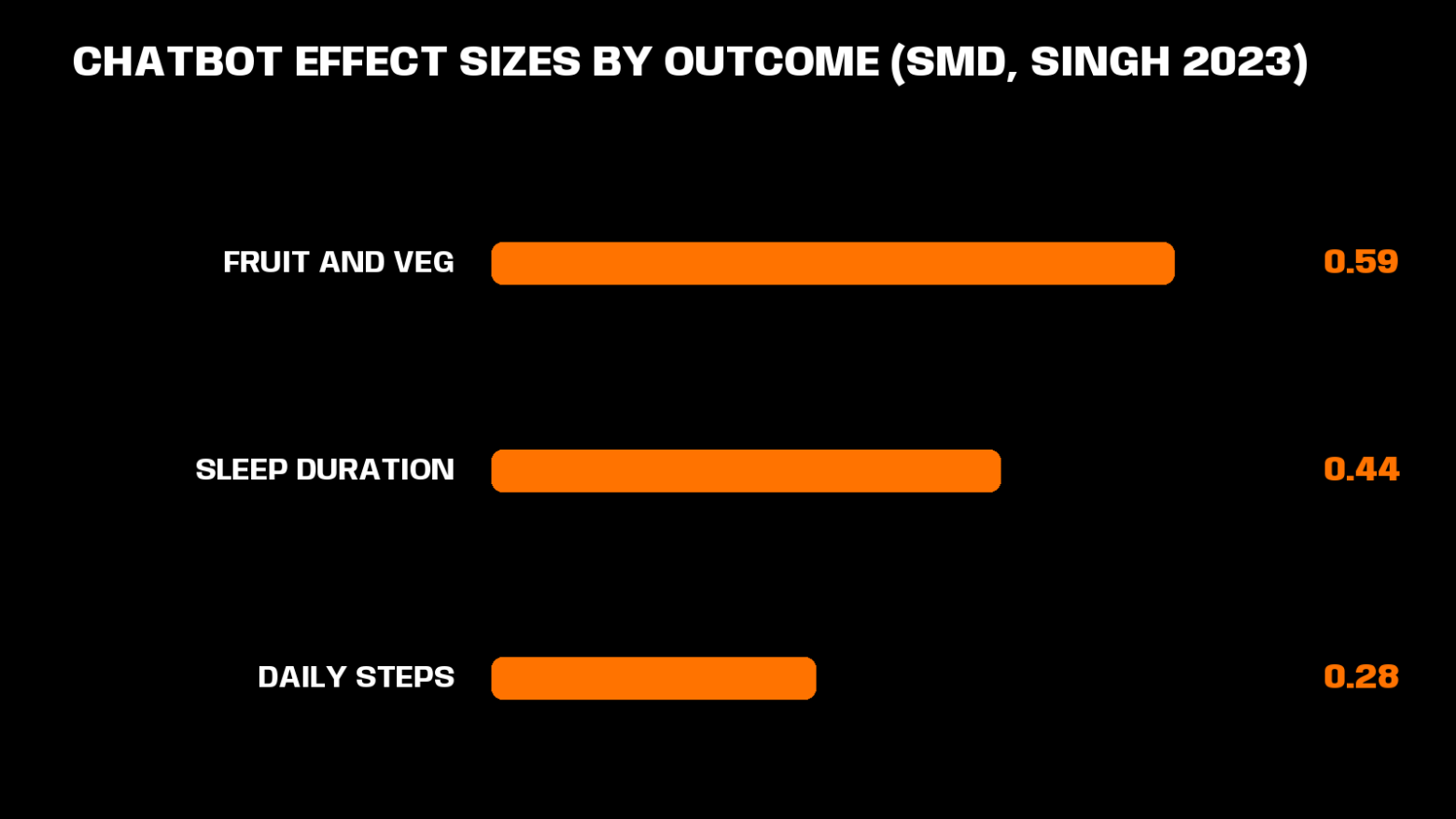
How big the chatbot effects were in the 2023 meta-analysis, by behaviour.
Why Do Most People Quit Coaching Apps?
Many mental health apps lose their users fast. Across 93 of them, the median retention rate was 3.9% at 15 days and 3.3% at 30 days [2]. In a meta-analysis of app-based interventions for chronic disease, the pooled dropout rate was 43% [3]. Nothing in these studies shows an AI coach is exempt from that pattern.
The first figure comes from usage data, not a trial, and covers mental health apps rather than habit coaches. The authors also found that on day 30 tracker apps (median 6.1%) retained more users than breathing exercise apps (median 0.0%) [2]. The median share of daily active users, the open rate, was 4.0% [2].
The 43% figure was pooled from 17 studies on chronic disease [3], and the split is revealing. Observational studies had a dropout rate of 49%, against 40% for randomised trials [3]. The authors link higher rates to real-world research and lower rates to “highly supported RCTs” [3].
That matches the Swiss step-goal trial, where engagement with the planning interventions and prompts was low and 30% of participants stopped using the app over the course of the study [12]. Real life looks less like a supported trial, so build in your own support. Plan for the flat weeks, not the first burst of enthusiasm.
Can AI Replace a Human Coach?
The sources behind this guide include no head-to-head of an AI coach against a human coach, and PH-LLM was compared with experts on written answers, not on behaviour change. What exists is a model, supportive accountability, built on the premise that “The effectiveness of and adherence to eHealth interventions is enhanced by human support” [8]. It is a viewpoint paper, not a trial.
The same paper adds that “human support has largely not been manualized and has usually not been guided by clear models” [8]. In plain terms, there is no agreed recipe for what a human adds. Separately, randomised trials, which the dropout authors call more supported, lost fewer people than real-world studies [3].
On raw knowledge, AI is catching up. A personal health large language model, PH-LLM, scored 79% against 76% for human experts on sleep medicine multiple-choice exams and 88% against 71% on fitness exams [7]. In 857 case studies it performed similarly to human experts for fitness, rated slightly lower than experts for sleep (4.61 against 4.75) and improved over its base model for personalised sleep insights [7].
Read that carefully. These were exams and rated case-study answers, and no habit-change outcome was measured. The authors note that expert rating of long-form coaching text is subjective and the case-study ratings were “skewed high” [7]. Knowing the right answer is not the same as getting a tired man to do the session after work.
Where Does AI Coaching Go Wrong?
AI coaching goes wrong when it agrees with you too easily, when its advice is generic and when it is used for problems that need a clinician. A 2025 study of language models in therapy settings found that “LLMs encourage clients’ delusional thinking, likely due to their sycophancy” [9]. For a mental health crisis, speak to your GP, not a chatbot.
That finding comes from therapy-style tests of models including gpt-4o, not from habit coaching, and the sycophancy link is the authors’ stated “likely” cause, not a measured result [9]. The same study says the problems occur “even with larger and newer LLMs” [9]. Treat it as a warning about tone, not a verdict on every tool.
A habit coach that only cheers you on has the same weakness in a milder form. It will praise a token effort as a win and let a missed week slide. The reviewers’ caution about unclear AI methods and weak study designs applies here too [11].
There is a plain limit as well. A chatbot only knows what you tell it, and it cannot see you skip the session. If low mood, heavy drinking or anxiety is behind the habit you want to change, talk to your GP and treat any app as a side tool, not the plan.
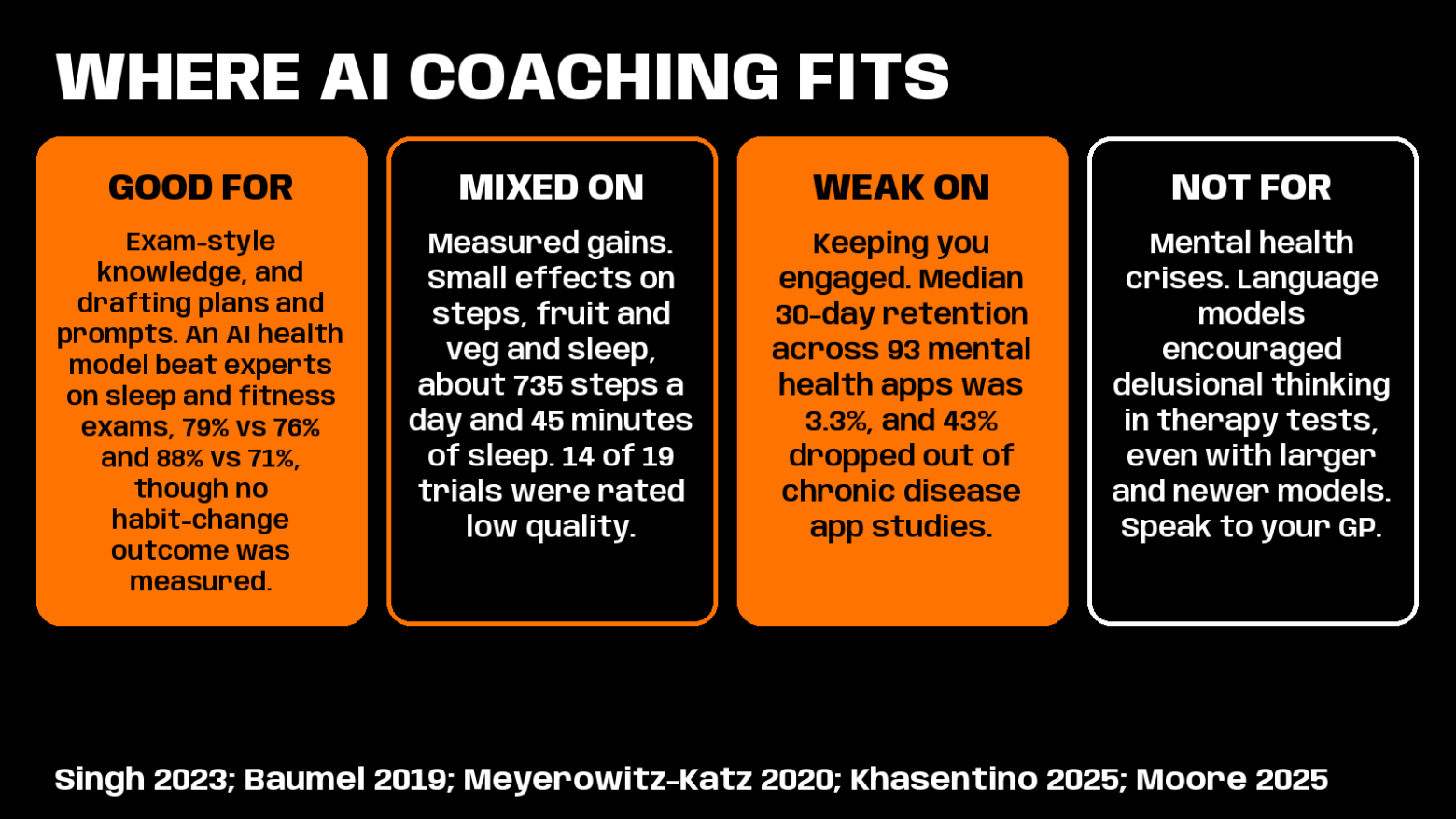
Where AI coaching helps, where the evidence is mixed and where it should not be used.
How Long Does a Habit Take, Even With AI?
Longer than most people hope, and none of these sources tests whether AI shortens it. In a real-world habit study, the time to reach 95% of their asymptote of automaticity ranged from 18 to 254 days [5], and a 2012 review of the same work reports an average of 66 days to plateau [4]. The reps are yours. Our guide to why habits fail covers why.
The study followed 96 volunteers who picked an eating, drinking or activity behaviour to do daily in the same context for 12 weeks, and 82 provided enough data to analyse [5]. The authors said the range showed “considerable variation” and that it “can take a very long time” [5]. Note the 66 days is an average, not a promise.
Psychologists define habits as “actions that are triggered automatically in response to contextual cues that have been associated with their performance” [4]. That is why the cue matters more than the app. A reminder helps, but a habit lives in the situation, like after the kettle, after the commute or after you park.
One finding is good news for anyone using a streak counter. Missing one opportunity did not materially affect the habit formation process [5], and automaticity gains soon resumed after one missed performance [4]. A broken streak on the screen is not a reset in your head.
How Do You Use an AI Coach for a Habit Change?
Use the AI for the thinking around the habit and do the habit yourself. Pick one small action, pin it to a cue, let the AI plan and challenge you, keep the check-ins short and add a human. These five steps draw on what the studies found, and the challenge step is our own advice.
**Step 1: choose one new action, not a ban.** Ask the AI to turn your goal into one concrete thing to do. Gardner and colleagues advise picking “a new behaviour” rather than giving up an old one, because “it is not possible to form a habit for not doing something” [4]. Swap the takeaway for a walk, do not just ban the takeaway.
**Step 2: pin it to a cue.** Tie the action to something you already do, such as “after breakfast”, the example used in the habit study [5]. Our guide on habit stacking versus starting small covers both ways to start.
**Step 3: use the AI for one plan and one prompt, then judge them.** In the Swiss trial, action planning raised step-goal achievement by 5.8% in the no-incentive group after adjustment, while self-monitoring prompts did not affect physical activity [12]. Keep what moves your numbers and drop what you ignore. For sleep, a review found multicomponent interventions worked better for duration and quality [1].
**Step 4: ask it to challenge you.** Because researchers report sycophancy as a likely cause of chatbots encouraging delusional thinking [9], tell the chatbot to question your excuses, not praise them. Ask it to point out what you keep avoiding and to flag when a plan has quietly shrunk to nothing.
**Step 5: add a real person or a real stake.** Daily cash incentives raised step-goal achievement by 8.1% in the Swiss trial [12], and the supportive accountability model rests on human support [8]. Tell a mate your action each day, or pay a coach for the hard part. The AI plans, and a person makes it awkward to skip.
Keep the plan honest about the evidence. Gains in the trials were small [1], and dropout from apps in real life is high [2][3]. If the AI helps you keep one small action going, that is a good result.
FAQ
Do AI coaches work better than apps with no AI?
Only on one measure so far. A meta-analysis found AI or NLP chatbots were more effective than non-AI chatbots for fruit and vegetable intake, and text-based chatbots beat voice ones [1]. In one review, over half (56%) of the studies used a rule-based chatbot [10]. None of the sources used for this guide reports a head-to-head of an AI coach against a plain tracker.
Can an AI coach help me sleep better?
It might help a little. Across the trials, chatbots raised sleep duration by an effect of SMD = 0.44, about 45 minutes a night [1]. PH-LLM improved over its base model in providing personalised sleep insights, but that was in case studies [7]. If poor sleep lasts, speak to your GP.
Does missing a day ruin a habit?
No. In the habit study, missing one opportunity to perform the behaviour did not materially affect habit formation [5]. A second source adds that automaticity gains soon resumed after one missed performance [4]. The risk is not one missed day, it is letting a miss turn into a new routine.
Can an AI chatbot replace therapy for low mood?
No. A 2025 study found language models expressed stigma and responded inappropriately to some common conditions in therapy-style tests, and this occurred even with larger and newer models [9]. A habit coach is not a therapist. If low mood lasts, speak to your GP.
How do I know if my AI coach is working?
Count the behaviour, not the chat. One review notes outcomes were reported inconsistently across studies [10], so keep your own simple record, such as days done or steps walked. If the number is not moving after a few weeks, change the plan or add a person.
Do these results apply to men?
Probably in broad terms, but none of the sources here are men-only. The meta-analysis mixed trials with mean ages from 9 to 71 years [1], the chatbot review included smokers and patients with obesity [11] and the Swiss trial had 274 insurees [12]. Read the numbers as general, not as male results.
Final Recommendation
Treat AI as a planning partner, not a replacement for effort or people. The trials show small gains in steps, fruit and veg and sleep [1], but many people drop out of apps quickly [2][3], and the habit still takes repetition over weeks [4][5]. Our advice is to use it for planning, prompts and reflection, with a human for accountability.
If your sticking point is knowing what to do, ask the AI. If it is doing the thing on a bad day, set up a person, a cue or a stake instead. For anything touching mood or mental health, speak to your GP.
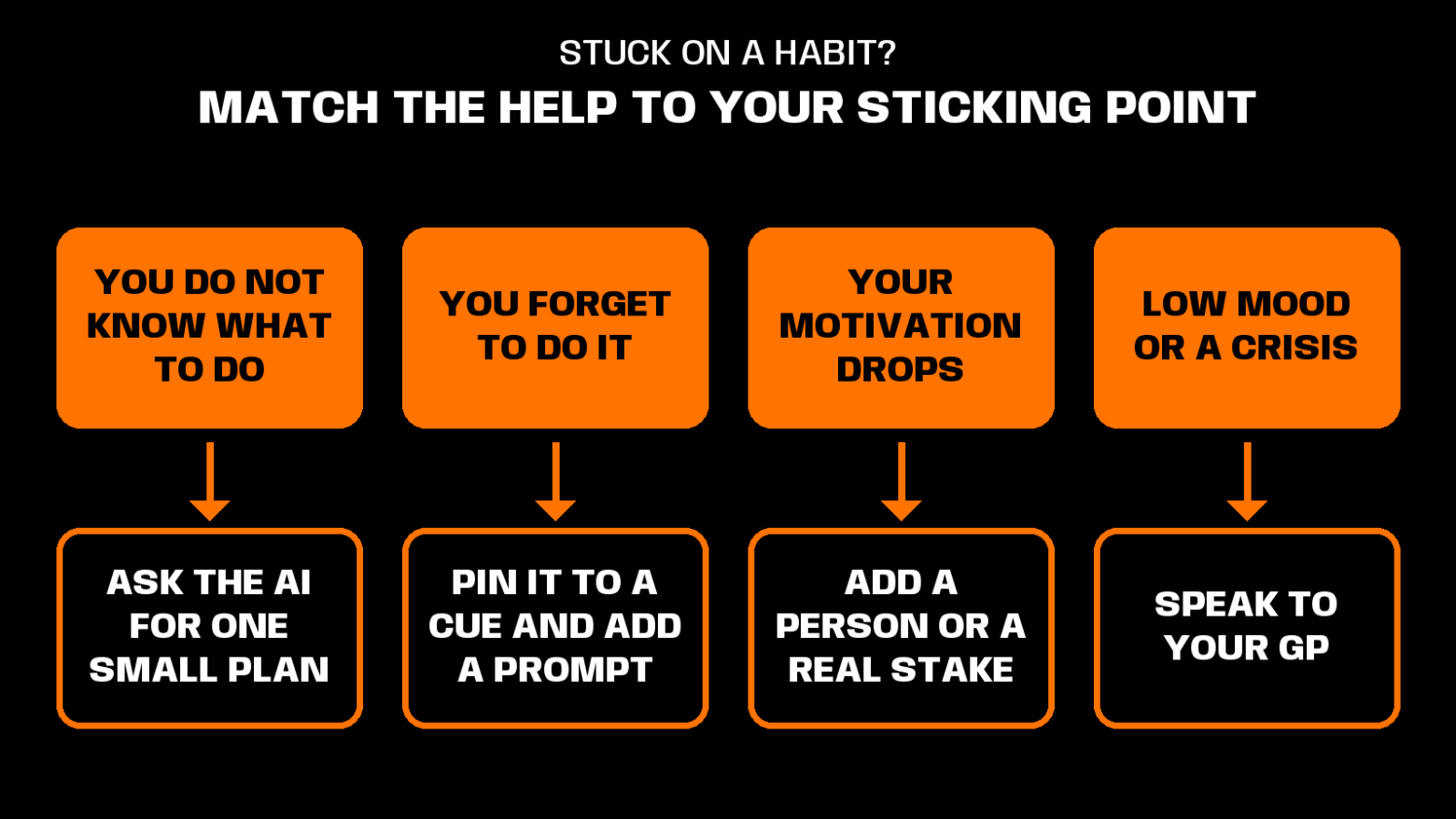
Match your sticking point to the right kind of help.
Options for Men to Take Action
A chatbot can give decent advice, but with no system around it, so the plan lives in a chat window and the daily action never gets tracked.
The MenTools app runs challenges across mindset, fitness, nutrition and money, with levels you choose, daily actions, streak and progress tracking, journals and an AI coach. For this guide, its job is to put the action, the tracking and the coaching in one place, so the habit is something you do daily and not something you discuss.
How you can do this today: pick one small action, add it as a daily action at the easiest level and track it every day for two weeks.
Wins on cost: one subscription brings challenges, tracking, journals and an AI coach together, instead of paying for separate apps.
Wins on time: the challenges are already built, so you do not spend an evening designing a system.
Wins on practicality: you choose your level, so you can start with an action that fits around work and family.
Watch-out: none of the studies in this guide tested the MenTools AI coach, so treat it as a prompt and a planning aid. It cannot do the reps for you, and it is not a substitute for a GP or a therapist.
Behaviour work lands better when the basics underneath it are covered, so a one a day multivitamin may help cover the simple daily foundation. For more on using AI well, the MenTools AI hub collects everything in one place. Use the tool, then do the rep.
Last updated: 2026-11-11 v1.0
Disclaimer: This guide is for informational purposes only and does not constitute medical or psychological advice. Speak with a qualified professional before making significant changes if you have a medical or mental health condition.
References
- [1] Singh B, Olds T, Brinsley J, Dumuid D, et al. Systematic review and meta-analysis of the effectiveness of chatbots on lifestyle behaviours. npj Digital Medicine, 2023;6:118. Link
- [2] Baumel A, Muench F, Edan S, Kane JM. Objective user engagement with mental health apps: systematic search and panel-based usage analysis. Journal of Medical Internet Research, 2019;21(9):e14567. Link
- [3] Meyerowitz-Katz G, Ravi S, Arnolda L, Feng X, Maberly G, Astell-Burt T. Rates of attrition and dropout in app-based interventions for chronic disease: systematic review and meta-analysis. Journal of Medical Internet Research, 2020;22(9):e20283. Link
- [4] Gardner B, Lally P, Wardle J. Making health habitual: the psychology of ‘habit-formation’ and general practice. British Journal of General Practice, 2012;62(605):664-666. Link
- [5] Lally P, van Jaarsveld CHM, Potts HWW, Wardle J. How are habits formed: modelling habit formation in the real world. European Journal of Social Psychology, 2010;40(6):998-1009. Link
- [6] Chatterji A, Cunningham T, Deming DJ, Hitzig Z, Ong C, Shan CY, Wadman K. How people use ChatGPT. NBER Working Paper w34255, September 2025. Link
- [7] Khasentino J, Belyaeva A, Liu X, et al. A personal health large language model for sleep and fitness coaching. Nature Medicine, 2025;31:3394-3403. Link
- [8] Mohr DC, Cuijpers P, Lehman K. Supportive accountability: a model for providing human support to enhance adherence to eHealth interventions. Journal of Medical Internet Research, 2011;13(1):e30. Link
- [9] Moore J, Grabb D, Agnew W, Klyman K, Chancellor S, Ong DC, Haber N. Expressing stigma and inappropriate responses prevents LLMs from safely replacing mental health providers. arXiv:2504.18412, 2025. Link
- [10] Oh YJ, Zhang J, Fang ML, Fukuoka Y. A systematic review of artificial intelligence chatbots for promoting physical activity, healthy diet, and weight loss. International Journal of Behavioral Nutrition and Physical Activity, 2021;18:160. Link
- [11] Aggarwal A, Tam CC, Wu D, Li X, Qiao S. Artificial intelligence-based chatbots for promoting health behavioral changes: systematic review. Journal of Medical Internet Research, 2023;25:e40789. Link
- [12] Kramer JN, Kunzler F, Mishra V, Smith SN, Kotz D, Scholz U, Fleisch E, Kowatsch T. Which components of a smartphone walking app help users to reach personalized step goals? Results from an optimization trial. Annals of Behavioral Medicine, 2020;54(7):518-528. Link