
MEN: Daily Habits for Men: 8 Small Ones That Compound (2026)
Quick Answer
The best daily habits for men in 2026 are small, repeatable actions that compound across the whole day: stack a new habit onto an old one, hit your steps, do one strength set, drink water at meals, read, journal one line, take a screen-free hour, and save automatically. Small reps, kept daily, beat big efforts you quit.
**Jump to:** How we chose these 8 | FAQ | Options for men
Disclosure: MenTools publishes this article and may feature MenTools products.
How we evaluate: Each habit is assessed on real-world use, evidence, cost and time, and how well it suits men. Every habit including the MenTools option carries an honest limitation. Full sources are in the references below.
The 8 Habits at a Glance
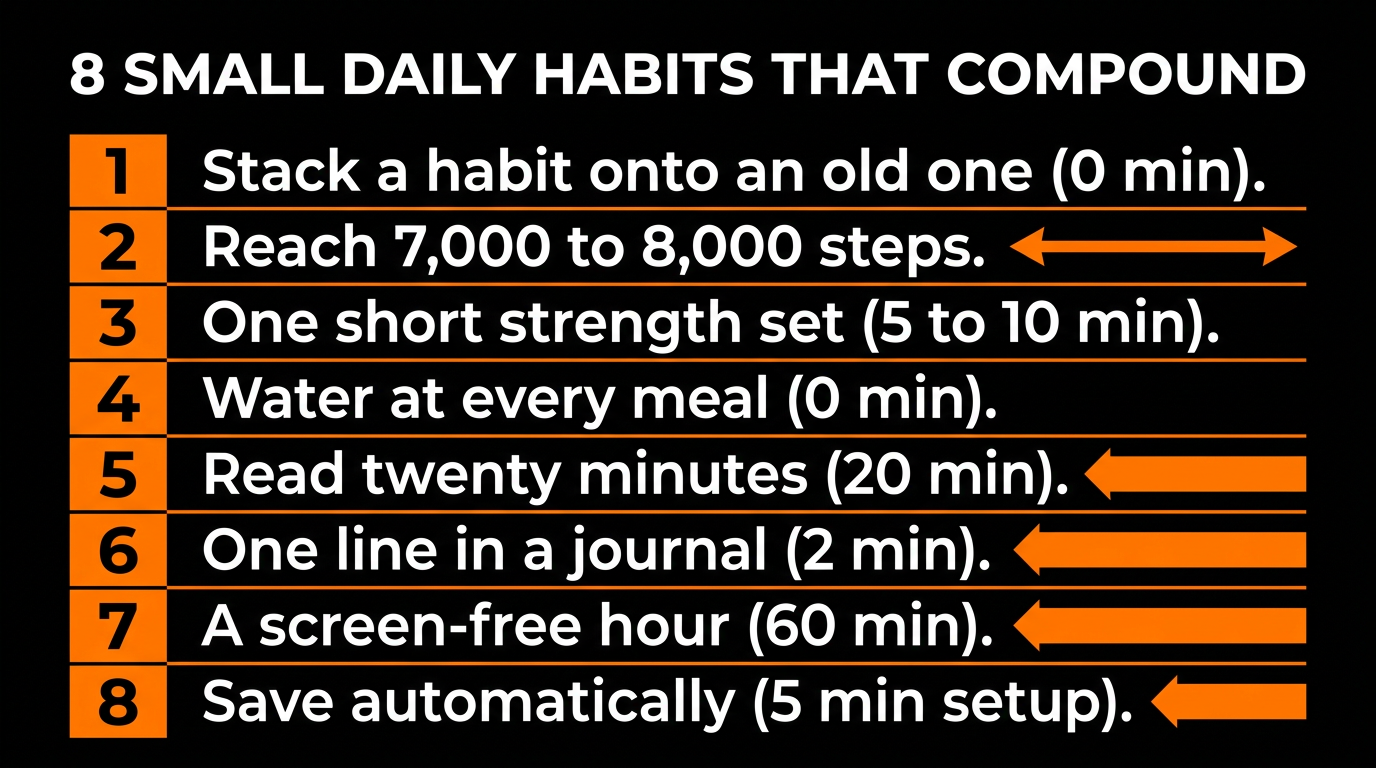
Eight small daily habits, and the time each one actually costs.
| Habit | Best for | Time | Watch-out |
|---|---|---|---|
| Stack a habit onto an old one | Making anything new stick | 0 min | The anchor must be rock solid |
| Reach 7,000 to 8,000 steps | Long-term health | Spread across day | Easy to skip in bad weather |
| One short strength set | Strength and longevity | 5 to 10 min | Not a full training plan |
| Water at every meal | Focus and energy | 0 min | Overdoing it just means more trips |
| Read 20 minutes | Mind and stress | 20 min | Phones steal the slot |
| One line in a journal | Mindset | 2 min | Feels pointless early on |
| A screen-free hour | Attention and sleep | 60 min | Withdrawal is real at first |
| Save a fixed amount automatically | Money | 5 min setup | Small sums feel not worth it |
How We Chose These 8
We picked habits that are small enough to do on a bad day, backed by real research, and built to compound rather than spike. Each one had to pass three tests: does the evidence support it, can a working man fit it in without a free hour, and does it still pay off when repeated for months. This is not a morning routine. These are habits that run across the whole day. Every one carries an honest watch-out, because no habit suits everyone.
The logic underneath all eight is simple. As James Clear writes in Atomic Habits, “Habits are the compound interest of self-improvement” [1]. A single rep looks like nothing. Hundreds of reps, stacked over a year, change the man.
1. Stack a New Habit Onto One You Already Do
Attach any new habit to something you already do without thinking, so the old action triggers the new one. This is the mechanism that makes the other seven stick, which is why it comes first.
What it is: A simple formula. After I [existing habit], I will [new habit]. For example, after I pour my coffee, I will read one page.
Best for: Any man who starts habits full of intent then loses them by week two.
Standout: Behaviour scientist BJ Fogg, who calls this anchoring, puts it plainly: “simplicity changes behavior” [2]. The old habit is already automatic, so it carries the new one along on neural pathways your brain has already built [2].
Watch-out: The anchor has to be genuinely reliable. If you stack a new habit onto something you only do sometimes, the new habit inherits that gap and fades.
2. Reach 7,000 to 8,000 Steps a Day
Move enough across the day to clear roughly 7,000 to 8,000 steps, spread over commutes, calls and errands rather than one big walk. Steps are the easiest health habit to compound because they hide inside things you already do.
What it is: Daily walking accumulated in small bouts, tracked loosely by a phone or watch.
Best for: Men who sit at a desk and want the highest health return for the least disruption.
Standout: A 2023 meta-analysis of 226,889 people found that each additional 1,000 steps a day was linked to a 15 percent lower risk of dying from any cause, with meaningful benefit starting below 4,000 steps [3]. You do not need 10,000 to gain.
Watch-out: Steps are easy to skip in bad weather or a packed week. Anchor them to fixed events, like walking during every phone call, so they survive a grim Tuesday.
3. Do One Short Strength Set
Do one honest set of a bodyweight move, press-ups, squats or a plank, most days. It takes minutes and protects the thing that quietly declines with age.
What it is: A single focused set to near failure, or a short circuit, done at home with no kit.
Best for: Men who cannot commit to the gym but do not want to lose strength through their thirties and forties.
Standout: A systematic review of 16 studies found that just 30 to 60 minutes of muscle-strengthening activity a week was associated with a 10 to 20 percent lower risk of death from all causes, heart disease and cancer [4]. That is under 10 minutes a day.
Watch-out: One daily set is a floor, not a full programme. If your goal is real muscle or a specific lift, you still need structured, progressive training on top.
4. Drink Water at Every Meal
Put a glass of water next to every meal and drink it. It is the lowest-effort habit here and it directly affects how sharp you feel.
What it is: A fixed cue, one glass with breakfast, lunch and dinner, which quietly gets you toward the daily target without counting.
Best for: Men who get afternoon fog, headaches or flat energy and blame it on sleep or work.
Standout: The European Food Safety Authority sets adequate daily fluid intake for men at about 2,500 ml [5], and research links poorer hydration to measurable declines in attention and cognitive performance [6]. Mild dehydration is common and easy to miss.
Watch-out: More is not better. Once you are meeting the target, extra water just means more trips to the toilet, not more focus.
5. Read for 20 Minutes
Read a book, on paper or a reader, for about 20 minutes a day. Not a feed, not an article, a book that asks you to hold a thread of thought.
What it is: A short, protected reading block, often stacked onto an existing habit like a commute or a coffee.
Best for: Men who feel their attention span shrinking and want to rebuild the ability to focus on one thing.
Standout: A Yale study that followed 3,635 older adults for up to 12 years found that book readers had a 20 percent lower risk of dying over the follow-up period, and just half an hour a day produced a measurable survival advantage [7].
Watch-out: The phone will fight you for this slot every day. Keep a physical book where you would normally reach for the phone, or the habit loses by default.
6. Write One Line in a Journal
Write a single honest line at the end of the day: what happened, what you are grateful for, or what you would change. One line is the whole habit.
What it is: A two-minute written note, in a paper journal or an app, done at a fixed time.
Best for: Men who run on autopilot and rarely stop to notice whether things are actually improving.
Standout: In the classic Emmons and McCullough gratitude research, people who kept a regular gratitude record felt better about their lives, reported fewer physical complaints and were more optimistic than those who logged hassles or neutral events [8].
Watch-out: It feels pointless for the first week or two, like writing to no one. That flat early phase is normal, so judge it after a month, not after three days.
7. Take a Screen-Free Hour
Carve out one hour a day with no screens, ideally the hour before bed. It is the habit that repairs your attention and your sleep at the same time.
What it is: A fixed, phone-free window, phone in another room or in a drawer, not just face down on the table.
Best for: Men who feel scattered, wired at night, or unable to sit still without reaching for a screen.
Standout: In a 2025 randomised trial in PNAS Nexus, blocking mobile internet for two weeks improved sustained attention, mental health and wellbeing, and participants slept about 18 minutes more each night [9]. Around 73 percent reported better wellbeing [9].
Watch-out: The first few days feel genuinely uncomfortable, and the urge to check is real. Plan what you will do with the hour, or you will fill it by picking the phone straight back up.
8. Save a Fixed Amount Automatically
Set up an automatic transfer to savings on payday, before you can spend it. The amount matters less than the automation.
What it is: A standing order that moves a set sum into a separate account the day you are paid, so saving happens without a decision.
Best for: Men who reach the end of the month with nothing left and no idea where it went.
Standout: This is compounding in its purest form. Save 25 pounds a week and you hold 1,300 pounds after a year on the deposits alone, and with modest interest compounding over ten years the same habit grows to roughly 14,000 pounds [10]. Consistency beats size.
Watch-out: Small sums feel not worth automating, which is exactly why most men never start. Set it low enough that you do not notice it leaving, then raise it later.
What Makes a Daily Habit Actually Compound?
A daily habit compounds when it is small enough to repeat on a bad day and pointed at something that grows with repetition, like health, savings or attention. Compounding needs two things: a rep that is easy to keep, and enough time for the reps to add up. That is why the habits above are tiny. A small habit done for a year beats a big one abandoned in a fortnight.
How Many New Habits Should a Man Start at Once?
Start with one, add the next only once the first runs on its own. Trying to install all eight at the same time overloads your willpower and usually ends with none of them surviving. Habits form on their own timeline, so give each one weeks, not days, before layering on the next. One habit that holds is worth more than eight you drop.
FAQ
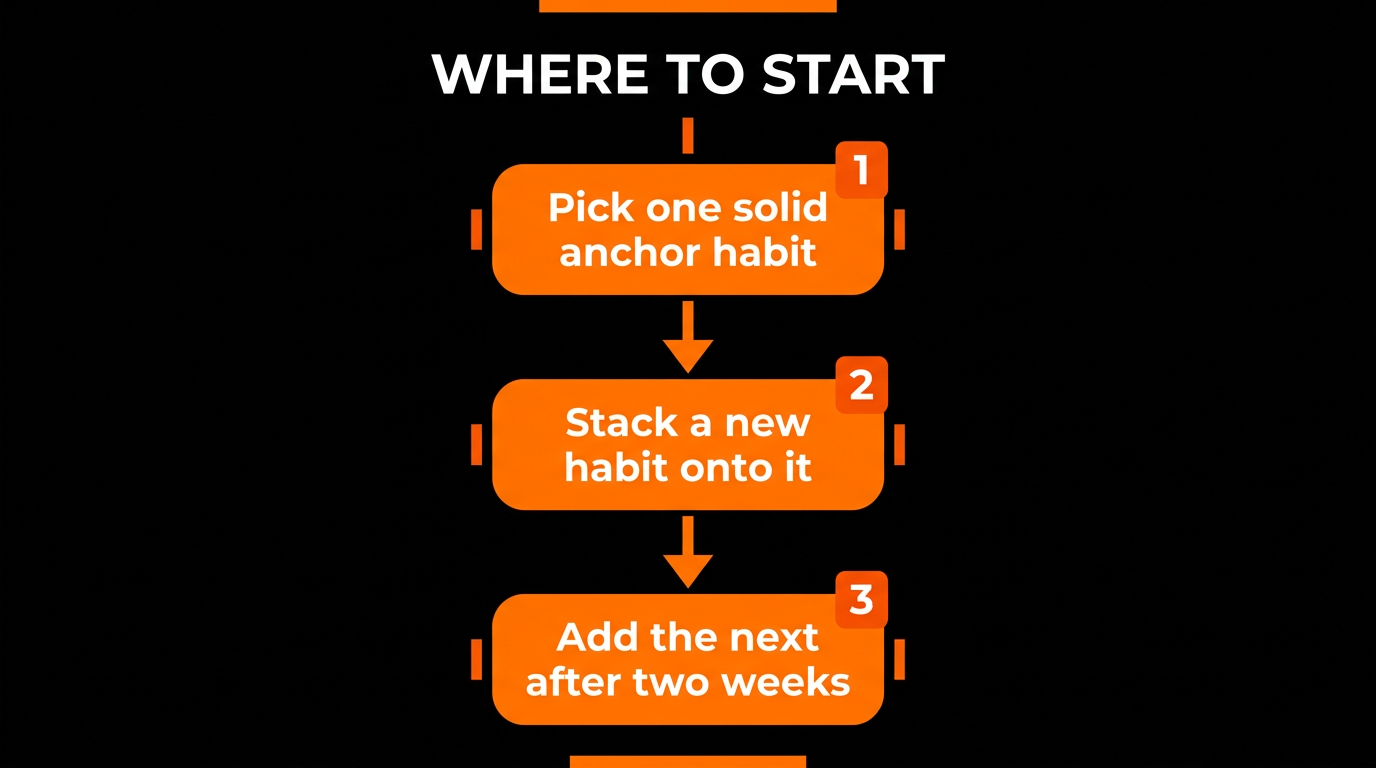
Not sure which habit to build first? Follow the flow.
How long does it take to build a daily habit?
On average about 66 days, with a real range of roughly 18 to 254 days depending on the person and the behaviour [11]. That is why small habits and a tracking system matter, because they carry you through the long stretch before the habit feels automatic.
What is the single most useful daily habit for a man?
Habit stacking, because it is the mechanism that makes every other habit stick. Attaching a new action to one you already do without thinking removes the daily decision, which is where most habits quietly die. Master that and the rest get easier.
Do small habits really make a difference?
Yes, because their effect multiplies with repetition rather than adding up in a straight line. A single day of steps, reading or saving looks trivial, but hundreds of repetitions across a year compound into measurable changes in health, focus and money.
Are daily habits better than a strict morning routine?
They serve different jobs. A morning routine wins the first hour, while daily habits run across the whole day and are harder to derail by a bad start. Most men do best combining a short morning routine with a few whole-day habits like steps and a screen-free hour.
What if I miss a day?
Missing one day does not break a habit. The research on habit formation found that a single missed opportunity had no meaningful effect on the process [11]. The danger is missing twice in a row, so the rule is simple: never miss two days running.
How do I stop giving up on habits after a week?
Make each habit smaller than feels necessary, stack it onto something you already do, and track it so you can see the streak. Most men quit because the habit was too big and left no trace. Shrink it, anchor it, and keep score.
Final Recommendation
Pick one habit from this list, not all eight. Choose the one that fixes your biggest current problem: steps if you sit all day, a screen-free hour if you feel scattered, automatic saving if money slips away. Stack it onto something you already do, keep it small, and track it from day one. Add the next habit only once the first runs without effort. Daily habits for men work when they are small, anchored and measured, not when they are big and perfect.
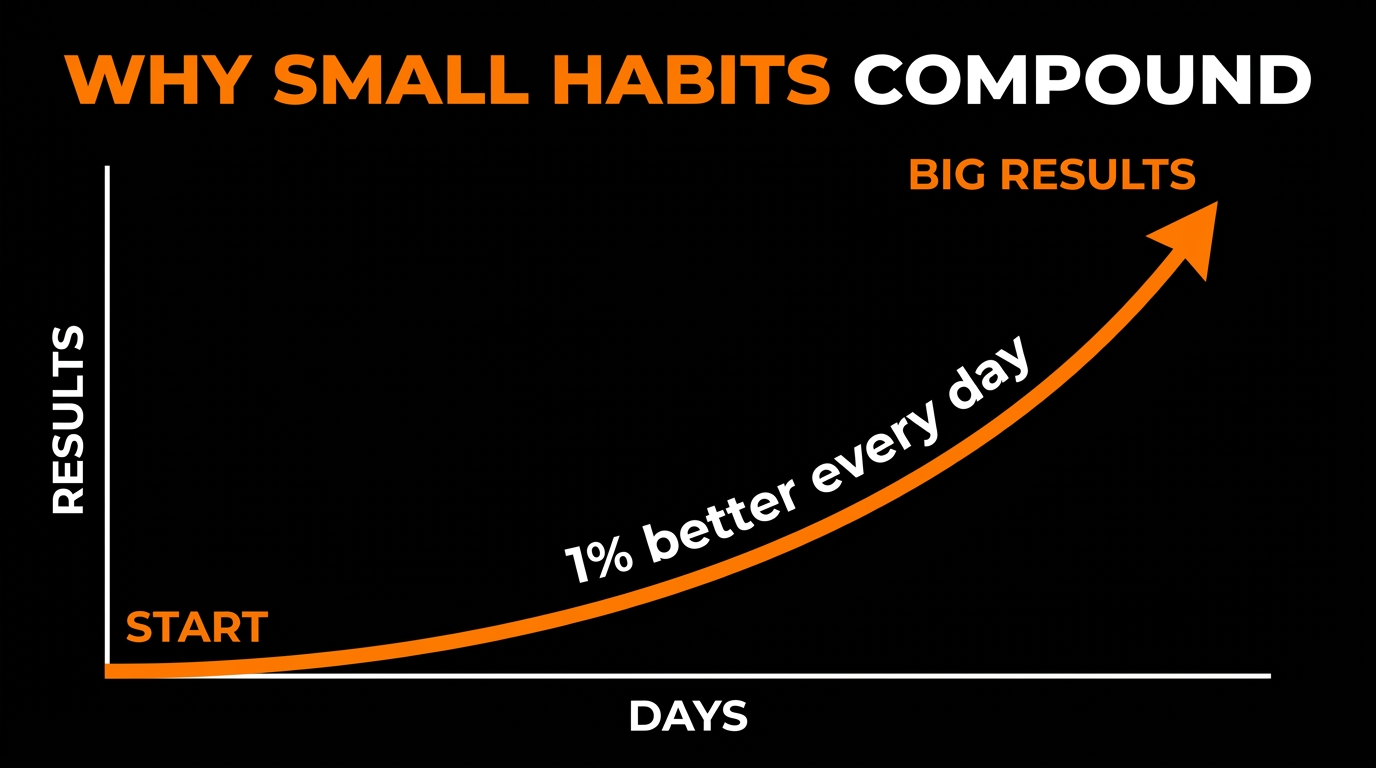
Why small habits win: the compounding curve pulls away over a year.
Options for Men to Take Action
Most men do not fail at habits because they lack ideas. They fail because the habits live in their head, there is no system, and week two arrives with nothing to keep score. Scattered notes, three half-used apps and pure willpower do not survive a busy month.
The MenTools app is built to run habits like these as one system, with daily actions, streaks, reminders and an AI coach, so stacking, steps, reading and the rest become simple daily check-ins instead of good intentions.
How you can do this today: pick one habit from this list, stack it onto something you already do, and log day one tonight.
Wins on cost: one app replaces a habit tracker, a journal and a stack of separate reminder tools, so you are not paying for four things that half work.
Wins on time: the habits and the tracking are set up in minutes, with no research or planning to do yourself, which is where you can go deeper on building habits that hold at the MenTools habits hub.
Wins on practicality: it lives on your phone and fits a working man’s day, so the habits survive travel, early starts and busy weeks. Small daily reps, tracked and repeated, are what turn a good week into a better year.
Last updated: 2026-07-09 v1.0
Disclaimer: This guide is for informational purposes only and does not constitute medical or psychological advice. Speak with a qualified professional before making significant changes if you have a medical or mental health condition.
References
- [1] Clear J. Habits are the compound interest of self-improvement. Atomic Habits. Link
- [2] Fogg BJ. Tiny Habits: The Small Changes That Change Everything, and jamesclear.com on habit stacking and anchoring. Link
- [3] Banach M et al. The association between daily step count and all-cause and cardiovascular mortality: a meta-analysis. European Journal of Preventive Cardiology, 2023. Link
- [4] Momma H et al. Muscle-strengthening activities are associated with lower risk and mortality in major non-communicable diseases: a systematic review and meta-analysis of cohort studies. British Journal of Sports Medicine, 2022. Link
- [5] European Food Safety Authority. Scientific opinion on dietary reference values for water. EFSA Journal, 2010. Link
- [6] Nishi SK et al. Water intake, hydration status and 2-year changes in cognitive performance: a prospective cohort study. BMC Medicine, 2023. Link
- [7] Bavishi A, Slade MD, Levy BR. A chapter a day: association of book reading with longevity. Social Science and Medicine, 2016. Link
- [8] Emmons RA, McCullough ME. Counting blessings versus burdens: an experimental investigation of gratitude and subjective well-being. Journal of Personality and Social Psychology, 2003. Link
- [9] Castelo N et al. Blocking mobile internet on smartphones improves sustained attention, mental health and subjective well-being. PNAS Nexus, 2025. Link
- [10] Bankrate. Compound savings calculator and the effect of regular saving over time. Link
- [11] Lally P et al. How are habits formed: modelling habit formation in the real world. European Journal of Social Psychology, 2010. Link