MEN: Evening Routine for Men: 7 Habits for Better Sleep and Recovery (2026)
Quick Answer
The best evening routine for men is a short, repeatable wind-down: fix your bedtime, cut screens and caffeine early, cool the room, skip the nightcap, and spend ten minutes relaxing before lights out. Consistency beats length. Five habits done nightly beat a perfect routine you drop by Thursday.
**Jump to:** How we chose these 7 | FAQ | Options for men
Disclosure: MenTools publishes this article and may feature MenTools products.
How we evaluate: Each habit is assessed on real-world use, evidence, cost and time, and how well it suits men. Every habit including the MenTools option carries an honest limitation. Full sources are in the references below.
The 7 Habits at a Glance
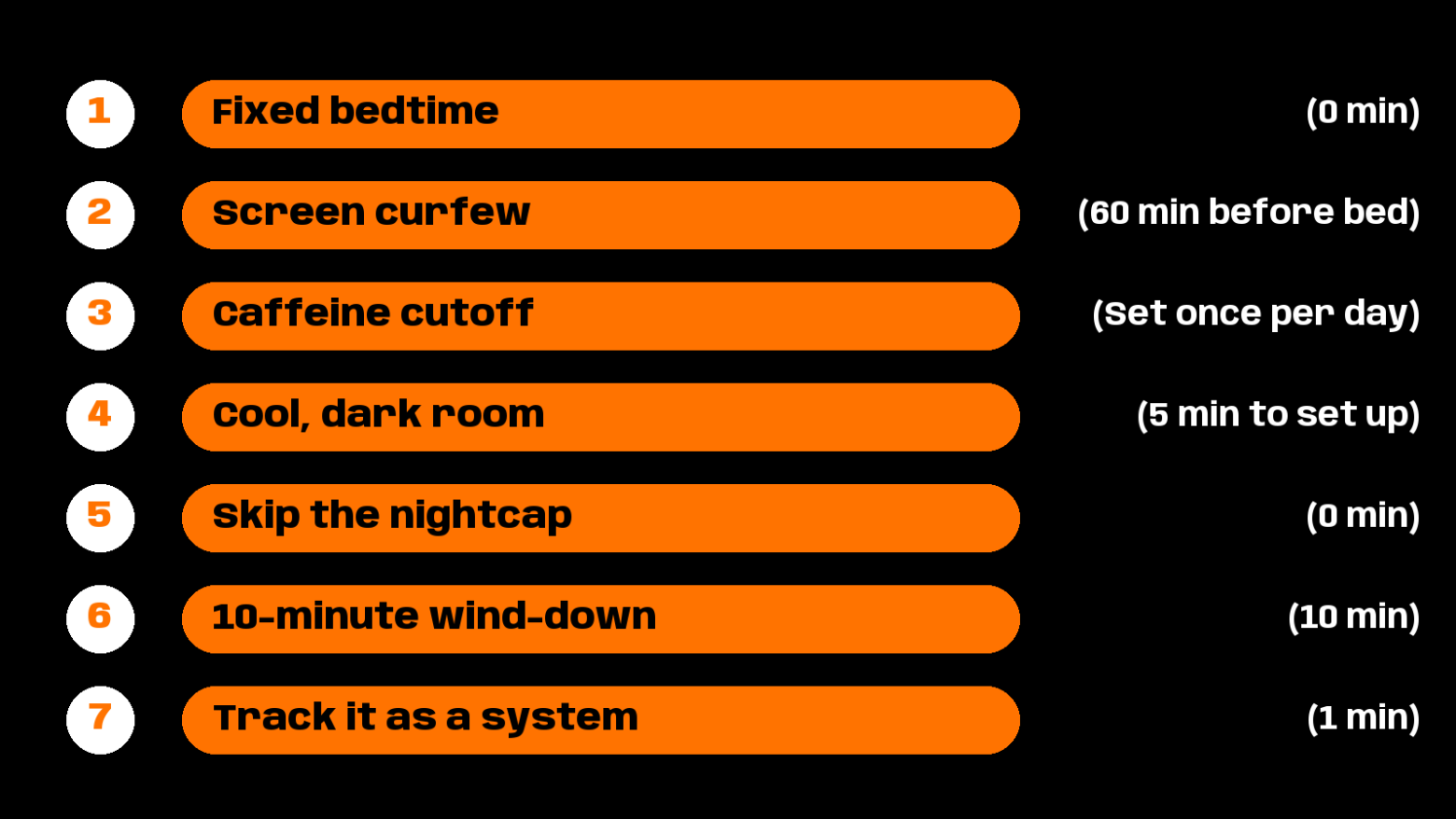
The 7-habit evening routine, in the order that works.
| Habit | Best for | Time | Watch-out |
|---|---|---|---|
| Fixed bedtime | Everyone, the foundation | 0 min | Hardest at weekends |
| Screen curfew | Falling asleep faster | 60 min before bed | Needs a real alarm clock |
| Caffeine cutoff | Deeper sleep | Set once per day | Afternoon coffee is the trap |
| Cool, dark room | Staying asleep | 5 min to set up | Partner may want it warmer |
| Skip the nightcap | Recovery and REM | 0 min | Feels sociable to break |
| 10-minute wind-down | Racing minds | 10 min | Feels slow at first |
| Track it as a system | Making it stick | 1 min | Easy to abandon after week one |
How We Chose These 7
We picked habits that are simple, backed by research, and realistic for a man with a job, a family and a full week. Each one had to earn its place on three tests: does the evidence support it, can it be done on a normal night, and does it still work when you are tired or busy. Every habit below carries an honest watch-out, because no habit suits every man.
1. Fix Your Bedtime and Hold It
Pick one bedtime and keep it, including weekends. A steady bedtime is the anchor the rest of the routine hangs on, and regularity matters more than the exact hour you turn in.
What it is: A fixed lights-out time, seven nights a week, within about 30 minutes each night.
Best for: Every man, especially anyone who sleeps enough hours but still wakes up flat.
Standout: In a study of more than 60,000 adults using UK Biobank data, the people with the most regular sleep and wake times had a 20 to 48 percent lower risk of early death than those with the most erratic schedules, and regularity predicted the risk better than total hours slept [1]. As sleep scientist Matthew Walker, Professor of Neuroscience at UC Berkeley, puts it, “Regularity is king. And when you anchor your sleep to a specific time, you will improve both the quantity and quality of that sleep” [2].
Watch-out: Weekends are the weak point. A Saturday late night and lie-in reset your body clock like a short bout of jet lag, so keep the drift small.
2. Set a Screen Curfew About an Hour Before Bed
Put the phone, laptop and tablet away roughly 60 minutes before lights out. Screens delay sleep in two ways: the bright light and the content that keeps your mind switched on.
What it is: A hard stop on scrolling, email and TV about an hour before bed, with the phone charged out of the bedroom.
Best for: Men who lie in bed wired, or who reach for the phone the moment they cannot sleep.
Standout: Bright evening light suppresses melatonin, the hormone that tells your body it is night, which delays your body clock and pushes back sleep. Experimental work shows that evening tablet and smartphone use reduces melatonin and shifts its onset, resulting in later bedtimes and shorter sleep [3]. Research in young men found the damage was largely undone when the phone was put away at least an hour before bed [4].
Watch-out: You will need a real alarm clock so the phone can leave the bedroom. It is a small cost most men underrate until they try it.
3. Set a Caffeine Cutoff Earlier Than You Think
Draw a line on caffeine in the early afternoon, not the evening. Caffeine has a long, variable half-life, so the coffee that feels fine at 4pm is still working at midnight.
What it is: A fixed daily cutoff time for coffee, tea, energy drinks and pre-workout, ideally by early afternoon.
Best for: Men who fall asleep fine but wake unrefreshed, or who wake in the night for no clear reason.
Standout: In a randomised crossover trial, a 400mg dose of caffeine taken four hours before bed cut total sleep by around 50 minutes, dropped sleep quality by 34 percent and reduced deep sleep by 30 minutes, and it still measurably disrupted sleep taken as far out as 12 hours before bed [5]. Tellingly, people could not feel the damage when they drank it earlier, even though the monitors could.
Watch-out: The afternoon coffee is the real trap, because it does not feel like a sleep problem. If you are sensitive, treat green tea and dark chocolate as caffeine too.
4. Make the Bedroom Cool and Dark
Drop the bedroom to the mid to high teens Celsius and get it properly dark. Your core temperature has to fall for sleep to begin, and a warm room fights that.
What it is: A cool room around 16 to 19 degrees Celsius, blackout where you can, and no standby lights or bright charger glow.
Best for: Men who fall asleep easily but wake hot, restless or too early.
Standout: Sleep tends to be most efficient and restful when night-time bedroom temperature sits in the cooler range, and quality declines as the room warms beyond that [6]. Cooling the room supports the natural drop in core temperature your body needs to move into deep sleep.
Watch-out: A partner may want it warmer, so agree the setting rather than fighting over the thermostat. Separate duvets solve more sleep arguments than most couples expect.
5. Skip the Nightcap
Leave the last drink well before bed, or skip it. Alcohol feels like it helps you drop off, but it wrecks the second half of the night and the recovery you actually want.
What it is: No alcohol in the wind-down window, and an honest look at how many nights a week you drink to relax.
Best for: Men who use a drink to switch off, then wake at 3am or feel unrested despite a full night in bed.
Standout: A systematic review of 27 studies found that alcohol before bed delays and reduces REM sleep, the stage tied to memory and emotional recovery, and that the disruption starts at around two drinks and worsens with each one [7]. The early sedation is real, but the rebound in the second half of the night cancels it out.
Watch-out: This one is social, not just physical, so it can feel awkward to change. Swapping to alcohol-free options on school nights is an easier first step than going dry.
6. Spend Ten Minutes Winding Down
Give your brain a landing runway with ten minutes of something calm and screen-free. Sleep is not a switch, and a busy mind needs time to slow before it will let go.
What it is: Ten minutes of reading on paper, slow breathing, a body scan, stretching or reflection, done at the same point every night.
Best for: Men who lie awake replaying the day or planning tomorrow.
Standout: Progressive muscle relaxation and slow breathing before bed consistently reduce pre-sleep anxiety, shorten the time it takes to fall asleep and increase time spent in deep, slow-wave sleep [8]. Matthew Walker describes it well: “Sleep is like landing a plane. It takes time for your biology to start to wind down” [9].
Watch-out: It feels slow and pointless for the first week or two. Push through that phase before you judge whether it works for you.
7. Track It as a System
Turn the routine into something you tick off, not something you hope to remember. What gets tracked gets repeated, and an evening routine dies in the long middle stretch where motivation drops.
What it is: A simple nightly checklist, whether that is a notebook, a habit tracker or an app that groups the whole wind-down into one routine.
Best for: Men who start strong then fade after a week.
Standout: Habits take an average of 66 days to become automatic, with a real range of 18 to 254 days, so a routine needs a tracking system to survive long enough to stick [10]. This is the point where most evening routines quietly die, and where one honest option is the MenTools app, which turns habits like these into a nightly routine with check-ins and streaks.
Watch-out: A tracker only helps if you actually look at it. Set the reminder for your wind-down time, or it becomes another ignored app.
How Long Should an Evening Routine for Men Take?
A good evening routine for men runs in about 30 to 60 minutes of protected wind-down, and it should stay that short. Most of the habits above cost no extra time at all, because a bedtime, a caffeine cutoff and a cool room are settings, not tasks. Only the screen curfew and the ten-minute wind-down ask for real minutes, so build the shortest version you will actually repeat.
What Is the Best Habit to Start With?
Start by fixing your bedtime, then add the screen curfew. These two do the heavy lifting because a regular clock and darker evenings set your body up to fall asleep on time. Add one new habit each week rather than all seven at once, so the routine holds instead of collapsing after the first hard night.
FAQ
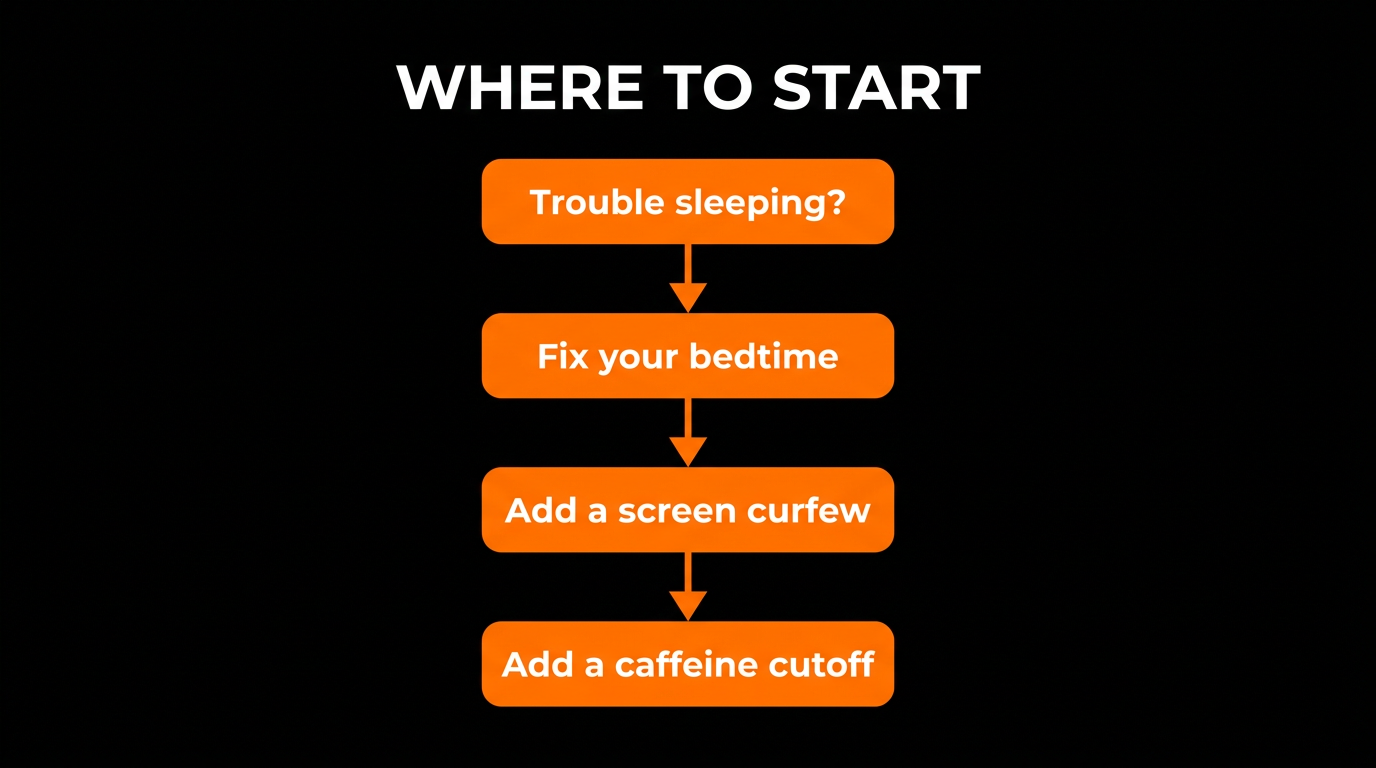
Not sure where to start? Follow the flow.
What time should a man start his evening routine?
Work back about 60 to 90 minutes from your fixed bedtime. That gives room for the screen curfew and a ten-minute wind-down without a rush. Set a reminder at that time so the routine starts on its own rather than whenever you happen to remember.
How long before bed should I stop looking at my phone?
About an hour. Bright evening light suppresses melatonin and delays your body clock, and the content keeps your mind switched on. Charging the phone outside the bedroom is the simplest way to hold the curfew, which is why a real alarm clock helps.
Does an evening routine actually help recovery, not just sleep?
Yes, because recovery mostly happens during sleep. Protecting deep and REM sleep by cutting caffeine and alcohol and cooling the room is how your body repairs, consolidates memory and balances hormones overnight. A better night is the recovery.
What should men avoid before bed?
Late caffeine, alcohol, bright screens and a warm room are the four big ones. A 400mg dose of caffeine can disrupt sleep even 12 hours before bed, and alcohol reliably cuts REM sleep. Removing these often does more than adding anything new.
Is it bad to work out late in the evening?
For most men a light or moderate session is fine, but finish intense training a couple of hours before bed so your body temperature and heart rate can settle. If late training leaves you wired, move the hard sessions earlier and keep evenings gentle.
What is the best evening routine for men who work shifts?
Anchor to your own bedtime, whatever hour it falls, and keep the sequence identical so your body reads the pattern. Make the room dark with blackout blinds, hold the caffeine cutoff relative to your sleep time, and protect the wind-down even when the clock looks unusual.
Final Recommendation
If you do nothing else, fix your bedtime and set a screen curfew an hour before it. Add a caffeine cutoff and a cool, dark room, then layer in the rest one week at a time. Track it from the first night so it survives the dip. An evening routine for men works when it is short, repeatable and measured, not when it is long and perfect.
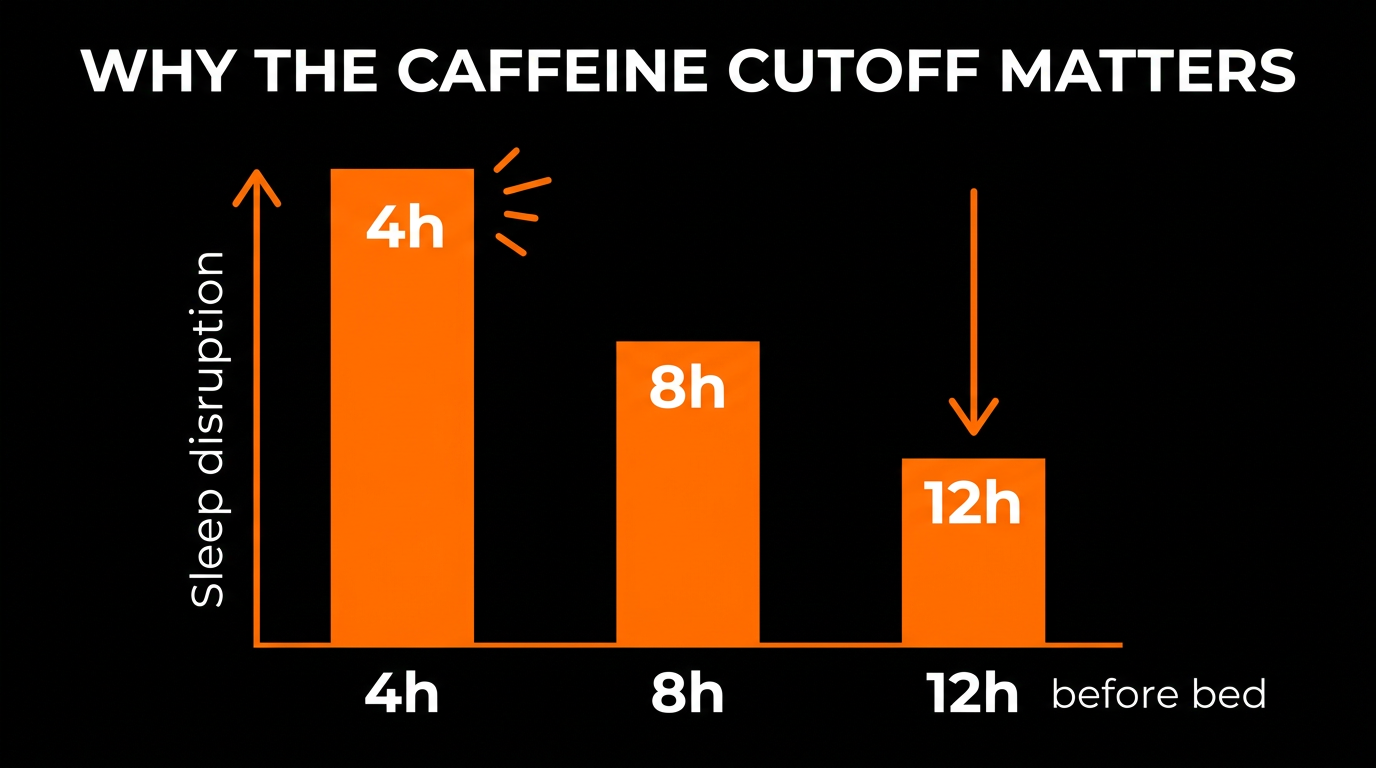
Why the caffeine cutoff matters: even a dose 12 hours out still cuts deep sleep.
Options for Men to Take Action
Most men do not fail at evenings because they lack ideas. They fail because the routine lives in their head, there is no system, and by the second hard week the phone is back in bed and the bedtime has drifted. Scattered reminders, three half-used apps and pure willpower do not hold at 11pm.
The MenTools app is built to run exactly this kind of routine as one system, with a nightly wind-down, reminders, streaks and an AI coach, so the habits above become check-ins instead of good intentions. For more on protecting sleep and recovery, the MenTools sleep hub pulls together the books, tools and guides worth using.
How you can do this today: set your bedtime, put the phone charger outside the bedroom, and tick off night one tonight.
Wins on cost: one app replaces a habit tracker, a journal and a stack of separate reminder tools.
Wins on time: the routine and the tracking are set up in minutes, with no research or planning to do yourself.
Wins on practicality: it lives on your phone and fits a working man’s night, so it survives late finishes, travel and busy weeks.
Small nightly reps, tracked and repeated, are what turn a good night into steady sleep and real recovery over a year.
Last updated: 2026-07-09 v1.0
Disclaimer: This guide is for informational purposes only and does not constitute medical or psychological advice. Speak with a qualified professional before making significant changes if you have a medical or mental health condition.
References
- [1] Windred DP et al. Sleep regularity is a stronger predictor of mortality risk than sleep duration. SLEEP, 2024. Link
- [2] Walker M, quoted in Somnee. Dr Matthew Walker’s sleep tips. Link
- [3] Chang AM et al, and related experimental work summarised by UCLA Health. Block screens’ blue light to get better sleep. Link
- [4] Effects of pre-bedtime blue-light exposure on ratio of deep sleep in healthy young men. Sleep Medicine, 2021. Link
- [5] Gardiner C et al. Dose and timing effects of caffeine on subsequent sleep: a randomized clinical crossover trial. SLEEP, 2025. Link
- [6] Best temperature for sleep. Sleep Foundation. Link
- [7] Ebrahim IO et al, and He S et al. The effect of alcohol on subsequent sleep: a systematic review and meta-analysis. Sleep Medicine Reviews, 2024. Link
- [8] Try this: progressive muscle relaxation for sleep. Harvard Health Publishing. Link
- [9] Walker M. How to sleep better, quoted via MasterClass. Link
- [10] Lally P et al. How are habits formed: modelling habit formation in the real world. European Journal of Social Psychology, 2010. Link