No products in the cart.
Return To Shop
MEN: Do Men Over 30 Need a Different Multivitamin?
Quick Answer
No, not by the numbers. UK government figures give a man aged 30 exactly the same daily amounts of vitamin D, vitamin B12, zinc, magnesium and selenium as a man aged 25, and most of those amounts do not change at 65 or 75 either. The useful question after 30 is what your diet is short of, not what your age is.
The UK sets one set of vitamin and mineral figures for men aged 19 to 64, and the figures for 65 to 74 and 75 plus are the same for almost every nutrient.[2] What does shift with age is how much food you need to eat, and the NHS notes that vitamin B12 becomes more difficult to absorb as you get older.[2][4]
Key points:
- A UK man needs 9.5mg of zinc, 300mg of magnesium and 75 micrograms of selenium a day at 25, at 30, at 65 and at 75.[2]
- Vitamin D stays at 10 micrograms a day for every adult, with standing NHS advice to consider a supplement through autumn and winter.[3]
- Energy needs fall from 2,500kcal a day at 19 to 64 to 2,342kcal at 65 to 74, while the vitamin and mineral figures hold, so each meal has to carry more.[2]
- Iron stays at 8.7mg a day for men of every adult age, which is why an iron-free formula still suits most men over 30.[6]
Jump to: Options compared | The figures by age | What actually changes
Supplements are foods, not medicines. They are designed to support normal health and nutrient status alongside a balanced lifestyle, not to diagnose, treat, prevent, or cure any medical condition.
Disclosure: MenTools publishes this article and sells MenTools One-A-Day Multivitamin.
How we evaluate: We assess mineral form quality, dose versus NRV, authorised health claims, and male-specific design. Full sources are listed in the references below.
Your Options Over 30, Compared
There are five realistic ways a man over 30 can cover his vitamins and minerals. Each one has a real limitation, including ours, and the right one depends on what your week of food looks like rather than on your birthday.[8]
| Option | What it covers | Iron | Suits a man who | Watch-out |
|---|---|---|---|---|
| Food first, no supplement | Everything a varied diet delivers, plus the protein and fibre no capsule carries | From food, against a need of 8.7mg a day | Eats meat or fish, dairy, nuts and green vegetables most days | Does not cover vitamin D in a UK autumn and winter, and it gets harder after 65 because calorie needs fall while vitamin and mineral figures stay the same |
| Vitamin D alone, 10 micrograms | One nutrient, the one with standing UK supplement advice behind it | None | Already eats well and wants to follow the NHS autumn and winter advice and nothing more | Covers a single nutrient, and it is easy to stack past the 100 microgram daily limit if a multivitamin also contains it |
| Standard adult men’s one-a-day | A spread of vitamins and minerals at around the reference amount | Usually iron-free | Has an inconsistent diet and wants one fixed dose he can add up | One formula for everyone, and it overlaps with any separate zinc or magnesium you already take |
| Age-labelled 40 plus or 50 plus men’s formula | Varies by brand, so the ingredients panel decides | Check the panel | Wants a formula whose ratios the maker has adjusted, and has read what those adjustments are | The UK figures it is measured against are the same as at 25, so you may be paying for the number on the front rather than a different panel |
| MenTools One-A-Day | One capsule a day, chelated minerals, active B-vitamin forms, 100% NRV of key vitamins and minerals | Iron-free | Wants one iron-free capsule that does not change between 35 and 55 | One fixed formula that is not tailored by age, it costs more per day than a supermarket tablet, and iron-free is wrong for a man a doctor has told to take iron |
Read the watch-out column first. The single most common mistake is running two of these at once, a multivitamin plus a separate vitamin D or zinc tub, without adding the doses together against the NHS limits.[3][5]
A UK Man’s Daily Figures at 19 to 64, 65 to 74 and 75 Plus
This table is the core of the answer. Every figure comes from the UK government dietary recommendations, which take the vitamin and mineral values from the Dietary Reference Values for the UK and the vitamin D value from the Scientific Advisory Committee on Nutrition.[2][9]
| Nutrient, men | Age 19 to 64 | Age 65 to 74 | Age 75 plus |
|---|---|---|---|
| Vitamin D | 10 micrograms | 10 micrograms | 10 micrograms |
| Vitamin B12 | 1.5 micrograms | 1.5 micrograms | 1.5 micrograms |
| Folate | 200 micrograms | 200 micrograms | 200 micrograms |
| Vitamin C | 40mg | 40mg | 40mg |
| Vitamin A | 700 micrograms | 700 micrograms | 700 micrograms |
| Zinc | 9.5mg | 9.5mg | 9.5mg |
| Magnesium | 300mg | 300mg | 300mg |
| Selenium | 75 micrograms | 75 micrograms | 75 micrograms |
| Iodine | 140 micrograms | 140 micrograms | 140 micrograms |
| Calcium | 700mg | 700mg | 700mg |
| Iron | 8.7mg | 8.7mg | 8.7mg |
| Thiamin | 1.0mg | 0.9mg | 0.9mg |
| Niacin | 16.5mg | 15.5mg | 15.1mg |
| Energy | 2,500kcal | 2,342kcal | 2,294kcal |
Eleven of those fourteen rows do not move at all. The two B vitamins that do change, thiamin and niacin, go down slightly in step with energy, and energy is the one line that falls properly.[2] There is no separate band that starts at 30.
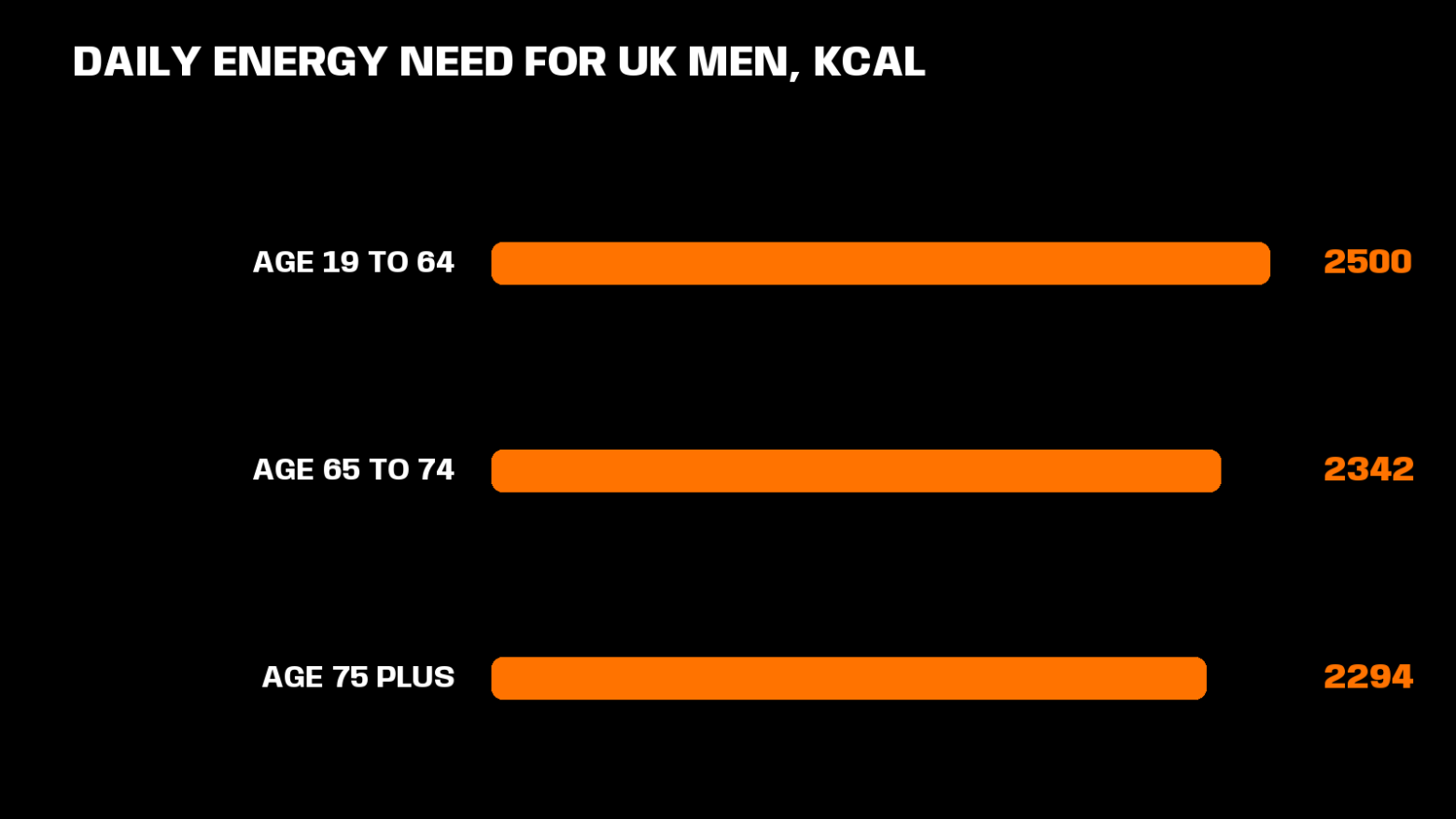
Less food, the same nutrient targets. That is the real change with age.
What Actually Changes After 30
If the figures stay the same, why do 50 plus formulas exist?
Because age is an easy way to segment a shelf. Nothing in the UK figures creates a separate band at 30 or 50, so the reference amounts the panel is measured against are the same ones used for a man of 25.[2]
That does not make every age-labelled formula pointless. It means the test is the ingredients panel, not the badge. Put the two panels side by side and look for the actual differences in amounts, then decide whether those differences are ones you want.
Does vitamin B12 matter more as you get older?
The amount does not change, at about 1.5 micrograms a day for adults.[4] What the NHS does note is that it becomes more difficult to absorb vitamin B12 as you get older.[4]
B12 comes from meat, fish, milk, cheese, eggs and some fortified breakfast cereals, and it is not found naturally in fruit, vegetables or grains.[4] A man over 30 who eats little animal food is the one who should check his B12 source most carefully, and a GP is the right person to ask if you have a concern.
Is vitamin D different for a man over 30?
No. Every adult needs 10 micrograms a day, and because the UK sun is not strong enough during autumn and winter, the NHS advises everyone to consider a daily 10 microgram supplement through autumn and winter.[3]
The advice moves to all year round if you are not often outdoors, or you usually wear clothes that cover most of your skin when outside.[3] A man who works long indoor hours and trains in a gym should read that line honestly. The NHS limit is 100 micrograms a day, and it applies to adults of every age.[3]
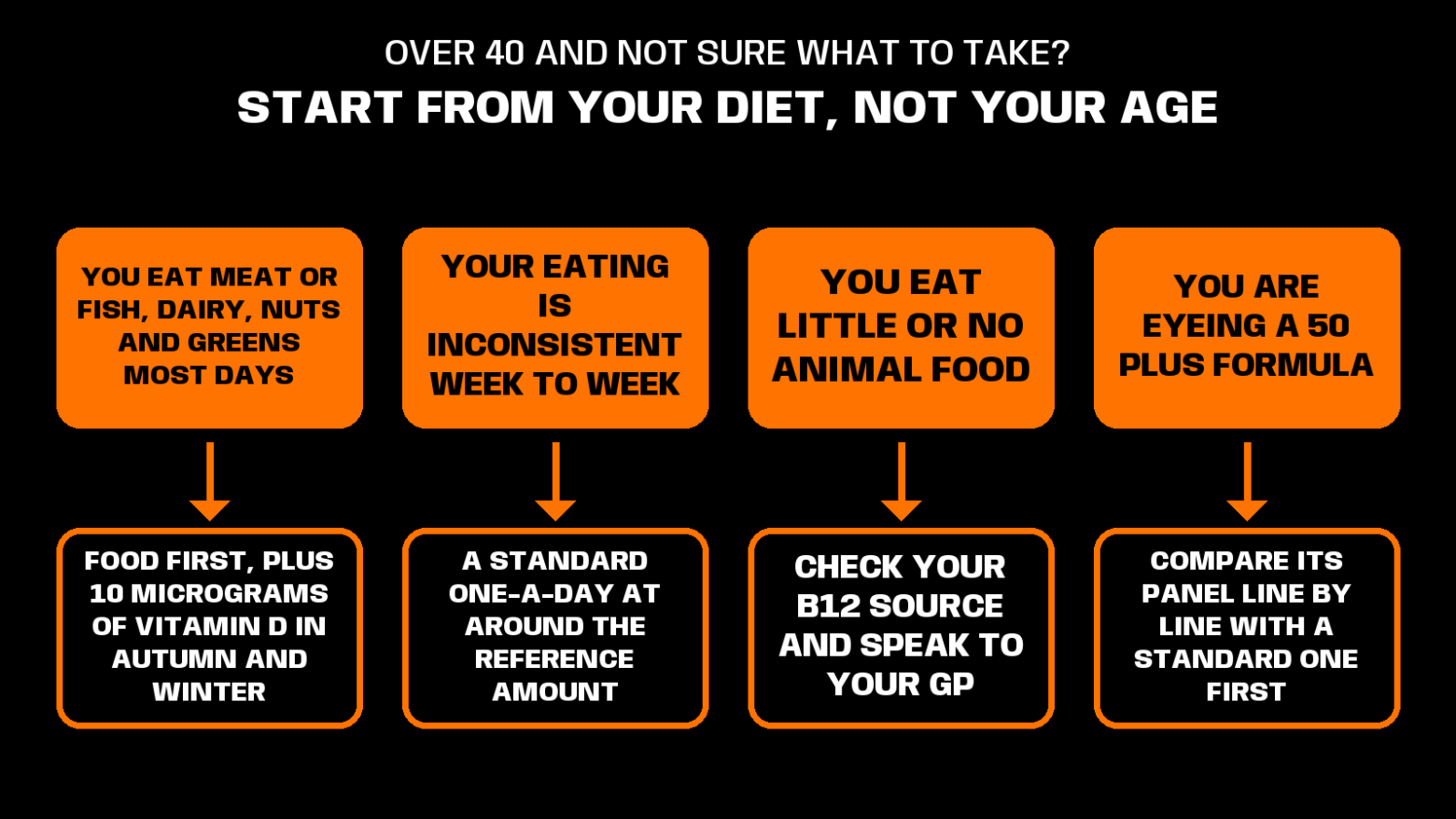
Start from your diet, not your age.
Where does UK guidance change with age?
In the few places it does, it points to less rather than more. The NHS says older people may be more sensitive to manganese, and that taking 0.5mg or less a day of manganese supplements is unlikely to cause harm for them, against 4mg for most people.[5]
It also says older people should not take potassium supplements unless advised to by a doctor.[5] And having more than 1.5mg of vitamin A a day over many years may affect your bones, which the NHS flags as particularly important for older people.[7] A formula that simply contains more of everything for an older man is moving in the wrong direction.
Does a man over 30 need iron?
Usually not from a supplement. Men aged 19 and over need 8.7mg of iron a day, and the NHS position is that you should be able to get all of it from your daily diet.[6] Side effects of high doses over 20mg include constipation, nausea and stomach pain.[6]
That is why most men’s formulas leave iron out, and why an age label on a men’s product should not add it back without a reason on the panel.
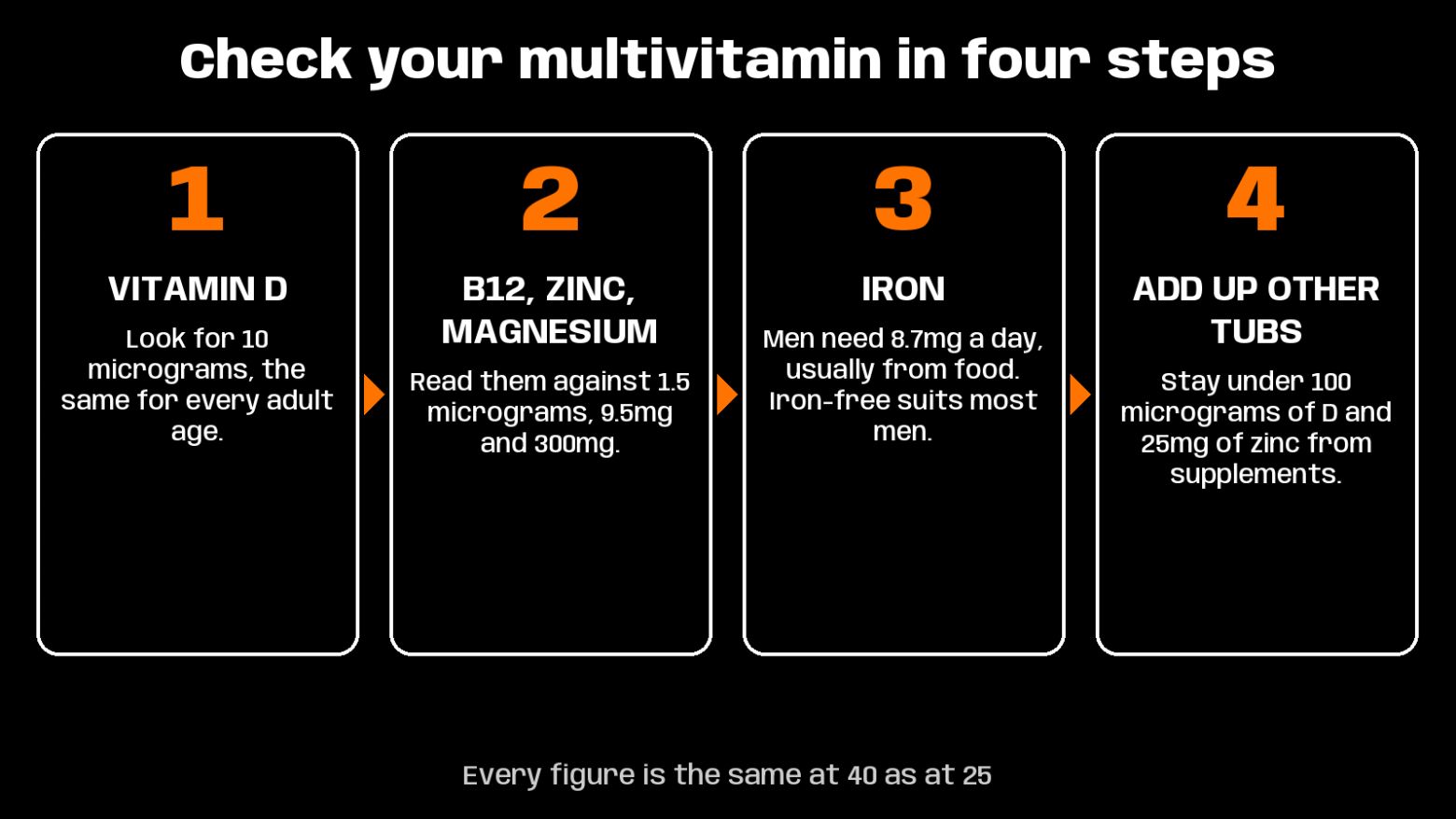
Four checks, about two minutes, and you know what the tub is doing.
What a Multivitamin Can Legally Say at Any Age
In Great Britain, health claims on food supplements must come from the GB Nutrition and Health Claims Register, which holds the authorised wording and the conditions of use for each claim.[1] None of those claims is written for a particular age.
MenTools One-A-Day carries 11 authorised health claims, each of which appears in the register in the exact wording below.[1] This is the full list of what the product is allowed to say it does:
- Pantothenic acid contributes to normal mental performance.
- Zinc and iodine contribute to normal cognitive function.
- Zinc contributes to the maintenance of normal testosterone levels.
- Vitamins B2, B3, B6, B12, vitamin C and magnesium contribute to the reduction of tiredness and fatigue.
- Magnesium contributes to normal psychological function.
- Vitamin D and vitamin K contribute to the maintenance of normal bones.
- Vitamin D contributes to normal muscle function.
- Vitamin D, vitamin C, selenium and zinc contribute to the normal function of the immune system.
- Selenium contributes to normal spermatogenesis.
- Vitamin C, vitamin E and selenium contribute to the protection of cells from oxidative stress.
- Biotin contributes to the maintenance of normal hair and skin.
Every line describes a contribution to a normal function in a man who is already well. When a pack aimed at men over 30 promises to turn back an age-related change, it has left the register behind, and that is a reason to put it back on the shelf.
FAQ
Do men over 30 need a different multivitamin?
Not by the numbers. UK government figures give a man aged 30 the same daily amounts of vitamin D, B12, zinc, magnesium and selenium as a man aged 25, and most of those amounts stay the same past 65 and 75.[2] What matters more is what your diet is short of.
Is a 50 plus multivitamin worth it for a man?
Not unless the ingredients panel shows a difference you actually want. The UK reference amounts it is measured against are the same at 50 as at 25, so compare the panel line by line with a standard formula before paying more for the number on the front.[2]
Do men over 30 need more vitamin D?
No. The figure is 10 micrograms a day for every adult. The NHS advises everyone to consider a daily 10 microgram supplement through autumn and winter, and all year round if you are not often outdoors. Do not take more than 100 micrograms a day.[3]
What about vitamin B12 after 30?
The amount stays at 1.5 micrograms a day. The NHS notes that it becomes more difficult to absorb vitamin B12 as you get older, and that B12 is not found naturally in fruit, vegetables or grains.[4] If you eat little or no animal food, or you have a concern, speak to your GP.
Should a man over 30 take iron?
Most do not need to. Men aged 19 and over need 8.7mg of iron a day and the NHS says you should be able to get all of it from your diet. Side effects of high doses over 20mg include constipation, nausea and stomach pain.[6] Take iron if a doctor has told you to.
Can a man over 30 take too much of a vitamin or mineral?
Yes. The NHS says not to take more than 100 micrograms of vitamin D a day or more than 25mg of zinc a day from supplements unless a doctor advises it.[3][5] Having 400mg or less of magnesium a day from supplements is unlikely to cause harm, and more than 1.5mg of vitamin A a day over many years may affect your bones.[5][7]
I am on TRT or prescription medication. Can I take a multivitamin?
If you are on TRT or any prescribed medication, speak with your prescribing doctor before adding any supplement. MenTools products are nutritional supplements designed to support general health and normal nutrient status, not medicines and not a replacement for medical treatment.
Are food supplements medicines?
No. Food supplements are foods in law, not medicines. They are designed to support normal health and nutrient status alongside a balanced lifestyle, not to diagnose, treat, prevent, or cure any medical condition.
Final Recommendation
Ignore the age on the front of the pack and start from your week of food. If it already contains meat or fish, dairy, nuts and green vegetables, the one gap the NHS asks every UK adult to think about is vitamin D through autumn and winter, and 10 micrograms covers it.[3]
If your week does not look like that, a one-a-day at around the reference amount is a reasonable floor while you fix the diet underneath it. Check the B12 source if you eat little animal food, keep iron out unless a doctor has said otherwise, and add up everything else in the cupboard before you start.[4][6]
MenTools One-A-Day is one option in that category and it has its own limitations. It is one fixed formula that is not tailored by age, it costs more per day than a supermarket tablet, and it is iron-free, which is right for most men but wrong for a man whose doctor has told him otherwise. For a wider look at how it compares with other brands, read our guide to choosing a men’s multivitamin, and for what each nutrient is there to do, see what a men’s multivitamin actually does.
Options For Men to Take Action
A lot of men hit 30 and quietly swap to whatever tub has a bigger number on the front, on the assumption that the body has changed and the formula should too. The UK figures say the targets have not moved. What has moved is how much room there is in the diet for food that carries nothing.
MenTools One-A-Day is built as the simple version of this: one capsule per day, chelated minerals, active B-vitamin forms, iron-free, at 100% NRV of key vitamins and minerals. The nutrition archive covers the food that sits around the capsule, and the MenTools challenges handle the daily habit side that no supplement can touch.
How you can do this today: take the pack you already own, find the ingredients panel, and read the vitamin D, B12, zinc, magnesium and iron lines against the age table above. Then add any separate tubs you take on top.
Wins on cost: you stop paying extra for an age badge when the panel underneath measures against the same figures as a standard formula.
Wins on time: the reading is done. Fourteen fixed UK figures replace another evening of comparing product pages.
Wins on practicality: one capsule a day that does not need swapping at 45, 50 or 55 is one less decision to remake every few years.
Consistency is what makes any of this count, and a routine you keep for ten years beats a new formula every time a birthday ends in a zero.
Last updated: 2026-10-02 v1.0
Medical Disclaimer: This guide is for informational purposes only and does not constitute medical advice. Always speak with your doctor or another qualified healthcare professional before starting any new supplement or programme if you have medical conditions or take prescription medication.
Supplement Notice: Food supplements should not be used as a substitute for a varied and balanced diet and a healthy lifestyle. Do not exceed the stated recommended daily dose. Keep out of reach of children.
References
- [1] Department of Health and Social Care. Great Britain nutrition and health claims (NHC) register. GOV.UK. https://www.gov.uk/government/publications/great-britain-nutrition-and-health-claims-nhc-register
- [2] Public Health England. Government Dietary Recommendations: government recommendations for energy and nutrients for males and females aged 1 to 18 years and 19+ years. GOV.UK. https://assets.publishing.service.gov.uk/media/5a749fece5274a44083b82d8/government_dietary_recommendations.pdf
- [3] NHS. Vitamins and minerals, Vitamin D. NHS. https://www.nhs.uk/conditions/vitamins-and-minerals/vitamin-d/
- [4] NHS. Vitamins and minerals, B vitamins and folic acid. NHS. https://www.nhs.uk/conditions/vitamins-and-minerals/vitamin-b/
- [5] NHS. Vitamins and minerals, Others, including magnesium, manganese, potassium, selenium and zinc. NHS. https://www.nhs.uk/conditions/vitamins-and-minerals/others/
- [6] NHS. Vitamins and minerals, Iron. NHS. https://www.nhs.uk/conditions/vitamins-and-minerals/iron/
- [7] NHS. Vitamins and minerals, Vitamin A. NHS. https://www.nhs.uk/conditions/vitamins-and-minerals/vitamin-a/
- [8] NHS. Vitamins and minerals. NHS. https://www.nhs.uk/conditions/vitamins-and-minerals/
- [9] Scientific Advisory Committee on Nutrition. SACN vitamin D and health report. GOV.UK. https://www.gov.uk/government/publications/sacn-vitamin-d-and-health-report