No products in the cart.
Return To Shop
MEN: What Is Intentional Friction? The 2026 Replacement for Digital Detox
Quick Answer
Intentional friction means making a habit you want less of slightly harder to start, so the default stops winning. It replaces the digital detox because it works on the moment you reach for the phone, not on willpower. In one field study, a short pause before opening an app cut openings by 57 percent over six weeks [1].
**Jump to:** At a glance | Why it replaced the detox | FAQ | Options for men
Disclosure: MenTools publishes this article and may feature MenTools products.
How we evaluate: Each recommendation is assessed on real-world use, evidence, cost and time, and how well it suits men. Every recommendation including the MenTools option carries an honest limitation. Full sources are in the references below.
Intentional Friction vs Digital Detox at a Glance
A digital detox removes the phone for a set period and hopes the change outlasts it. Intentional friction keeps the phone and puts small, deliberate obstacles in front of the uses you regret. The detox is a sprint. Friction is a permanent change to the layout of your day, and the research on the two points in different directions [4][1].
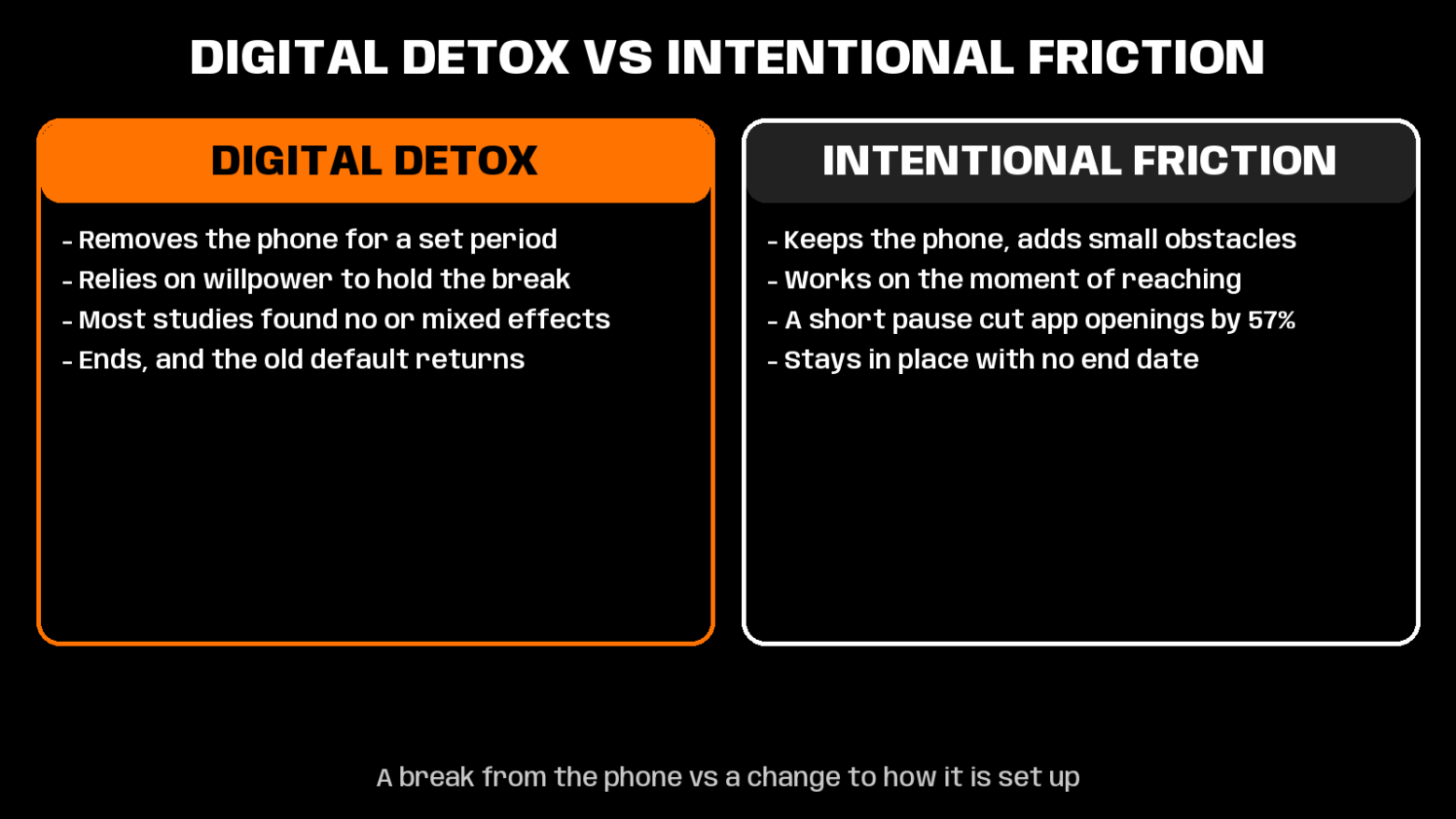
One is a break from the phone. The other is a change to how the phone is set up.
The table sets the two side by side on the things a man can actually check, with the source for each line.
| What matters | Digital detox | Intentional friction |
|---|---|---|
| What you change | Remove the phone or apps for a period [4] | Add small obstacles to specific uses [1] |
| What it relies on | Holding a break with willpower | The layout of your environment [9] |
| Strongest measured result | 60 fewer minutes a day during a month off Facebook [3] | 57 percent fewer app openings after six weeks [1] |
| Weight of evidence | 21 studies, mostly no effect or mixed [4] | Smaller and newer, but consistent in direction [1][5] |
| Best for | A reset before a big change | A permanent default you can live with |
| Watch-out | Old habits return when the break ends | Easy to undo, so it needs to be set up well |
What Is Intentional Friction, in Plain Terms?
It is the practice of adding a small cost, usually a few seconds or a few steps, to a behaviour you want to do less of. Cambridge Dictionary added the related term friction-maxxing in January 2026, defining it as “the practice of making everyday activities slightly less convenient to reduce reliance on digital devices and to discourage overuse” [11].
The idea is older than the name. Habit researchers have long described friction as anything that stands between you and an action, such as time, distance or effort, and they treat it as one of the strongest levers on what people actually do [9].
The word intentional matters. Modern apps are built to remove every possible step between the urge and the scroll. Intentional friction puts a few of those steps back on purpose, and only on the uses you have decided you do not want.
Why Is Friction Replacing the Digital Detox?
Because the detox rarely lasts and the evidence for it is weak. A systematic review of 21 studies, 12 of them randomised controlled trials, found that most showed no effect or mixed results on well-being, social and performance outcomes [4]. Friction does not ask you to quit anything. It asks the phone to wait a moment.
The review defined a detox as the “voluntary and intentional” abstinence from a smartphone or specific apps [4]. That is the problem in one line. Anything that depends on volunteering to abstain every day is running on the resource that runs out first in a hard week.
There was one consistent finding worth keeping. All three studies in that review that measured depressive symptoms found a decline after a detox [4]. A break can help. It just does not change the setup you return to.
The scale of the default is the other reason. Ofcom found UK adults spend an average of 4 hours 30 minutes online a day outside work, with men at 4 hours 17 minutes and smartphones accounting for 75 percent of men’s online time [10]. A weekend without the phone does not move a number that size for long.
How Does Intentional Friction Actually Work?
It works on habits, not decisions. Wendy Wood, the USC psychologist who has spent decades on habit research, reports that “about 43 percent of what people do every day is repeated in the same context, usually while they are thinking about something else” [9]. Reaching for a phone is almost entirely that kind of behaviour.
Habits run on cues and ease. When the easy path is always open, the habit fires before any conscious decision gets a vote. A few seconds of friction interrupts that automatic chain and gives the deliberate part of your mind a chance to catch up.
Wood’s explanation of why some people seem to have more self-control is blunt. They do not resist better. As she puts it, “They don’t have much ‘friction’ in their lives and so are not tempted to act in counterproductive ways” [9]. The same logic, run in reverse, is what intentional friction does to the habits you want less of.
Economists have measured the same pattern. In a large field experiment, Allcott, Gentzkow and Song estimated that self-control problems cause 31 percent of social media use, and that letting people set limits on their future screen time substantially reduced use [2]. Friction is a way of setting that limit in advance, before the urge arrives.
What Does the Research Say About Friction That Works?
Small obstacles produce measurable changes, and the smallest ones often do the most. The best tested example is a pause screen. In a PNAS study of the one sec app, 36 percent of attempts to open a target app ended with the user closing it, attempts fell 37 percent over six weeks, and actual openings fell 57 percent [1].
The same paper ran a preregistered online experiment with 500 people to test which part of the pause mattered. Giving people a clear option to dismiss the attempt had the strongest effect, the time delay itself also reduced consumption, and the reflective message on its own did not work [1].
Colour is a second lever. Holte and Ferraro switched students’ phones to greyscale and found daily screen time fell by roughly 38 minutes a day [5]. Nothing was blocked. The phone simply became less rewarding to look at.
Distance is a third. Ward and colleagues found that having your own smartphone on the desk, even switched off, reduced available working memory and fluid intelligence compared with leaving it in another room [6]. Ward explained that trying not to think about the phone “uses up some of your limited cognitive resources” [6].
The pattern holds outside phones. Rozin and colleagues moved foods about 10 inches further away in a cafeteria salad bar, or swapped the serving spoon for tongs, and intake of those foods fell by 8 to 16 percent [8]. A tiny inconvenience, repeated every day, adds up.
How Much Friction Is Enough?
Usually less than you think. The one sec result came from a pause of a few seconds [1], and the greyscale result from a single setting [5]. Start with the lightest friction that interrupts the automatic reach, and only escalate to heavier barriers for the uses that keep getting through.
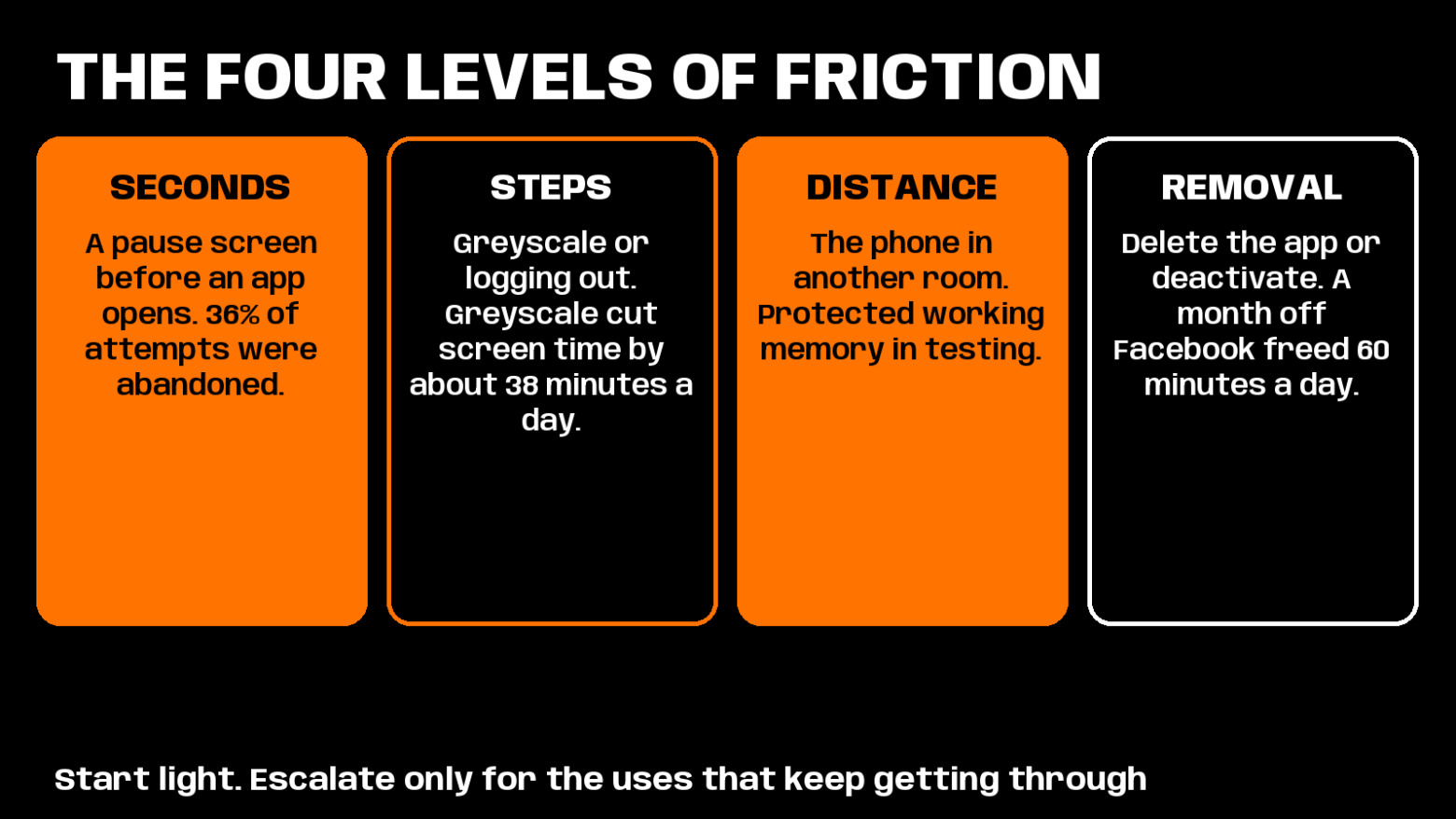
Start at the lightest level that works, and escalate only for the uses that keep getting through.
Think of it as four levels. Seconds, such as a pause screen. Steps, such as greyscale, logging out after each use or moving an app off the home screen. Distance, such as charging the phone outside the bedroom. Removal, such as deleting an app entirely.
Removal is the heaviest and still has a place. When Allcott and colleagues paid people to deactivate Facebook for a month, it freed up about 60 minutes a day, produced small improvements in self-reported well-being, and caused a large, lasting drop in Facebook use afterwards [3]. That last part matters. Even a temporary barrier changed the habit beyond the experiment.
The trade-off is that heavier friction costs you the useful parts too. Deleting a messaging app to stop scrolling also stops the message from your partner. The lighter levels let you keep what you need and tax only what you regret.
Where Does Intentional Friction Fall Short?
It is easy to undo, the evidence is younger than the hype, and some headline findings are weaker than they look. Friction works on the automatic reach. It does little against a deliberate binge, and anyone determined to scroll can switch colour back on in five seconds. It shapes defaults, it does not replace a reason to change.
Read the studies with their limits attached. One of the three authors of the one sec paper built the app [1], which is a real conflict of interest even in a peer reviewed journal. The greyscale study was run on college students [5], not on working men with families and commutes.
The phone distance effect has also been tested harder since. A 2023 meta-analysis of 22 studies and 43 effects concluded that “the results of the meta-analysis indicate a negative effect of smartphone use or smartphone presence on various aspects of cognitive performance” [7]. But the effect was significant for memory and not for attention or general cognitive performance [7]. Moving the phone helps, but not everywhere.
And the Facebook experiment was run in the United States around a national election [3], a period when feeds are at their most heated. The size of the effect may not transfer to a normal month.
How Do You Start Adding Friction This Week?
Pick the one use you regret most, add the lightest friction that interrupts it, and leave everything else alone for a fortnight. Most men try to fix every app at once and abandon the whole setup inside a week. One targeted barrier, kept, beats ten that were switched off by Friday [1].
Day one, install a pause before the app you open without thinking, or move it into a folder on the last screen. Day three, switch the phone to greyscale for the evening [5]. By the weekend, charge the phone outside the bedroom so the first reach of the morning costs a walk [6].
If you want more structure around the phone itself, our comparison of app blockers against mindset approaches sets out which tools add friction and which just add rules. For the other side of the problem, what to do with the attention you get back, the beginner’s guide to focus covers the basics.
If you want to know how quickly your focus comes back once the barriers are in, how long it takes to rebuild your attention span sets out the timeline from the trials. If you have been told to try a dopamine detox instead, whether a dopamine detox actually works separates the myth from the part the evidence supports. Pair every barrier with a replacement. Friction removes the easy option, and the gap it leaves is where the old habit returns unless something else fills it. A book on the bedside table, a notebook on the desk and a set time for messages all do that job [9].
FAQ
Is intentional friction the same as friction-maxxing?
Closely related. Friction-maxxing is the 2026 cultural label, defined by Cambridge Dictionary as making everyday activities slightly less convenient to reduce reliance on digital devices [11]. Intentional friction is the narrower practice of adding small barriers only to the specific habits you want less of, rather than making life harder across the board.
Does a digital detox work at all?
Sometimes, and mostly while it lasts. A review of 21 studies found most showed no effect or mixed results, although all three that measured depressive symptoms found a decline [4]. A month off Facebook freed about an hour a day and reduced later use [3]. The problem is what happens when the break ends.
What is the easiest friction to add to a phone?
A pause before the apps you open automatically. In the one sec study, users closed the app on 36 percent of attempts once a short delay appeared, and openings fell 57 percent over six weeks [1]. Greyscale is the next easiest, at roughly 38 fewer minutes a day [5].
Does putting your phone in another room really help concentration?
Partly. The original study found your own phone on the desk reduced working memory and fluid intelligence, even when switched off [6]. A later meta-analysis of 22 studies confirmed an effect on memory but not on attention or general cognitive performance [7]. It is worth doing for demanding work, not a guarantee.
Can friction help with habits other than phone use?
Yes. The principle applies to any habit driven by ease. Moving a food about 10 inches further away or changing the serving utensil cut intake by 8 to 16 percent in a cafeteria study [8]. Keeping snacks out of sight, beer out of the fridge or a games console unplugged all work the same way.
Will friction stop working once I get used to it?
Some of it does, which is why it is set up in layers. In the one sec study, attempts to open target apps still fell 37 percent across six weeks rather than rebounding [1], which suggests the habit itself weakened. If a barrier stops interrupting you, escalate to the next level.
Is intentional friction enough on its own?
Rarely. Friction interrupts the automatic reach, but it does nothing for a deliberate choice to scroll, and it leaves a gap in the time you used to spend on the phone. It works best alongside a clear replacement and a reason to change that you actually care about [9].
Final Recommendation
Choose one use you regret, add the lightest friction that interrupts it, and give it two weeks before judging it. A short pause cut openings by 57 percent in the best tested case [1]. That is a bigger result than most detoxes produce, and you never have to give anything up.
Escalate only where the light barriers fail, and keep the heavy options, deleting or deactivating, for the apps that keep winning [3]. Treat friction as a permanent change to the setup of your day rather than a challenge you complete.
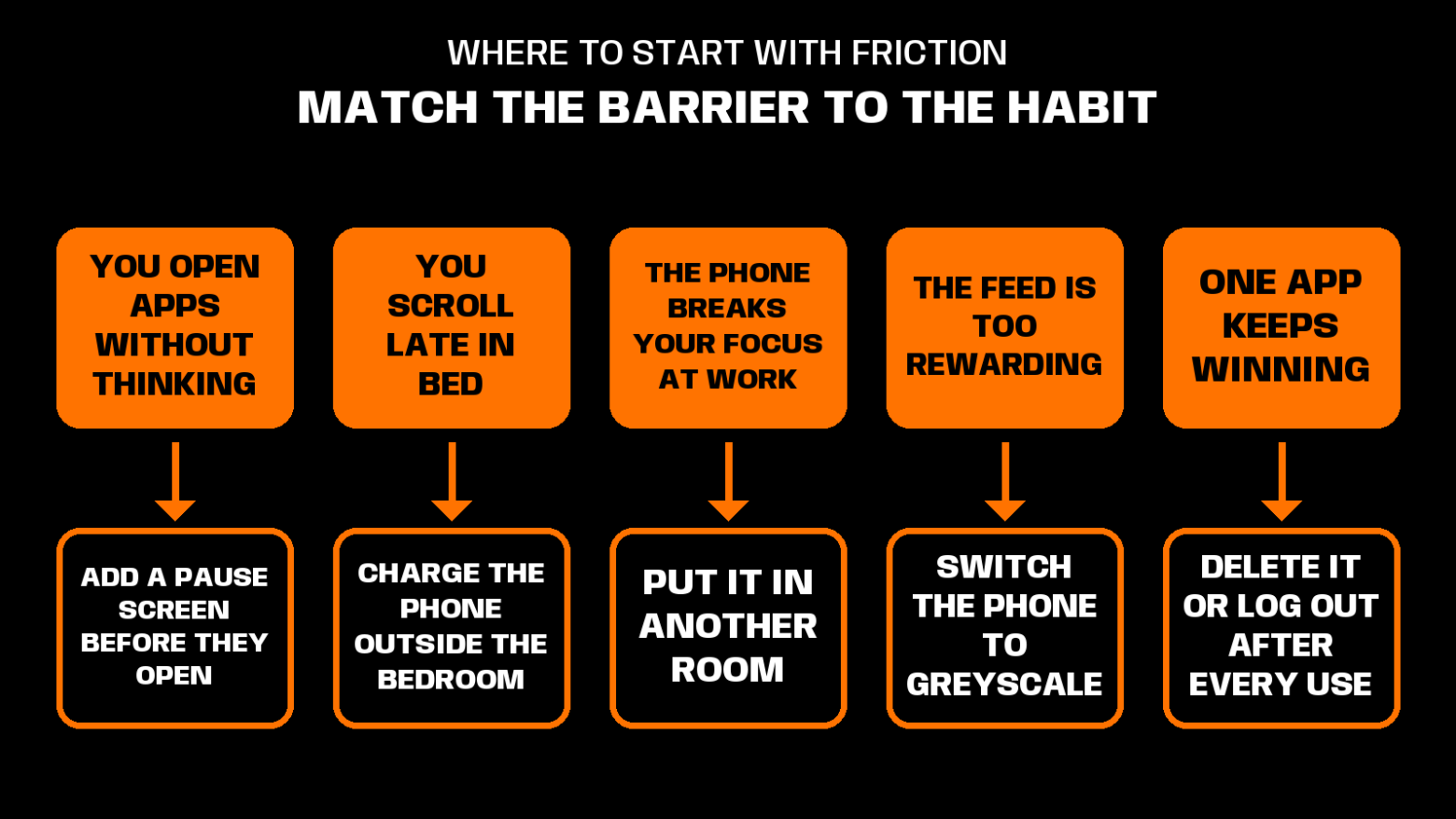
Match the barrier to the moment the habit fires.
Options for Men to Take Action
Friction removes the easy option, but most men set up a barrier, feel good for a week, then switch it off in the first stressful evening, because nothing is tracking whether the new default is holding or filling the time it frees up.
The MenTools app runs focus as a challenge alongside mindset, fitness, nutrition and money, with daily actions, levels you choose, reminders, streak and progress tracking, and an AI coach. Its job here is narrow, which is keeping one barrier and one replacement habit in place long enough to judge them fairly.
How you can do this today: pick one friction from this article, pick one replacement habit to fill the time, and track both as a single daily action.
Wins on cost: one subscription covers focus, sleep and training together, instead of stacking separate blocker, habit and coaching apps.
Wins on time: the challenge structure already exists, so there is nothing to design before you start.
Wins on practicality: a daily action takes seconds to log, which fits long workdays, travel and young children.
Watch-out: it is a habit and consistency tool, not a phone blocker. It will not stop you opening an app, so pair it with at least one real barrier on the phone itself.
A flat afternoon is harder to out-plan than to prevent, and the reach for the phone is strongest when energy is low, so a one a day multivitamin may help cover the simple daily foundation underneath the behaviour work. For more built for men on attention and the phone, see the MenTools focus hub. One barrier, kept for a month, will tell you more than any detox.
Last updated: 2026-10-06 v1.0
Disclaimer: This guide is for informational purposes only and does not constitute medical or psychological advice. Speak with a qualified professional before making significant changes if you have a medical or mental health condition.
References
- [1] Grüning DJ, Riedel F, Lorenz-Spreen P. Directing smartphone use through the self-nudge app one sec. Proceedings of the National Academy of Sciences, 2023;120(8):e2213114120. Link
- [2] Allcott H, Gentzkow M, Song L. Digital addiction. American Economic Review, 2022;112(7):2424-2463. Link
- [3] Allcott H, Braghieri L, Eichmeyer S, Gentzkow M. The welfare effects of social media. American Economic Review, 2020;110(3):629-676. Link
- [4] Radtke T, Apel T, Schenkel K, Keller J, von Lindern E. Digital detox, an effective solution in the smartphone era? A systematic literature review. Mobile Media and Communication, 2022. Link
- [5] Holte AJ, Ferraro FR. True colors, grayscale setting reduces screen time in college students. The Social Science Journal, 2020. Link
- [6] Ward AF, Duke K, Gneezy A, Bos MW. Brain drain, the mere presence of one’s own smartphone reduces available cognitive capacity. Journal of the Association for Consumer Research, 2017;2(2):140-154. Summary via ScienceDaily. Link
- [7] Böttger T, Poschik M, Zierer K. Does the brain drain effect really exist? A meta-analysis. Behavioral Sciences, 2023. Link
- [8] Rozin P, Scott S, Dingley M, Urbanek JK, Jiang H, Kaltenbach M. Nudge to nobesity I, minor changes in accessibility decrease food intake. Judgment and Decision Making, 2011;6(4):323-332. Link
- [9] Behavioral Scientist. Good Habits, Bad Habits, a conversation with Wendy Wood. Link
- [10] Ofcom. Online Nation 2025 report. Published 10 December 2025. Link
- [11] Cambridge Dictionary. New words, 19 January 2026 (friction-maxxing). Link