No products in the cart.
Return To Shop
MEN: Wired but Tired: Why Men Feel Both at Once
Quick Answer
Wired but tired is what it feels like when your arousal system stays switched on while your need for sleep keeps building. Tiredness and alertness are two separate systems, so both can run high at once. In most men the drivers are a short night, caffeine later than they think, the evening drink, and a wake time that moves.
**Jump to:** The numbers behind it | Why both at once | FAQ | Options for men
Disclosure: MenTools publishes this article and may feature MenTools products.
How we evaluate: Each change is assessed on real-world use, evidence, cost and time, and how well it suits men. Every change including the MenTools option carries an honest limitation. Full sources are in the references below.
The Numbers Behind It at a Glance
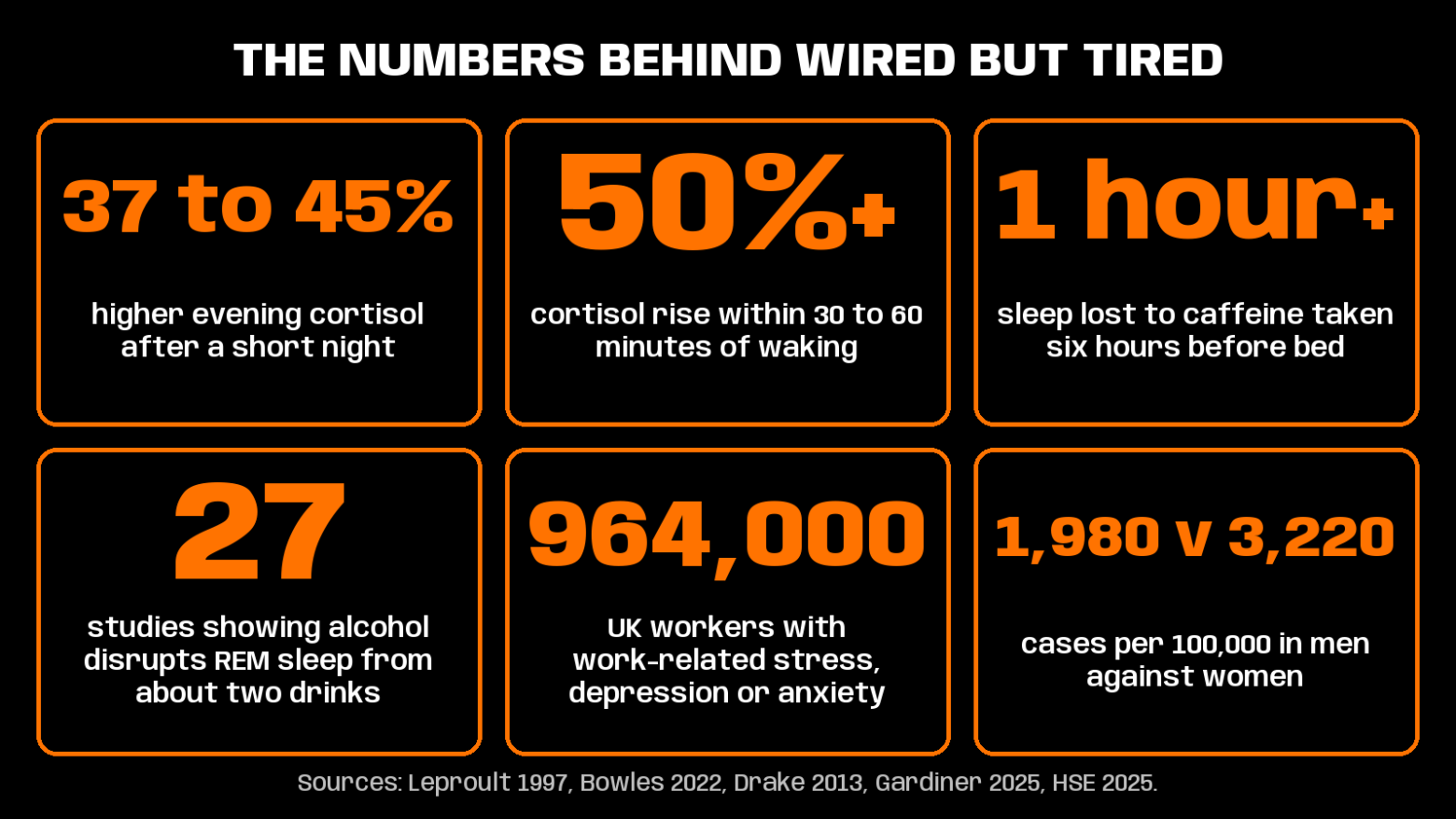
Six measured figures that explain the pattern better than any single symptom does.
Being exhausted and switched on at the same time is not a contradiction, and it is not a sign that something is broken. It is what happens when one system is measuring how long you have been awake and a second system is deciding how alert you are, and only the second one is being driven hard.
The table below is the short version. Each row is a real input rather than a personality trait, which is why each one has something you can do about it.
| Driver | What it does | What to change | How fast you notice |
|---|---|---|---|
| A short night | Raises evening cortisol 37 to 45 percent | Hold one wake time, seven days | 3 to 7 days |
| Caffeine later than you think | Cuts over an hour of sleep at 6 hours before bed | Last coffee 8 hours before bed | 2 to 3 nights |
| The evening drink | Delays and shortens REM sleep from about 2 drinks | Finish 3 hours before bed | 2 to 3 nights |
| A moving wake time | Keeps the body clock unsettled all week | Same wake time at weekends | 1 to 2 weeks |
| No down-shift in the day | Leaves arousal high into the evening | 5 minutes of slow breathing | Same session |
Why You Can Be Exhausted and Alert at the Same Time
Because they are two different systems. Sleep pressure builds the longer you are awake, and it keeps building whatever else is happening. Alertness is set separately by your body clock and your arousal system, so a hard day can hold alertness high while sleep pressure is already at the top of its range. Feeling both is the normal result, not a fault.
The arousal side of that equation has been studied most closely in insomnia research, where the leading explanation is hyperarousal. Dressle and Riemann describe it as a dysregulation of the arousal systems across the full 24 hours rather than a night-time problem, with evidence of both raised resting arousal and a stronger arousal response to stress [1].
That is the reason it does not resolve when you finally get to bed. If arousal is running high all day, bedtime is simply when you notice it, and the physical markers used to track it include heart rate, heart rate variability, body temperature and metabolic rate [1].
Your autonomic nervous system is the machinery underneath. The sympathetic branch raises heart rate and blood pressure and pauses digestion, and the parasympathetic branch brings heart rate down and restores normal digestion [2]. Neither branch is the problem. The problem is not coming back down once the demand has passed.
Is Wired but Tired a Real Condition?
No. It is a plain description of a state, not a diagnosis, and it does not appear in any diagnostic manual. The physiology behind it is real and measurable, and the phrase itself is informal. Treat it as a useful description of a pattern you can influence, and not as a label that explains everything.
That distinction matters more than it sounds. A term that covers every kind of tiredness stops carrying information, and it delays the men whose exhaustion has a medical cause rather than a habits cause.
Our guide to what nervous system regulation actually means sets out where the honest evidence stops and the marketing starts.
What Does It Actually Feel Like in Men?
The common shape is being flattened by six in the evening and still awake at midnight, with a short fuse in the afternoon, a tight jaw, a head that will not stop, and a resting heart rate that no longer settles. Most men notice the physical version first. Very few arrive at it by saying they feel stressed.
Look for the shape across a week rather than any single sign. One bad night is a bad night. Six weeks of the same shape is a pattern worth acting on.
The scale of the background load is not in question. The Health and Safety Executive recorded 964,000 workers in Great Britain with work-related stress, depression or anxiety in 2024/25, a rate of 2,770 per 100,000 workers, costing an estimated 22.1 million working days, and stress, depression or anxiety accounted for 52 percent of all work-related ill health that year [3].
Why Men Under-Report It
Men record far fewer cases and almost certainly experience more than they report. In the HSE figures, men recorded 1,980 cases per 100,000 workers against 3,220 for women and 2,580 across all workers [3]. That is a reporting gap rather than a stress-proof nervous system.
Survey data points the same way. In the Mental Health Foundation’s UK stress survey of 4,619 adults, 67 percent of men said they had felt overwhelmed or unable to cope because of stress in the past year, against 81 percent of women [4].
The practical consequence is that men tend to arrive at this through the physical door. It shows up as broken sleep, a short temper, a flat afternoon or a heart rate that will not come down, which is also why it gets treated as a sleep problem or a fitness problem for months before anything changes.
Why the Mornings Are Worse Than the Evenings
Because your cortisol rhythm is designed to spike as you wake, and a short night exaggerates it. Cortisol rises sharply in the first hour of being awake, which is normal and useful. What is not useful is a night too short to let the system settle overnight, which leaves you both flat on waking and switched on by evening.
The morning rise has a name. Bowles and colleagues describe it plainly, noting that “circulating cortisol usually peaks 30-60 min after awakening from nocturnal sleep, this is commonly referred to as the cortisol awakening response (CAR)”, with an increase of 50 percent or more [5].
The evening half of the pattern is where short sleep shows up. In a controlled study of young men, evening cortisol concentrations were 37 and 45 percent higher after partial and total sleep deprivation than after a normal night [6]. The authors concluded that “even partial acute sleep loss delays the recovery of the HPA from early morning circadian stimulation and is thus likely to involve an alteration in negative glucocorticoid feedback regulation” [6].
Read that as a loop rather than a one-off. A short night leaves the stress system running into the evening, the raised evening arousal makes the next night shorter, and by Thursday it is no longer obvious what started it.
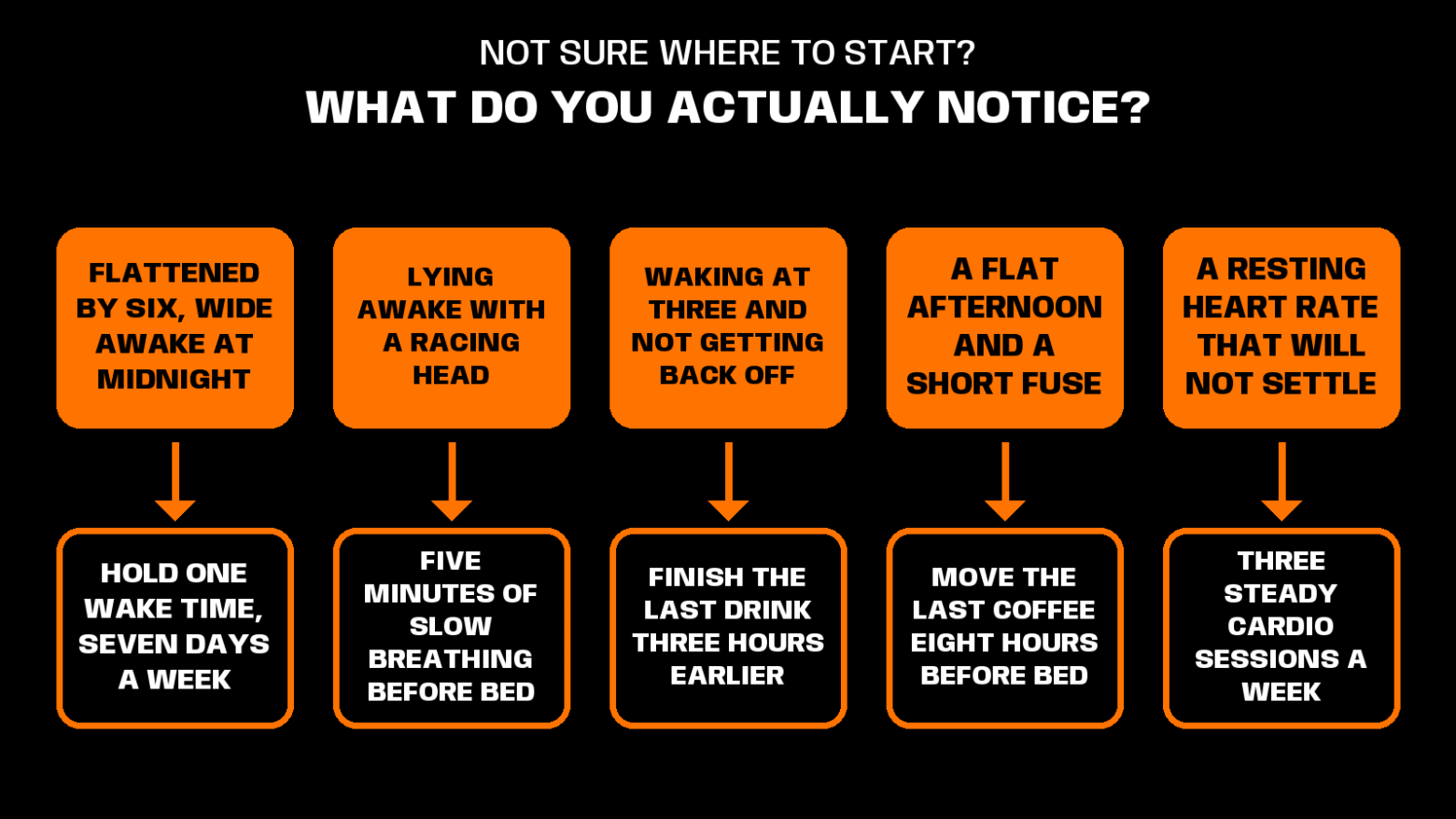
Start where the problem actually shows up, rather than changing everything at once.
Does Caffeine Do This Even When You Stop Early?
Yes, and further out than most men assume. In a controlled study of 12 healthy sleepers, 400 mg of caffeine, roughly two to three cups of coffee, taken six hours before bed reduced objectively measured total sleep time by more than an hour [7]. The participants did not notice it, which is the part that matters.
That gap between the measurement and the experience is the whole problem. A man who sleeps badly and feels certain his four o’clock coffee is not the cause is describing exactly what the study found, because the subjective reports showed no awareness of the disturbance [7].
The practical version is to move the last caffeine to eight hours before bed and hold it for a fortnight. It is a cheap experiment, it needs no equipment, and it is the fastest of the changes here to show a result.
Does the Evening Drink Help or Make It Worse?
It helps the part you notice and damages the part you do not. Alcohol gets you to sleep faster at higher doses, then disrupts the second half of the night, which is why a man can be asleep by eleven and awake at three feeling wired.
A systematic review and meta-analysis of 27 studies found that alcohol delays the onset of rapid eye movement sleep and reduces how much of it you get, with the disruption appearing at a low dose of roughly two standard drinks and worsening as the dose rises [8]. Reductions in the time taken to fall asleep only appeared at high doses [8].
The alertness side shows a similar threshold. In 12 subjects, one standard drink of red wine or ethanol had no effect on heart rate or muscle sympathetic nerve activity, while two drinks raised both [9].
Two drinks is therefore not a neutral amount. It is roughly where the measured cost starts on both the sleep side and the arousal side, which is a more useful number than any general advice about moderation.
What Actually Settles It Down
Four changes, in this order, and one at a time. Hold a single wake time seven days a week, move the last coffee to eight hours before bed, finish the last drink three hours before bed, and add five minutes of slow breathing with a long exhale at a fixed point in the day. Everything else is optional until those four are running.
The breathing is the only one that does anything tonight. Everything else buys you a better starting point for next week, which is why men who want an immediate result usually quit before the changes that matter have had a chance.
Our full guide to how to reset your nervous system covers the seven methods with real evidence and the order to add them in. For the day-to-day side, how men manage stress deals with the load rather than the symptoms.
How Long Does It Take to Come Out of It?
Expect the caffeine and alcohol changes to show inside three nights, the wake time to show inside a week, and the whole pattern to shift over two to four weeks. That is only true if you change one thing at a time. Four changes started on the same Monday are usually all gone by Friday, which reads as failure rather than as a scheduling problem.
The honest caveat is that nothing here is fast. If you have been running like this for a year, a fortnight of better inputs is a start rather than a conclusion.
The men who come out of it are the ones who fixed the wake time and kept it boring, rather than the ones who bought a ring and started measuring.
When It Is Not Just Stress
No routine fixes a medical cause. If exhaustion, low mood, a racing heart or persistent anxiety has run for weeks, or arrived without an obvious stressor, that is a GP appointment rather than a better evening. The same applies to loud snoring with daytime sleepiness, which is worth getting checked properly rather than managing.
Also see a GP if you are drinking daily to switch off, if the tiredness is worsening despite decent sleep, or if you have thoughts of harming yourself. The NHS stress pages list the routes in, and none of them require you to have tried everything else first [10].
Getting checked does not cancel the habits work, it puts it in the right order.
FAQ
Why am I exhausted but cannot fall asleep?
Because tiredness and alertness run on separate systems. Sleep pressure builds with every hour you are awake, while your body clock and arousal system set how alert you feel, so both can be high at once. The usual drivers are a short previous night, late caffeine, the evening drink, and arousal that stayed high all day [1].
Is being tired but wired a sign of adrenal fatigue?
No. Adrenal fatigue is not a recognised medical diagnosis. The measurable part is your cortisol rhythm, which normally rises by 50 percent or more within 30 to 60 minutes of waking [5] and is pushed up in the evening by short sleep [6]. That is a rhythm worth protecting, and it is not a gland running out.
How late is too late for coffee?
Eight hours before bed is the safe working rule. In controlled testing, 400 mg of caffeine taken six hours before bed cut objectively measured total sleep time by more than an hour, and the people in the study could not tell [7]. If you go to bed at eleven, that puts your last coffee at three in the afternoon.
Does alcohol help you sleep if you are wired?
Only the first part of the night. Across 27 studies, alcohol delayed and shortened rapid eye movement sleep from as little as two standard drinks, while faster sleep onset only showed up at high doses [8]. Two drinks also raise heart rate and sympathetic nerve activity, where one does not [9].
Why do I wake up at three in the morning feeling alert?
Most often the drink, the room or the pattern. Alcohol consolidates the first half of the night and disrupts the second half [8], a short night raises evening cortisol into the following day [6], and raised arousal is a 24 hour pattern rather than a bedtime one [1]. Start by moving the last drink three hours earlier.
Can exercise make wired but tired worse?
Late hard sessions can. Steady aerobic training raises resting vagal tone over weeks, which is the effect you want, but finishing a hard session close to bedtime adds arousal at the point you are trying to lose it. Keep the volume, move the timing, and finish at least an hour before bed.
Should I track my heart rate variability?
Only as a weekly trend. Heart rate variability is the standard proxy for this, and it moves with sleep, alcohol, illness and training, so a single low night means very little. Men who read it nightly usually add a new source of stress rather than removing one.
Is this just burnout?
Not necessarily, and the difference is worth taking seriously. Wired but tired describes a physiological state that often responds to a few changed inputs. Burnout is a longer pattern tied to work, with cynicism and reduced capability alongside the exhaustion. If a fortnight of better sleep and less caffeine changes nothing, treat it as the larger problem.
Final Recommendation
Fix the wake time first. One time, seven days a week, chosen for your worst weekday rather than your best. It costs no time, it needs nothing, and it is the single change that moves the evening half of this pattern.
Then move the last coffee to eight hours before bed, finish the last drink three hours before bed, and put five minutes of long-exhale breathing at a fixed point in your day. Give it a fortnight before you judge it, and change one thing at a time so you can tell which one worked. If nothing has shifted after a month, stop optimising and book the appointment.
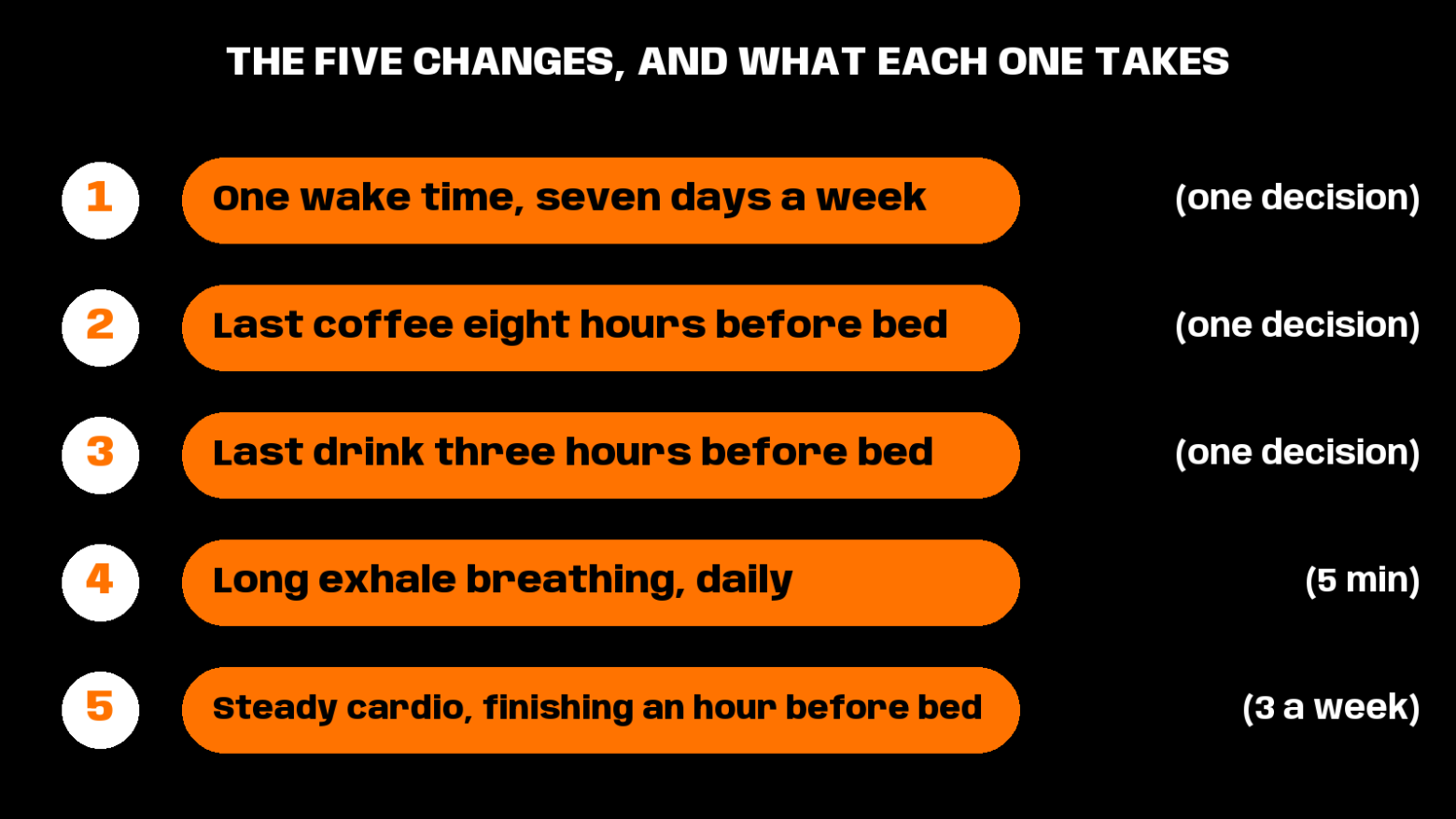
Four decisions and one practice. Change one a week, not all five on Monday.
Options for Men Who Want This to Stop Repeating
Most men have already worked out what to change here. What they have not got is anything holding the changes in place on the week it matters, which is why the same fortnight gets started in January, April and September without ever finishing.
The MenTools app runs this alongside mindset, fitness, nutrition and money in one challenge system, with daily actions, levels you choose, reminders timed to when a thing should actually happen, streak and progress tracking, and an AI coach. Its job here is specific rather than broad, which is keeping a wake time and a caffeine cut-off in place long enough for you to see whether they worked.
How you can do this today: set your wake time as a daily action and your last-coffee time as a second one, so both are decided before the day starts deciding for you.
Wins on cost: one subscription covers the sleep, stress and training sides together rather than three separate apps and a wearable.
Wins on time: the structure and tracking already exist, so there is nothing to design before you start.
Wins on practicality: a wake time and a coffee cut-off survive shifts, travel and young children, which is where longer routines break first.
Watch-out: it is a behaviour and consistency tool, not a sleep tracker, a diagnosis or a treatment. If the section above applies to you, it supports the medical route rather than replacing it.
Recovery is what all of this is protecting, and it is hardest to hold together in the weeks a man is running on empty, so a one a day multivitamin may help cover the simple daily foundation underneath the behaviour work. For more built for men on this topic, see the MenTools stress hub. Hold the wake time for a fortnight and the rest of the list gets much easier to judge.
Last updated: 2026-09-24 v1.0
Disclaimer: This guide is for informational purposes only and does not constitute medical or psychological advice. Speak with a qualified professional before making significant changes if you have a medical or mental health condition.
References
- [1] Dressle RJ, Riemann D. Hyperarousal in insomnia disorder, current evidence and potential mechanisms. Journal of Sleep Research, 2023;32(6):e13928. Link
- [2] Waxenbaum JA, Reddy V, Das JM. Anatomy, Autonomic Nervous System. StatPearls Publishing, updated 1 December 2025. Link
- [3] Health and Safety Executive. Work-related stress, depression or anxiety statistics in Great Britain, 2025. Published 20 November 2025. Link
- [4] Mental Health Foundation. Stressed nation, 74 percent of UK overwhelmed or unable to cope at some point in the past year. YouGov survey of 4,619 adults, 2018. Link
- [5] Bowles NP, Thosar SS, Butler MP, Clemons NA, Robinson LD, Ordaz OH, Herzig MX, McHill AW, Rice SPM, Emens J, Shea SA. The circadian system modulates the cortisol awakening response in humans. Frontiers in Neuroscience, 2022;16:995452. Link
- [6] Leproult R, Copinschi G, Buxton O, Van Cauter E. Sleep loss results in an elevation of cortisol levels the next evening. Sleep, 1997;20(10):865-870. Link
- [7] Drake C, Roehrs T, Shambroom J, Roth T. Caffeine effects on sleep taken 0, 3, or 6 hours before going to bed. Journal of Clinical Sleep Medicine, 2013;9(11):1195-1200. Link
- [8] Gardiner C, Weakley J, Burke LM, Roach GD, Sargent C, Maniar N, Huynh M, Miller DJ, Townshend A, Halson SL. The effect of alcohol on subsequent sleep in healthy adults, a systematic review and meta-analysis. Sleep Medicine Reviews, 2025;80:102030. Link
- [9] Spaak J, Tomlinson G, McGowan CL, Soleas GJ, Morris BL, Picton P, Notarius CF, Floras JS. Dose-related effects of red wine and alcohol on heart rate variability. American Journal of Physiology, Heart and Circulatory Physiology, 2010;298(6):H2226-H2231. Link
- [10] National Health Service. Stress. NHS. Link