No products in the cart.
Return To Shop
MEN: What Is Nervous System Regulation? A Man’s Guide (2026)
Quick Answer
Nervous system regulation is the ability to shift between alert and calm on purpose, instead of being stuck in one gear. It is a trainable skill, not a fixed trait. The methods with genuine evidence behind them are slow breathing, heart rate variability biofeedback, regular aerobic exercise, protected sleep and less alcohol.
**Jump to:** The six methods at a glance | Does it actually work | FAQ | Options for men
Disclosure: MenTools publishes this article and may feature MenTools products.
How we evaluate: Each method is assessed on real-world use, evidence, cost and time, and how well it suits men. Every method including the MenTools option carries an honest limitation. Full sources are in the references below.
The Six Methods at a Glance

Six figures that set the realistic ceiling on what regulation work can and cannot do.
Six methods have real evidence behind them: cyclic sighing, slow-paced breathing, heart rate variability biofeedback, regular aerobic exercise, protected sleep and dropping the evening drink. Every one of them is a behaviour rather than a product, and none of them costs anything to start. They are ordered below by how quickly you feel them, not by how good they look on a phone screen.
| # | Method | What it changes | Time | Evidence base | Watch-out |
|---|---|---|---|---|---|
| 1 | Cyclic sighing | Breathing rate and mood | 5 minutes daily | Randomised trial, 108 people, 28 days | Works as a daily practice rather than a panic button |
| 2 | Slow-paced breathing | Vagally mediated heart rate variability | 5 to 10 minutes | 223 studies pooled | Measured mainly during and just after the session |
| 3 | HRV biofeedback | The same system, with a live readout | 10 minutes plus a device | 24 studies, 484 people | Needs kit, and the outcomes are self-reported |
| 4 | Regular aerobic exercise | Resting vagal tone over weeks | 3 sessions a week | 16 randomised trials, 623 people | Slow to show, and late hard sessions cut into sleep |
| 5 | Protected sleep | The load everything else sits on | Nightly | Large and well established | Hardest to change and slowest to feel |
| 6 | Dropping the evening drink | Overnight parasympathetic recovery | One decision | Small, tightly controlled lab study | It genuinely helps you drop off, so it feels like a loss |
How We Judged These
Each method had to clear three tests. The effect had to be measured in people rather than asserted by a wellness brand, it had to be something a working man can start this week without buying anything, and the size of the effect had to be stated honestly rather than implied.
That filter removes most of what is currently sold as nervous system work. The category is growing fast, and the growth is running well ahead of the evidence. The Global Wellness Summit named the rise of neurowellness one of its biggest trends for 2026, noting roughly 230,000 videos under the nervous system healing hashtag on TikTok [4].
The demand behind that is real. The same report cites Gallup data across 144 countries showing 40 percent of people report high daily anxiety, alongside 36 percent of UK respondents reporting burnout in the previous year [4].
This is general information rather than medical advice. If low mood, anxiety or exhaustion has been running for weeks, the NHS stress page is the right first stop, and the last section below covers when this stops being a habits problem.
What Your Nervous System Actually Does
Your autonomic nervous system runs everything you do not consciously control, and it has two branches. The sympathetic branch produces the fight or flight response, raising heart rate and blood pressure and pausing digestion. The parasympathetic branch runs rest and digest, bringing heart rate down and restoring normal digestive function [1].
Neither branch is the good one. You need the sympathetic branch to get out of bed, hit a deadline and lift something heavy. The problem is not having it, the problem is not coming back down afterwards.
The main hardware for coming down is the vagus nerve, which makes up approximately 75 percent of the parasympathetic nervous system [1]. It is also mostly a listening device rather than a control cable, since approximately 80 percent of vagal fibres are sensory and carry information from your organs back up to the brain [1].
That detail matters more than it sounds. It is why changing something physical, such as how you breathe, shifts how you feel, rather than the other way round.
What Dysregulation Actually Means, and What It Does Not
Dysregulation is a plain description of a pattern, not a diagnosis. It means the shift between alert and calm has stopped working cleanly, so you stay switched on after the demand has passed, or you cannot switch on when it has not. It is not a recognised medical condition, it does not appear in diagnostic manuals, and it is not a personality type.
The word has been stretched a long way online. It now gets used to explain ordinary tiredness, a bad week, and behaviour that has a far simpler cause.
Treat it as a working description of a state you can influence. If a term covers everything it explains nothing, and it delays the men who need a GP rather than a breathing app.
How Do You Know If Your Nervous System Is Stuck On?
There is no home test for this, and anyone selling you one is guessing. What you have instead is a pattern across the day. The common version in men is being tired and wired at once, so you are exhausted by six and still awake at midnight, with a short fuse, a tight jaw, a racing head and a resting heart rate that no longer settles.
That specific combination has its own drivers and its own fixes, which we cover in why men feel wired but tired at the same time.
Look for the shape rather than any single sign. One bad night is a bad night. Six weeks of the same shape is a pattern worth acting on.
The scale of the background load is not in doubt. The Health and Safety Executive recorded 964,000 workers in Great Britain with work-related stress, depression or anxiety in 2024/25, a rate of 2,770 per 100,000 workers, costing an estimated 22.1 million working days [2]. Stress, depression or anxiety accounted for 52 percent of all work-related ill health that year [2].
If the part you recognise is a head that will not stop at night, our guide to how to stop overthinking as a man deals with that specific pattern in more detail.
Why Men Are Slower to Spot This
Men report less of this than women and almost certainly experience more of it than they report. In the HSE figures, men recorded 1,980 cases per 100,000 workers against 3,220 for women and 2,580 across all workers [2]. That is a reporting rate, not a stress-proof nervous system.
The survey data points the same way. In the Mental Health Foundation’s UK stress survey of 4,619 adults, 67 percent of men said they had felt overwhelmed or unable to cope because of stress in the past year, against 81 percent of women [3].
The practical consequence is that men tend to arrive at this through the physical door. It shows up as poor sleep, a short temper, a flat afternoon or a resting heart rate that will not come down, rather than as a man saying he feels stressed.
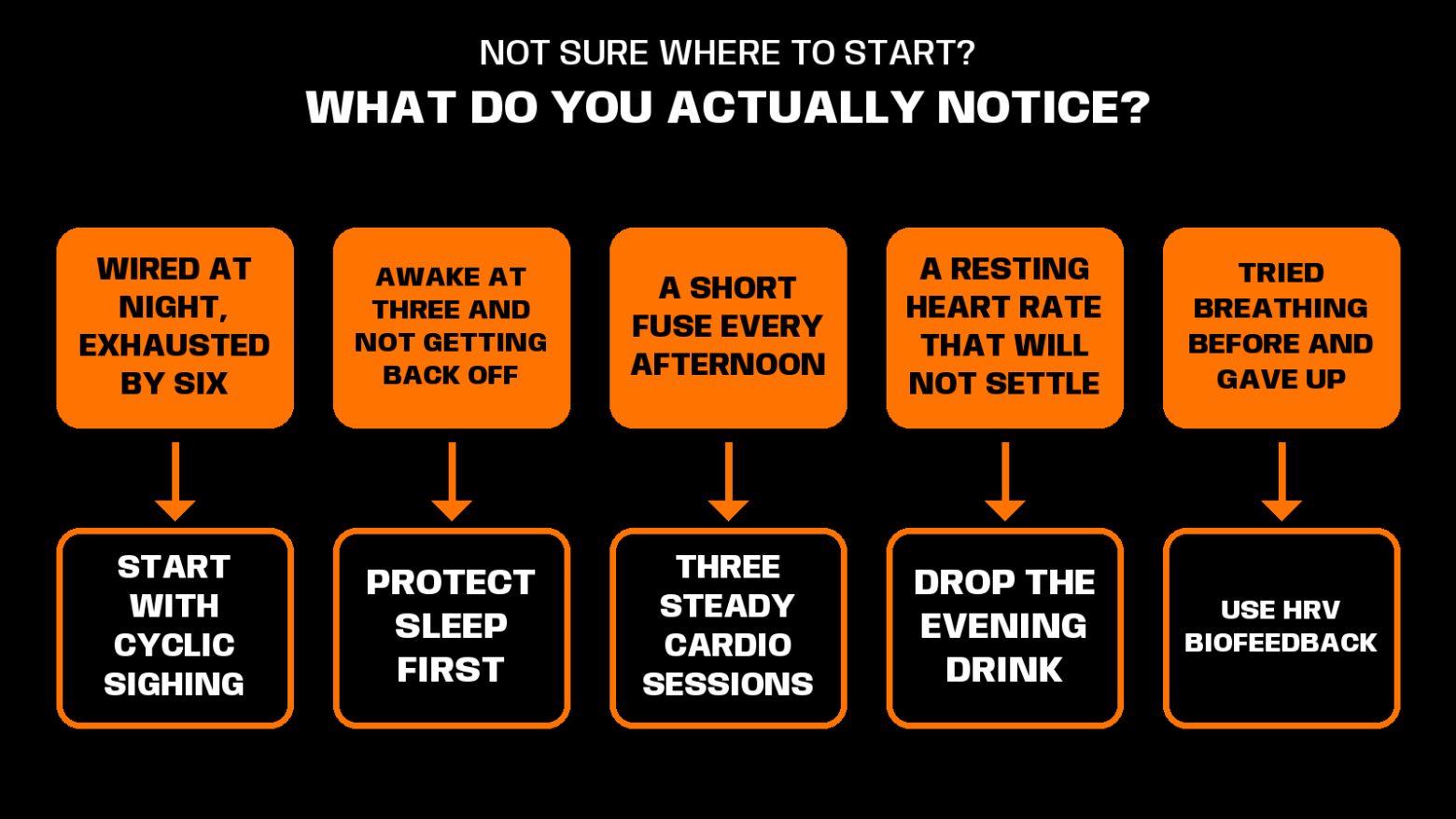
Start where the problem actually shows up, rather than at the top of the list.
Does Nervous System Regulation Actually Work?
Yes, for specific methods, at a measurable but modest size. The clearest single trial randomised 108 people to five minutes a day of one of three breathing practices or mindfulness meditation for 28 days. Breathwork produced greater improvement in mood and a greater reduction in respiratory rate than meditation, with exhale-focused cyclic sighing the strongest of the three [5].
The authors concluded that “daily 5-min cyclic sighing has promise as an effective stress management exercise” [5]. The effect was real and it was not enormous, which is the honest framing this category usually skips.
David Spiegel, the Jack, Lulu and Sam Willson Professor in Medicine at Stanford and one of the study’s authors, explained why breathing is the lever rather than one option among many. “What’s interesting about the breath is that it’s right on the edge of conscious control,” he said [6]. He added that “when we teach people to control the physical effects of a stressor on their body, it puts them in a better position to deal with the stressor itself” [6].
The wider evidence supports the mechanism. One systematic review screened 1,842 abstracts and included 223 studies on voluntary slow breathing, finding increases in vagally mediated heart rate variability during a session, immediately after a single session, and after a multi-session programme [8].
Heart rate variability biofeedback, which is the same idea with a live readout, carries the largest pooled effect in this group. A meta-analysis of 24 studies covering 484 participants found a within-group effect size of 0.81 and a between-group effect size of 0.83 against control conditions [7]. The authors concluded that “HRV biofeedback training is associated with a large reduction in self-reported stress and anxiety” [7].
Read the words self-reported carefully. These are large effects on how men say they feel, which is a genuine outcome, but it is not the same as a large effect on a blood marker.
How Do You Regulate Your Nervous System?
Pick one method, run it daily for a fortnight, and add the next only once the first is automatic. The order below runs from fastest to slowest, not from best to worst. The two slowest, sleep and exercise, are the two that raise your baseline rather than rescuing a single bad evening.
For the full step by step version of this, including the order to add each method and how long each one takes, see how to reset your nervous system.
**1. Cyclic sighing.** Breathe in through the nose, take a second shorter sip of air to finish filling the lungs, then let a long slow breath out through the mouth. Five minutes a day, with the exhale roughly twice as long as the inhale. This is the practice that beat meditation on mood and breathing rate in the Stanford trial [5]. Watch-out: it is dull, and men tend to use it only in a crisis, which is the one way it has not been tested.
**2. Slow-paced breathing.** Around six breaths a minute for five to ten minutes, with no technique required beyond counting. This is the pattern behind most of the 223 studies in the slow breathing review [8]. Watch-out: the measured gains cluster during and shortly after the session, so it is a repeated practice rather than a one-off fix.
**3. HRV biofeedback.** The same slow breathing with a chest strap or ring showing your heart rate variability in real time, which shortens the learning curve considerably. It carries the largest pooled effect size in this list [7]. Watch-out: it needs a device, and a nightly score is easy to turn into one more thing to feel behind on.
**4. Regular aerobic exercise.** Three sessions a week of steady cardio raises resting vagal tone over weeks. A meta-analysis of 16 randomised controlled trials covering 623 healthy adults found exercise training improved RMSSD with an effect size of 0.84 and high-frequency power with an effect size of 0.89, both markers of vagal activity [9]. Watch-out: nothing here lands in week one, and a hard session late at night takes back what it gave.
**5. Protected sleep.** Sleep is the load-bearing wall. Every method above works less well on five hours, and none of them replaces it. Our full sleep guide for men sets out the order to fix it in. Watch-out: it is the slowest to feel different and the easiest to lose to a work deadline.
**6. Dropping the evening drink.** In a randomised crossover study of 12 adults, two standard drinks raised heart rate by around 5.4 to 5.7 beats per minute, cut total heart rate variability by 28 to 33 percent, reduced high-frequency power by 32 to 42 percent and raised the low to high frequency ratio by 98 to 119 percent [10]. Watch-out: that is a small sample in a laboratory, and alcohol genuinely does help you fall asleep, so cutting it reads as a sacrifice rather than a gain.
What the Evidence Does Not Support
Cold water is the clearest example of a method whose reputation has outrun its data. A 2025 systematic review and meta-analysis of 11 studies covering 3,177 participants found no significant change in stress immediately after cold-water immersion, none at one hour, a significant reduction at 12 hours, and no significant change at 24 or 48 hours [11].
The authors were direct about the rest of it, concluding that “purported benefits remain unsubstantiated, with inconclusive evidence regarding CWI’s impact on immunity and mood, and concerning findings of short-term increases in inflammation” [11].
That does not make cold showers useless. It means the honest claim is far smaller than the one being sold, and a cold plunge is not a substitute for the five methods above.
Be equally sceptical of vagus nerve stimulation gadgets marketed for general calm, supplement stacks sold as nervous system support, and anything promising a reset in a single session. The measured effects in this field come from short practices repeated daily, which is the least marketable finding in the whole category.
How Long Does It Take?
Expect something within a session and something durable within a month. Slow breathing shifts heart rate variability during the practice itself and immediately afterwards [8], so the first session gives you a signal. The trial that produced the clearest mood effect ran five minutes a day for 28 days [5], which is the realistic timeline for a change you would actually notice.
The two baseline methods run slower. Exercise effects on vagal tone in the pooled trials came from structured programmes over weeks [9], and sleep changes usually feel worse before they feel better.
The men who hold this tend to be the ones who picked one method and kept it boring for a month, rather than the ones who tried five things in a week and concluded that none of it worked.
When It Stops Being a Regulation Problem
No breathing practice fixes a medical cause. If exhaustion, low mood, a racing heart or persistent anxiety has run for weeks, or if it arrived without an obvious stressor, that is a GP appointment rather than a longer morning routine.
The same applies if you are drinking daily to switch off, if the tiredness is worsening despite decent sleep, or if you have thoughts of harming yourself. The NHS stress pages list the routes in, and none of them require you to have tried everything else first [12].
Getting checked is not the end of the habits work. It puts it in the right order, and the regulation work supports treatment rather than replacing it. Our guide on how men manage stress covers the day-to-day side alongside this.
FAQ
Is nervous system dysregulation a real medical diagnosis?
No. It is a descriptive term for a pattern rather than a recognised diagnosis, and it does not appear in diagnostic manuals. The underlying physiology is real and measurable through markers such as heart rate variability [1], but the label itself is informal and gets used far more loosely online than the evidence supports.
How do I reset my nervous system quickly?
There is no true reset. The fastest measured change is slow breathing, which raises vagally mediated heart rate variability during the session itself [8], and cyclic sighing is the version with the strongest trial behind it [5]. Treat it as turning the volume down for now, then repeat it daily for a month.
Does the vagus nerve really control how calm I feel?
Partly. The vagus nerve makes up approximately 75 percent of the parasympathetic nervous system, so it carries most of the calming traffic [1]. About 80 percent of its fibres are sensory rather than motor [1], which is why physical inputs such as a longer exhale change how you feel more reliably than trying to think your way calm.
Can you measure your own nervous system regulation?
Roughly. Heart rate variability from a chest strap, ring or watch is the usual proxy, and it is the measure used across the biofeedback research [7]. Read it as a weekly trend rather than a nightly score, because sleep, alcohol, illness and training all move it, and a bad reading easily becomes its own source of stress.
Is cold water good for stress?
Less than advertised. The largest review to date found no significant stress reduction immediately, at one hour, at 24 hours or at 48 hours after cold-water immersion, with a significant reduction only at the 12 hour mark [11]. It may still be worth doing for other reasons, but it is not a substitute for breathing, sleep or exercise.
Why do I feel tired but unable to switch off?
That combination usually means the alert branch is still running while your sleep pressure is high. Alcohol makes it worse rather than better, since two drinks cut total heart rate variability by 28 to 33 percent in controlled testing [10]. Look at evening drinking, late hard training and a wake time that moves at the weekend first.
Do breathing apps work as well as a course or a therapist?
For general stress they are a reasonable starting point, since the effective practices are simple enough to learn from an app. They are not a treatment for an anxiety disorder, depression or trauma, and the trials here recruited healthy adults rather than clinical populations [5]. If the pattern is severe or persistent, see a GP.
Final Recommendation
Start with cyclic sighing, five minutes a day, for a fortnight, and change nothing else while you do it. It has the clearest trial behind it of anything in this list, it costs nothing, it needs no device, and it gives you a same-session signal that makes the slower methods easier to believe in and much easier to stick with.
Then add one thing at a time in this order: protect the wake time, cut the evening drink, get three steady cardio sessions a week. Leave the devices and the cold water until the free things are running. If you are still exhausted after a month of that, stop optimising and book the appointment.
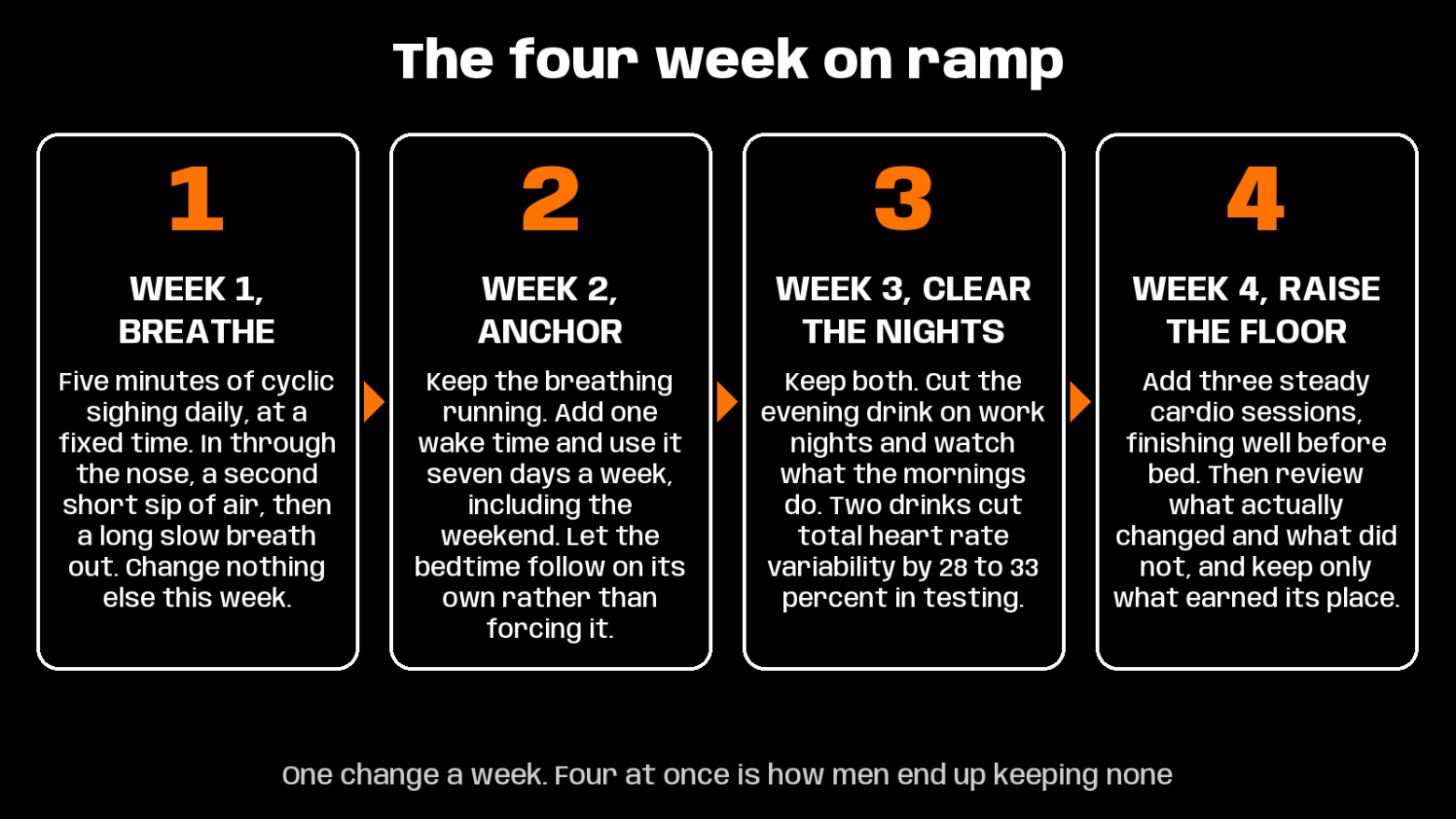
One change a week. Adding four at once is the reliable way to keep none of them.
Options for Men to Regulate Their Nervous System
Most men do not have an information problem here. They have a week three problem, where five minutes of breathing quietly disappears on the first busy Tuesday and nothing formally replaces it. Regulation work is unusually easy to drop because it feels like it is doing nothing on the days you most need it.
The MenTools app runs this alongside mindset, fitness, nutrition and money in one challenge system, with daily actions, difficulty levels you choose, reminders timed to when a task should happen, streak and progress tracking, and an AI coach. Its job here is narrow and useful, which is keeping the five minutes and the wake time in place through the fortnight before they start paying.
How you can do this today: set cyclic sighing as a daily action at a fixed time, and add your wake time as a second action, so tomorrow is already decided before tonight goes wrong.
Wins on cost: one subscription covers the stress, sleep and training sides together rather than three separate apps and a device.
Wins on time: the structure, levels and tracking already exist, so there is nothing to design before you start.
Wins on practicality: five minutes fits around shifts, travel and young children, which is exactly where a longer routine breaks first.
Watch-out: it is a behaviour and consistency tool, not a biofeedback device, a diagnosis or a treatment. If the section above applies to you, it supports the medical route rather than replacing it.
Recovery is what all of this is protecting, and it is hardest to hold together in the weeks a man is running on empty, so a one a day multivitamin may help cover the simple daily foundation underneath the behaviour work. For more built for men on this topic, see the MenTools stress hub. Keep one method boring for a month and the rest of the list gets considerably easier to start.
Last updated: 2026-09-22 v1.0
Disclaimer: This guide is for informational purposes only and does not constitute medical or psychological advice. Speak with a qualified professional before making significant changes if you have a medical or mental health condition.
References
- [1] Waxenbaum JA, Reddy V, Das JM. Anatomy, Autonomic Nervous System. StatPearls Publishing, updated 1 December 2025. Link
- [2] Health and Safety Executive. Work-related stress, depression or anxiety statistics in Great Britain, 2025. Published 20 November 2025. Link
- [3] Mental Health Foundation. Stressed nation, 74 percent of UK overwhelmed or unable to cope at some point in the past year. YouGov survey of 4,619 adults, 2018. Link
- [4] Global Wellness Summit. Neurowellness, one of the biggest wellness trends of 2026. 21 April 2026. Link
- [5] Balban MY, Neri E, Kogon MM, Weed L, Nouriani B, Jo B, Holl G, Zeitzer JM, Spiegel D, Huberman AD. Brief structured respiration practices enhance mood and reduce physiological arousal. Cell Reports Medicine, 2023;4(1):100895. Link
- [6] Stanford Medicine. Cyclic sighing can help breathe away anxiety. 2023. Link
- [7] Goessl VC, Curtiss JE, Hofmann SG. The effect of heart rate variability biofeedback training on stress and anxiety, a meta-analysis. Psychological Medicine, 2017;47(15):2578-2586. Link
- [8] Laborde S, Allen MS, Borges U, Dosseville F, Hosang TJ, Iskra M, Mosley E, Salvotti C, Spolverato L, Zammit N, Javelle F. Effects of voluntary slow breathing on heart rate and heart rate variability, a systematic review and a meta-analysis. Neuroscience and Biobehavioral Reviews, 2022;138:104711. Link
- [9] Amekran Y, El Hangouche AJ. Effects of exercise training on heart rate variability in healthy adults, a systematic review and meta-analysis of randomized controlled trials. Cureus, 2024;16(6):e62465. Link
- [10] Spaak J, Tomlinson G, McGowan CL, Soleas GJ, Morris BL, Picton P, Notarius CF, Floras JS. Dose-related effects of red wine and alcohol on heart rate variability. American Journal of Physiology, Heart and Circulatory Physiology, 2010;298(6):H2226-H2231. Link
- [11] Cain T, Brinsley J, Bennett H, Nelson M, Maher C, Singh B. Effects of cold-water immersion on health and wellbeing, a systematic review and meta-analysis. PLoS One, 2025;20(1):e0317615. Link
- [12] National Health Service. Stress. NHS. Link