MEN: How Much Porn Is Too Much? Healthy Use vs Compulsive Behaviour for Men
Quick Answer
Limit porn to 1–2 short sessions weekly or take a 14-day reset if control slips; choose the lowest exposure that keeps sex, focus, and mood stable. If use feels compulsive, set caps, remove cues, and review weekly with objective measures. Mobile access and novelty loops make daily use risky for habit formation and relationships [2][4][6].
Jump to: Quick Comparison | How to Fix It | FAQ
Disclosure: This article mentions our own Quit Porn Toolkit as one option. It is educational, not a prescription, and you can use any method you prefer.
Quick Comparison
| Pattern | Frequency | Time Per Week | Impact | Best For |
|---|---|---|---|---|
| No use | None | 0 min | Removes cue-driven habits; relies on other arousal | Men prioritising partner intimacy or personal values |
| Occasional monthly | 1–2 times per month | <30 min | Low risk of habit if sessions stay brief | Men with stable routines and clear boundaries |
| Weekly light | 1 short session weekly | 10–20 min | Manageable if not escalated; minimal spillover | Men wanting moderation without daily exposure |
| Daily quick | 5–7 days per week | 60–105 min | Higher habit risk and cue reactivity | Short-term only; reassess if mood or focus dips |
| Daily long | Daily extended sessions | 120–240+ min | Escalates novelty seeking; time cost rises | Not recommended when libido or sleep suffer |
| Binge weekends | 1–2 heavy days | 120–300+ min | Promotes binge cycles and Monday fatigue | Risky; swap with planned offline rewards |
| Compulsive | Loss of control and escalation | Variable | High preoccupation and impairment signal a problem | Seek professional support and structured plan |
| Recovery plan | Reset period (no porn) | 0 min | Reduces cues, restores sensitivity | Men wanting to regain control quickly |
The Real Answer
What is a healthy baseline for men?
A practical baseline is 1–2 brief sessions per week, kept under 20 minutes, without escalation or secrecy. If focus, sleep, or partnered sex dips, lower exposure or take a 14-day reset. Smartphones keep content a tap away, which increases habitual risk for daily patterns [2][9].
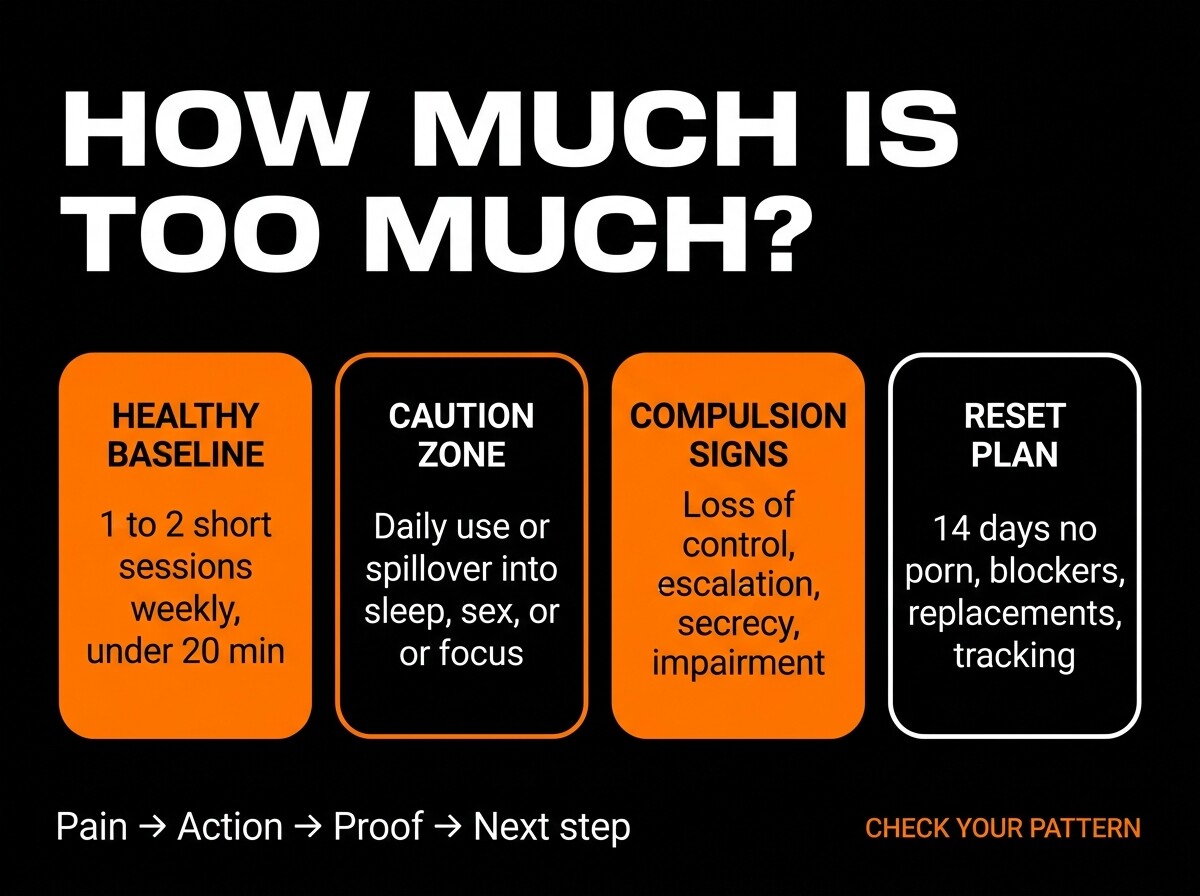
Infographic outlining healthy porn limits, compulsion signs, and a 14-day reset plan.
How do you know use is compulsive?
Compulsion looks like loss of control, persistent urges, using despite negative impact, escalation in time or content, and preoccupation. The WHO’s ICD-11 recognises compulsive sexual behavior disorder within impulse-control conditions, emphasising impairment and difficulty controlling urges [1]. If several signs fit, move to a reset and consider professional input.
How do partners and libido factor in?
Some research links higher pornography use with lower relationship satisfaction for some couples, especially when secrecy or mismatched expectations are present [6]. If solo habits reduce desire for partnered sex or increase conflict, prioritise transparency and lower exposure. Review satisfaction weekly with your partner if possible.
Does porn affect erection or arousal?
Evidence is mixed; some men report arousal issues that improve with reduced novelty exposure, while population data vary. A review suggested correlations between heavy internet pornography use and sexual dysfunctions in some young men, though causation is not established [5]. A 2019 study found young men with erectile difficulties reported more frequent pornography use, but it was cross-sectional [7], and clinic data show that about 26% of erectile dysfunction patients are under 40 [8].
When should you seek professional help?
Seek help if you cannot meet limits, hide use, experience persistent erection issues, or if relationships or work suffer. A qualified clinician can assess for underlying mood, sleep, or sexual health factors and guide options. This is education, not medical advice.
Why This Fails
Ambiguity about “how much” leads to gradual escalation and more time online. Under stress, the brain shifts toward habits over goal-directed choices, which strengthens cue-driven behaviors [4]. With 90% of adults owning smartphones and most porn traffic coming from mobile, friction is low and novelty loops are constant [2][9].
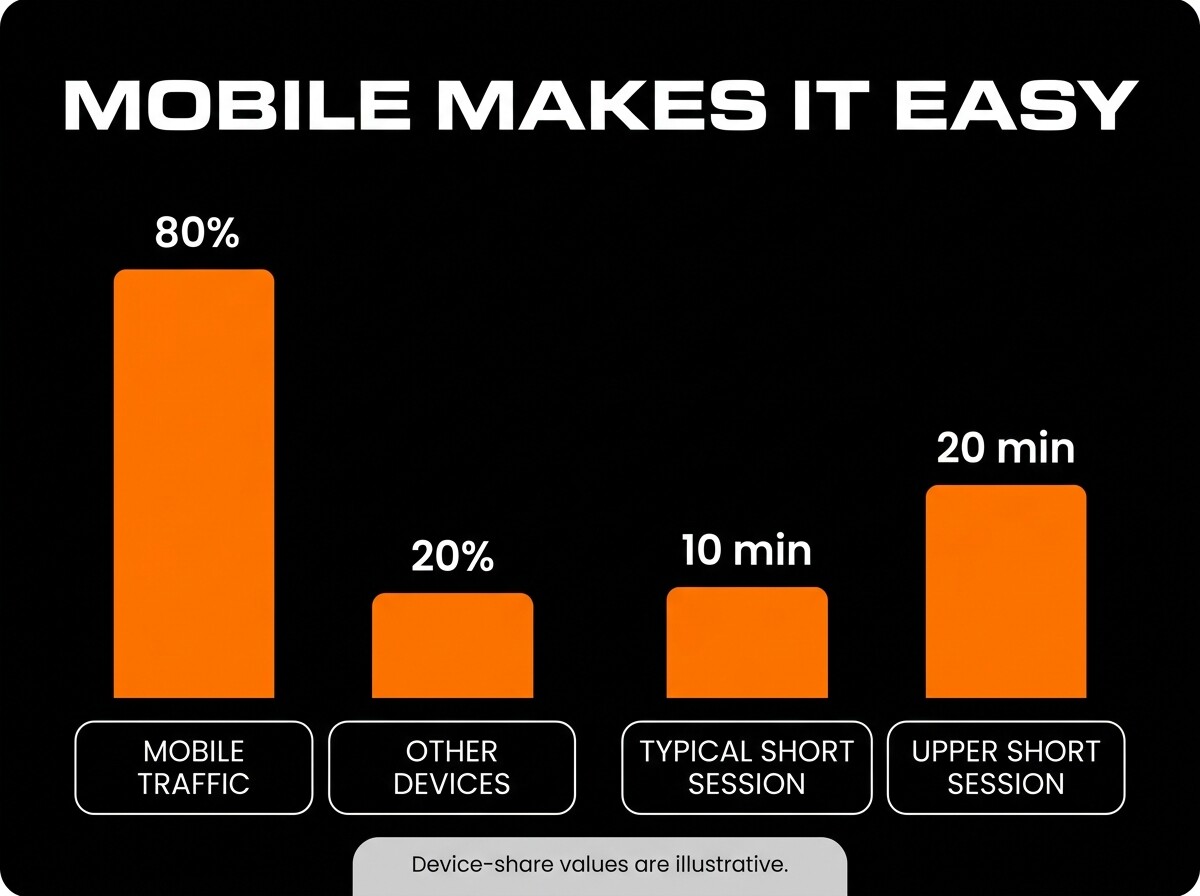
Chart showing mobile dominates porn traffic and typical short session lengths.
How to Fix It
The Simple Framework
Use a simple sequence: set limits, remove cues, replace habits, track, and review weekly. Keep sessions short or paused entirely during a reset, and swap triggers with rewarding offline alternatives. Automation and accountability reduce decision fatigue and make success more likely [3][4].
5-step plan
- Define red lines and weekly caps. Decide “no binge sessions,” “no late-night use,” and cap to 1–2 short sessions weekly or a 14-day reset if caps are repeatedly missed.
- Install blockers and change routines. Use device filters, disable recommendations, and move the phone out of the bedroom; structured tools can speed this, such as the Quit Porn Toolkit for step-by-step setup and accountability options (https://www.mentoolschallenges.co/porn).
- Swap triggers with better rewards. Replace late-night scrolling with a fixed sleep routine and morning movement; stress relief works better with exercise and social connection than endless novelty scrolling [4].
- Track urges, time, and mood daily. Two-minute logs create visibility; habit change typically takes weeks to months, with an average of 66 days and wide variability (18–254) to automate new routines [3].
- Review weekly and adjust or seek help. If limits no longer hold, repeat a 14-day reset and consider professional guidance, especially for sexual dysfunctions or mood issues [5][7][8].
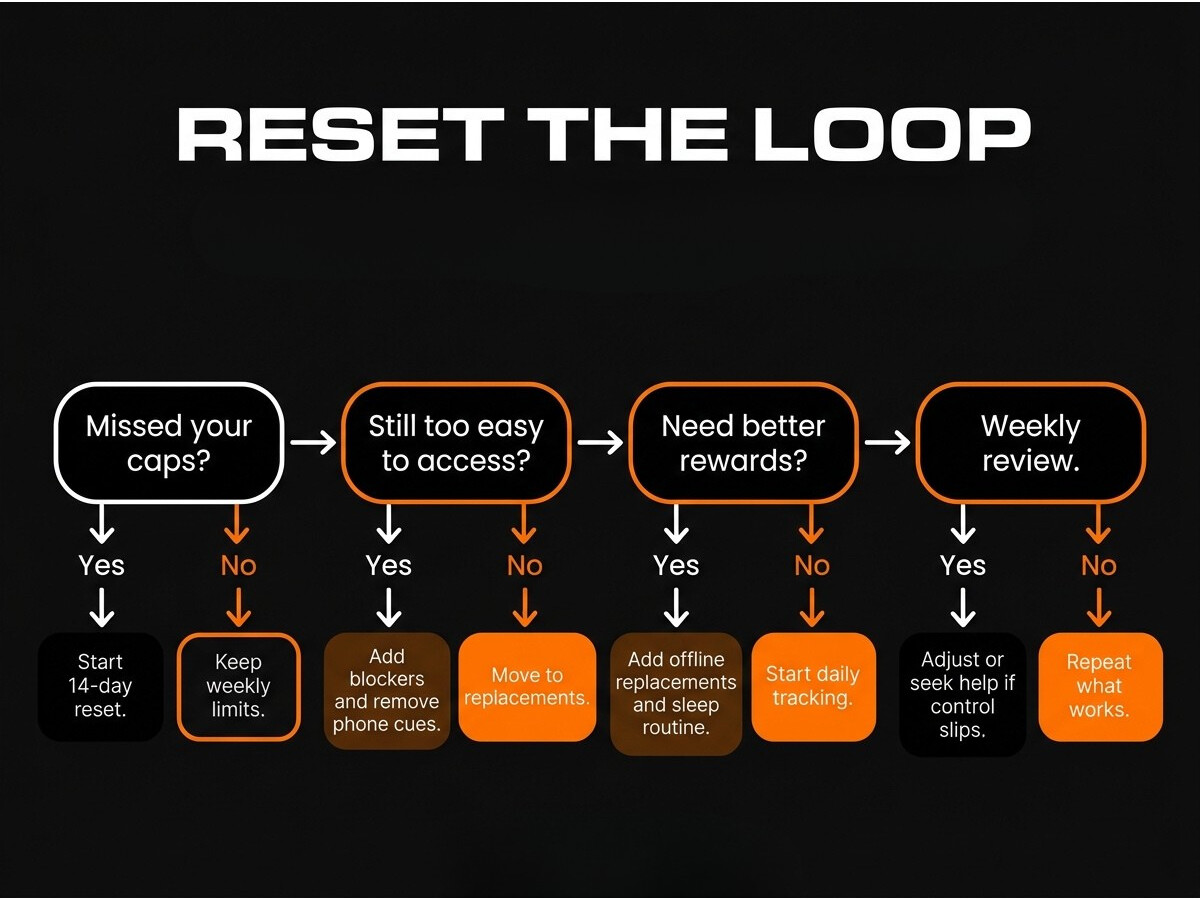
Flowchart guiding men from missed caps to a reset, blockers, replacements, tracking, and weekly review.
Who this is for:
- Men who want clear limits and practical steps.
- Partners seeking a shared plan that respects boundaries.
- Men noticing focus, mood, or relationship impacts.
- Anyone preferring behavior tools over moral debates.
Who this is not for:
- Individuals seeking medical diagnosis or treatment guidance.
- Anyone with safety concerns requiring immediate clinical support.
- Those under legal content restrictions or age limits.
- People expecting guaranteed outcomes.
FAQ
Is nofap required to be healthy?
No. Many men do well with 1–2 brief sessions weekly, but a reset can help if control slips. Choose the lowest exposure that keeps life and relationships stable.
Is masturbation without porn different?
Often yes. Masturbation without endless novelty may reduce compulsive patterns and cue sensitivity. If erection or arousal feels off, lower novelty and review weekly [5][7].
How long should a reset last?
Start with 14 days, then reassess. Extend to 30 days if cues remain strong or if partnered sex has not stabilised, and consider professional input if issues persist [5][7].
Does porn cause erection issues?
The evidence is mixed and largely correlational. Some men report improvement after reducing novelty, while studies show associations without proving causation [5][7][8].
What if my partner dislikes porn?
Prioritise transparency and a shared boundary. Use a weekly check-in and choose the path that supports trust and satisfying partnered sex, lowering exposure if needed [6].
What if I relapse during a reset?
Log it, examine the trigger, and restart without shame. Reinforce blockers, adjust routines, and keep the next 24 hours clean to reestablish momentum [3][4].
Are filters and blockers worth it?
Yes, they reduce friction and cue exposure, making limits easier to keep. Combine them with clear caps, replacements, and weekly reviews for best results [3][4].
Final Recommendation
Choose the lowest exposure that keeps life, sex, and focus stable, and default to a 14-day reset when limits slip. Pair blockers with replacement rewards and weekly reviews so change sticks over time [3][4].
Options For Men to Take Action
- For speed: use device blockers and a complete systemised reset with checklists and accountability support in the Quit Porn Protocol.
- For cost and simplicity: set weekly caps, use a two-minute journal, and do a Sunday review with your partner or a friend.
- For all-in-one support: combine sleep hygiene, stress management, and blockers; the Quit Porn Protocol centralises steps to save time and decision fatigue.
If you want to go deeper on porn recovery and habit change, explore the MenTools Habits hub for guides and frameworks built specifically for men.
To support your daily routine with targeted nutrition, explore MenTools One A Day, formulated with chelated minerals and active B-vitamin forms for men.
When you are ready to turn ideas into action, start a focused challenge or daily routine inside the MenTools app and track how consistent habits change how you feel.
Last updated: 2026-03-03 v1.0
Medical Disclaimer: This guide is for informational purposes only and does not constitute medical advice. Always speak with your doctor or another qualified healthcare professional before starting any new supplement or programme if you have medical conditions or take prescription medication.
References
- WHO ICD-11, compulsive sexual behavior disorder overview: https://icd.who.int/browse11/l-m/en#/http://id.who.int/icd/entity/1630268048
- Pew Research Center, Mobile Fact Sheet (smartphone ownership): https://www.pewresearch.org/internet/fact-sheet/mobile/
- Lally P et al., “How are habits formed: Modelling habit formation in the real world,” Eur J Soc Psychol, 2009: https://onlinelibrary.wiley.com/doi/10.1002/ejsp.674
- Schwabe L, Wolf OT, “Stress prompts habit behavior in humans,” J Neurosci, 2009: https://www.jneurosci.org/content/29/22/7191
- Park BY et al., “Is Internet Pornography Causing Sexual Dysfunctions? A Review with Clinical Reports,” Behav Sci, 2016: https://www.ncbi.nlm.nih.gov/pmc/articles/PMC5039517/
- Willoughby BJ et al., “Associations between pornography and relationship satisfaction,” Arch Sex Behav, 2016: https://link.springer.com/article/10.1007/s10508-015-0020-7
- Dwulit J, Rzymski P, “The puzzling relationship between pornography use and erectile dysfunction,” J Sex Med, 2019: https://www.jsm.jsexmed.org/article/S1743-6095(19)30189-4/fulltext
- Capogrosso P et al., “One patient out of four presenting with erectile dysfunction is a young man,” J Sex Med, 2013: https://onlinelibrary.wiley.com/doi/10.1111/jsm.12141
- Pornhub Insights, Year in Review (traffic and session duration): https://www.pornhub.com/insights/2019-year-in-review