MEN: Does Porn Change Your Brain? Neuroscience of Porn, Dopamine, and Compulsive Use
Quick Answer
Treat compulsive‑feeling use as habit learning, not damage. Reduce cues with device controls, add one accountability partner, and anchor sleep and exercise to steady urges [2][3][8].
Jump to: Quick Comparison | The Real Answer | How to Fix It
This is education, not medical advice.
Disclosure: MenTools publishes this article and may feature MenTools products.
Quick Comparison
| Concept | Means | Evidence | Best for |
|---|---|---|---|
| Incentive sensitization | Cue‑triggered wanting | Addiction theory and lab data [9] | Trigger mapping |
| Habit shift | Automatic responding | Real‑world habit studies [2] | Routine risk |
| Dopamine spikes | Reward learning | Imaging and animal research [9] | Urge education |
| Novelty escalation | Seeking new stimuli | Mesolimbic novelty effects [5] | Novelty seekers |
| Prefrontal strain | Weaker inhibition when tired | Sleep deprivation findings [3][8] | Night use |
| Reversibility | Plastic change over time | Brain plasticity and habits [2][9] | Early reset |
| Comorbidity | ADHD and mood links | ICD‑11 and clinical reviews [7] | Tailored supports |
| Context drivers | Isolation and opportunity | Smartphone access data [1] | Environment fixes |
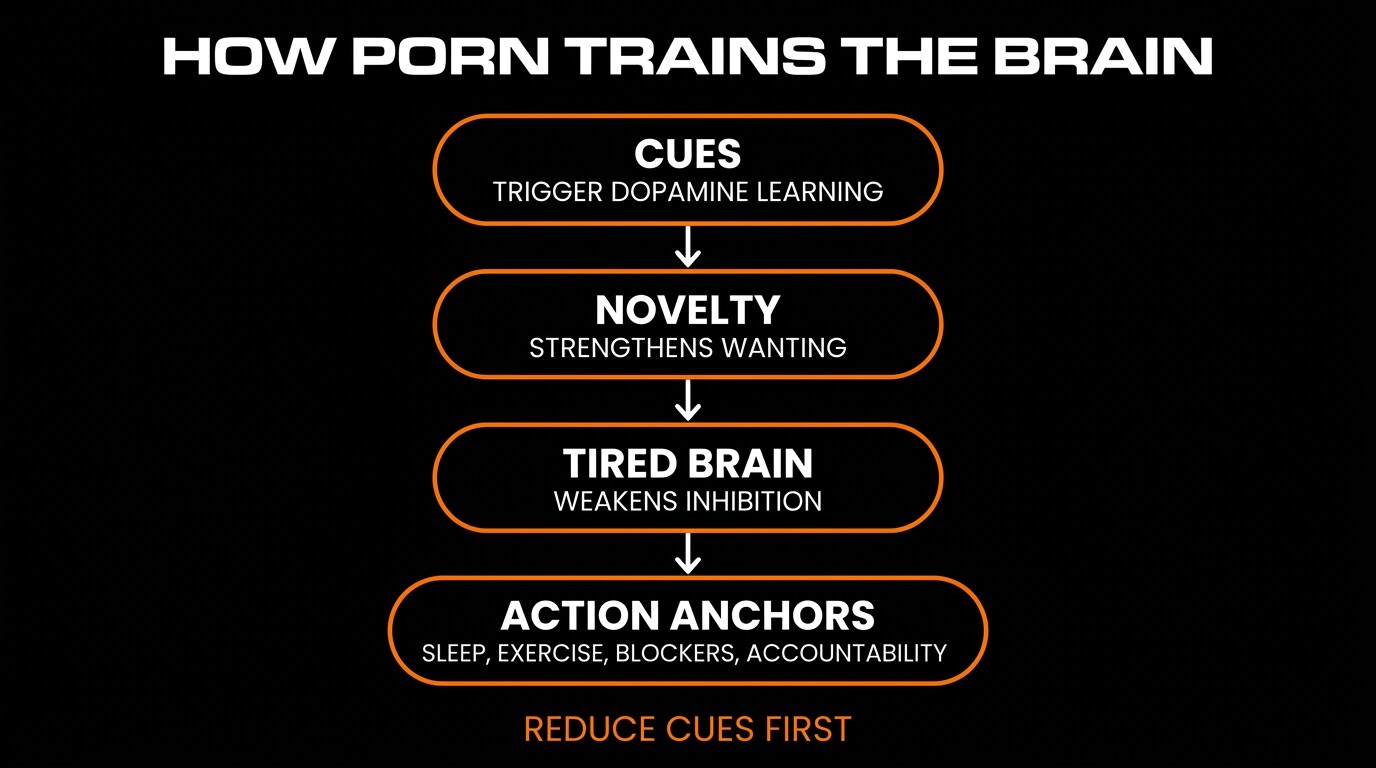
How porn trains the brain: cues, dopamine learning, novelty seeking, and inhibition under fatigue, plus action anchors.
The Real Answer
Does porn change dopamine pathways?
Porn engages the same reward learning systems as other appetitive cues, including dopaminergic signaling that strengthens cue‑response associations over time [9]. This is consistent with the brain learning to anticipate and seek rewarded stimuli in particular contexts.
Functional studies in compulsive sexual behavior show heightened reactivity to sexual cues in reward regions, suggesting a sensitized wanting response to triggers rather than global damage [6]. That pattern aligns with incentive‑sensitization theory’s focus on cue‑driven motivation [9].
Is it the same as drug addiction?
There are overlaps in cue reactivity and habit loops, but pharmacologic tolerance, withdrawal, and toxicity differ from substance use disorders [9]. The ICD‑11 classifies compulsive sexual behaviour disorder as an impulse‑control condition, highlighting behavior patterns and distress, not chemical dependence [7].
Practically, treating porn use as learned behavior helps because habits respond to cue control, implementation intentions, and accountability without medicalizing normal sexual function [2][7].
Are brain changes permanent or reversible?
Most learning‑based changes are plastic and can update with time and repetition. In habit research, new routines often take weeks, with a median of about 66 days to reach automaticity, depending on the behavior and person [2].
Reducing exposure to potent cues and building replacement routines can downshift sensitized responses, especially when supported by sleep and exercise that improve self‑regulation [3][8]. This reframes recovery as re‑training, not repair.
How do cues and novelty drive use?
Novelty activates mesolimbic circuits, which can push escalation toward new or more intense stimuli as the brain searches for prediction errors and fresh rewards [5]. If devices are unprotected, that novelty is one tap away in high‑risk moments.
When tired, frontal control systems are less effective, and emotional reactivity is higher. One study found sleep loss increased amygdala responses to emotional stimuli by about 60 percent and weakened regulatory connectivity, which can amplify urges at night [3].
What timelines do men actually report?
Men often describe early weeks as the most volatile, which fits habit formation curves and state‑dependent control. Locking in device controls first matters, because 85 percent of U.S. adults carry smartphones, making access the primary risk surface [1].
Expect gradual improvements as cues are removed and routines stabilize. Focus on controllables like blockers installed, hours slept, and if‑then plans executed rather than day counts [2][8].
Why This Fails
- Myths about dopamine damage and permanence.
- Binary labels that ignore habits and context.
- Ignoring sleep, stress, and unprotected devices.
How to Fix It
The Simple Framework
- Explain urges with neuroscience so they feel predictable.
- Reduce cues with blockers and friction in high‑risk contexts.
- Build default routines that anchor sleep, exercise, and downtime.
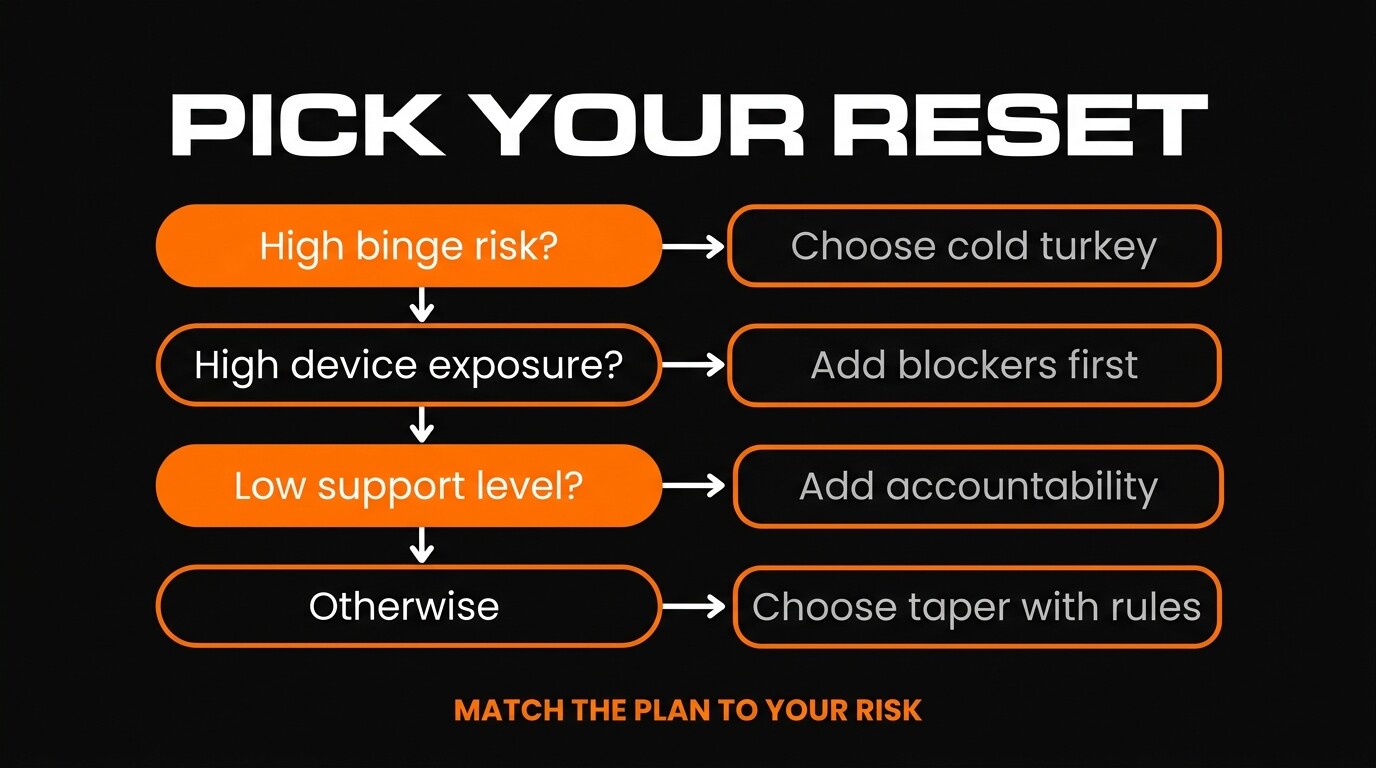
Pick your reset: flowchart branches by binge frequency, night‑use risk, and device exposure to cold‑turkey or taper with rules and accountability.
5‑step plan
- Map cues and high‑risk contexts.
List top triggers by time, place, and state. Write if‑then intentions for each, which are shown to improve goal follow‑through across behaviors [2][9]. - Secure devices and reduce novelty exposure.
Protect phone, laptop, and Wi‑Fi so explicit searches fail. Mobile access is ubiquitous, so closing that door first removes the fastest route to novelty escalation [1][5]. - Add sleep and exercise anchors.
Aim for the CDC baseline of 150 minutes of moderate activity weekly with two strength sessions, which supports mood and stress regulation [4]. Adults who sleep 7 or more hours tend to show better self‑control and emotional stability, useful when urges spike [8][3]. - Practice if‑then plans for urges.
For example, “If I am alone after 10 pm, then I dock my phone in the kitchen, shower, and read for 10 minutes.” Keep plans visible and rehearsed to make the response automatic under pressure [2]. - Use accountability and weekly reviews.
Tell one trusted person the rules and check in weekly. Review blockers, sleep, and plans for five minutes to nudge consistent progress.
Who this is for
- Men who want to understand urges through neuroscience and practical steps.
- Those seeking to reduce or quit porn with structured, low‑risk changes.
- Men open to device controls, routines, and accountability.
Who this is not for
- Anyone at risk of harm to self or others, or in acute crisis.
- Severe depression, trauma, or substance issues without clinical support.
- Situations requiring legal, workplace, or relationship safety planning.
For medication or mental health questions, speak with a qualified clinician.
FAQ
Does dopamine get depleted by porn?
No. Dopamine is a signaling molecule, not a fuel that runs out. Patterns involve learning and cue sensitivity rather than depletion [9].
Do brain scans show damage from porn?
Findings point to cue reactivity and habit loops rather than structural damage in typical use. In compulsive sexual behaviour samples, reward areas respond more to sexual cues, consistent with sensitization [6][7].
Is compulsive porn use a medical diagnosis?
ICD‑11 includes compulsive sexual behaviour disorder, defined by persistent patterns, distress, and impairment, not moral beliefs. Assessment is clinical and considers context and comorbidities [7].
Can quitting reset sensitivity and motivation?
Reducing cues and building alternative routines can change learned responses over weeks. Habit research and plasticity evidence support re‑training through repetition and context control [2][9].
How long until urges ease for most men?
Early weeks are often hardest. Many notice improvements as sleep increases and device access tightens, consistent with habit timelines and state regulation data [2][3][8].
Does masturbation without porn change recovery?
Some men separate behaviors to reduce cue learning while keeping sexual health. If you choose that path, use clear rules and blockers so erotic browsing does not creep back into routines.
What about ADHD or depression comorbidity?
Compulsive sexual behaviour can co‑occur with attention and mood issues. If present, tailored supports and clinician guidance are helpful to address overlapping drivers [7].
Final Recommendation
Use a habit‑plus‑cues model. Secure devices, anchor sleep and exercise, and practice if‑then plans so urges become predictable and manageable over time [2][3][4][8][9].
Options For Men to Take Action
- Fast start and most effective: use the Quit Porn Protocol for a guided reset with blocker guides, AI accountability coach, journals, meditations, and if‑then plans so you can launch and get yourself into a routine in under an hour.
- Cost‑savvy: start with built‑in device limits, free DNS filters, and a weekly check‑in with a friend. Add simple cue maps and routine anchors to compound gains.
- Time‑efficient: pick one high‑leverage change per week, like docking the phone outside the bedroom or adding two 20‑minute walks. Consistency beats intensity.
If you want to go deeper on porn recovery and habit change, explore the MenTools Habits hub for guides and frameworks built specifically for men.
To support your daily routine with targeted nutrition, explore MenTools One A Day, formulated with chelated minerals and active B-vitamin forms for men.
When you are ready to turn ideas into action, start a focused challenge or daily routine inside the MenTools app and track how consistent habits change how you feel.
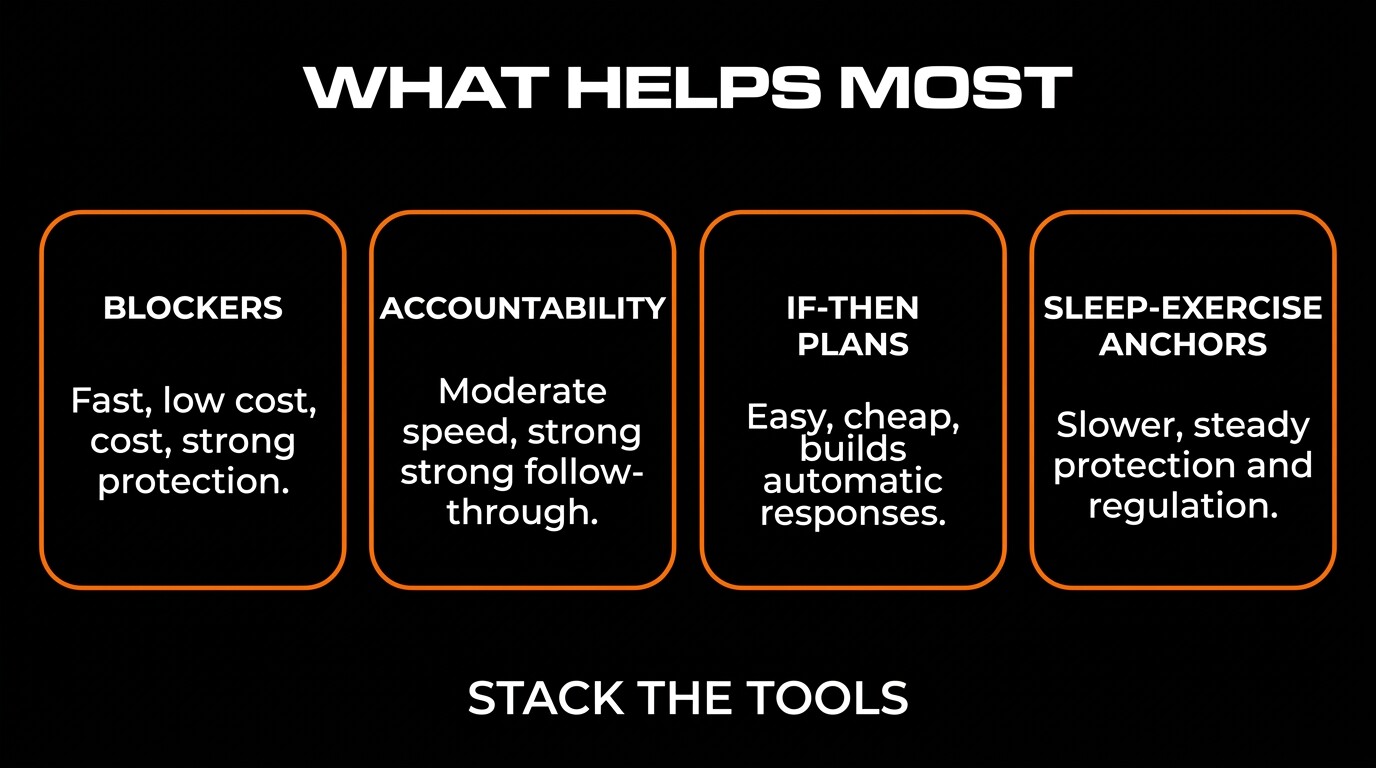
Comparison: blockers, accountability, if‑then plans, and sleep‑exercise anchors rated on speed, ease, cost, and relapse protection.
Last updated: 2026-03-04 v1.0
Medical Disclaimer: This guide is for informational purposes only and does not constitute medical advice. Always speak with your doctor or another qualified healthcare professional before starting any new supplement or programme if you have medical conditions or take prescription medication.
References
- Pew Research Center. Mobile fact sheet. https://www.pewresearch.org/internet/fact-sheet/mobile/
- Lally P, van Jaarsveld CH, Potts HW, Wardle J. How are habits formed in the real world? European Journal of Social Psychology. 2009. https://onlinelibrary.wiley.com/doi/10.1002/ejsp.674
- Yoo SS, Gujar N, Hu P, Jolesz FA, Walker MP. The human emotional brain without sleep. Current Biology. 2007. https://www.cell.com/current-biology/fulltext/S0960-9822(07)01507-4
- Centers for Disease Control and Prevention. How much physical activity do adults need? https://www.cdc.gov/physicalactivity/basics/adults/index.htm
- Bunzeck N, Düzel E. Absolute novelty is processed by the mesolimbic system. Journal of Neuroscience. 2006. https://www.jneurosci.org/content/26/18/6730
- Voon V, Mole TB, Banca P, et al. Neural correlates of sexual cue reactivity in individuals with and without compulsive sexual behaviours. PLoS One. 2014. https://journals.plos.org/plosone/article?id=10.1371/journal.pone.0102419
- Kraus C, Krueger RB, Briken P, et al. Compulsive sexual behaviour disorder in ICD‑11. World Psychiatry. 2018. https://www.ncbi.nlm.nih.gov/pmc/articles/PMC6329386/
- Centers for Disease Control and Prevention. How much sleep do I need? https://www.cdc.gov/sleep/about_sleep/how_much_sleep.html
- Robinson TE, Berridge KC. The incentive sensitization theory of addiction: some current issues. Addiction. 2008; and updates. https://onlinelibrary.wiley.com/doi/10.1111/j.1360-0443.2008.02285.x