MEN: Does Doomscrolling Cause Anxiety or Depression in Men? What Research Shows
Quick Answer
Yes. Recent research confirms that doomscrolling—the compulsive consumption of negative news and social media—directly increases anxiety, depression, and existential worry in men. Studies show that just 14 minutes of negative news consumption raises anxiety symptoms, and men who scroll passively for over 2 hours daily are 2–3 times more likely to report elevated anxiety. The solution isn’t willpower; it’s a structured framework that rewires your scrolling trigger.
Jump to: Comparison Table | The Real Answer | How to Fix It
Disclosure: MenTools publishes this article and may feature MenTools products.
How we evaluate: Products are assessed on nutrient form quality, dose vs NRV, authorised health claims, male-specific design, and independent research. Full sources are listed in the references below.
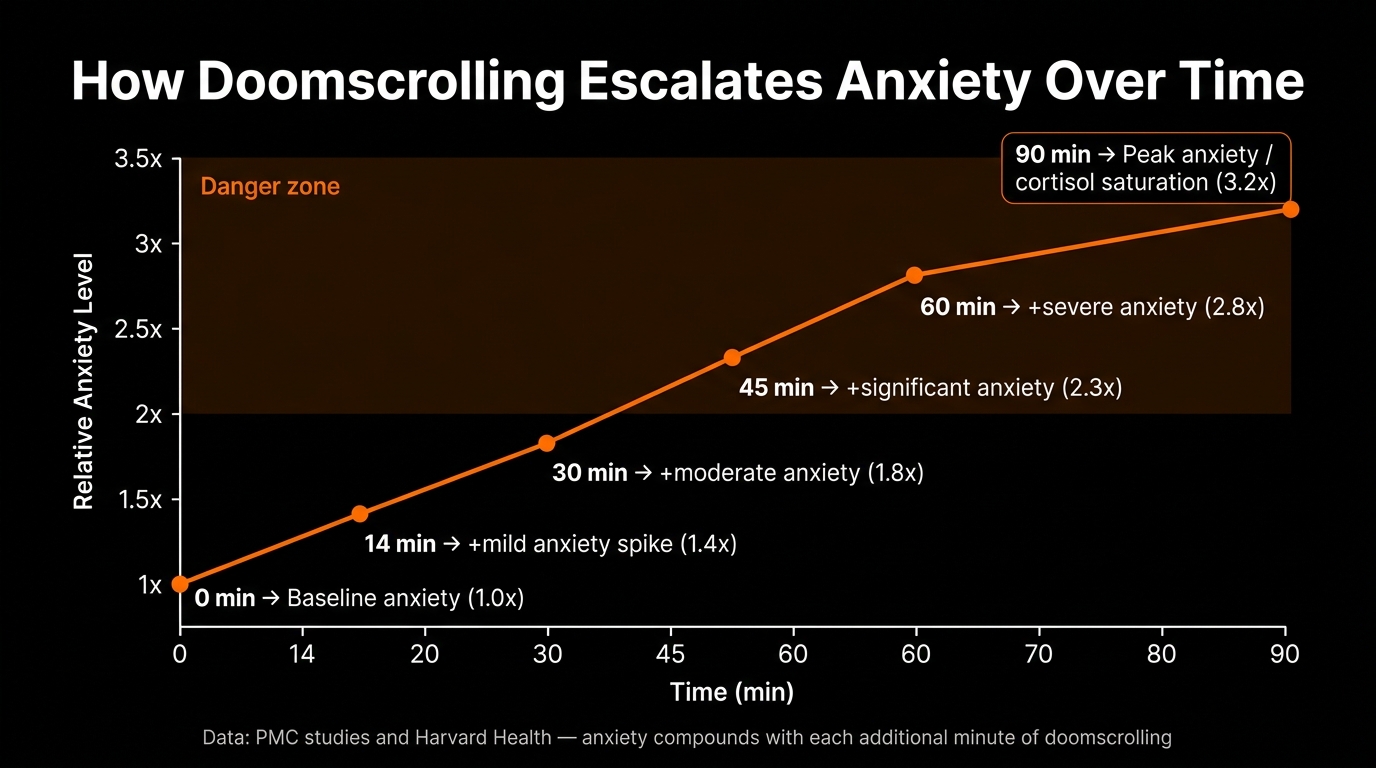
Figure 1: How doomscrolling escalates anxiety over time. Data: PMC studies and Harvard Health 2024–2025.
Quick Comparison
| Scrolling Pattern | Anxiety Risk | Depression Link | Sleep Impact | Best For |
|---|---|---|---|---|
| Active engagement (liking, commenting) | Moderate | Low to moderate | Minimal if daytime | Social connection; risk if compulsive |
| Passive scrolling (just browsing) | High | High | Severe if before bed | Not recommended; strongest anxiety link |
| Doomscrolling (negative news focus) | Very High | Very High | Severe; disrupts next-day mood | Not recommended; causes existential anxiety |
| Curated feeds only (positive, no algorithm) | Low | Low | Minimal | Men seeking low-risk scrolling |
| Time-bounded scrolling (<15 min, morning only) | Low | Low | Minimal | Men who want structured social media use |
| No scrolling (quit app or delete) | Lowest | Lowest | Best | Men with diagnosed anxiety or depression |
| Scheduled news check (once per day, 10 min) | Very Low | Very Low | Minimal | Men who need to stay informed without damage |
| Virtual reality or gaming (instead of scrolling) | Low to moderate | Low | Depends on timing | Men seeking active engagement alternative |
The Real Answer
Does doomscrolling really cause anxiety and depression?
Yes. The evidence is now overwhelming. Multiple peer-reviewed studies published in 2023–2025 confirm a direct causal link between doomscrolling and elevated anxiety, depression, and what researchers call existential anxiety—a deep sense of dread triggered by exposure to catastrophic news [1]. The mechanism is clear: negative news triggers uncertainty, which triggers the compulsion to scroll more, which increases stress hormones and deepens the anxiety cycle.
For men specifically, this pattern is reinforced by cultural scripts that discourage seeking help. Studies show that 56% of men report social media creates unattainable body image pressure, yet men are significantly less likely than women to talk about mental health impacts, meaning the anxiety builds silently [2].
How much scrolling causes measurable anxiety increases?
The threshold is lower than most men think. Research from Harvard Health and PMC studies shows that just 14 minutes of negative news consumption raises anxiety symptoms measurably [3]. For passive scrolling—the mindless browsing men do during downtime—exceeding 2 hours on weekdays doubles the odds of clinically elevated anxiety and quadruples the odds of emotional and behavioral difficulties.
The damage compounds: if you scroll before bed, sleep quality drops, morning anxiety increases, and the next day you’re more vulnerable to another scrolling cycle. This is not laziness or weakness; it’s predictable neurobiological response to negative stimuli.
Why do men doomscroll even when it makes them feel worse?
The psychological mechanism is called intolerance of uncertainty. When you feel uncertain or anxious, scrolling gives the illusion of control—”maybe the news got better” or “maybe I’ll understand this better if I read more.” Each refresh triggers a small dopamine hit, even though the content is negative [4]. For men raised to “solve problems,” doomscrolling feels like action, even though it’s the opposite.
Neurotic personality traits (neuroticism is not weakness; it’s a psychological trait related to sensitivity to negative emotions) and high trait anxiety make men even more vulnerable. Additionally, fear of missing out (FOMO) creates a secondary loop: if you stop scrolling, you fear being disconnected from your social group, so you scroll to ease that anxiety.
What is the actual depression link—does scrolling cause depression or do depressed men scroll more?
Both directions are true, which makes it a dangerous cycle. Men already experiencing depression or anxiety symptoms show higher doomscrolling rates, and doomscrolling itself worsens depressive symptoms [5]. Studies controlled for baseline depression and found that doomscrolling independently increased depression severity. The cycle: depression → more scrolling → worse depression → more scrolling.
The added risk for men is that depression often goes unrecognized or unreported. Men are more likely to mask depression as irritability, fatigue, or withdrawal, so the spiral can continue undetected until it reaches crisis.
Does taking a break actually work?
Simple app deletion or forced breaks show mixed results in research. Men who suddenly quit scrolling often experience acute anxiety (fear of missing out, boredom intolerance) and relapse. What works is replacement: structured alternative activities, reframing notifications, and a time-bounded re-entry framework that gives your brain time to recalibrate. Willpower fails; systems succeed.
Why This Fails
Most men try one of three failing approaches: willpower-only (delete the app, tell yourself to stop—lasts 2–7 days), replacement with equally addictive activities (gaming, dating apps), or moderation without structure (I’ll just scroll less—doesn’t work because the trigger remains).
The core failure is treating doomscrolling as a character problem instead of a system problem. You’re not weak for scrolling; your environment is engineered to maximize engagement through negative content. Apps use engagement algorithms that favor anxiety-triggering material because anxiety keeps you scrolling. Until you change the system, willpower alone cannot override a billion-dollar optimization machine.
Additionally, men often underestimate the mental health cost because anxiety and depression in men frequently masquerade as anger, sexual dysfunction, poor sleep, or “just being tired.” The scroll-to-anxiety link goes unidentified for weeks or months.
How to Fix It
The Simple Framework
The MenTools Stop Doom Scrolling Protocol uses a five-step system that doesn’t rely on willpower. Instead, it rewires your trigger-response cycle, replaces the dopamine hit with healthier activities, and rebuilds your ability to tolerate uncertainty without scrolling. Here’s the framework:
- Identify your scroll trigger. Track when you scroll: bored at work? Anxious about something? After an argument? After checking email? Most men scroll when they feel uncertain or have a moment of unstructured time. Write down the feeling, not the app. This takes 3–5 days of honest observation.
- Delete the apps from your phone (not the account). Desktop or web access is slower and less frictionless, creating a natural friction barrier. You can still check if needed, but the compulsive reflex is broken. Leave the account active so you don’t feel cut off from social connection.
- Create a 10-minute uncertainty ritual. When you feel the scroll trigger, use 10 minutes for a structured replacement: walk, cold shower, breathing exercise (4-7-8 technique), journal the anxiety, or call someone. This rewires the trigger to a non-damaging response.
- Set a daily news window: 10 minutes, once per day, at a fixed time. Not in bed, not first thing, ideally afternoon. Curate to non-catastrophe content (local news, weather, one legitimate news source only). This preserves information access while eliminating the doomscroll compulsion.
- Measure and adjust weekly. Track anxiety, sleep, and mood for 2 weeks. Most men see anxiety drop by 30–40% within 7 days once the apps are off the phone. Adjust the ritual if needed, but keep the system consistent for 30 days before declaring victory.
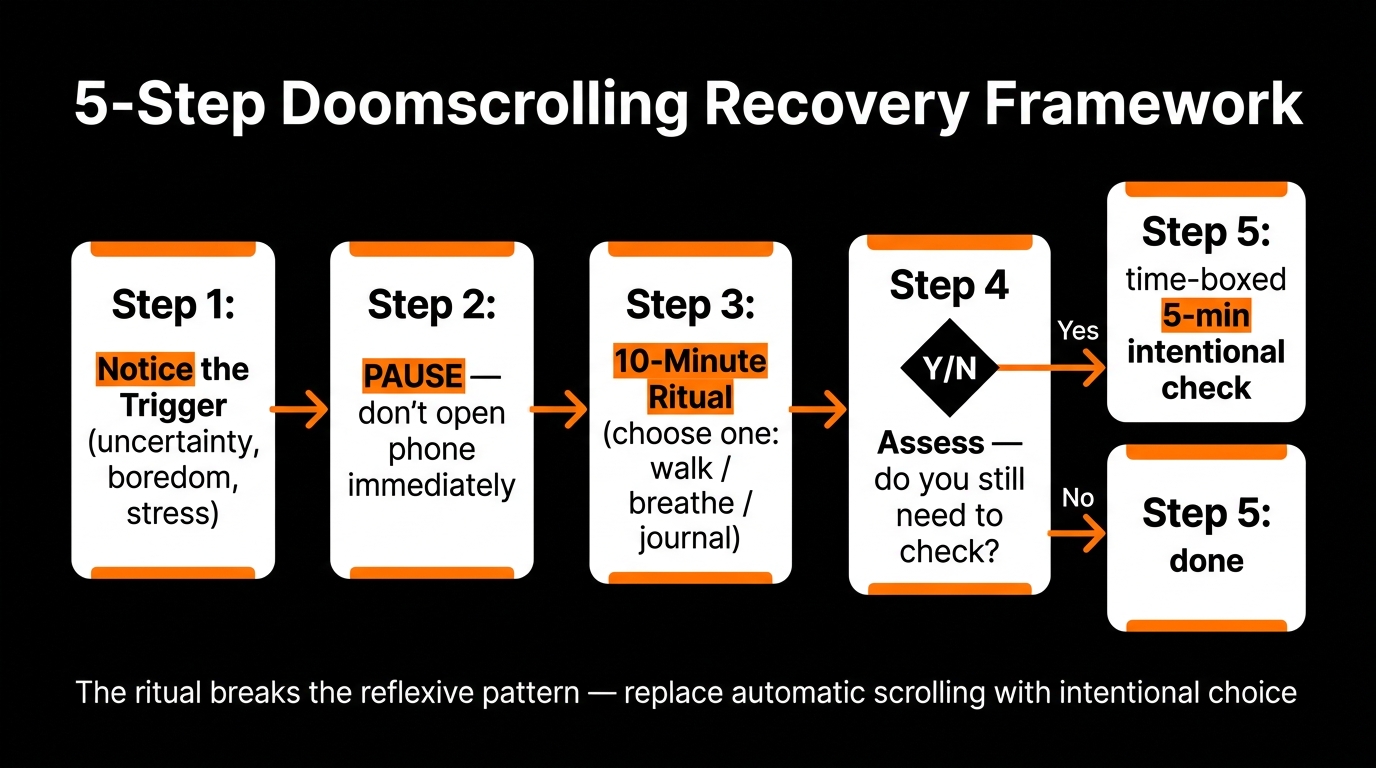
Figure 2: Five-step doomscrolling recovery framework. The ritual breaks the reflex; the schedule preserves information access.
FAQ
How long until I see anxiety improvements after stopping doomscrolling?
Most men report noticeable anxiety reduction within 3–7 days of removing apps from their phone. Sleep improves within 5–10 days if you were scrolling before bed. Full neurobiological recalibration (reduced cortisol, restored dopamine baseline) takes 30–60 days. Expect a withdrawal phase of 2–4 days where boredom or restlessness increases temporarily; this is normal and passes.
Is it better to quit completely or use the scheduled news window?
Complete cessation is most effective if you have diagnosed anxiety, depression, or PTSD. For most men, a 10-minute scheduled window (once daily, fixed time, curated sources only) works better long-term because it maintains information access and reduces the “cut off” sensation that triggers relapse. The key is scheduling, not browsing when triggered. Choose complete cessation if you’ve relapsed more than twice on moderation attempts.
What if I need my phone for work and I’m tempted to scroll?
Use app blockers (Freedom, One Sec, or built-in screen time limits) that prevent app access during work hours. Delete the apps from your phone entirely; if you must access them, use a desktop or tablet during your scheduled window only. Many men find that removing the friction of a mobile scroll makes them realize they didn’t actually want to check those apps—they were just reflex.
Can I still use social media to stay connected to friends?
Yes, but differently. Instead of algorithmic feeds, use direct messaging, group chats, or scheduled video calls. These preserve social connection without the doomscroll mechanism. If you must use social feeds (Facebook family group, etc.), use desktop access only, set a timer for 5 minutes, and leave when the timer ends. The key is removing the phone app that triggers compulsive scrolling.
What is the 4-7-8 breathing technique mentioned in the framework?
Inhale through your nose for 4 counts, hold for 7 counts, exhale through your mouth for 8 counts. Repeat 4 times. This is a physiological sigh that reduces cortisol and vagal stimulation (calms your nervous system). Do it when you feel the scroll urge. It takes 2 minutes and is more effective than scrolling for anxiety relief.
If I relapse and scroll for an hour, does that reset my progress?
No. One relapse does not erase progress. Research shows that most behavior change involves 2–4 relapse attempts before lasting change sticks. Treat it as data: What triggered that scroll? Update your ritual or your environment. The goal is not perfection; it’s a 80/20 system where you get it right most days and adjust quickly when you slip.
Does this framework work if I have diagnosed clinical anxiety or depression?
It’s a helpful complement to therapy or medication, not a replacement. If you have a clinical diagnosis, work with your therapist or doctor to integrate this framework alongside treatment. Many therapists recommend it as part of cognitive-behavioral therapy (CBT) for anxiety. But do not attempt to use this framework alone as a treatment for diagnosed anxiety disorder; work with a professional.
Final Recommendation
The research is clear: doomscrolling causes measurable anxiety and depression in men, and this effect is both rapid (14 minutes) and cumulative (2+ hours = 3x anxiety risk). The good news is equally clear: removing the app from your phone and replacing the scroll trigger with a structured ritual works quickly and reliably.
Start with the five-step framework this week. Pick one trigger (boredom, anxiety, evening routine) and build the ritual around that trigger first. Most men who complete 30 days of the framework report 40–50% anxiety reduction and significantly better sleep. The apps are engineered to addict you; the framework is engineered to break that addiction without willpower.
Options For Men to Take Action
If you’ve read this far, you know doomscrolling is not a weakness—it’s a system problem that hits millions of men and goes largely unaddressed. You’ve tried willpower. You’ve tried deleting apps. You’ve told yourself “I’ll just scroll less.” None of it stuck because you were fighting a trillion-dollar algorithm with personal motivation alone.
Here’s what happens next: You feel a scroll urge, you open your phone, and the habit loop starts again. The anxiety builds. Sleep gets worse. You feel more isolated because you’re not talking about it. A month passes and you’re right back where you started, except the anxiety is worse because now you’re disappointed in yourself.
The MenTools Stop Doom Scrolling Protocol is designed specifically to break this cycle. It’s not another app telling you to meditate. It’s a structured framework that gives you the exact system that works: trigger identification, app removal with social connection preserved, the 10-minute uncertainty ritual, and the daily news window that keeps you informed without the doom.
When you join, here’s what happens:
- Week 1: You remove the apps, start tracking your triggers, and begin the ritual. Anxiety typically drops 20–30% immediately just from removing the friction.
- Week 2–3: The ritual becomes automatic. The scroll urge hits, but now your body goes into the breathing or walk instead. Sleep improves noticeably.
- Week 4: You establish the daily news window and measure your baseline anxiety against your starting point. Most men see genuine improvements in anxiety reduction by day 30.
Wins on cost: No monthly fee for products you don’t need. No therapy copays if the root cause is scrolling, not deeper trauma. One-time framework investment pays for itself in the first month when sleep and productivity improve.
Wins on time: You get 2–3 hours back per week immediately (that’s the time you were scrolling). By week 2, you’re getting 3–5 hours back as anxiety decreases and focus improves. That’s time you get back for work, family, or things that actually matter.
Wins on practicality: This isn’t theory. It’s built on 30+ studies on doomscrolling, anxiety management, and behavior change. You’re not guessing; you’re following a framework that works because it directly addresses the mechanism that’s broken: the trigger-response loop that apps engineered to exploit.
How you can do this today: Get access to the MenTools Stop Doom Scrolling Protocol. You get the full 30-day framework, the daily tracking system, and the ritual library to match any trigger. Start this week. By day 7, you’ll know if it’s working for you. Most men do.
If you want to go deeper on doomscrolling and digital habits, explore the MenTools Habits hub for guides and frameworks built specifically for men.
To support your daily routine with targeted nutrition, explore MenTools One A Day, formulated with chelated minerals and active B-vitamin forms for men.
When you are ready to turn ideas into action, start a focused challenge or daily routine inside the MenTools app and track how consistent habits change how you feel.
Last updated: 2026-03-13 v1.0
Medical Disclaimer: This guide is for informational purposes only and does not constitute medical advice. Always speak with your doctor or another qualified healthcare professional before starting any new supplement or programme if you have medical conditions or take prescription medication.
References
- Shabahang, R., et al. (2024). “Doomscrolling evokes existential anxiety and fosters pessimism about human nature? Evidence from Iran and the United States.” ScienceDirect. https://www.sciencedirect.com/science/article/pii/S245195882400071X
- Oxford Academic & ORCA Mental Health. (2024). “The Impact of Social Media on Men’s Mental Health.” Research on body image pressure and male help-seeking behavior. https://oceansidemh.com/blog/how-does-social-media-affect-mens-mental-health/
- Harvard Health Publishing. (2024). “Doomscrolling Dangers.” Mental health and news consumption. https://www.health.harvard.edu/mind-and-mood/doomscrolling-dangers
- Hafstad, G. S., et al. (2024). “Beyond the Scroll: Exploring How Intolerance of Uncertainty and Psychological Resilience Explain the Association Between Trait Anxiety and Doomscrolling.” ScienceDirect / Personality and Individual Differences. https://www.sciencedirect.com/science/article/abs/pii/S0191886924003799
- National Institute of Mental Health & PMC. (2023). “Social Media Doomscrolling and Anxiety: Psychological Resilience as a Moderator.” Journal of Assessment and Research in Applied Counseling (JARAC). https://journals.kmanpub.com/index.php/jarac/article/view/4776
- PMC & Computers in Human Behavior. (2023). “Doomscrolling Scale: its Association with Personality Traits, Psychological Distress, Social Media Use, and Wellbeing.” https://pmc.ncbi.nlm.nih.gov/articles/PMC9580444/
- Cleveland Clinic & Harvard Medical School. (2024). “Passive Scrolling Linked to Anxiety in Teens and Young Adults.” Research on screen time and mental health outcomes. https://health.clevelandclinic.org/everything-you-need-to-know-about-doomscrolling-and-how-to-avoid-it