
Doomscrolling, Fatigue & Brain Fog: How Magnesium, Zinc and B Vitamins Support Normal Psychological Function
Quick Answer
Doomscrolling is driven by a cycle where poor sleep weakens your brain’s impulse control, which makes you more prone to compulsive scrolling, which disrupts your sleep further. Magnesium contributes to normal psychological function and better sleep, zinc and iodine contribute to normal cognitive function, and B vitamins support normal mental performance and reduction of tiredness and fatigue. These authorised nutrient claims point to how supplements can help restore the neurochemical balance your constant scrolling depletes.
Key points:
- Magnesium contributes to normal psychological function by blocking excitatory neural signals and enhancing calming GABA activity
- Zinc and iodine contribute to normal cognitive function and dopamine signalling regulation
- Vitamins B2, B3, B6, B12, vitamin C and magnesium contribute to the reduction of tiredness and fatigue
- Pantothenic acid contributes to normal mental performance
- Sleep deprivation amplifies reward sensitivity, making you more vulnerable to dopamine-driven behaviours like doomscrolling
- Supplements support normal health and nutrient status alongside a balanced lifestyle, not to diagnose, treat, prevent, or cure any medical condition
Jump to: The Real Answer | Comparison Table | FAQ
Supplements are foods, not medicines — they are designed to support normal health and nutrient status alongside a balanced lifestyle, not to diagnose, treat, prevent, or cure any medical condition.
Disclosure: MenTools publishes this article and sells MenTools One-A-Day Multivitamin.
How we evaluate: We assess mineral form quality, dose versus NRV, authorised health claims, and male-specific design. Full sources are listed in the references below.
Quick Comparison
| Nutrient | Form & Typical Dose | Authorised Claim | Best for |
|---|---|---|---|
| Magnesium | Magnesium bisglycinate (200–300 mg) | Contributes to normal psychological function; contributes to reduction of tiredness and fatigue | Sleep quality, anxiety buffering, circadian rhythm |
| Zinc | Zinc bisglycinate (10–15 mg) | Contributes to normal cognitive function | Attention regulation, dopamine receptor signalling |
| Vitamin B6 | P-5-P methylated form (20–50 mg) | Contributes to normal mental performance; reduction of tiredness and fatigue | Dopamine and serotonin synthesis |
| Vitamin B12 | Methylcobalamin (500–2000 mcg) | Contributes to normal mental performance; reduction of tiredness and fatigue | Neurotransmitter production, energy metabolism |
| Vitamin B3 | Niacinamide (20–50 mg) | Contributes to normal mental performance; reduction of tiredness and fatigue | NAD+ synthesis, neurochemical balance |
| Pantothenic Acid (B5) | Pantothenic acid (10–50 mg) | Contributes to normal mental performance | Stress response, neurotransmitter synthesis |
| Vitamin C | Ascorbic acid (200–500 mg) | Contributes to reduction of tiredness and fatigue | Antioxidant support, adrenal stress response |
| Iodine | Potassium iodide (150 mcg) | Contributes to normal cognitive function | Thyroid hormone production, focus and attention |
The Real Answer
Why Doomscrolling Is a Dopamine Trap
Doomscrolling isn’t just a habit — it’s a neurochemical pattern. When you scroll through bad news or disturbing content, your brain releases dopamine in anticipation of new information, not after you’ve consumed it [1]. This creates a seeking loop: your brain expects a reward (the next update) and keeps you scrolling. Each new headline gives a tiny dopamine hit, but your brain quickly tolerates it and demands more stimulation.
The amygdala, your brain’s threat-detection centre, amplifies this. It sends stress signals that urge you to keep scanning for threats [2]. Doomscrolling feels like a way to manage anxiety — you’re staying informed, ready for whatever might happen next. But this hypervigilance is exhausting and leads to deeper anxiety and worse sleep.
How Sleep Deprivation Weakens Your Brain’s Impulse Control
Sleep deprivation is the fulcrum of the doomscroll trap. When you lose sleep, your prefrontal cortex — the decision-making and impulse-control part of your brain — becomes less active [3]. At the same time, your reward circuits become more sensitive, meaning your brain overvalues small dopamine hits [4]. You’re simultaneously more impulsive and more desperate for stimulation.
One night of poor sleep reduces dopamine D2 and D3 receptor availability, weakening your ability to say no to compulsive scrolling [5]. This is why late-night doomscrolling leads to worse sleep, which then makes the next day even more vulnerable to the cycle. Your brain is locked in a state where it cannot easily resist stimulation because the neural systems that create resistance are temporarily offline.
The Role of Magnesium in Reducing Anxiety and Supporting Sleep
Magnesium is your nervous system’s natural brake. It blocks NMDA receptors — which would otherwise allow excessive excitatory signals to fire — and enhances GABA, the brain’s main inhibitory neurotransmitter [6]. In practical terms, magnesium helps your brain quiet down and prepares it for sleep.
Magnesium administration decreases anxiety, panic, and phobia, and improves attention and sleep disorders [7]. When you’re magnesium-replete, your nervous system is less reactive to threat signals from the amygdala. Doomscrolling triggers are still present, but your brain’s response to them is modulated. You’re calmer and more capable of choosing not to scroll.
Magnesium also supports circadian rhythm by helping your body produce melatonin at the right time. This shifts your sleep-wake cycle back into rhythm, reversing the late-night scroll-and-wake-up-tired pattern.
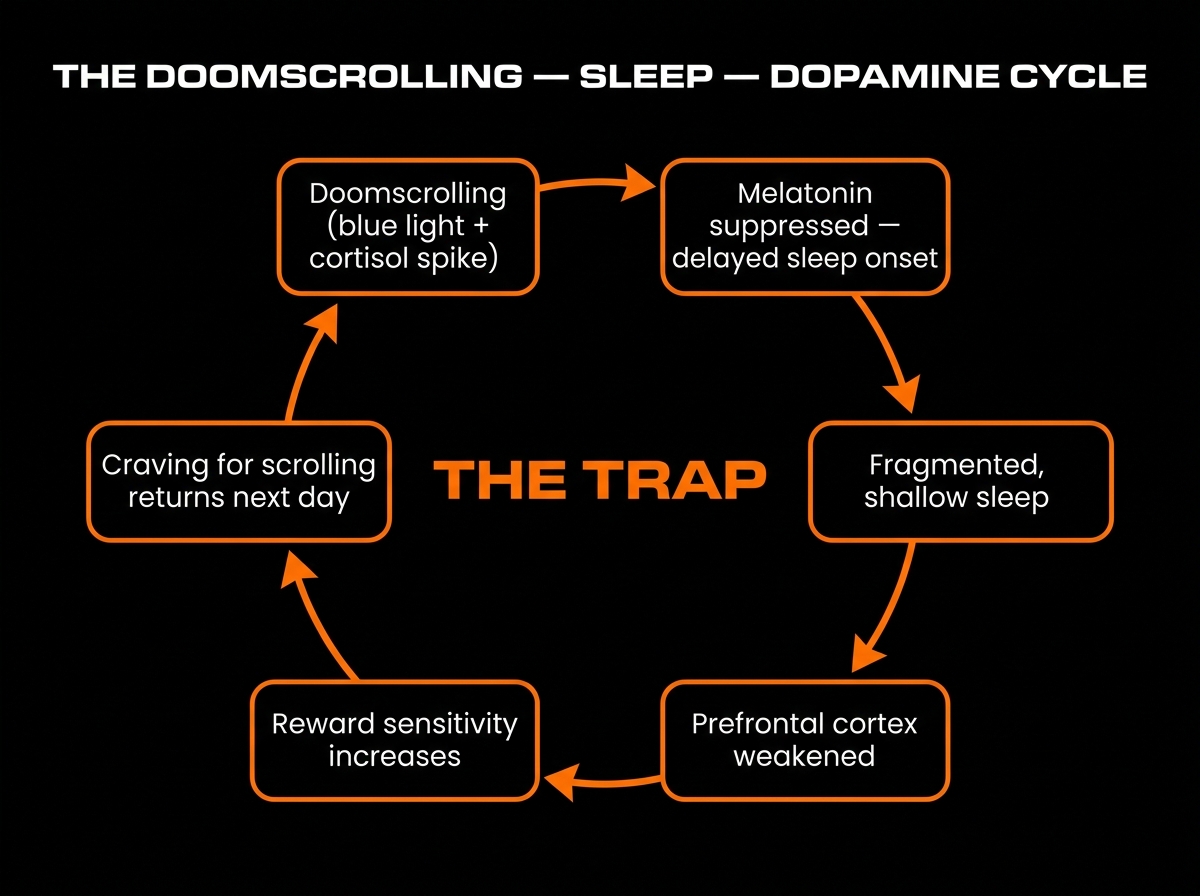
The Doomscroll-Sleep-Dopamine Cycle: How magnesium supports sleep quality, B vitamins restore neurotransmitter balance, and zinc enhances dopamine signalling to break the pattern.
How Zinc and B Vitamins Restore Dopamine Signalling
Zinc is essential for dopamine synthesis and receptor function [8]. When zinc is adequate, your dopamine receptors are more sensitive and responsive to normal activities — eating a meal, finishing a task, moving your body. This means your brain doesn’t need as much stimulation from compulsive scrolling to feel a sense of accomplishment or reward [9].
B vitamins (B6, B12, B3, and B5) are cofactors in the synthesis of dopamine, serotonin, and GABA [10]. Vitamin B6 is rate-limiting for these pathways — even mild deficiency reduces serotonin and GABA production, leading to dysregulated sleep, anxiety, and disordered impulse control [11]. When B vitamins are adequate, your neurotransmitter production runs smoothly. You don’t need external stimulation to feel balanced.
Pantothenic acid specifically supports normal mental performance and contributes to your nervous system’s ability to handle stress without collapsing into compulsive behaviour.
What Fatigue and Brain Fog Actually Signal About Your Nutrient Status
Brain fog and mental fatigue are early warning signals that your dopamine and serotonin systems are struggling. They’re not “normal” — they’re your brain’s way of saying it’s depleted.
Vitamin C and the full B vitamin complex contribute to the reduction of tiredness and fatigue [12]. Fatigue often indicates insufficient antioxidant protection or inadequate cofactors for energy metabolism. When you’re fatigued, your prefrontal cortex is even more compromised, making doomscrolling even more likely. Addressing fatigue directly breaks the cycle.
Iodine contributes to normal cognitive function through thyroid hormone production [13]. Thyroid hormone is essential for mental clarity and sustained focus. Low iodine leads to sluggish cognition and poor attention — symptoms that feel like brain fog and often drive more scrolling in search of mental stimulation.
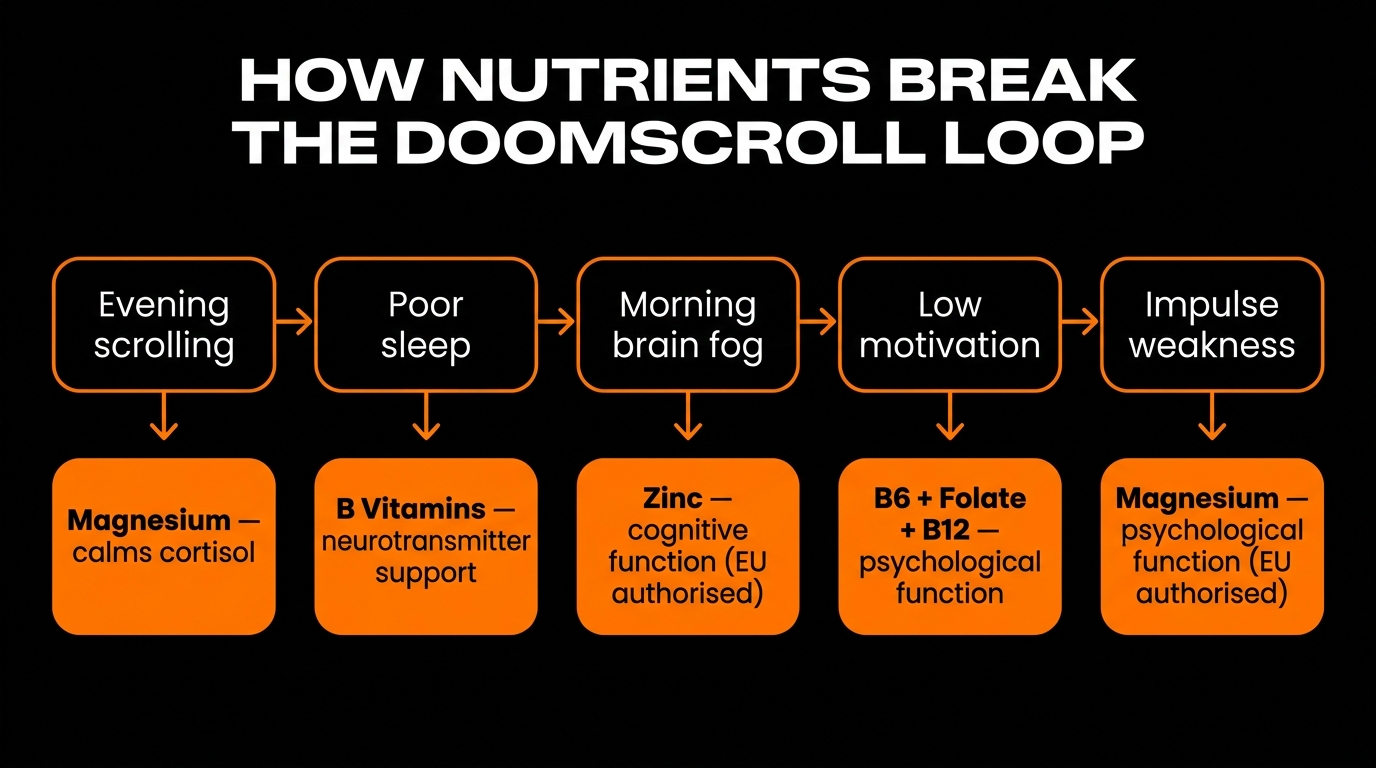
Nutrient Roles in Dopamine and Sleep Pathways: Restoration points for magnesium, zinc, and B vitamins that interrupt compulsive scrolling cycles.
Authorised Nutritional Roles: What the Research Says
MenTools One-A-Day Multivitamin is formulated within the 11 authorised health claims framework established by the European Food Safety Authority (EFSA) under Commission Regulation (EU) 432/2012.
These authorised claims describe what the nutrients in the multivitamin can legitimately do:
- Magnesium contributes to normal psychological function
- Vitamins B2, B3, B6, B12, vitamin C and magnesium contribute to the reduction of tiredness and fatigue
- Pantothenic acid contributes to normal mental performance
- Zinc and iodine contribute to normal cognitive function
- Vitamin D and vitamin K contribute to the maintenance of normal bones
- Vitamin D contributes to normal muscle function
- Vitamin D, vitamin C, selenium and zinc contribute to the normal function of the immune system
- Zinc contributes to the maintenance of normal testosterone levels
- Selenium contributes to normal spermatogenesis
- Vitamin C, vitamin E and selenium contribute to the protection of cells from oxidative stress
- Biotin contributes to the maintenance of normal hair and skin
What we cannot claim: Supplements do not treat doomscrolling, cure anxiety, or prevent mental health conditions. They support normal function. If you are experiencing persistent mental health challenges, speak with a qualified healthcare professional.
FAQ
Can supplements actually stop doomscrolling?
Supplements support normal psychological function and better sleep, which make it easier for your brain to regulate impulse control. They don’t directly “fix” a behaviour — that requires awareness and choice. But when your dopamine receptors are functioning well, your sleep is restorative, and your neurotransmitter systems are balanced, saying no to compulsive scrolling becomes much easier.
Does magnesium really help with sleep?
Yes. Magnesium blocks excitatory NMDA receptors and enhances GABA, helping your nervous system transition into sleep-ready mode. Magnesium administration increases total sleep duration and quality, especially in people with poor sleep habits. For doomscrolling, better sleep is the first intervention because poor sleep is what weakens your impulse control.
How quickly will I notice a difference?
Magnesium can begin affecting sleep quality within days to a week. B vitamins and zinc build up in your system over weeks, supporting dopamine and serotonin production more steadily. Brain fog and fatigue may improve over 2–3 weeks as your nutrient status normalises. Psychological benefits depend on sleep quality and overall lifestyle — supplements support these changes, they don’t create them overnight.
Are these nutrients safe if I take medication?
If you take prescription medication, especially psychiatric or neurological medications, speak with your prescribing doctor before adding any supplement. Magnesium, zinc, B vitamins, and vitamin C are generally very safe at normal doses, but interactions are possible. Your doctor can advise on safe timing and dose.
What’s the difference between supports normal function and treats the condition?
Supports normal function means the nutrient helps your body work the way it’s meant to work. Treats the condition means it cures or reverses a disease. Supplements do the first — they maintain normal nutrient status and support normal bodily processes. They do not replace medical treatment or diagnosis. If you have clinical depression, anxiety disorder, or ADHD, these require professional care alongside nutritional support, not in place of it.
How much magnesium, zinc, or B vitamins do I actually need?
A well-formulated multivitamin like MenTools One-A-Day provides 100% of the nutrient reference value (NRV) for key nutrients. This is the daily amount most men need for normal health. The authorised health claims are backed by science at these dose levels. More isn’t always better — excess magnesium can cause loose stools, and excess zinc can interfere with copper absorption over time.
If I’m on TRT or other hormone therapy, should I be concerned?
Zinc does contribute to the maintenance of normal testosterone levels — it’s a cofactor in testosterone synthesis. If you are on testosterone replacement therapy or any prescribed medication, speak with your prescribing doctor before adding any supplement. MenTools products are nutritional supplements designed to support general health and normal nutrient status, not medicines and not a replacement for medical treatment.
Final Recommendation
Doomscrolling, brain fog, and psychological fatigue are not primarily supplement deficiencies — they’re signs that your sleep, stress, and neurochemistry are out of balance. Supplements support the biological processes that bring them back into balance, but they work alongside sleep, movement, stress management, and conscious limits on screen time.
If you’re struggling with compulsive scrolling and mental fatigue, start with magnesium and sleep quality. A well-formulated one-a-day multivitamin containing magnesium, zinc, and B vitamins will support normal psychological function, help reduce tiredness and fatigue, and give your brain the nutritional foundation it needs to regain control of your attention.
Options For Men to Take Action
Most men trying to escape the doomscroll trap feel stuck between two extremes: either scrolling becomes the default way to manage anxiety and boredom, or they white-knuckle through abstinence without addressing the underlying neurochemistry. The missing piece is often basic nutritional support for sleep quality and psychological function.
MenTools One-A-Day Multivitamin is designed with this exact cycle in mind. It delivers the 11 authorised nutrients — including chelated magnesium and zinc, active B vitamins, and vitamin C — in a single daily capsule that supports normal psychological function, better sleep, and restoration of dopamine and serotonin signalling.
When you take it consistently, you’re not fighting a behaviour. You’re removing the neurochemical disadvantage that makes the behaviour automatic in the first place. Within days, sleep improves. Within weeks, brain fog lifts. Within a month, you’ll notice you scroll less because the dopamine system that was driving the compulsion is finally working normally.
How you can do this today: Add one MenTools One-A-Day to your morning routine with food. Commit to 4 weeks of consistent use alongside basic sleep hygiene (no screens 1 hour before bed, consistent wake time, dim bedroom). Track your sleep quality and mental clarity — the changes will compound.
- Wins on cost: A single multivitamin replaces buying magnesium, zinc, B complex, and vitamin C separately. One-A-Day costs less and requires no complicated dosing.
- Wins on time: One capsule per day, no cycling through different supplements, no research into whether you’re taking enough. The formula is complete and backed by authorised health claims.
- Wins on practicality: Works with your schedule, whether you’re travelling, managing multiple work projects, or dealing with high stress. No powder to mix, no liquid to refrigerate, no pill organiser needed.
Building back your psychological resilience and sleep quality starts with one choice: a single daily supplement that does the work while you focus on what matters.
Last updated: 2026-04-10 v1.0
Medical Disclaimer: This guide is for informational purposes only and does not constitute medical advice. Always speak with your doctor or another qualified healthcare professional before starting any new supplement or programme if you have medical conditions or take prescription medication.
Supplement Notice: Food supplements should not be used as a substitute for a varied and balanced diet and a healthy lifestyle. Do not exceed the stated recommended daily dose. Keep out of reach of children.
References
- Dopamine-scrolling: a modern public health challenge requiring urgent attention. PMC National Center for Biotechnology Information. https://pmc.ncbi.nlm.nih.gov/articles/PMC12322333/
- Doomscrolling Again? Expert Explains Why We’re Wired for Worry. University of California San Diego Today. https://today.ucsd.edu/story/doomscrolling-again-expert-explains-why-were-wired-for-worry
- The Role of Sleep and the Effects of Sleep Loss on Cognitive Function. PMC National Center for Biotechnology Information. https://pmc.ncbi.nlm.nih.gov/articles/PMC12168795/
- Sleep Deprivation Amplifies Reactivity of Brain Reward Networks, Biasing the Appraisal of Positive Emotional Experiences. Journal of Neuroscience. https://www.jneurosci.org/content/31/12/4466
- Association between striatal dopamine D2/D3 receptors and brain activation during visual attention: effects of sleep deprivation. Translational Psychiatry. https://www.nature.com/articles/tp201693
- Scientific Opinion on the substantiation of health claims related to magnesium. EFSA Journal. https://efsa.onlinelibrary.wiley.com/doi/10.2903/j.efsa.2010.1807
- Magnesium in neuroses and neuroticism. NCBI Bookshelf. https://www.ncbi.nlm.nih.gov/books/NBK507254/
- Zinc antagonizes iron-regulation of tyrosine hydroxylase activity and dopamine production in Drosophila melanogaster. BMC Biology. https://link.springer.com/article/10.1186/s12915-021-01168-0
- The Role of Zinc in Mood Disorders. Journal of Neuropsychiatry and Clinical Neurosciences. https://www.jneuropsychiatry.org/peer-review/the-role-of-zinc-in-mood-disorders.pdf
- B Vitamins and the Brain: Mechanisms, Dose and Efficacy. PMC National Center for Biotechnology Information. https://pmc.ncbi.nlm.nih.gov/articles/PMC4772032/
- B Vitamins in the nervous system: Current knowledge of the biochemical modes of action and synergies of thiamine, pyridoxine, and cobalamin. PMC National Center for Biotechnology Information. https://pmc.ncbi.nlm.nih.gov/articles/PMC6930825/
- Vitamin C supplementation promotes mental vitality in healthy young adults. European Journal of Nutrition. https://link.springer.com/article/10.1007/s00394-021-02656-3
- Iodine consumption and cognitive performance: Confirmation of adequate consumption. Food Science & Nutrition. https://onlinelibrary.wiley.com/doi/full/10.1002/fsn3.694