MEN: 8 Ways to Manage Stress for Men (Backed by Science)
Quick Answer
To manage stress, men do best with a mix of fast resets and daily habits: a 30-second breathing reset for acute moments, then regular exercise, early sunlight and sleep, real conversation, less alcohol, time outdoors, short meditation, and more control over your day. Start with one, not eight.
**Jump to:** How we chose these 8 | FAQ | Options for men
Disclosure: MenTools publishes this article and may feature MenTools products.
How we evaluate: Each habit is assessed on real-world use, evidence, cost and time, and how well it suits men. Every habit including the MenTools option carries an honest limitation. Full sources are in the references below.
The 8 Techniques at a Glance
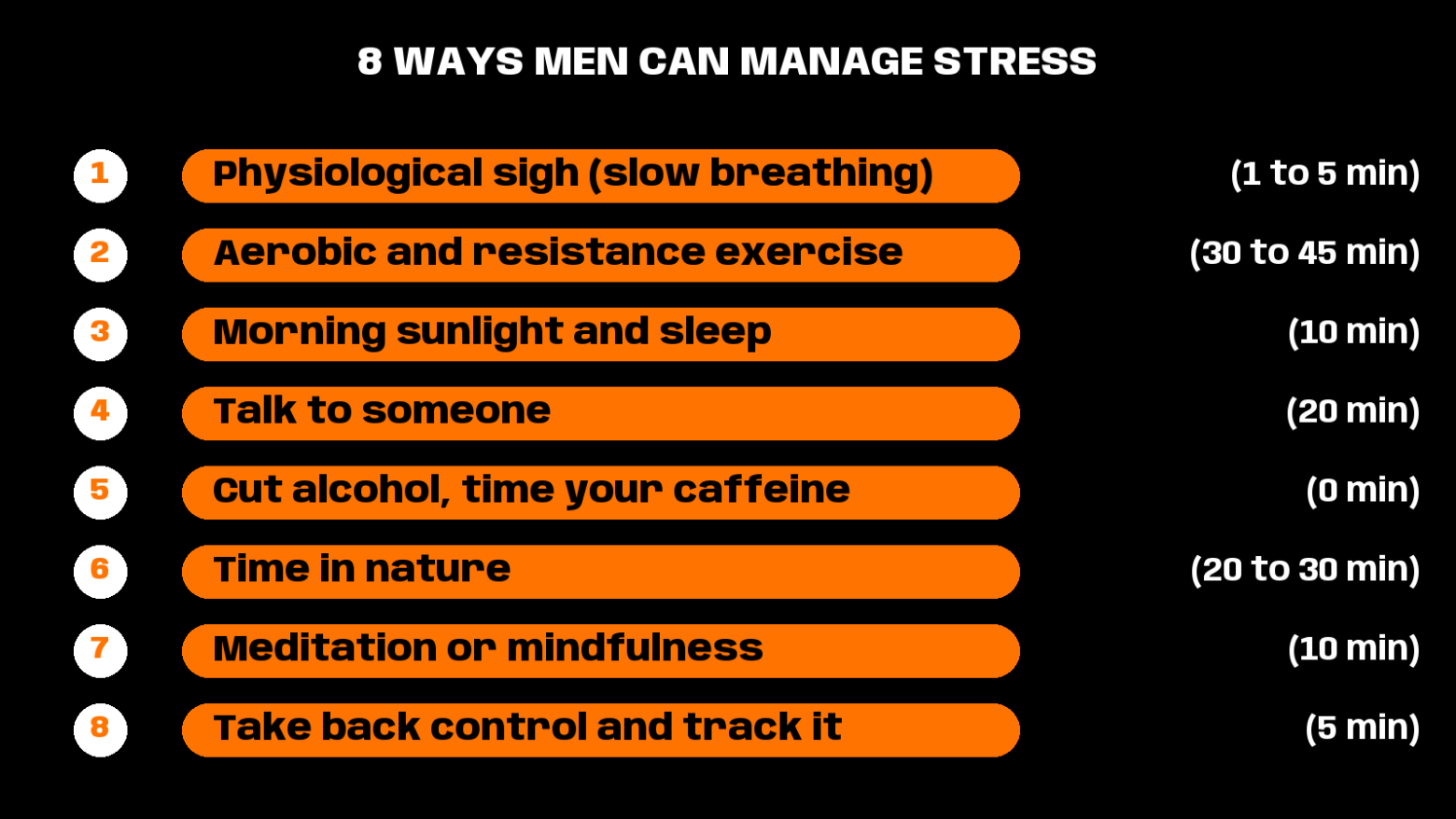
The 8 stress techniques at a glance, and how long each one takes.
| Technique | Best for | Time |
|---|---|---|
| Physiological sigh (slow breathing) | Acute stress spikes | 1 to 5 min |
| Aerobic and resistance exercise | A lower stress baseline | 30 to 45 min |
| Morning sunlight and protected sleep | Wired-but-tired days | 10 min |
| Talk to someone | Carrying a load silently | 20 min |
| Cut alcohol, time your caffeine | Anxious or wired men | 0 min |
| Time in nature | Desk-bound, city life | 20 to 30 min |
| Meditation or mindfulness | A busy, looping mind | 10 min |
| Take back control and track it | Feeling stretched thin | 5 min |
How We Chose These 8
We picked techniques that are simple, backed by real research, and realistic for a working man with responsibilities. Each had to pass three tests: does the evidence stack up, can it be done on a normal day, and does it actually shift how the body handles stress rather than just distract from it. This matters for men in particular, because one in ten men experience anxiety or depression yet fewer than half receive treatment for it [6]. Every technique below carries an honest watch-out, because none of them works for every man or every kind of stress.
1. The Physiological Sigh (Slow Breathing)
This is the fastest way to bring stress down in the moment. Two short inhales through the nose, then one long, slow exhale through the mouth, repeated for a minute or five, shifts your body out of high alert while the stressful thing is still in front of you.
What it is: A physiological sigh, also called cyclic sighing: a double inhale through the nose followed by a slow, full exhale through the mouth, done for one to five minutes.
Best for: Acute stress spikes, before a meeting, mid-argument, stuck in traffic, or lying awake at 2am.
Standout: In a Stanford randomised trial of 111 people, five minutes of daily cyclic sighing improved mood more than mindfulness meditation and lowered resting breathing rate, with the breathing group’s positive mood rising 1.91 points a day against 1.22 for meditation [1]. Study co-author and Stanford psychiatrist David Spiegel put it plainly: “When we teach people to control the physical effects of a stressor on their body, it puts them in a better position to deal with the stressor itself” [2].
Watch-out: It calms the body in the moment but does not remove the source of the stress. If you are hyperventilating or panicking hard, start with slow normal breaths first, and it is not a substitute for proper treatment of an anxiety disorder.
2. Aerobic and Resistance Exercise
Move your body most days and your whole stress system settles to a lower baseline. This is the single most reliable long-term stress tool for men, because it burns off the stress chemistry and builds a body that reacts less to pressure.
What it is: A mix of aerobic work (brisk walking, running, cycling) and resistance training, aiming for around 150 minutes of moderate activity a week.
Best for: Men who feel wound up or restless, or carry stress physically in a tight chest, jaw or shoulders.
Standout: In a one-year randomised trial referenced by Stanford Lifestyle Medicine, a group doing 150 minutes of moderate-to-vigorous aerobic exercise a week showed a sustained drop in cortisol, the body’s main stress hormone, against a control group [3]. Physically active people also tend to show smaller cortisol and heart-rate spikes when put under pressure in the first place [3].
Watch-out: The effect is gradual, not a same-day fix, and very hard or very long sessions can briefly push cortisol up. Judge it over weeks, and do not train yourself into exhaustion chasing calm.
3. Morning Sunlight and Protected Sleep
Get outside into daylight early and guard your sleep, and you fix the rhythm that stress runs on. A tired, dysregulated body manufactures stress you did not earn.
What it is: Five to ten minutes of outdoor morning light within an hour of waking, plus a protected seven to nine hour sleep window with a fixed wind-down.
Best for: Men who feel flat, wired-but-tired, or on a short fuse for no clear reason.
Standout: Morning outdoor light delivers roughly 10,000 to 100,000 lux, against 50 to 500 lux from indoor lighting, and getting it early anchors the natural cortisol rhythm that should peak in the morning and fall at night [4]. Get the timing wrong and that rhythm flattens, which is a large part of what chronic stress feels like.
Watch-out: Light and sleep set the stage but will not resolve a real stressor on their own, and sleep is the hardest habit to defend against work and screens. On dark winter mornings you may need longer outside or a daylight lamp.
4. Talk to Someone
Say the thing out loud to another human. Men are conditioned to bottle it up, and that is exactly why talking is one of the most underused stress tools available to them.
What it is: A real conversation about what is actually going on, with a mate, partner, brother, or a professional. Not small talk.
Best for: Men carrying a heavy load silently, or feeling isolated.
Standout: The World Health Organization reported in 2025 that one in six people worldwide is affected by loneliness, which raises the risk of heart disease, stroke and early death [5]. Men are hit hard here. As Kevin Simon, chief behavioural health officer for the City of Boston, observes, “Men tend not to seek services because they’re just not even fully aware of the emotions they’re having” [6].
Watch-out: Talking helps you process stress, not fix its cause, and offloading on the same person constantly can strain the relationship. If low mood or stress is persistent, a friend is not a replacement for a doctor or therapist.
5. Cut Alcohol and Time Your Caffeine
The two drinks most men reach for under stress, a pint and a strong coffee, both make the underlying stress worse. Adjusting them is a free win with no gym kit required.
What it is: Cutting back on alcohol and stopping caffeine by early afternoon, or simply lowering the dose.
Best for: Men who wind down with a drink or run on coffee and feel anxious or wired.
Standout: Caffeine raises cortisol secretion even at rest and adds to the cortisol produced by mental stress, and regular drinkers do not fully build a tolerance to that effect [7]. Alcohol gives short-term relief and then rebounds; Drinkaware notes that using alcohol to cope can actually increase anxiety and create more stress over time [8].
Watch-out: Cutting caffeine too fast brings headaches and a slump, so taper rather than quit cold. Going teetotal will not fix a stressful life on its own either, it just stops you pouring petrol on it. If you find it genuinely hard to cut down, that itself is worth raising with a doctor.
6. Time in Nature
Twenty minutes among trees, grass or water measurably lowers your stress hormones. It is one of the cheapest and best-evidenced resets there is.
What it is: Twenty to thirty minutes sitting or walking somewhere green, phone away, several times a week. A city park counts.
Best for: Men in cities, desk-bound, or glued to screens all day.
Standout: In a 2019 study in Frontiers in Psychology, a nature experience produced a 21.3 percent per hour drop in salivary cortisol beyond the hormone’s normal daily decline, and the greatest benefit came from spending 20 to 30 minutes in nature [9].
Watch-out: The clock matters less than the disconnection, so scrolling on a park bench blunts the effect. It is a reset, not a cure for an ongoing stressor, and bad weather makes consistency harder in a British winter.
7. Meditation or Mindfulness
A few minutes of daily meditation trains your nervous system to react less to stress over time. It is a slow build, not an instant off-switch.
What it is: Around ten minutes a day of focused-attention or guided meditation, done consistently.
Best for: Men with a busy, looping mind who cannot switch off.
Standout: A 2020 meta-analysis in Health Psychology Review found meditation produced a significant, moderate reduction in cortisol, with a pooled effect size of g = 0.41 in at-risk groups [10]. Longer programmes, more than 20 total hours of practice, worked best.
Watch-out: The effect is moderate, not dramatic, and it takes weeks of consistency before it pays off, which is where most men quit. For some, sitting still with their thoughts feels worse at first, so guided sessions or a movement-based practice can be an easier start.
8. Take Back Control and Track It
Much of men’s stress comes from feeling out of control, at work and at home. Setting boundaries and tracking what you can actually control turns a vague sense of overwhelm into a short list you can act on.
What it is: Saying no to low-value demands, protecting your time, and keeping a simple record of the habits above so they actually happen.
Best for: Men who feel stretched thin and reactive, run by a workload or a life that never lets up.
Standout: The Whitehall II study of more than 10,000 civil servants found that men and women with low control over their work had a higher risk of coronary heart disease, independent of other risk factors [11]. Control is not a nice-to-have, it is protective. One honest way to make these habits stick is to track them, and a paper journal, a reminders app, or the MenTools app, which turns stress habits into daily check-ins and streaks, all do the job. Men tend to keep the habits they can actually see progress on.
Watch-out: You cannot control everything, and trying to can become its own stressor. Boundaries take practice and can meet resistance at first, and a tracker only helps if you actually review it.
Why Do Men Struggle to Manage Stress?
Men often struggle because they are taught to push through and stay quiet, so stress builds unmanaged. One in ten men experience anxiety or depression, yet fewer than half receive treatment [6]. Many are not fully aware of what they are feeling until it surfaces as anger, drinking or physical symptoms. Add shrinking friendship circles and long hours with little control, and stress has plenty of room to grow before a man admits it is even there.
When Should a Man See a Doctor About Stress?
See a doctor when stress is persistent, stops you sleeping, eating or working, or shows up physically as chest pain, a racing heart or constant headaches. Chronic stress is linked to real harm, and low control at work raises the risk of heart disease [11]. Also seek help if you are leaning on alcohol or drugs to cope, feel hopeless, or have any thoughts of self-harm. Managing stress yourself is sensible, but persistent or severe stress is a medical issue, not a weakness.
FAQ
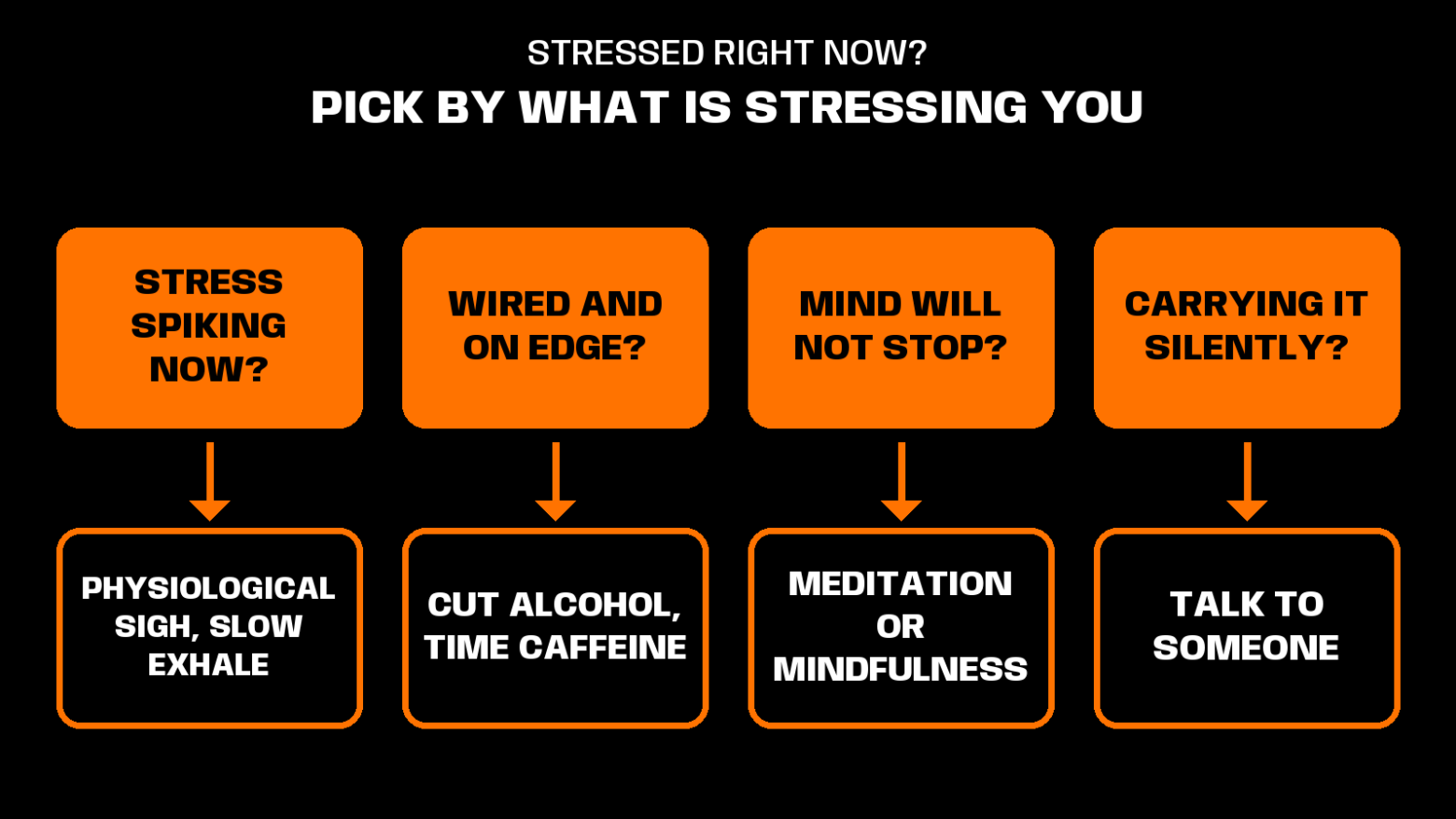
Not sure where to start? Pick by what is stressing you.
What is the fastest way to reduce stress for men?
The physiological sigh. Two short inhales through the nose then one long exhale through the mouth, repeated for a minute, calms the body in real time. A Stanford trial found five minutes of daily cyclic sighing improved mood more than meditation. It is the best tool for an acute spike, though it does not remove the underlying cause.
Does exercise really lower stress or just distract you?
It genuinely lowers it. A one-year trial referenced by Stanford Lifestyle Medicine linked 150 minutes of weekly aerobic exercise to a sustained drop in cortisol, and active people react less to pressure in the first place. The distraction helps too, but the deeper benefit is a body that carries a lower stress baseline all day.
Is it normal for men to feel more stressed as they get older?
Some rise in pressure is common as work, money and family responsibilities stack up, but constant or worsening stress is not something to just accept. Shrinking social circles make it worse for many men. If stress is climbing year on year, treat it as a signal to act on the habits here and, if it persists, to see a doctor.
Can you manage stress without medication?
For everyday stress, usually yes. The techniques here, breathing, exercise, sleep, connection, nature and meditation, all have research behind them and need no prescription. But they are not a replacement for medical care when stress is severe or persistent, or when it tips into an anxiety disorder or depression. Use the self-help tools first and escalate if they are not enough.
How long does it take to feel less stressed?
It depends on the tool. Breathing and a nature break work within minutes. Exercise, sleep and meditation build over weeks, with cortisol studies typically running four to eight weeks or longer. Expect fast relief in the moment from the resets, and a lower overall baseline after a month or two of the daily habits.
What is the best stress technique if I only have five minutes?
Do the physiological sigh, then step outside if you can. A minute of cyclic sighing drops your arousal fast, and even a short spell of daylight or fresh air helps. If five minutes is all you get most days, protect it and make it a habit rather than a one-off, because consistency is what moves your baseline.
Final Recommendation
If you do nothing else, learn the physiological sigh for the bad moments and get moving most days for the long game. Add early daylight and protected sleep as the base, talk to someone instead of bottling it, and take back a little control over your week. Managing stress as a man is not about one perfect fix, it is a handful of proven habits repeated until your baseline drops. Start with one this week.
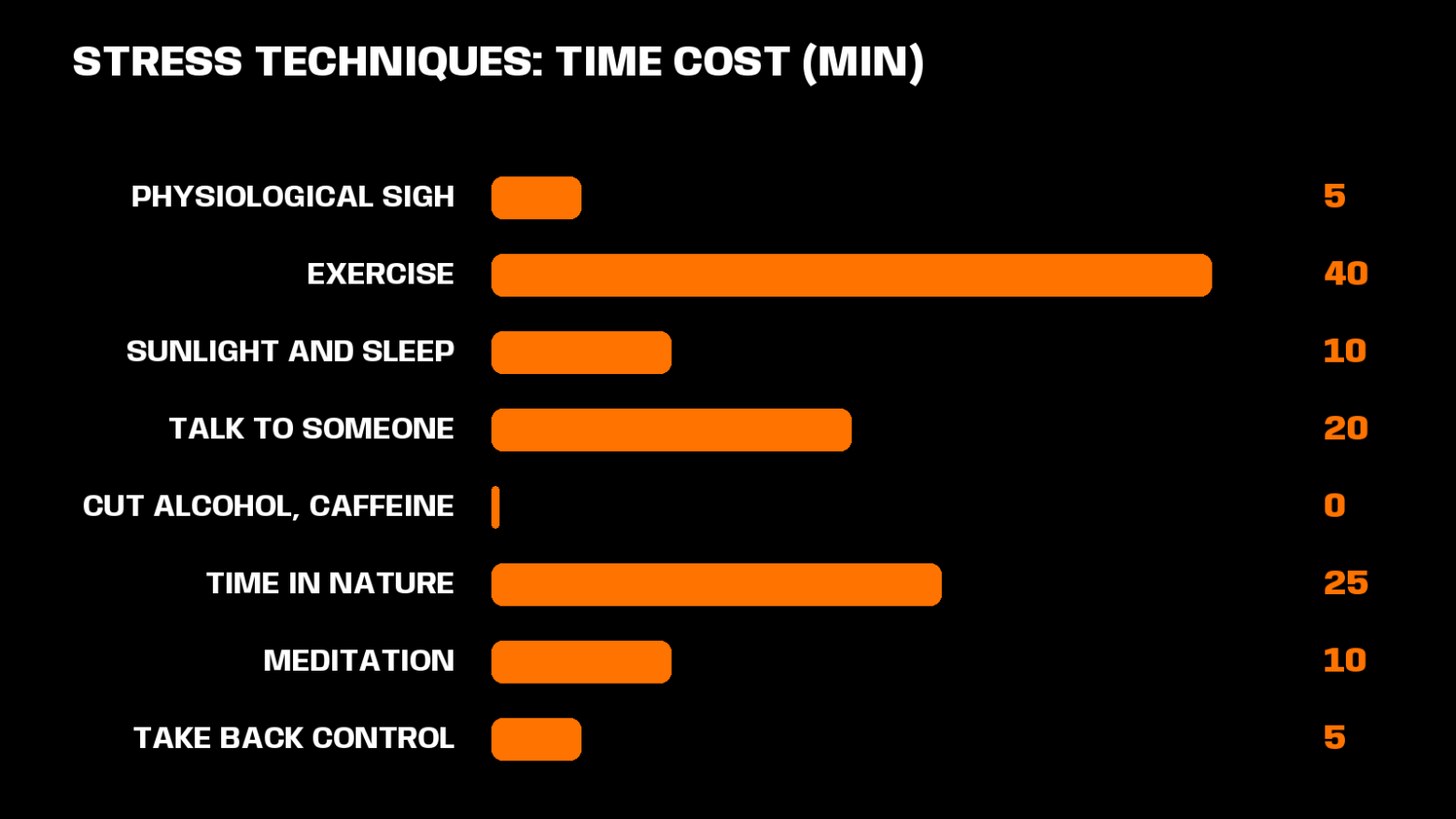
Time cost per technique: from a one-minute breathing reset to a 40-minute workout.
Options for Men to Take Action
Most men do not lack stress-management ideas. They lack a system. The breathing gets forgotten, the gym slips, the walk never happens, and week two arrives with no way to tell whether any of it stuck. Scattered good intentions and pure willpower do not hold up against a busy life.
The MenTools app is built to run exactly this kind of set of habits as one system, with daily actions, reminders, streaks and an AI coach, so a breathing reset, a walk and a lights-out time become check-ins instead of things you meant to do. Men who track these habits tend to keep the ones they can see progress on.
How you can do this today: pick one technique from this list, set it as a daily action tonight, and log day one before you sleep.
Wins on cost: one app replaces a habit tracker, a stress journal and a stack of separate reminder tools.
Wins on time: the habits and the tracking are set up in minutes, with no research or planning to do yourself.
Wins on practicality: it lives on your phone and fits a working man’s day, so it survives travel, early starts and busy weeks.
For the wider picture, and more tools built for men, see the MenTools stress hub, and if part of your stress is low mood, the guide to the best mental health apps for men is a sensible next read. Small habits, tracked and repeated, are what turn a stressed month into a steadier year. For stress that is severe or persistent, see a doctor as well.
Last updated: 2026-07-29 v1.0
Disclaimer: This guide is for informational purposes only and does not constitute medical or psychological advice. Speak with a qualified professional before making significant changes if you have a medical or mental health condition.
References
- [1] Balban MY, Spiegel D, Huberman AD et al. Brief structured respiration practices enhance mood and reduce physiological arousal. Cell Reports Medicine, 2023. Link
- [2] Stanford Medicine. Cyclic sighing can help breathe away anxiety (David Spiegel quote). 2023. Link
- [3] Stanford Lifestyle Medicine. How exercise balances cortisol levels. Link
- [4] Huberman Lab. Using light (sunlight, blue light and red light) to optimise health. Link
- [5] World Health Organization. Social connection linked to improved health and reduced risk of early death. 2025. Link
- [6] Harvard Gazette. Why men are less likely to seek mental health care. 2023. Link
- [7] Lovallo WR et al. Caffeine stimulation of cortisol secretion across the waking hours in relation to caffeine intake levels. University of Minnesota Experts. Link
- [8] Drinkaware. Alcohol and stress, does drinking reduce stress?. Link
- [9] Hunter MR, Gillespie BW, Chen SY. Urban nature experiences reduce stress in the context of daily life based on salivary biomarkers. Frontiers in Psychology, 2019. Link
- [10] Koncz A, Demetrovics Z, Takacs ZK. Meditation interventions efficiently reduce cortisol levels of at-risk samples: a meta-analysis. Health Psychology Review, 2020. Link
- [11] Bosma H, Marmot MG et al. Low job control and risk of coronary heart disease in Whitehall II (prospective cohort) study. BMJ, 1997. Link