MEN: How Can a Man Become More Confident? What Actually Works
Quick Answer
A man becomes more confident by collecting real evidence that he can handle the thing he is avoiding. Pick one area that matters, take a step small enough that you will actually do it, write down that you did it, then make the next step harder. Confidence is a by-product of accumulated proof, not a mindset you install first.
**Jump to:** What works at a glance | FAQ | Options for men
Disclosure: MenTools publishes this article and may feature MenTools products.
How we evaluate: Each recommendation is assessed on real-world use, evidence, cost and time, and how well it suits men. Every recommendation including the MenTools option carries an honest limitation. Full sources are in the references below.
What Actually Works at a Glance
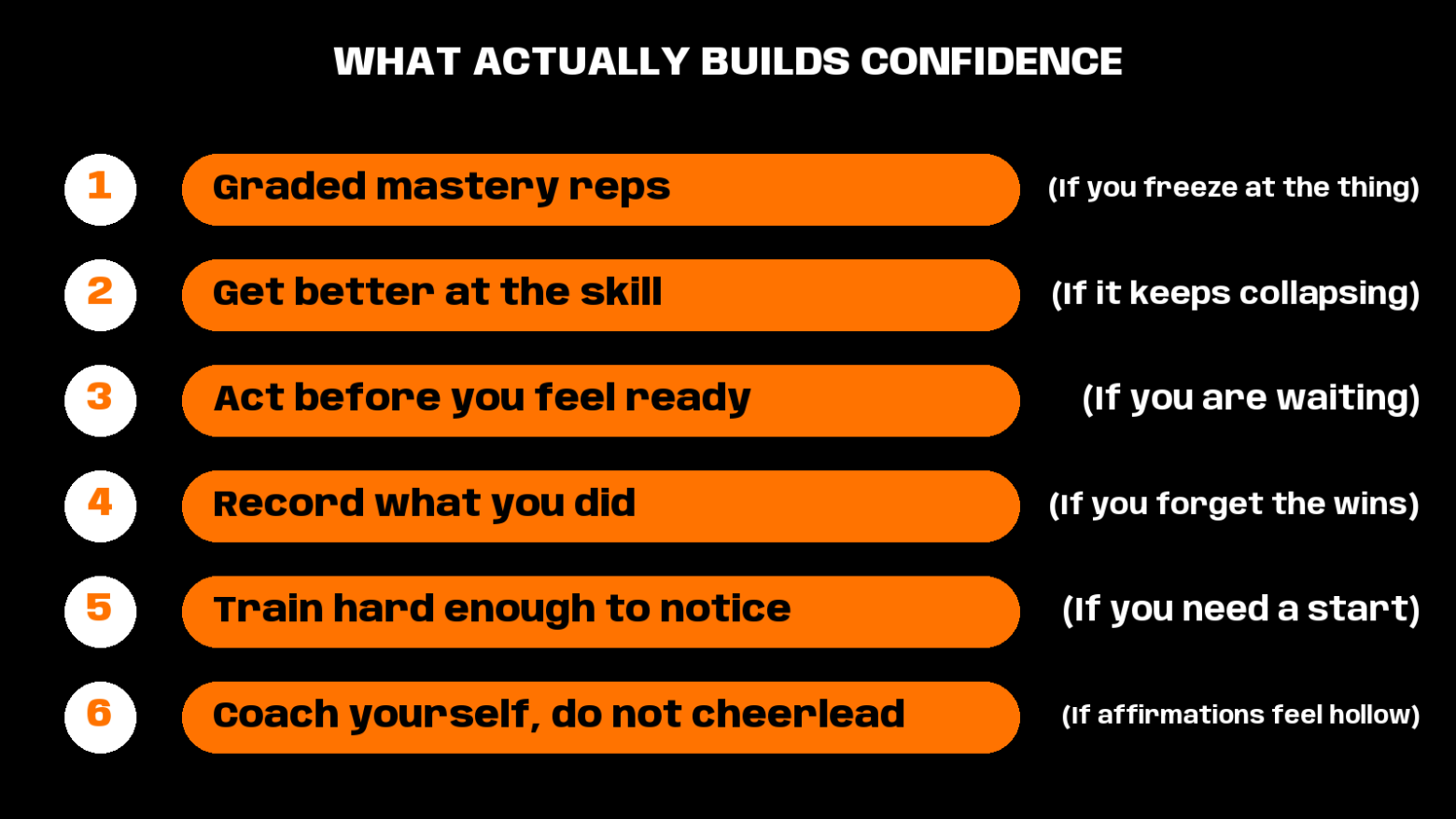
The six approaches with real evidence behind them, and what each one is actually good for.
| Approach | What the evidence shows | Best for | Watch-out |
|---|---|---|---|
| Graded mastery reps | Strongest known source of self-belief | Men who freeze at the thing itself | The wins have to be real, not rigged |
| Get better at the skill | Self-belief tracks performance closely | Confidence that keeps collapsing | Slow, and it stays domain specific |
| Act before you feel ready | Feelings follow evidence, not the reverse | Men waiting to feel ready first | Needs steps small enough to survive |
| Record what you did | Monitoring progress lifts follow-through | Men who forget every win by Friday | Feels like admin, first thing dropped |
| Train hard enough to notice | Measurable proof you can bank weekly | Men with nowhere obvious to start | Does not transfer to every setting |
| Coach yourself, do not cheerlead | Distanced self-talk steadies you without extra effort | Men who find vague affirmations hollow | Sweeping praise you do not believe can backfire |
How We Judged What Works
We only included approaches with published evidence behind them, that a man with a job and a family can run without a coach, and that keep working after the initial motivation has gone. Everything that failed replication or only shifts how you feel for ten minutes is covered further down rather than quietly left out. This matters because the feeling of not being good enough is close to universal. A systematic review by Dena Bravata and colleagues in the Journal of General Internal Medicine covered 62 studies and 14,161 participants and found reported rates of impostor feelings ranging from 9 to 82 percent depending on how they were measured [1]. Every approach below carries an honest watch-out.
Where Does Confidence Actually Come From?
Confidence comes mainly from doing the thing and surviving it. Psychologist Albert Bandura identified four sources of self-belief and ranked them clearly: your own past performance, watching people like you succeed, being persuaded by someone credible, and how your body feels in the moment. Performance beats the other three by a wide margin.
Bandura put it plainly: “Mastery experiences are the most influential source of efficacy information because they provide the most authentic evidence of whether one can muster whatever it takes to succeed” [2].
That ordering has a practical consequence most men get backwards. Being told you are capable sits third on the list, which is why a pep talk from a mate fades by lunchtime, and why the fastest route to feeling capable is a small piece of first-hand proof you cannot argue with.
Does Confidence Come Before or After Competence?
Mostly after, and then the two feed each other. Self-belief and performance are strongly linked, but the reliable direction to push on is performance, because that is the input you control. Get measurably better at something and the belief tends to follow. Try to install belief without changing anything you do and it usually does not hold past the first setback.
The link is well quantified. In a meta-analysis published in Psychological Bulletin, Alexander Stajkovic and Fred Luthans pooled 114 studies with 157 effect sizes and 21,616 participants and found a weighted average correlation of 0.38 between self-efficacy and work performance [3]. That is a substantial relationship for a single psychological variable.
The practical read is simple. If your confidence at work, in the gym or in a room full of strangers keeps collapsing, the fix is usually more reps at the thing rather than more thinking about the thing. Confidence built on evidence survives a bad day. Confidence built on nothing does not.
Why Do Men Who Look Confident Often Not Feel It?
Because you are judging yourself from the inside and everyone else from the outside. You have full access to your own doubt and none to theirs, so you compare your internal experience to their external performance and conclude you are the only one struggling. Two well-replicated biases make this worse.
Thomas Gilovich, Victoria Medvec and Kenneth Savitsky named the spotlight effect in the Journal of Personality and Social Psychology, showing across five studies that people consistently overestimate how much others notice their appearance and their contributions, good or bad [4]. Your stumble over a word was, to almost everyone in the room, invisible.
The second is the liking gap. Erica Boothby and colleagues found in Psychological Science that after conversations people systematically underestimate how much their partner liked them and enjoyed their company, and that this happened between strangers in the lab, between new students in halls, and between adults meeting at a workshop [5]. Part of the reason, the researchers note, is that people are unusually harsh when judging their own conversational performance. You are almost certainly landing better than you think.
Do Affirmations and Power Posing Work?
One of them does not, and the other depends entirely on how you do it. Power posing has not held up under proper testing. Self-talk has, but only the specific kind, and the vague kind can genuinely backfire.
Start with what fails. Joanne Wood, Elaine Perunovic and John Lee ran two experiments published in Psychological Science on repeating a positive self-statement. Among people with low self-esteem, those who repeated “I’m a lovable person” or focused on how it was true felt worse afterwards than those who did not [6]. Read their conclusion closely, though, because it is conditional rather than absolute: “repeating positive self-statements may benefit certain people but backfire for the very people who need them the most” [6]. The problem is not the act of talking to yourself. It is repeating a sweeping claim about your worth that part of you does not believe, because the gap between the words and the evidence is what stings.
Change the wording and the picture changes. Jason Moser, Ethan Kross and colleagues found in Scientific Reports that addressing yourself in the third person, using your own name rather than “I”, helped regulate emotion without the extra mental effort that usually costs you [10]. Kristin Neff’s work points the same way: talking to yourself as you would to a mate who was struggling holds up better than trying to talk yourself into feeling great [11]. The versions that work are specific, they are about the thing in front of you, and they sound like a coach rather than a cheerleader. “You have done the prep, now get on with it” is a different instrument from “I am amazing”.
Power posing is the weaker of the two. Eva Ranehill and colleagues ran a larger, better-controlled replication with 200 participants in Psychological Science. They did reproduce a rise in self-reported feelings of power, but found no effect on hormone levels and no effect across three behavioural tasks [7]. So the pose can change how you feel for a few minutes, and there is no good evidence it changes what you do.
The practical rule is simple. Point your self-talk at the next action, or at something you genuinely value, rather than at a global verdict on yourself, and keep it in the second or third person. Guided affirmations and mantras are that same tool with the structure already built in, which is why the MenTools affirmation and mantra tools are written around a specific commitment rather than hollow praise. Used that way, it is a real aid on the days motivation is thin. Used as a substitute for doing the reps, it is the thing that makes men decide confidence work is nonsense.
What Should a Man Actually Do First?
Pick one area, take one step this week that is small enough you will definitely do it, and write down that you did it. That is the whole first move. The area should be something you genuinely care about, because self-belief is domain specific and getting braver at the wrong thing does nothing for the thing you actually avoid.
Then make it slightly harder each time. If speaking up is the problem, the first rep is one sentence in a meeting, not a presentation. If it is the gym, it is turning up twice, not a twelve-week programme. Deciding the exact when and where in advance is what turns intention into action. The meta-analysis by Peter Gollwitzer and Paschal Sheeran across 94 independent tests found that spelling out when, where and how you will act had a medium to large effect on goal attainment, with a d value of 0.65 [8].
Recording it is not optional decoration. Benjamin Harkin and colleagues, reviewing 138 studies with 19,951 participants in Psychological Bulletin, found that prompting people to monitor their progress raised monitoring sharply and improved goal attainment (d = 0.40), with bigger effects when the information was physically recorded or reported to someone else [9]. A notes app, a paper log, a training diary or a habit-tracking app will all do it. What matters is that the evidence exists outside your head, because your memory will quietly delete the wins and keep the failures.
How Long Does It Take to Feel More Confident?
Expect a noticeable shift in two to four weeks and a genuine change in three to six months, in that one area. The first change is usually not feeling brave, it is the absence of dread before something you used to avoid. That is the real signal, and it arrives before the feeling of confidence does.
The timeline depends on how often you get reps. Something you can practise daily moves in weeks. Something you face monthly, like presenting or a difficult conversation, moves over a season. This is also why men judge themselves too early: three attempts is not enough evidence for your own brain to update on, no matter how much you want it to.
Is Building Confidence Different for Men?
The mechanism is the same, the obstacles tend to differ. Men are more likely to hide the practice, to skip the small graded steps because they feel embarrassing, and to interpret one bad rep as proof of a permanent trait rather than as data. None of that changes what works. It changes how likely you are to actually run it.
The practical adjustments are straightforward. Pick a domain where reps are cheap and frequent, do the early reps somewhere the audience does not matter, and get one person who knows what you are working on, since monitoring that is reported to someone else produces larger effects than monitoring done privately [9]. Doing it quietly and alone is the version most men choose and the version most likely to stall.
FAQ
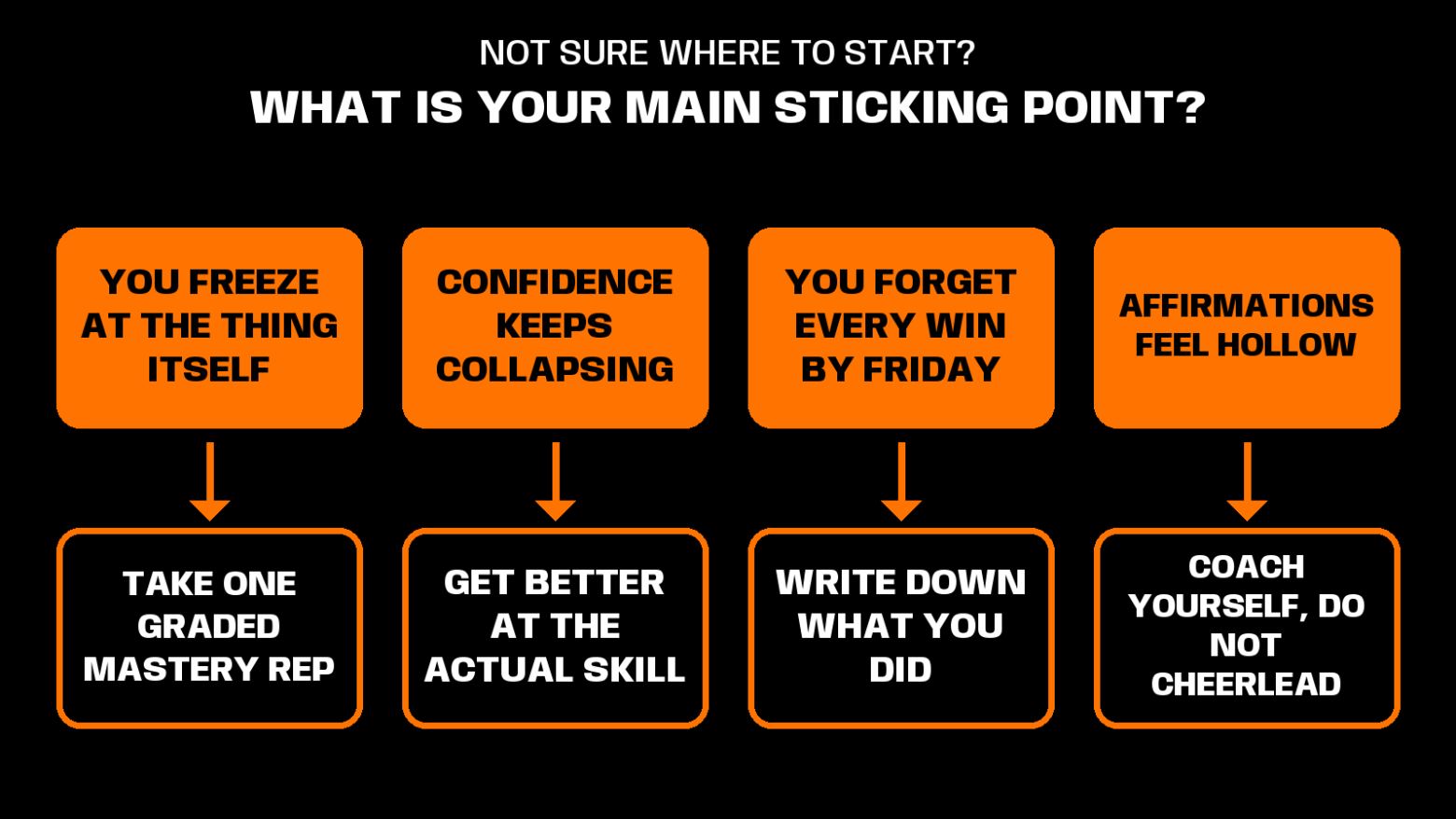
Start with the move that matches your actual sticking point, not the one that sounds most impressive.
Can you be confident and still feel nervous?
Yes, and that is the normal state. Nerves are your body preparing for something that matters, not evidence that you are not ready. Confidence is the expectation that you can handle it anyway, based on having handled similar things before. Waiting for the nerves to disappear before you act is the mistake.
What is the difference between confidence and self-esteem?
Confidence is your expectation that you can do a specific thing. Self-esteem is your overall view of your own worth. Confidence is domain specific and moves with evidence, which is why a man can be certain at work and lost socially. It is also why targeted practice shifts confidence faster than general self-improvement shifts self-esteem.
Does going to the gym make you more confident?
It can, and for a specific reason. Training gives you frequent, measurable proof that you did something hard on a day you did not want to, which is exactly the kind of first-hand evidence self-belief is built on. The limit is transfer. A heavier squat does not automatically make a difficult conversation easier, so treat it as a reliable place to start rather than the whole answer.
Is faking confidence a good idea?
Acting before you feel ready is useful. Performing a confidence you have no evidence for is not, because it raises the stakes without building anything underneath. The difference is whether you are taking a real step slightly beyond your current level, or hiding the gap. One accumulates proof and the other accumulates pressure.
How do I stop caring what other people think?
You do not stop entirely, and you probably should not. What helps is knowing how wrong your read of the room usually is, because people notice far less than you assume and like you more than you think. Then set your own standard for the rep, judge yourself against that, and let the room have its own opinion.
What if my confidence collapses after one failure?
That usually means the evidence base is thin rather than that you have gone backwards. One bad rep can outweigh three good ones when you have only had three. Keep the record, keep the reps frequent, and expect single failures to matter less as the total grows. This is also why writing the wins down is worth the two minutes.
Final Recommendation
Choose one area that genuinely matters, decide the exact time and place for this week’s step, make it small enough that it will definitely happen, and write it down when it is done. Repeat weekly, raise the difficulty when the current level stops feeling like a step. Skip power posing, and keep any self-talk pointed at the next action rather than at your worth. Confidence is what accumulated evidence feels like from the inside, so your only real job is to keep manufacturing the evidence.
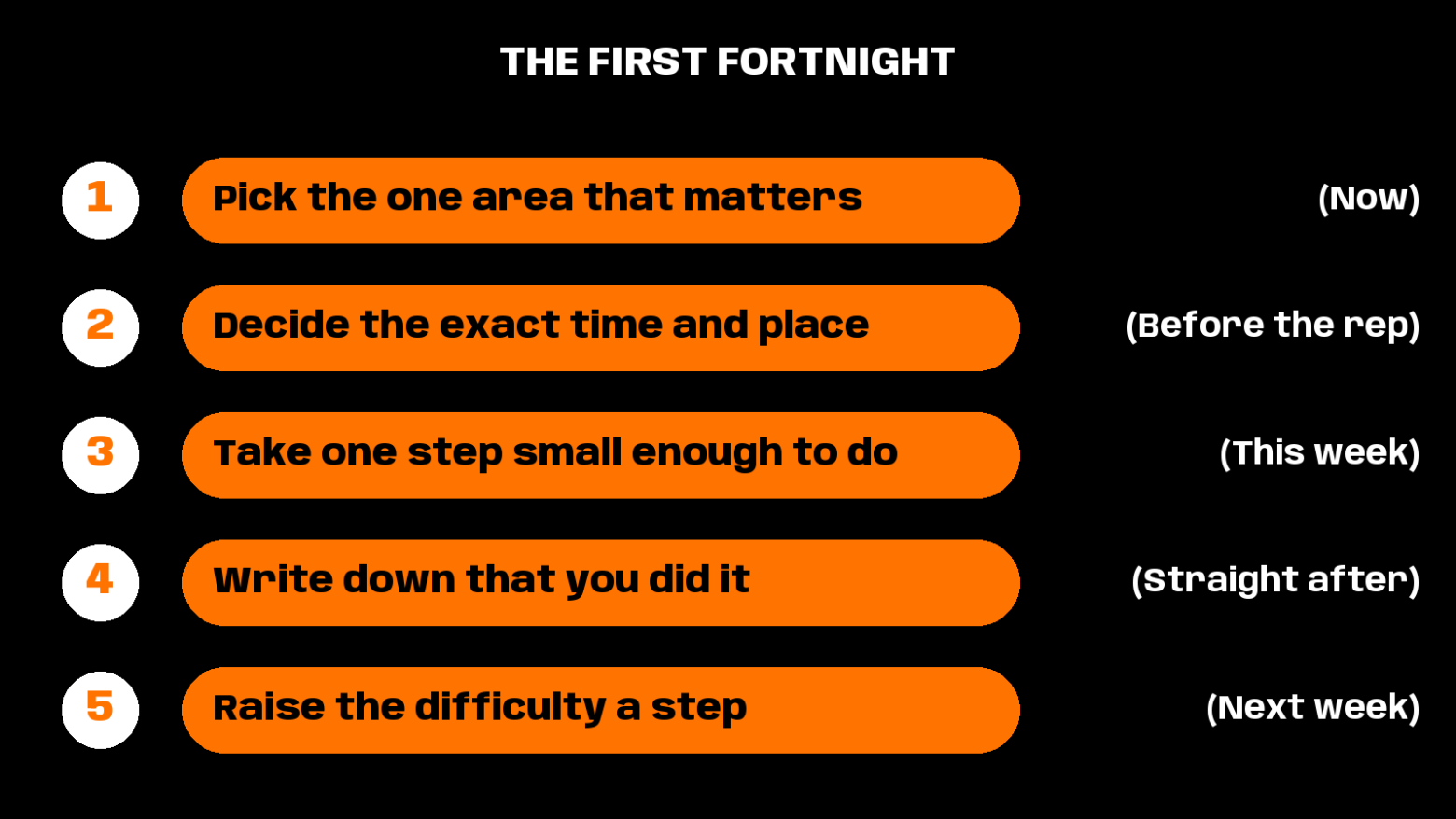
The first fortnight, as five actions and when each one happens, rather than a mindset shift.
Options for Men to Take Action
Most men do not need a different attitude. They need a reason to take the step this Tuesday, somewhere the step gets recorded, and a way to see that it has now happened eleven times rather than feeling like it never happens. Good intentions in your head, no record, and nobody who knows what you are working on is how a confidence plan quietly disappears by week three.
The MenTools app is built to run this as one system rather than a series of resolutions, with daily actions, chosen difficulty levels so the step can start genuinely small, reminders at the moment they matter, streaks and progress tracking, and an AI coach for the weeks a rep goes badly. Men tend to keep the habits they can see progress on.
How you can do this today: pick the one area, set the first step as a daily or weekly action, and log it tonight.
Wins on cost: one subscription replaces a habit tracker, a reminders app and a stack of confidence books.
Wins on time: the structure, levels and tracking already exist, so there is no system to design before the first rep.
Wins on practicality: the difficulty levels mean the first step can be small enough to be embarrassing, which is exactly what graded practice needs.
Watch-out: an app cannot take the step for you, and it will not help if you never choose the area that actually matters. A paper log and one honest friend will do the same job if you are disciplined about both.
Confidence holds up far better when the habit of showing up on the bad days is already there, which is why it is worth reading our guide to self-discipline for men alongside this one. For the specific daily behaviours that carry it, see our list of confidence habits every man should master. Graded practice is also easier to keep up when the basics underneath it are covered, which is why a simple daily foundation like the MenTools One a Day multivitamin can support the steady energy the reps depend on. More tools built for men sit in the MenTools confidence hub. One small step, recorded, repeated for a month, will move you further than any amount of deciding to feel differently.
Last updated: 2026-08-19 v1.0
Disclaimer: This guide is for informational purposes only and does not constitute medical or psychological advice. Speak with a qualified professional before making significant changes if you have a medical or mental health condition.
References
- [1] Bravata DM, Watts SA, Keefer AL, et al. Prevalence, predictors, and treatment of impostor syndrome: a systematic review. Journal of General Internal Medicine, 2020;35:1252-1275. Link
- [2] Bandura A. Self-Efficacy: The Exercise of Control. New York: Freeman, 1997, p. 80, quoted in Sources of Self-Efficacy, Inclusive Perspectives in Primary Education. Link
- [3] Stajkovic AD, Luthans F. Self-efficacy and work-related performance: a meta-analysis. Psychological Bulletin, 1998;124(2):240-261. Link
- [4] Gilovich T, Medvec VH, Savitsky K. The spotlight effect in social judgment: an egocentric bias in estimates of the salience of one’s own actions and appearance. Journal of Personality and Social Psychology, 2000;78(2):211-222. Link
- [5] Boothby EJ, Cooney G, Sandstrom GM, Clark MS. The liking gap in conversations: do people like us more than we think? Psychological Science, 2018. Link
- [6] Wood JV, Perunovic WQE, Lee JW. Positive self-statements: power for some, peril for others. Psychological Science, 2009;20:860-866. Link
- [7] Ranehill E, Dreber A, Johannesson M, Leiberg S, Sul S, Weber RA. Assessing the robustness of power posing: no effect on hormones and risk tolerance in a large sample of men and women. Psychological Science, 2015;26(5):653-656. Link
- [8] Gollwitzer PM, Sheeran P. Implementation intentions and goal achievement: a meta-analysis of effects and processes. Advances in Experimental Social Psychology, 2006, figures as reported in Gollwitzer PM, Implementation Intentions, National Cancer Institute. Link
- [9] Harkin B, Webb TL, Chang BPI, Prestwich A, Conner M, Kellar I, Benn Y, Sheeran P. Does monitoring goal progress promote goal attainment? A meta-analysis of the experimental evidence. Psychological Bulletin, 2016;142(2):198-229. Link
- [10] Moser JS, Dougherty A, Mattson WI, et al. Third-person self-talk facilitates emotion regulation without engaging cognitive control: converging evidence from ERP and fMRI. Scientific Reports, 2017;7:4519. Link
- [11] Neff KD. Why self-compassion trumps self-esteem. Greater Good Science Center, University of California, Berkeley. Link