No products in the cart.
Return To Shop
MEN: How to Plan Your Week as a Man: A Sunday Reset System
Quick Answer
Plan your week in one fixed 30 minute slot on Sunday evening. Empty your head onto a single list, unpack the big jobs into real steps, pick two priorities for the week, book those two into the diary first, protect one genuine recovery block, then review last week before you stand up. Two priorities beat ten.
**Jump to:** The 7 steps at a glance | FAQ | Options for men
Disclosure: MenTools publishes this article and may feature MenTools products.
How we evaluate: Each step is assessed on real-world use, evidence, cost and time, and how well it suits men. Every step including the MenTools option carries an honest limitation. Full sources are in the references below.
The 7 Steps at a Glance
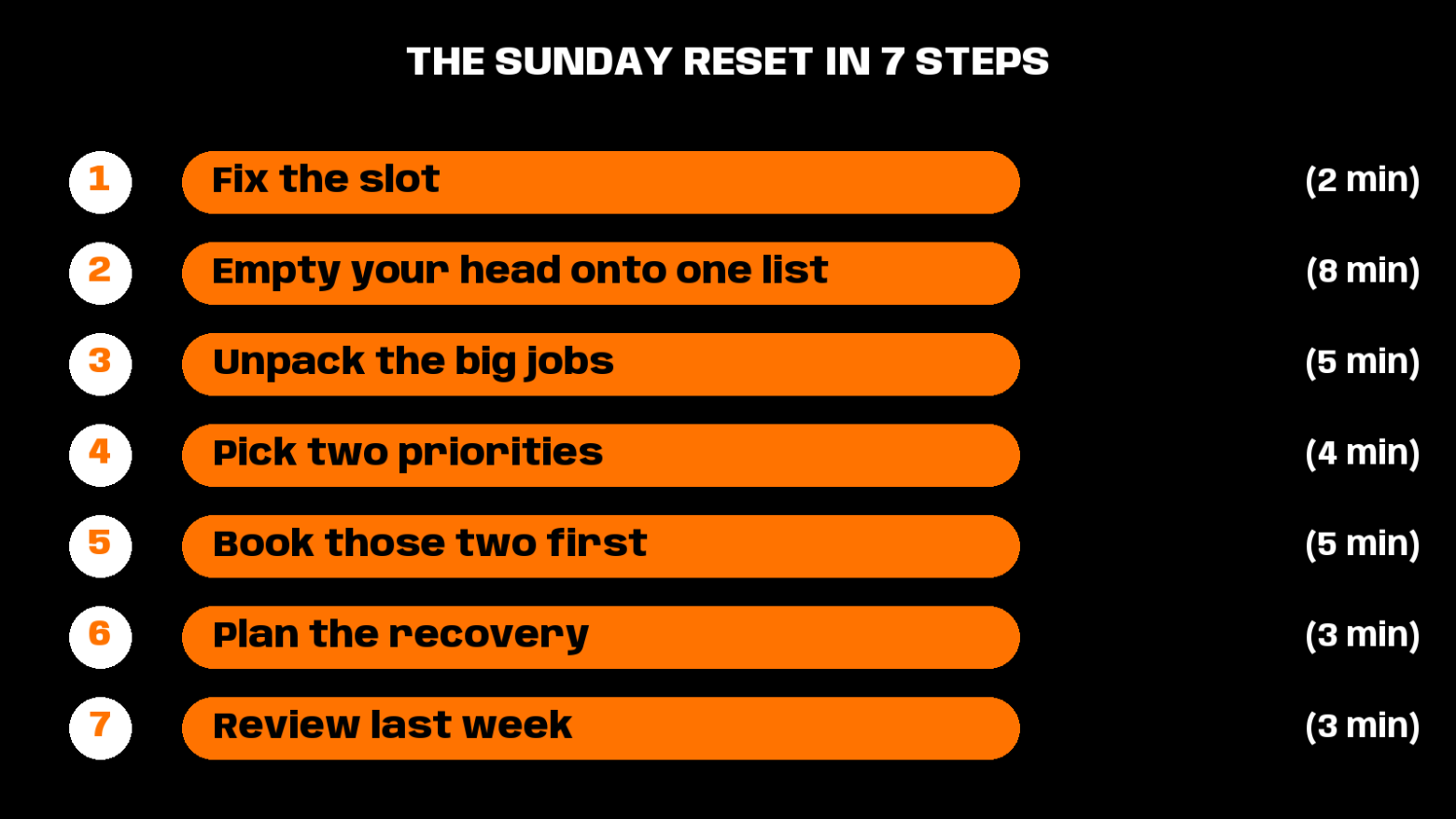
The seven steps of a Sunday reset, and what each one actually costs you in time.
| Step | Best for | Watch-out | Time |
|---|---|---|---|
| Fix the slot | Men who plan only when they feel like it | Sunday evening clashes with family time | 2 min setup |
| Empty your head | Carrying the whole week in your head | Feels worse before it feels better | 8 min |
| Unpack the big jobs | Anyone whose estimates always run over | Tempting to skip on the vague jobs | 5 min |
| Pick two priorities | Men trying to do everything at once | Choosing two means dropping the rest | 4 min |
| Book those two first | Weeks that fill up with other people | A booked block still needs defending | 5 min |
| Plan the recovery | Men who run flat out then crash | Easy to treat as the optional bit | 3 min |
| Review last week | Systems that quietly stop working | Turns into brooding if you let it | 3 min |
How We Chose These 7 Steps
We chose steps that fit inside half an hour and survive a real week with a job, a family and a commute, rather than a planning ritual built for people who control their whole diary. Each step had to pass three tests: is there research behind it, can you actually run it in the time stated, and does it still work when the week goes wrong on Tuesday. The need is not niche. A LinkedIn survey of more than 1,000 employed adults found that 80 percent of professionals experience the Sunday Scaries, rising to 91 percent of millennials and 94 percent of Gen Z workers [1]. Every step below carries an honest watch-out, because a plan cannot shrink a workload that is genuinely too big.
Why Does Weekly Planning Work Better Than Daily Planning?
A week is the smallest unit that contains your whole life, so it is the level at which trade-offs become visible. A daily plan can only shuffle today. A weekly plan lets you see that three big jobs and a birthday will not fit, and decide that now rather than on Thursday night. The start of a week also carries a motivational advantage that no random Wednesday has.
Researchers Hengchen Dai, Katherine Milkman and Jason Riis analysed daily gym attendance for 11,912 university gym members and found that the probability of visiting the gym rose by 33.4 percent at the start of a new week, against 14.4 percent at the start of a month and 11.6 percent at the start of a year [2]. In a separate study of goal contracts, commitments to pursue a goal rose by 62.9 percent at the start of a new week [2].
The authors explain the mechanism directly: these landmarks “demarcate the passage of time, creating many new mental accounting periods each year, which relegate past imperfections to a previous period, induce people to take a big-picture view of their lives, and thus motivate aspirational behaviors” [2]. A Sunday reset uses a motivational window you get 52 times a year and most men waste.
1. Pick a Fixed 30 Minute Slot on Sunday Evening
Choose one slot, the same time every week, and treat it as the appointment that makes the other appointments work. Thirty minutes on Sunday evening is the default because it sits close enough to Monday to be real and far enough from it to still be calm.
What to do: Put a recurring 30 minute block in your calendar, Sunday between 6pm and 9pm. Same chair, same drink, phone face down and out of reach.
Best for: Men who already know they should plan the week and only ever do it when they happen to feel organised.
Why it works: The fresh start effect is strongest at the boundary, and the boundary is what a fixed slot captures. With goal commitments rising 62.9 percent at the start of a new week [2], you are deliberately doing your deciding at the point where your own motivation is highest rather than at the point where it is lowest.
Watch-out: Sunday evening is family time in a lot of houses, and a plan that costs you the only quiet hour with your partner will not last a month. Move it to Monday 7am or Friday afternoon if that fits your life better. The fixed slot matters more than the specific day.
2. Empty Your Head Onto One List
Write down everything you are carrying, in one place, before you plan anything. Work, home, money, the car, the message you have not replied to. This is a dump, not a plan, and it should take about eight minutes.
What to do: One list, one page or one note. Keep writing until nothing new comes. Do not sort, do not estimate, do not decide anything yet.
Best for: Men who lie awake mentally re-checking a list that only exists in their head.
Why it works: Unfinished goals interfere with everything else until they are planned. In studies by E. J. Masicampo and Roy Baumeister published in the Journal of Personality and Social Psychology, unfinished goals produced intrusive thoughts and worse performance on unrelated tasks, and making a specific plan for those goals removed the interference [3]. The list is what lets you put it down.
Watch-out: Seeing all of it on one page usually feels worse for about two minutes, and some men stop there and never get to the deciding part. Push through to step four in the same sitting, because the dump on its own just makes the load visible without making it smaller.
3. Unpack the Big Jobs Into Real Steps
Take anything on the list that is really a project and break it into the actual actions it contains. A job written as one line gets estimated as one line, which is how a two hour task becomes a lost Thursday.
What to do: For every item that is a project rather than a task, write the three to five specific steps underneath it. Estimate the steps, not the project.
Best for: Anyone whose plan looks reasonable on Sunday and has collapsed by Wednesday lunchtime.
Why it works: Justin Kruger and Matt Evans showed in the Journal of Experimental Social Psychology that unpacking a task into its subcomponents raised people’s time estimates significantly, moving them closer to reality and reducing the planning fallacy [4]. Nothing about your speed changes. Your estimate stops lying to you.
Watch-out: Unpacking is most needed on the vague, uncomfortable jobs and those are exactly the ones men skip, so the plan stays accurate everywhere except where it matters. If you cannot name the first physical action, that is the signal to unpack it, not to move on.
4. Choose Two Priorities for the Week and Name Them
Pick two things that, if they happen, make it a good week. Write them at the top of the page in plain words. Everything else on the list is now maintenance, and you have just decided that on purpose.
What to do: Two priorities, no more. One work, one personal, is a reliable split. Write them as outcomes (“first draft finished”, “three training sessions done”), not as themes.
Best for: Men who say yes to everything and end the week having moved eleven things two inches each.
Why it works: Specific advance decisions outperform general intentions by a wide margin. The meta-analysis by Peter Gollwitzer and Paschal Sheeran, covering 94 independent tests, found that spelling out the when, where and how of acting in advance had a medium to large effect on goal attainment, with a d value of 0.65 [5]. Two named outcomes give you something to spell out.
Watch-out: Choosing two means actively accepting that the other six will not move, and that is uncomfortable enough that men quietly pick five instead. Five priorities is the same as none. If you cannot cut to two, rank all of them and draw a line under number two.
5. Book Those Two Into the Diary Before Anything Else
Put your two priorities into specific calendar slots first, while the week is still empty. If they go in after the meetings, they get the leftovers, and the leftovers are Friday at 4pm.
What to do: Open next week’s calendar and block the time for priority one and priority two now. Give each a start time, an end time and a location. Then let the rest of the week arrange itself around them.
Best for: Men whose week gets filled by other people’s requests before they have made a single decision of their own.
Why it works: Writing in Harvard Business Review, Marc Zao-Sanders reported that in a review of 100 productivity techniques, timeboxing, meaning moving your to-do list into your calendar, ranked as the most useful of all of them [6]. A calendar has a fixed size and a list does not, so the diary is where a plan meets reality.
Watch-out: A booked block is a claim, not a guarantee, and it still needs defending on Wednesday when something urgent appears. Leave 20 to 30 percent of the week unbooked so the plan bends instead of snapping, and tell one colleague when your blocks are.
6. Plan the Recovery, Not Just the Work
Book one real recovery block into the week the same way you booked the work. Not a gap where nothing is scheduled, an actual thing you are going to do that switches your head off.
What to do: Choose one block, 90 minutes or more, and name the activity. Training, football, a walk, time with your kids where the phone is in another room. Put it in the calendar with the same commitment as a meeting.
Best for: Men who run flat out for three weeks and then lose the fourth one entirely.
Why it works: How you spend your non-work time predicts how you turn up afterwards. In a longitudinal study of 87 emergency service workers across three measurement points, Charlotte Fritz and Sabine Sonnentag found that non-work hassles, an absence of positive reflection on work, and low social activity during the weekend predicted burnout and poorer general well-being in the following week [7]. Recovery is an input, not a reward.
Watch-out: This is the first block men delete when the week gets tight, which makes it the step most likely to exist only on paper. Treat it as load-bearing and cancel a work block instead, or accept that you are planning a week you cannot repeat.
7. Review Last Week Before You Leave the Chair
Spend three minutes looking at what actually happened. Did the two priorities move, did the blocks hold, and what got in the way. Then close the book. This is the step that keeps the whole system honest.
What to do: Three questions, same three every week. What moved, what did not, and what one change would help next week. Write the answers down where you can see them next Sunday.
Best for: Men whose planning habit worked brilliantly for three weeks and then quietly stopped.
Why it works: Checking progress is one of the most reliable levers in behaviour change. The meta-analysis by Benjamin Harkin and colleagues in Psychological Bulletin covered 138 studies with 19,951 participants and found that prompting people to monitor their progress increased monitoring sharply (d = 1.98) and improved goal attainment (d = 0.40), with larger effects when the information was physically recorded or reported to someone [8]. The authors concluded that “monitoring goal progress is an effective self-regulation strategy” [8]. Writing it down is not admin, it is the active ingredient.
Watch-out: A review can turn into a weekly self-criticism session, which is why it is three minutes and three questions rather than an open reflection. If it consistently leaves you flat, shorten it and only record what moved.
What If Your Week Has No Fixed Shape?
Anchor the reset to an event rather than a clock, and plan the week you actually have. Shift workers, tradesmen and men on call should run the same seven steps at the start of each rota block, protect a shorter 45 minute priority block instead of 90, and accept that the diary is a rough shape rather than a grid. Consistency of sequence beats consistency of hour.
Your estimates will still be optimistic, so keep step three. In the study that named the planning fallacy, Roger Buehler, Dale Griffin and Michael Ross asked students to predict when they would finish their thesis. They predicted 33.9 days on average and took 55.5 days, about 64 percent longer, and only around 30 percent finished by the date they had called 99 percent certain [9]. Irregular hours make that worse, not better, which is why the unpacking step earns its five minutes.
FAQ
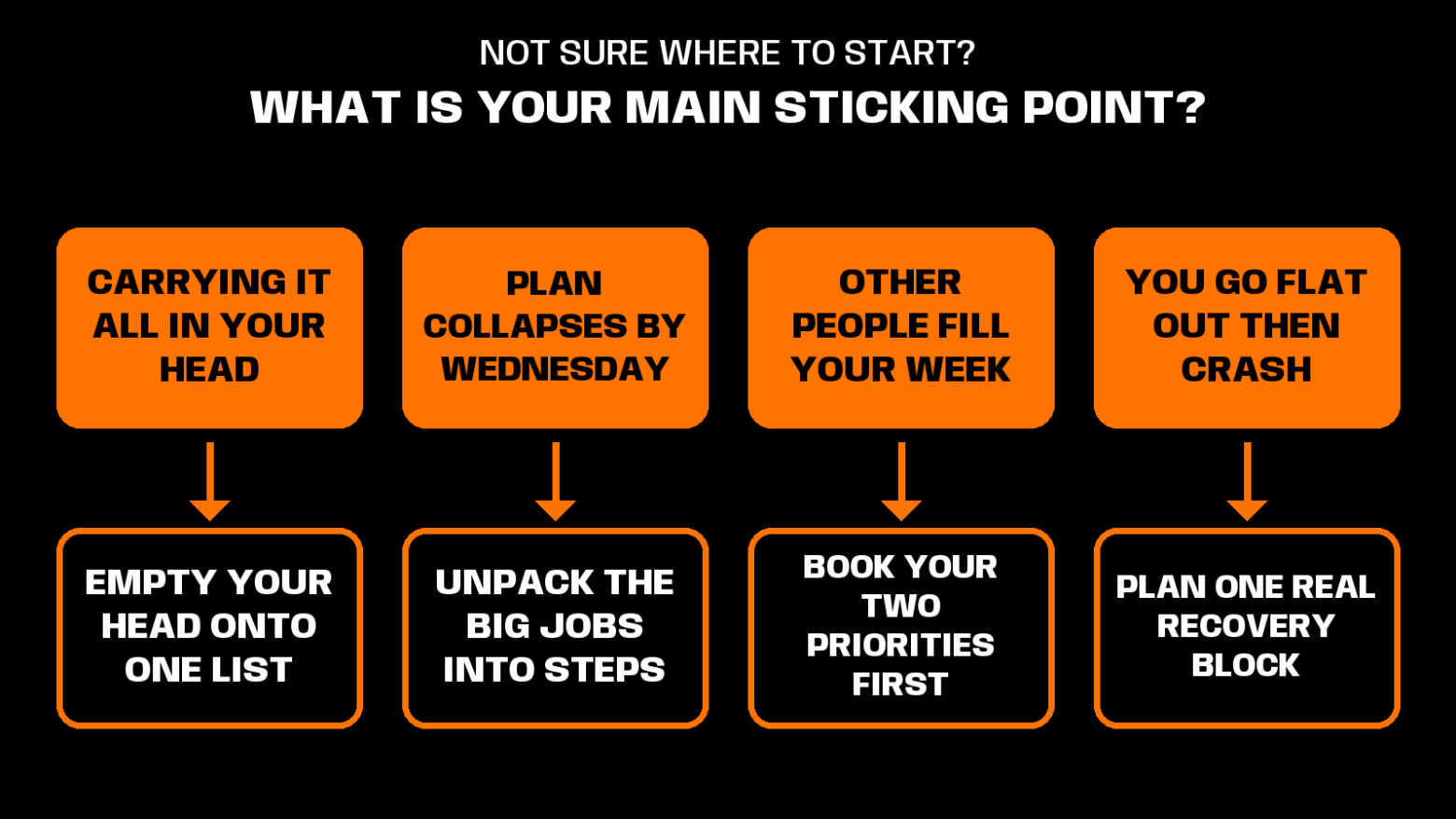
Start with the step that matches your actual sticking point, not the one that sounds most organised.
How long should a weekly planning session take?
Thirty minutes is the target and 20 is enough once you have done it a few times. If yours regularly runs past 45 minutes you are doing the work rather than planning it. Keep a hard stop, and move anything that needs real thinking into a booked block during the week.
Is Sunday the best day to plan the week?
Sunday evening suits most men because the fresh start effect is strongest at the boundary of a new week and nothing has landed on you yet. Monday first thing works nearly as well if Sunday is family time. Friday afternoon is the third option and has the advantage of a clear head about what just happened.
What do I do when the plan is wrecked by Tuesday?
Rebuild the remaining days rather than abandoning the week. Look at your two priorities, ask which one still fits, block the next available window for it, and move the rest to a named later slot. A half-rescued week is the normal outcome, not a failed system.
Do I need an app to plan my week?
No. A single list and whichever calendar you already use will run all seven steps. An app helps with two specific things, cueing you at the right moment and showing whether the blocks actually happened. If opening the app becomes the task, go back to paper and the calendar.
Should I plan my home life or just work?
Both, in the same session. The main advantage of planning by the week is seeing work and home compete for the same hours, which is invisible if you only plan one of them. One work priority and one personal priority is the split most men can sustain.
How many weeks before this makes a difference?
Expect a clearer, calmer week almost straight away, and a real difference in what you finish within three or four weeks as the priority blocks accumulate. The review step takes longest to pay off, because it needs a few cycles of your own data before you start trusting it.
Final Recommendation
Start with three steps, not seven: the fixed slot, two named priorities, and booking those two into the diary before anything else. Add the head-dump and the unpacking in week two, then recovery and the review once the first three hold. Weekly planning works because it is the level where trade-offs become visible, so the whole thing lives or dies on whether you are willing to name two priorities and let the rest wait.
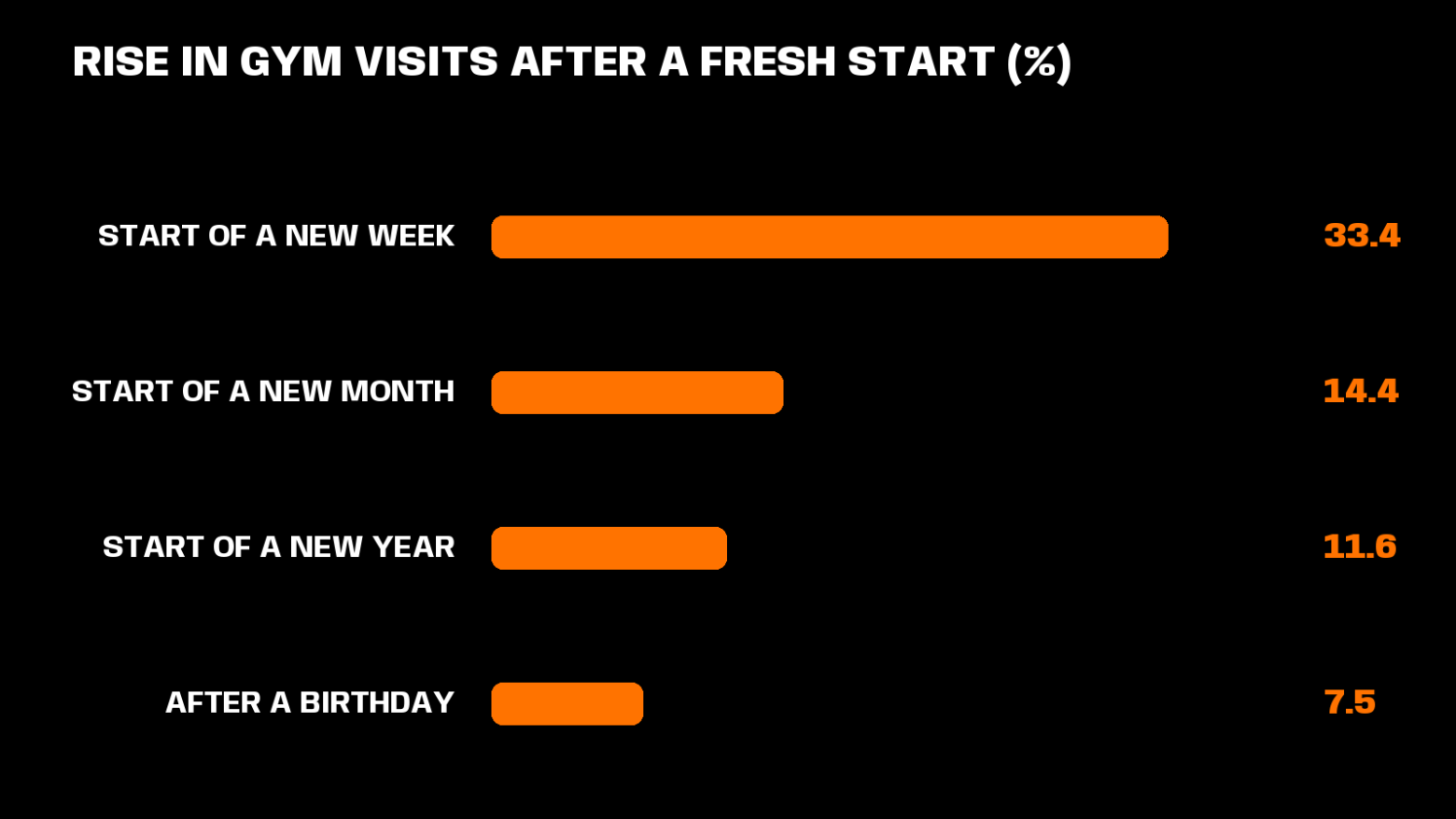
Why Sunday matters: gym attendance rises most at the start of a new week, ahead of a new month or a new year.
Options for Men to Take Action
Most men do not need a better planning template. They need the two priorities to survive contact with Wednesday, the recovery block to stop being the first thing deleted, and something that shows whether the blocks actually happened three weeks running. A list in one app, a calendar in another and a review nobody ever does is how a good Sunday quietly becomes a reactive week.
The MenTools app runs habits like these as one system rather than seven separate intentions, with daily actions, chosen difficulty levels, reminders at the moment they matter, streaks and progress tracking, and an AI coach for the weeks that fall apart on Tuesday. Men tend to keep the habits they can see progress on.
How you can do this today: set your Sunday reset as a weekly action, name your two priorities for this week, and log the first one tonight.
Wins on cost: one subscription replaces a habit tracker, a reminders app and a shelf of planning books.
Wins on time: the structure, levels and tracking already exist, so there is no system to design before you start.
Wins on practicality: it works around shift patterns, travel and school runs, which is exactly where rigid desk-bound planning systems fall over.
Watch-out: an app cannot choose your two priorities or defend your calendar for you, and it will not fix a workload that is genuinely too large. If you already run a weekly review you trust, this adds tracking rather than a transformation.
A weekly plan holds far better when the daily habits underneath it are already steady, which is why it is worth reading our guide to daily habits for men alongside this one. If you are rebuilding after a broken summer, start with the September routine reset, and for the systems that run inside the week see how men manage their time better. More tools built for men sit in the MenTools time management hub. Thirty minutes on a Sunday, run for a month, will do more for your week than any new app.
Last updated: 2026-08-18 v1.0
Disclaimer: This guide is for informational purposes only and does not constitute medical or psychological advice. Speak with a qualified professional before making significant changes if you have a medical or mental health condition.
References
- [1] LinkedIn survey of more than 1,000 employed US adults on Sunday work anxiety, reported by ABC7 Chicago, 2018. Link
- [2] Dai H, Milkman KL, Riis J. The fresh start effect: temporal landmarks motivate aspirational behavior. Management Science, 2014;60(10):2563-2582. Link
- [3] Masicampo EJ, Baumeister RF. Consider it done! Plan making can eliminate the cognitive effects of unfulfilled goals. Journal of Personality and Social Psychology, 2011. Link
- [4] Kruger J, Evans M. If you don’t want to be late, enumerate: unpacking reduces the planning fallacy. Journal of Experimental Social Psychology, 2004;40(5):586-598. Link
- [5] Gollwitzer PM, Sheeran P. Implementation intentions and goal achievement: a meta-analysis of effects and processes. Advances in Experimental Social Psychology, 2006. Link
- [6] Zao-Sanders M. How timeboxing works and why it will make you more productive. Harvard Business Review, December 2018. Link
- [7] Fritz C, Sonnentag S. Recovery, health, and job performance: effects of weekend experiences. Journal of Occupational Health Psychology, 2005;10:187-199. Link
- [8] Harkin B, Webb TL, Chang BPI, Prestwich A, Conner M, Kellar I, Benn Y, Sheeran P. Does monitoring goal progress promote goal attainment? A meta-analysis of the experimental evidence. Psychological Bulletin, 2016;142(2):198-229. Link
- [9] Buehler R, Griffin D, Ross M. Exploring the planning fallacy: why people underestimate their task completion times. Journal of Personality and Social Psychology, 1994. Link