
MEN: The Best Multivitamins for Men in 2026: What to Actually Look For
Quick Answer
A men’s multivitamin is worth buying when four things line up: the mineral forms are ones you absorb well, the doses sit near the nutrient reference value rather than far above it, the formula is iron-free unless a doctor has advised otherwise, and the company publishes its testing. Most of the visible difference between products on a shelf is packaging rather than formulation.
UK men aged 19 to 64 need about 9.5mg of zinc, 300mg of magnesium and 75 micrograms of selenium a day, and the NHS advises that everyone consider a daily 10 microgram vitamin D supplement through autumn and winter.[3][2]
Key points:
- Read the ingredients panel, not the front of the pack.
- A dose far above the NRV is a reason to check the published upper level, not a mark of quality.
- Men aged 19 and over need 8.7mg of iron a day and can usually get it from food, so an iron-free formula suits most men.[4]
- Vitamin D is the one nutrient with standing UK supplement advice behind it.[2]
Jump to: Compare the four formats | What to actually look for | What a label can legally claim
Supplements are foods, not medicines. They are designed to support normal health and nutrient status alongside a balanced lifestyle, not to diagnose, treat, prevent, or cure any medical condition.
Disclosure: MenTools publishes this article and sells MenTools One-A-Day Multivitamin.
How we evaluate: We assess mineral form quality, dose versus NRV, authorised health claims, and male-specific design. Full sources are listed in the references below.
Compare the Four Formats
Almost every men’s multivitamin on sale in the UK falls into one of four formats. The table compares them on the things printed on the label, not on how they are marketed. Every format has a watch-out, including ours.
| Feature | Supermarket one-a-day | High-street men’s formula | Chelated one-a-day (including MenTools One-A-Day) | Personalised subscription pack |
|---|---|---|---|---|
| Typical mineral form | Oxides and sulphates are common | Varies by product, check the label | Contains chelated minerals (magnesium bisglycinate, zinc bisglycinate) | Varies by provider |
| Dose position versus NRV | At or below 100% NRV | Often above 100% NRV | 100% NRV of key vitamins and minerals | Set from a questionnaire |
| Iron | Check the label | Check the label | Iron-free formulation | Depends on the answers given |
| Units per day | Usually one tablet | One to three tablets | One capsule per day | Several capsules or a sachet |
| B-vitamin forms | Standard forms | Check the label | Active B-vitamins (methylcobalamin B12, P-5-P B6, 5-MTHF folate) | Varies by provider |
| Purchase model | One-off pack | One-off pack | One-off or subscription | Subscription only |
| Watch-out | Testing detail is rarely published, and the mineral forms are often the cheapest available | Doses can sit well above the NRV, and the NHS publishes safe upper levels for zinc, magnesium and vitamin D | Costs more per day than a supermarket tablet, and it is one fixed formula rather than a tailored one | You are paying for the questionnaire and the packaging as well as the nutrients |
| Best for | Men who want a low-cost nutritional floor | Men who want higher doses and will read the upper levels | Men who want chelated forms in one capsule a day | Men who would rather the decision was made for them |
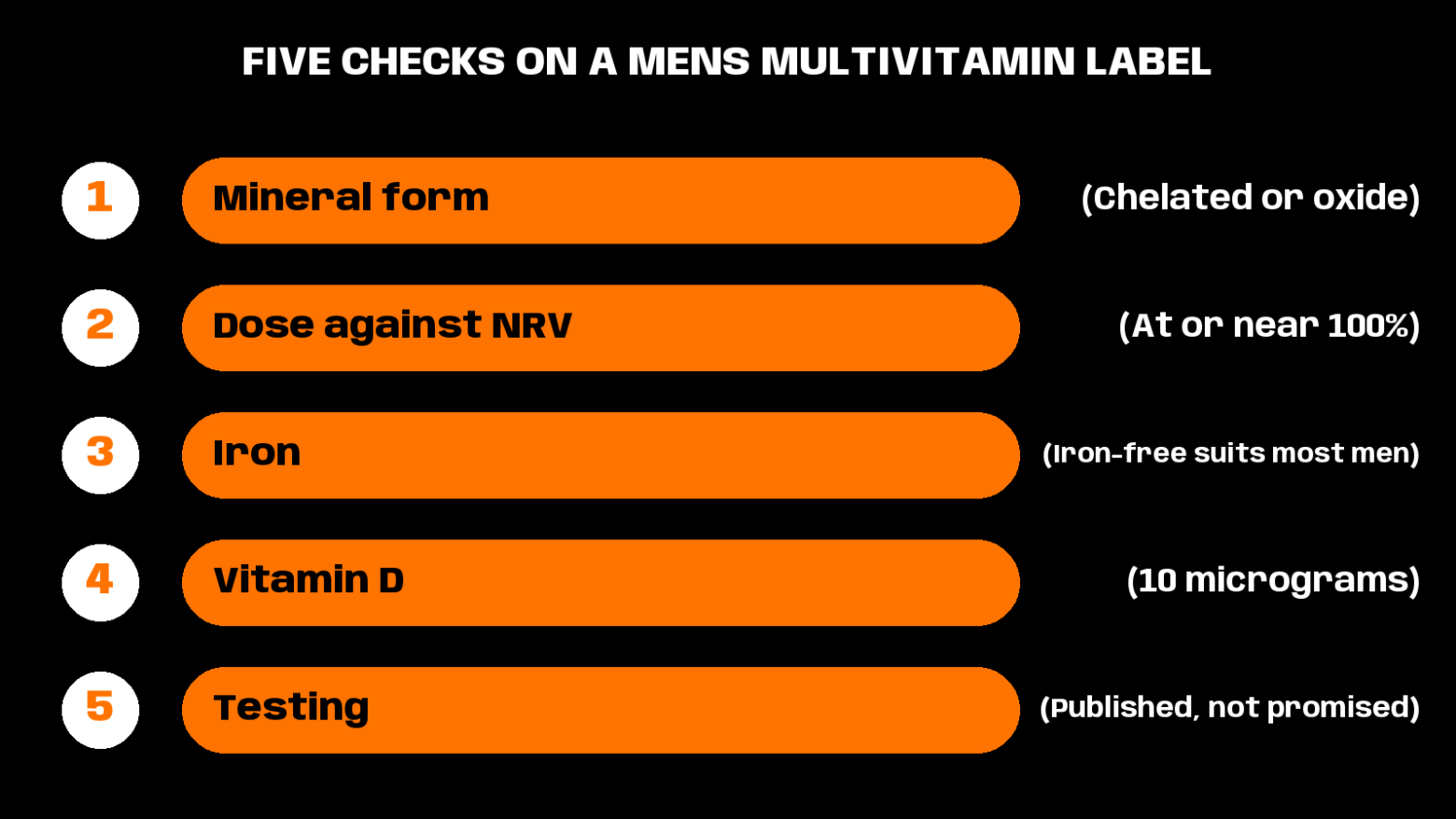
Five checks that separate a considered multivitamin from a marketed one.
What to Actually Look For
Does the mineral form actually matter?
It matters more than the number next to it. Two products can both state 100% NRV of magnesium while using different salts, and the salt determines how much of that magnesium is elemental and how well it is tolerated.
Chelated forms such as magnesium bisglycinate and zinc bisglycinate are bound to an amino acid. Oxides are cheaper to formulate and are the default in low-cost tablets. The label does not have to tell you which one is in the pack, so a brand that states the form is giving you information a brand that hides it is not.
How close to the NRV should the doses be?
Close. The nutrient reference value exists as a population benchmark, and a one-a-day sitting at or near 100% NRV covers the gap a patchy week leaves behind. UK men aged 19 to 64 need about 9.5mg of zinc, 300mg of magnesium and 75 micrograms of selenium a day.[3]
A dose many times the NRV is not automatically a stronger product. The NHS advises not taking more than 100 micrograms of vitamin D a day, notes that high doses of zinc reduce how much copper the body can absorb, and warns that more than 400mg of supplemental magnesium over a short period can cause diarrhoea.[2][3]
Should a men’s multivitamin contain iron?
For most men, no. Men aged 19 and over need 8.7mg of iron a day, and the NHS position is that you should be able to get all of it from your daily diet.[4]
Men do not have the monthly losses that raise the requirement for many women, which is why an iron-free formulation is a reasonable default in a male product. If a blood test has shown you are low, that is a conversation with your doctor and not a reason to pick a different multivitamin off a shelf.
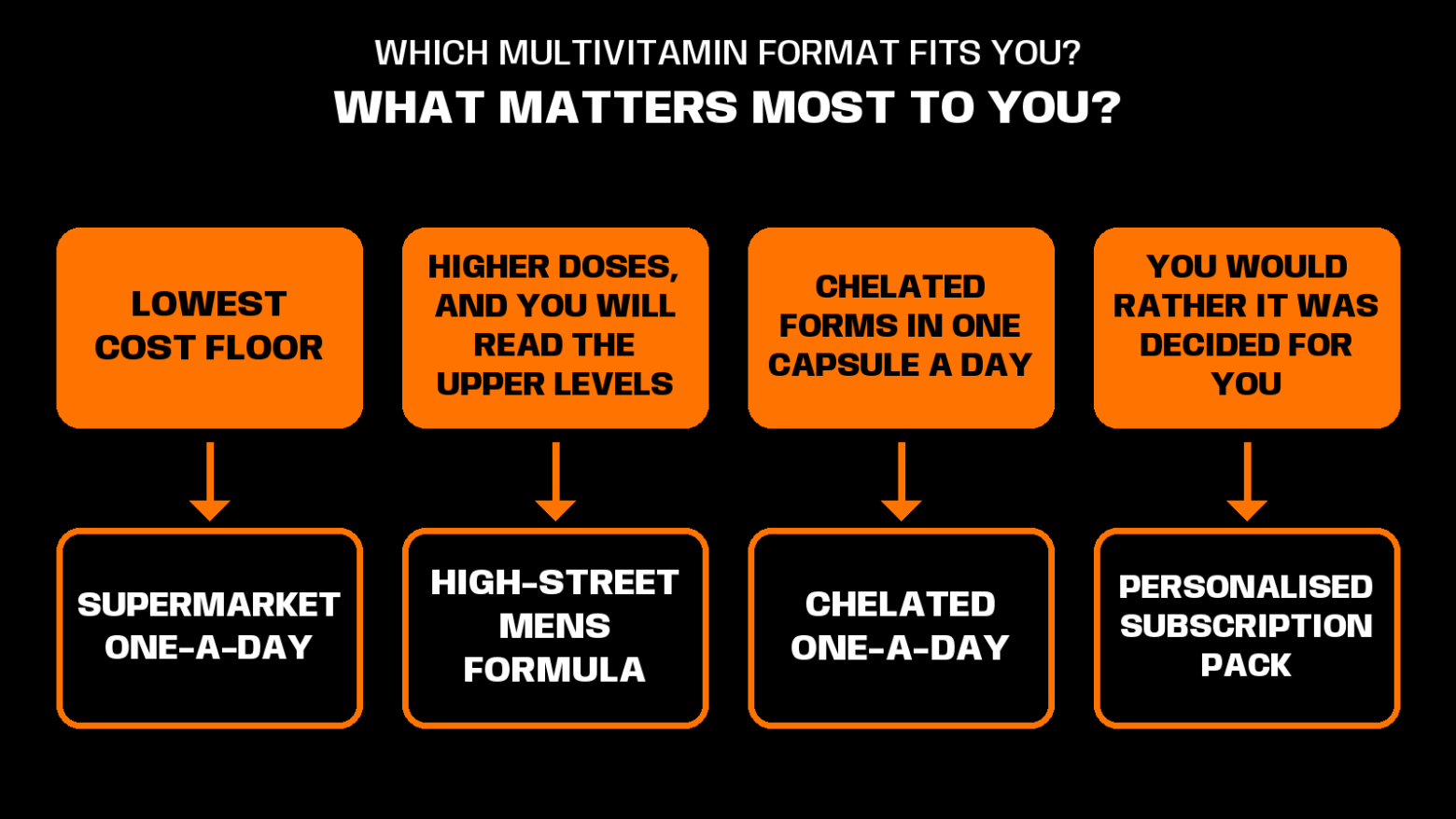
A decision path for choosing between the four formats.
Why vitamin D is the one to check first
Vitamin D is the nutrient on a UK multivitamin label with standing government supplement advice behind it. The NHS advises that everyone consider a daily supplement containing 10 micrograms through autumn and winter, because it is difficult to get enough from food alone.[2] Ten micrograms is equal to 400 IU, which is the unit some labels use.[2]
The Scientific Advisory Committee on Nutrition set out the evidence behind that advice in its vitamin D and health report.[8] If a multivitamin gives you meaningfully less than 10 micrograms, it is not doing the one job the UK actually recommends a supplement for.
What does published testing actually prove?
It proves the contents match the label. A certificate of analysis from an independent laboratory confirms identity, potency and contaminant screening for a specific batch, which is a different thing from a brand stating that its product is tested.
The practical test is whether you can find the testing without emailing anyone. A brand that publishes batch documents on its own site is making a checkable statement, and a brand that does not is asking you to take its word.
What does a multivitamin not do?
It does not replace food. The National Diet and Nutrition Survey tracks what UK adults actually eat and where intakes fall short, and the honest reading is that a capsule narrows specific nutrient gaps rather than fixing a diet.[7]
It also does not act on symptoms. Under GB law a food supplement may carry authorised nutrient function claims, which describe contributions to normal body functions, and nothing about diagnosing or managing a condition.[6]
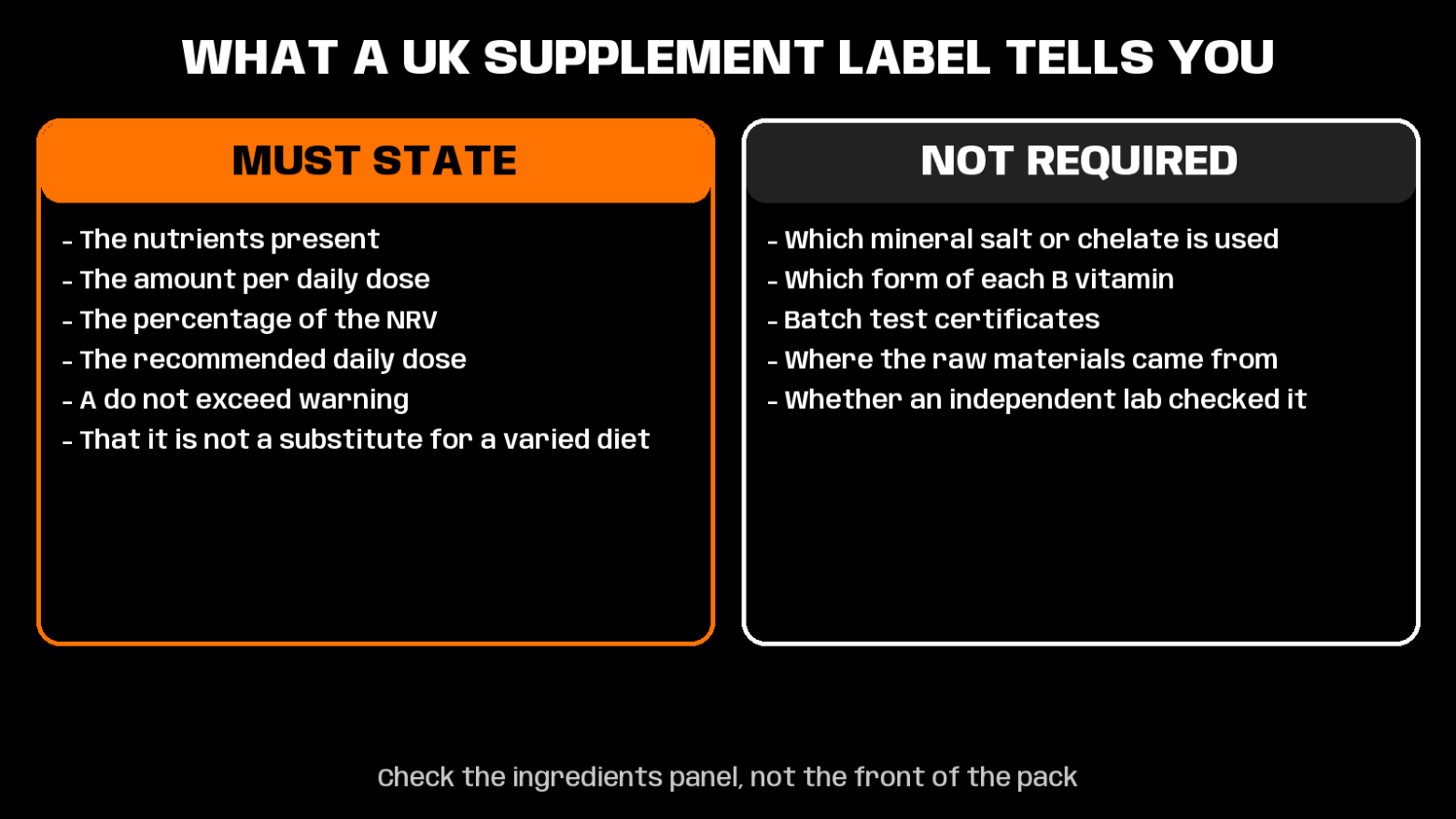
What a UK supplement label must tell you, and what it will not.
What a Label Can Legally Claim
In Great Britain, health claims on food supplements must come from the GB Nutrition and Health Claims Register, which holds the authorised wording and the conditions of use for each claim.[6] A brand cannot write its own version of a claim, and neither can we.
MenTools One-A-Day carries 11 authorised health claims, each of which appears in the register in the exact wording below.[6] These are the claims, reproduced as they must legally appear:
- Pantothenic acid contributes to normal mental performance.
- Zinc and iodine contribute to normal cognitive function.
- Zinc contributes to the maintenance of normal testosterone levels.
- Vitamins B2, B3, B6, B12, vitamin C and magnesium contribute to the reduction of tiredness and fatigue.
- Magnesium contributes to normal psychological function.
- Vitamin D and vitamin K contribute to the maintenance of normal bones.
- Vitamin D contributes to normal muscle function.
- Vitamin D, vitamin C, selenium and zinc contribute to the normal function of the immune system.
- Selenium contributes to normal spermatogenesis.
- Vitamin C, vitamin E and selenium contribute to the protection of cells from oxidative stress.
- Biotin contributes to the maintenance of normal hair and skin.
Read what that wording does and does not say. Every one of them describes a contribution to a normal function, at a normal level, in a person who is already well.
So when a product page tells you a supplement will raise a hormone, sharpen a mood or stop you getting ill, it has left the register behind. That is a useful filter when you are comparing two packs and cannot tell them apart any other way.
FAQ
Do most men need a multivitamin?
Not automatically. The NHS position is that a varied and balanced diet should supply the nutrients most adults need, with vitamin D the standing exception through autumn and winter.[1][2] A multivitamin is a sensible floor if your diet is inconsistent, but it is a supplement to food, not a replacement for it.
Does a higher price mean a higher quality multivitamin?
Not on its own. Price can reflect chelated mineral forms, active B-vitamin forms and published testing, which are real differences. It can also reflect packaging, a questionnaire or a subscription. Read the ingredients panel and the testing page rather than the price.
Can you take too much of a vitamin or mineral?
Yes. The NHS advises not taking more than 100 micrograms of vitamin D a day.[2] Taking high doses of zinc reduces how much copper the body can absorb, and more than 400mg of supplemental magnesium over a short period can cause diarrhoea.[3] More than 1,000mg of vitamin C a day can cause stomach pain and diarrhoea.[5] A dose far above the NRV is a reason to check the label, not a selling point.
What if the label does not say which mineral forms are used?
Treat that as missing information. A UK label must list the nutrients and their amounts, but it is not obliged to spell out the salt or chelate used. If the ingredients panel says magnesium without saying which magnesium, you cannot tell what you are buying.
Can you take a multivitamin alongside other supplements?
You can, but add the doses together before you do. Stacking a multivitamin with a separate zinc, magnesium or vitamin D product is the most common way men drift past the published upper levels without noticing.[2][3]
I am on TRT or prescription medication. Can I take a multivitamin?
If you are on TRT or any prescribed medication, speak with your prescribing doctor before adding any supplement. MenTools products are nutritional supplements designed to support general health and normal nutrient status, not medicines and not a replacement for medical treatment.
Are food supplements medicines?
No. Food supplements are foods in law, not medicines. They are designed to support normal health and nutrient status alongside a balanced lifestyle, not to diagnose, treat, prevent, or cure any medical condition.
Final Recommendation
Pick the format that matches how you actually buy and swallow things, then hold it to the four checks. If you want the lowest cost floor and will take a tablet without thinking about it, a supermarket one-a-day is a defensible choice, and you should accept that you will not know much about the forms or the testing.
If you want to know what is in the capsule, want it in one capsule, and are willing to pay more per day for chelated minerals and active B-vitamin forms, a chelated one-a-day is the format to look at. MenTools One-A-Day sits in that column, and its honest limitation is the same as every product in it. It is one fixed formula, it costs more per day than a supermarket tablet, and it is not tailored to your blood work.
Whichever you choose, check the vitamin D figure first, add up your total intake if you take anything else, and treat any claim that goes beyond the authorised wording as a reason to put the pack down.
Options For Men to Take Action
Most men end up with three half-used tubs in a cupboard, bought at different times for different reasons, none of which add up to a plan. The gap is rarely effort. It is that nobody tells you what the label means, so every purchase starts from scratch.
MenTools One-A-Day is built as the simple version of this: one capsule per day, chelated minerals, active B-vitamin forms, iron-free, at 100% NRV of key vitamins and minerals. If you want the wider reading on food and nutrition for men first, the nutrition archive covers what sits around the capsule, and the MenTools challenges handle the daily habit side that a supplement cannot touch.
How you can do this today: take the pack you already own, find the ingredients panel, and check the four things in the table above. That takes about two minutes and tells you whether to finish the tub or replace it.
Wins on cost: one considered one-a-day replaces the scattergun habit of buying a separate zinc, magnesium and vitamin D tub that between them cost more and overlap badly.
Wins on time: the comparison work is done. You are reading a label against four fixed checks instead of researching forms and upper levels every time you restock.
Wins on practicality: one capsule a day travels, survives a work trip, and does not need a pill organiser or a morning ritual to keep up with.
Consistency is what makes any of this count, and a format you will actually keep taking beats a formula you abandon in March.
Last updated: 2026-09-18 v1.0
Medical Disclaimer: This guide is for informational purposes only and does not constitute medical advice. Always speak with your doctor or another qualified healthcare professional before starting any new supplement or programme if you have medical conditions or take prescription medication.
Supplement Notice: Food supplements should not be used as a substitute for a varied and balanced diet and a healthy lifestyle. Do not exceed the stated recommended daily dose. Keep out of reach of children.
References
- [1] NHS. Vitamins and minerals. NHS. https://www.nhs.uk/conditions/vitamins-and-minerals/
- [2] NHS. Vitamins and minerals, Vitamin D. NHS. https://www.nhs.uk/conditions/vitamins-and-minerals/vitamin-d/
- [3] NHS. Vitamins and minerals, Others, including zinc, selenium and magnesium. NHS. https://www.nhs.uk/conditions/vitamins-and-minerals/others/
- [4] NHS. Vitamins and minerals, Iron. NHS. https://www.nhs.uk/conditions/vitamins-and-minerals/iron/
- [5] NHS. Vitamins and minerals, Vitamin C. NHS. https://www.nhs.uk/conditions/vitamins-and-minerals/vitamin-c/
- [6] Department of Health and Social Care. Great Britain nutrition and health claims (NHC) register. GOV.UK. https://www.gov.uk/government/publications/great-britain-nutrition-and-health-claims-nhc-register
- [7] Office for Health Improvement and Disparities. National Diet and Nutrition Survey. GOV.UK. https://www.gov.uk/government/collections/national-diet-and-nutrition-survey
- [8] Scientific Advisory Committee on Nutrition. SACN vitamin D and health report. GOV.UK. https://www.gov.uk/government/publications/sacn-vitamin-d-and-health-report