MEN: Sleep for Men: The Complete Guide to Fixing Your Sleep
Quick Answer
Fix sleep in this order. Anchor one wake time seven days a week, get daylight into your eyes early, move your caffeine cut off back to eight hours, drop the nightcap, write tomorrow’s list before bed, keep training but not in the final hour, and get persistent daytime sleepiness checked rather than managed. Regularity does more than hours.
**Jump to:** The 7 at a glance | How we built this guide | FAQ | Options for men
Disclosure: MenTools publishes this article and may feature MenTools products.
How we evaluate: Each area is assessed on real-world use, evidence, cost and time, and how well it suits men. Every area including the MenTools option carries an honest limitation. Full sources are in the references below.
The 7 at a Glance
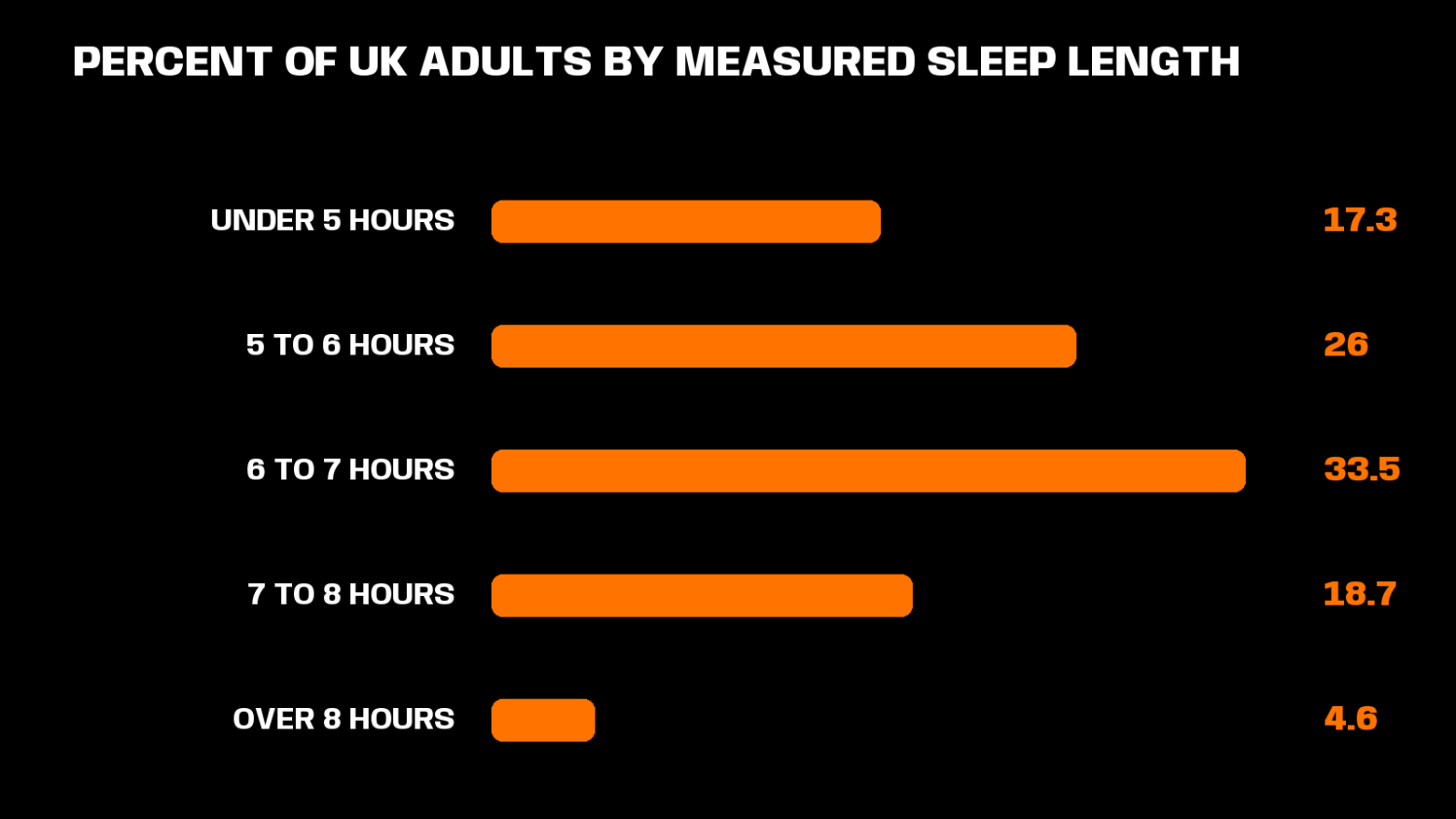
Objectively measured, not self reported. Most UK adults land under the seven hour mark.
| # | Area | What it fixes | Time to do it | Watch-out |
|---|---|---|---|---|
| 1 | Anchor your wake time | The whole rhythm, including how fast you fall asleep | One alarm decision | The first week is worse before it is better |
| 2 | Daylight early | Timing, mood, and how sleepy you feel at night | 20 to 30 minutes outdoors | Hard in a British winter and on early shifts |
| 3 | Caffeine cut off | Sleep you are losing without noticing | One decision, daily | Withdrawal headaches for a few days |
| 4 | The nightcap | The second half of the night | One decision, nightly | It genuinely does help you drop off, so it feels like a loss |
| 5 | Five minute brain dump | The lying awake planning tomorrow problem | 5 minutes | Does nothing for a physical cause |
| 6 | Training, timed right | Sleep depth and how quickly you drop off | Existing training | Only the last hour actually matters |
| 7 | Know when to get it checked | The thing no routine will fix | One GP appointment | Needs you to stop self managing |
How We Built This Guide
Every area below had to clear three tests. The effect had to be measured rather than asserted, it had to be something a working man can change this week without buying anything, and it had to survive contact with an ordinary schedule. That removes most of what gets sold as sleep advice.
The order matters more than the list. The single biggest finding in recent sleep research is that when you sleep is a stronger signal than how long you sleep, so the areas are ranked by what actually moves the needle rather than by what is easiest to write about.
Men have the worse end of this to start with. In a study of 82,995 UK adults who wore wrist accelerometers for a week, men made up 54.9 percent of the group sleeping under five hours a night but only 35.4 percent of those sleeping more than eight, and men’s sleep efficiency was lower than women’s at 0.811 against 0.829 [1].
This is general information rather than medical advice. The NHS insomnia page is the right first stop if your sleep has been poor for months, and area 7 below covers when to stop treating this as a habits problem.
1. Anchor One Wake Time, Seven Days a Week
If you change one thing, change this. Getting up at roughly the same time every day, including Saturday and Sunday, does more for your sleep than adding an hour to it. A regular pattern sets the clock that decides when you feel sleepy at night, which is why irregular sleepers struggle to fall asleep even when they go to bed early.
What it is: a fixed wake time, not a fixed bedtime. You control when you get up far more reliably than when you fall asleep, so the wake time is the lever with a handle on it.
Who it is for: the man who sleeps six hours in the week and nine on Sunday, then cannot get off to sleep on Sunday night.
What the evidence says: researchers calculated a sleep regularity score from over 10 million hours of accelerometer data in 60,977 UK Biobank participants and tracked deaths for an average of 6.3 years. The most regular sleepers had between 20 percent and 48 percent lower risk of death from any cause than the least regular [3]. The authors concluded that “sleep regularity was a stronger predictor of all-cause mortality than sleep duration” [3].
How to do it: pick the wake time your worst weekday demands and use it every day for two weeks. Let the bedtime follow on its own rather than forcing it.
Watch-out: the first week is genuinely worse. You lose the Sunday lie in before you gain the easier Sunday night, and most men quit in that gap.
2. Get Daylight Into Your Eyes Early
Morning light is the input that sets the clock you just anchored. Getting outside within an hour or so of waking, for twenty to thirty minutes, pulls your body clock earlier and makes you sleepy at a sensible hour that night. It is free, it works through cloud, and no indoor lighting is a real substitute for it.
What it is: outdoor light exposure early in the day, not a lamp, a supplement or a screen setting.
Who it is for: the man who drives to work in the dark, sits under office lighting all day, and wonders why he is wide awake at midnight.
What the evidence says: across more than 400,000 UK Biobank participants, who reported a median of just 2.5 daylight hours outdoors per day, each additional hour spent outdoors was associated with lower odds of depression and antidepressant use, greater happiness, and improved sleep and earlier sleep timing [4]. The authors concluded that “low daytime light exposure is an important environmental risk factor for mood, sleep, and circadian-related outcomes” [4].
How to do it: attach it to something you already do. Walk the first part of the commute, take the morning call outside, or get the coffee from somewhere that requires a walk.
Watch-out: this is an association study rather than a trial, and a British January makes the dose hard to hit. Take what light there is and accept that winter is the harder half of the year.
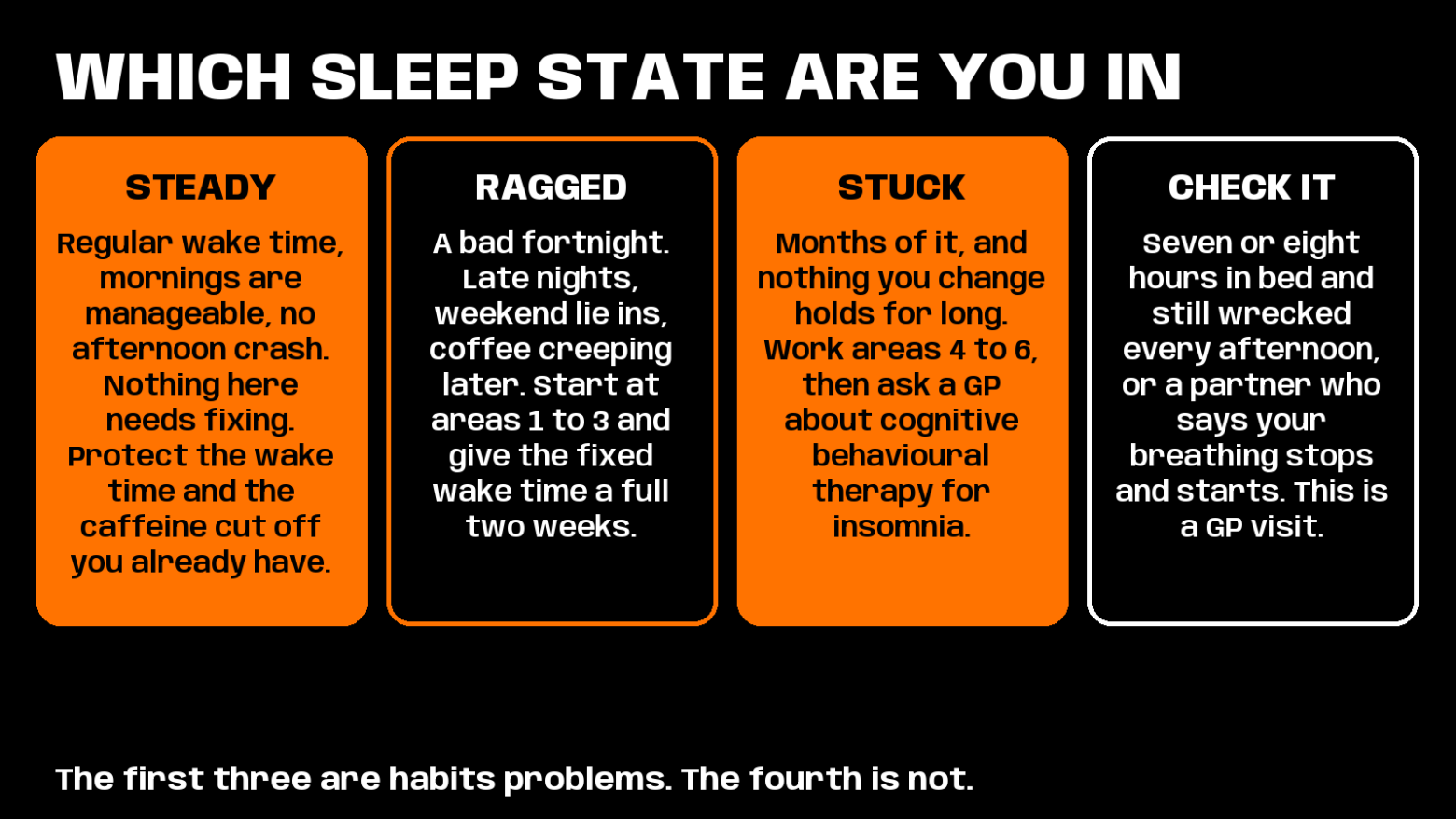
Find the column you are actually in. The first three are habits problems and the fourth is not.
3. Move Your Caffeine Cut Off Back to Eight Hours
Most men set their caffeine cut off by how they feel, and that is exactly the problem. Caffeine taken six hours before bed measurably cuts your sleep without you noticing it happened, so the honest cut off sits earlier than instinct suggests. For a midnight bedtime that means nothing after about four in the afternoon.
What it is: a fixed time after which no coffee, strong tea, energy drinks or pre workout.
Who it is for: the man who insists coffee does not affect him because he falls asleep fine. Falling asleep is not the part caffeine damages most.
What the evidence says: in a controlled study, a 400 milligram dose of caffeine taken six hours before bed reduced objectively measured total sleep time by more than an hour, and the researchers noted that participants were largely unaware their sleep had been disturbed [5]. That gap between how sleep felt and what was measured is the whole point. NHS advice is not to have coffee, tea or alcohol for “at least 6 hours before going to bed” [2].
How to do it: set the cut off at eight hours before your anchored bedtime, and make the afternoon drink the decaf version. In the same 82,995 adult UK study, decaffeinated coffee drinkers had significantly higher sleep efficiency than regular coffee drinkers [1].
Watch-out: 400 milligrams is a large dose, roughly four cups, so your own effect may well be smaller. Expect a few days of headaches if you have been running on a late afternoon habit.
4. Be Honest About the Nightcap
Alcohol is the most convincing sleep aid there is, which is the trouble with it. It genuinely gets you to sleep faster and deepens the first half of the night, then takes the second half apart. The 3am wake up that feels like stress is very often last night’s drink wearing off.
What it is: the beer or two in the evening treated as a wind down tool rather than as a drink.
Who it is for: the man who sleeps badly on the nights he has not drunk and concludes that drink helps.
What the evidence says: a review of the research on alcohol and normal sleep found that at all doses alcohol reduces the time taken to fall asleep and consolidates the first half of the night, while increasing disruption in the second half, and that total night rapid eye movement sleep is decreased at moderate and high doses [6]. You are trading the back half of the night for the front half.
How to do it: move drinking earlier in the evening rather than banning it, and keep two or three nights a week clear so you can see what your sleep is like without it.
Watch-out: this one feels like a downgrade for the first fortnight, because you lose a reliable way of dropping off and gain a benefit you only notice at five in the morning.
5. Spend Five Minutes Writing Tomorrow Down
If your problem is lying there running through tomorrow, the fix is not relaxation, it is offloading. Writing a specific list of what needs doing tomorrow, on paper, before you get into bed, measurably shortens the time it takes to fall asleep. It works because the list stops your head from rehearsing it.
What it is: five minutes, a pen, and tomorrow’s tasks written out in enough detail to be useless to think about again.
Who it is for: the man whose body is tired and whose head is still in the working day.
What the evidence says: in a sleep laboratory study of 57 adults monitored with polysomnography, those who spent five minutes writing a to do list before bed fell asleep in about 16 minutes, against about 25 minutes for those who wrote about tasks they had already completed [7]. The more specific the list, the faster they fell asleep.
How to do it: do it before you get into bed rather than in it, and write the next actions rather than the worries. If your head is busy most nights rather than some nights, our guide on how to stop overthinking as a man covers the daytime half of the problem.
Watch-out: it is a fix for a busy head and nothing else. If you are waking at 3am rather than struggling to drop off, areas 4 and 7 are the ones to read.
6. Keep Training, Just Not in the Last Hour
Regular exercise is one of the few things the NHS lists as a straightforward do for sleep [2]. The common advice to stop training four hours before bed is stronger than the evidence supports, and it costs a lot of men their only realistic training slot. The hour before bed is the part that genuinely matters.
What it is: keeping your training where your life allows it, and protecting only the final hour.
Who it is for: the man who can only train at half nine at night and has been told that is the reason he sleeps badly.
What the evidence says: a systematic review and meta analysis of 23 studies found the evidence does not support the idea that evening exercise harms sleep. Evening exercise slightly increased slow wave sleep by 1.3 percentage points and reduced light stage 1 sleep by 0.9 percentage points. The exception the authors identified was vigorous exercise finishing an hour or less before bedtime, which might impair how quickly you fall asleep, total sleep time and sleep efficiency [8].
How to do it: train when you can, and aim to finish more than an hour before you intend to be asleep. A hard session at eight is fine for an eleven o’clock bed.
Watch-out: this covers healthy participants and mostly structured exercise. If a late session leaves you visibly wired, trust that over the average.
7. Know When It Stops Being a Habits Problem
No routine fixes a breathing disorder. If you are sleeping seven or eight hours and still exhausted every afternoon, or your partner tells you your breathing stops and starts in the night, that is a medical question rather than a discipline question. This is the area men are most likely to keep managing for years instead of getting looked at.
What it is: recognising the signs that belong to a GP rather than to a better evening routine.
Who it is for: the man who has done everything above for two months and is still wrecked.
What the evidence says: sleep disordered breathing is substantially more common in men. In a population study, an estimated 10 percent of men aged 30 to 49 had moderate to severe sleep disordered breathing, against 3 percent of women the same age, rising to 17 percent of men aged 50 to 70 [9]. The NHS advises seeing a GP if “your breathing stops and starts while you sleep”, if you “make gasping, snorting or choking noises while you sleep”, or if you “always feel very tired during the day”, and notes that sleep apnoea “can be serious if it’s not diagnosed and treated” [10].
For insomnia that has lasted months, the treatment that works is not a tablet. The NHS notes that GPs “now rarely prescribe sleeping pills to treat insomnia” and that you may be offered cognitive behavioural therapy, either face to face or as an online programme [2]. A meta analysis of 20 randomised controlled trials covering 1,162 adults with chronic insomnia found it cut the time taken to fall asleep by 19.03 minutes and the time spent awake during the night by 26.00 minutes, and improved sleep efficiency by 9.91 percent [11].
How to do it: book the appointment and describe the daytime symptoms, not just the nights. Take your partner’s account of your breathing with you, because you cannot report what happens while you are asleep.
Watch-out: that same meta analysis found total sleep time improved by only 7.61 minutes, and the confidence interval crossed zero [11]. Cognitive behavioural therapy reliably improves the quality and efficiency of your sleep rather than adding hours to it, and men expecting two extra hours will read that as a failure.
Why This Is Worth the Effort for Men Specifically
Short sleep is more than a tiredness problem. In a laboratory study, ten healthy young men averaging 24 years old slept under five hours a night for a week, and their daytime testosterone levels fell by 10 to 15 percent [12]. That is a small sample in tightly controlled conditions, so treat it as a mechanism rather than a promise about your own numbers.
The researcher who ran it, Eve Van Cauter, professor in medicine at the University of Chicago, noted that “low testosterone levels are associated with reduced well being and vigor, which may also occur as a consequence of sleep loss”, and that “as research progresses, low sleep duration and poor sleep quality are increasingly recognized as endocrine disruptors” [13].
The men who hold these changes tend to be the ones who fixed the wake time first and let everything else follow, rather than the ones who tried to change six things on a Sunday night.
FAQ
How many hours of sleep do men actually need?
The NHS puts the adult range at 7 to 9 hours a night on average [2]. There is no separate male figure. Chasing a number matters less than hitting a similar window every night, since regularity predicted mortality risk more strongly than duration in the largest study on it [3].
Can you catch up on sleep at the weekend?
Partly, but the lie in is also what keeps the cycle going. Sleeping until eleven on Sunday shifts your clock later, which makes Sunday night harder and Monday worse. If you are short, go to bed earlier rather than getting up later, and keep the wake time fixed.
Why do I wake up at 3am every night?
Second half waking has a short list of usual causes, and alcohol is near the top of it, since drink consolidates the first half of the night and increases disruption in the second [6]. Room temperature, a full bladder and a late heavy meal account for most of the rest. If it persists with none of those, see a GP.
Does cutting screens before bed actually work?
The NHS advises against screens before bed because of the light and the stimulation [2]. In practice the content matters as much as the screen, since a phone that keeps your head working defeats the point of winding down. Treat the last hour as the target rather than the device.
Is snoring something to worry about?
Loud snoring on its own is common. It becomes a medical question alongside breathing that stops and starts, gasping or choking noises, or heavy daytime sleepiness, which the NHS lists as reasons to see a GP [10]. Men are considerably more affected than women at every age band studied [9].
How long before better sleep habits show a result?
Expect the first week of a fixed wake time to feel worse, and a noticeable difference across two to three weeks. The changes that act fastest are the brain dump, which shortened sleep onset the same night in testing [7], and moving the caffeine cut off.
Do sleep trackers help?
They are useful for spotting a pattern you would otherwise miss, such as how much later you wake at weekends. They are less reliable as a nightly score, and worrying about a bad readout is its own sleep problem. Use one for a fortnight to find the pattern, then act on it.
Final Recommendation
Anchor your wake time this week and change nothing else. It is the lever the other six sit on top of, it costs nothing, and it has the strongest evidence behind it. Give it a fortnight before you judge it, because the first week is the worst week by design.
Then add one area a fortnight, working down the list. If you reach the end and you are still exhausted during the day, stop optimising and book the appointment, because area 7 is the only one here that a better routine cannot solve. For the practical version of the last hour, our evening routine guide for men sets out what to put in it.
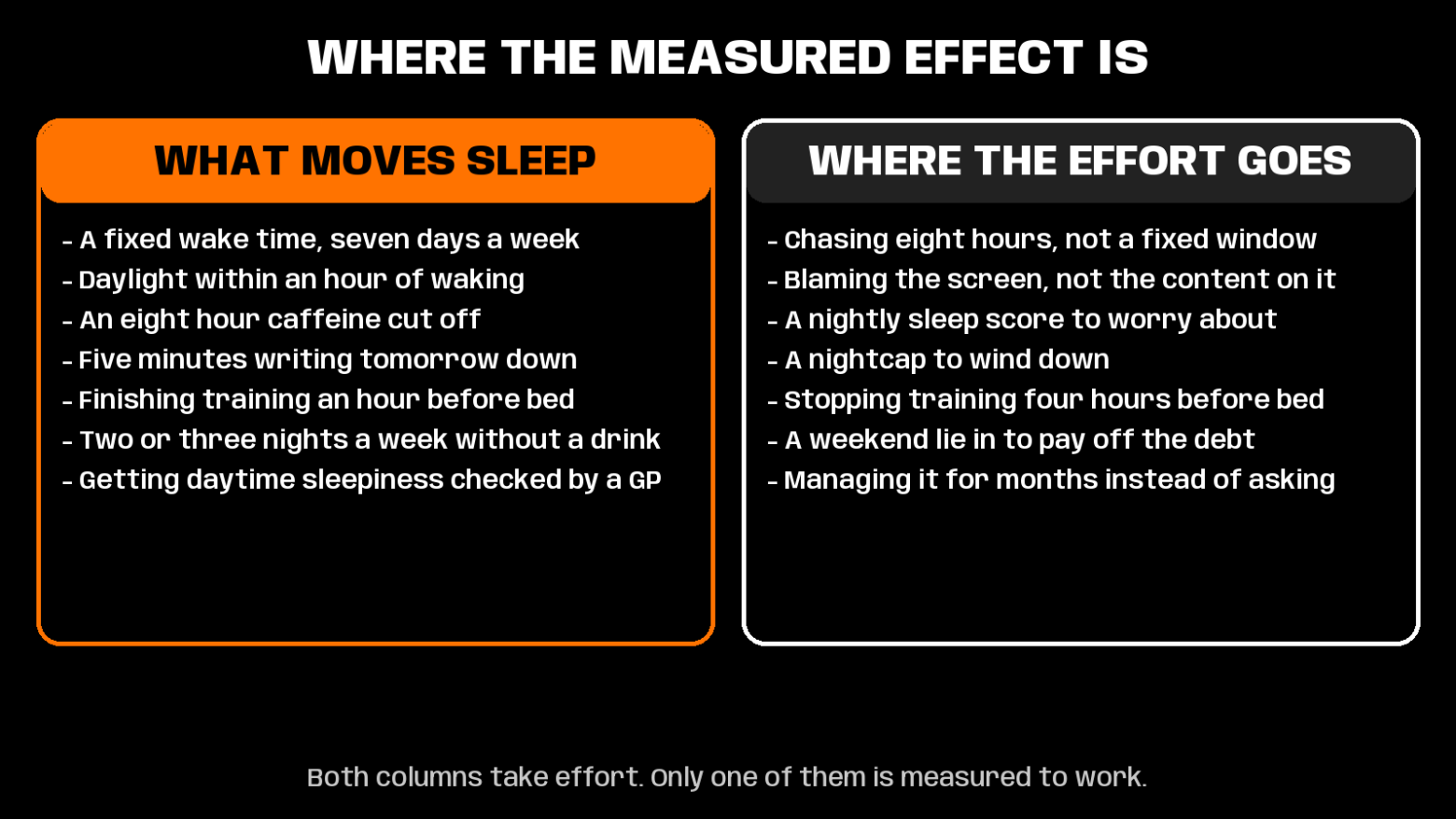
The left column is where the measured effects are. The right column is where most of the effort goes.
Options for Men to Fix Their Sleep
Most men do not have a sleep information problem. They have a Tuesday problem, where the wake time slips once, the caffeine cut off goes with it, and three weeks later nothing that was decided is still running. Sleep changes are unusually easy to abandon because the payoff arrives a fortnight after the effort does.
The MenTools app runs sleep alongside mindset, fitness, nutrition and money in one challenge system, with daily actions, difficulty levels you pick, reminders timed to when a task should actually happen, streaks, progress tracking and an AI coach. The job it does here is holding the wake time and the cut off in place through the fortnight before they start paying.
How you can do this today: set your anchored wake time as a daily action and put the caffeine cut off against a fixed clock time, so tomorrow is already logged before you go to bed tonight.
Wins on cost: one subscription covers the habit side of sleep, training and mindset rather than three separate apps.
Wins on time: the structure, levels and tracking already exist, so there is nothing to design before you start.
Wins on practicality: it works around shifts, travel and young children, which is exactly where a rigid sleep routine usually breaks first.
Watch-out: it is a behaviour and consistency tool, not a sleep tracker, a diagnosis or a treatment. If area 7 applies to you, this supports the medical route rather than replacing it.
Recovery is the thing this whole routine is protecting, and it is hardest to hold together in the weeks a man is running on empty, so a one a day multivitamin may help cover the simple daily foundation underneath the behaviour work. For more built for men, see the MenTools sleep hub. Fix the wake time properly this month and the other six areas get easier on their own.
Last updated: 2026-09-17 v1.0
Disclaimer: This guide is for informational purposes only and does not constitute medical or psychological advice. Speak with a qualified professional before making significant changes if you have a medical or mental health condition.
References
- [1] Zhu G, Catt M, Cassidy S, Birch Machin M, Trenell M, Hiden H, Woodman S, Anderson KN. Objective sleep assessment in more than 80,000 UK mid life adults, associations with sociodemographic characteristics, physical activity and caffeine. PLoS One, 2019;14(12):e0226220. Link
- [2] National Health Service. Insomnia. NHS. Link
- [3] Windred DP, Burns AC, Lane JM, Saxena R, Rutter MK, Cain SW, Phillips AJK. Sleep regularity is a stronger predictor of mortality risk than sleep duration, a prospective cohort study. Sleep, 2024;47(1):zsad253. Link
- [4] Burns AC, Saxena R, Vetter C, Phillips AJK, Lane JM, Cain SW. Time spent in outdoor light is associated with mood, sleep, and circadian rhythm related outcomes, a cross sectional and longitudinal study in over 400,000 UK Biobank participants. Journal of Affective Disorders, 2021;295:347-352. Link
- [5] Drake C, Roehrs T, Shambroom J, Roth T. Caffeine effects on sleep taken 0, 3, or 6 hours before going to bed. Journal of Clinical Sleep Medicine, 2013;9(11):1195-1200. Link
- [6] Ebrahim IO, Shapiro CM, Williams AJ, Fenwick PB. Alcohol and sleep I, effects on normal sleep. Alcoholism, Clinical and Experimental Research, 2013;37(4):539-549. Link
- [7] Scullin MK, Krueger ML, Ballard HK, Pruett N, Bliwise DL. The effects of bedtime writing on difficulty falling asleep, a polysomnographic study comparing to do lists and completed activity lists. Journal of Experimental Psychology, General, 2018;147(1):139-146. Link
- [8] Stutz J, Eiholzer R, Spengler CM. Effects of evening exercise on sleep in healthy participants, a systematic review and meta analysis. Sports Medicine, 2019;49(2):269-287. Link
- [9] Peppard PE, Young T, Barnet JH, Palta M, Hagen EW, Hla KM. Increased prevalence of sleep disordered breathing in adults. American Journal of Epidemiology, 2013;177(9):1006-1014. Link
- [10] National Health Service. Sleep apnoea. NHS. Link
- [11] Trauer JM, Qian MY, Doyle JS, Rajaratnam SMW, Cunnington D. Cognitive behavioral therapy for chronic insomnia, a systematic review and meta analysis. Annals of Internal Medicine, 2015;163(3):191-204. Link
- [12] Leproult R, Van Cauter E. Effect of 1 week of sleep restriction on testosterone levels in young healthy men. JAMA, 2011;305(21):2173-2174. Link
- [13] University of Chicago Medicine. Sleep loss lowers testosterone in healthy young men. UChicago Medicine, 2011. Link