
MEN: Best Porn Recovery Influencers for Men to Follow (Coaches, Therapists, and Creators, 2026 List)
Quick Answer
If you want one place to start, follow Andrew Huberman for the neuroscience of dopamine and compulsive behaviour, Chris Williamson for psychology-first mindset work, and Jocko Willink for the discipline framework that keeps you consistent when motivation fails.
Around 28% of adult male pornography users report patterns that meet criteria for problematic use [1]. The gap between wanting to change and actually changing is closed by having a structured system behind the content you consume, not by finding the right influencer.
Jump to: Comparison Table | How We Ranked | FAQs
Disclosure: MenTools publishes this article and may feature MenTools products.
How we evaluate: Creators are assessed on behavioural science grounding, practical usability, male-friendly framing, honest framing of difficulty, and transferability under pressure. Full sources are listed in the references below.
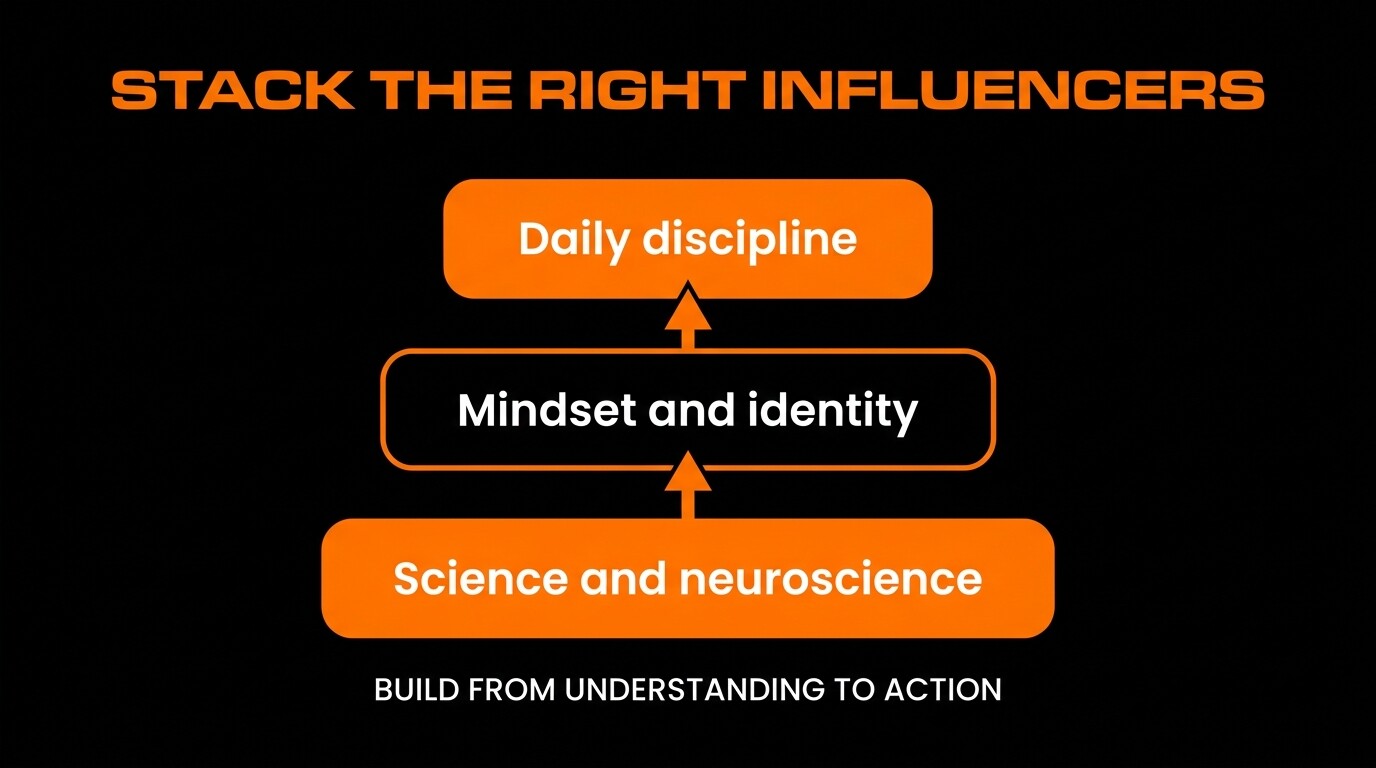
A 3-category model showing how to stack creator types for porn recovery: science and neuroscience at the base, psychology and mindset in the middle, discipline and identity at the top.
Quick Comparison
| Creator | Best For | Recovery Angle | Simple Action Plan |
|---|---|---|---|
| Andrew Huberman | Science and neuroscience | Dopamine cycles, habit formation, compulsive behaviour biology | 1 video/week, write 1 mechanism down |
| Chris Williamson (Modern Wisdom) | Sceptical men | Honest psychology and identity science without forced positivity | 1 episode/week, journal 3 lines |
| Jocko Willink | Discipline and ownership | Personal responsibility and non-negotiable daily structure | 1 episode/week on a long walk |
| Rob Dial (Mindset Mentor) | Daily mental resets | Breaking thought loops and rebuilding identity step by step | 10 min/day, 1 prompt per episode |
| Mark Manson | Men who hate soft framing | Values-first thinking and honest self-assessment | 2 episodes/month, 1 hard truth written down |
| Jay Shetty | Meaning and purpose | Replacing compulsive habits with values-driven daily routines | 1 episode/week, 1 specific action |
| Steven Bartlett (Diary of a CEO) | Behaviour change conversations | Deep research-connected interviews on identity, habits, and psychology | 2 episodes/month, reflect and write after |
| Ryan Holiday | Stoic discipline and character | Philosophical framework for self-mastery and long-term character building | 1 book or episode/month, 1 principle to apply |
| Tom Bilyeu (Impact Theory) | Belief and identity change | Rewiring self-concept before trying to change behaviour | 1 full episode/week, 1 belief to challenge |
| Andy Frisella | Raw accountability | Direct, no-excuse framework for building unbreakable daily standards | 1 episode/week, set 1 non-negotiable rule |
How We Ranked These Creators
This list does not rank by follower count or engagement rate. It ranks by how useful a creator is to a man who wants to address problematic pornography use and build a better daily structure in its place.
Research identifies PPU as frequently functioning as a maladaptive coping strategy for stress, loneliness, and low mood [2][3]. Creators who address these underlying drivers are more useful than those who focus only on surface-level motivation.
Behavioural science grounding: Creators who explain dopamine, habit loops, and the cue-craving-response-reward cycle give men a mechanism to address, not just inspiration to act on [4].
Practical usability: A creator who gives one concrete daily action per episode is worth ten who give only motivational energy without structure.
Male-friendly framing: Responsibility, structure, and clear steps. Research on habit change shows that identity-based approaches sustain change more effectively than rule-based or shame-based ones [5].
Honest framing of difficulty: Creators who acknowledge that change is slow, non-linear, and involves setbacks are more useful than those who imply quick transformation.
Transferability under pressure: Content should work when a man is stressed, tired, or recovering from a setback, not only when he is already motivated.
The Real Answer
Why do men reach for influencers when they want to quit porn?
Most men do not go straight to therapy or clinical support when they first notice a problematic pattern. They search YouTube, follow accounts, and listen to podcasts. This is a reasonable starting point, because understanding why a pattern forms matters before trying to change it [4].
The risk is that passive content consumption without a system creates the illusion of progress. Watching a dopamine episode does not reset your dopamine system. What it does is give you the language and the framework to build a system. The creators below are ranked by how well they enable that.
What does the research say about why this is so hard to break?
Two peer-reviewed studies found a 28% prevalence rate of problematic pornography use among adult male pornography users [1]. Research also shows PPU is strongly associated with higher levels of anxiety, depression, stress, and loneliness in men [2]. When pornography is used primarily as an emotional regulation strategy, reducing it without building replacement coping strategies tends to fail [3].
This is why discipline-only content is insufficient on its own. A man who cuts access without addressing the emotional trigger will find a different outlet, or return to the same one. The most useful creators help men build the replacement behaviour, not just remove the habit.
Why does identity change matter more than willpower?
Research on habit formation consistently identifies identity-based approaches as producing more durable behavioural change than outcome-based or willpower-based ones [5]. When a man builds consistent evidence that he is the kind of person who does not need this pattern, the behaviour change becomes self-reinforcing rather than effortful.
Creators like Tom Bilyeu, Ryan Holiday, and Steven Bartlett address this level of change. Their content is useful not because it is specifically about pornography, but because it addresses the belief systems and daily character decisions that underlie all compulsive habits.
How does shame make the pattern worse?
Research identifies moral incongruence, the distress that occurs when behaviour contradicts a man’s values, as a significant driver of psychological harm in PPU [2]. Shame-based responses after a relapse tend to lengthen the gap between setback and recovery rather than shortening it.
The most effective creators on this list replace shame with a practical framework: honest self-assessment without self-destruction, and a return to the system after a setback rather than an abandonment of it.
Why This Fails
Most men follow the same pattern. They consume content for a weekend, feel ready, set a hard rule, break it once, feel shame, and use that shame as the trigger for the next relapse. This is a predictable cycle in compulsive behaviour research, and no influencer will break it for you [3].
Following creators without a daily system behind the following produces the same result. The content is useful. The inspiration is real. And then the cue fires at 11pm on a Tuesday and the plan collapses because there was no structure between the watching and the doing.
How to Fix It
The Simple Framework
The most effective approach to problematic pornography use follows the same behavioural architecture as any compulsive habit: identify the trigger, interrupt the routine, and replace the reward with something that builds the identity you are working toward [5]. Use the creators below to understand which part of that chain you need to work on this week.
- Pick one creator from the comparison table that matches your current barrier: science, mindset, discipline, identity, or daily habit design.
- Watch or listen to one piece of content. Write down one specific action you will take differently today, not this week, today.
- Identify your most common trigger: boredom, stress, loneliness, or a specific time of day.
- Build one replacement routine for that trigger: a training session, a walk, a journalling prompt, a cold shower, or a phone call.
- Track one signal for 14 days: sleep quality, mood, urge frequency, or training consistency. Review and adjust.
Best for neuroscience: Andrew Huberman
Andrew Huberman is a professor of neurobiology and ophthalmology at Stanford School of Medicine and host of the Huberman Lab podcast [4]. His content on dopamine, habit formation, and compulsive behaviour translates peer-reviewed neuroscience into practical daily tools.
His dopamine work explains how regularly exposing yourself to high-stimulation content lowers your dopamine baseline over time, producing the flatness, low motivation, and escalation pattern many men with problematic pornography use report [4]. Understanding this mechanism changes how a man relates to the pattern entirely.
Neuroscience-first action plan in 5 steps
- Watch one full episode with a notepad. No scrolling while watching.
- Write down one biological mechanism you learned.
- Choose one 7-day experiment based on that mechanism.
- Track one daily signal: mood, energy, sleep, or urge frequency.
- Decide after 7 days whether to keep, adjust, or drop the experiment.
Start here
- The dopamine masterclass covering motivation, craving, and compulsive behaviour.
- The habit formation episode on how routines become automatic.
- The sleep and recovery episode, because impulse control is directly tied to sleep quality.
Best for sceptical men: Chris Williamson (Modern Wisdom)
Chris Williamson hosts research-connected conversations on psychology, identity, and behaviour without the excess positivity. For men who find recovery-adjacent content too soft or earnest, this is the most practical entry point into the mindset work that actually drives behaviour change.
Identity-based habit change, where a man builds new beliefs about who he is rather than new rules about what he avoids, produces more durable outcomes than willpower-based approaches [5]. Williamson’s content addresses this consistently in plain language.
Sceptic-friendly action plan in 5 steps
- Listen on a commute or walk to keep the context low-distraction.
- Identify one idea from the episode that challenges a belief you hold about yourself.
- Write one sentence starting with: “The kind of man I am building is…”
- Do one small action that day consistent with that identity statement.
- Repeat weekly. Consistency over intensity, every time.
Start here
- An episode on self-control and impulse management.
- A psychology-focused episode with a behavioural science or neuroscience guest.
- An episode on identity, long-term behaviour change, and what actually drives men.
Best for discipline and ownership: Jocko Willink
Jocko Willink’s approach is direct: you own the problem and you own the solution. For men who respond to accountability and hard structure rather than therapy-adjacent framing, this fits.
Personal responsibility framing is associated with higher rates of sustained behaviour change in compulsive behaviour research [5]. The Jocko framework applies that principle without softening it, which is exactly what some men need to move from knowing to doing.
Discipline-first action plan in 5 steps
- Listen on a long walk or during training. Not while sitting still.
- Pull one ownership principle from the episode.
- Write one thing you are avoiding being honest about in your current pattern.
- Set one non-negotiable rule for this week. Keep it simple.
- Track days you held the standard. Focus on direction, not streak counts.
Start here
- An episode on extreme ownership applied to personal behaviour.
- An episode on discipline as a daily practice rather than a motivational state.
- An episode on building daily standards when motivation is absent.
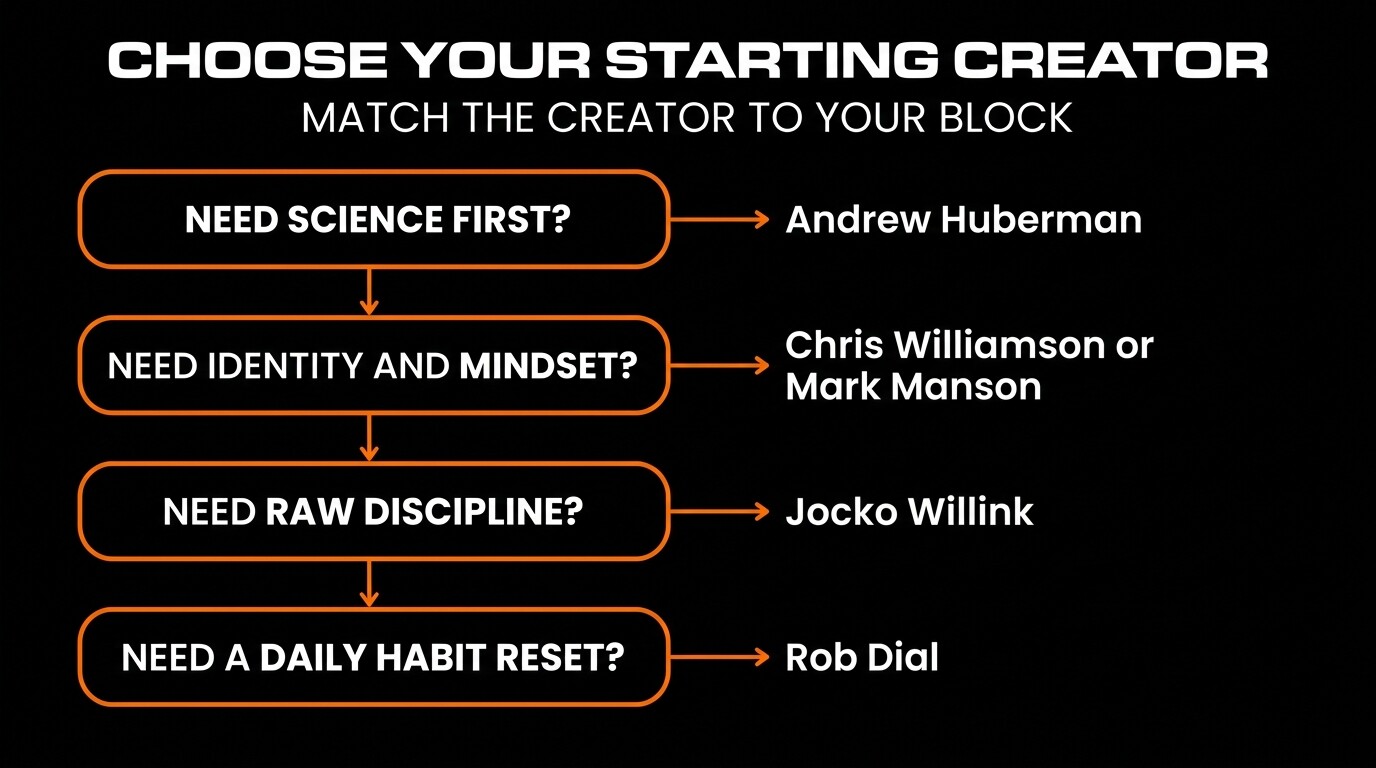
Choose your starting creator based on what is blocking you most right now, whether that is neuroscience understanding, mindset and identity work, discipline, or daily habit structure.
Best for daily mindset resets: Rob Dial (The Mindset Mentor)
Rob Dial produces short, focused episodes on breaking thought loops and rebuilding identity from the inside out. For men who need something practical in under 15 minutes, this fits a daily slot without requiring long blocks of free time.
Short daily inputs are more effective for habit anchoring than single long weekly content binges. Research on habit formation shows that consistency and repetition are the core mechanisms of building automaticity, regardless of input length [5].
Daily reset action plan in 5 steps
- Pick a fixed slot: first thing in the morning or just before bed.
- Listen to one episode only. Do not queue the next one.
- Write one sentence on what you will do differently today.
- At the end of the day, write one sentence on what you actually did.
- Hold this for 14 days before judging whether it is working.
Start here
- An episode on breaking negative thought loops and resetting after a setback.
- An episode on building a new identity rather than suppressing an old behaviour.
- An episode on why discipline is a daily choice, not a personality trait.
Best for values and honest self-assessment: Mark Manson
Mark Manson’s approach to self-deception, values, and the honest examination of why men do what they do maps directly onto the psychological drivers of PPU. For men who find recovery framing too earnest, this is a practical starting point for the honest self-assessment that real change requires.
Research identifies the gap between a man’s values and his behaviour as one of the strongest predictors of psychological distress in men with PPU [2]. Manson’s content regularly helps men close that gap, without shame spirals or forced positivity.
Values-first action plan in 5 steps
- Listen with one question in mind: “What am I avoiding being honest about?”
- Write one hard truth from the episode.
- Identify one value you are currently betraying with your current pattern.
- Do one concrete action today consistent with that value.
- Repeat weekly. Daily is not required if weekly is genuine.
Best for meaning and purpose: Jay Shetty (On Purpose)
Jay Shetty’s content works for men who are drawn to examining why they do what they do at a deeper level. His background in philosophy and coaching gives him practical tools for helping men replace compulsive habits with purpose-led daily choices.
Research on acceptance and commitment therapy approaches, which focus on values clarification and psychological flexibility, shows promise in reducing compulsive behaviour patterns [2]. Shetty’s content is not clinical, but it consistently addresses the same territory in accessible language.
Purpose-first action plan in 5 steps
- Listen on a slow walk with nothing else open.
- Write one sentence on a value or purpose currently disconnected from your daily life.
- Identify one daily behaviour that would reconnect you to it.
- Do it today. Keep it small enough to be non-negotiable.
- Add one more behaviour after 14 days if the first is holding.
Best for deep behaviour change conversations: Steven Bartlett (Diary of a CEO)
Steven Bartlett’s interviews are among the most research-connected in the men’s personal development space. His guests regularly include psychologists, neuroscientists, and behaviour change specialists covering habit formation, identity, and the roots of compulsive behaviour.
Multiple studies identify that effective interventions for PPU need to incorporate emotion regulation training, stress management, and coping strategy development alongside behaviour change tools [2]. Bartlett’s guest selection consistently covers this territory.
Deep-dive action plan in 5 steps
- Pick one episode with a psychology or neuroscience guest.
- Listen in full. Take one note per 20 minutes.
- Identify the most applicable idea to your current pattern.
- Build one daily action around that idea for the next 7 days.
- Review after 7 days. Keep what works, drop what does not.
Best for stoic discipline: Ryan Holiday
Ryan Holiday’s work on Stoic philosophy applied to modern life gives men a framework for self-mastery that predates modern psychology and has been tested across centuries. For men who want more than a productivity system, the Stoic emphasis on character over comfort is directly applicable to any compulsive pattern.
Identity-based research supports the Stoic insight that character is built through repeated daily choices, not single moments of resolution [5]. Holiday’s books and podcast give men the philosophical architecture to make those choices consciously over time.
Stoic action plan in 5 steps
- Start with one book or one episode. Do not consume both at once.
- Extract one principle that applies to your current pattern.
- Write it down somewhere visible in your daily environment.
- Apply it to one specific decision today where you would normally give in.
- Review weekly: what do your past 7 days say about the man you are becoming?
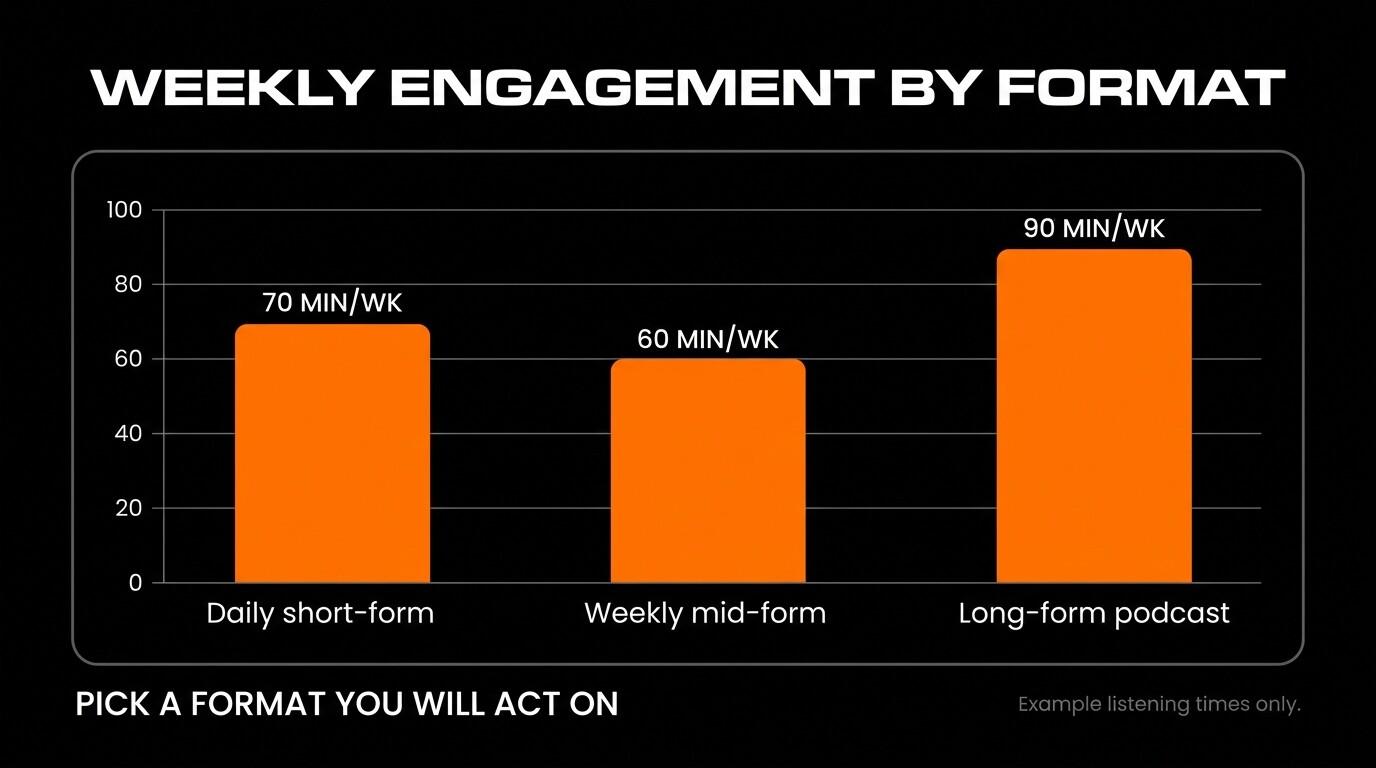
Weekly engagement comparison across creator formats, showing how daily short-form and weekly long-form content differ in habit anchoring for men working on behaviour change.
FAQ
Who is the best influencer to follow when quitting porn?
There is no single best creator. Huberman works for men who need the science. Chris Williamson works for sceptics. Jocko works for men who respond to accountability. Rob Dial works for men who want a daily 10-minute reset. Match the creator to how you think, then act on one thing per episode.
Can following influencers alone help you quit?
Content is a framing and knowledge tool. It works best when you extract one concrete action per video or episode and apply it the same day. Passive consumption without action is unlikely to change the pattern on its own.
Is porn addiction a real medical diagnosis?
The WHO’s ICD-11 recognises Compulsive Sexual Behaviour Disorder as an impulse-control disorder, but does not classify it as a formal addiction equivalent to substance use disorders [6]. The DSM-5 does not include it as a formal diagnosis. Many men experience real distress and functional impairment from problematic use regardless of the label. If you are concerned, speak with a qualified clinician.
What is the difference between a recovery coach and a therapist?
A therapist is a licensed clinical professional who can diagnose and treat mental health conditions. A recovery coach is an unregulated role providing structured support, accountability, and practical frameworks. Both can be useful. If you have significant anxiety, depression, or other mental health symptoms alongside PPU, speak with a licensed clinician first.
What role does emotional regulation play in pornography use?
Research identifies PPU as frequently functioning as a coping strategy for stress, loneliness, low mood, or boredom rather than for sexual reasons alone [3]. This means reducing access without building replacement coping strategies tends to fail. The most useful creators on this list help men build those replacements, not just remove the behaviour.
How long does it take to change a compulsive habit?
Research on habit formation suggests automaticity builds over an average of 66 days, with a wide range across individuals [5]. Do not judge progress by streak counts alone. Direction and consistency matter more than an unbroken number.
What should I do after a relapse?
Return to the plan immediately. Identify the trigger. Adjust one thing before the next attempt. Shame-based responses, including extended self-criticism or abandoning the plan entirely, tend to lengthen the gap between setback and recovery [2].
Should I use multiple creators at the same time?
Stick to one at a time in the early weeks. Multiple inputs without a unified system creates information overload without action. Once you have a working daily structure in place, adding a second creator for a complementary angle can be useful.
Final Recommendation
If you need the science first: Andrew Huberman. Understand dopamine, habit loops, and the biology of compulsive behaviour before trying to change it.
If you are sceptical and dislike soft framing: Chris Williamson or Mark Manson. Both give honest psychology without forced positivity.
If you respond to structure and accountability: Jocko Willink. The most direct discipline framework on this list.
If you want a daily 10-minute anchor: Rob Dial. Short episodes, clear identity prompts, no long time blocks required.
If you need to rebuild your belief about yourself: Tom Bilyeu. The best creator on this list for identity-level change.
If you want purpose and meaning as your driver: Jay Shetty. Most useful when the goal is building something worth choosing over the old pattern.
If you want deep research-backed conversations: Steven Bartlett. The best for understanding the psychology behind why the pattern formed.
Pick one. Watch or listen to one piece of content this week. Write down one thing you will do differently today. That is the entire starting framework.
Options For Men to Take Action
Creators give you the framing. The gap between framing and results is where most men stall. You watch a video, you feel informed and ready, and then the same trigger fires that evening and nothing has changed because there was no structure between the watching and the doing.
What works is a structured daily system: a morning prompt, a replacement behaviour for your most common trigger, a simple tracker, and a clear identity statement you are building toward. Without that, even the best content is entertainment rather than change.
The MenTools Quit Porn Protocol gives you that structure. It puts the daily prompts, the habit-stacking framework, the reflection tools, and the identity-building work in one place, so you are not trying to piece it together from ten different creators. Start today, not after the next video.
If you want to go deeper on porn recovery and habit change, explore the MenTools Habits hub for guides and frameworks built specifically for men.
To support your daily routine with targeted nutrition, explore MenTools One A Day, formulated with chelated minerals and active B-vitamin forms for men.
When you are ready to turn ideas into action, start a focused challenge or daily routine inside the MenTools app and track how consistent habits change how you feel.
Last updated: 2026-03-05 v1.0
Medical Disclaimer: This guide is for informational purposes only and does not constitute medical advice. Always speak with your doctor or another qualified healthcare professional before starting any new supplement or programme if you have medical conditions or take prescription medication.
References
- Wery A & Billieux J; Kraus SW, Martino S & Potenza MN. Cited in: Tandfonline. “Problematic Pornography Use and Mental Health: A Systematic Review.” 2024. https://www.tandfonline.com/doi/full/10.1080/26929953.2024.2348624
- Psychology Today. “The Impact of Problematic Pornography Use in Men.” March 2025. https://www.psychologytoday.com/us/blog/mental-health-nerd/202503/the-impact-of-problematic-pornography-use-in-men
- PMC / National Library of Medicine. “Problematic Pornography Use as an Externalizing Depression Symptom in Cisgender Men.” 2025. https://pmc.ncbi.nlm.nih.gov/articles/PMC12486261/
- Huberman A. “Controlling Your Dopamine For Motivation, Focus and Satisfaction.” Huberman Lab Podcast. 2021. https://www.hubermanlab.com/episode/controlling-your-dopamine-for-motivation-focus-and-satisfaction
- Clear J. “Identity-Based Habits: How to Actually Stick to Your Goals.” JamesClear.com. 2020. https://jamesclear.com/identity-based-habits
- World Health Organisation. “ICD-11: Compulsive Sexual Behaviour Disorder.” 2022. https://icd.who.int/browse/2024-01/mms/en#1630268048