MEN: Best Porn Addiction & NoFap Podcasts for Men (2026 List)
Quick Answer
If you want one place to start, use Huberman Lab for the neuroscience of why compulsive behaviours form, Modern Wisdom for sceptic-friendly mindset work, and Jocko Podcast for the discipline framework that keeps you on track long-term.
No single podcast will do the work. Surveys indicate around 11% of men believe they are addicted to pornography, and approximately 85% of those seeking treatment are male [1][2]. The real win is picking one show, pulling one tool, and acting on it today.
Jump to: Comparison Table | How We Ranked | FAQs
Disclosure: MenTools publishes this article and may feature MenTools products.
How we evaluate: Podcasts are assessed on behavioural science grounding, practical usability, male-friendly framing, and absence of hype. Full sources are listed in the references below.
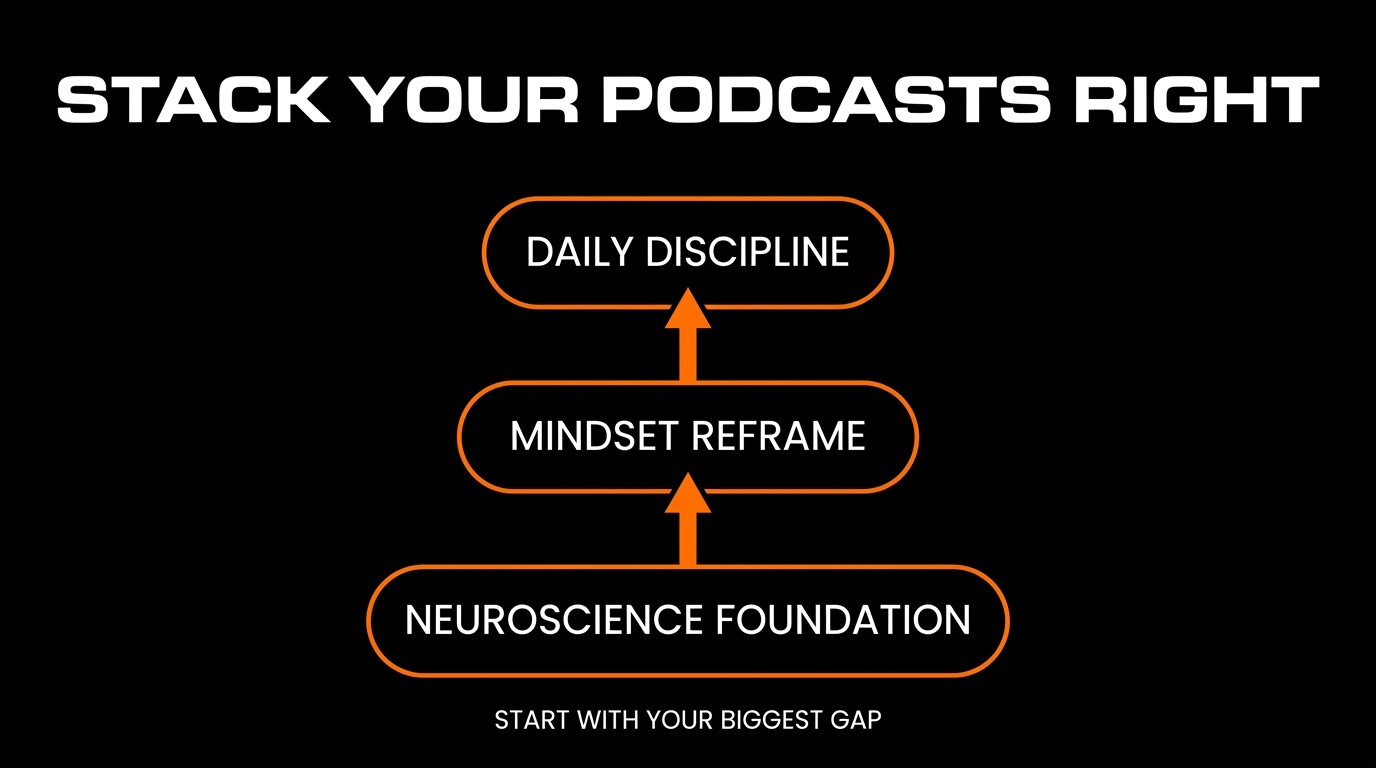
A 3-layer model (neuroscience foundation → mindset reframe → daily discipline) for choosing the right podcast this week.
Quick Comparison
| Podcast | Best For | Recovery Angle | Simple Listening Plan |
|---|---|---|---|
| Huberman Lab | Science and neuroscience | Dopamine, habit loops, and why compulsive use forms | 1 episode/week + 1 written takeaway |
| Modern Wisdom | Sceptical men | Honest psychology without forced positivity | 1 episode/week, journal 3 lines |
| Jocko Podcast | Discipline and ownership | Personal responsibility and consistent action | 1 episode/week on a long walk |
| The Mindset Mentor Podcast | Daily mental resets | Identity change and breaking thought loops | 10 min/day, one prompt |
| SOLVED with Mark Manson | Men who hate fluff | Values-first thinking, cutting self-deception | 2 episodes/month, one hard truth |
| 10% Happier | Mindfulness-first recovery | Meditation and craving awareness without hype | 10 min/day for 7 days |
| Diary of a CEO | Motivation and identity | Big life shifts and behaviour change science | 2 episodes/month, reflect after |
| On Purpose with Jay Shetty | Meaning and purpose | Replacing compulsive habits with values-driven routines | 1 episode/week, one action |
| The Rich Roll Podcast | Long-game identity change | Endurance mindset applied to recovery | 1 episode/week, walk + listen |
| Tom Bilyeu’s Impact Theory | Performance and mindset | Rewiring beliefs and upgrading identity | 1 episode/week, one belief to challenge |
How We Ranked These Podcasts
This list does not rank by popularity or download numbers. It ranks by how useful a show is to a man who wants to reduce or quit pornography use and build a better daily routine.
Around 45% of men say they have tried to stop viewing pornography and failed [3]. That gap between wanting to stop and actually stopping is what each podcast is evaluated on.
Behavioural science grounding: Shows that explain habit loops, dopamine, and craving cycles help men understand the mechanism, not just the symptom [4].
Practical usability: A podcast that gives a man a concrete next action is worth ten that give him only inspiration.
Male-friendly framing: Responsibility, structure, and clear steps. Recovery sticks better when it is framed around identity and action rather than shame [5].
Absence of hype: We excluded shows that make outcome promises. Evidence on behavioural change interventions consistently shows that realistic expectations sustain effort better than inflated ones [4].
The Real Answer
Does porn actually cause addiction in the way substances do?
This question matters before you pick a podcast. The World Health Organisation’s ICD-11 (2022) recognised Compulsive Sexual Behaviour Disorder as an impulse-control disorder, but it is not classified as an addiction in the same category as substance use disorders [6]. The DSM-5 does not classify compulsive pornography use as a formal mental disorder.
What research does show is that some men experience significant distress, loss of control, and negative effects on relationships and functioning [1][6]. Whether you call it addiction or problematic use, the practical question is the same: is this pattern interfering with your life?
Why do so many men find it hard to stop on their own?
Approximately 70% of men with compulsive pornography use report negative effects on their relationships [2]. Around 60% also report concurrent anxiety and depression [3]. These are not signs of weakness; they reflect how habit loops work in the brain.
Dopamine-driven reinforcement cycles are well-documented in compulsive behaviour research [4]. The pattern of cue, craving, routine, and reward becomes automatic over time, which is why willpower-only approaches tend to fail.
Why does shame make the problem worse, not better?
Up to 50% of people with problematic pornography use report guilt or shame after use [3]. Research on behaviour change consistently shows that shame-based approaches reduce the likelihood of sustained change by reinforcing avoidance rather than building new skills [5].
The podcasts in this list that work best are the ones that replace shame with a practical framework, whether that is neuroscience, discipline, mindfulness, or values-based identity work.
Why This Fails
Most men approach this the wrong way. They rely on motivation, set a strict streak target, fail once, feel shame, and then use that shame as the trigger for the next relapse cycle. This is one of the most predictable failure patterns in compulsive behaviour research [4].
Listening to podcasts without a system behind them creates the same problem. You feel informed and inspired for a day, then fall back into the same routine when stress hits. The shows below work when you extract one tool from each episode and use it that day.
How to Fix It
The Simple Framework
Recovery from problematic pornography use follows the same behavioural architecture as any compulsive habit: identify the trigger, interrupt the routine, and replace the reward [4]. A podcast is most useful when it helps you identify which part of that chain to work on this week.
- Pick one podcast from the table above that matches where you are right now: neuroscience, mindset, discipline, or daily habit.
- Listen to one episode only. Write down one specific thing you will do differently today.
- Identify your most common trigger: boredom, stress, loneliness, or a specific time of day.
- Build one replacement routine for that trigger: a walk, a training session, a phone call, or a short journalling prompt.
- Track one signal for 14 days: sleep quality, mood, or time spent on the habit you are building instead.
Best for neuroscience and the “why”: Huberman Lab
This is for men who need to understand the mechanism before they commit to changing. Andrew Huberman’s episodes on dopamine, habit formation, and compulsive behaviour give you the science in plain language.
Dopamine-driven reinforcement is central to understanding why high-stimulation content creates escalating patterns over time [4]. Once a man understands this, he stops blaming his character and starts addressing the system.
Neuroscience-first listening plan in 5 steps
- Listen with a notepad. Do not scroll while listening.
- Write down one biological mechanism from the episode.
- Choose one 7-day experiment based on that mechanism.
- Track a single daily signal (mood, sleep, urge frequency).
- Decide after 7 days whether to keep, adjust, or drop the experiment.
Start here
- An episode on dopamine and motivation cycles.
- An episode on habit formation and how routines become automatic.
- An episode on sleep and recovery, which directly affects impulse control.
Best for sceptical men: Modern Wisdom
Chris Williamson consistently brings guests who discuss psychology, identity, and behaviour without the fluff. For men who find recovery-adjacent content too earnest, this is the entry point.
Research on self-control and identity-based behaviour change shows that men who reframe their identity (“I am the kind of man who does not do this”) sustain change better than those relying on rules alone [5].
Sceptic-friendly listening plan in 5 steps
- Listen on a commute or walk, so the context is already low-distraction.
- Identify one idea that challenges a belief you currently hold about yourself.
- Write one sentence starting with: “The kind of man I am building is…”
- Do one small action that day that is consistent with that identity.
- Repeat once a week. Consistency over intensity.
Start here
- An episode on self-control and impulse management.
- An episode on identity change and long-term behaviour.
- A psychology-heavy episode with a behavioural science guest.
Best for discipline and ownership: Jocko Podcast
Jocko Willink’s approach is direct: you own the problem and you own the solution. For men who respond better to accountability and structure than to therapy-adjacent framing, this fits.
Personal responsibility framing is associated with higher rates of sustained behaviour change in compulsive behaviour research [5]. The Jocko framework applies that principle without softening it.
Discipline-first listening plan in 5 steps
- Listen on a long walk or during training, not while sitting still.
- Pull one ownership principle from the episode.
- Write one thing you are avoiding facing about your current pattern.
- Set one rule for this week. Keep it simple and non-negotiable.
- Do not reset your count. Track days won, not streaks lost.
Start here
- An episode on ownership and taking control of behaviour.
- An episode on discipline as a daily practice, not a feeling.
- An episode on building structure when motivation is low.
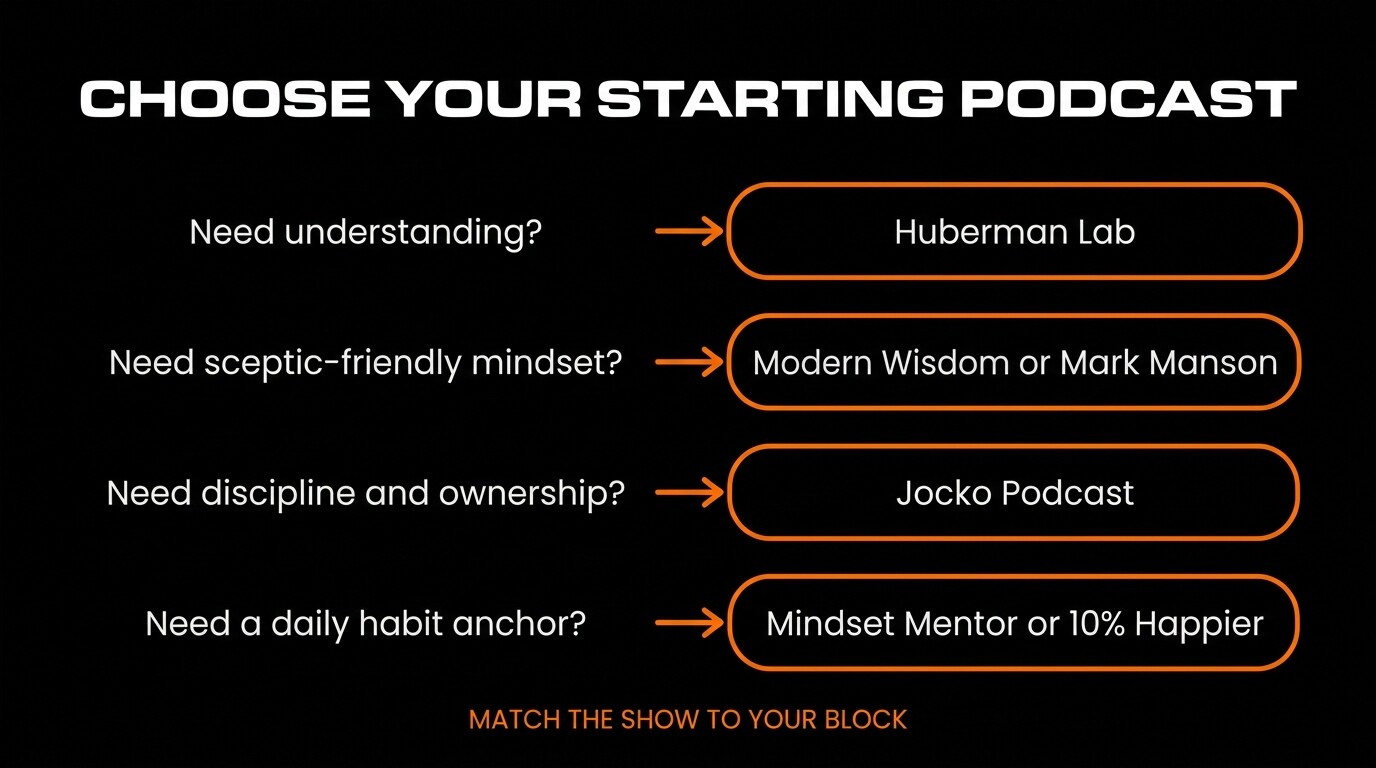
Choose your starting podcast based on what is blocking you most right now.
Best for daily mental resets: The Mindset Mentor Podcast
Rob Dial produces short, focused episodes on breaking thought loops and building identity. For men who need something practical in under 15 minutes, this fits a daily slot easily.
Thought interruption techniques are part of well-established cognitive-behavioural approaches to compulsive behaviour management [4][5]. Short daily inputs are better than one long weekly binge for habit anchoring.
Daily reset listening plan in 5 steps
- Pick a fixed daily slot: first thing in the morning or just before bed.
- Listen to one episode only. No queuing the next one.
- Write one sentence on what you will do differently today.
- At the end of the day, write one sentence on what you actually did.
- Keep it for 14 days before evaluating whether it is working.
Best for men who hate forced positivity: SOLVED with Mark Manson
This show works for men who find recovery framing too soft. Mark Manson’s approach to values, self-deception, and honest self-assessment maps cleanly onto the psychological drivers of compulsive pornography use.
Values-based behaviour change, where action is driven by what you actually care about rather than what you want to avoid, is associated with more durable outcomes in impulse-control contexts [5].
Straight-talk listening plan in 5 steps
- Listen with one question: “What am I avoiding being honest about?”
- Write one hard truth you needed to hear.
- Identify one value you are currently betraying with your current pattern.
- Do one concrete action today that aligns with that value.
- Repeat weekly. Daily is not required if weekly is real.
Best for mindfulness and craving awareness: 10% Happier
Dan Harris and his guests take mindfulness seriously without the spiritual excess. For men who want to understand craving cycles and how to sit with discomfort without acting on it, this is a strong starting point.
Mindfulness-based approaches have research support in compulsive behaviour management, particularly for increasing awareness of the gap between a cue and a response [4]. That gap is where change happens.
Mindfulness-first listening plan in 5 steps
- Pick a 10-minute daily slot. Pair it with an existing habit like morning coffee.
- Listen to one episode. Do not rush to the next one.
- Practice one craving awareness exercise: notice the urge, name it, do not act on it.
- Keep a simple log: urge appeared, what triggered it, what you did instead.
- Review after 7 days. Keep the practice if the log shows progress.
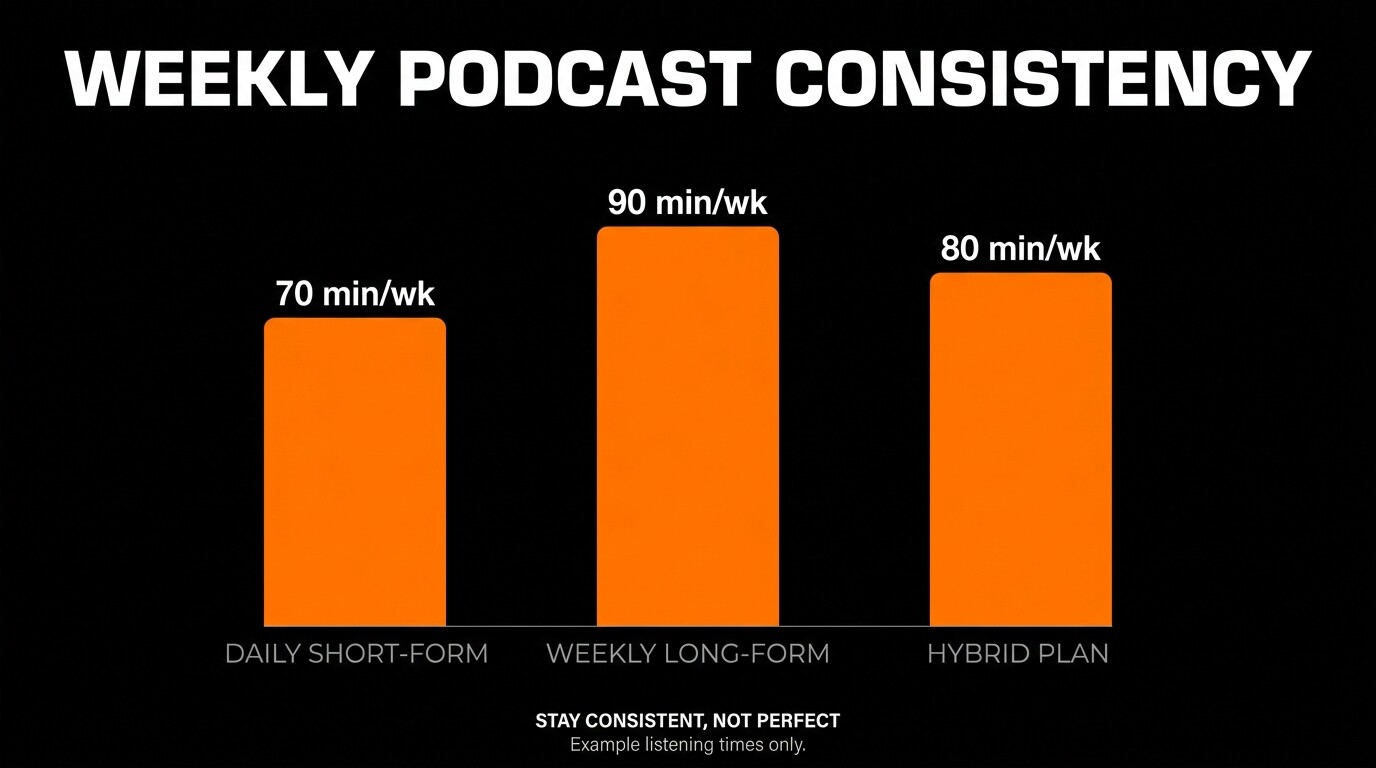
Weekly consistency across podcast types, showing how short daily inputs compare to weekly long-form listens for habit anchoring in compulsive behaviour recovery.
FAQ
What is the best podcast for quitting porn?
There is no single best show. Huberman Lab works for men who need the science first. Modern Wisdom works for sceptics. Jocko works for men who respond to accountability. Pick the one that matches how you think, not the most popular one.
Is porn addiction a real diagnosis?
The WHO’s ICD-11 recognises Compulsive Sexual Behaviour Disorder as an impulse-control disorder, but it does not classify it as an addiction in the same way as substance use disorders [6]. The DSM-5 does not include it as a formal diagnosis. That said, many men experience real distress and functional impairment from problematic use, which warrants taking it seriously regardless of the label.
Can listening to podcasts actually help you quit?
Podcasts are a knowledge and framing tool, not a treatment. They work best when you extract one concrete action per episode and apply it the same day. Passive listening without action is unlikely to change the pattern.
What is NoFap and is it science-based?
NoFap is a community-based approach centred on abstaining from pornography and masturbation. There is limited high-quality clinical research supporting specific NoFap claims. However, structured behavioural goals and community accountability are well-established components of behaviour change frameworks [4][5].
How long does it take to change the habit?
Research on habit formation suggests automaticity builds over an average of 66 days, with a range of 18 to 254 days depending on the behaviour and individual [4]. Expect several weeks before the new routine feels normal. Do not judge progress by streaks alone.
What should I do when I relapse?
Relapse is common in compulsive behaviour recovery and does not mean failure. The most evidence-supported approach is to return to the plan immediately, identify the trigger, and adjust one thing before the next attempt [5]. Shame-based responses tend to extend the gap between relapse and recovery.
Can these podcasts help with porn-induced erectile dysfunction (PIED)?
This post does not address medical conditions. If you are concerned about erectile dysfunction, speak with a qualified clinician. Some men report improvements in sexual function after reducing pornography use, but the evidence base is developing and individual outcomes vary [1].
Should I tell someone I am doing this?
Accountability is one of the most consistently supported elements of behaviour change research [5]. Telling one person you trust what you are working on significantly improves follow-through.
Final Recommendation
If you need the science first: Start with Huberman Lab. Understand dopamine, habit loops, and why the pattern forms before trying to change it.
If you are sceptical and hate soft framing: Use Modern Wisdom or SOLVED with Mark Manson. Both give you honest psychology without forced positivity.
If you respond to structure and accountability: Jocko Podcast is the most direct discipline framework on this list.
If you want a daily habit anchor: The Mindset Mentor Podcast fits a 10-minute morning slot and works without long episodes.
If mindfulness is your entry point: 10% Happier is the cleanest option that combines craving awareness with practical meditation.
Pick one. Listen to one episode. Write down one thing you will do differently today. That is the entire framework.
Options For Men to Take Action
Podcasts give you the ideas. The gap between ideas and results is where most men stall. You listen, you feel informed, and then the same cue-craving-routine cycle fires at 11pm on a Tuesday and the plan disappears.
What works is having a structured system behind the listening: a daily prompt, a habit anchor, a simple tracking method, and a clear identity statement you are building toward. Without that structure, podcasts are entertainment, not change.
The MenTools Quit Porn Protocol brings the structure. It gives you the daily prompts, the habit-stacking framework, and the reflection tools in one place, so you are not piecing it together from five different shows.
If you want to go deeper on porn recovery and habit change, explore the MenTools Habits hub for guides and frameworks built specifically for men.
To support your daily routine with targeted nutrition, explore MenTools One A Day, formulated with chelated minerals and active B-vitamin forms for men.
When you are ready to turn ideas into action, start a focused challenge or daily routine inside the MenTools app and track how consistent habits change how you feel.
Last updated: 2026-03-05 v1.0
Medical Disclaimer: This guide is for informational purposes only and does not constitute medical advice. Always speak with your doctor or another qualified healthcare professional before starting any new supplement or programme if you have medical conditions or take prescription medication.
References
- eCare Behavioral Institute. “25 Porn Addiction Statistics for 2025.” 2025. https://www.ecarebehavioralinstitute.com/blog/porn-addiction-statistics/
- WifiTalents. “Porn Addiction Statistics: Reports 2025.” 2025. https://wifitalents.com/porn-addiction-statistics/
- ZipDo. “Porn Addiction Statistics: Education Reports 2025.” 2025. https://zipdo.co/porn-addiction-statistics/
- Wikipedia. “Pornography Addiction.” Updated 2026. https://en.wikipedia.org/wiki/Pornography_addiction
- Gardner B, Lally P, and Wardle J. “Making health habitual: the psychology of ‘habit-formation’ and general practice.” British Journal of General Practice. 2012. https://bjgp.org/content/62/605/664
- World Health Organisation. “ICD-11: Compulsive Sexual Behaviour Disorder.” 2022. https://icd.who.int/browse/2024-01/mms/en#1630268048