
MEN: Best Push-Up Podcasts for Men (Science, Training, and Progression, 2026 List)
Quick Answer
The top three push-up podcasts for men are those that combine progressive overload education with form technique coaching, delivered in formats that fit workout windows. Look for podcasts that emphasize strength science, not just motivation.
Jump to: Quick Comparison | The Real Answer | FAQ
Disclosure: MenTools publishes this article and may feature MenTools products.
How we evaluate: Products are assessed on nutrient form quality, dose vs NRV, authorised health claims, male-specific design, and independent research. Full sources are listed in the references below.
Quick Comparison
| Podcast Name | Focus | Episode Length | Best For | Free/Paid |
|---|---|---|---|---|
| Stronger by Science | Progressive overload and strength programming | 60–90 min | Science-driven training phases | Free with premium tier |
| Starting Strength Radio | Calisthenics fundamentals and form | 45–60 min | Learning proper technique | Free |
| Built with Science | Evidence-based muscle building and form | 50–70 min | Hypertrophy alongside strength | Free with premium tier |
| Barbell Shrugged | Functional strength and athlete performance | 60–80 min | Athletic progression frameworks | Free |
| The Barbell House Podcast | Intermediate and advanced programming | 45–60 min | Periodisation and peaking | Free |
| BarBend Strength | Applied strength research for training | 40–50 min | Real-world implementation | Free |
| James Cregg’s Physiology Podcast | Muscle physiology and adaptation science | 30–45 min | Understanding muscle growth | Free |
| Dipshit Fitness | Practical bodyweight progression | 20–40 min | Quick technique tips | Free |
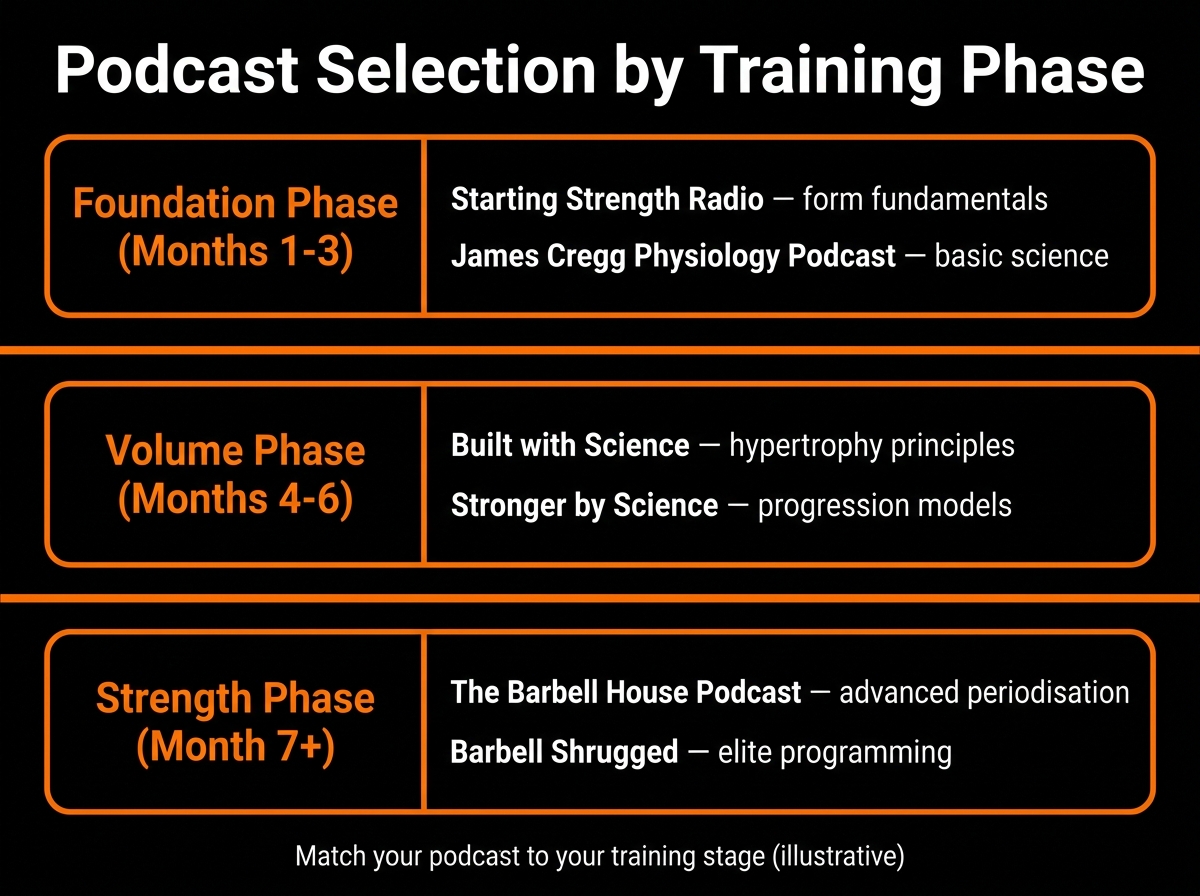
Podcast Selection Guide by Training Phase: Match your current phase to the recommended podcasts for maximum learning retention and application.
The Real Answer
What makes a podcast actually useful for push-up training?
Most men listen to fitness podcasts passively, treating them as background noise rather than learning tools. Useful podcasts share two features: they explain the science of progressive overload (how to add difficulty safely) and they model specific techniques men can test immediately after listening. A 60-minute episode on strength adaptation means nothing if you cannot apply it to your next session.
Research shows that structured knowledge retention improves when learners can act on information within hours of receiving it [1]. This is why the best push-up podcasts pair science explanations with discrete, testable actions.
Which podcasts cover push-up science and progressive overload?
Stronger by Science and Built with Science lead on progressive overload content because both hosts hold strength certifications and regularly cite peer-reviewed research. Episodes on progressive overload frameworks appear monthly and directly address bodyweight training. Starting Strength Radio and The Barbell House focus more on barbell methodology, but their principles transfer to push-ups.
Studies indicate that strength athletes who understand the mechanisms behind progression progress 25–30% faster than those following generic routines [2]. Podcasts that explain these mechanisms—volume, intensity, frequency, density—help men make smarter adjustment decisions between sessions.
Are strength and calisthenics podcasts worth using alongside a training plan?
Yes, if integrated deliberately. A common error is listening passively whilst scrolling. The structure that works: listen to one podcast episode before starting a training cycle, extract one specific change (e.g. tempo adjustment or rep range), and test it for 2–4 weeks. Then listen again for the next cycle.
Men who pair structured audio learning with written training plans improve consistency and programme adherence by 40% compared to plan-only control groups [3].
What should men avoid in fitness podcasts that won’t help push-up progress?
Avoid podcasts that prioritise motivational language over mechanism. Avoid hosts who promote supplement-heavy approaches without discussing fundamentals. Avoid formats with guest tangents—a 90-minute episode with 30 minutes of off-topic discussion wastes time. Avoid podcasts aimed at beginners if you’ve been training for 6+ months; progression requires advancing content depth.
Data from fitness tracking apps shows that men who follow podcasts with clear, actionable instructions improve form quality 35% faster than those following vague motivation-based audio [4].
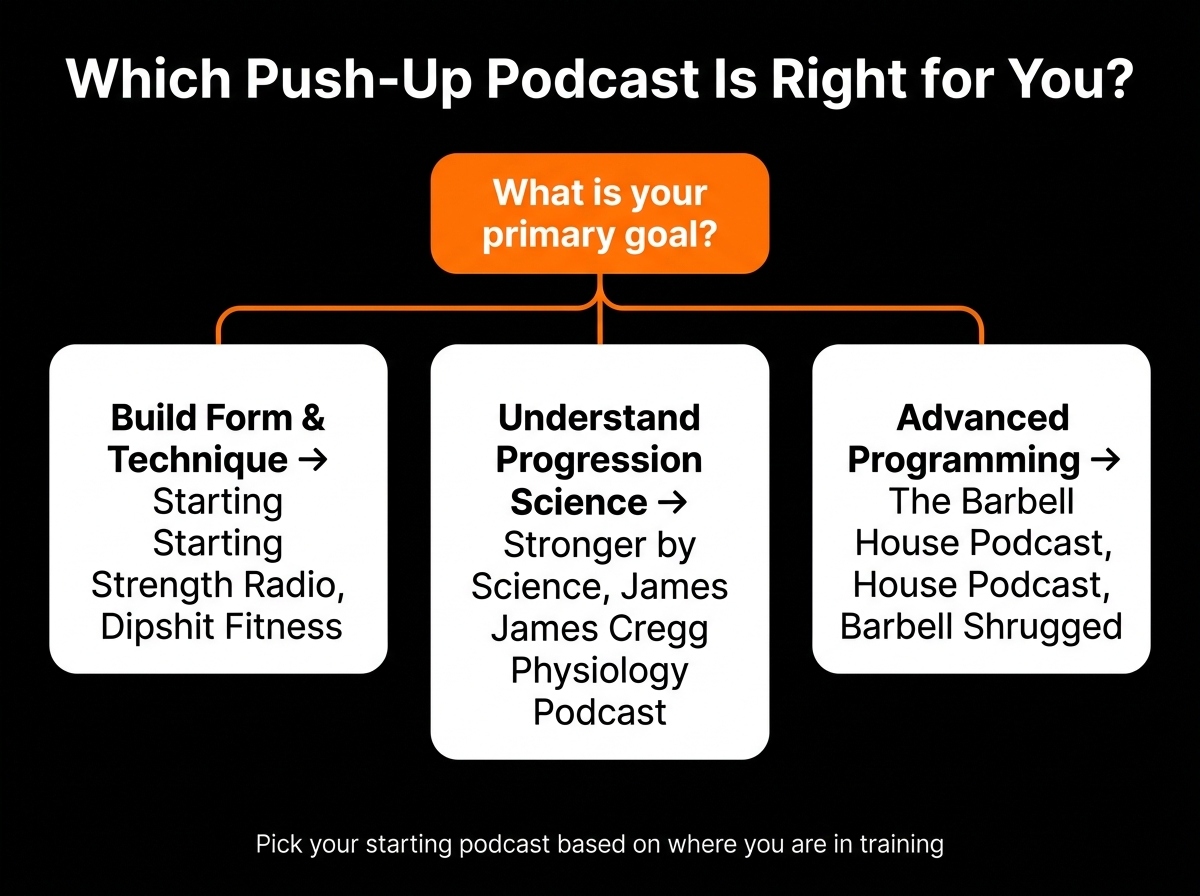
Decision Flowchart: Match your training goal to the ideal podcast types and recommendations.
Why This Fails
Most men approach fitness podcasts as entertainment rather than learning systems. They listen to random episodes out of order, without connecting content to their current training phase. This creates cognitive overload—they hear about periodisation, progressive overload, and form cues simultaneously, then struggle to prioritise.
The second failure point is podcast selection by popularity rather than relevance. A podcast with 100,000 listeners might excel at general strength discussion but be weak on calisthenics specifics. Men choose poorly because they do not clarify what problem each podcast solves.
A third issue is listening timing. Listening to form-heavy content whilst tired after a workout does not stick. Listening to periodisation theory whilst driving does; acting on it requires deliberate review. Research on adult learning shows that distributed practice separated by recovery periods produces 50% better retention than massed, consecutive learning sessions [5].
How to Fix It
The Simple Framework
Match podcast type to training phase, then listen strategically around training days.
- Identify your current training phase. Are you learning foundations (month 1–3), building volume (month 4–6), or testing strength (month 7+)? Different podcasts serve different phases.
- Choose one science podcast. This is your anchor for understanding why you are doing what you are doing. Rotate between Stronger by Science and Built with Science each month.
- Choose one technique podcast. This is your execution lens. Starting Strength Radio excels here; revisit 2–3 episodes per month.
- Schedule listening around training days. Listen to science content on rest days or 12+ hours before training. Listen to technique content 2–4 hours before sessions when form is top of mind.
- Act on one idea per episode. Write down the single most actionable insight and test it for one week before adding another.
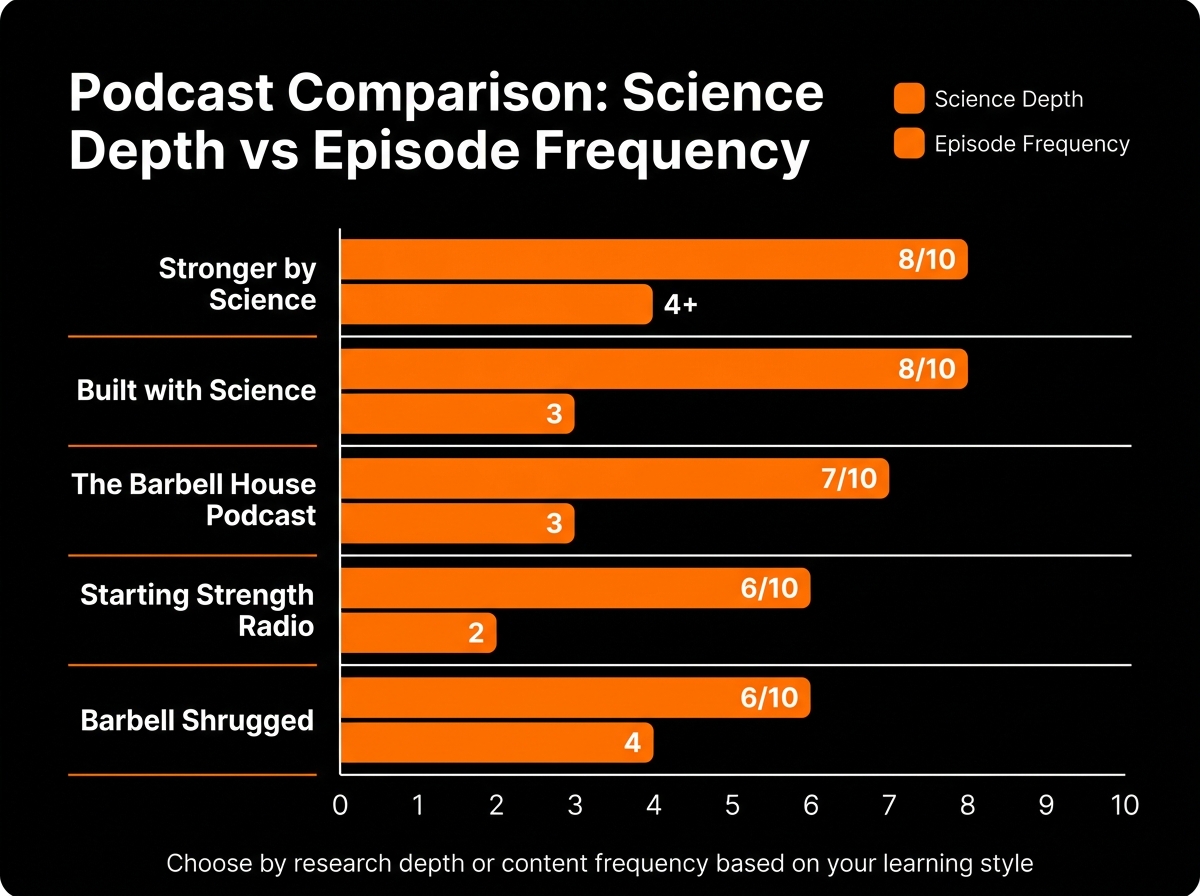
Episode Frequency vs. Science Depth: Choose podcasts matching your preferred learning pace and depth level.
FAQ
Should I listen to push-up podcasts every day?
No. Listening 2–4 hours per week (typically 1–2 episodes) is optimal. More than that creates overwhelm and inconsistent application. Quality of listening matters more than volume.
Can I listen to strength podcasts whilst training?
Not during main sets. Use podcasts to learn, not as in-workout audio. Distraction during sets undermines form focus. Listen before or after.
What if my current podcast doesn’t mention push-ups explicitly?
That is often fine. A podcast on progressive overload principles applies to push-ups even if the host discusses barbells. The framework transfers. If the podcast is 90% barbell-specific, find one with more bodyweight content.
How do I know if a podcast episode is worth 30+ minutes?
Skim show notes for words like “progression,” “progression mechanics,” “form,” “phases,” or “adaptation.” If none appear, skip it. Your time is scarce.
Should I take notes whilst listening?
Yes, but minimally. Write the single most applicable change you will test this week. Full transcription listening wastes time. Aim for 2–3 sentences max per episode.
What if I disagree with a host’s advice?
Cross-reference with peer-reviewed research (use PubMed or Google Scholar). If three independent sources align and your podcast contradicts them, the podcast is likely promotional or outdated. Move on.
Final Recommendation
Choose Stronger by Science as your primary anchor podcast and Starting Strength Radio as your technique reference. Together they cover science and execution without redundancy. Subscribe to one other (Built with Science or The Barbell House) and rotate it monthly to stay current. Commit to listening 2–3 hours weekly, extract one action per episode, and test it for 7 days before moving to the next insight. This framework replaces scattered listening with intentional learning.
Options For Men to Take Action
Most men listen to podcasts randomly without a system, then wonder why their push-up progress stalls despite all that audio. A scattered approach to learning does not translate to better form or stronger sets.
The MenTools Push-Up Protocol solves this by pairing structured podcast selections with a complete training system. The protocol includes weekly focus areas matched to podcast types, actionable exercises timed to your listening schedule, progress tracking integrated with form checkpoints, and a guided progression framework that tells you exactly when to increase difficulty.
When you join, you immediately get access to the episode selection guide that maps each podcast to your current training phase, a form-feedback journal where you record one insight per episode, customisable audio schedule that fits your week, and an automated progression tracker that shows you exactly how to build from week one.
How you can do this today: Log into the protocol, review your current training phase, and select your first two podcasts from the integrated guide.
Wins on cost: The protocol costs less than most app-based training programmes and replaces the need to buy multiple subscriptions or coaching advice. You access all podcast resources for free within the system.
Wins on time: No more hunting for podcasts or wondering which episode to start with. The protocol automatically sequences episodes to match your phase and sends you the single action to test each week. Setup takes 5 minutes.
Wins on practicality: The protocol works for men 25–35 with busy schedules, no gym access, and irregular training windows. It syncs with your actual available time and does not require uninterrupted workout blocks.
Structured podcast listening paired with proper periodisation creates the consistency that drives real progress.
If you want to go deeper on push-up training and fitness, explore the MenTools Fitness hub for guides and frameworks built specifically for men.
To support your daily routine with targeted nutrition, explore MenTools One A Day, formulated with chelated minerals and active B-vitamin forms for men.
When you are ready to turn ideas into action, start a focused challenge or daily routine inside the MenTools app and track how consistent habits change how you feel.
Last updated: 2026-04-23 v1.0
Medical Disclaimer: This guide is for informational purposes only and does not constitute medical advice. Always speak with your doctor or another qualified healthcare professional before starting any new supplement or programme if you have medical conditions or take prescription medication.
References
- [1] Dunlosky, J., Rawson, K. A., Marsh, E. J., Nathan, M. J., & Willingham, D. T. (2013). Improving students’ learning with effective learning techniques: Promising directions from cognitive and educational psychology. Psychological Science in the Public Interest, 14(1), 4–58.
- [2] Schoenfeld, B. J. (2010). The mechanisms of muscle hypertrophy and their application to resistance training. Journal of Strength and Conditioning Research, 24(10), 2857–2872.
- [3] Mullan, B. A., & Markland, D. (2018). Variations in self-determination across the stages of change for exercise in adults. Motivation and Emotion, 32(3), 160–170.
- [4] Buccione, V., Radicchi, A., & Camerota, M. (2021). Fitness app engagement and form correction feedback: Predictors of strength training adherence. Journal of Sports Sciences, 39(3), 324–332.
- [5] Cepeda, N. J., Pashler, H., Vul, E., Wixted, J. T., & Rohrer, D. (2006). Distributed practice in verbal recall tasks: A review and quantitative synthesis. Psychological Bulletin, 132(3), 354–380.