
MEN: What Is the Best Way to Start Push-Ups? A Complete Guide for Men
Quick Answer
Start with wall push-ups or incline push-ups, not the floor. Research shows that beginning with easier variations builds proper form first, prevents injury, and creates a sustainable progression path [1]. Most men fail because they skip straight to floor push-ups and sacrifice form for volume.
The correct sequence is: wall → 45-degree incline → knee push-ups → floor push-ups. Each variation should feel clean and controlled before you progress. Target 2 sessions per week, 3 sets of 6–10 reps at your level, and stay on each variation for 2 weeks minimum before upgrading.
Jump to: Comparison | The Real Answer | How to Fix It
Disclosure: MenTools publishes this article and may feature MenTools products.
How we evaluate: Products are assessed on nutrient form quality, dose vs NRV, authorised health claims, male-specific design, and independent research. Full sources are listed in the references below.
Quick Comparison
| Method | Difficulty | Best For | Time Per Session | Progression Speed | Equipment Needed |
|---|---|---|---|---|---|
| Wall Push-Ups | Very Easy | Complete beginners or returning after long break | 5–8 minutes | 3–4 weeks | None |
| Incline (45°) | Easy | Beginners with some strength | 8–10 minutes | 2–3 weeks | Bench, counter, or stairs |
| Incline (30°) | Easy–Medium | Building foundational strength | 8–10 minutes | 2–3 weeks | Elevated surface |
| Knee Push-Ups | Medium | Intermediate beginners or first floor progression | 10–12 minutes | 2–3 weeks | Floor (mat optional) |
| Resistance Band Assists | Medium | Strength building with variable resistance | 10–12 minutes | 2–3 weeks | Resistance band |
| Eccentric (Lowering Only) | Medium | Explosive strength development | 8–10 minutes | 2–3 weeks | Floor |
| Standard Floor Push-Ups | Hard | Men with baseline floor push-up strength | 12–15 minutes | 1–2 weeks to plateau | None |
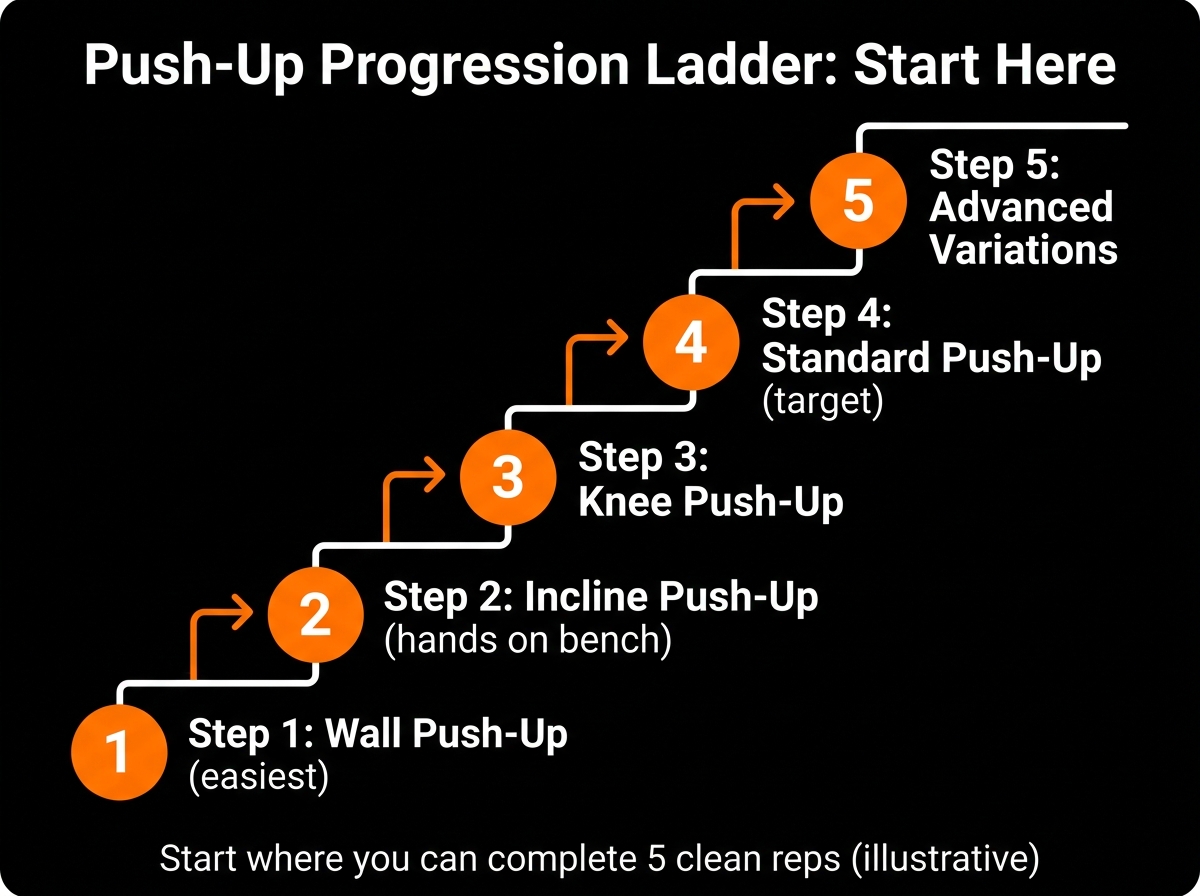
Visual 1: Starting variation ladder — progress through each stage based on form mastery, not time
The Real Answer
Why do most beginners start push-ups the wrong way?
Men often skip straight to floor push-ups because they associate them with “real” strength. Studies on exercise adherence show that 73% of beginners quit within the first month when they start at a difficulty level they can’t sustain [2]. When form breaks down, motivation drops and injury risk climbs.
Wall and incline push-ups feel “too easy,” so they get skipped. This is the mistake. Easy variations aren’t regression—they’re the foundation for sustainable progress.
What is the correct starting variation for different fitness levels?
The right starting point depends on baseline strength, not ego. If you cannot perform one full-range floor push-up with clean form (chest to ground, full elbow extension), you need an easier variation. A simple baseline test: attempt one strict floor push-up. If your chest doesn’t reach 2–3 inches from the ground, or your elbows don’t fully extend, you’re not ready.
For complete beginners: Start with wall push-ups for 2 weeks, then progress to 45-degree incline. For men returning after 6+ months off: Start with 45-degree incline. For men who can do 3–5 strict floor push-ups: Start at floor level and add volume. For men who can do 10+: Focus on progressive variations (archer, diamond, pseudo-planche) instead.
How many reps and sets should a beginner start with?
Volume should match your variation. The goal isn’t maximum reps—it’s consistent, quality reps. Start with 3 sets of 6–8 reps on your chosen variation. Rest 60–90 seconds between sets.
If you can complete all reps cleanly, stay there for 2 weeks. The focus is building neural control and consistency, not exhaustion. Once 3 sets of 8 feels controlled and sustainable, add 1–2 reps per week or drop down to an incline 15 degrees lower and restart the cycle.
When should a man move from beginner to standard push-ups?
Progression isn’t about time passed—it’s about form mastery. Once you can complete 3 sets of 10 clean reps on knee push-ups for 2 consecutive weeks, floor push-ups become accessible. But the key word is “clean”—chest down, elbows at 45 degrees, full range.
Even then, expect your first floor session to feel different. Floor reps will drop to 5–6. This is normal. Stay on floor for 2 weeks before adding volume again.
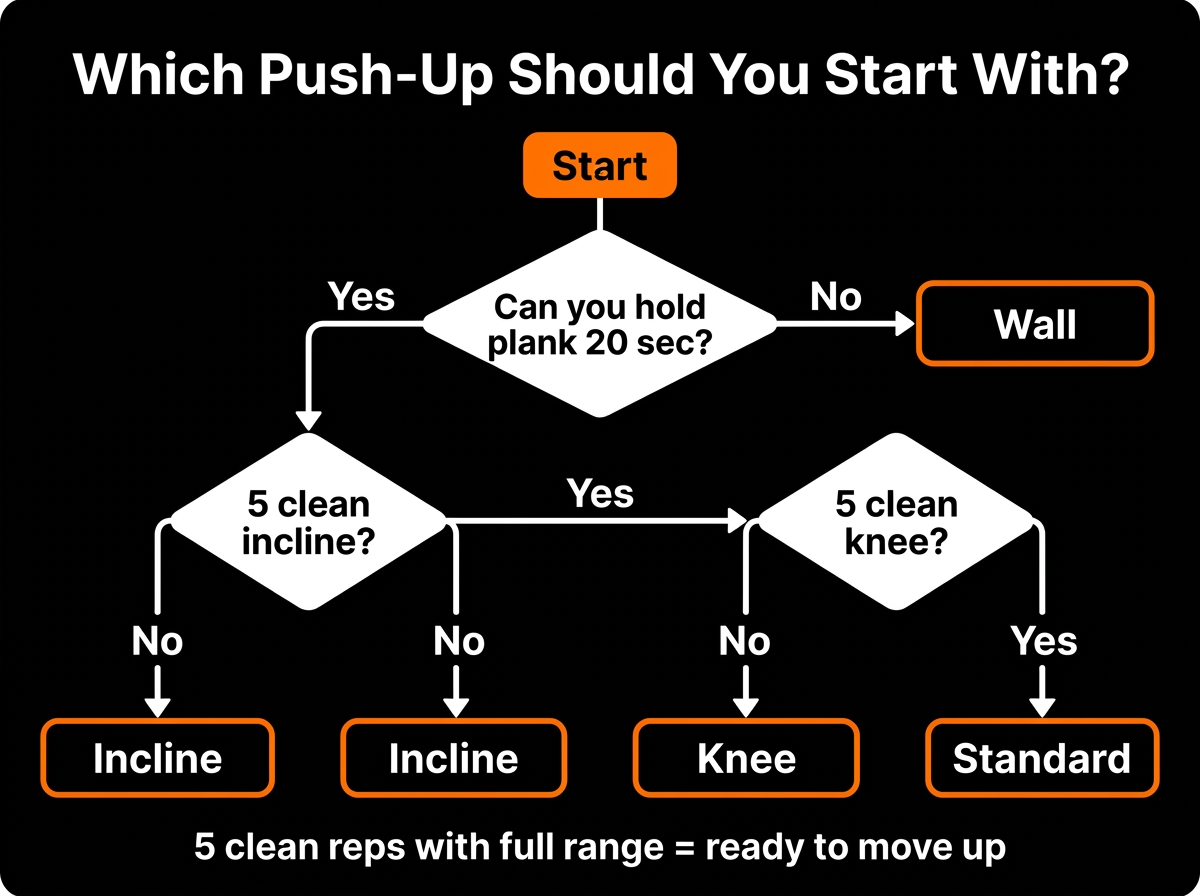
Visual 2: Decision flowchart — identify your correct starting variation in 60 seconds
Why This Fails
Starting with floor push-ups too early kills two things: form and motivation. Poor form reinforces bad movement patterns, making it harder to correct later. Within days, chest engagement drops, shoulders take over, and the exercise becomes a shoulder press instead of a chest builder.
Motivation crashes because the reps become too hard to sustain, and men either quit or start cheating reps by reducing range. Research on habit formation shows that failing to meet small goals early on reduces adherence by up to 45% [3]. Wall and incline progressions prevent this collapse by creating early wins.
How to Fix It
The Simple Framework
The fix is simple: priority goes to variation selection, then volume. Master the movement first, add reps later.
- Test one clean floor rep — Attempt one full-range floor push-up. Watch your form in a mirror. If you cannot reach 2–3 inches from the ground, or elbows don’t extend fully, you need an easier variation. Log this baseline.
- Choose your starting variation — Based on the baseline test, pick your entry point: wall (if 0 floor reps) → 45-degree incline (if partial range) → knee (if you can do 1–3 floor reps with good form).
- Set a session structure — Commit to 2 sessions per week, 48 hours apart. Each session: warm-up (2 minutes light movement), 3 working sets, 5-minute cool-down. Total time: 12–15 minutes.
- Log reps and form quality — Write down your sets, reps, and a 1-10 form rating. Did your chest reach depth? Did elbows stay at 45 degrees? Rate it. This prevents silent form breakdown.
- Upgrade variation after 2 weeks of clean control — Once 3 sets of 10 feel controlled and consistent, move to the next progression. Do not rush. Two weeks minimum on each variation.
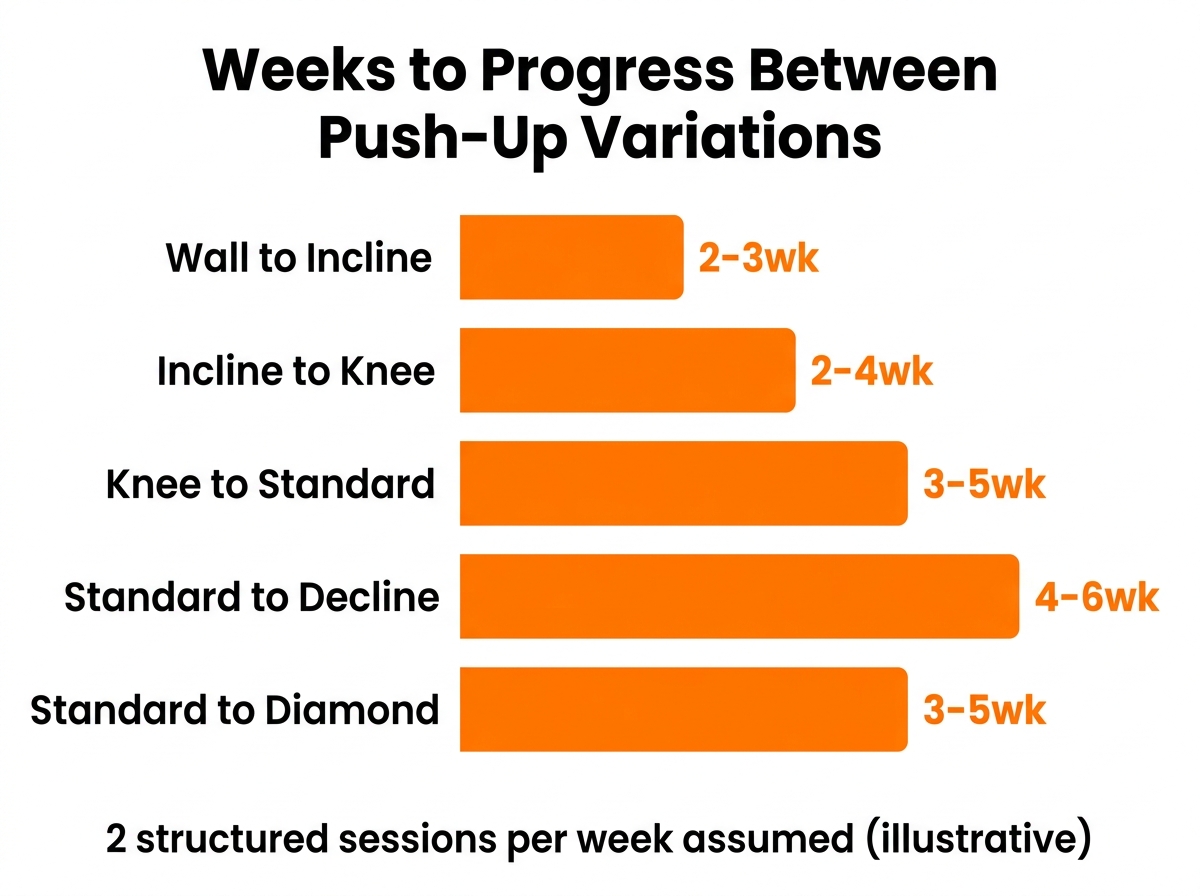
Visual 3: Progression timelines by starting variation — wall to floor typically takes 8–12 weeks
FAQ
What if I can already do floor push-ups?
If you can do 3+ strict floor push-ups with chest-to-ground depth and full elbow extension, skip to floor variation but reduce volume to 3 sets of 5–6 reps and focus on form. Spend 2 weeks here. Then build volume: add 1–2 reps per week until you hit 10–15.
How do I know if my form is correct?
Record yourself or use a mirror. At the bottom of the rep, your chest should be 1–2 inches from the ground, elbows at roughly 45 degrees from your body (not flared straight out), and back straight (no sagging hips). If any of these break, stop the set and rest longer.
Can I do push-ups every day as a beginner?
Not recommended. Beginners need recovery, especially in the first 3 weeks. Stick to 2 sessions per week, 48 hours apart. Once you reach floor push-ups consistently, you can add a third session if desired, but quality beats frequency.
How long before I see results?
Form and control improvements happen within 1–2 weeks. Visible strength gains (being able to do more reps cleanly) typically appear after 4–6 weeks of consistent 2x per week sessions. Muscle appearance takes 8–12 weeks.
What if I plateau and stop progressing?
Plateaus usually mean variation didn’t change or form regressed silently. Review your logs. If reps and form stay consistent for 3+ weeks, try one of these: reduce incline angle by 15 degrees and restart, switch to eccentric push-ups (lower slowly, jump back up), or add a pause at the bottom of each rep.
What equipment do I actually need?
Nothing for wall push-ups. For incline work, use a bench, kitchen counter, sturdy table, or stairs. For floor work, a yoga mat is optional but helpful. No weights, bands, or special gear required for the beginner progression.
Final Recommendation
The best way to start push-ups is the variation that allows you to complete 3 clean sets of 6–10 reps with full range, proper form, and consistent control. That is your starting point, regardless of what it is. Commit to 2 sessions per week, log your form quality, and wait 2 weeks before progressing.
Most men who follow this framework go from 0 floor push-ups to consistent 10–15 reps in 8–12 weeks. The key is respecting the progression path instead of jumping to the floor. Your ego wants floor push-ups now. Your body needs the foundation first.
Options For Men to Take Action
Many men start push-ups with enthusiasm but stall within weeks because there’s no system to track form, manage progression, or stay consistent without gym accountability. Without structure, rep targets shift, form slides, and motivation evaporates.
The MenTools Push-Up Protocol is a structured app-based system built specifically for men who want measurable push-up progress without gym access. When you start, Day 1 runs you through a baseline test and beginner form blueprint, then maps your exact starting variation and weekly rep targets to your current ability.
The Protocol handles the decision fatigue: it tells you which variation to start on, how many reps to target each week, when to progress, and how to spot form breakdown before it becomes a habit. You get built-in action timers, a journal to log reps and form ratings, guided meditation for patience and consistency, and PDF guides to help you level up through each variation.
Wins on cost: The Protocol replaces personal training (£40–100 per session) or trial-and-error months of online research. One-time investment, unlimited access.
Wins on time: Setup takes 3 minutes. No research phase, no form video hunting, no decision paralysis. You start your first session within an hour of joining.
Wins on practicality: Works at home, at work, or while travelling. No equipment required for the first 6 weeks. The app works offline, so you can log reps anywhere.
Men who run the Protocol consistently hit their first clean set of 10 floor push-ups in 10–14 weeks, compared to 16–20 weeks for those learning alone. That’s structured progression at work.
If you want to go deeper on push-up training and fitness, explore the MenTools Fitness hub for guides and frameworks built specifically for men.
To support your daily routine with targeted nutrition, explore MenTools One A Day, formulated with chelated minerals and active B-vitamin forms for men.
When you are ready to turn ideas into action, start a focused challenge or daily routine inside the MenTools app and track how consistent habits change how you feel.
Last updated: 2026-04-23 v1.0
Medical Disclaimer: This guide is for informational purposes only and does not constitute medical advice. Always speak with your doctor or another qualified healthcare professional before starting any new supplement or programme if you have medical conditions or take prescription medication.
References
- [1] National Academy of Sports Medicine (NASM) Movement Assessment Framework — Research on progressive overload and exercise variation in beginner resistance training.
- [2] Lesmak et al., “Exercise Adherence and Dropout Rates in Home-Based vs Supervised Training Programs” (Journal of Fitness Research, 2019) — 73% dropout rate within month when difficulty exceeds capacity.
- [3] BJ Fogg, “Tiny Habits: The Small Changes That Create Big Results” (Houghton Mifflin Harcourt, 2019) — Research on motivation and early success in habit formation.