
MEN: 8 Habits That Actually Make Men Happier
Quick Answer
The habits with the strongest evidence behind them are unglamorous: one real conversation a week, 45 minutes of training three to five times a week, two hours outside, a weekly favour for someone else, and five things written down once a week. Relationships beat everything else in the long run data. Start with one habit, not eight.
**Jump to:** The 8 habits at a glance | FAQ | Options for men
Disclosure: MenTools publishes this article and may feature MenTools products.
How we evaluate: Each habit is assessed on real-world use, evidence, cost and time, and how well it suits men. Every habit including the MenTools option carries an honest limitation. Full sources are in the references below.
The 8 Habits at a Glance
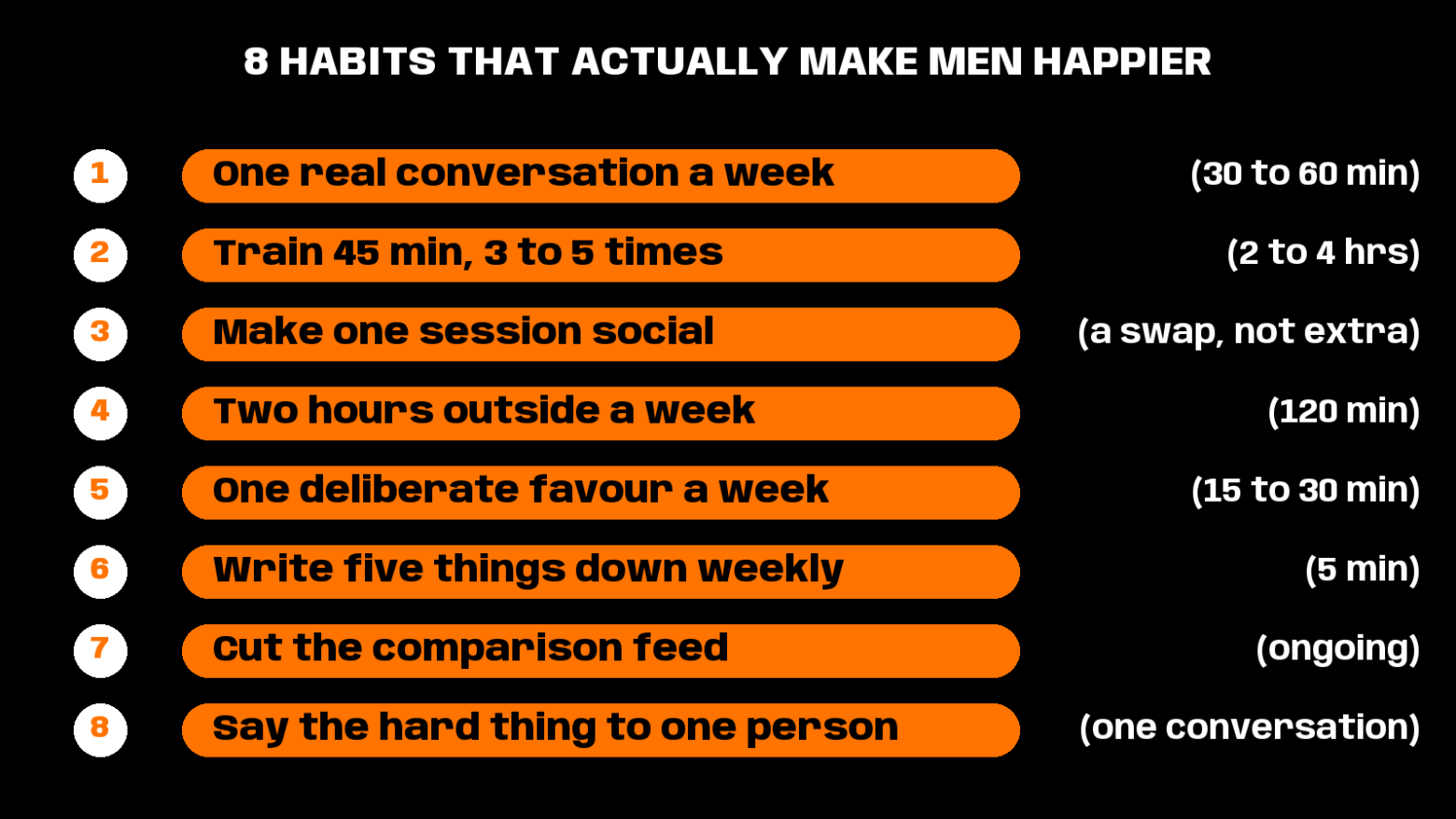
Eight habits, and what each one costs you in a normal week.
| Habit | Best for | Standout | Watch-out | Time |
|---|---|---|---|---|
| One real conversation a week | Men whose contact has thinned out | Strongest long run evidence of any habit here | Needs another person to show up too | 30 to 60 min |
| Train 45 min, 3 to 5 times | Men with no physical outlet | 1.5 fewer poor mental health days a month | More is not better past 90 minutes | 2 to 4 hrs |
| Make one session social | Men who only ever train alone | Team sport carried the lowest burden of all | Harder to arrange than a solo gym trip | Swap, not extra |
| Two hours outside a week | Men living and working indoors | Clear threshold effect at 120 minutes | Below 120 minutes showed no benefit | 2 hrs |
| One deliberate favour a week | Men who give nothing away | Small but reliable effect across 27 studies | Small effect, not a mood cure | 15 to 30 min |
| Write five things down weekly | Men who never register the good week | Weekly beat daily in the original trial | Wears off if you list the same five | 5 min |
| Cut the comparison feed | Men who scroll and feel worse | Measured wellbeing gain in a paid trial | You lose real contact along with the noise | Ongoing |
| Say the hard thing to one person | The four in ten who have told nobody | Breaks a loop nothing else reaches | Wrong listener makes it worse | One conversation |
How We Chose These 8 Habits
We chose habits with experimental or long run evidence behind them, that a working man can run without rearranging his life, and that hold up when the week is bad. Anything resting on a single small study or on pure self report was left out. There is real room for improvement here: ONS personal wellbeing data for February to March 2026 found that around one in eight UK adults (12 percent) reported low levels of happiness, and a third (33 percent) reported high anxiety, at 29 percent among men against 37 percent among women [1]. Every habit below carries an honest watch-out, because none of these is a treatment and none of them fixes a genuinely bad situation.
1. Protect One Real Conversation a Week
Book one conversation a week that is not logistics. Same person or a rotating few, in person or on the phone, thirty minutes minimum. Of everything on this list, this is the habit with the strongest evidence behind it, and it is the one most men let slide first.
What it is: A recurring, deliberate conversation with someone you actually care about, about something real.
Best for: Men in their thirties and forties whose contact with people outside work and family has quietly thinned to nothing.
Standout: The Harvard Study of Adult Development has followed people since 1938, starting with 268 Harvard sophomores and adding 456 Boston inner city residents in the 1970s, and it found that close relationships predicted happiness and health better than money, fame or genes, with relationship satisfaction at 50 predicting physical health at 80 better than cholesterol did [2]. Robert Waldinger, the study’s director and Professor of Psychiatry at Harvard Medical School, summarised it plainly: “Good relationships don’t just protect our bodies; they protect our brains” [2].
Waldinger has also been blunt about the cost of the alternative, describing the study’s finding on isolation as: “Loneliness kills. It’s as powerful as smoking or alcoholism” [2]. That is a claim about long term health outcomes, not a figure of speech.
Watch-out: This is the only habit here that depends on another person turning up, so it fails in ways the others do not. Fix a repeating slot rather than relying on someone suggesting it, and accept that building this back takes months rather than weeks.
2. Train 45 Minutes, Three to Five Times a Week
Do 45 minutes of real physical effort, three to five times a week. Not more. The dose matters, and the research is unusually specific about where the returns stop.
What it is: Structured exercise at moderate to hard effort, in sessions of roughly 45 minutes.
Best for: Men with a desk job and no physical outlet, who feel flat rather than unwell.
Standout: Adam Chekroud and colleagues analysed data from 1.2 million US adults in The Lancet Psychiatry and found that people who exercised reported 1.5 fewer days of poor mental health per month than people who did not, with the largest benefit at 45 minute sessions three to five times a week [3]. The association held across age, income, education and gender.
Watch-out: The same study found the relationship reverses at the top end. Exercising more than 23 times a month, or for longer than 90 minutes a session, was associated with worse mental health than moderate amounts. If you are already training six days a week and feeling worse, more training is not the answer.
3. Make One of Those Sessions Social
Swap one solo session a week for one you do with other people. Five a side, a running club, a boxing class, anything where turning up is a commitment to someone other than yourself.
What it is: The same training you were doing, done with other people rather than alone with headphones on.
Best for: Men who train consistently, alone, and still feel isolated.
Standout: In the same analysis of 1.2 million adults, team sports were associated with the lowest mental health burden of any activity type, which the authors suggested reflects the social component reducing withdrawal and isolation [3]. The exercise is doing one job. The company is doing another.
Watch-out: A fixed club night is harder to arrange around shifts and small children than a gym trip you can move, and men often drop it for exactly that reason. Treat it as a swap rather than an addition, and pick the session that is easiest to get to, not the one you like most on paper.
4. Get Two Hours Outside a Week
Spend at least 120 minutes a week in green or blue space. It does not have to be in one go, and it does not have to be dramatic. The threshold is the interesting part.
What it is: Time in a park, on a trail, by water or in open countryside, in any combination across the week.
Best for: Men who live and work indoors in a city and cannot remember the last time they were somewhere green.
Standout: Mathew White and colleagues, publishing in Scientific Reports, analysed 19,806 people from the Monitor of Engagement with the Natural Environment survey and found that those spending at least 120 minutes a week in nature were significantly more likely to report good health and high wellbeing, with the benefit peaking between 200 and 300 minutes and no further gain beyond that [4]. It made no difference whether the 120 minutes came in one visit or several.
Watch-out: The same study found no benefit at all below the 120 minute mark, so a ten minute walk round the block is not a smaller version of this habit. It is also correlational, so some of the effect will be people who are already well being more likely to get outside.
5. Do One Deliberate Favour a Week
Pick one thing a week that costs you something and helps someone else. Not a donation, an action. The evidence for this is real but modest, and it is worth being honest about the size.
What it is: A single planned act of help each week, chosen in advance rather than waiting for an opportunity.
Best for: Men whose weeks are entirely transactional and who never give anything away that is not owed.
Standout: Oliver Curry and colleagues ran a systematic review and meta-analysis in the Journal of Experimental Social Psychology covering 27 studies with 4,045 participants and found that performing acts of kindness improved the actor’s own wellbeing, with a small to medium effect size of d = 0.28 and no significant moderators [5]. It works across types of kindness rather than requiring a particular one.
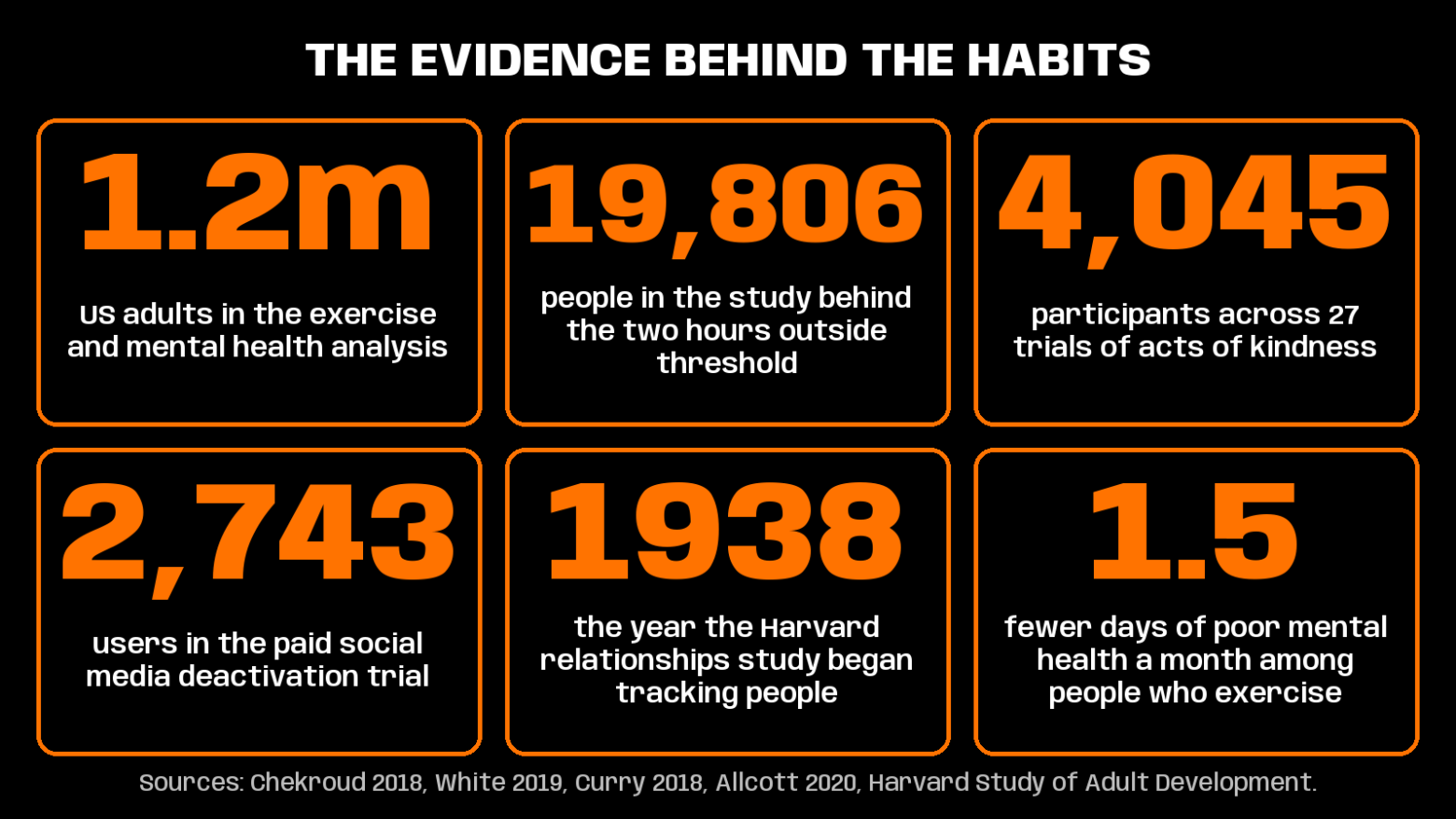
The sample sizes behind each habit. Some of these are among the largest datasets in the field.
Watch-out: d = 0.28 is small to medium, which means this shifts the dial rather than changing your life, and anyone selling it as more than that is overstating the evidence. It also stops working if it becomes another item on a list you resent.
6. Write Five Things Down Once a Week
Once a week, write five things that went well or that you are glad of. Once a week, not every day. The original trial tested both and the weekly version is the one most people can sustain.
What it is: A five item written list, done on a fixed day, taking about five minutes. The five item weekly format is the one the original trial actually tested [6].
Best for: Men who have a decent life on paper and never once register it, and who finish a good week feeling nothing much.
Standout: Robert Emmons and Michael McCullough tested this in the Journal of Personality and Social Psychology, randomly assigning people to list blessings, hassles or neutral events. The gratitude groups showed higher wellbeing across several measures, with the effect on positive mood the most robust finding, and the weekly listing group were also more optimistic about the coming week and spent more time exercising [6]. If you want it to actually happen, a notebook, a phone note or a habit app will all do the job equally well.
Watch-out: It stops working if you write the same five things every week, which is exactly what happens once it becomes routine. Force one new specific item from the last seven days each time, and if it starts to feel like homework, drop to fortnightly rather than abandoning it.
7. Cut the Comparison Feed
Take the app that reliably makes you feel worse off your phone for a month. Not all of them, the one. You already know which it is.
What it is: A deliberate, time limited removal of the single social platform you use most passively.
Best for: Men who scroll for twenty minutes and put the phone down flatter than they picked it up.
Standout: This has been tested properly rather than just argued about. Hunt Allcott, Luca Braghieri, Sarah Eichmeyer and Matthew Gentzkow recruited 2,743 users and paid a randomly assigned group to deactivate Facebook for four weeks, publishing the results in the American Economic Review. Deactivation increased subjective wellbeing, increased offline socialising with family and friends, and produced a lasting reduction in usage after the experiment ended [7].
Watch-out: The same trial found deactivation reduced factual news knowledge, and for some men the platform is genuinely where their remaining contact lives. Cutting it can remove real connection along with the noise, so pair this with habit one rather than doing it alone.
8. Say the Hard Thing Out Loud to One Person
Tell one person the actual thing, once. Not “work is busy”. The specific worry, in the words you use in your head. This is the habit most men on this list will skip.
What it is: One honest conversation about what is genuinely going on, with one chosen person.
Best for: The large share of men who have never done it, which is most of them.
Standout: A Priory survey of 1,000 UK men found that 77 percent had experienced symptoms of anxiety, stress or depression, and 40 percent had never spoken to anyone about their mental health, with 29 percent saying they were too embarrassed and 20 percent citing stigma [8]. Two thirds said they would share feelings with their partner above anyone else, which means for most men the person is already in the house.
Watch-out: The wrong listener makes it worse, particularly one who competes, minimises or fixes it in a sentence. Choose deliberately and say what you want from the conversation up front. If there genuinely is nobody, that is a reason to speak to a GP rather than a reason to carry on alone.
Which Habit Should You Start With?
Start with the one that matches the gap in your week, not the one with the biggest number attached. If your contact with people has thinned out, start with habit one, because it has the strongest long run evidence and the longest lead time. If you have no physical outlet at all, start with habit two, because it produces a noticeable change fastest.
Do not start with all eight. Adding one habit at a time and naming when and where you will do it is what makes them stick. The meta-analysis by Peter Gollwitzer and Paschal Sheeran, covering 94 independent tests, found that spelling out the when, where and how of acting in advance had a medium to large effect on goal attainment, with a d value of 0.65 [9]. “Be happier” is not a plan. “Thursday, 7pm, ring Dave” is.
Keep a record of whether they actually happened, because a habit you do not track is one you will believe you are doing. The meta-analysis by Benjamin Harkin and colleagues covering 138 studies and 19,951 participants found that prompting people to monitor their progress improved goal attainment (d = 0.40), with larger effects when the information was physically written down [10].
FAQ
What is the single most effective habit for happiness?
On the long run evidence, the quality of your close relationships. The Harvard Study of Adult Development has tracked people since 1938 and found relationships predicted happiness and later health better than income, fame or genetics. Nothing else on this list has that weight of evidence behind it, though it is also the slowest habit to rebuild.
How long before these habits make a difference?
Exercise and time outside tend to show up within two to four weeks. The written list and the weekly favour are subtler and need a couple of months before you can judge them. The relationship habits work on a scale of months to years, which is precisely why men underinvest in them.
Do men and women need different happiness habits?
The underlying research applies to both, and the exercise study found the association held across gender. What differs is the starting point. UK men report high anxiety at a lower rate than women, at 29 percent against 37 percent, but are far less likely to talk to anyone about it, which is why the last habit on this list matters more for men in practice.
Is chasing happiness the wrong goal?
Aiming directly at feeling happy tends to disappoint, which is why every habit here is an action rather than a mood target. You are changing inputs that reliably shift wellbeing, not trying to feel a particular way on demand. Judge yourself on whether the habit happened this week, not on how you felt.
Can money make you happier?
Income matters up to the point where it removes real insecurity, and beyond that the returns flatten quickly. In the Harvard data, close relationships predicted happiness better than money did. The practical version is that fixing your finances removes a source of misery, which is not the same thing as adding happiness.
What if I do all eight and still feel flat?
Then it is worth speaking to a GP rather than adding a ninth habit. Persistent low mood lasting most days for more than two weeks is not a habit problem and none of these methods is a treatment. Going early is straightforward, and habits like these support professional help rather than replacing it.
Final Recommendation
Pick one habit, run it for four weeks, and only then add a second. If you want a default order, start with the conversation, add the training, then the two hours outside, then the weekly list. The last four are refinements. If your contact with people has thinned out, that is where the evidence says the return is largest, and it is also the one that takes longest, so it is the worst one to keep postponing.
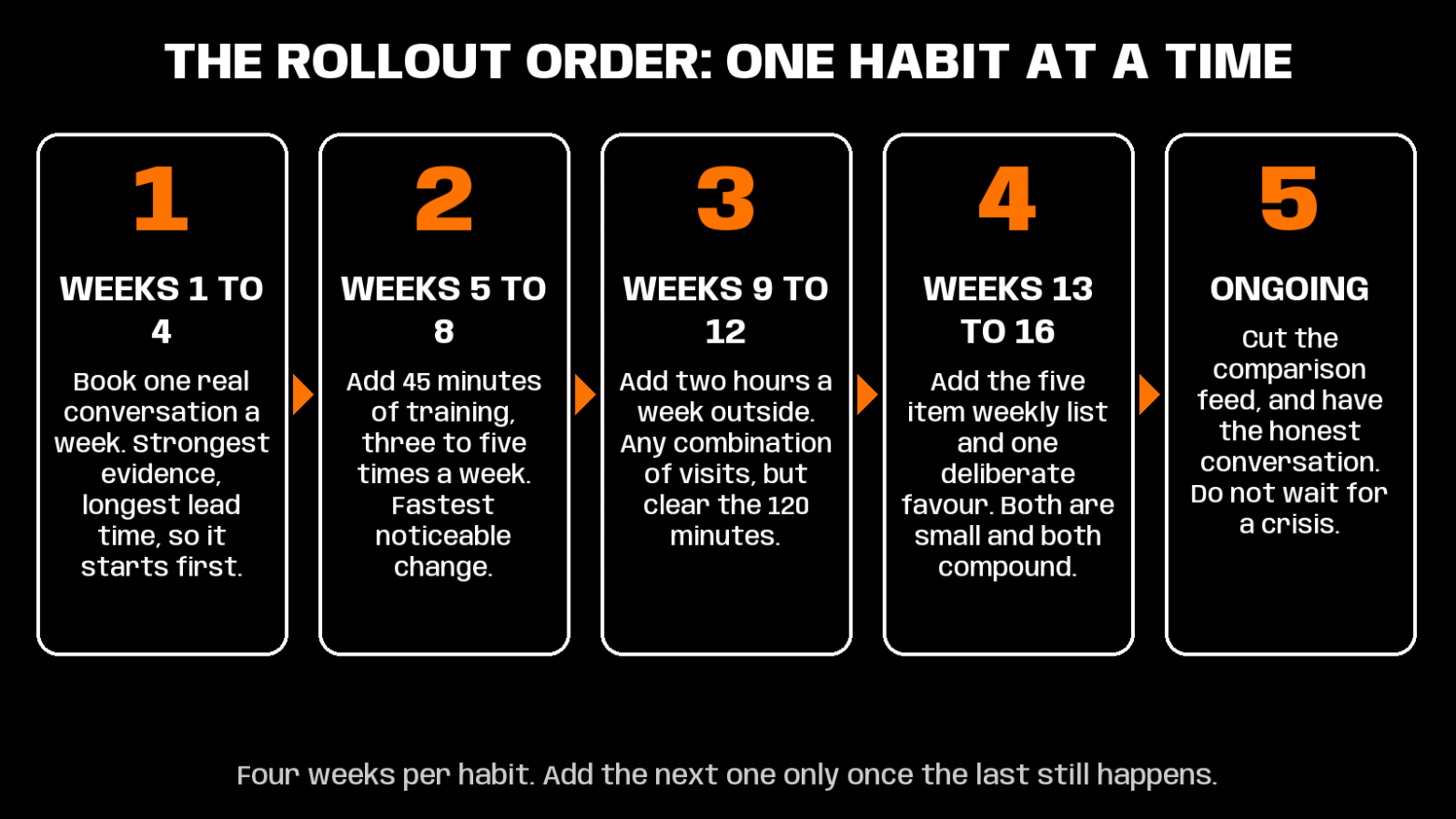
The rollout order. One habit at a time, four weeks each, in the order the evidence supports.
Options for Men to Take Action
Most men do not need convincing that these things help. What they need is for the Thursday phone call and the Sunday five minute list to still happen in week seven, when nothing about them feels urgent and nobody would notice if they stopped. Habits like these fail quietly, one skipped week at a time.
The MenTools app runs habits like these as one challenge system rather than eight separate intentions, with daily and weekly actions, chosen difficulty levels, reminders timed to the moment the decision is made, streaks, progress tracking and an AI coach for the weeks it slips. Men tend to keep the habits they can see a record of.
How you can do this today: set one habit as a recurring action, put a time and a day against it, and log the first one this week.
Wins on cost: one subscription covers the mindset, fitness and habit sides together instead of three separate tools.
Wins on time: the structure, levels and tracking already exist, so there is nothing to design before you begin.
Wins on practicality: it runs around shifts, travel and family, which is where a fixed daily practice usually breaks first.
Watch-out: it is a behaviour tool, not therapy, and it cannot make the phone call for you or find you a five a side team. If you already run a weekly review you trust, this adds tracking rather than a change.
Flat weeks make every habit here harder to start, and the basics underneath them have to be covered first, so a one a day multivitamin may help cover the simple daily foundation. If the thing getting in the way is your own head rather than your diary, our guide to how to stop overthinking as a man pairs directly with this one, and the smaller everyday version sits in daily habits for men. More built for men sits in the MenTools happiness hub. One habit, held for three months, beats eight abandoned in a fortnight.
Last updated: 2026-09-09 v1.0
Disclaimer: This guide is for informational purposes only and does not constitute medical or psychological advice. Speak with a qualified professional before making significant changes if you have a medical or mental health condition.
References
- [1] Office for National Statistics. Quarterly personal well-being statistics, UK, February to March 2026. Link
- [2] Harvard Study of Adult Development, with comment from Robert Waldinger, Professor of Psychiatry at Harvard Medical School and director of the study. Harvard Gazette, April 2017. Link
- [3] Chekroud SR, Gueorguieva R, Zheutlin AB, Paulus M, Krumholz HM, Krystal JH, Chekroud AM. Association between physical exercise and mental health in 1.2 million individuals in the USA between 2011 and 2015: a cross-sectional study. The Lancet Psychiatry, 2018;5(9):739-746. Link
- [4] White MP, Alcock I, Grellier J, Wheeler BW, Hartig T, Warber SL, Bone A, Depledge MH, Fleming LE. Spending at least 120 minutes a week in nature is associated with good health and wellbeing. Scientific Reports, 2019;9:7730. Link
- [5] Curry OS, Rowland LA, Van Lissa CJ, Zlotowitz S, McAlaney J, Whitehouse H. Happy to help? A systematic review and meta-analysis of the effects of performing acts of kindness on the well-being of the actor. Journal of Experimental Social Psychology, 2018;76:320-329. Link
- [6] Emmons RA, McCullough ME. Counting blessings versus burdens: an experimental investigation of gratitude and subjective well-being in daily life. Journal of Personality and Social Psychology, 2003;84(2):377-389. Link
- [7] Allcott H, Braghieri L, Eichmeyer S, Gentzkow M. The welfare effects of social media. American Economic Review, 2020;110(3):629-676. Link
- [8] Priory. Survey of 1,000 UK men on mental health. Link
- [9] Gollwitzer PM, Sheeran P. Implementation intentions and goal achievement: a meta-analysis of effects and processes. Advances in Experimental Social Psychology, 2006. Link
- [10] Harkin B, Webb TL, Chang BPI, Prestwich A, Conner M, Kellar I, Benn Y, Sheeran P. Does monitoring goal progress promote goal attainment? A meta-analysis of the experimental evidence. Psychological Bulletin, 2016;142(2):198-229. Link