
MEN: How to Stop Overthinking as a Man: 7 Practical Ways
Quick Answer
Overthinking stops when you give the thinking a shape. Put your worries in one fixed 20 minute window instead of all day, switch the question from why to what next, talk to yourself by name rather than as I, get the loop out of your head and onto paper, then move your body and get outside. Structure beats willpower.
**Jump to:** The 7 ways at a glance | FAQ | Options for men
Disclosure: MenTools publishes this article and may feature MenTools products.
How we evaluate: Each step is assessed on real-world use, evidence, cost and time, and how well it suits men. Every step including the MenTools option carries an honest limitation. Full sources are in the references below.
The 7 Ways at a Glance
| Way | Best for | Watch-out | Time |
|---|---|---|---|
| Fix a worry window | Worrying in scattered bursts all day | Takes a week or two to work | 20 min daily |
| Switch why to what next | Replaying the same problem endlessly | Feels dismissive at first | 2 min |
| Use your own name | Spiralling before something stressful | Feels ridiculous until it works | 1 min |
| Write the loop down | Loops that keep restarting at 2am | Can become more rumination on paper | 10 min |
| Move at real intensity | Physical tension with the thinking | Not enough on its own | 30 to 60 min |
| Get outside, properly | Urban men whose head never quietens | Needs green space and time | 60 to 90 min |
| Say it to one person | Men who have told nobody anything | Requires picking the right person | One conversation |
How We Chose These 7 Ways
We chose methods with real trial evidence behind them, that a working man can run without a therapist and without an hour a day, and that keep working when the week is bad. Each one had to survive three tests: published research, a realistic time cost, and a version that fits a normal life. The scale of the problem is not in doubt. Mental Health UK’s Burnout Report 2026, based on polling of 4,502 UK adults with fieldwork between 3 and 5 November 2025, found that 91 percent had experienced high or extreme levels of pressure and stress in the previous year [1]. Every method below carries an honest watch-out, because none of these is a treatment.
What Is Overthinking, Actually?
Overthinking is repetitive negative thinking: going over the same material again and again without moving toward an answer. Psychologists split it into rumination, which looks backwards at what happened, and worry, which looks forwards at what might. Both feel like problem solving. Neither is.
The distinction matters because the research is clear that the loop makes things worse rather than better. Susan Nolen-Hoeksema’s response styles work found that ruminating in response to low mood prolongs it. In one prospective study, 79 people recorded their moods and their responses to those moods every day for 30 days, and the more ruminative their responses, the longer their periods of low mood lasted, even after accounting for how bad the mood was to begin with [2]. Her later reviews summarised the wider evidence: rumination enhances negative thinking, impairs problem solving, interferes with taking action, and erodes social support [3].
Men are also more likely to run this alone. A Priory survey of 1,000 UK men found that 77 percent had experienced symptoms of anxiety, stress or depression, and 40 percent had never spoken to anyone about their mental health, with 29 percent saying they were too embarrassed and 20 percent citing stigma [4]. Dr Natasha Bijlani, Consultant Psychiatrist at Priory Hospital Roehampton, described the pattern directly: “Traditionally, men have been less likely to seek support for mental health issues. This is probably for a number of reasons, including stigma and the traditional ‘strong male’ stereotype” [4].
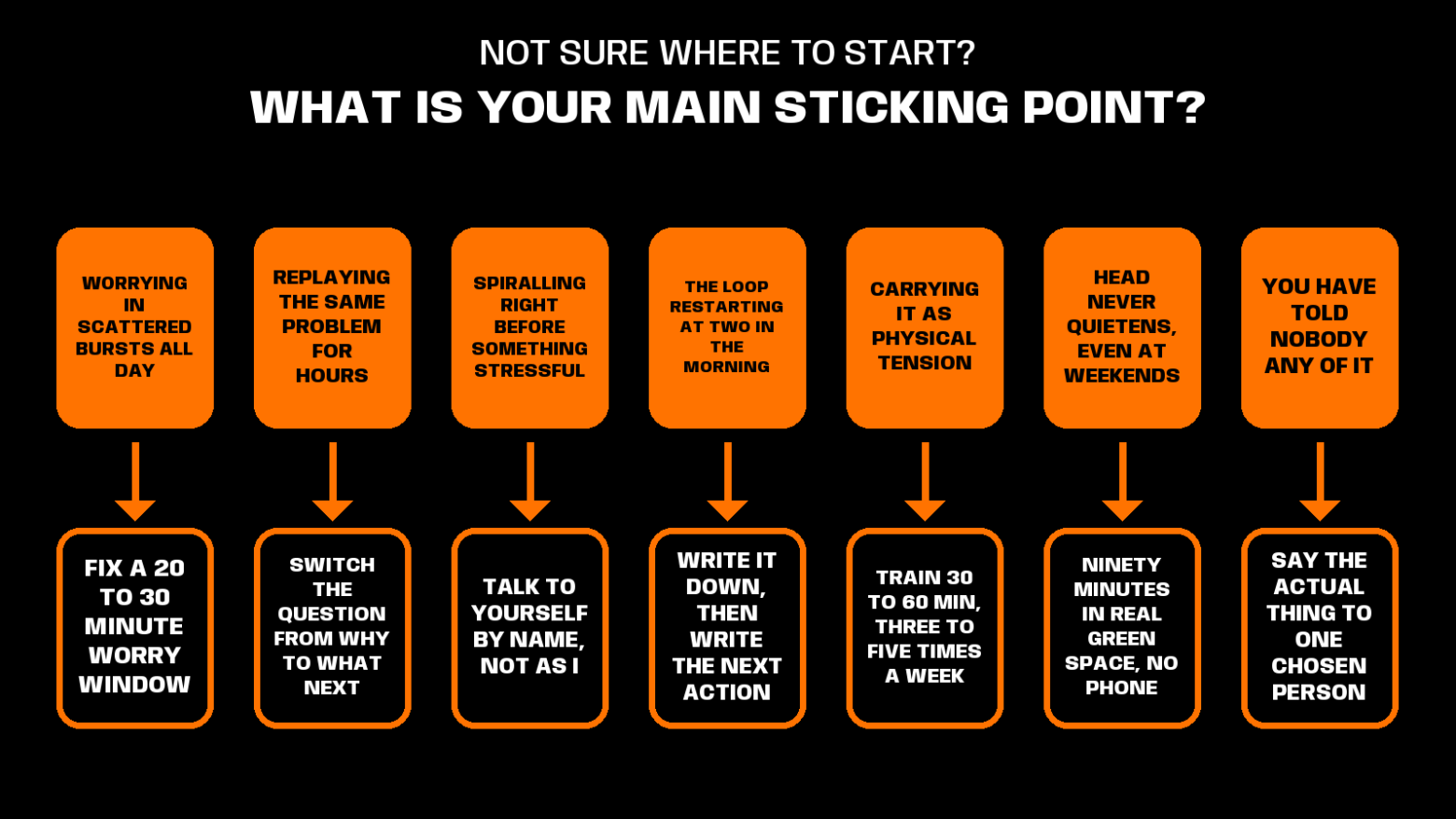
Start with the method that matches your actual sticking point, not the one that sounds most disciplined.
1. Give Worry a Fixed Window Instead of the Whole Day
Book one 20 to 30 minute slot, at the same time each day, and postpone worries to it. When a worry arrives outside the window, note it in one line and return to what you were doing. You are not banning the thought. You are scheduling it.
What to do: Pick a slot, ideally early evening and not within two hours of bed. Keep a one line list during the day. At the slot, work through the list and stop when the time is up.
Best for: Men whose worrying is spread thinly across the whole day rather than concentrated in one bad hour.
Why it works: This is stimulus control, first tested by Thomas Borkovec and colleagues in 1983, and it has held up. A 2023 meta-analysis by Annika Dippel, Jos Brosschot and Bart Verkuil in the International Journal of Cognitive Therapy pooled seven randomised trials with 999 participants and found worry postponement reduced both the duration of daily worry (d = 0.313) and its frequency (d = 0.189) when practised for between a week and a month [5].
Watch-out: Those are small effects, and the technique takes a week or two before it feels like anything other than an annoying extra task. It also fails if you use the window to catastrophise for half an hour, so treat the slot as time boxed problem solving, not a licence to spiral on schedule.
2. Switch the Question From Why to What Next
Change the shape of the thinking rather than trying to stop it. Abstract questions such as “why does this always happen to me” have no answer and feed the loop. Concrete questions such as “what is the first thing I will do about this on Monday” end it.
What to do: When you catch the loop, write the current thought down and rewrite it as a specific question about a specific next action, with a time and a place.
Best for: Men who replay the same problem for hours and end up exactly where they started.
Why it works: Ed Watkins built a whole training on this. In a Phase II randomised controlled trial published in Psychological Medicine, 121 primary care patients with major depression were assigned to treatment as usual, treatment as usual plus guided self help concreteness training, or treatment as usual plus relaxation training. Concreteness training was superior to treatment as usual in reducing rumination, worry and depression [6]. The mechanism is simple: repeated practice at switching from an abstract thinking habit to a concrete one.
Watch-out: It feels dismissive the first few times, as though you are refusing to take the problem seriously. It also does not suit genuinely unsolvable situations such as grief, where the honest concrete answer is that there is no action, and forcing one makes it worse.
3. Talk to Yourself by Name, Not as “I”
When you catch yourself spiralling before something stressful, address yourself in the second or third person. Use your own name. “Right, Dave, this is a twenty minute conversation and you have done fifty of them.” It sounds absurd. The effect is well documented.
What to do: Say it out loud in the car or under your breath. Use your name and “you” rather than “I” and “me”. Ten seconds is enough.
Best for: The tight minutes before a difficult meeting, a hard conversation or anything you have been dreading.
Why it works: Ethan Kross and colleagues ran seven studies with 585 participants and found that using non first person pronouns and one’s own name during introspection created psychological distance, and that people in the non first person condition performed better under social stress according to objective raters, showed less distress, and engaged in less unhelpful replaying of the event afterwards [7]. Kross, Professor of Psychology at the University of Michigan, explains the mechanism as: “Distanced self-talk shifts people’s perspective, making it easier for them to coach themselves through a problem like they were advising a friend” [8].
Watch-out: It feels ridiculous, and a lot of men abandon it before the second attempt for that reason alone. It is also a short acting tool for a specific moment, not something that fixes a background habit of overthinking, so pair it with method one rather than using it alone.
4. Get the Loop Out of Your Head and Onto Paper
Write the thing down in full, once, in plain words, and then write what you will actually do. The point is to move the loop from a format where it can repeat forever into one where it has an end.
What to do: Ten minutes, one page, no editing. Then draw a line and write the next concrete action and when you will take it. Keep the page. Do not reread it that night.
Best for: Loops that restart at two in the morning, or the same argument replaying for the fifth time.
Why it works: An unfinished problem keeps demanding attention until it has a plan. This is also where methods two and four combine, because writing is the easiest place to force the concrete version of the question that Watkins’ trial trained directly [6]. Recording things also raises follow through on its own: the meta-analysis by Benjamin Harkin and colleagues covering 138 studies and 19,951 participants found that prompting people to monitor progress improved goal attainment (d = 0.40), with larger effects when the information was physically recorded [9].
Watch-out: Journalling can become rumination with a pen if you keep circling the same feelings without ever reaching an action. Cap it at ten minutes, always end with a next step, and if you finish the page more wound up than you started, stop using this one.
5. Move at Real Intensity, Not a Gentle Walk
Train hard enough that holding the thought becomes difficult. Overthinking is partly an attention problem, and moderate to hard physical effort is a reliable way to occupy the attention it needs.
What to do: Thirty to sixty minutes at moderate to high intensity, three to five times a week. Whatever you will actually do: gym, running, five a side, hard cycling.
Best for: Men who carry the thinking as physical tension and who sleep badly on the back of it.
Why it works: A 2025 systematic review in PLOS ONE by Shimeng Wang and colleagues covering 19 studies and 1,084 participants found that physical activity interventions reduced repetitive negative thinking, with positive results in five of the six studies measuring rumination and seven of the eight measuring worry. The strongest effects came from sessions of 30 to 60 minutes, three to five times a week, and from programmes combining exercise with psychological training [10].
Watch-out: The same review found physical activity alone was not always sufficient, and that the best outcomes came when it was paired with a cognitive method. Treat training as the thing that lowers the volume, not the thing that answers the question, and do not schedule it late enough to wreck your sleep.
6. Get Outside, and Make It Green
Take the thinking outdoors, into actual green space rather than a walk around the block between two roads. The evidence here is unusually specific about the setting mattering, not just the walking.
What to do: Ninety minutes in a park, on a trail or anywhere genuinely green. No podcast, no phone call. Once a week is a realistic starting point.
Best for: Men living and working in dense urban areas whose head does not quieten even at the weekend.
Why it works: Gregory Bratman and colleagues, publishing in the Proceedings of the National Academy of Sciences, found that a 90 minute walk in a natural setting reduced both self reported rumination and neural activity in the subgenual prefrontal cortex, a region associated with self referential thought, while a 90 minute walk in an urban setting produced neither effect [11]. Same duration, same effort, different result.
Watch-out: Ninety minutes and access to real green space is a genuine constraint if you work six days and live in a city centre. A shorter green walk is still worth doing, but do not expect the same result, and do not substitute a pavement walk and call it the same intervention.
7. Say It Out Loud to One Person
Tell one person the actual thing, once. Not a general “work is busy”. The specific worry, in the words you use in your head. This is the step men skip most often and the one that most reliably breaks a long running loop.
What to do: Pick one person, ask for ten minutes, and say the thing without the edit. You are not asking them to fix it.
Best for: Any man who recognises himself in the statistic below, which is a large share of them.
Why it works: Rumination erodes the social support that would otherwise interrupt it, which is one of the mechanisms Nolen-Hoeksema identified [3]. The gap is measurable: 40 percent of the 1,000 UK men Priory surveyed had never spoken to anyone about their mental health, and 40 percent said it would take thoughts of suicide or self harm before they sought professional help [4]. Two thirds said they would share feelings with their partner above anyone else, so for most men the person is already there.
Watch-out: The wrong listener makes it worse, particularly someone who immediately competes, minimises or tries to solve it in one line. Choose deliberately, tell them what you want from the conversation, and if there is nobody, that is a reason to speak to a GP rather than a reason to keep going alone.
How Long Does It Take to Stop Overthinking?
Expect a noticeable difference within one to two weeks on the fast methods and a real change in the habit over one to three months. Distanced self talk works in the moment. The worry window and concreteness training need repetition, because you are retraining a default, and the trials that show effects ran for weeks rather than days [5][6].
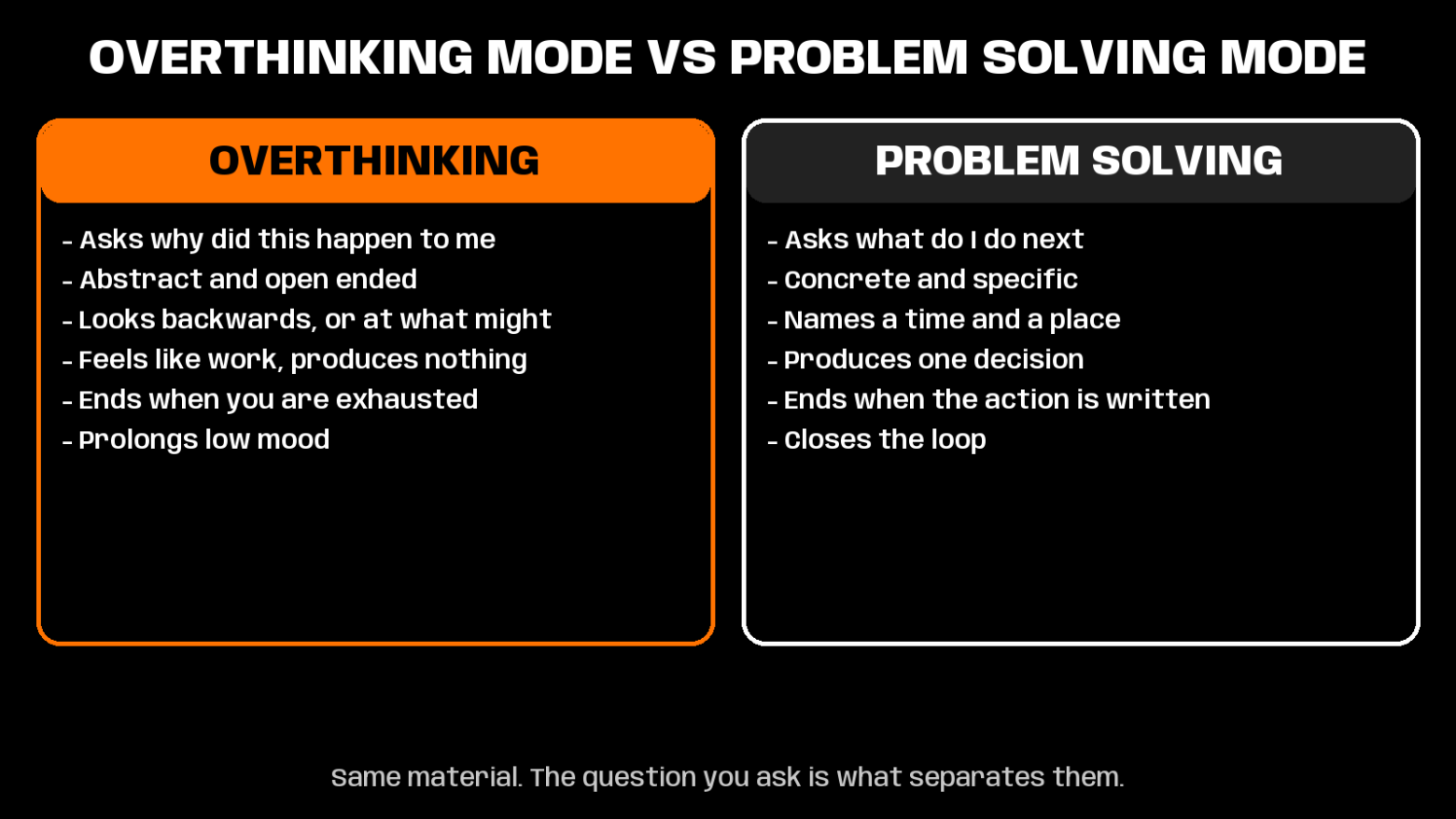
The two modes feel identical from the inside. The question you are asking is what separates them.
It also matters that you are not aiming for an empty head. As Ethan Kross puts it, we should not try to shut the inner voice up, but “make the most of its good points while keeping its bad ones in check” [8]. The target is a mind that reaches a decision, not one that never thinks.
When Overthinking Is Something to Get Checked
Speak to a GP if the thinking is constant, if it has lasted most days for more than two weeks, if it stops you sleeping night after night, or if it is affecting your work, your relationships or your appetite. The same applies if you are using alcohol to switch it off. None of the methods here is a treatment, and the honest position is that persistent repetitive negative thinking is a recognised risk factor for depression and anxiety [11]. Getting it looked at early is the same logic as getting a knee looked at early.
FAQ
Why do I overthink everything at night?
Night removes the distractions that were holding the loop off during the day, and tiredness reduces your capacity to shut it down. A fixed worry window in the early evening moves the processing earlier, so there is less unfinished material waiting when you lie down. Keeping a pad by the bed for one line notes also stops the mental rehearsing.
Is overthinking the same as anxiety?
No. Overthinking is a thinking pattern, and anxiety is a broader condition with physical and emotional symptoms. Repetitive negative thinking is common in anxiety and depression and is a known risk factor for both, but plenty of men overthink without having either. If the thinking is persistent and affecting daily life, that is the point to speak to a GP.
Does distraction actually help or is it avoidance?
Short term distraction genuinely interrupts the loop, and the original response styles research treated it as the alternative to rumination. It becomes avoidance when it is the only tool you use and the underlying problem never gets a concrete next step. Use distraction to break the spiral, then use the worry window to deal with the content.
Why do men overthink in silence?
Stigma and the expectation of self reliance are the two reasons that come up repeatedly in UK survey data, with around four in ten men reporting they have never talked to anyone about their mental health. Silence also makes it worse, because rumination erodes the support that would otherwise interrupt it. One person is enough to change that.
Can an app help with overthinking?
It can help with the repetition and the reminder, which is the part most men fail on. What it cannot do is the thinking itself, and no app substitutes for professional support if the pattern is persistent. Use one to run the worry window and the written loop consistently, not as a replacement for talking to someone.
What if none of this works?
Then it is time for professional input rather than a different self help method. Rumination focused cognitive behavioural therapy exists specifically for this pattern and has trial evidence behind it. A GP is the normal route in the UK, and going early is straightforward rather than a last resort.
Final Recommendation
Start with two methods, not seven. Run the worry window daily, and use distanced self talk in the moment before anything stressful. Add the written loop in week two and the training in week three, once the window has actually held for a fortnight. Get outside properly at the weekend, and have the one conversation as soon as you can rather than as the last resort. If the pattern is constant after a month of doing this honestly, that is information, and the next step is a GP rather than an eighth technique.
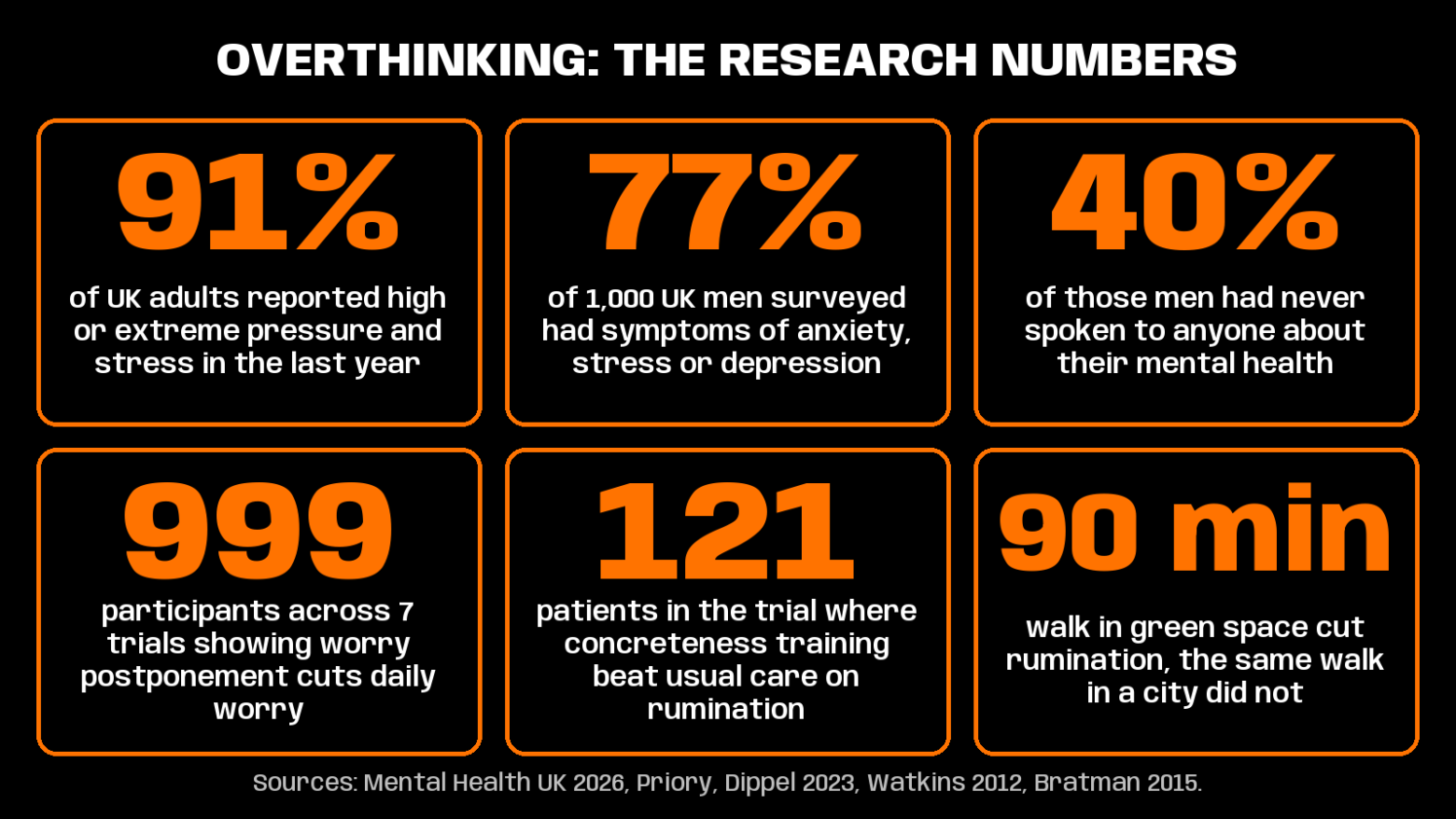
The numbers behind the loop, and behind the silence around it.
Options for Men to Take Action
Most men do not need another explanation of overthinking. They need the worry window to still happen on the Wednesday nothing is going right, and the written loop to happen at eleven at night rather than being replayed until two. Methods like these fail at the point of repetition, not at the point of understanding.
The MenTools app runs mindset work as one challenge system rather than seven separate intentions, with daily actions, chosen difficulty levels, reminders timed to the moment it matters, streaks, progress tracking and an AI coach for the weeks it slips. Men tend to keep the habits they can see a record of.
How you can do this today: set the worry window as a daily action at a fixed time, and log tonight’s before you go to bed.
Wins on cost: one subscription covers the mindset, fitness and habit sides together rather than three separate tools.
Wins on time: the structure, levels and tracking already exist, so there is nothing to design before you start.
Wins on practicality: it runs around shifts, travel and a full working week, which is where a fixed daily practice usually breaks first.
Watch-out: it is a behaviour tool, not therapy and not a diagnosis. If the thinking is persistent, it supports professional help rather than replacing it, and it will not make you have the conversation in method seven.
Broken sleep and long weeks make the loop louder, and the methods above are all harder to run on empty, so a one a day multivitamin may help cover the simple daily foundation underneath them. If confidence is part of what you are replaying, our guide to how a man becomes more confident covers the same ground from the other side, and the structural fix for a week that generates worry is in how to plan your week as a man. More built for men sits in the MenTools mindset hub. Two methods, run for a month, will do more than another year of reading about it.
Last updated: 2026-09-08 v1.0
Disclaimer: This guide is for informational purposes only and does not constitute medical or psychological advice. Speak with a qualified professional before making significant changes if you have a medical or mental health condition.
References
- [1] Mental Health UK. Burnout Report 2026, polling of 4,502 UK adults, fieldwork 3 to 5 November 2025. Link
- [2] Nolen-Hoeksema S, Morrow J, Fredrickson BL. Response styles and the duration of episodes of depressed mood. Journal of Abnormal Psychology, 1993;102(1):20-28. Link
- [3] Nolen-Hoeksema S, Wisco BE, Lyubomirsky S. Rethinking rumination. Perspectives on Psychological Science, 2008;3(5):400-424. Link
- [4] Priory. Survey of 1,000 UK men on mental health, with comment from Dr Natasha Bijlani, Consultant Psychiatrist, Priory Hospital Roehampton. Link
- [5] Dippel A, Brosschot JF, Verkuil B. Effects of worry postponement on daily worry: a meta-analysis. International Journal of Cognitive Therapy, 2023. Link
- [6] Watkins ER, Taylor RS, Byng R, Baeyens C, Read R, Pearson K, Watson L. Guided self-help concreteness training as an intervention for major depression in primary care: a Phase II randomized controlled trial. Psychological Medicine, 2012;42(7):1359-1371. Link
- [7] Kross E, Bruehlman-Senecal E, Park J, Burson A, Dougherty A, Shablack H, Bremner R, Moser J, Ayduk O. Self-talk as a regulatory mechanism: how you do it matters. Journal of Personality and Social Psychology, 2014;106(2):304-324. Link
- [8] John Templeton Foundation. Talk to yourself like a friend, a question and answer with Ethan Kross, Professor of Psychology, University of Michigan. Link
- [9] Harkin B, Webb TL, Chang BPI, Prestwich A, Conner M, Kellar I, Benn Y, Sheeran P. Does monitoring goal progress promote goal attainment? A meta-analysis of the experimental evidence. Psychological Bulletin, 2016;142(2):198-229. Link
- [10] Wang S, Lu M, Dong X, Xu Y. Does physical activity-based intervention decrease repetitive negative thinking? A systematic review. PLOS ONE, 2025. Link
- [11] Bratman GN, Hamilton JP, Hahn KS, Daily GC, Gross JJ. Nature experience reduces rumination and subgenual prefrontal cortex activation. Proceedings of the National Academy of Sciences, 2015;112(28):8567-8572. Link