No products in the cart.
Return To Shop
MEN: How Do Men Manage Their Time Better? 8 Systems That Work
Quick Answer
Men manage their time better by scheduling work rather than listing it. Put every task in your calendar, protect one deep block a day, batch shallow work into set windows, cut the switching that fragments your attention, plan tomorrow before you finish today, review the week once, pad your estimates, and decide what you are dropping.
**Jump to:** The 8 systems at a glance | FAQ | Options for men
Disclosure: MenTools publishes this article and may feature MenTools products.
How we evaluate: Each step is assessed on real-world use, evidence, cost and time, and how well it suits men. Every step including the MenTools option carries an honest limitation. Full sources are in the references below.
The 8 Systems at a Glance
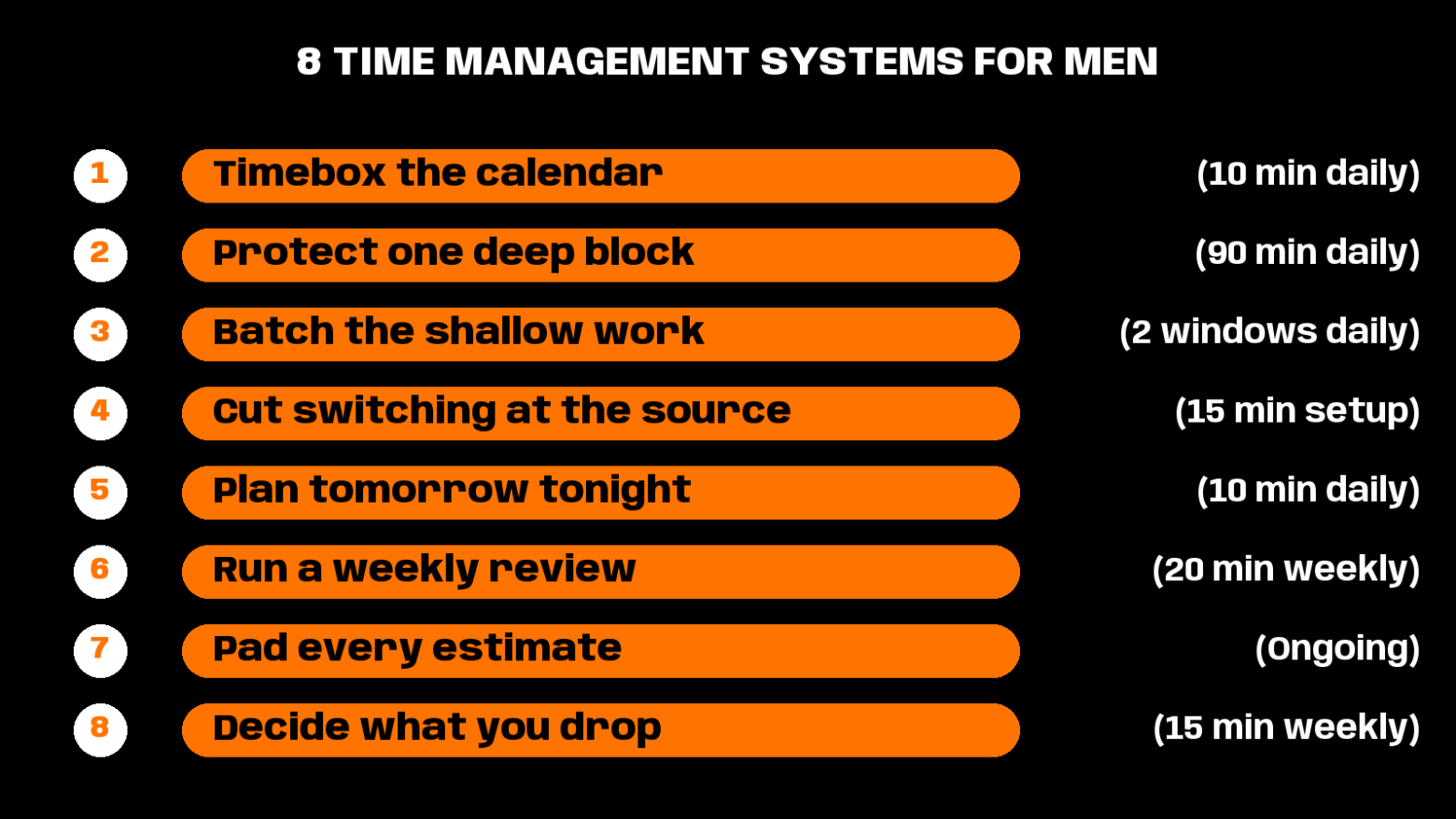
The eight systems at a glance, and what each one actually costs you in time.
| System | Best for | Watch-out | Time |
|---|---|---|---|
| Timebox the calendar | Men drowning in an endless list | Rigid days break on contact | 10 min daily |
| Protect one deep block | Work that needs real thought | Two or three hours is the ceiling | 90 min daily |
| Batch the shallow work | Constant email and messages | Slower replies annoy some people | 2 windows daily |
| Cut switching at the source | Phone-driven distraction | Needs a real conversation at work | 15 min setup |
| Plan tomorrow tonight | Chaotic mornings | Ten minutes you will want to skip | 10 min daily |
| Run a weekly review | Things falling through cracks | The first habit to get dropped | 20 min weekly |
| Pad every estimate | Chronic over-committers | Padding can hide real slowness | Ongoing |
| Decide what you drop | Men saying yes to everything | Someone will be disappointed | 15 min weekly |
How We Chose These 8 Systems
We chose systems with real evidence behind them that survive a working week with a job, a family and a commute, rather than productivity theory that only works for people who control their whole diary. Each had to pass three tests: is it supported by research, can you run it in the time stated, and does it still work on a bad Wednesday. The problem these systems solve is measurable. Research by Professor Gloria Mark at the University of California, Irvine found that average attention on any screen has fallen to about 47 seconds, with a median of 40 seconds, down from roughly 2.5 minutes in 2004 [1]. Every system below carries an honest watch-out, because none of them fixes a workload that is genuinely too big.
Why Do Most Time Management Systems Fail Men?
Most systems fail because they organise tasks without protecting attention. A longer, tidier list still leaves you switching between jobs all day, and switching is where the time actually goes. According to the American Psychological Association, research by David Meyer and colleagues found that the brief mental blocks created by shifting between tasks can cost as much as 40 percent of a person’s productive time [2].
The second reason is that lists have no relationship with the hours available. A list of fourteen items fits happily on a page and never fits in a Tuesday. Mark describes the mechanism plainly: “Every time you switch your attention, you have to reorient to that new activity, that new thing you’re paying attention to, and it takes a little bit of time” [1]. A system that does not reduce switching, and does not force your work to meet a real clock, is decoration.
1. Timebox Your Calendar Instead of Keeping a List
Move every task off your list and onto a specific slot in your calendar. This one change forces your work to meet the hours you actually have, and it is the highest-rated technique in the field.
What to do: Each morning, take your list and give every item a start time, an end time and a place in the diary. Anything that does not fit does not happen today, and you decide that now rather than at 6pm.
Best for: Men with a list that never empties and days that disappear without a clear result.
Why it works: Writing in Harvard Business Review, Marc Zao-Sanders reported that in a review of 100 productivity techniques, timeboxing, meaning migrating your to-do list into your calendar, ranked as the most useful of all of them [3]. It works because a calendar has a fixed size and a list does not.
Watch-out: A fully packed calendar shatters the first time a real emergency lands, and men who plan every minute often abandon the whole system by Wednesday. Leave 20 to 30 percent of the day unbooked so the plan bends instead of breaking.
2. Protect One Deep Block Every Day
Ring-fence 90 minutes of uninterrupted work on the thing that matters most, and defend it like a meeting with your boss. One protected block beats a whole day of fragmented availability.
What to do: Pick the same window each day, ideally early. Close email and chat, put the phone in another room, and work on one task only. Tell colleagues in advance that you are unavailable in that window.
Best for: Anyone whose real output needs thinking, writing, planning, building or studying.
Why it works: Cal Newport, the computer science professor who popularised deep work, writes: “A 40 hour time-blocked work week, I estimate, produces the same amount of output as a 60+ hour work week pursued without structure” [4]. Uninterrupted blocks are where that difference comes from.
Watch-out: Two to three hours a day of genuine deep work is the realistic ceiling for most men, so trying for six will fail and make you feel inadequate. It also needs a conversation at work if your role is reactive by design.
3. Batch the Shallow Work Into Fixed Windows
Group email, messages, admin and calls into two or three set windows instead of handling them as they arrive. Shallow work is unavoidable, so the goal is to contain it rather than eliminate it.
What to do: Choose two windows, for example 11am and 4pm, and process email, messages and admin only then. Close the tabs and mute notifications outside those windows.
Best for: Men whose day is fragmented by a steady drip of email and messages.
Why it works: Batching directly attacks the switching cost. With average attention on a screen now around 47 seconds [1], every unbatched notification is an invitation to a switch, and those switches can cost up to 40 percent of productive time [2]. Handling twenty messages in one window costs one reorientation, not twenty.
Watch-out: Slower replies genuinely irritate some managers and clients, so this needs to be agreed rather than imposed. Keep one genuinely urgent channel open, usually the phone, so nothing critical waits four hours.
4. Cut Switching at the Source
Turn off the interruptions rather than resisting them. Willpower is a poor defence against a device engineered to interrupt you, and removing the trigger costs about fifteen minutes once.
What to do: Turn off all non-human notifications on your phone and laptop, remove the badge counts, log out of social apps on your work machine, and keep the phone out of arm’s reach during deep blocks.
Best for: Men who feel busy all day but cannot point at what they finished.
Why it works: The cost of interruption is not just lost minutes, it is the state you come back in. Mark’s work on interrupted work found that people who have been interrupted report a greater workload, more stress and frustration, more time pressure, and having to exert more effort [5]. Mark also notes that the faster the switching happens, the more measured stress rises [1].
Watch-out: This is the step most men skip because it feels trivial, and it is also the one that quietly does the most. It can create real friction at work, so agree an expected response time with your team instead of going silent.
5. Plan Tomorrow Before You Finish Today
Spend the last ten minutes of the working day deciding tomorrow’s three priorities and where they sit in the diary. You get a clean start in the morning and a quieter head in the evening.
What to do: Before you shut the laptop, write tomorrow’s three most important tasks, put them into calendar slots, and note the first action of the first task so there is nothing to decide at 8am.
Best for: Men whose mornings vanish into email and who never reach the important work.
Why it works: Planning unfinished work reduces its mental drag. In studies by E. J. Masicampo and Roy Baumeister in the Journal of Personality and Social Psychology, unfinished goals caused intrusive thoughts and worse performance on unrelated tasks, and making a specific plan for those goals removed the interference [6]. The plan is what lets you stop carrying it.
Watch-out: Ten minutes at the end of a tiring day is easy to skip, and skipping it a few times kills the habit. Attach it to a fixed cue, such as closing your laptop, rather than relying on remembering.
6. Run a Twenty Minute Weekly Review
Once a week, empty your head, check every commitment, and lay out the week ahead. This is the maintenance step that stops a good daily system silently degrading.
What to do: Pick a fixed slot, Friday afternoon or Sunday evening. Write down everything open, clear your inbox and notes, look at the next seven days, and place your priorities and habits into real slots.
Best for: Men with several projects, or with things that keep falling through the cracks.
Why it works: The point is to get commitments out of your head and into a system you trust. David Allen, who created the Getting Things Done method, puts the principle as “Your mind is for having ideas, not holding them” [7]. A weekly pass is what keeps that external system accurate enough to trust.
Watch-out: The weekly review is the first thing dropped in a busy week and the hardest to restart. Keep it to twenty minutes and a short fixed checklist, because a 90 minute ritual will not survive September.
7. Add Half Again to Every Estimate
Take your honest estimate for a task and increase it by roughly 50 percent. Men do not run out of time because they are lazy, they run out because they systematically underestimate how long work takes.
What to do: When you block time, add half again to your first estimate. Track three or four tasks against your prediction for a fortnight so you learn your personal error rate.
Best for: Chronic over-committers, and anyone whose timeboxed calendar keeps overrunning.
Why it works: In the study that named the planning fallacy, Roger Buehler, Dale Griffin and Michael Ross asked psychology students to predict when they would finish their thesis. They predicted 33.9 days on average and actually took 55.5 days, about 64 percent longer, and only around 30 percent finished by the date they had said they were 99 percent certain about [8].
Watch-out: Padding can quietly become an excuse for slow work, and inflated estimates for everything make you look unresponsive. Pad the estimate, keep the deadline, and use the buffer for overruns rather than announcing a later date.
8. Decide What You Are Not Doing
Choose, on purpose, what you are dropping this week. Time management without subtraction is just a tidier version of doing too much.
What to do: Each week, name two things you are deliberately not doing and one commitment you are declining or renegotiating. Write them down so the decision is real rather than a vague hope.
Best for: Men who say yes automatically and are stretched across work, family and their own goals.
Why it works: Specific advance decisions hold up better than general intentions. The meta-analysis by Peter Gollwitzer and Paschal Sheeran, covering 94 independent tests, found that spelling out the when, where and how of acting in advance had a medium-to-large effect on goal attainment (d = 0.65) [9]. A written “I am not doing X this week” is that same mechanism applied to saying no.
Watch-out: Somebody will be disappointed, and that is the actual cost of this step rather than a side effect. Drop things explicitly and tell the people affected, because quietly dropping commitments damages trust far more than declining them.
What Is the Best Time Management System for Men?
For most men it is timeboxing plus one protected deep block, run with a short weekly review. Timeboxing forces your work to meet the real hours in the day, the deep block is where meaningful output actually happens, and the weekly review keeps the system honest. Start with those three and add batching, notification cuts and estimate padding once they hold. If you want the specific tools to run this, our roundup of the top productivity and time management tools for men covers what each one is good for.
FAQ
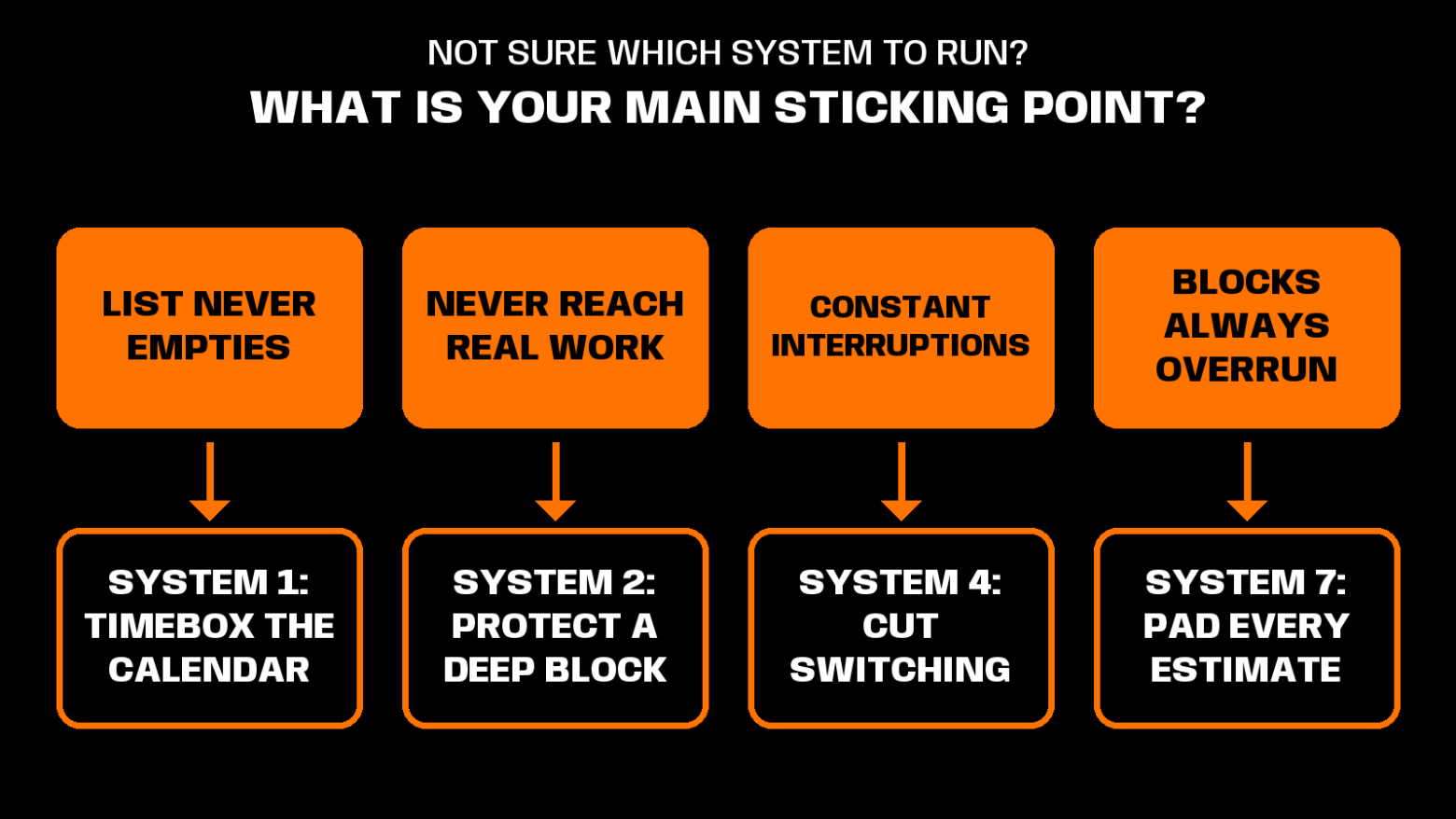
Pick your system by the sticking point you actually have, not the one that sounds best.
How many hours of deep work can a man realistically do in a day?
Around two to three hours of genuinely focused work is the practical ceiling for most people, and one protected block of 90 minutes is a strong start. Beyond that, quality drops sharply. Plan the rest of the day for shallow work, meetings and admin rather than pretending you will focus for eight hours.
Is a to-do list still worth keeping if I use a calendar?
Yes, as a holding place. Keep one list to capture everything so nothing is stored in your head, then move items into calendar slots to decide when they happen. The list answers what exists and the calendar answers when it gets done. Using the list alone is where most men come unstuck.
How do I manage my time with shift work or unpredictable hours?
Anchor habits to events rather than clock times, and timebox the day you actually have rather than an ideal one. Decide your one priority for each shift, protect a shorter block of 45 minutes, and run the weekly review on a fixed day off. Consistency of sequence beats consistency of hour.
Do time-tracking and blocking apps actually help?
They help with cueing and visibility, which are the two things men lose first. They do not decide your priorities or make you close the laptop. An app earns its place if it prompts you at the right moment and shows progress you care about. If checking the app becomes the task, drop it.
What do I do when the day falls apart by 10am?
Rebuild the remaining hours rather than abandoning the plan. Take what is left, pick the single most important task, block the next available window for it, and move everything else to a specific later slot. Half a rescued day is a normal outcome, not a failed system.
How long before better time management shows up in results?
Expect a clearer week almost immediately and a real difference in output within two to three weeks, as the deep blocks accumulate. The systems that take longest to pay off are the weekly review and estimate padding, because both need a few cycles of data before you trust them.
Final Recommendation
Start with timeboxing, one protected 90 minute block, and a twenty minute weekly review. Add batching and notification cuts in week two, then estimate padding and deliberate subtraction once the first three are steady. Managing time better is mostly about reducing switching and making your work meet a real clock, so pick the two systems that hit your biggest sticking point and run them for a fortnight before adding anything else.
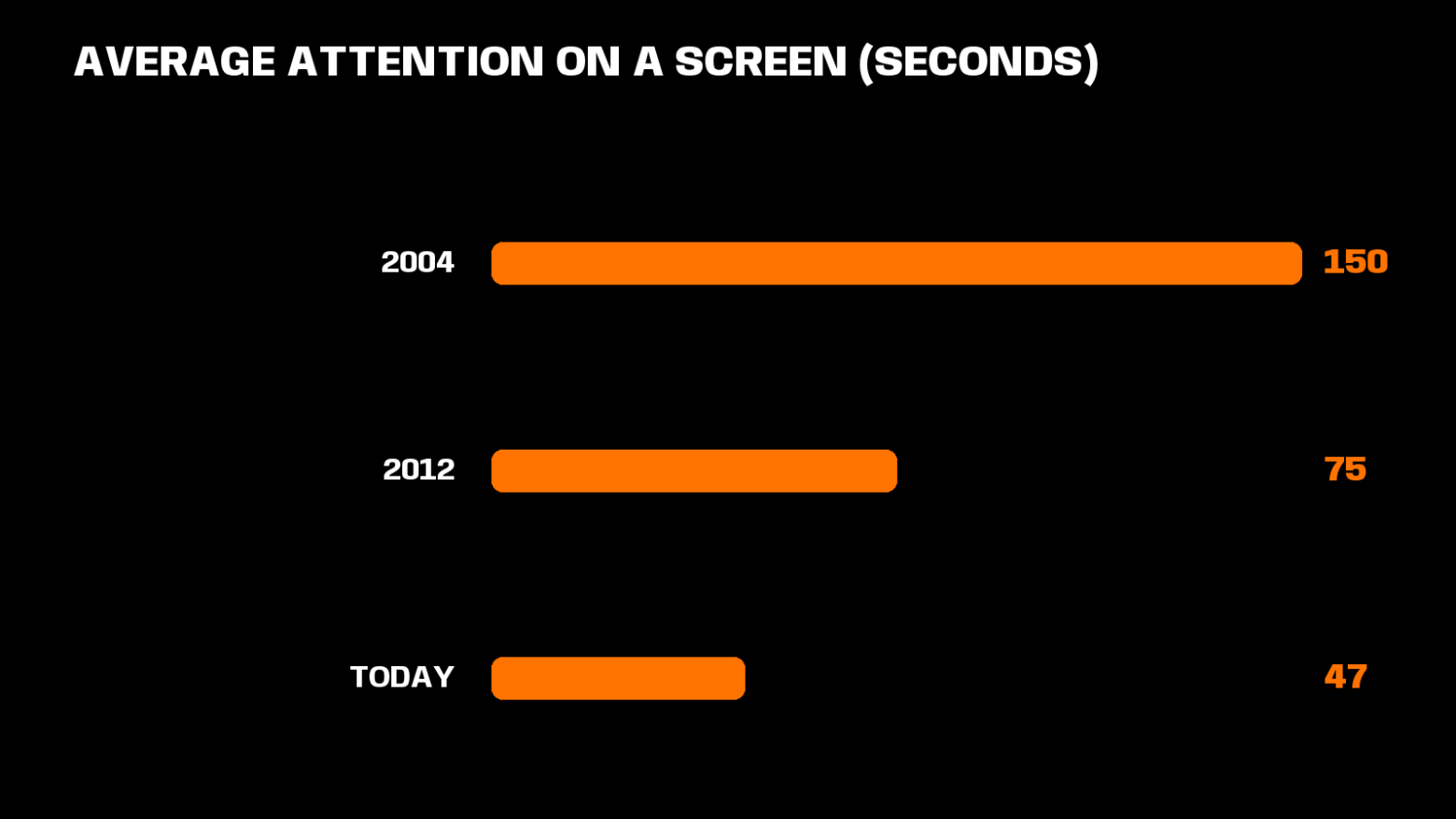
Why switching is the real problem: average attention on a screen has fallen from 2.5 minutes to 47 seconds.
Options for Men to Take Action
Most men do not need another list app. They need the work to land in real hours, the phone to stop interrupting them, and something showing whether the deep block actually happened four days out of five. Notes in three places and a diary nobody protects is how a good week quietly turns into a reactive one.
The MenTools app is built to run habits like these as one system rather than eight separate resolutions, with daily actions, chosen difficulty levels, reminders at the moment they matter, streaks and progress tracking, and an AI coach for the days the plan falls apart by ten. Men tend to keep the habits they can see progress on.
How you can do this today: set one daily action for your deep block, put tomorrow’s block in your calendar now, and log day one tonight.
Wins on cost: one subscription replaces a habit tracker, a reminders app and a shelf of productivity books.
Wins on time: the structure, levels and tracking already exist, so there is no system to design before you start.
Wins on practicality: it works around shift patterns, travel and school runs, which is exactly where rigid desk-bound systems fall over.
Watch-out: an app will not decide your priorities or close your laptop for you, and it cannot fix a workload that is genuinely too large. If you already timebox reliably in a calendar you trust, this adds tracking rather than a transformation.
Better time management holds far better when the underlying habit of showing up is there, which is why it is worth reading our guide to self-discipline for men alongside this one. If you are rebuilding after a broken summer, start with the September routine reset. For more tools built for men, see the MenTools time management hub. Two systems run properly for a month will do more for your week than eight read about and never scheduled.
Last updated: 2026-08-12 v1.0
Disclaimer: This guide is for informational purposes only and does not constitute medical or psychological advice. Speak with a qualified professional before making significant changes if you have a medical or mental health condition.
References
- [1] Mark G. Why our attention spans are shrinking. Speaking of Psychology, American Psychological Association, 2023. Link
- [2] American Psychological Association. Multitasking: switching costs (Rubinstein, Meyer and Evans, Journal of Experimental Psychology: Human Perception and Performance, 2001). Link
- [3] Zao-Sanders M. How timeboxing works and why it will make you more productive. Harvard Business Review, December 2018. Link
- [4] Newport C. Deep habits: the importance of planning every minute of your work day. calnewport.com. Link
- [5] Mark G, Gudith D, Klocke U. The cost of interrupted work: more speed and stress. CHI 2008, reported in Greater Good Magazine, University of California, Berkeley. Link
- [6] Masicampo EJ, Baumeister RF. Consider it done! Plan making can eliminate the cognitive effects of unfulfilled goals. Journal of Personality and Social Psychology, 2011. Link
- [7] Allen D. Getting Things Done, official method overview. Getting Things Done. Link
- [8] Buehler R, Griffin D, Ross M. Exploring the planning fallacy: why people underestimate their task completion times. Journal of Personality and Social Psychology, 1994. Link
- [9] Gollwitzer PM, Sheeran P. Implementation intentions and goal achievement: a meta-analysis of effects and processes. Advances in Experimental Social Psychology, 2006. Link