No products in the cart.
Return To Shop
MEN: Time Blocking vs To-Do Lists: What Works Better for Men?
Quick Answer
Time blocking wins when your problem is not enough hours or not enough focus. A to-do list wins when your days are unpredictable and you need to capture everything. For most men the honest answer is both: keep one list so nothing is lost, then block the two or three things that genuinely matter into the calendar.
**Jump to:** Both methods at a glance | FAQ | Options for men
Disclosure: MenTools publishes this article and may feature MenTools products.
How we evaluate: Each option is assessed on real-world use, evidence, cost and time, and how well it suits men. Every option including the MenTools option carries an honest limitation. Full sources are in the references below.
Time Blocking vs To-Do Lists at a Glance
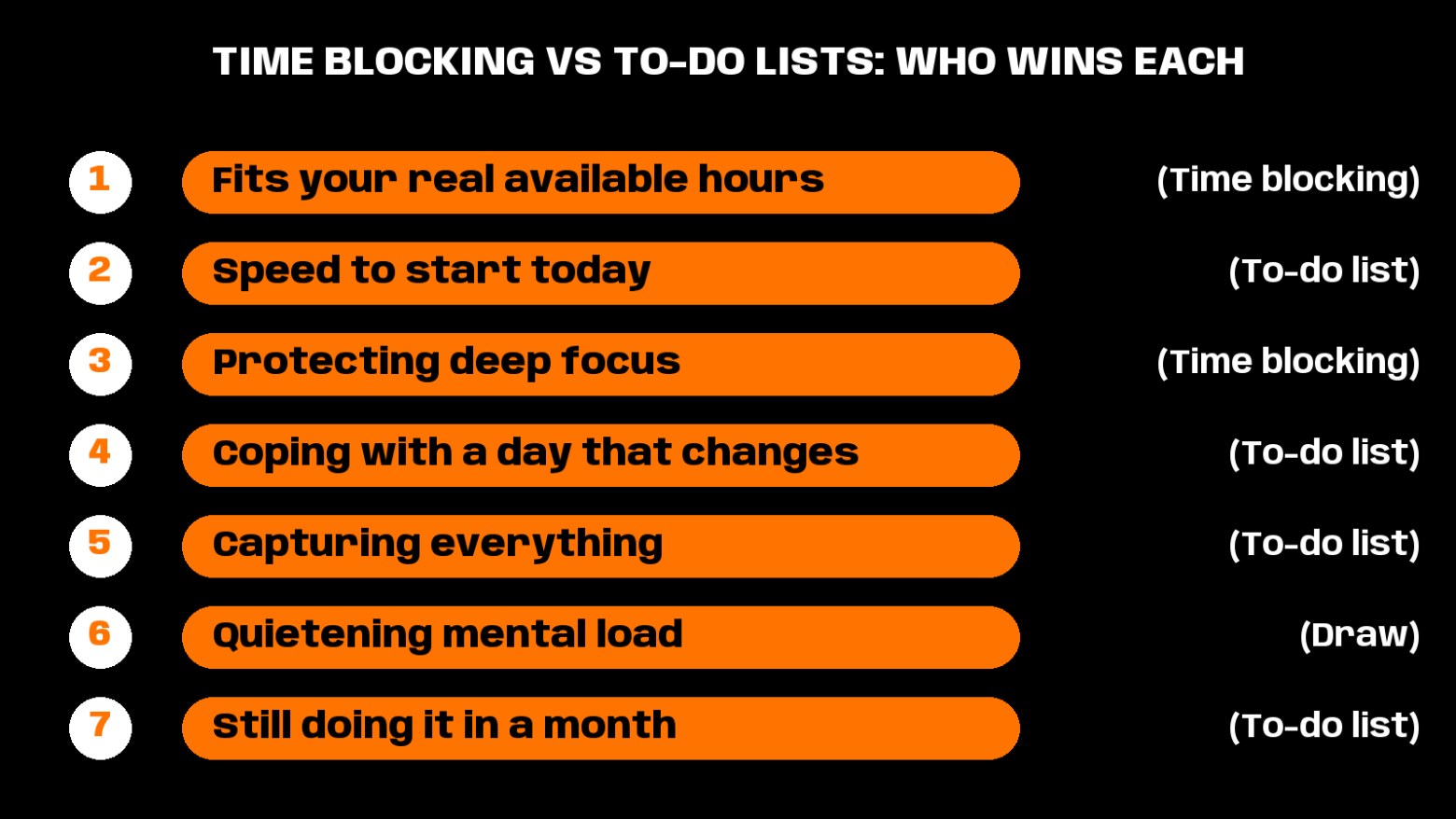
Seven criteria, and which method actually wins each one.
| Option | Best for | Standout | Watch-out | Time |
|---|---|---|---|---|
| Time blocking | Men short on hours or focus | Forces the work to meet a real clock | Breaks on an unpredictable day | 10 to 15 min daily |
| To-do list | Men with reactive, changing days | Captures everything with no friction | No relationship with your real hours | 2 to 5 min daily |
How We Chose the Criteria
We compared the two methods on the seven things that decide whether a system survives a real working week, rather than which one looks more disciplined. Each criterion had to be something a man can feel within a fortnight: does it fit my hours, can I start it today, does it protect focus, does it cope when the day changes, does it catch everything, does it quieten my head, and will I still be doing it in a month. Both options carry honest limitations below, because neither method fixes a workload that is genuinely too big for the hours available.
1. Time Blocking: What It Is and Who It Suits
Time blocking means giving every task a specific start and end time in your calendar, so your work has to fit the hours you actually have. It suits men whose real constraint is available time or protected focus rather than forgetting things.
What it is: You take your tasks and place each one into a named slot in the diary, for example 7am to 8.30am on one project, 11am to 11.30am on email. Anything that does not fit is consciously deferred.
Best for: Men with a list that never empties, and anyone whose important work keeps losing to whatever is loudest.
Standout: Writing in Harvard Business Review, Marc Zao-Sanders reported that across a review of 100 productivity techniques, timeboxing, meaning moving your to-do list into your calendar, ranked as the most useful of them all [1]. Cal Newport, who popularised deep work, goes further: “A 40 hour time-blocked work week, I estimate, produces the same amount of output as a 60+ hour work week pursued without structure” [2].
Watch-out: A fully booked calendar breaks the first time something urgent lands, and men who plan every minute usually abandon the method within a fortnight. It also exposes how little discretionary time you have, which is useful information and uncomfortable reading.
2. To-Do Lists: What They Are and Who They Suit
A to-do list is a single running record of everything you have committed to, with no times attached. It suits men whose days change hour to hour and whose main risk is dropping something rather than running out of hours.
What it is: One trusted place, on paper or in an app, where every task and commitment gets written down as soon as it appears, then ticked off or carried forward.
Best for: Reactive roles, shift work, trades, parents of young children, and anyone juggling several unrelated projects.
Standout: Capture has a measurable cognitive benefit. In studies by E. J. Masicampo and Roy Baumeister in the Journal of Personality and Social Psychology, unfinished goals produced intrusive thoughts and worse performance on unrelated tasks, and making a specific plan for those goals removed the interference [3]. David Allen, who created the Getting Things Done method, sums up the principle as “Your mind is for having ideas, not holding them” [4].
Watch-out: A list has no relationship with the hours in your day, so it grows indefinitely and quietly becomes a record of everything you are behind on. Fourteen items fit comfortably on a page and never fit into a Tuesday.
Which Method Fits Your Real Hours Better?
Time blocking wins this decisively, because a calendar has a fixed size and a list does not. When you place a task into a slot, you are forced to confront how long it takes and what it displaces, which is the decision most men avoid until 6pm. A list lets you add a fifteenth item at no apparent cost.
This is also where the main failure of blocking appears, and it is a predictable one. In the study that named the planning fallacy, Roger Buehler, Dale Griffin and Michael Ross asked psychology students to predict when they would finish their thesis. Their best-case estimate averaged 27.4 days, their realistic prediction 33.9 days and their worst-case estimate 48.6 days. They actually took 55.5 days, which is worse than their own worst case [5]. Blocks built on optimistic estimates overrun, so add roughly half again to every estimate before it goes in the diary.
| Criteria | Time blocking | To-do list | Better for this |
|---|---|---|---|
| Fits your real available hours | Forces work into fixed slots | Grows with no limit | Time blocking |
| Speed to start today | Needs 10 to 15 min planning | Write it and go | To-do list |
| Protecting deep focus | Ring-fences uninterrupted work | No protection at all | Time blocking |
| Coping with a day that changes | Needs rebuilding when disrupted | Absorbs change easily | To-do list |
| Capturing everything | Poor, only holds what fits | Excellent, catches it all | To-do list |
| Quietening mental load | Strong once planned | Strong once planned | Draw |
| Still doing it in a month | Higher friction to maintain | Very low friction | To-do list |
Which Protects Deep Focus Better?
Time blocking, and by a wide margin, because a list offers no defence against interruption at all. A block is a decision made in advance about what you will refuse for the next 90 minutes, which is the only thing that reliably creates uninterrupted work.
The scale of the problem is measurable. Research by Professor Gloria Mark at the University of California, Irvine found average attention on any screen has fallen to about 47 seconds, with a median of 40 seconds, down from around 2.5 minutes in 2004 [6]. The American Psychological Association reports that research by David Meyer and colleagues found the brief mental blocks created by shifting between tasks can cost as much as 40 percent of a person’s productive time [7]. A list does nothing about either number. A protected block does.
Which Survives a Day That Falls Apart?
The to-do list, comfortably. When a morning is destroyed by something urgent, a list simply carries forward, whereas a timeboxed calendar becomes a row of appointments you missed, which is demoralising and often the point men quit.
The fix is not to abandon blocking but to block less of the day. Leave 20 to 30 percent of your hours unbooked, block only the two or three things that genuinely matter, and let the list hold the rest. That way a bad Wednesday costs you one rebuilt block rather than an entire failed system.
Why Does a Slot Beat a Line on a List?
Because a slot names when, where and how, and a line names only what. That difference is one of the better-evidenced effects in behaviour-change research. The meta-analysis by Peter Gollwitzer and Paschal Sheeran, covering 94 independent tests and more than 8,000 participants, found that forming an implementation intention, spelling out the when, where and how of acting in advance, produced a medium-to-large effect on goal attainment (d = 0.65) [8].
An item that reads “sort the tax return” is a wish. “Saturday 9am to 10.30am, kitchen table, tax return” is a plan. This is the strongest single argument for moving your most important two or three items out of the list and into the calendar, and for leaving the other twelve where they are.
Pick Time Blocking If, Pick a List If
Pick time blocking if you have enough time on paper but never seem to get to the important work, if your focus is repeatedly broken, or if you are working towards something with a real deadline. Pick a to-do list if your day is genuinely unpredictable, if you are dropping commitments, or if you have tried blocking before and quit within two weeks.
Run both if you are like most men, which means one list as the capture layer and the calendar as the commitment layer. Write everything down so none of it lives in your head, then each morning promote two or three items into real slots. For the wider system this sits inside, see our guide to how men manage their time better.
FAQ
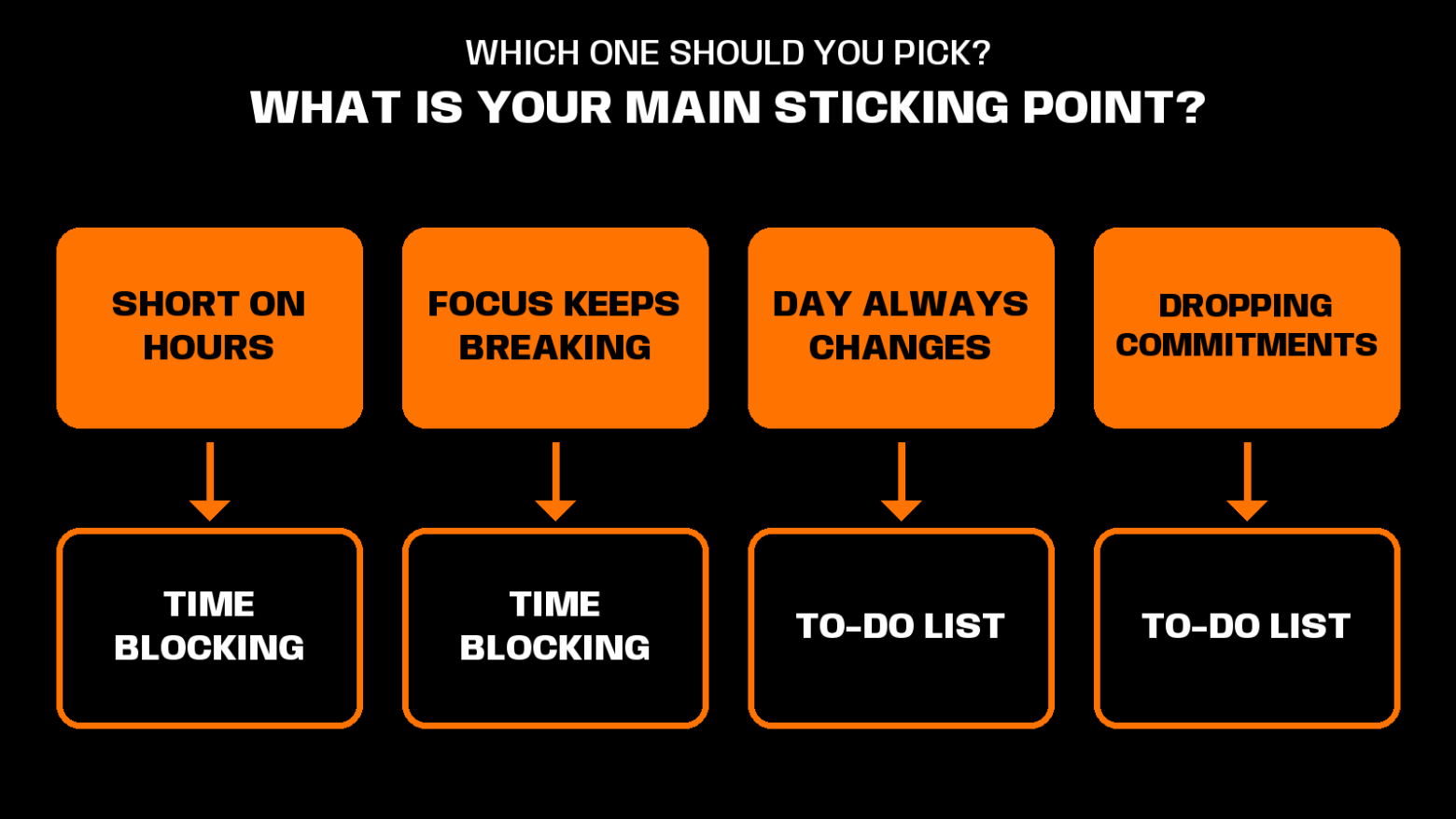
Match the method to the sticking point you actually have, not the one that sounds most disciplined.
Is time blocking realistic if my job is reactive?
Partly. Block one protected window early in the day, usually 45 to 90 minutes, and leave the rest of the diary open for whatever lands. Trying to block a reactive day hour by hour fails quickly. One defended block plus a running list is the version that survives in reactive roles.
How long should each time block be?
Between 45 and 90 minutes for focused work, and 20 to 30 minutes for admin batches. Shorter than 45 minutes rarely allows real depth, and beyond about 90 minutes attention drops for most people. Two to three hours of genuine deep work in a day is a realistic ceiling.
What do I do with a task that keeps getting rescheduled?
Treat three moves as a decision point. Either it is bigger than the block you keep giving it, in which case break it into a smaller first step, or it is not actually a priority, in which case drop it deliberately and tell whoever is waiting. Endless carrying forward is the real time cost.
Is a paper list better than an app?
Paper is better for thinking and for a short daily shortlist, because writing forces you to choose. An app is better for capture, search and reminders, especially across work and home. Many men end up with an app as the master list and paper for the day, which is a reasonable split rather than a compromise.
Does time blocking work for gym and family time too?
Yes, and often better than for work, because those blocks are less likely to be interrupted by someone else’s urgency. Blocking training and protected family time first, then fitting work around them, is usually more effective than hoping both survive whatever is left at the end of the day.
Why does my to-do list never get finished?
Because a list has no size limit and your day does. Lists collect faster than you can clear them, so completion is not a realistic measure. Judge a list on whether nothing important is lost, and judge your calendar on whether the two or three things that mattered actually happened.
Final Recommendation
Keep one list so nothing lives in your head, then block your two or three most important tasks into real slots each day and add roughly half again to every estimate. Block 20 to 30 percent less of the day than you think you can, protect one focus window, and let the list absorb everything else. That combination beats either method used alone, and it is the version that is still running in a month.
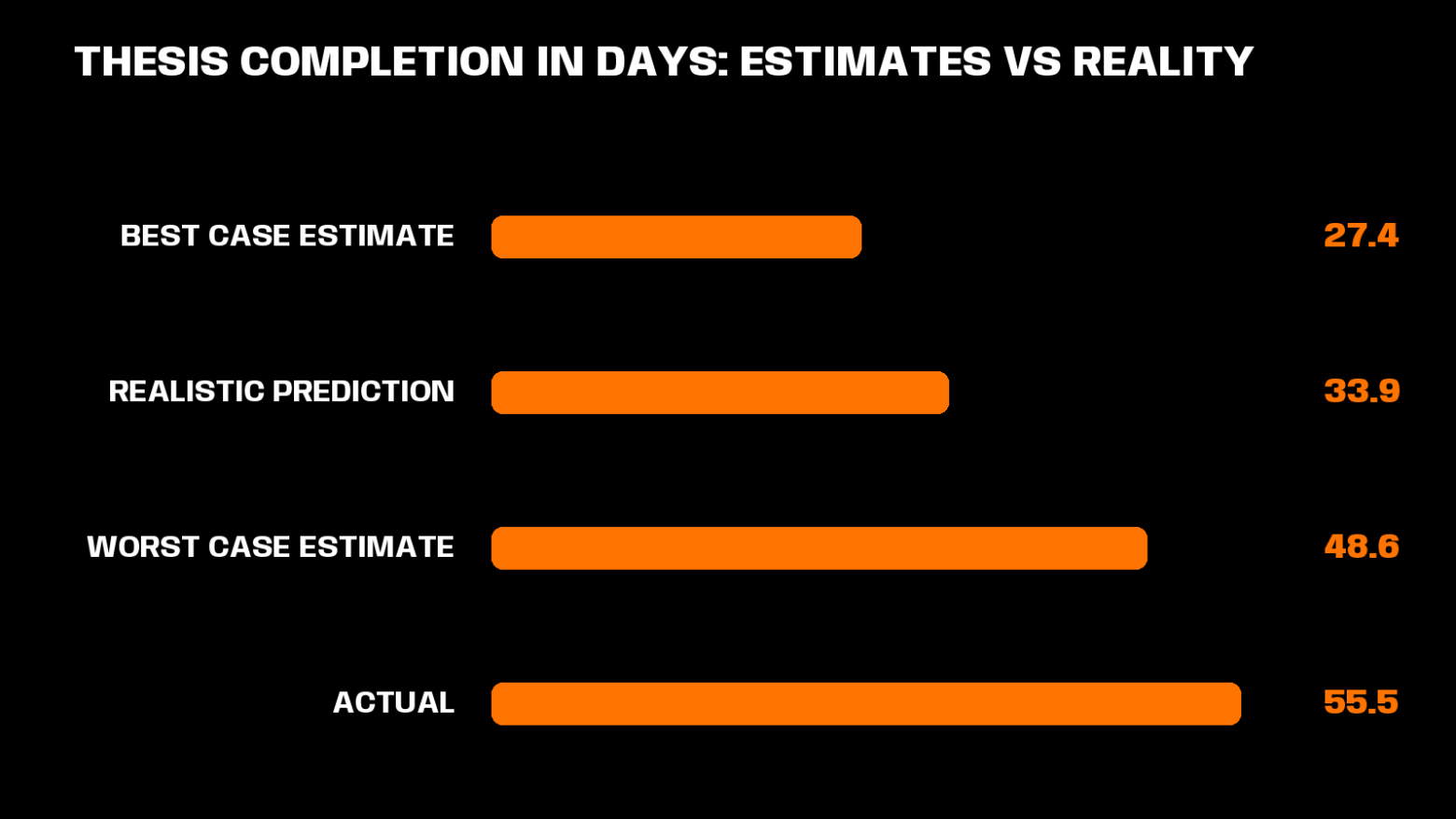
Why blocks overrun: actual completion came in at 55.5 days, worse than the students own worst-case estimate.
Options for Men to Take Action
Most men do not lose time because they picked the wrong method. They lose it because the list lives in three places, the calendar has nothing protected in it, and there is nothing showing whether the block they promised themselves actually happened on Tuesday. Choosing between two systems matters far less than running one of them consistently for a month.
The MenTools app is built to run this as one system rather than a stack of separate tools, with daily actions, chosen difficulty levels, reminders at the moment they matter, streaks and progress tracking, and an AI coach for the days the plan collapses before ten. Men tend to keep the habits they can see progress on.
How you can do this today: set your protected focus block as a daily action, put tomorrow’s block in the calendar now, and log day one tonight.
Wins on cost: one subscription replaces a habit tracker, a reminders app and a shelf of productivity books.
Wins on time: the structure, levels and tracking are already built, so there is nothing to design before you start.
Wins on practicality: it works around shift patterns, travel and school runs, which is where rigid calendar-only systems tend to fall over.
Watch-out: it is a tracking and consistency tool, not a calendar or a task manager, so it complements your diary rather than replacing it. If you already block reliably and keep one trusted list, this adds accountability rather than a transformation.
Either method holds far better when the underlying habit of showing up is already there, which is why our guide to self-discipline for men is worth reading alongside this one. If you want the specific tools, our roundup of the top productivity and time management tools for men covers what each is good for. For more built for men, see the MenTools time management hub. One method run properly for a month will teach you more than another fortnight spent choosing.
Last updated: 2026-08-13 v1.0
Disclaimer: This guide is for informational purposes only and does not constitute medical or psychological advice. Speak with a qualified professional before making significant changes if you have a medical or mental health condition.
References
- [1] Zao-Sanders M. How timeboxing works and why it will make you more productive. Harvard Business Review, December 2018. Link
- [2] Newport C. Deep habits: the importance of planning every minute of your work day. calnewport.com. Link
- [3] Masicampo EJ, Baumeister RF. Consider it done! Plan making can eliminate the cognitive effects of unfulfilled goals. Journal of Personality and Social Psychology, 2011. Link
- [4] Allen D. Getting Things Done, official method overview. Getting Things Done. Link
- [5] Buehler R, Griffin D, Ross M. Exploring the planning fallacy: why people underestimate their task completion times. Journal of Personality and Social Psychology, 1994. Link
- [6] Mark G. Why our attention spans are shrinking. Speaking of Psychology, American Psychological Association, 2023. Link
- [7] American Psychological Association. Multitasking: switching costs (Rubinstein, Meyer and Evans, Journal of Experimental Psychology: Human Perception and Performance, 2001). Link
- [8] Gollwitzer PM, Sheeran P. Implementation intentions and goal achievement: a meta-analysis of effects and processes. Advances in Experimental Social Psychology, 2006. Link