
MEN: How to Get Back Into Routine After Summer: A 7-Step September Reset
Quick Answer
To get back into routine after summer, pick a restart date, fix your wake time first, then rebuild one anchor habit at a time. Write down when, where and how you will do it, keep the first two weeks deliberately small, reset your week every Sunday, and decide in advance what happens on the days you miss.
**Jump to:** The 7 steps at a glance | FAQ | Options for men
Disclosure: MenTools publishes this article and may feature MenTools products.
How we evaluate: Each step is assessed on real-world use, evidence, cost and time, and how well it suits men. Every step including the MenTools option carries an honest limitation. Full sources are in the references below.
The 7-Step Reset at a Glance
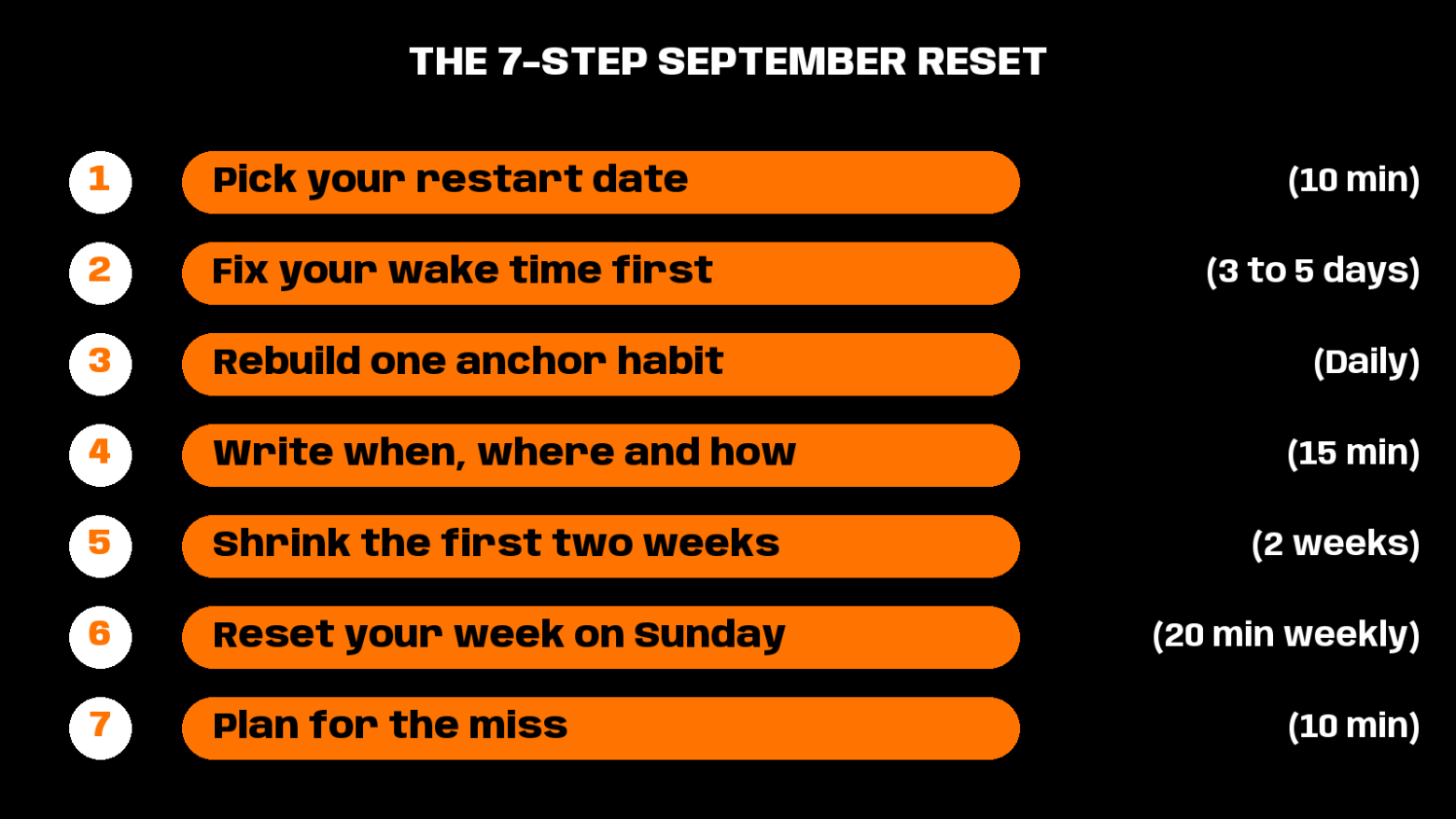
The seven-step September reset at a glance, and the time each step actually takes.
| Step | Best for | Watch-out | Time |
|---|---|---|---|
| Pick a restart date | Men who keep saying next week | A date alone changes nothing | 10 min |
| Fix your wake time first | Late summer nights and lie-ins | Takes several days, not one | 3 to 5 days |
| Rebuild one anchor habit | Anyone rebuilding from scratch | Feels too slow at first | Daily |
| Write when, where and how | Vague good intentions | Needs a real plan, not a wish | 15 min |
| Shrink the first two weeks | Men who always overreach | Your ego will resist it | 2 weeks |
| Reset your week on Sunday | Busy or unpredictable weeks | Useless if you skip it | 20 min weekly |
| Plan for the miss | Perfectionists and all-or-nothing men | Not a licence to drift | 10 min |
How We Chose These 7 Steps
We picked steps that are backed by real behaviour-change research, that work in a normal working week, and that address the specific reason routines collapse over summer rather than general motivation advice. Each step had to pass three tests: is there evidence behind it, can a working man do it in the time stated, and does it survive a bad week. The starting point matters, because habits are far more automatic than most men assume. Research by Professor Wendy Wood at the University of Southern California found that around 43 percent of what people do each day is repeated in the same context, usually while thinking about something else [1]. Summer breaks that context, which is exactly why September feels like starting over. Every step below carries an honest watch-out.
Why Do Routines Fall Apart Over Summer?
Routines fall apart over summer because habits are tied to context, not willpower. Holidays, lighter evenings, school breaks and a different work rhythm remove the cues that used to trigger the behaviour, so the habit stops firing. As Wood puts it: “We are all dependent on the context in which we live. We form habits based on what’s easy and rewarding, what’s easy for us to do repeatedly and what’s rewarding in our context in the places where we live” [1].
That same mechanism is why September is a genuine opportunity rather than a punishment. Research led by Professor Bas Verplanken at the University of Bath describes a habit discontinuity effect: when a change of context disrupts an established habit, a window opens in which behaviour is consciously reconsidered instead of running on autopilot [2]. Your summer already broke the old pattern. The question is what you install in the gap before a new default sets itself.
1. Pick Your Restart Date and Treat It as a Line
Choose one specific date to restart, write it down, and treat everything before it as a closed chapter. A date gives your brain a clean break from the version of you that skipped six weeks of training, and there is good evidence that these markers genuinely change behaviour.
What to do: Pick a Monday or the 1st of the month in the next fortnight. Put it in your calendar as a real appointment with a start time, not a vague intention.
Best for: Men who have been saying “I’ll start properly next week” since July.
Why it works: Research by Hengchen Dai, Katherine Milkman and Jason Riis, published in Management Science, found that gym visits, diet-related searches and commitments to pursue goals all rise after temporal landmarks such as the start of a new week, month or year, a birthday, or a holiday [3]. The landmark separates your past slips from the period you are now in, which makes aspirational action feel more available.
Watch-out: The date is the easy part and does nothing on its own. Men who pick a date without doing steps two to seven simply get a fresh sense of failure on day four, so treat the date as the container for the plan, not the plan itself.
2. Fix Your Wake Time Before Anything Else
Set one consistent wake time and get bright light into your eyes soon after. Almost every other habit hangs off when you get up, so fixing your wake time first is the highest-leverage move in the whole reset.
What to do: Pick a wake time you can hold on a Tuesday and a Saturday. Get outside or by a window within 30 minutes of waking, and shift your bedtime earlier in 15 to 20 minute steps rather than all at once.
Best for: Men whose sleep drifted late over summer holidays and light evenings.
Why it works: Clinical work on circadian timing by Stephanie Crowley and Charmane Eastman at Rush University found that morning bright light combined with a gradually shifted sleep schedule reliably advances the body clock, and that a 30 minute morning light exposure was as effective as spreading a longer exposure across the morning [4]. Gradual beats abrupt, and morning light does the work.
Watch-out: This takes several days, not one, and a single early alarm after a late night just makes you tired and irritable. Expect three to five days of adjustment, and do not stack a demanding new training plan on top during that week.
3. Rebuild One Anchor Habit, Not Seven
Choose a single habit and attach it to something you already do every day without thinking. One habit rebuilt properly restores momentum faster than five half-kept ones, because it re-establishes the cue-and-context link that summer broke.
What to do: Pick one habit that makes other things easier, such as a morning walk, a 20 minute session, or writing tomorrow’s three priorities before bed. Anchor it to a fixed daily event: after you make coffee, after you shut your laptop.
Best for: Anyone rebuilding from a standing start, and men who have tried and failed with a full overhaul.
Why it works: In the habit-formation study by Phillippa Lally and colleagues at University College London, 96 volunteers repeated a chosen behaviour daily in the same context, and the time to reach near-automatic performance ranged from 18 to 254 days with a median of 66 days [5]. Automaticity comes from repetition in a stable context, which is why the anchor matters more than the intensity.
Watch-out: It will feel too slow, and it is genuinely hard to accept doing one thing when you can see five that need fixing. The trade is real though, because one habit that survives October beats five that die in week two. For more on the small habits worth choosing, see our guide to daily habits for men.
4. Write Down When, Where and How
Turn each habit into a specific if-then plan rather than a general aim. This single step has one of the strongest evidence bases in behaviour-change research, and it takes about fifteen minutes.
What to do: For each habit, write one sentence in this shape: “When it is 7am on a weekday, I will train in the garage for 25 minutes.” Name the time, the place and the action. Keep it somewhere you will see it.
Best for: Men whose plans are currently good intentions with no detail attached.
Why it works: The meta-analysis by Peter Gollwitzer and Paschal Sheeran covering 94 independent tests and more than 8,000 participants found that forming an implementation intention, spelling out the when, where and how of acting in advance, produced a medium-to-large effect on goal attainment (d = 0.65) [6]. Specificity, not enthusiasm, is what moves the number.
Watch-out: A plan written once and never looked at fades quickly, and over-detailed plans for ten habits at once collapse under their own weight. Write plans for one or two habits, keep them visible, and rewrite them when the situation changes.
5. Shrink the First Two Weeks on Purpose
Deliberately make the first fortnight easier than you think you need. The goal in weeks one and two is attendance, not performance, because a routine you complete is a routine that survives.
What to do: Halve it. If the plan is 45 minutes, do 20. If it is five sessions, do three. Hold the reduced version for 14 days before adding anything, and treat “I did it” as the only measure that counts.
Best for: Men who always come back too hard and are injured, exhausted or demoralised by week three.
Why it works: Because the mechanism you are rebuilding is repetition in a stable context, not output. Lally’s data showed automaticity building through consistent daily repetition, and encouragingly, that missing a single opportunity did not materially affect habit formation [5]. Frequency is what compounds early on, so protect the streak and let the volume come later.
Watch-out: Your ego will fight this, and a 20 minute session can feel pointless next to what you were doing in June. It is also easy to stay small for too long, so put a date on the end of the fortnight and increase deliberately when it arrives.
6. Reset Your Week Every Sunday
Spend twenty minutes at the end of each week putting the next one on paper. Autumn weeks fill up fast, and a routine that is never scheduled quietly loses to whatever else lands in the diary.
What to do: Sit down each Sunday, look at the week ahead, and place your habits and sessions into actual slots. Note the two days that look difficult and decide now what the reduced version looks like on those days.
Best for: Men with unpredictable work, shift patterns, travel or young children.
Why it works: Writing plans down organises the week and frees up mental bandwidth at the same time. In the studies by E. J. Masicampo and Roy Baumeister published in the Journal of Personality and Social Psychology, unfinished goals produced intrusive thoughts and worse performance on unrelated tasks, and making a specific plan for those goals removed the interference [7]. Planning the week reduces the low-level nagging that comes with it.
Watch-out: The habit of resetting is itself a habit, and it is usually the first thing dropped in a busy week. Anchor it to something fixed on a Sunday, and keep it to twenty minutes so it never feels like admin worth avoiding.
7. Decide in Advance What Happens When You Miss
Write your miss rule before you need it. Most restarts do not die from a missed day, they die from what a man tells himself after the missed day.
What to do: Write one line: “If I miss a day, I do the ten minute version the next day, and I never miss two in a row.” Then treat two consecutive misses as the only real warning sign.
Best for: All-or-nothing men, and anyone who has written off a whole month over one bad week.
Why it works: Lally’s study found that missing one opportunity to perform the behaviour did not materially affect the habit-formation process [5], so the single missed session is not the problem. Deciding the response in advance is the same if-then mechanism that made step four effective, applied to setbacks instead of starts [6].
Watch-out: A miss rule is not permission to drift, and men who use it loosely end up doing the ten minute version indefinitely. Pair it with the two-in-a-row limit so the rule protects the routine instead of dismantling it.
How Long Does It Take to Get Back Into Routine?
Expect the first week to feel like effort, two to three weeks before it feels normal, and roughly two months before it runs without much thought. Lally’s data put the median time to near-automatic behaviour at 66 days, with a range from 18 to 254 days depending on the person and the habit [5]. Wood puts it in similar terms: “The best evidence we have at this point is that it can take two to three months to form a simple habit, to make something so automated that you don’t have to think about it” [1]. Rebuilding a habit you held before summer is usually quicker than building one from nothing, but plan for weeks rather than days.
FAQ
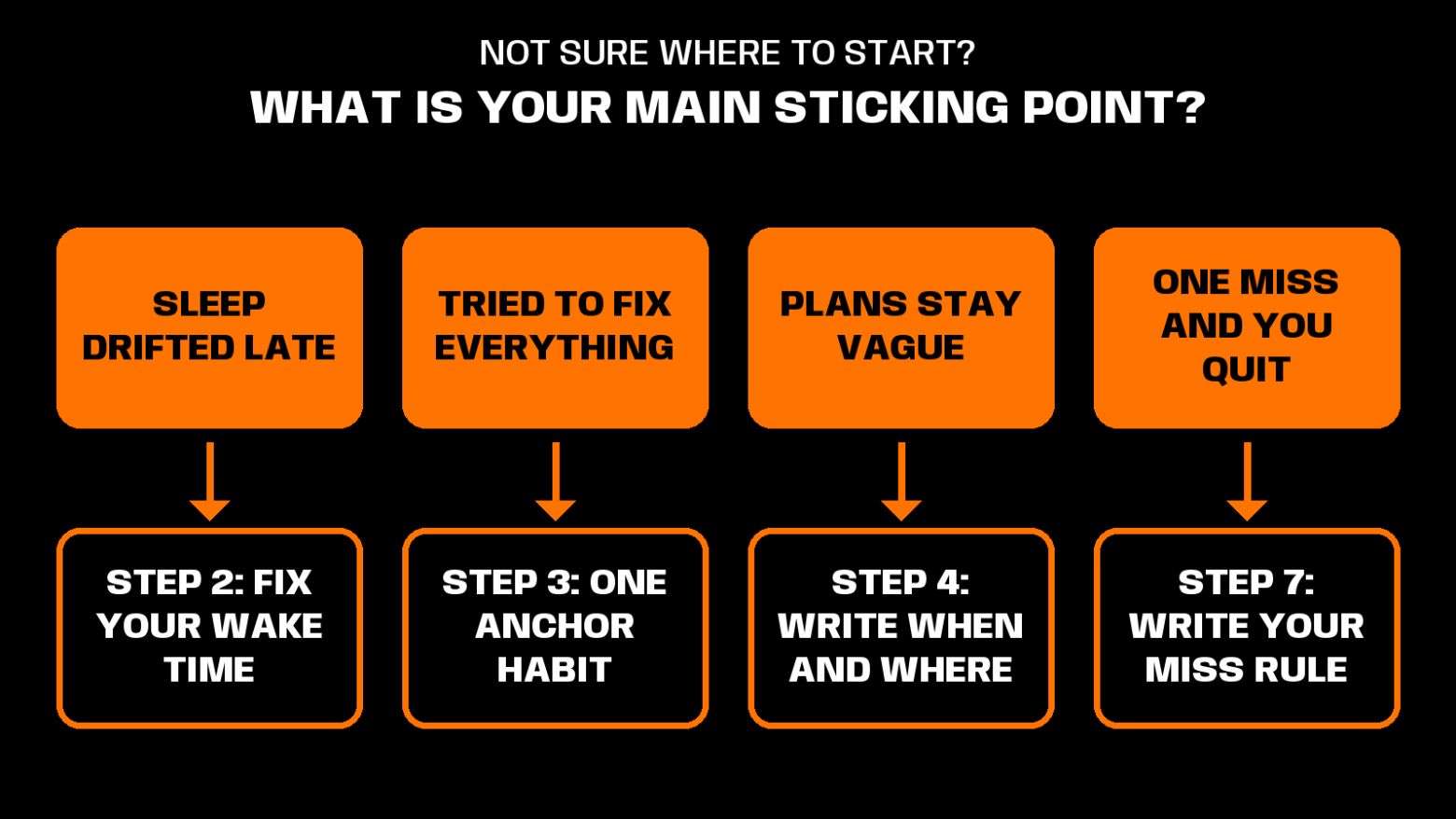
Not sure where to start? Match your main sticking point to the step that fixes it.
What is the best first habit to restart after summer?
A consistent wake time, followed by one anchor habit attached to something you already do daily. Wake time sets the frame for training, food and focus, so fixing it first makes everything else easier. Pick the habit that unblocks the most other things, not the most impressive one.
Should I restart everything at once or one thing at a time?
One thing at a time. Habits form through repetition in a stable context, and each new habit competes for the same limited attention. Rebuild one until it runs with little effort, usually two to three weeks, then add the next. Full overhauls feel decisive and rarely survive the first difficult week.
Is it worth waiting until Monday or the 1st of the month to start?
A near-term landmark genuinely helps. Research on the fresh start effect found gym visits and goal commitments rise after markers such as a new week or month. Waiting a few days for a clean marker is fine. Waiting three weeks is procrastination wearing a calendar.
What if I miss a day in the first two weeks?
Do the shortest version the next day and carry on. In the University College London habit study, missing a single opportunity did not materially affect habit formation. The risk is not one missed day, it is two in a row turning into a fortnight, so make never missing twice your only hard rule.
How do I fix my sleep after a summer of late nights?
Hold one wake time, get bright light within about half an hour of waking, and move bedtime earlier in 15 to 20 minute steps. Clinical research shows morning light plus a gradually shifted schedule advances the body clock effectively. Expect three to five days of adjustment rather than an overnight fix.
Do habit apps actually help with a reset, or are they a distraction?
They help with the two things men lose first, which are the daily cue and visible progress. They do not supply the plan or the willingness to show up on a bad day. An app is worth using if it prompts you at the right moment and shows a streak you care about, and worth dropping if checking it becomes the habit.
Final Recommendation
If you only do three things, fix your wake time, rebuild one anchor habit, and write the when, where and how. Add the shrunken fortnight and the Sunday reset once those are steady, and write your miss rule before you need it. The window summer opened will close on its own within a few weeks as a new default settles, so pick your date in the next fortnight and start with step one.
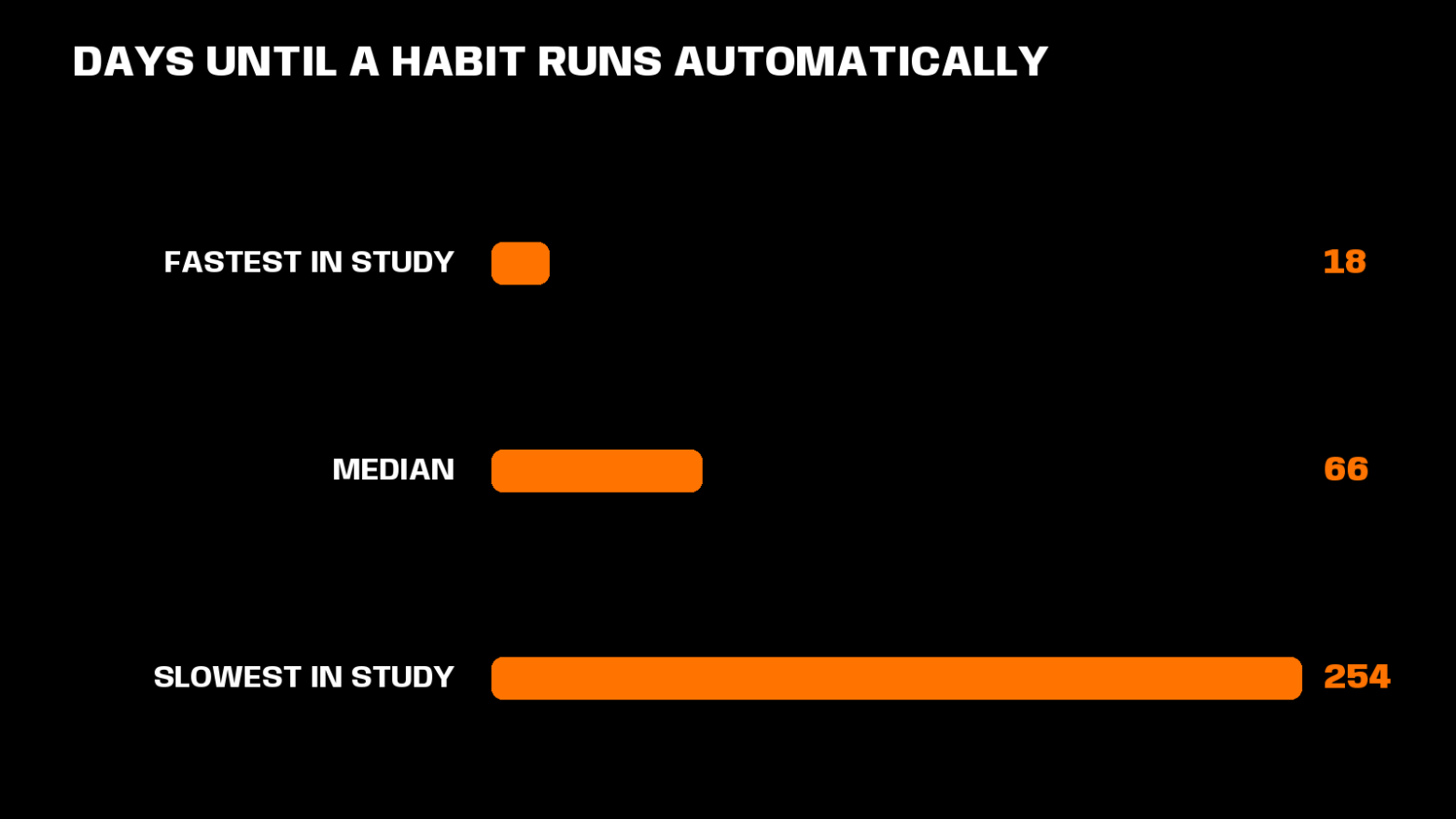
How long habits actually take to become automatic, from the University College London habit-formation study.
Options for Men to Take Action
Most men do not fail a September reset because they lack discipline. They fail because the plan lives in their head, the cue disappeared over summer, and there is nothing showing them whether they are three days in or three weeks in. Scattered notes, a half-used tracker and good intentions do not hold up against a busy autumn.
The MenTools app is built to run this kind of reset as one system rather than seven separate resolutions, with daily actions, a chosen difficulty level, reminders at the right moment, streaks and progress tracking, and an AI coach for the days you want to skip. Men tend to keep the habits they can see progress on.
How you can do this today: pick one habit from step three, set it as a daily action tonight, and log day one before you sleep.
Wins on cost: one subscription replaces a habit tracker, a reminders app and a stack of half-read books on discipline.
Wins on time: the structure, the levels and the tracking are already built, so there is no system to design before you start.
Wins on practicality: it lives on your phone and works around shift patterns, travel and young children, which is where paper plans usually fall over.
Watch-out: an app cannot make you show up, and it will not replace fixing your wake time or writing your if-then plans. If you already keep a routine reliably with paper, it adds convenience rather than transformation.
A reset holds better when the underlying discipline is there, so it is worth reading our guide to self-discipline for men alongside this one. If your mornings are the weak point, the morning routine for men guide covers the first hour in detail. For more tools built for men, see the MenTools habits hub. Small steps, repeated through October and November, are what turn a September restart into the way you simply operate.
Last updated: 2026-08-11 v1.0
Disclaimer: This guide is for informational purposes only and does not constitute medical or psychological advice. Speak with a qualified professional before making significant changes if you have a medical or mental health condition.
References
- [1] Wood W. Good Habits, Bad Habits: a conversation with Wendy Wood. Behavioral Scientist, 2019. Link
- [2] Verplanken B, Walker I, Davis A, Jurasek M. Context change and travel mode choice: combining the habit discontinuity and self-activation hypotheses. Journal of Environmental Psychology, 2008. Link
- [3] Dai H, Milkman KL, Riis J. The fresh start effect: temporal landmarks motivate aspirational behavior. Management Science, 2014. Link
- [4] Crowley SJ, Eastman CI. Phase advancing human circadian rhythms with morning bright light, afternoon melatonin, and gradually shifted sleep: can we reduce morning bright-light duration? Sleep Medicine, 2015. Link
- [5] Lally P, van Jaarsveld CHM, Potts HWW, Wardle J. How are habits formed: modelling habit formation in the real world. European Journal of Social Psychology, 2010. Link
- [6] Gollwitzer PM, Sheeran P. Implementation intentions and goal achievement: a meta-analysis of effects and processes. Advances in Experimental Social Psychology, 2006. Link
- [7] Masicampo EJ, Baumeister RF. Consider it done! Plan making can eliminate the cognitive effects of unfulfilled goals. Journal of Personality and Social Psychology, 2011. Link