No products in the cart.
Return To Shop
MEN: How Long Does It Take to Build a Habit? What the Research Says
Quick Answer
Most habits take between 59 and 66 days to become automatic, not 21. The honest range across studies runs from 4 days to 335 days, because the timeline depends on how complex the behaviour is and how consistent your cue is. Simple daily actions land near two months. Going to the gym averages closer to six.
**Jump to:** The timeline at a glance | FAQ | Options for men
Disclosure: MenTools publishes this article and may feature MenTools products.
How we evaluate: Each approach is assessed on real-world use, evidence, cost and time, and how well it suits men. Every approach including the MenTools option carries an honest limitation. Full sources are in the references below.
How Long It Takes at a Glance
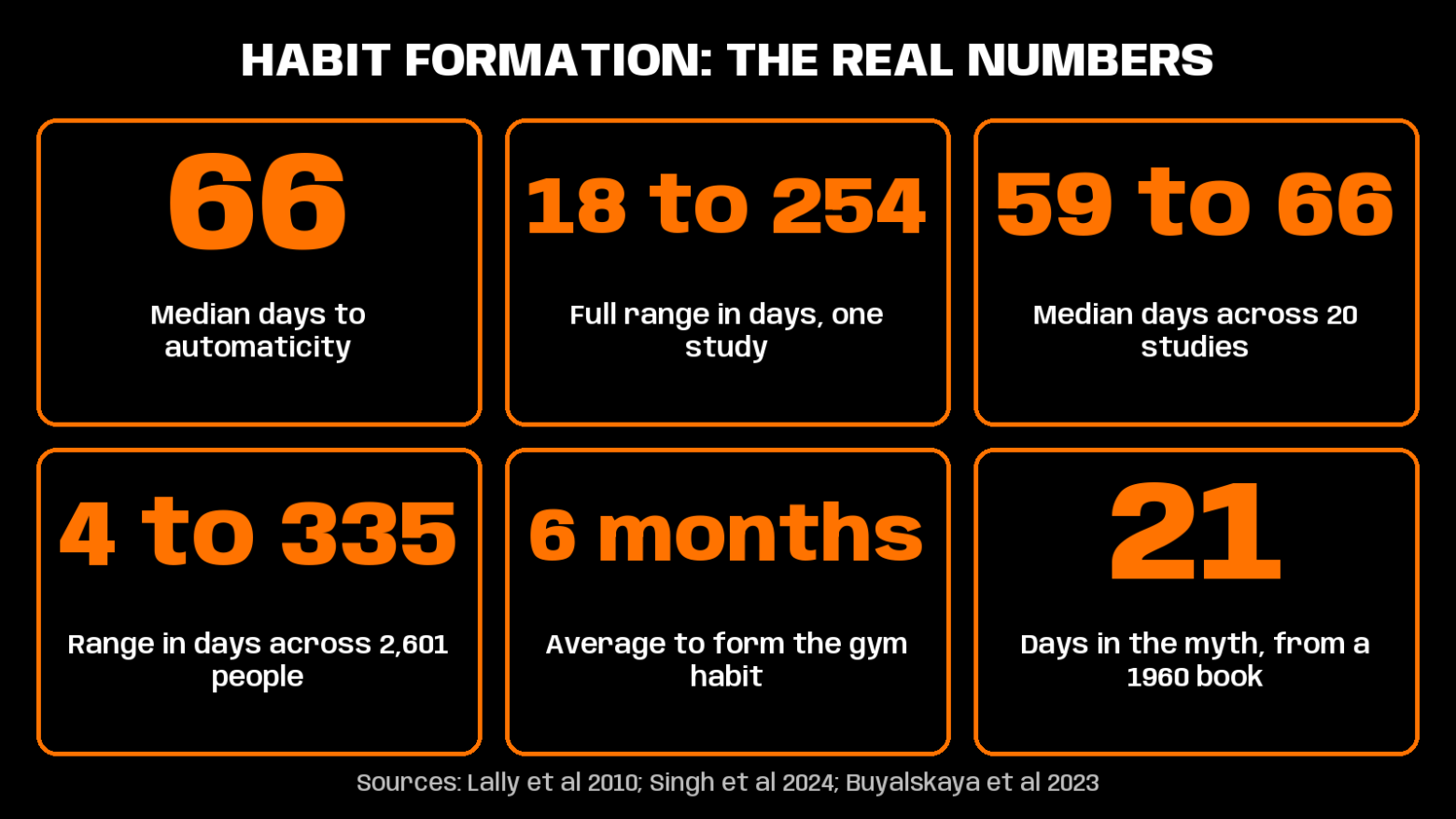
The six numbers that answer the question properly, and the one that does not belong.
| Behaviour type | Typical time to automatic | What the evidence is | Watch-out |
|---|---|---|---|
| Simple drink or food action | Fastest of the lot | Reached plateau soonest in the 12 week trial | The easiest possible case, not a template for training |
| Simple daily action | Around 2 months | Sits on the 59 to 66 day median | Still needs the same cue every single day |
| Exercise habit | Around 91 days | Took 1.5 times longer than drinking habits | The slowest habit most men attempt first |
| Gym attendance specifically | Around 6 months | Traced across 12 million gym visits | Averages hide men who took far longer |
| Hygiene habit in a fixed setting | A few weeks | Traced across 40 million handwashing events | Fast only because the setting forces the cue |
| Complex multi step routine | Often past 100 days | Study means ran to 106 and 154 days | Treat it as several habits, not one |
The Short Answer, and the Honest Range
Two months is the number to plan around. A 2024 systematic review and meta analysis in the journal Healthcare pooled 20 studies covering 2,601 participants and found the median time to form a health habit was 59 to 66 days [1]. That is the best single estimate available, and it is roughly three times the figure most men have been told.
The averages tell a different story to the medians, and the gap matters. The same review reported means of 106 and 154 days, with individual times running from 4 days to 335 days [1]. A mean that far above the median means a long tail of people who took the better part of a year.
That variation is not noise or weak methodology. It is the actual finding. Dr Ben Singh of the University of South Australia, who led the review, put it plainly: “There is significant variability, with formation times ranging from four days to nearly a year” [2]. Any article giving you one confident number is hiding that from you.
Where the 21 Day Number Actually Came From
It came from a 1960 self help book, not a study. Maxwell Maltz was a plastic surgeon who noticed roughly how long his patients took to adjust to a changed appearance, and wrote it down as an observation about mental images. It was never a habit experiment, and it never involved measuring a habit.
His actual words in Psycho-Cybernetics were: “It usually requires a minimum of about 21 days to effect any perceptible change in a mental image” [3]. Read that again. He wrote minimum, he wrote about, and he wrote mental image.
Somewhere between 1960 and the modern internet, minimum and about were deleted and mental image became habit. A surgeon’s clinical field note turned into a law of behaviour change. Singh is direct about the result: the popular three week claims “are not evidence-based”, and men should not “give up at that mythical three-week mark” [2].
Why the Range Is So Wide
Because complexity drives the clock, and most men pick a complex habit first. The original real world study on this, published by Phillippa Lally and colleagues in the European Journal of Social Psychology, asked 96 volunteers to repeat one eating, drinking or activity behaviour daily in the same context for 12 weeks, and fitted an automaticity curve to each person [4].
The behaviour they chose changed the answer. Exercise habits took roughly one and a half times longer to reach their plateau than drinking habits, averaging around 91 days [5]. The habit itself is the variable, not the man.
The other reason is that automaticity does not build in a straight line. Lally found it follows an asymptotic curve, meaning it climbs steeply early and then flattens as it approaches a ceiling [4]. The first three weeks genuinely do feel like progress, which is exactly why the 21 day myth survived. The problem is that the curve keeps going for another two months after that.
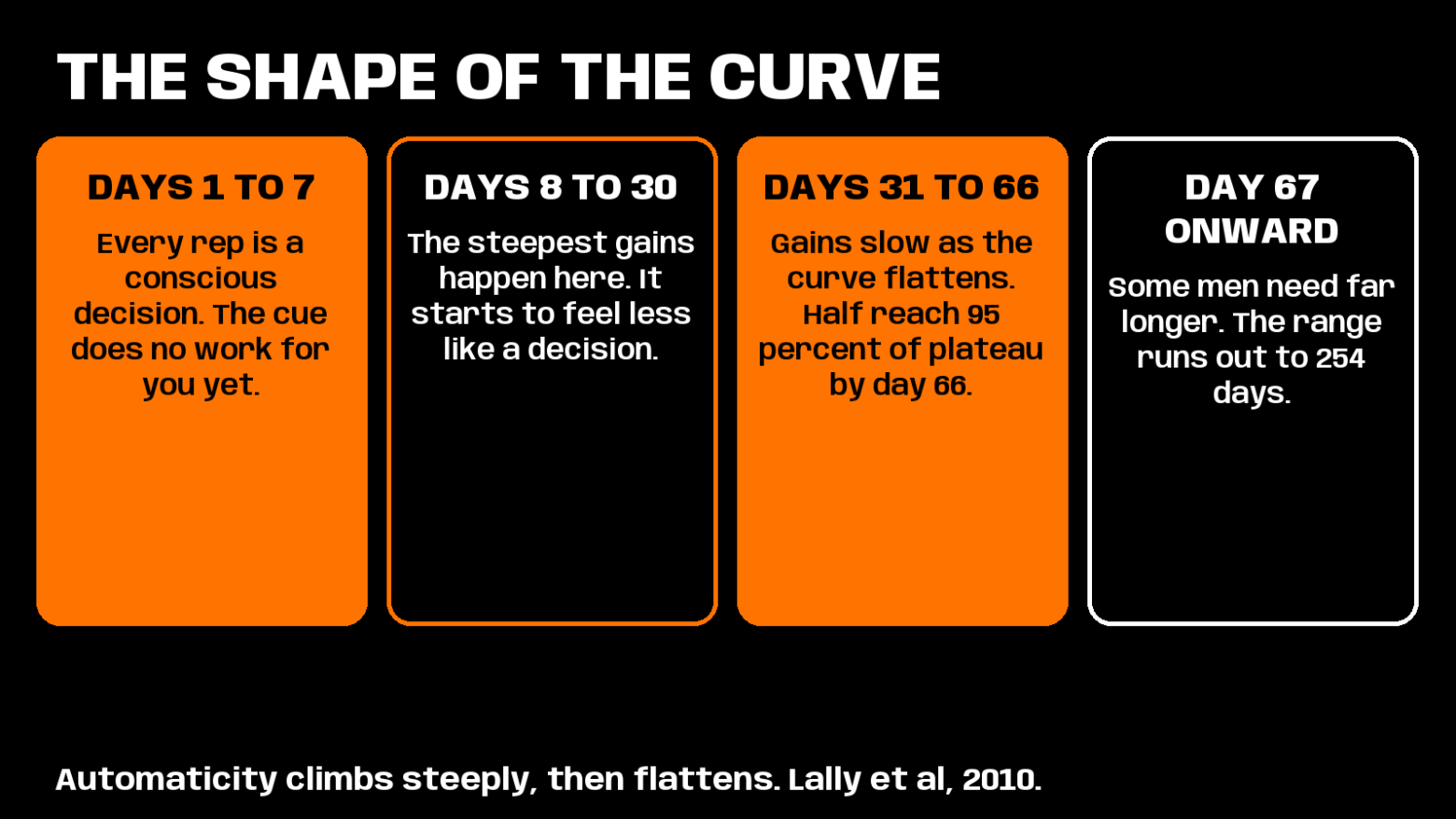
Automaticity climbs fast, then flattens. Knowing which phase you are in stops you quitting in the wrong one.
Does the Type of Habit Change the Timeline?
More than anything else you control. The largest study on this used machine learning rather than self report, and the two answers it produced were months apart. Anastasia Buyalskaya and colleagues analysed over 12 million gym attendance observations and over 40 million hospital handwashing observations in the Proceedings of the National Academy of Sciences [6].
The gym result is the one worth sitting with. Across more than 30,000 gym members tracked over four years, forming the gym habit took an average of about six months [7]. Handwashing among more than 3,000 hospital workers took an average of a few weeks [7].
The difference is not willpower, it is the setting. A hospital forces the cue dozens of times a shift in a fixed physical context. A gym requires you to generate the cue yourself, travel to it, and repeat that against traffic, weather and fatigue. Buyalskaya’s conclusion was blunt: “There is no magic number for habit formation” [7].
What Actually Shortens It
Four things, and only one of them is effort. The first is cue consistency, which is the mechanism the whole timeline runs on. Same trigger, same place, same order, every time.
The second is a written plan rather than an intention. Peter Gollwitzer and Paschal Sheeran’s meta analysis of 94 independent tests across more than 8,000 participants found that specifying when and where you will act produced a medium to large effect on goal attainment, at d equals 0.65 [8]. Deciding “Tuesday at 6am in the garage” beats deciding “more often” by a measurable margin.
The third is simplicity. Given that exercise took 91 days and drinking habits took far less in the same trial [5], the fastest route to your first automatic habit is to make the first one small enough to be boring.
The fourth is picking something you do not resent. Singh’s review found success is influenced by “how frequently we undertake the new activity, the timing of the practice, and whether we enjoy it or not” [2]. His data also pointed to morning routines being more likely to stick [2], though the gym study found time of day had no effect on habit formation at all [7]. Where two good studies disagree, treat morning as a reasonable default rather than a rule.
What Happens If You Miss a Day?
Very little, and this is the most useful finding in the whole literature. Lally’s team tested it directly and reported that “missing one opportunity to perform the behaviour did not materially affect the habit formation process” [4]. One missed day is not a reset.
What the research does not license is missing two. The curve is built by repetition in a consistent context, so the damage comes from the cue quietly losing its meaning, not from a single gap. Treat one miss as noise and the next day as non negotiable.
This is where most men lose habits they had nearly built. They interpret day 34 as failure rather than as a data point, and quit something that was two thirds of the way to automatic. If you want the wider system this sits inside, our guide to daily habits for men covers what to actually run day to day.
How Do You Know When It Has Become a Habit?
When the decision disappears. The research standard is automaticity, meaning the behaviour starts without you weighing it up, and you notice its absence more than its presence. That is a different signal to feeling motivated, and it arrives later.
There are two practical tells. The first is that skipping it feels worse than doing it. The second is that you have done it in bad conditions, tired, travelling, or in a week that went wrong, without renegotiating.
The gym study found a useful proxy for this. For 76 percent of members, the time since their previous visit predicted their next one, and 69 percent were more likely to attend on the same weekdays [7]. Pattern, not enthusiasm, is what a real habit looks like from the outside. Getting to that point is mostly a discipline problem, which our guide to self discipline for men addresses directly.
Should You Plan for 66 Days or 254?
Plan for 66 and be unsurprised by 120. The median is the right planning figure because half of people reach 95 percent of their plateau by then, but the range to 254 days in Lally’s data [4] and to 335 days in the 2024 review [1] means a long timeline is normal rather than a sign you are doing it wrong.
The practical version is to commit for three months rather than three weeks, and to judge yourself on repetitions completed rather than on how automatic it feels. Automaticity is the output, not the input.
If you are restarting after a break rather than beginning from scratch, the timeline is usually shorter, because the cue already has history. Our guide to getting back into routine after summer covers that case specifically.
FAQ
Is 21 days enough to form a habit?
No. The 21 day figure came from a 1960 book by a plastic surgeon describing how long patients took to adjust to a new appearance, not from habit research. Pooled evidence across 20 studies puts the median at 59 to 66 days, with some behaviours taking several months. Three weeks is roughly a third of what most habits need.
How long does it take to make going to the gym a habit?
Around six months on average. Analysis of over 12 million gym attendance records covering more than 30,000 members found the gym habit took an average of about six months to form, which makes it one of the slowest common habits. Expect roughly three months before it stops feeling like a decision.
What is the difference between a streak and a habit?
A streak is a count you are maintaining, a habit is a behaviour you no longer decide on. Streaks are useful early because they give you evidence before automaticity arrives, but they rely on attention, so a broken streak can end the behaviour. A habit survives the broken count.
Why do some people form habits in a few weeks?
Usually because the behaviour is simple and the cue is forced by their surroundings. Hospital handwashing became habitual in a few weeks because the setting triggers it dozens of times per shift. Simple actions attached to a cue you cannot avoid form fastest, which is why anchoring a new habit to something you already do reliably works.
How many habits should I build at once?
One, until it is automatic. Each habit needs its own accumulated repetitions in its own context, so running four at once divides your consistency across all of them without shortening any single timeline. Add the second once the first survives a bad week without a decision.
Is it easier to build a habit in the morning?
Probably, though the evidence is not unanimous. The 2024 review found morning routines were more likely to stick, while the large scale gym study found time of day had no effect on habit formation. Morning is a sensible default because there are fewer competing demands, not because the clock itself does anything.
How long does it take to break a habit rather than build one?
There is far less reliable evidence on breaking than on building, so treat any specific number with suspicion. What the formation research implies is that removing the cue matters more than resisting the behaviour, because the cue is what carries the automaticity. Changing the context is more effective than fighting the impulse inside it.
Final Recommendation
Commit to one habit for three months, not three weeks, and anchor it to a cue you already hit every day without thinking. Write down the exact time and place rather than the intention. Keep it small enough that a bad day cannot stop it, count repetitions instead of judging how automatic it feels, and treat a single missed day as noise rather than a verdict. Two months in you will know, because you will have stopped deciding.
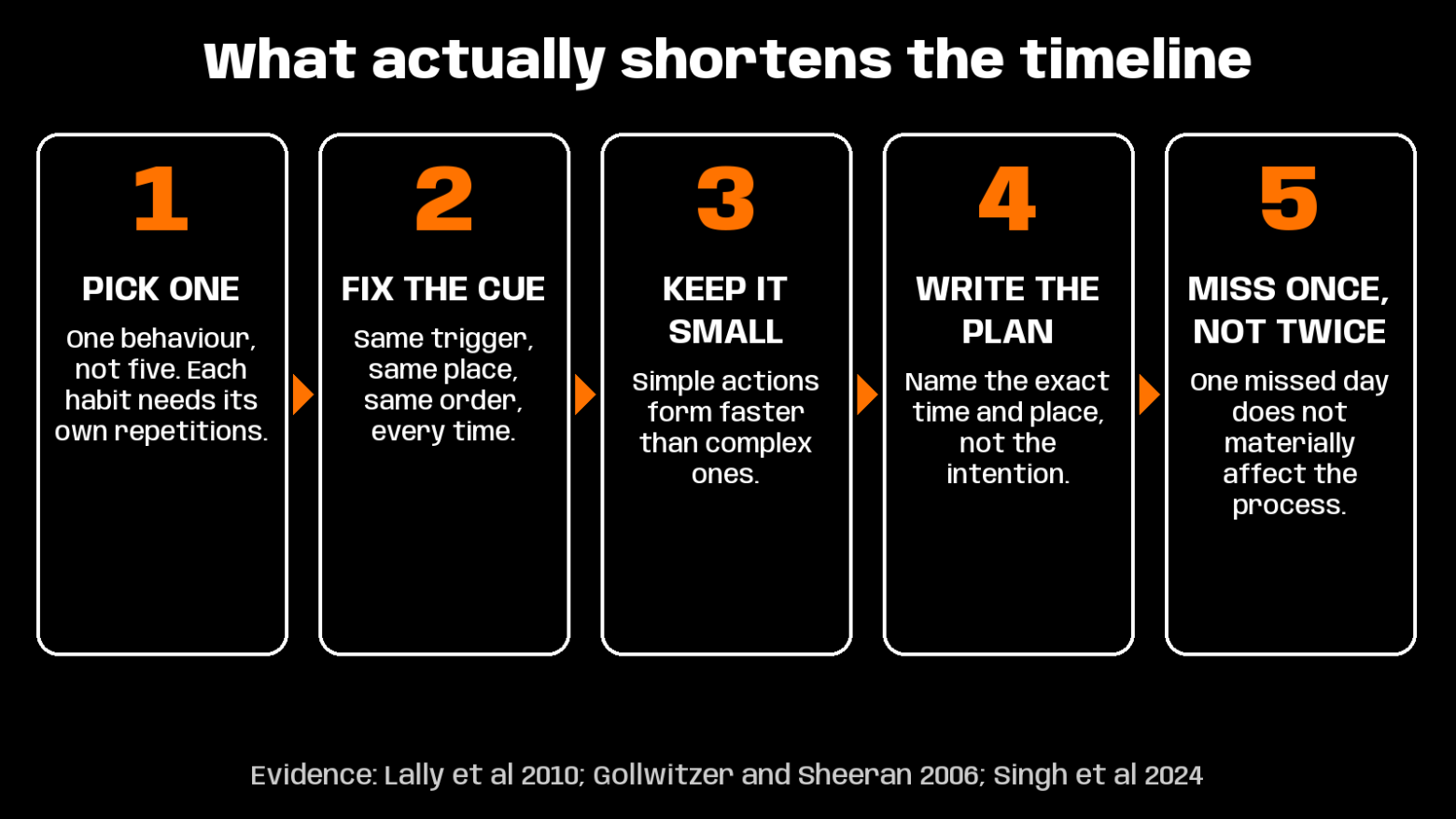
The five moves the evidence actually supports, in the order they matter.
Options for Men to Build Habits That Stick
Most men do not fail at habits because they lack discipline. They fail because nothing is counting. Day 19 and day 41 feel identical from the inside, so there is no way to tell the difference between a habit that is two thirds built and one that never started, and the guessing is what ends it.
The MenTools app exists to be the counter. It runs on a challenge system with daily actions, chosen difficulty levels, streaks and progress tracking, reminders at the moment the cue should fire, and an AI coach for the weeks the plan starts losing an argument with your mood.
How you can do this today: pick the one habit you want automatic by November, set it as a daily action at a fixed time, and log tonight as repetition one.
Wins on cost: one subscription replaces a habit tracker, a journal app and a shelf of behaviour change books.
Wins on time: the levels, actions and tracking are already built, so there is nothing to design before you start tonight.
Wins on practicality: it works around shifts, travel and family, which is where a rigid 21 day programme breaks first.
Watch-out: it is a tracking and consistency tool, not a motivation transplant. If the real obstacle is that you have picked a habit you quietly do not want, no tracker will fix that, and choosing a different habit will.
A 66 day project also runs on the basics underneath it holding up, because a flat week is harder to out plan than to prevent, and a one a day multivitamin may help cover the simple daily foundation while you do the behaviour work. For the wider set of habit guides built for men, see the MenTools habits hub. Three months of counted repetitions will settle this question better than another year of starting again in January.
Last updated: 2026-08-25 v1.0
Disclaimer: This guide is for informational purposes only and does not constitute medical or psychological advice. Speak with a qualified professional before making significant changes if you have a medical or mental health condition.
References
- [1] Singh B, Murphy A, Maher C, Smith AE. Time to Form a Habit, a Systematic Review and Meta-Analysis of Health Behaviour Habit Formation and Its Determinants. Healthcare, 2024. Link
- [2] University of South Australia. Myth busted, healthy habits take longer than 21 days to set in. ScienceDaily, January 2025. Link
- [3] Maltz M. Psycho-Cybernetics, 1960, quoted in Debunking the 21 Day Myth. Michigan State University Women’s Health Research Institute. Link
- [4] Lally P, van Jaarsveld CHM, Potts HWW, Wardle J. How are habits formed, modelling habit formation in the real world. European Journal of Social Psychology, 2010. Link
- [5] Lally P et al, reported in How Long Does It Take to Form a Habit, What Lally et al Actually Found. The Behavioral Scientist. Link
- [6] Buyalskaya A, Ho H, Milkman KL, Li X, Duckworth AL, Camerer C. What can machine learning teach us about habit formation, evidence from exercise and hygiene. Proceedings of the National Academy of Sciences, 2023. Link
- [7] No magic number for time it takes to form habits. Neuroscience News, reporting Buyalskaya et al, 2023. Link
- [8] Gollwitzer PM, Sheeran P. Implementation intentions and goal achievement, a meta-analysis of effects and processes. Advances in Experimental Social Psychology, 2006. Link