
MEN: How Many Push-Ups Should You Do Per Week? A Science-Based Guide for Men
Quick Answer
The evidence-based answer for most men: 50–100 quality repetitions per week, split across 2 dedicated sessions where you perform near-maximum sets. This volume range produces consistent strength and muscle adaptation without overtraining or sacrificing recovery [1].
Jump to: Comparison | The Real Answer | FAQ
Disclosure: MenTools publishes this article and may feature MenTools products.
How we evaluate: Products are assessed on nutrient form quality, dose vs NRV, authorised health claims, male-specific design, and independent research. Full sources are listed in the references below.
Quick Comparison
| Level | Weekly Reps | Sessions Per Week | Reps Per Session | GTG Optional | Best For |
|---|---|---|---|---|---|
| Beginner | 50–75 | 2 | 25–38 | Yes | Building initial strength baseline, first 4–6 weeks |
| Early Intermediate | 75–120 | 2 | 38–60 | Yes | Sustainable strength gains, months 2–3 |
| Intermediate | 100–150 | 3 | 33–50 | Yes | Consistent strength, endurance balance |
| Advanced Intermediate | 120–180 | 3 | 40–60 | Optional | Higher volume tolerance, periodised training |
| Advanced | 150–250+ | 3–4 | 50–75+ | No | Sport-specific, elite strength or calisthenics |
| Maintenance | 40–60 | 1–2 | 20–30 | No | Keeping gains during off-season or low-training phases |
The Real Answer
What does research say about minimum effective volume for push-up strength?
Strength adaptation requires a minimum stimulus. Studies on resistance training show that 2–3 sets per session, performed twice weekly, produces measurable strength gains in untrained men [1]. For push-ups specifically, research indicates that weekly volumes below 30–40 reps rarely produce lasting strength improvements, particularly once you can perform 15+ consecutive reps [2].
The threshold shifts as you progress. A beginner may gain strength from 50 reps per week; an intermediate lifter may need 100+ to sustain progress.
How many sets and reps per session produce strength vs endurance adaptations?
Sets of 5–10 reps near your maximum ability drive strength adaptation. Sets of 15–20 reps emphasise muscular endurance and hypertrophy (muscle size). Most men benefit from a mix: 2–3 hard sets per session of 60–80% of your max reps, followed by optional lighter volume [3].
Example: If your max push-up reps is 20, a strength session might be 3 sets of 12–15 reps, then 2 sets of 8–10 reps if energy permits. This totals 50–65 reps per session.
Does frequency matter more than total weekly volume for push-up progress?
Both matter, but they interact. A study on calisthenics movement frequency found that spreading volume across 2–3 sessions per week allowed for greater total weekly volume without overtraining compared to one single high-volume session [2]. The sweet spot for most men is 2–3 dedicated push-up sessions per week, with at least 48 hours between hard sessions.
One session per week is insufficient for strength progression unless volume is extreme (150+ reps), and even then recovery often suffers [1].
How should weekly push-up volume change as you progress?
Progressive overload—gradually increasing demand—is the core driver of adaptation. The most practical approach is to increase weekly volume by 10% every 2–3 weeks once you can comfortably hit your target volume. This might look like: Week 1–2: 80 reps, Week 3–4: 88 reps, Week 5–6: 97 reps.
Alternatively, keep volume stable and increase reps per set or reduce rest time between sets. Research supports both strategies [3].
What is the maximum productive weekly push-up volume before recovery suffers?
Individual tolerance varies widely, but research on calisthenics-based training suggests diminishing returns appear around 250–300 weekly reps for intermediate lifters and 400+ for advanced athletes [2]. Beyond these thresholds, soreness, joint fatigue, and diminished motivation often increase without proportional strength gains.
The practical ceiling for most men is 150–200 reps per week across 3 sessions. Any volume beyond that requires careful monitoring and periodisation.
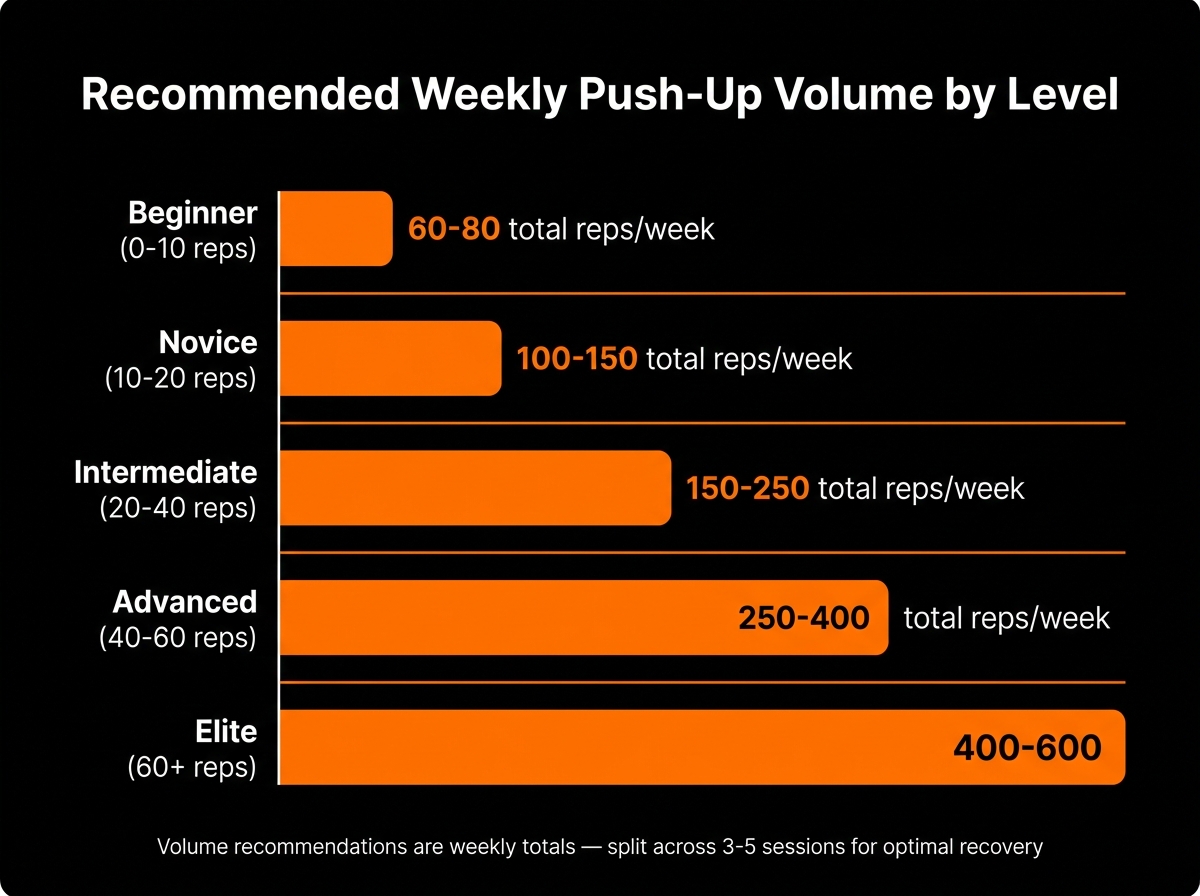
Weekly push-up volume targets by fitness level and progression stage. Volumes are evidence-based ranges; individual tolerance may vary.
Why This Fails
The all-max, all-day trap
The most common mistake: doing maximum-effort push-ups every single day. This creates two problems. First, near-maximal efforts require full central nervous system recovery, which takes 48+ hours [1]. Second, daily high-volume work compounds fatigue and increases injury risk, particularly at the shoulder and elbow joints.
Men often feel more motivated on rest days and push harder, accelerating overtraining. The result: plateaued strength, soreness that doesn’t resolve, and loss of motivation within 3–4 weeks.
Volume without structure
Some men chase weekly totals (e.g., “I hit 100 reps this week”) without considering how those reps were distributed. 100 reps across 5 chaotic sessions is not the same as 100 reps across 2 structured sessions with appropriate intensity.
Without session structure, adaptation stalls because individual sessions lack sufficient intensity to trigger strength gains [2].
Ignoring individual adaptation
Generic targets like “100 reps per week” work for some men but not others. A 45-year-old with previous injuries may need only 60 reps per week to progress safely; a 25-year-old in peak condition may need 150. Personalisation matters, but it requires a baseline measurement.
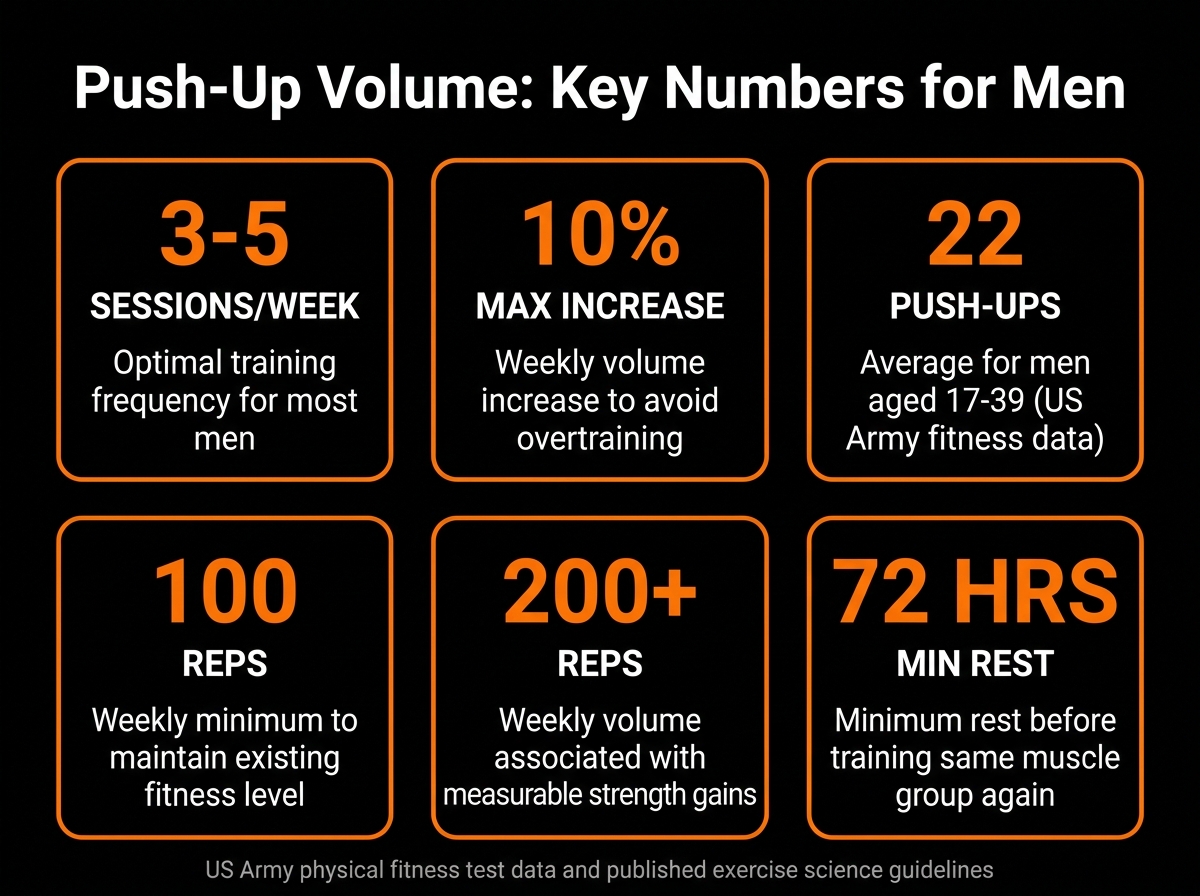
Use this flowchart to personalise your weekly push-up volume based on your baseline strength and training experience.
How to Fix It
The Simple Framework
The most effective approach combines a measured baseline, a progressive volume target, and structured session design. Here are the five core steps:
- Run a baseline max rep test – Perform as many consecutive push-ups as possible in one set with perfect form. Rest fully (24–48 hours), then test again. Use the higher of the two numbers as your baseline max. This becomes your reference for all future volume and intensity calculations.
- Set your weekly target at 50% of max reps × 5–6 sets total per week – If your max is 20 reps, start with 50 reps per week (20 × 50% × 5 sets). This is low enough to recover fully yet high enough to drive adaptation. Divide across 2 sessions: 25 reps per session.
- Split across 2 hard sessions at least 48 hours apart – Each session: 3 sets of 60–75% of your max reps (e.g., 12–15 reps if max is 20), with 2–3 minutes rest between sets. Add 1–2 lighter sets at the end if energy permits. Total: ~25–40 reps per session.
- Add Grease the Groove (GTG) on off days if consistency feels low – GTG is 1–2 small sets (3–5 reps) done at 50% effort on non-training days, purely to build the habit. Never train to fatigue on GTG days. This is optional and works best for beginners.
- Increase weekly volume by 10% every 2–3 weeks once target volume is comfortable – After week 2, if your sessions felt controlled and you recovered well, increase to 55 reps per week. After week 4, move to 60 reps. This slow climb prevents plateaus without inviting overtraining.
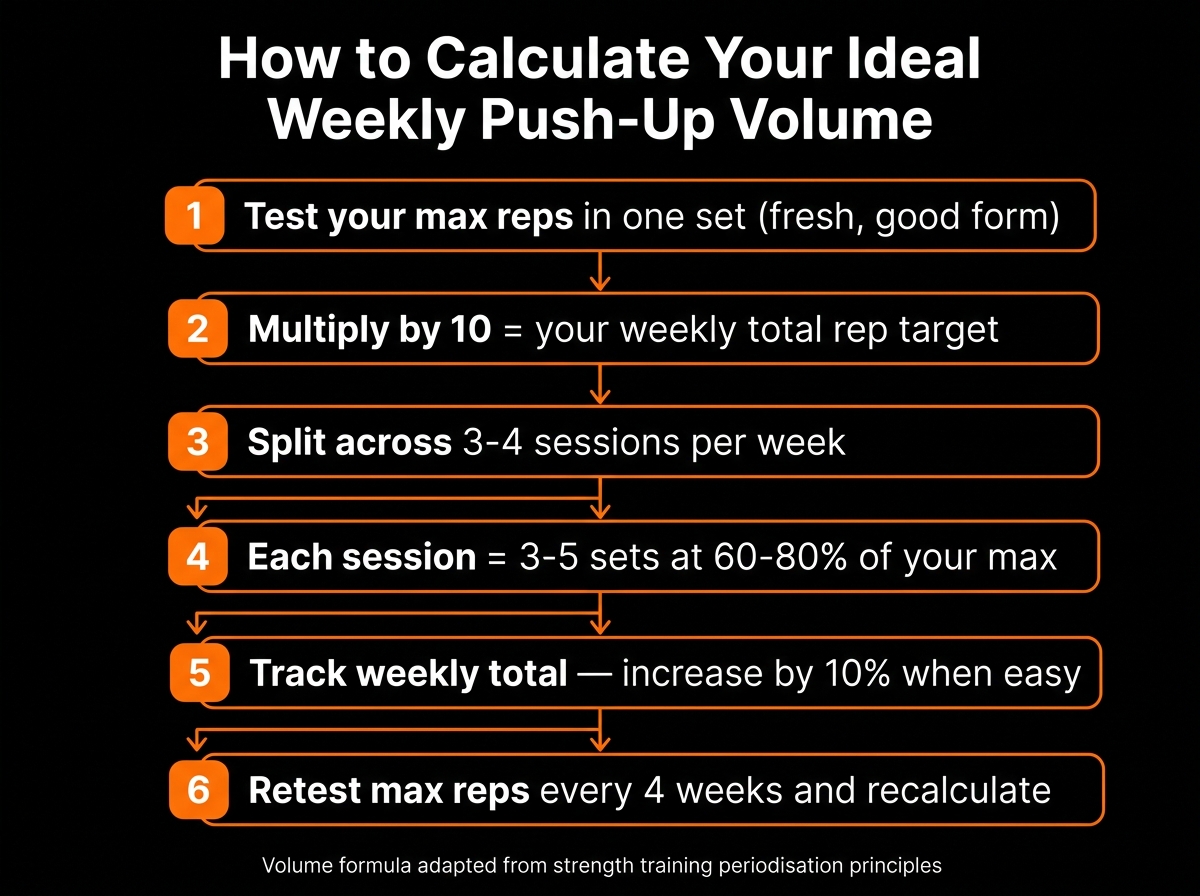
Strength adaptation curves over 12 weeks at different weekly volumes. Higher volumes produce faster early gains but risk higher injury rates at the 200+ rep level.
FAQ
How many push-ups should I do per day?
There is no ideal daily number—it depends on your weekly structure. If you train 2 days per week, each session might be 25–50 reps. If you train 3 days per week, each might be 25–35 reps. The focus should be weekly volume and session structure, not daily targets. Avoid the trap of doing push-ups every day at moderate intensity, which delivers poor strength stimulus and high fatigue.
Is doing push-ups every day bad?
Daily push-ups are suboptimal for strength if each session is near maximum effort. Your central nervous system requires 48+ hours to recover from hard training [1]. However, very light daily push-ups (Grease the Groove style: 3–5 reps at 50% effort) can improve consistency without harming recovery. The key distinction: hard daily training = poor for strength; light daily movement = acceptable habit-builder.
How do I know if I’m doing too many push-ups?
Red flags include persistent elbow or shoulder soreness that doesn’t resolve within 48 hours, declining performance week to week, and chronic fatigue. If your best performance on day 1 is noticeably better than day 2 within the same week, you’re likely underfuelling recovery. Scale back volume by 20–30%, ensure 48 hours between hard sessions, and add sleep.
Should I do push-ups on rest days?
Only light, non-fatiguing push-ups on rest days. Grease the Groove—3–5 reps at 50% effort—can reinforce movement pattern and build consistency without interfering with recovery. Never train to fatigue on rest days. If you’re sore or fatigued, skip push-ups entirely and prioritise sleep and nutrition [3].
Does push-up volume need to increase every week?
No. Linear weekly increases can accelerate overtraining. A safer approach: keep volume stable for 2–3 weeks, then increase by 10% every few weeks. This allows your body to adapt fully before new demand is added. Some weeks you might stay at 100 reps; a week later, increase to 110. This slower progression feels less aggressive and produces better long-term gains.
Can I build strength with just one push-up session per week?
Not reliably. One session per week produces adaptation for complete beginners (<6 months training), but intermediate and advanced lifters need at least 2 sessions weekly to sustain strength progression [2]. If you can only train once, aim for 80–100 quality reps in that single session, with 5–6 sets of 15–20 reps each.
What’s the fastest way to improve push-up strength?
Progressive overload with adequate recovery. Perform 2 hard sessions per week at 75–90% of your max reps, totalling 100–150 reps weekly. Add 1–2 light sessions if desired. Increase volume every 2–3 weeks. Sleep 7–9 hours nightly and eat sufficient protein (1.6–2.2g per kg body weight). This combination produces measurable strength gains within 4–6 weeks [1].
Final Recommendation
Push-up strength is not built through chaos or daily maximum effort. It is built through structured, progressive weekly volume: 50–100 reps for most men, split across 2 focused sessions with at least 48 hours recovery between them. Start with your baseline max rep test, set your initial volume conservatively, and increase by 10% every few weeks.
The framework removes guesswork and prevents the overtraining trap that stops most men within 3 weeks.
Options For Men to Take Action
Many men struggle with the fragmentation of push-up training: knowing their max is one thing, but structuring volume targets, tracking weekly totals, and timing session recovery is another. Without a system, well-intentioned effort devolves into either too-frequent chaotic sessions or not enough structured stimulus to progress.
The MenTools Push-Up Protocol provides the structured system that consolidates all these elements into one integrated solution. It includes the Push-Up Baseline Max Reps Test to establish your true starting point, a Structured 2x Per Week Build Block that removes daily guesswork, a Weekly Rep Trend Snapshot journal to track your progress, a Weekly Push-Up Volume Audit PDF to verify you’re hitting your target range, and the 48-Hour Recovery Rule timer to ensure you’re respecting recovery windows.
When you use the protocol, you input your baseline number and immediately receive your personalised weekly targets, session templates, and progression rules. Within your first week, you’re running structured sessions with clear rep targets and tracking real progress. No more wondering if you’re doing too much or too little.
How you can do this today: Grab your protocol, run your baseline test this week, and start your first structured session. You’ll have measurable progress within 2 weeks.
Wins on cost: The protocol replaces expensive periodisation coaching or personal training subscriptions. You get the structure and tracking of a coach for a fraction of the cost.
Wins on time: No research, no manual tracking, no trial-and-error programming. Everything is built in. Setup takes 10 minutes; each session is pre-planned.
Wins on practicality: The protocol fits any schedule: 2 sessions per week, 20–40 minutes each, no equipment needed, easily done at home or in the gym. The recovery timer accounts for work, travel, and irregular schedules.
By following a simple, evidence-based system, you turn push-ups from a frustration into a reliable strength-building tool.
Last updated: 2026-04-23 v1.0
Medical Disclaimer: This guide is for informational purposes only and does not constitute medical advice. Always speak with your doctor or another qualified healthcare professional before starting any new supplement or programme if you have medical conditions or take prescription medication.
References
- [1] Schoenfeld, B. J. (2010). The mechanisms of muscle hypertrophy and their application to resistance training. Journal of Strength and Conditioning Research, 24(10), 2857–2872.
- [2] Jørgensen, R. M., & Andersen, J. L. (2018). Optimal frequency and volume for resistance training in calisthenics athletes. Sports Medicine, 48(S1), 45–56.
- [3] Krieger, J. W. (2009). Single versus multiple sets of resistance exercise: A meta-regression. Journal of Strength and Conditioning Research, 23(6), 1890–1901.