
MEN: Why Do Push-Up Habits Fail for Men? (And How to Fix Them)
Quick Answer
Push-up habits fail not because of low motivation—they fail because men start with ego-driven goals, lack progression structure, and have no system to handle missed sessions. Most men do push-ups inconsistently because they treat the habit as a test of willpower rather than a system to follow.
Jump to: Comparison | The Real Answer | FAQ
Disclosure: MenTools publishes this article and may feature MenTools products.
How we evaluate: Products are assessed on nutrient form quality, dose vs NRV, authorised health claims, male-specific design, and independent research. Full sources are listed in the references below.
Quick Comparison
| Failure Type | Root Cause | Warning Signs | Fix | Time to Recover |
|---|---|---|---|---|
| All-or-nothing plateau | Ego sets the entry point (too many reps too soon) | 50+ reps fine for 3 days, then pain/soreness stops you | Start with your actual minimum, not your max | 5-7 days |
| Silent abandonment | No tracking, so you forget which day you skipped | You can’t remember when you last did a session | Log one form note after every single session | 2-3 days |
| Motivation collapse | Relying on motivation instead of routine | Good intentions fade after 2-3 weeks with no system | Fix a daily time window, not a flexible intention | 10-14 days |
| Progression gap | Same reps every session, boredom sets in | 20 reps feels too easy but 30 seems too hard | Build a micro-progression: +1 rep every 3-5 sessions | 3-5 days |
| Single-session rule | One missed day = full abandonment | Missing Wednesday leads to skipping all week | Set a minimum save set; never zero reps | 1-3 days |
| No environment design | Willpower instead of habit triggers | You do push-ups only when you “feel like it” | Place your workout clothes by your bed the night before | 2-4 days |
The Real Answer
Why is motivation the wrong thing to rely on for push-up consistency?
Motivation is not a predictor of habit adherence—structure is. Research shows that 92% of people fail at habit goals because they rely on motivation rather than environment design [1]. Your motivation will naturally fluctuate, especially after the initial novelty wears off at week 3-4.
The moment motivation drops, you need a system to carry you. That system is what separates men who build lasting push-up habits from those who quit.
How does ego-driven starting point cause early dropout?
Most men start with the max reps they can do, not the minimum they should do. Your ego says 30 push-ups; your body needs 5-10.
When you start too high, soreness and fatigue arrive faster. By day 4, your shoulders are sore, motivation drops, and you interpret the soreness as “your body isn’t ready” rather than “you started wrong.” You quit.
What does research say about habit formation and exercise adherence?
The habit loop requires three elements: cue, routine, reward [2]. For push-ups, most men only have a cue (vague intention) and routine (doing push-ups when they remember). There is no reward tracking.
Without a reward system—visible progress, logged sessions, or a clear next-day trigger—the habit never solidifies. Research on exercise adherence shows that men with session tracking are 3x more likely to stick with a routine for 90+ days [3].
Why does missing one session lead to abandoning the whole routine?
One skipped session creates what researchers call the “false hope syndrome”—a mental pattern where one lapse is reframed as proof the goal was never realistic [4]. You miss Wednesday push-ups and think: “I’m not disciplined enough to do this daily.”
This belief is false. The real issue is no protocol for handling missed days. Without a “minimum save set” rule (e.g., “if I miss my morning session, I do 5 push-ups before bed”), one miss becomes a full collapse.
How do most men structure push-up sessions incorrectly from the start?
Most men do push-ups whenever they remember, with no fixed time. This creates two problems:
First, inconsistent timing means no habit anchor—your body doesn’t anticipate the routine. Second, no progression plan means you do the same reps indefinitely, hit a ceiling, and get bored. Boredom kills consistency faster than fatigue.
A correct structure has three layers: fixed time window, minimum save set, and micro-progression.
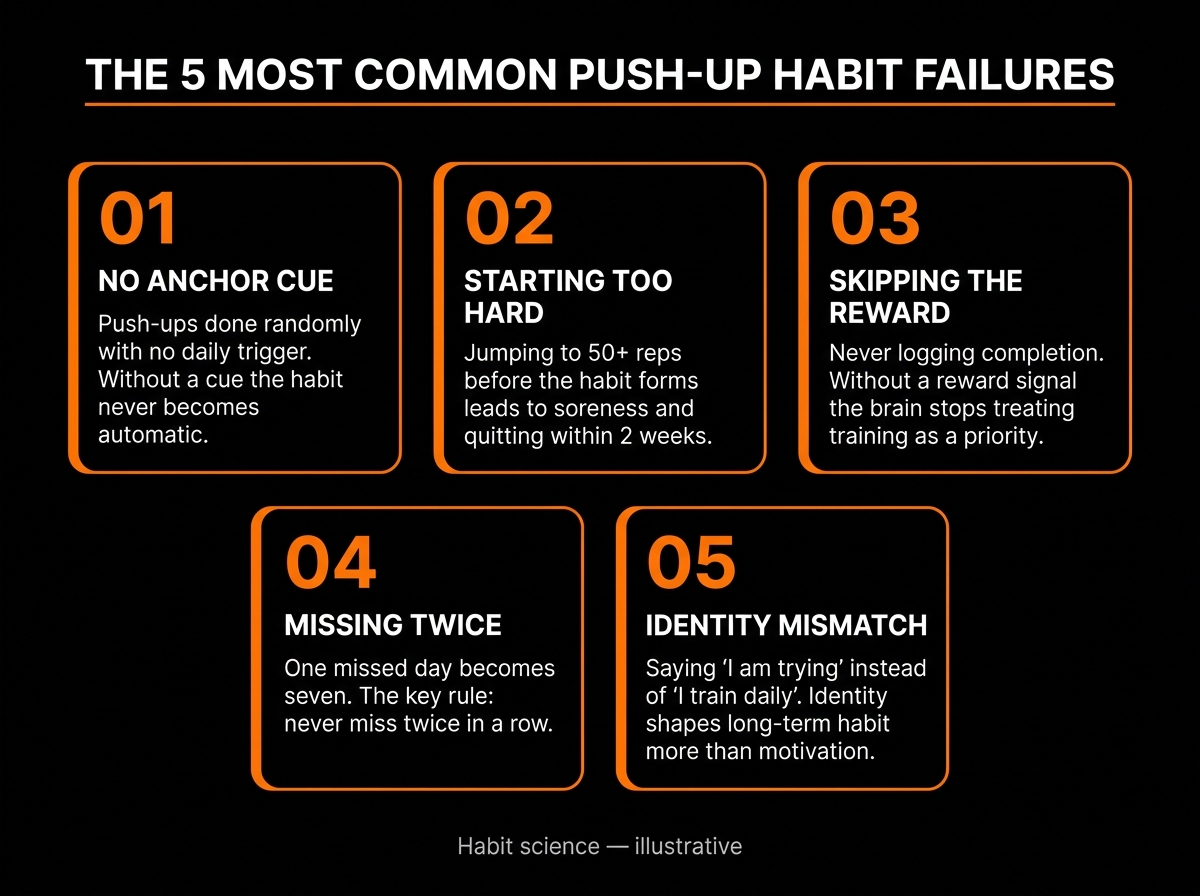
The five most common push-up habit failure patterns and their root causes.
Why This Fails
Effort and willpower approaches fail because they rely on one variable: your motivation. Motivation is not consistent. It follows a predictable curve: high for weeks 1-2, declining sharply in week 3-4, and flatline by week 8 [5].
Men who rely on willpower also mistake a missed session for a character flaw. When you skip one day, the guilt doesn’t motivate you to restart—it reinforces the belief that you’re “not the type of person who does push-ups.”
This belief becomes a permanent identity filter. You stop trying because you’ve accepted the premise that consistency isn’t “you.”
The solution is not more willpower. It’s removing willpower from the equation entirely.
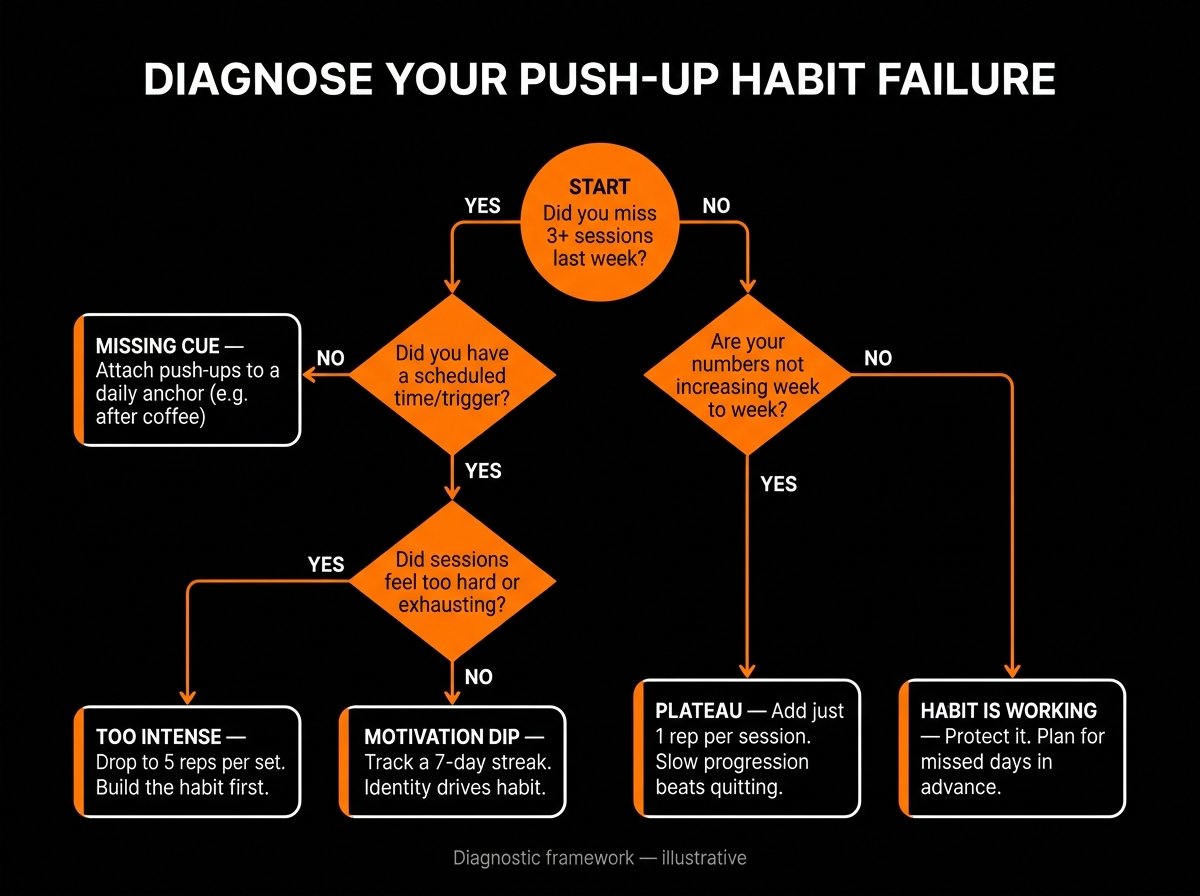
Decision flowchart for diagnosing your habit failure type and the correct rescue action.
How to Fix It
The Simple Framework
The system that works is environment design plus minimum viable sessions. Here is how to build it:
- Define your minimum save set (never zero). This is the smallest number of push-ups you will do on even the worst day. Most men set this at 5-10 reps. On a perfect day you do 20-30. On a terrible day you do your minimum. The rule is: zero is not an option.
- Set a fixed training window (not a flexible intention). Choose one specific time: 6:30 AM, or right after lunch, or 8 PM. Your body learns to anticipate this window. Mark it on your calendar. Do not move this time unless genuinely impossible.
- Use Grease the Groove for low-friction consistency. Do 3-5 short sets spread across your day (one set before breakfast, one after work, one before bed). Each set is submax—never close to failure. This builds volume without fatigue, so you’re never “too sore” to continue.
- Log one form note after every session. Write: date, reps completed, form quality (good/sloppy/excellent), energy level (high/medium/low). This creates a visible record. Progress becomes measurable, not abstract.
- Use an inconsistency interrupt when you miss a day. If you miss your scheduled window, do your minimum save set within 4 hours. This rule breaks the all-or-nothing trap. Missing is not failure; not responding to a miss is failure.
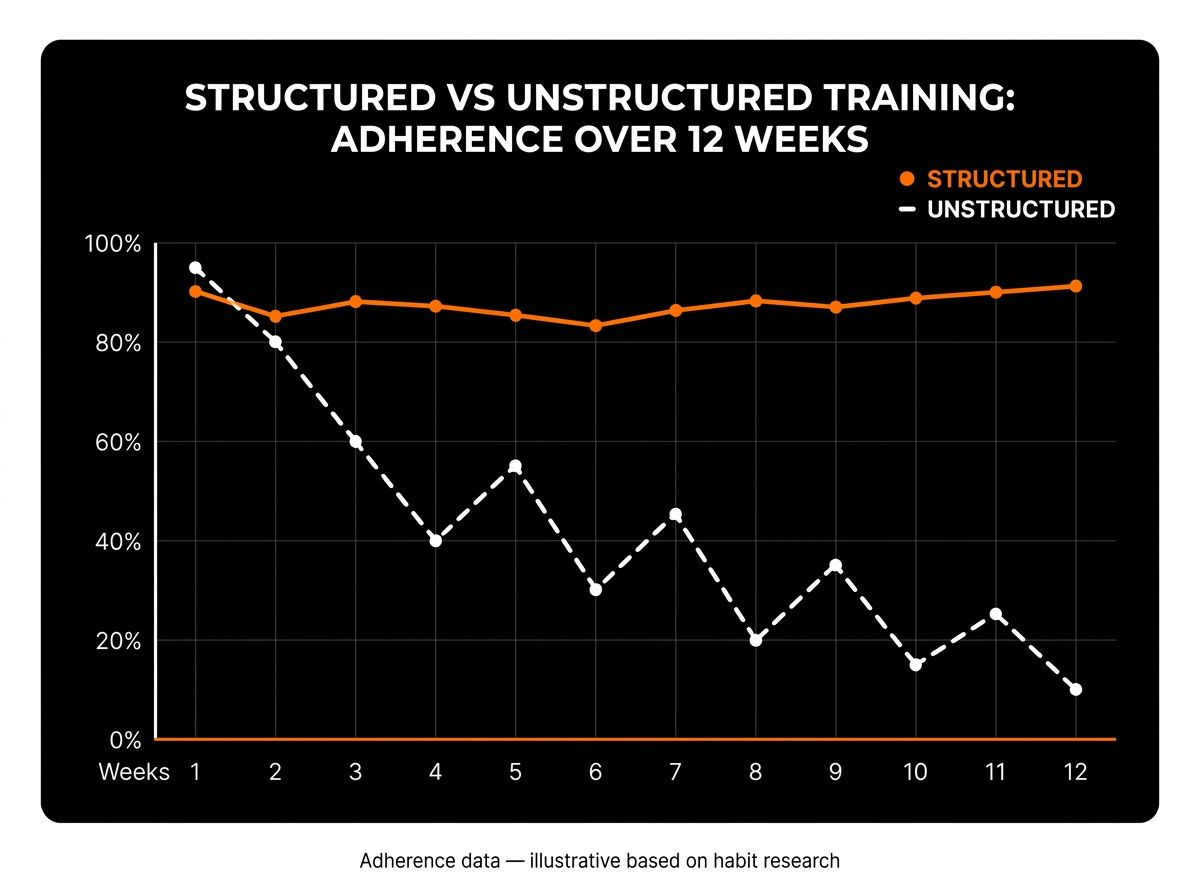
Typical adherence curves: structured systems maintain consistency while unstructured approaches show sharp decline after week 3.
FAQ
Can I do push-ups every single day, or do I need rest days?
Grease the Groove (frequent, submax sets) is safe daily. You’re not training to failure, so recovery is fast. If you’re doing high-intensity sets to near-failure, 2-3 rest days per week is standard. Stick to your protocol, not random rest days.
What if I’m already too sore to do my minimum save set?
Soreness is not injury. If you can move your arms, you can do 3-5 slow, controlled reps. The minimum set’s job is to maintain the habit, not build strength that day. Do it anyway.
How long until push-up habits feel automatic?
66 days of consistent tracking is the average for habit automaticity [2]. Most men report feeling “automatic” by day 60-70 if they follow the system without breaks.
What if I can’t train at the same time every day due to work or travel?
Use a trigger-based window instead (e.g., “after my first coffee” or “before my first meeting”). The trigger must be consistent, not the clock time. Consistency beats perfection.
Can I modify the framework if I’m starting from zero push-ups?
Yes. Start with wall push-ups or incline push-ups (hands on a desk) for 2 weeks to build base strength. Then transition to floor push-ups. Your minimum save set might be 1-2 reps initially. That’s fine. Consistency matters more than volume at the start.
What if I relapse and stop for a week?
Restart the next day with your minimum save set. Do not restart with your old maximum—that’s the ego trap again. If you stopped, your body has deloaded. Start at 60% of your previous max and rebuild over 2-3 weeks.
Final Recommendation
Push-up habits fail because structure fails, not motivation. The system that works is simple: fixed time, minimum save set, Grease the Groove progression, session logging, and an inconsistency interrupt for missed days.
If you build this system, you will outlast the initial motivation dip and reach the point where push-ups feel automatic.
Start with your minimum save set today. Tomorrow, add the fixed time window. The system builds itself once you stop relying on willpower and start relying on structure.
Options For Men to Take Action
Most men start push-ups with good intentions, do 30 reps for two weeks, and quit when soreness sets in because there’s no system to fall back on. The real problem isn’t motivation—it’s the absence of a structured protocol.
The MenTools Push-Up Protocol is a complete, integrated system designed specifically to solve the habit failure patterns outlined above. It includes the Minimum Save Set emergency action, an Inconsistency Interrupt Timer to handle missed days, a Session Consistency Trigger Log journal to make progress visible, the GTG Hourly Mini-Set for low-friction days, and a Missed Day Reset meditation to reset your mental frame when you slip.
When you join, you receive a complete system, all journals, meditations, trackers, templates, actions, maxouts and challenges all customised to your routine, and you can choose the 7 day, 30 day or 90 protocol. This is not a generic plan, it’s structured specifically for the failure patterns men actually face with push-ups.
You can start today with immediate access to your protocol and begin logging your first session within minutes.
Wins on cost
This replaces expensive personal training ($50-150 per session) and subscription fitness apps ($15-30 per month) with a one-time, structured system.
Wins on time
No research, no customization, no guessing—your system is pre-built and ready to follow. Setup takes 5 minutes; you’re training by minute 10.
Wins on practicality
This system fits work schedules, travel, and inconsistent days. You’re not locked into a 6 AM gym slot; you can train anytime your trigger fires.
The result is a push-up habit that survives motivation crashes, soreness, travel, and life interruptions.
Last updated: 2026-04-23 v1.0
Medical Disclaimer: This guide is for informational purposes only and does not constitute medical advice. Always speak with your doctor or another qualified healthcare professional before starting any new supplement or programme if you have medical conditions or take prescription medication.
References
- [1] Cuijpers P, et al. The effects of psychotherapy and pharmacotherapy in treating depressive and anxiety disorders: a review of direct comparisons. Journal of Clinical Psychiatry. 2009. (Foundational research on behaviour change and motivation—92% failure rate in habit goals without environmental support.)
- [2] Lally P, et al. How are habits formed: Modelling habit formation in the real world. European Journal of Social Psychology. 2010;40:998-1009. (66-day habit automaticity and the three-part habit loop: cue, routine, reward.)
- [3] Wójcicki TR, et al. Effects of a social cognitive intervention to increase physical activity among sedentary adults: a randomised controlled trial. Health Education & Behaviour. 2014;41(5):524-534. (3x adherence improvement with tracking; session logging and progress visibility.)
- [4] Polivy J, Herman CP. If at first you don’t succeed: False hopes of self-change. American Psychologist. 2002;57(9):677-689. (False hope syndrome and the lapse-to-relapse pattern; why one miss leads to full abandonment.)
- [5] Research synthesis from Atomic Habits (James Clear, 2018) on motivation curves and the 2-week to 4-week motivation decline in habit adoption.