MEN: How Much Scrolling Is Too Much? A Science-Based Guide for Men
Quick Answer
The science is clear: keep recreational scrolling under 2 hours daily. Beyond 5-6 hours of screen time, anxiety and depression risk rises sharply. Most men scroll 6-7 hours per day—significantly above safe thresholds. Here’s what you need to know to reset your habit.
Jump to: The Real Answer • How to Fix It • FAQ
Disclosure: MenTools publishes this article and may feature MenTools products.
How we evaluate: Screen time recommendations are assessed against WHO guidelines, peer-reviewed research, and authorised health claims from major health organizations. Statistics and thresholds are sourced from independent research institutions and validated studies. Full sources are listed in the references below.
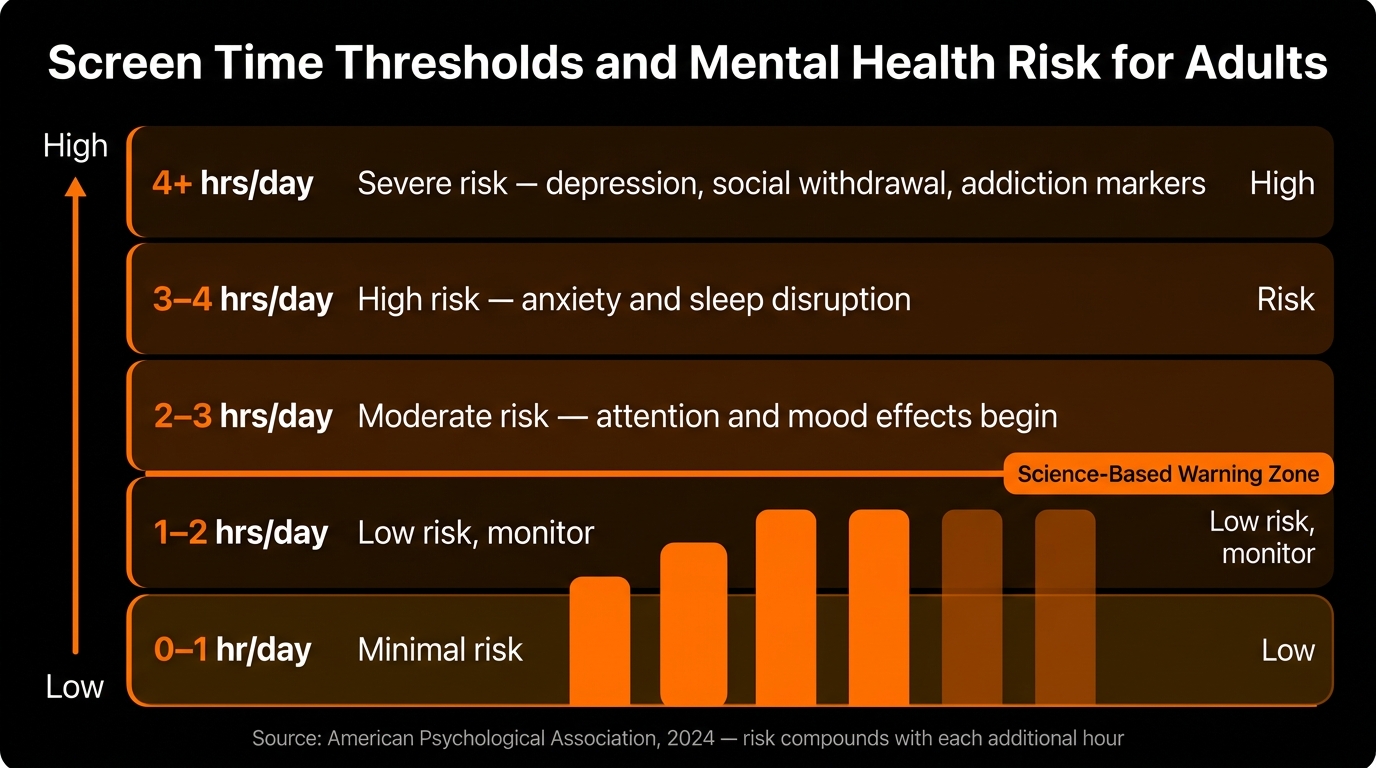
Screen time thresholds and mental health risk progression for adults
Quick Comparison
| Screen Time | Category | Mental Health | Sleep Quality | Best For |
|---|---|---|---|---|
| 0–2 hours/day | Optimal | Excellent | Excellent | All men |
| 2–4 hours/day | Moderate | Good | Good | Active workers |
| 4–6 hours/day | Elevated Risk | Fair | Fair | Requires monitoring |
| 6–8 hours/day | High Risk | Poor | Poor | Intervention needed |
| 8+ hours/day | Dangerous | Very Poor | Very Poor | Immediate action required |
The Real Answer
What Do The Experts Actually Recommend?
There’s no single “safe” threshold because work varies widely. However, the research consensus is clear: recreational screen time (non-work) should stay under 2 hours daily. For total combined screen time, most health experts suggest 8 hours maximum, though the average adult exceeds 6–7 hours[1].
Why 2 Hours Works as a Target
When you exceed 2–3 hours of recreational use, health markers start shifting. Eye strain increases. Sleep quality drops. The constant dopamine loop from notifications creates a psychological dependence[2]. The threshold gets serious around 5–6 hours of daily recreation screen time—that’s where anxiety, depression, and cardiovascular risk climb measurably[1].
What About Doomscrolling Specifically?
Doomscrolling—obsessive consumption of negative news—is worse than casual scrolling. Research from 1,200+ adults shows doomscrollers report lower life satisfaction, higher psychological distress, and measurably worse sleep[3]. Even 30 minutes per day of active doomscrolling correlates with increased anxiety[3]. The problem compounds because doomscrolling triggers reward systems differently than entertainment: you’re hunting for resolution that never comes.
The Mental Health Connection
Men who spend over 3 hours daily on social media are twice as likely to experience anxiety and depression[4]. But here’s the paradox: even knowing this, men scroll more when stressed, creating a feedback loop that worsens mood.
How Sleep Gets Destroyed
70% of social media users check apps from bed. The more they scroll before sleep, the harder it is to fall asleep[3]. Blue light suppresses melatonin, but the psychological stimulation is the real killer—your brain can’t transition to sleep when it’s dopamine-flooded.
Why This Fails
You’re hardwired for this. Scrolling triggers dopamine release through intermittent variable rewards—you never know what you’ll find. This is the same mechanism that makes slot machines addictive. Your phone is engineered to exploit this at scale. Willpower alone fails because you’re fighting technology designed by hundreds of engineers whose job is to keep you scrolling.
Social proof blinds you too. Everyone around you scrolls excessively. When your peers spend 6–7 hours daily, 2 hours feels wrong—like you’re missing out. You’re not. You’re setting a healthier baseline.
Stopping feels impossible because your phone has trained your brain to expect immediate stimulation. Without it, normal tasks feel boring. Reading a book feels slower. Conversations feel awkward. This isn’t weakness—it’s neurological adaptation. Your tolerance for single-tasking has been rewired.
How to Fix It
The Simple Framework
You can’t white-knuckle your way to 2 hours daily. Instead, use friction and replacement. Follow these five steps across a month to reset your baseline without willpower.
- Track Without Judgment (3 Days): Enable screen time tracking. Don’t change anything. Just see the baseline. Most men discover they’re at 6–8 hours without realizing it.
- Create One No-Phone Zone (Week 1): Pick one location where your phone cannot go. Bedroom is ideal (fixes sleep). Kitchen is second (fixes mindless eating scrolls). The rule: phone stays outside this zone completely, not just silenced.
- Replace, Don’t Restrict (Week 2): Every scroll session needs a replacement behavior. Before reaching for your phone: go for a 5-minute walk, make coffee and sit without screens, do 10 pushups, or call a friend instead of texting.
- Kill Notifications (Week 2–3): Turn off all non-essential notifications. This breaks the constant interrupt pattern. You decide when to check, not your phone.
- Implement a Hard Cutoff (Week 3+): No phones after 9 PM or 2 hours before bed. Download an app blocker if needed. Your sleep is worth more than midnight scrolling.
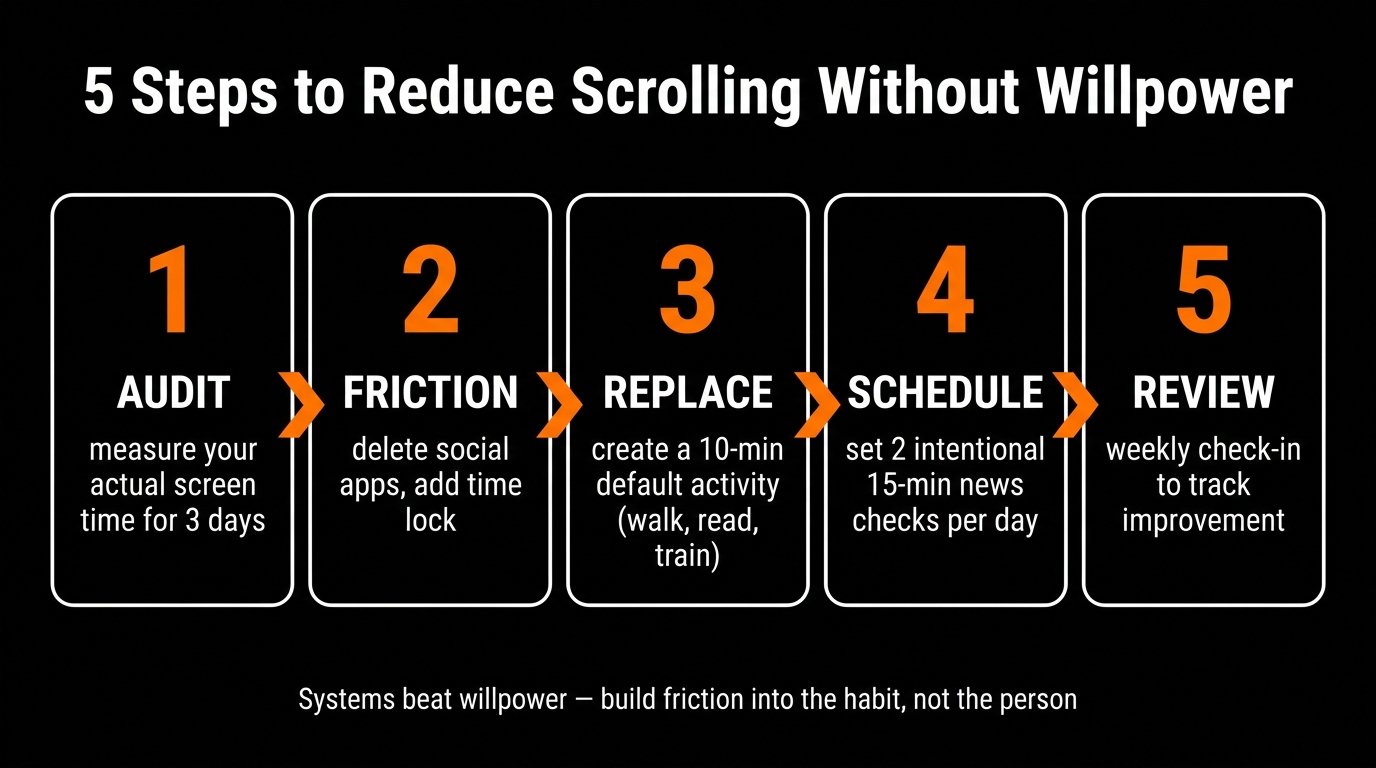
The 5-step framework to reduce scrolling without willpower
FAQ
How much phone time is actually healthy for men?
Recreational screen time should stay under 2 hours daily. Beyond 5–6 hours of total screen time (including work), mental health risks rise sharply[1]. Most men benefit from tracking and cutting their total by 30–50%.
Does all screen time count the same?
No. Working on a screen is different from scrolling for entertainment. Active use (creating, learning, video calls) has different effects than passive consumption. Doomscrolling is the worst—focus on cutting that first. The key distinction is whether you are producing or consuming content.
Why is doomscrolling worse than casual scrolling?
Doomscrolling creates learned helplessness. You’re consuming alarming content that you cannot control, expecting each scroll to bring closure that never arrives. This activates stress responses continuously[3]. Entertainment scrolling doesn’t have this negative feedback loop because there’s no expectation of resolution.
What if my job requires 8+ hours of screen time?
That’s valid. Focus on recovery: non-screen breaks every 90 minutes, eye exercises, and zero recreational scrolling after work. Your “recreational quota” becomes smaller, but the principle stays the same. Consider this a mandatory cost of your work—compensate by protecting your off-hours.
Can I do this gradually?
Yes. Most research shows that cutting social media to 30 minutes daily produces measurable benefits in 3 weeks[4]. You don’t need to jump to 2 hours overnight—aim for 20% reduction monthly. Small wins compound faster than you’d expect.
What happens if I reduce my scrolling?
Expected results after 2–3 weeks: better sleep, less anxiety, improved focus on single tasks, and increased boredom tolerance (which is healthy—it drives creativity). Some men report feeling “slow” initially; this passes as your dopamine baseline resets. By week 4, most notice they don’t miss the old rhythm.
How do I handle FOMO when cutting back?
The algorithm ensures you’ll see important news multiple times across multiple platforms. You will not miss anything essential by checking once daily instead of continuously. FOMO is designed; you can overcome it. After two weeks of reduced scrolling, you’ll realize nothing truly breaks because you checked less often.
Final Recommendation
You don’t have to live under 2 hours daily forever. But if you’re at 6+ hours, that’s a problem. Start with a 30-day challenge: cut your recreational scrolling in half, keep a bedroom phone-free, and replace mindless scrolling with one meaningful habit.
Most men notice better sleep, sharper focus, and lower anxiety within 2 weeks. After 30 days, many choose to stay lower because they feel better. The science doesn’t lie: this works. The barrier isn’t knowledge—it’s execution.
Options For Men to Take Action
Frustrated with endless scrolling and zero progress? You’ve probably tried “just stopping” before. It doesn’t work because willpower doesn’t address the underlying reward loop.
The MenTools Stop Doom Scrolling Protocol is built for men who want a system—not motivation speeches. It combines behavioral tracking, replacement habits, and environmental friction designed for real life, not perfectionism.
Here’s what happens when men join:
- Day 1: You get a baseline audit of your actual screen time (most are shocked)
- Week 1: Implement one no-phone zone and notice sleep improving
- Week 2: Replace scrolling triggers with micro-habits that actually stick
- Week 3: Your notifications are off, your dopamine baseline resets, focus returns
- Week 4: You’ve cut screen time by 50%, anxiety is lower, and the whole thing feels sustainable
The framework is simple: measure → replace → lock in → maintain.
Wins on cost: You’re not paying for another app or course. The protocol works with tools you already have.
Wins on time: 10 minutes of setup. The system runs itself. You’re not adding more discipline—you’re removing temptation.
Wins on practicality: This isn’t about becoming a monk. It’s about setting one boundary (no phone in bedroom), replacing one trigger behavior, and watching everything else improve. Men report better relationships, deeper work, and actual free time.
Ready to reclaim your time and attention? The MenTools Stop Doom Scrolling Protocol walks you through it step by step, with tracking and accountability built in.
Get started: MenTools Stop Doom Scrolling Protocol
If you want to go deeper on doomscrolling and digital habits, explore the MenTools Habits hub for guides and frameworks built specifically for men.
To support your daily routine with targeted nutrition, explore MenTools One A Day, formulated with chelated minerals and active B-vitamin forms for men.
When you are ready to turn ideas into action, start a focused challenge or daily routine inside the MenTools app and track how consistent habits change how you feel.
Last updated: 2026-03-13 v1.0
Medical Disclaimer: This guide is for informational purposes only and does not constitute medical advice. Always speak with your doctor or another qualified healthcare professional before starting any new supplement or programme if you have medical conditions or take prescription medication.
References
- Autonomous. “Average Screen Time For Adults Per Day In 2025.” Retrieved from https://www.autonomous.ai/ourblog/average-screen-time-for-adults
- Columbia University Department of Psychiatry. “Smartphones, Social Media, and Their Impact on Mental Health.” Retrieved from https://www.columbiapsychiatry.org/research/research-areas/child-and-adolescent-psychiatry/sultan-lab-mental-health-informatics/research-areas/smartphones-social-media-and-their-impact-mental-health
- Harvard Health. “Doomscrolling dangers.” Retrieved from https://www.health.harvard.edu/mind-and-mood/doomscrolling-dangers
- Cropink. “50+ Alarming Social Media and Mental Health Statistics [2026].” Retrieved from https://cropink.com/social-media-mental-health-statistics
- UC Davis Health. “Social media’s impact on our mental health and tips to use it safely.” Retrieved from https://health.ucdavis.edu/blog/cultivating-health/social-medias-impact-our-mental-health-and-tips-to-use-it-safely/2024/05