
MEN: How to Be a Present Dad When You Work Full Time
Quick Answer
Stop trying to add hours and start protecting anchors. Pick two short slots a day that belong to your kids, put the phone in another room during them, own one routine end to end, play properly instead of supervising, and book the fixed dates before work fills the week. Two protected anchors beat a vague promise of more time.
**Jump to:** The 7 steps at a glance | FAQ | Options for men
Disclosure: MenTools publishes this article and may feature MenTools products.
How we evaluate: Each step is assessed on real-world use, evidence, cost and time, and how well it suits men. Every step including the MenTools option carries an honest limitation. Full sources are in the references below.
The 7 Steps at a Glance
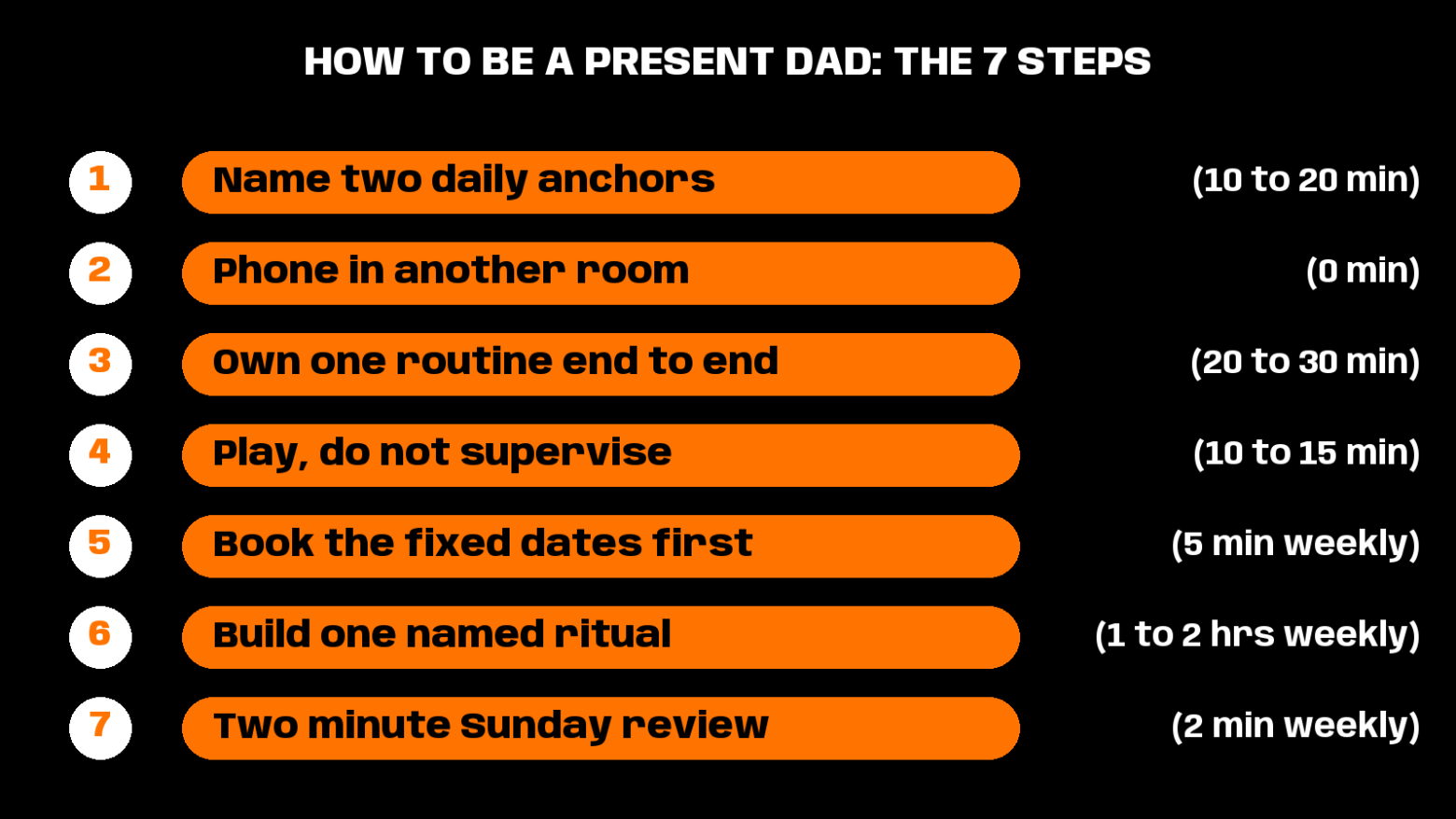
The seven steps, and what each one actually costs you on a working day.
| Step | Best for | Watch-out | Time |
|---|---|---|---|
| Name two daily anchors | Dads who get home and the evening evaporates | Two anchors means saying no to a late call | 10 to 20 min |
| Phone in another room | Being in the room but not in the conversation | Genuinely hard if you are on call | 0 min |
| Own one routine end to end | Dads who help rather than lead | The routine still has to happen on bad days | 20 to 30 min |
| Play, do not supervise | Men who default to watching from the sofa | Costs energy you may not have after work | 10 to 15 min |
| Book the fixed dates first | Weeks that fill with other people’s meetings | A booked date still needs defending | 5 min weekly |
| Build one named ritual | Weeks that blur into each other | Only counts if it survives a bad month | 1 to 2 hrs weekly |
| Two minute Sunday review | Systems that quietly stop working | Turns into guilt if you let it | 2 min weekly |
How We Chose These 7 Steps
We chose steps a man can run after a full working day, not steps built for someone who controls his own diary. Each one had to clear three tests: real research behind it, a time cost you can meet on a normal Tuesday, and a version that still works when the job overruns. The problem is close to universal. A Pew Research Center survey of 2,242 working parents, fielded between 2 and 15 March 2026, found that 60 percent of full time working parents think they spend too little time with their children, and 62 percent of full time working dads handle parenting tasks while they are at work [1]. Every step below carries an honest watch-out, because no routine can shrink a job that is genuinely too big.
Does the Amount of Time You Spend With Your Kids Actually Matter?
Not in the way most working dads assume. The total number of hours is a poor predictor of how children turn out. What shows up in the research is the quality and predictability of the contact, which is good news if your hours are fixed and long.
The clearest test came from Melissa Milkie, Kei Nomaguchi and Kathleen Denny in the Journal of Marriage and Family. Using time diary data on 1,605 children aged 3 to 11 and 778 adolescents aged 12 to 18, they found that the overall amount of parental time was not associated with children’s behavioural, emotional or academic outcomes [3]. That is not permission to disappear. It is permission to stop measuring yourself with a stopwatch.
What does show up is involvement. A systematic review of longitudinal studies by Anna Sarkadi and colleagues in Acta Paediatrica concluded that active father involvement was associated with fewer behavioural problems in boys and fewer psychological problems in young women, along with better cognitive development [4]. Involvement is a pattern of contact, not a total.
The bar has also moved. Research by Dr Giacomo Vagni, covering more than 4,500 parents across 54 years of UK time use data, found fathers’ daily childcare time rose from 18 minutes in 1961 to 71 minutes in 2015 [2]. You are almost certainly doing four times what your grandfather did and still feeling behind, because the standard rose faster than the hours did.
1. Name Two Daily Anchors and Defend Them
Pick two short slots that belong to your children every working day, and treat them as fixed. Morning breakfast and bedtime is the default pair for most working dads. The point is not the length. The point is that the slot is named, repeated and defended, so nobody in the house has to wonder whether tonight is one of the nights.
What to do: Choose two slots, write them down, and tell your kids what they are. Ten minutes each is enough to start.
Best for: Dads who walk in at seven, mean to give the evening to the family, and find it gone by half past eight.
Why it works: Specific advance decisions beat general good intentions by a wide margin. The meta-analysis by Peter Gollwitzer and Paschal Sheeran, covering 94 independent tests, found that spelling out when, where and how you will act had a medium to large effect on goal attainment, with a d value of 0.65 [9]. “More time with the kids” is an intention. “Breakfast and bath, every weekday” is a plan.
Watch-out: Naming two anchors means declining the calls and commutes that land on top of them, and some weeks you will not win that. Pick anchors that sit at the edges of the working day rather than the middle, and agree the fallback in advance so a missed anchor has a stated replacement rather than a silent one.
2. Put the Phone in Another Room During the Anchors
Leave the phone out of the room for the ten or twenty minutes the anchor lasts. Face down on the table is not the same thing. The research on interrupted parenting is consistent enough that this is the single cheapest step on the list, and the one most men quietly skip.
What to do: Phone on the kitchen worktop or in the hall, on silent, for the whole anchor. Tell whoever might need you that you are off for twenty minutes.
Best for: The dad who is physically home every night and still gets told he is not really there.
Why it works: Brandon McDaniel and Jenny Radesky’s technoference research followed 183 couples with children aged 0 to 5 across four measurement points and found that problematic parental device use predicted more technology interruptions in parent and child interactions, which in turn predicted higher reported child externalising behaviour such as tantrums and aggression, and internalising behaviour such as withdrawal [5]. Parents also reported that while using a device it was harder to read their child’s cues and respond to them.
Watch-out: If you are genuinely on call, this step has to be negotiated rather than obeyed. Set the phone to ring only for the two numbers that matter, and accept that a partially protected anchor beats a cancelled one. Do not swap a phone in your hand for a laptop on your knee.
3. Own One Routine From Start to Finish
Take one daily routine and run it completely, not as the helper. Bedtime is usually the highest value one to take, because it is repeated, it has a clear shape, and the evidence behind it is unusually strong.
What to do: Pick a routine, learn the whole sequence, and run it on the nights you are home without being managed through it.
Best for: Dads who are involved but always assisting, and who end up holding no part of the day on their own.
Why it works: In a study of 10,085 children aged 0 to 5 across 14 countries, Jodi Mindell and colleagues found a dose dependent relationship between a consistent bedtime routine and sleep outcomes, with children who had a nightly routine sleeping over an hour longer per night on average than children who never had one, alongside earlier bedtimes, fewer night wakings and fewer daytime behaviour problems [6]. Owning that routine is one of the highest leverage twenty minutes available to a working dad.
Watch-out: Owning a routine means it has to happen on the nights you are tired, late and short tempered, and that is exactly when it is easiest to hand back. Agree with your partner that ownership includes the bad nights, or it is not ownership. It also does not scale: pick one routine, not four.
4. Play Properly Instead of Supervising
Get on the floor, in the garden or in the water and actually play, rather than watching from the sofa with one eye on the phone. Physical, unpredictable, slightly boisterous play is the thing fathers reliably bring, and the evidence suggests it does specific work.
What to do: Ten to fifteen minutes of active play, led by them, with you fully involved. Wrestling, chasing, football, building, whatever fits the age.
Best for: Men who are present in the house but default to supervising rather than joining in.
Why it works: A systematic review by Anna Amodia-Bidakowska, Ciara Laverty and Paul Ramchandani covering 78 studies published between 1977 and 2017 found that father and child play is more physical than mother and child play, and that children who get high quality play with their father show better emotional regulation, less aggression and fewer behavioural problems at school [7]. Ramchandani, Professor of Play in Education, Development and Learning at the University of Cambridge, put the mechanism plainly: “Physical play creates fun, exciting situations in which children have to apply self-regulation” [8]. He was also careful about the limits, noting: “It’s important not to overstate the impact of father-child play as there are limits to what the research can tell us, but it does seem that children who get a reasonable amount of playtime with their father benefit as a group” [8].
Watch-out: This costs physical energy at the exact point in the day when you have least, so it is the first step to degrade into supervising again. Keep it short and put it before you sit down, because the sofa is a one way door.
5. Book the Fixed Dates Before Work Fills the Week
Put the school assembly, the match and the parents’ evening into your work calendar as soon as you know about them, not after the meetings arrive. If they go in second, they get the leftovers, and the leftovers are whatever nobody else wanted.
What to do: Once a week, take the dates from the school calendar and the kids’ fixtures and block them in the work diary with a start time, an end time and a location.
Best for: Dads whose week gets filled by other people’s requests before they have made a single decision of their own.
Why it works: Missing these is the specific thing that hurts. In the same Pew survey, 47 percent of working parents said work responsibilities cause them to miss their children’s activities, and 45 percent of fathers said they feel extremely or very upset when it happens [1]. A booked block does not remove the conflict, but it moves the decision from the morning of the match to three weeks before it.
Watch-out: A block in a calendar is a claim, not a guarantee, and it still needs defending when something urgent lands on it. Leave some slack elsewhere in the week so the plan bends instead of snapping, and tell one colleague which blocks are immovable.
6. Build One Named Weekly Ritual
Create a single repeating thing with a name that your kids can predict and describe. Saturday morning swim. Friday chippy tea. Sunday walk with the dog. One is enough, and naming it is not a gimmick.
What to do: Choose one weekly slot, name it out loud, and run it for three months before you judge it.
Best for: Working weeks that blur into one another, where nobody can point to a thing that was theirs.
Why it works: Barbara Fiese and colleagues reviewed 50 years of research on family routines and rituals in the Journal of Family Psychology, drawing on 32 publications, and found that routines and rituals were linked to parenting competence, child adjustment and marital satisfaction, and that meaningful rituals contributed to adolescents’ sense of identity [10]. The distinction in that work matters: routines are what you do, rituals are what the family understands them to mean.
Watch-out: A ritual only counts once it has survived a bad month, so the first eight weeks tell you nothing. Keep it cheap and local, because an expensive ritual gets cancelled first, and cancelling the named thing costs more than never naming it.
7. Run a Two Minute Review Every Sunday
Spend two minutes checking whether the anchors actually happened. Not how you felt about it, what actually happened. This is the step that keeps the other six honest, and it is the one men skip because it feels like admin.
What to do: Three questions, same three every week. Did both anchors happen most days, did the ritual happen, and what one thing gets in the way most often. Write the answers where you will see them next Sunday.
Best for: Dads whose new routine worked brilliantly for a fortnight and then quietly stopped.
Why it works: Monitoring is one of the most reliable levers in behaviour change. The meta-analysis by Benjamin Harkin and colleagues in Psychological Bulletin covered 138 studies with 19,951 participants and found that prompting people to monitor their progress sharply increased monitoring (d = 1.98) and improved goal attainment (d = 0.40), with larger effects when the information was physically recorded [11]. Writing it down is the active ingredient, not the paperwork.
Watch-out: A review can turn into a weekly guilt session, which is why it is two minutes and three factual questions rather than an open reflection. If it consistently leaves you flat, record only what happened and drop the commentary.
How Much Presence Is Enough on a Working Week?
Enough is two anchors that happen on most working days, one routine you own, and one named weekly ritual. That is the realistic target for a man working full time, and it is a long way below the standard most dads privately hold themselves to. Presence is a pattern, and a small pattern that repeats beats a big one that does not.
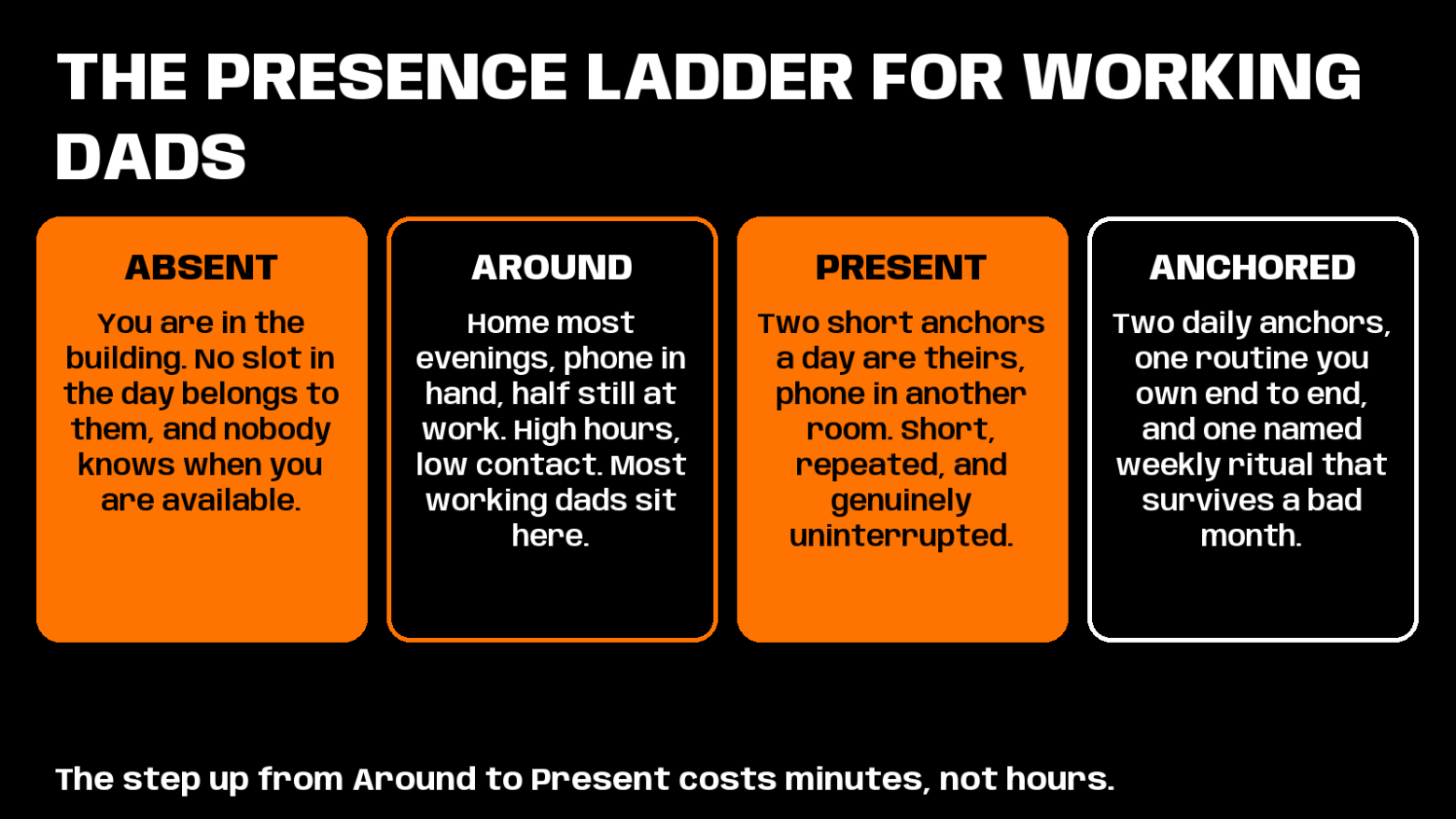
Most working dads are stuck at “around”. The step up to “present” is smaller than it looks.
It is worth being honest about who carries what. The Working Families Index 2025, based on responses from over 3,000 UK parents, found that working fathers carry the mental load for parenting at markedly lower rates than working mothers, at 48 percent against 74 percent [12]. Anchors and owned routines are the practical way a working dad takes a real share of that load rather than a visible share of the hours.
What If You Work Shifts, Nights or Away From Home?
Anchor to events rather than clock times, and run the same seven steps on the pattern you actually have. If you work nights, your anchors are breakfast before sleep and a phone call at a fixed time. If you work away, the ritual becomes the thing that happens the first evening you are back, every time, without exception.
Predictability is what the research keeps pointing at, and predictability does not require a nine to five. Since total hours were not the thing that predicted outcomes in the Milkie time diary data [3], a rotating shift pattern is not the barrier it feels like. What breaks is the unnamed promise, so name a smaller thing and keep it.
Do not treat the job itself as the enemy either. In the Pew data, 52 percent of full time working parents said their job makes it harder to be a good parent, which means roughly half did not report that [1]. The difference is usually not the hours. It is whether anything in the week is fixed.
FAQ
How much time a day should a working dad spend with his kids?
There is no research backed minimum, and total hours are a weak predictor of outcomes. Two protected slots of ten to twenty minutes on working days, plus one owned routine, is a realistic and defensible target. Consistency and full attention matter more than the total, so aim for slots you can actually keep every week.
Is it too late to become a more present dad if my kids are older?
No. Father and child play declines naturally between ages 6 and 12, but involvement keeps showing up in longitudinal outcomes across childhood and adolescence. With older children the anchors change shape, usually to lifts, meals and side by side activities, because teenagers talk more easily when they are not being looked at directly.
Does quality time really beat quantity?
Broadly yes, with a caveat. The time diary evidence found no association between the sheer amount of parental time and children’s behavioural, emotional or academic outcomes, while involvement and predictable routines do show associations. You still need enough contact for a routine to exist, so it is not an argument for a very small amount of time.
What if I get home after bedtime most nights?
Move both anchors to the morning and make the weekend ritual non negotiable. A fifteen minute breakfast that happens every weekday is worth more than an evening that happens twice a month. Where it is possible, negotiate two fixed early finishes a week rather than a vague promise to leave earlier.
How do I stop thinking about work when I am with my kids?
Put the phone in another room and give yourself a short shutdown before you walk in, such as three minutes in the car writing down the two things you will pick up tomorrow. The unfinished job is what keeps pulling attention, and writing down when you will handle it is what releases it.
Should I feel guilty about working long hours?
Guilt is common and it is a poor guide to action. Around 60 percent of full time working parents say they spend too little time with their children, so the feeling is close to standard rather than a signal that you are failing. Judge yourself on whether the anchors happened this week, which is measurable, rather than on how you feel about the hours.
Final Recommendation
Start with two steps, not seven. Name your two daily anchors, and put the phone in another room while they happen. Add the owned routine in week two, the play and the booked dates in week three, and the named ritual once the anchors have held for a month. The two minute Sunday review goes on last, because it only has something useful to tell you once there is a pattern to check.
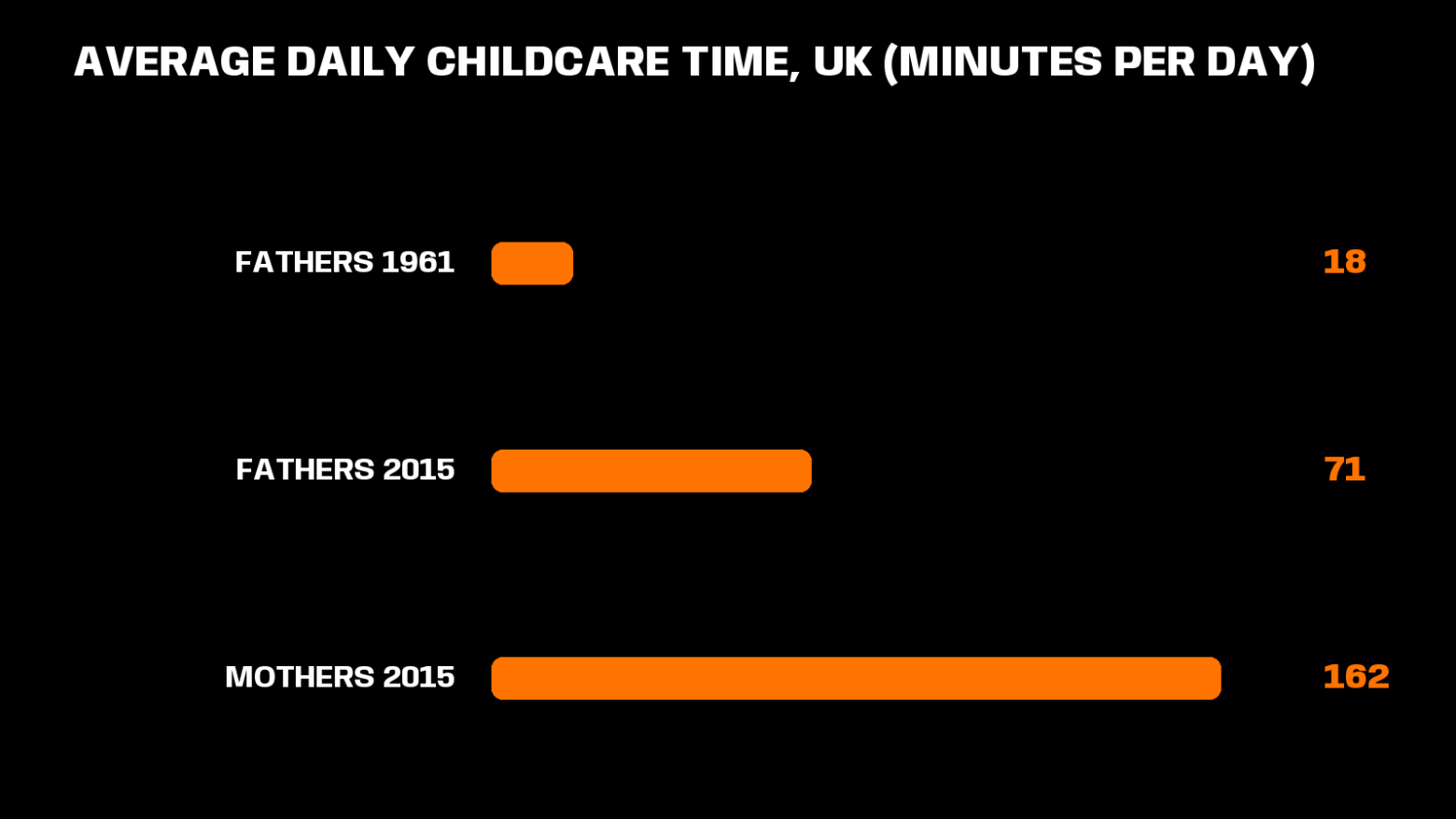
Fathers already do roughly four times what they did in 1961. The gap you feel is the standard rising, not you slipping.
Options for Men to Take Action
Most working dads do not need to be told that their kids matter. What they need is something that makes the anchor still happen in week seven, on the Thursday the job overruns and nobody would notice if it quietly stopped. That is the point at which good intentions turn back into a normal evening.
The MenTools app runs commitments like these as one challenge system rather than seven separate promises, with daily actions, chosen difficulty levels, reminders timed to the moment the decision is actually made, streaks, progress tracking and an AI coach for the weeks that fall apart on Tuesday. Men tend to keep the things they can see a record of.
How you can do this today: set your two anchors as daily actions, name the weekly ritual, and log tonight’s anchor before you sit down.
Wins on cost: one subscription covers the habit side of fatherhood, fitness, mindset and money instead of four separate tools.
Wins on time: the structure, levels and tracking already exist, so there is nothing to design before you start.
Wins on practicality: it works around shifts, night work, travel and school runs, which is exactly where rigid parenting plans fall over first.
Watch-out: an app cannot defend your calendar, negotiate your hours or make you get off the sofa. If you already run a reliable bedtime and a weekly ritual, this adds tracking rather than a change.
Long days take something out of you, and the anchors are easiest to keep when you are not running on empty, so a one a day multivitamin may help cover the simple daily foundation underneath the routine. If you want the behaviours rather than the system, our guide to the habits of a great dad sits directly alongside this one, and the calendar side is covered in how to plan your week as a man. More built for men sits in the MenTools fatherhood hub. Two anchors, held for three months, will change more than any promise to work less.
Last updated: 2026-09-03 v1.0
Disclaimer: This guide is for informational purposes only and does not constitute medical or psychological advice. Speak with a qualified professional before making significant changes if you have a medical or mental health condition.
References
- [1] Minkin R, Lin L, Braga D, Hurst K. For working parents, the boundary between work and family is often blurred. Pew Research Center, survey of 2,242 US working parents, fieldwork 2 to 15 March 2026. Link
- [2] Vagni G. Analysis of UK parental childcare time 1961 to 2015, more than 4,500 parents, Journal of Time Use Research, reported by the University of Essex, November 2023. Link
- [3] Milkie MA, Nomaguchi KM, Denny KE. Does the amount of time mothers spend with children or adolescents matter? Journal of Marriage and Family, 2015;77(2):355-372. Link
- [4] Sarkadi A, Kristiansson R, Oberklaid F, Bremberg S. Fathers’ involvement and children’s developmental outcomes: a systematic review of longitudinal studies. Acta Paediatrica, 2008;97(2):153-158. Link
- [5] McDaniel BT, Radesky JS. Technoference: longitudinal associations between parent technology use, parenting stress, and child behavior problems. Pediatric Research, 2018;84:210-218. Link
- [6] Mindell JA, Li AM, Sadeh A, Kwon R, Goh DYT. Bedtime routines for young children: a dose-dependent association with sleep outcomes. Sleep, 2015;38(5):717-722. Link
- [7] Amodia-Bidakowska A, Laverty C, Ramchandani PG. Father-child play: a systematic review of its frequency, characteristics and potential impact on children’s development. Developmental Review, 2020;57:100924. Link
- [8] University of Cambridge. Playtime with dad may improve children’s self-control, June 2020. Link
- [9] Gollwitzer PM, Sheeran P. Implementation intentions and goal achievement: a meta-analysis of effects and processes. Advances in Experimental Social Psychology, 2006. Link
- [10] Fiese BH, Tomcho TJ, Douglas M, Josephs K, Poltrock S, Baker T. A review of 50 years of research on naturally occurring family routines and rituals. Journal of Family Psychology, 2002;16(4):381-390. Link
- [11] Harkin B, Webb TL, Chang BPI, Prestwich A, Conner M, Kellar I, Benn Y, Sheeran P. Does monitoring goal progress promote goal attainment? A meta-analysis of the experimental evidence. Psychological Bulletin, 2016;142(2):198-229. Link
- [12] Working Families. Working Families Index 2025, survey of over 3,000 UK parents. Link