
MEN: What Should Men Eat to Stay Lean and Energised?
Quick Answer
Build most meals from a protein source, two portions of vegetables, a high fibre carbohydrate and a little fat, and keep ultra processed food to the minority of what you eat. Aim at roughly 30 grams of fibre a day and spread protein across the day rather than loading the evening. Lean comes from the total. Steady energy comes from the pattern.
**Jump to:** The day at a glance | FAQ | Options for men
Disclosure: MenTools publishes this article and may feature MenTools products.
How we evaluate: Each recommendation is assessed on real-world use, evidence, cost and time, and how well it suits men. Every recommendation including the MenTools option carries an honest limitation. Full sources are in the references below.
What a Lean and Energised Day Looks Like at a Glance
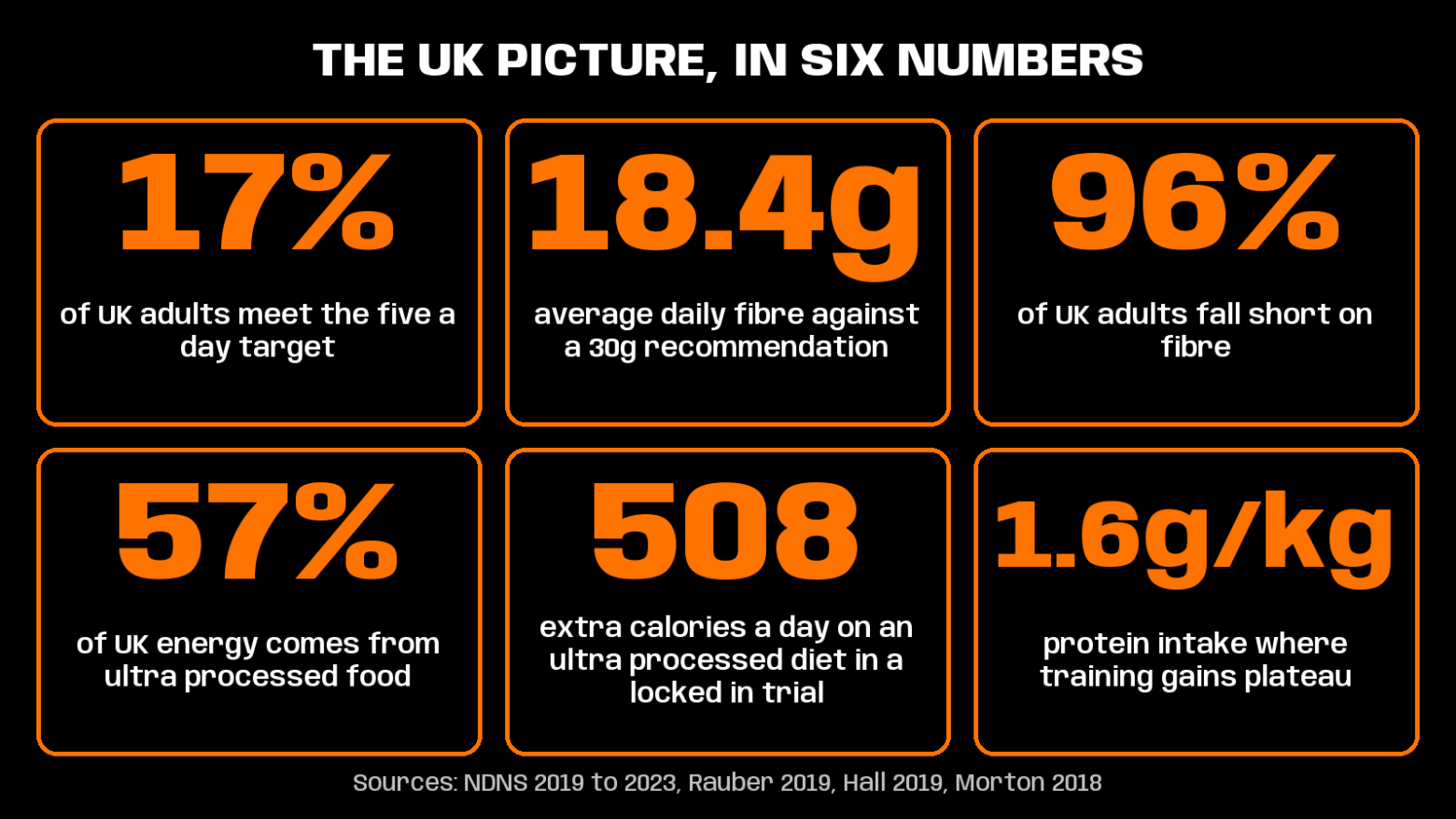
Six numbers that explain most of what goes wrong with a man’s diet.
| Eating occasion | Build it from | Why it matters | Watch-out |
|---|---|---|---|
| Breakfast | Protein plus a high fibre base | Sets the protein floor and softens the mid morning dip | Skipping it is fine, but the protein has to move somewhere |
| Lunch | Protein, two veg, a whole grain | Keeps the afternoon workable | A heavy lunch measurably worsens afternoon alertness |
| Afternoon | Protein and fibre, decided in advance | This is where most men’s day comes apart | A fast carbohydrate on its own tends to bring the dip forward |
| Dinner | Protein, half the plate veg, carbohydrate to appetite | The meal with the most control over the daily total | Cooking it yourself matters more than what it is |
| Drinks | Water anchored to fixed points | Removes a free cause of afternoon fog | Liquid calories are the easiest to miss |
| What to limit | Ultra processed items you eat daily | The single largest lever on total intake | Cutting all of it at once almost never lasts |
The Short Answer, and What Actually Drives It
Staying lean is decided by your total intake over months, and staying energised is decided by the pattern of your meals within the day. Those are two different problems, which is why the food advice men get tends to solve one and ignore the other. The pattern below happens to do both, because the things that keep you full also tend to keep you steady.
The starting point is where the British diet actually sits. National Diet and Nutrition Survey data covering 2019 to 2023 found that only 17 percent of UK adults meet the five a day target, 82 percent exceed the saturated fat recommendation and 96 percent fall short on fibre [1] [2]. Most men are not one clever tweak away from a good diet, they are several ordinary defaults away from an average one.
This article is general information about eating patterns and is not medical or dietary advice. It recommends no specific diet and promises no specific outcome. If you have a medical condition or are working with a dietitian, follow that guidance instead.
Why Ultra Processed Food Makes Lean Harder Than It Should Be
Ultra processed food appears to increase how much you eat without you noticing, which is a different problem from it being nutritionally poor. This is the most direct evidence in the whole field, because it was tested under controlled conditions rather than inferred from surveys.
In a residential randomised controlled trial, 20 adults ate about 508 calories more per day on an ultra processed diet than on an unprocessed one, despite the two diets being matched for calories presented, sugar, fat, salt and fibre [3]. Participants gained roughly a kilogram in two weeks on the ultra processed diet and lost roughly a kilogram on the unprocessed one, with no instruction to restrict anything [4].
Kevin Hall, who led the study at the National Institutes of Health, pointed at eating speed as one likely mechanism: “If you’re eating very quickly, perhaps you’re not giving your gastrointestinal tract enough time to signal to your brain that you’re full” [4].
The scale of the exposure in the UK is the part most men underestimate. Ultra processed items make up around 57 percent of total energy in the British diet and around 65 percent of free sugars [5]. You do not need to eliminate that to see a change, but you cannot ignore it and expect the rest of the pattern to carry you.
Why Your Energy Dips, and How Much of It Is Food
Some of the afternoon dip is your body clock and some of it is what you ate, and it helps to know which part you can actually change. The circadian component arrives whether or not you eat lunch. The food component decides how deep it goes.
The clearest food evidence comes from continuous glucose monitoring. In a study of 1,070 people eating more than 70,000 standardised and freely chosen meals, people who experienced large blood sugar dips two to four hours after eating reported 9 percent more hunger, waited around half an hour less before their next meal, and ate about 75 more calories in the following three to four hours and around 312 more calories over the whole day, on identical meals [6] [7].
Sarah Berry of King’s College London, one of the study’s authors, summarised the finding directly: “Sugar dips are a better predictor of hunger and subsequent calorie intake than the initial blood sugar peak” [7].
The clock component is real too, and it is worth not blaming your lunch for all of it. Sleep researchers at Loughborough describe the post lunch dip as “a bi-circadian phenomenon, largely unrelated to lunch, and worsened by a disturbed prior night’s sleep” [8]. In their driving study, though, a large lunch did measurably worsen driving performance and sleepiness markers in the second half hour compared with a light one [8]. So the honest position is that your lunch does not cause the dip, it decides how bad the dip is.
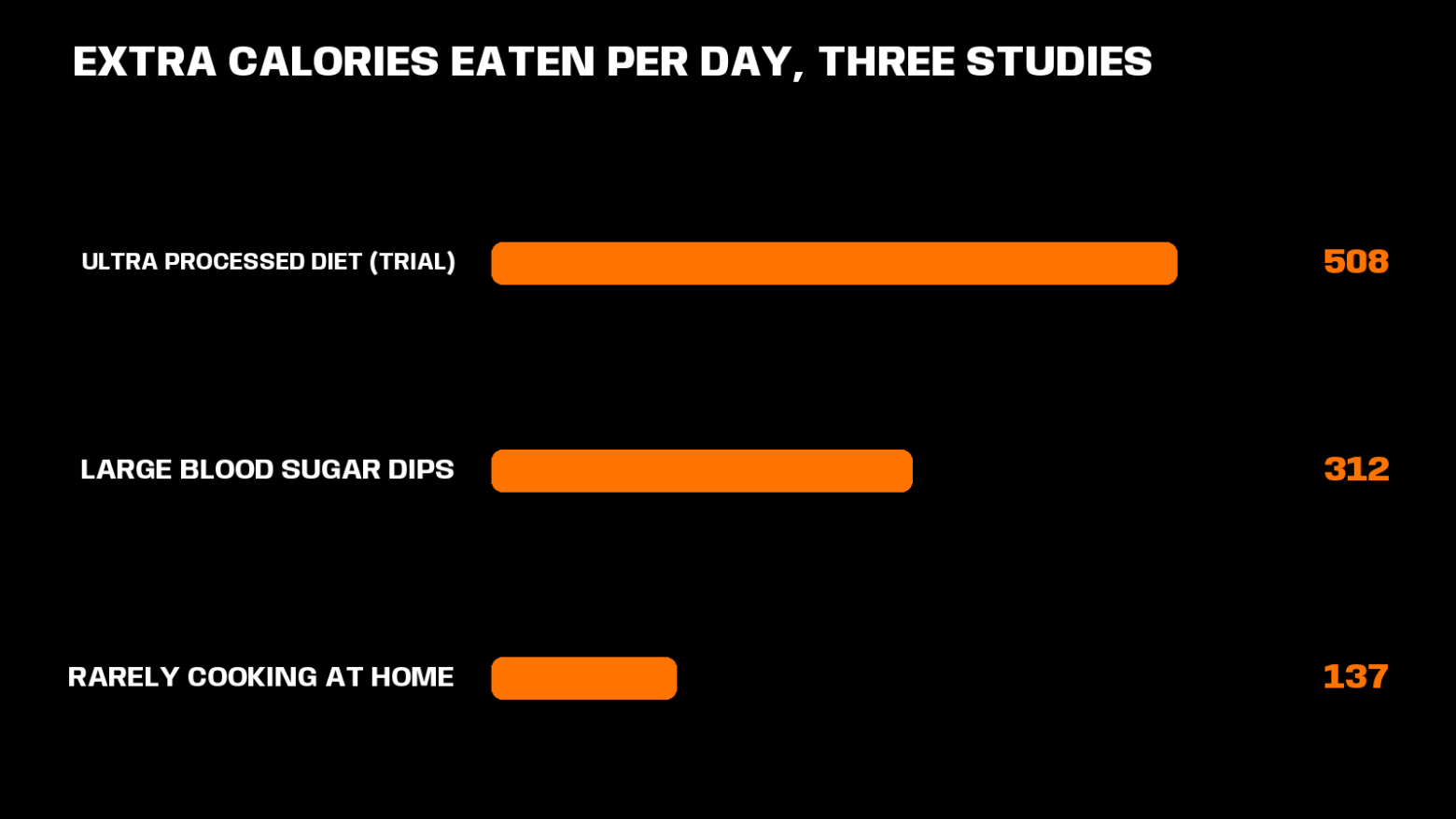
Extra calories a day from three different studies. Only the first is a randomised trial.
The third bar is the one men underrate. Analysing 9,569 adults, researchers found those cooking dinner once a week or less took in about 137 more calories a day than those cooking six or seven nights, along with more fat and notably more sugar [14]. That is an association from survey data rather than proof, but it points the same direction as the trial evidence.
How Much Protein Does a Man Actually Need?
The UK reference intake is 0.75 grams per kilogram of body weight a day, about 56 grams for a 75 kilogram man, and that is a floor for avoiding deficiency rather than a target for staying lean. Men who train have a case for considerably more, and men who do not still benefit from the fullness that protein brings to a meal.
The upper end is better defined than most men assume. A meta analysis of 49 trials covering 1,863 participants found that gains in muscle mass and strength from higher protein intake plateau at around 1.6 grams per kilogram of body weight per day, with no additional benefit in the pooled data above that [9]. For a 75 kilogram man that is about 120 grams a day, which is a long way above the reference intake and a long way below what the supplement aisle implies.
Distribution looks like it matters as well as the total. A crossover feeding study found 24 hour muscle protein synthesis was around 25 percent higher when protein was spread evenly at roughly 30 grams per meal than when the same daily amount was skewed towards dinner [10]. That study followed only eight adults, so treat it as a sensible default rather than a proven rule, and note that UK intake data shows exactly that evening skew in real life [11].
How Much Fibre, and Why It Matters for Staying Lean
Aim at 30 grams a day, and accept that you are probably around 18. Fibre is the least glamorous item on this list and the one with the widest gap between what men eat and what is recommended, which makes it the highest yield thing most men could change.
A 2026 analysis in the British Journal of Nutrition tracking 4,386 UK adults across a decade found average fibre intake moved from 17.4 grams to 18.4 grams a day against the 30 gram recommendation, leaving 96 percent of adults short [11]. Ten years of public health messaging produced one gram, which should tell you that this gets fixed at the shop rather than by intention.
Fibre helps on both halves of the problem at once. It slows the rise and fall of blood sugar that drives the dips above, and it adds volume and fullness to a meal without adding much energy. Practically, that means the bread, the breakfast base and the standard snack are worth changing before anything else.
What About Carbohydrates?
Carbohydrates are not the problem, and cutting them is not what makes men lean. What changes the outcome is the form they arrive in and what sits alongside them, because that decides how quickly they hit and how full you feel afterwards.
The evidence above points the same way twice. Ultra processed carbohydrate sources drove an extra 508 calories a day in a controlled trial [3], and the men most prone to large glucose dips ate an extra 312 calories a day on the same meals as everyone else [6]. Neither of those findings is about carbohydrate as a macronutrient. Both are about the version of it.
The practical version is simple. Keep carbohydrate attached to protein, fat or fibre rather than eating it alone, favour the less processed form where there is a choice, and size the portion to your actual activity that day rather than to habit. This is close to what the NHS Eatwell Guide already recommends, with starchy foods based on wholegrain or higher fibre versions making up just over a third of what you eat [13].
What Should a Man Cut First?
Cut the ultra processed item you eat every single day, not the one you eat at weekends. Daily items are where the volume is, and they are also the easiest to replace because you already know exactly when they happen.
There is a reason to be honest about pace here. Given that ultra processed food supplies around 57 percent of UK energy [5], a man trying to remove all of it in one week is making a very large change on willpower alone. One daily swap sustained for six months moves more than a perfect fortnight.
Liquid calories deserve a separate mention because they bypass the fullness response almost entirely. If you drink sugary drinks daily, that is usually the highest yield single swap available before you touch anything on your plate.
Does When You Eat Change Anything?
Timing matters less than composition for staying lean, and more than composition for staying energised. Total intake over weeks decides body composition, so eating late does not itself make a man heavier if the total is the same.
Where timing does earn its place is the afternoon. Out of home eating is where the British diet quietly comes apart, with NDNS data showing 72 percent of participants eat out at least weekly and around 23 percent of total calorie intake now coming from occasions outside the home [12]. Deciding your afternoon food the previous evening removes the decision from the point where you are hungriest and busiest.
If you want the habit level version of everything above, our guide to simple nutrition habits for busy men turns this pattern into eight specific habits with the time each one costs.
FAQ
Is a high protein breakfast better than no breakfast?
For most men, yes, but only because it makes the rest of the day easier rather than because breakfast is magic. If you prefer not to eat in the morning, keep the daily protein total and spread it across the meals you do eat. The mistake is skipping breakfast and then not making the protein up anywhere.
Do I need to eat six small meals a day?
No. Meal frequency has little effect on staying lean once total intake is matched, and three or four meals suits most working patterns better. Frequency only matters if very long gaps leave you so hungry that the next meal goes out of control.
Will cutting carbohydrates make me leaner faster?
It often produces fast early weight loss because stored carbohydrate holds water, which is not the same as fat loss. Over months, low carbohydrate approaches perform similarly to other approaches at matched intake, so pick the one you can keep rather than the one that moves the scales fastest in week one.
How much water should a man drink?
There is no single number that fits every man, because body size, heat and activity all change it. Anchoring water to three fixed points in the day works better than a litre target, because the failure mode is forgetting rather than not knowing.
Are protein shakes necessary?
No, they are a convenience rather than a requirement. They are useful when hitting a protein target from food alone is impractical, such as an early shift or a day of back to back meetings, and pointless if you are already reaching the target.
Can supplements replace any of this?
No. A one a day multivitamin may help cover simple daily basics on the weeks when the diet slips, but it does not change total intake, fibre, protein distribution or how full a meal leaves you.
How long before eating this way shows up?
Energy changes are the fast ones and most men notice something inside two weeks. Body composition moves on a scale of months, so judge the pattern at eight to twelve weeks rather than at the end of a fortnight.
Final Recommendation
Do not adopt all of this at once. Fix the afternoon first, because it is where most men’s day breaks and the improvement is immediate. Then change the three fibre defaults at the shop, then set a protein floor at your first meal of the day.
That is three changes over roughly six weeks, and it puts you ahead of the large majority of UK adults on the two measures that matter most. Lean follows the total, energy follows the pattern, and both follow whatever you can still be doing at Christmas.
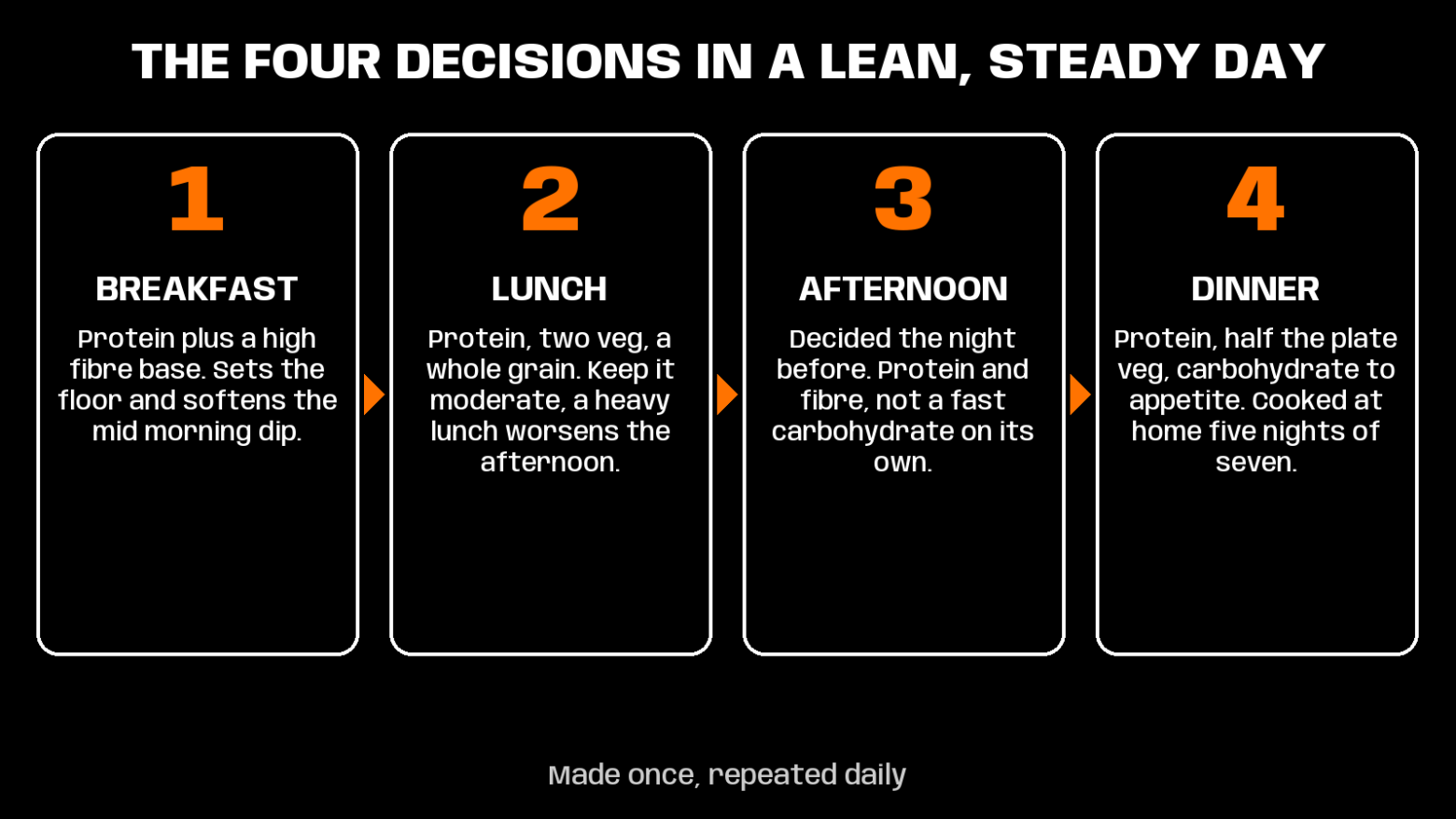
The same four decisions, made once, repeated daily.
Options for Men to Eat for Lean and Steady Energy
Most men already know roughly what to eat. What they do not have is anything that makes the afternoon decision still get made in week seven, when the novelty has gone and the week is busy. Eating patterns fail quietly, because nothing goes wrong on the day you drop one.
The MenTools app runs nutrition alongside mindset, fitness and money in one challenge system, with daily actions, chosen difficulty levels, reminders timed to when the decision actually happens, streaks, progress tracking and an AI coach. The point is the prompt and the record, not more information about food.
How you can do this today: set the afternoon decision as a recurring evening action, and log the first one tonight so the pattern starts before motivation has a say.
Wins on cost: one subscription covers the habit side of food, training and mindset rather than three separate tools.
Wins on time: the structure, levels and tracking already exist, so there is nothing to design before you begin.
Wins on practicality: it works around shifts, travel and family meals, which is where a fixed eating plan usually fails first.
Watch-out: it is a behaviour tool, not a meal planner, a calorie tracker or a source of dietary advice. If you need a personalised plan for a medical condition, it supports that work rather than replacing it.
On the weeks the pattern slips, and there will be some, a one a day multivitamin may help cover the simple daily foundation underneath it. For more built for men, see the MenTools nutrition hub. Three changes, held for three months, will do more than another plan you follow perfectly for nine days.
Last updated: 2026-09-02 v1.0
Disclaimer: This guide is for informational purposes only and does not constitute medical or psychological advice. Speak with a qualified professional before making significant changes if you have a medical or mental health condition.
References
- [1] The Food Foundation. UK still failing to meet basic dietary guidelines. Food Foundation, 14 July 2025. Link
- [2] MRC Epidemiology Unit, University of Cambridge. National Diet and Nutrition Survey 2019 to 2023 highlights dietary deficiencies and inequalities. 12 June 2025. Link
- [3] Hall KD, Ayuketah A, Brychta R, et al. Ultra processed diets cause excess calorie intake and weight gain, an inpatient randomised controlled trial of ad libitum food intake. Cell Metabolism, 2019. Link
- [4] National Institutes of Health. NIH study finds heavily processed foods cause overeating and weight gain. EurekAlert, May 2019. Link
- [5] Rauber F, da Costa Louzada ML, Steele EM, et al. Ultra processed foods and excessive free sugar intake in the UK, a nationally representative cross sectional study. BMJ Open, 2019. Link
- [6] Wyatt P, Berry SE, Finlayson G, et al. Postprandial glycaemic dips predict appetite and energy intake in healthy individuals. Nature Metabolism, 2021. Link
- [7] King’s College London. New research reveals why some of us are hungry all the time. KCL, April 2021. Link
- [8] Reyner LA, Wells SJ, Mortlock V, Horne JA. Post lunch sleepiness during prolonged, monotonous driving, effects of meal size. Physiology and Behavior, 2012. Link
- [9] Morton RW, Murphy KT, McKellar SR, et al. A systematic review, meta analysis and meta regression of the effect of protein supplementation on resistance training induced gains in muscle mass and strength in healthy adults. British Journal of Sports Medicine, 2018. Link
- [10] Mamerow MM, Mettler JA, English KL, et al. Dietary protein distribution positively influences 24 hour muscle protein synthesis in healthy adults. Journal of Nutrition, 2014. Link
- [11] Papagiannaki M, et al. Changes in food patterns over a 10 year period in the UK adult population, findings from the National Diet and Nutrition Survey. British Journal of Nutrition, 2026, reported by NutraIngredients. Link
- [12] Action on Salt. National Diet and Nutrition Survey 2019 to 2023. Action on Salt, 2025. Link
- [13] NHS. The Eatwell Guide. NHS, reviewed 2025. Link
- [14] Wolfson JA, Bleich SN. Is cooking at home associated with better diet quality or weight loss intention. Public Health Nutrition, 2015. Link