No products in the cart.
Return To Shop
MEN: How Do You Break a Bad Habit Without Going Cold Turkey?
Quick Answer
Break a bad habit by changing what sets it off, making it harder to do and planning a replacement, rather than relying on willpower [1]. Quitting outright beats cutting down for smoking [2], but most everyday habits respond better to a swap and a plan. Allow about ten weeks, as new habits averaged 66 days [3].
**Jump to:** The six steps | Cold turkey or gradual | FAQ | Options for men
Disclosure: MenTools publishes this article and may feature MenTools products.
How we evaluate: Each step is assessed on real-world use, evidence, cost and time, and how well it suits men. Every step including the MenTools option carries an honest limitation. Full sources are in the references below.
How to Break a Bad Habit at a Glance
There are six steps, in this order: find the cue, change it, add friction, swap in a replacement, ride out the urge and plan for slips. The first step is a week of noticing, the next three can be set up in one sitting, and the last two carry you through roughly ten weeks. None of them needs you to give up everything on day one [1][3].
| Step | What you do | When | What the evidence shows |
|---|---|---|---|
| 1. Find the cue | Note where, when and what comes before the habit | Week 1 | Habits run on cues people are often not aware of [1] |
| 2. Change the cue | Move or remove what sets it off | Day 8 | Cinema popcorn was eaten out of habit only in the usual setting [4] |
| 3. Add friction | Put the habit further away or make it fiddly | Day 8 | Snacks at 70 and 140 cm were eaten less than at 20 cm [5] |
| 4. Swap in a replacement | Write an if-then plan that names a new action | Day 8 | Plans that said what not to do backfired [6] |
| 5. Ride the urge | Notice it and stay curious until it passes | Every urge | 31% vs 6% not smoking at 17 weeks after mindfulness training [7] |
| 6. Plan for slips | Decide your next move after a miss | Weeks 4 to 10 | Habits took 66 days on average, with a range of 18 to 254 [3] |
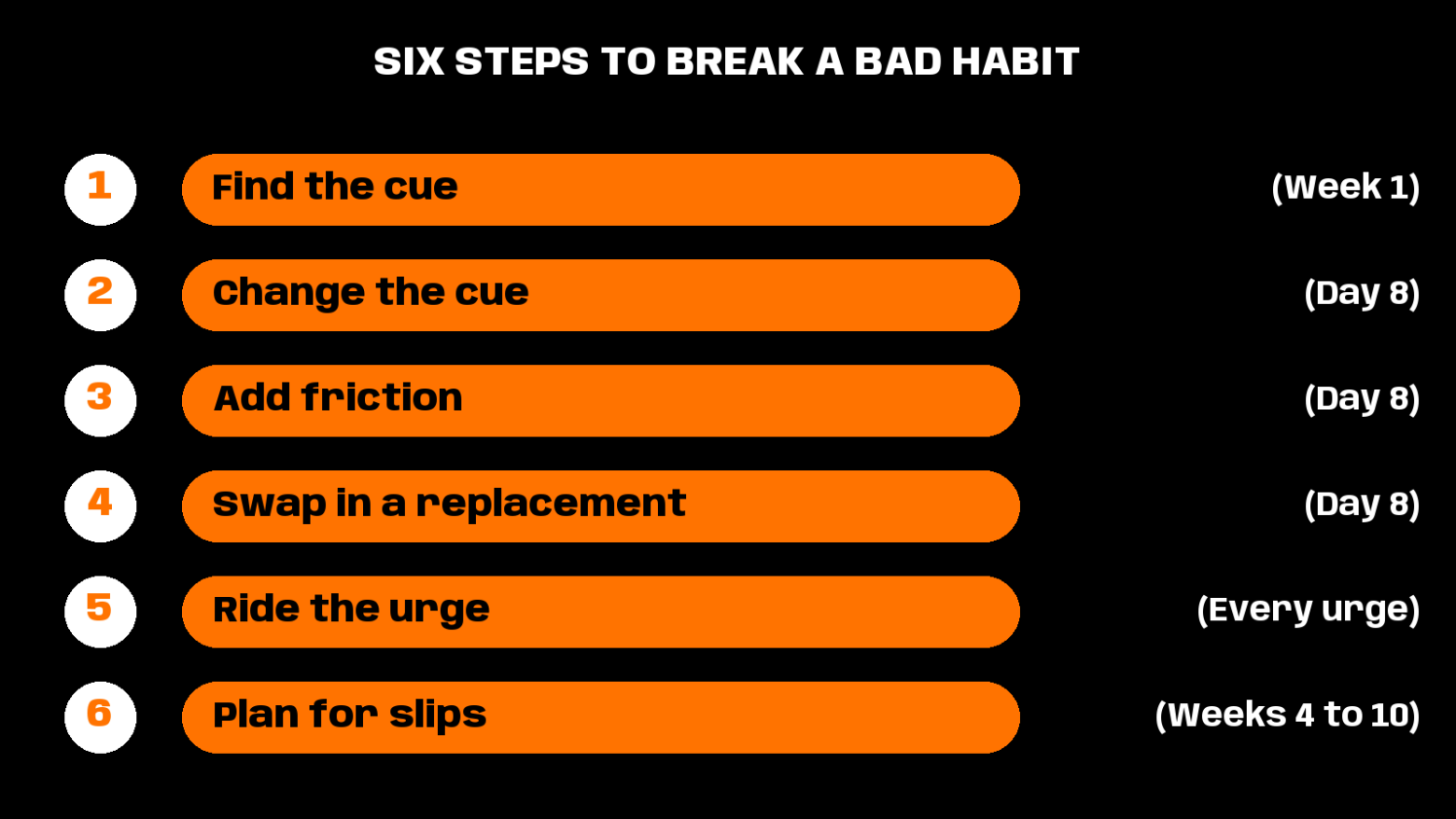
One week of noticing, one sitting to set up, then ten weeks of holding the line.
Why Is Breaking a Habit Harder Than Building One?
A bad habit is hard to break because it runs on autopilot, set off by a cue you often do not notice, so a decision to stop has nothing to grab onto. Building a habit gives you something to do. Breaking one asks you to stop doing what your brain expects, in a setting that still triggers it [1][8].
“About 43 percent of everyday actions are done repeatedly almost every day in the same context,” says Wendy Wood, a psychology professor at the University of Southern California [8]. You make the decision to stop in one frame of mind, and the habit waits for you in another.
Wood is direct about the usual fix. “Habits don’t change easily by willpower because habits are automated and we’re not always aware of what the cues are or of the associations that are driving our behavior,” she told the Wharton School’s Katy Milkman [1]. She adds that “willpower is a really tough thing to rely on” [1].
People with good self-control seem to be better set up rather than stronger. In six studies of 2,274 people, those with better self-control relied on beneficial habits and used less effortful inhibition [9]. If your last attempt faded inside a fortnight, our guide to why habits fail after two weeks shows where it usually breaks.
Cold Turkey or Gradual? What the Evidence Says
Neither always wins. For smoking, quitting abruptly beat cutting down first in a randomised trial of 697 smokers, so cold turkey is the better call there. For most everyday habits, such as snacking, scrolling or a nightly drink, we did not find an equivalent trial, and the research points to changing cues, swapping in a replacement and adding friction instead [2][10].
In the smoking trial, 49.0% of the abrupt group were not smoking four weeks after quit day, against 39.2% of the gradual group [2]. At six months it was 22.0% against 15.5% [2]. The authors concluded: “Quitting smoking abruptly is more likely to lead to lasting abstinence than cutting down first, even for smokers who initially prefer to quit by gradual reduction” [2].
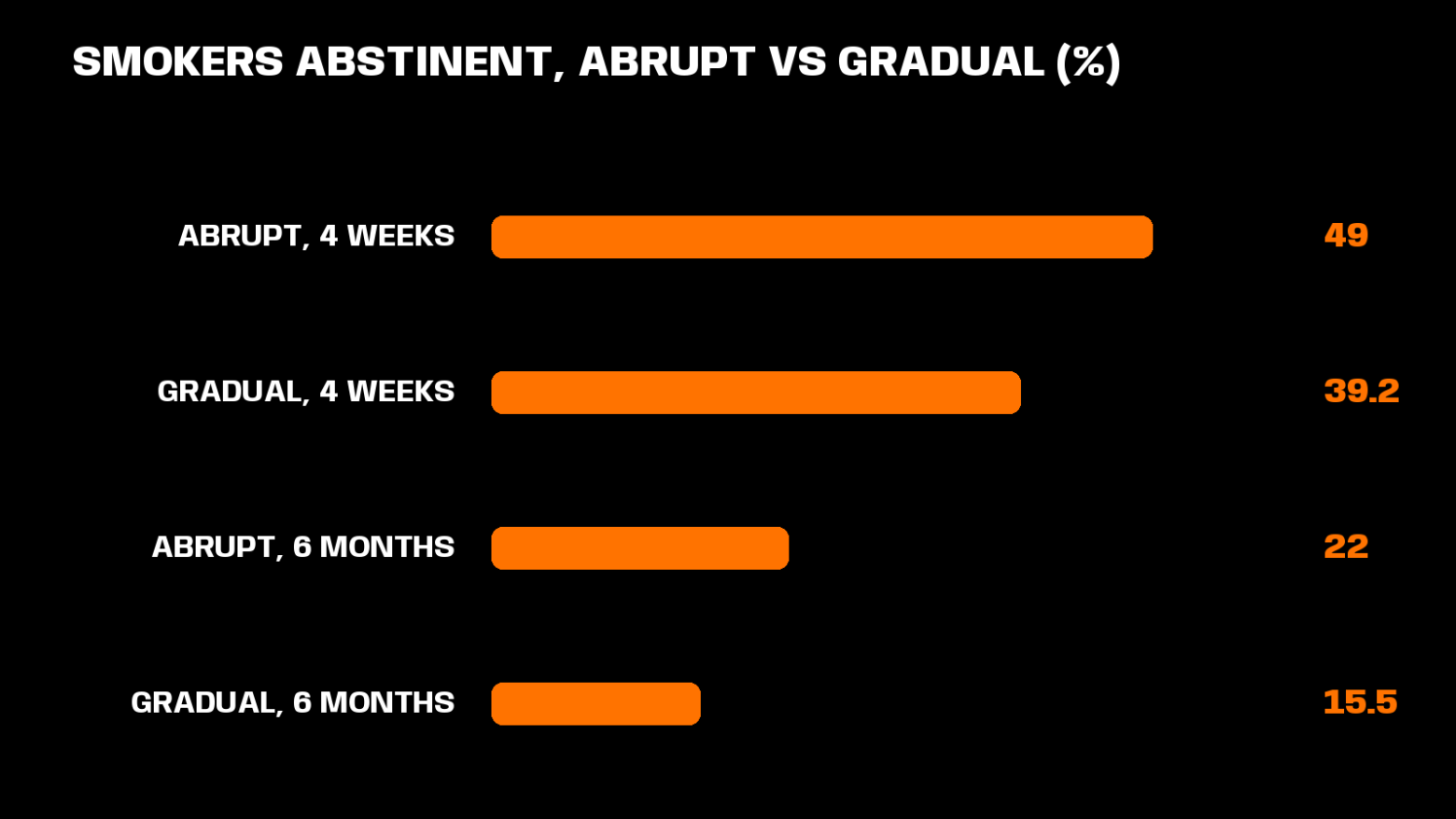
Abrupt quitting beat cutting down first for smoking, at both 4 weeks and 6 months.
Read that result carefully. Both groups had nurse support and nicotine replacement, and the gradual group still cut by 75 percent over two weeks before a quit day [2]. The trial shows that a clean stop beat a slow fade for a chemical addiction, not that every habit should end overnight.
Cold turkey is the better call when the habit has a clear on and off line and one taste keeps the cue alive, such as cigarettes, a gambling app or sweets in the house. It also works best with a date set and someone to tell. That is a judgement drawn from the trial, not a rule it proved.
Most everyday habits cannot be removed, because you still need your phone, your kitchen and your inbox. Cold turkey then means constant resistance, and Wood warns that “continually denying yourself something like that just gets harder and harder over time” [1]. Even the best method is no sure thing. A review of 23 studies found if-then plans helped people include healthy foods with an effect of d = 0.51, but helped them eat fewer unhealthy foods with only d = 0.29 [10].
One safety point on alcohol. The NHS warns: “It can be dangerous to stop drinking too quickly without proper help” [11]. If a nightly drink has become hard to skip, speak to a GP before you stop altogether [12].
Step 1: Find the Cue and the Payoff
Spend a week noticing, not changing. Each time the habit happens, note where you are, the time, who is there, how you feel and what came just before. You are hunting for the cue, because habits repeat in the same setting and often without you registering what set them off [1][4].
The cue can be stronger than the craving. In one field experiment, habitual popcorn eaters at a cinema were minimally influenced by hunger or liking, and they ate equal amounts of stale and fresh popcorn [4]. They ate out of habit only in the cinema, the setting linked to past eating [4].
Then ask what the habit pays you. In Judson Brewer’s account of reward-related eating, the loop is a trigger such as stress, a behaviour and a reward such as temporary relief [13]. Relief, a break, company or something to do with your hands are all payoffs, and the replacement you pick in Step 4 has to offer something similar.
Step 2: Change or Remove the Cue
Alter the setting that triggers the habit, because that is the part that still acts on you. Move the chair, change your route, charge the phone in another room or stop buying the trigger food. Wood’s advice is the same: change the environment rather than lean on willpower [1].
“What does work to break a habit, it seems, is changing the environment we’re in, which can disrupt those cues,” she says [1]. Her own example is bringing apples into the office so something else is ready when the pull towards the vending machine arrives [1].
Big life changes help too. In a field experiment of 800 participants, an intervention promoting sustainable behaviour worked better among people who had recently moved home, and the researchers estimated the window of opportunity at three months after the move [14]. The behaviours studied were environmental, not bad habits, so read it as a pattern. A new job, a new gym or a new flat is a good moment to reset.
Step 3: Add Friction
Make the habit slightly harder to do, because small amounts of effort change what people do. Put the snack in a high cupboard, log out of the app after each use or delete the saved card. Friction does not stop you. It gives you a moment to choose [1][5].
Wood defines it simply: “whether the behavior is easy or difficult is something I think of as friction” [1]. In two experiments with 77 and 54 people, a bowl of snacks was placed 20, 70 or 140 cm away. Fewer people ate snacks, and they ate fewer, when the bowl was at 70 or 140 cm than at 20 cm, with no rise in craving [5].
The limit is that this was a bowl in a lab, not a habit that has run for years. A determined man will still walk to the cupboard. Use friction to slow the automatic version of the habit, not to defeat the deliberate one.
Step 4: Swap in a Replacement
Decide in advance what you will do instead, and write it as an if-then plan that names the new action. “If I feel the urge to open the news app, then I will drink a glass of water” beats “if I feel the urge, then I will not open it”. The replacement gives the habit somewhere to go [6][15].
The wording matters. In a series of studies, Marieke Adriaanse and colleagues found that plans shaped as “if situation, then not habitual response” produced ironic rebound effects compared with replacement plans, and were most likely to backfire when the habit was strong [6]. Their summary is that such plans are “ineffective when they have a negating structure” [6].
Planning in general has solid support. A meta-analysis of 94 tests and 8,461 people found if-then plans had a medium to large effect on reaching goals (d = 0.65) [15]. Another meta-analysis found that a medium to large change in intention (d = 0.66) produced only a small to medium change in behaviour (d = 0.36) [16]. Intending to stop is not enough, so write the plan.
For small physical habits such as nail biting, a structured method called habit reversal training has the best evidence. A meta-analysis of 18 studies and 575 people found a large effect (d = 0.80) across repetitive behaviours that included nail biting, tics and stuttering [17]. That makes it support for the method, not a promise for any one habit. Pair your swap with an anchor you already have, as our comparison of habit stacking and starting small explains.
Step 5: Ride the Urge Instead of Obeying It
When the urge hits, notice it and stay with it for a few breaths before you act. Ask where you feel it and what it does. This is the approach behind the mindfulness trials below, where people learn to observe a craving with curiosity instead of obeying it [7][18][13].
Brewer and colleagues write that being mindful means “allowing experiences to unfold with curiosity rather than with attempts at control” [13]. In a trial of 88 smokers, 31% of those given mindfulness training were not smoking at the 17-week follow-up against 6% of those on the American Lung Association’s Freedom From Smoking programme [7]. The gap at the end of treatment, 36% against 15%, was not statistically significant, and the trial was small [7].
An app-based programme for craving-related eating cut it by 40.21% in 104 adult women with overweight or obesity [18]. There was no comparison group, so treat it as a promising signal rather than proof [18]. The practical version is short. Name the urge, notice it in your body and wait for it to pass before you decide.
Step 6: Plan for Slips and Give It Ten Weeks
Decide now what you will do after a slip, and plan for about ten weeks. A slip tells you which cue you missed, not what kind of man you are. Phillippa Lally’s study of habit formation found the average took 66 days, with a range from 18 to 254 days [3].
That research was on forming habits, and we did not find a matching figure for breaking them, so use ten weeks as a planning guide. Lally says the finding is often taken out of context: “what we really showed was that how long habit formation takes is highly variable” [3]. The long-held view that it takes only 21 days is what her study challenged [3].
For strong habits, add a watch. In two diary studies, the strategy that worked for strong habits was vigilant monitoring, which meant thinking “don’t do it” and watching carefully for slip-ups [19]. That sits oddly beside the negation finding in Step 4. They are different tools. A plan written in advance that says what not to do can backfire, while alertness in the moment helped people hold a habit in check [6][19].
How Do the Steps Look for Everyday Habits?
The same six steps apply to any habit, and only the cue, the swap and the friction change. The table shows how this could look for six common ones. Treat each row as a starting point to test, because none of these exact pairings has been trialled, though the methods behind them have been [5][6].
| Bad habit | Cue to change | Replacement | Friction to add |
|---|---|---|---|
| Late night phone | Phone on the bedside table | Read ten pages of a book | Charge it in another room |
| Evening snacking | Snacks in sight on the sofa | A tea or a glass of water | Keep snacks in a high cupboard |
| A pint every night | Pouring one as soon as you sit down | An alcohol-free drink in the same glass | Do not stock the fridge, and plan drink-free days [11] |
| Procrastinating | Opening the browser first | Open the document and write one line | Block distracting sites until noon |
| Nail biting | Idle hands at your desk | Hold a pen or squeeze a ball | Keep nails trimmed short |
| Checking email | Tab always open | Check at two set times a day | Close the tab and remove the app from your phone |
What Mistakes Make a Bad Habit Harder to Break?
Four mistakes cause most failures: relying on willpower alone, writing plans that say what you will not do, expecting 21 days, and choosing cold turkey for a habit you cannot remove from your life. Each one fights how habits actually work. Avoiding them matters as much as any of the six steps [1][6][3].
Willpower alone fails because the cue still fires. Wood notes that whatever we deny ourselves tends to pull harder over time [1]. Negation plans can strengthen the very habit they target, and the 21 day target fails because the average in Lally’s study was 66 days [6][3].
The fourth mistake is the all or nothing one. If you cannot remove the habit, such as email or snacking, set a smaller rule you can keep. A rule you can keep beats a rule you break by Thursday.
FAQ
When should a man quit outright instead of cutting down?
When the habit has a clear on and off line and one taste restarts it, as with smoking. In a trial of 697 smokers, quitting abruptly beat cutting down first, 22.0% against 15.5% at six months [2]. For habits you cannot remove from daily life, a swap and a plan fit better.
How long does it take to break a bad habit?
There is no fixed number. Lally’s research on forming habits found an average of 66 days and a range of 18 to 254 days [3]. We did not find a matching figure for breaking them, so plan for about ten weeks and judge it by whether the cue still pulls, not by the calendar.
Can willpower alone break a bad habit?
Rarely. Wendy Wood says habits are automated, so we are often unaware of the cues driving them, and denying yourself makes the pull stronger over time [1]. Willpower still helps in the moment, but a changed setting, some friction and a replacement do most of the work.
Does replacing a habit work better than just stopping?
Usually, yes. Plans that said what not to do produced rebound effects, especially for strong habits, while replacement plans did not [6]. A review of 23 studies found if-then plans were weaker for cutting unhealthy eating (d = 0.29) than for adding healthy foods (d = 0.51), so expect gains, not a guarantee [10].
Should I try to break more than one habit at once?
Start with one. We did not find a trial that settled the question, but each habit needs its own cue, swap and friction, which is a lot to run at once. Once the first habit has held for about ten weeks, take on the next [3].
What makes a good replacement for a bad habit?
One that pays you the same way the old habit did. If the habit brings relief from stress, a break or something to do with your hands, pick a swap that does too [13]. Write it as an if-then plan that names the new action, because plans that only say what not to do can backfire [6].
Final Recommendation
Pick one bad habit and change the setting before you test your willpower. Find the cue, move it, add some friction, write a replacement plan and stay curious about the urge [1][6]. Use cold turkey for smoking, where the trial favours it, and a swap and a plan for most everyday habits [2][10].
Run it as a ten week plan. Spend week 1 watching, weeks 2 and 3 rebuilding your setup, weeks 4 to 10 holding the line, and review in week 10. If the cue still pulls, adjust the setup, not your willpower. Expect variation, because habits took anywhere from 18 to 254 days to form in Lally’s study [3].
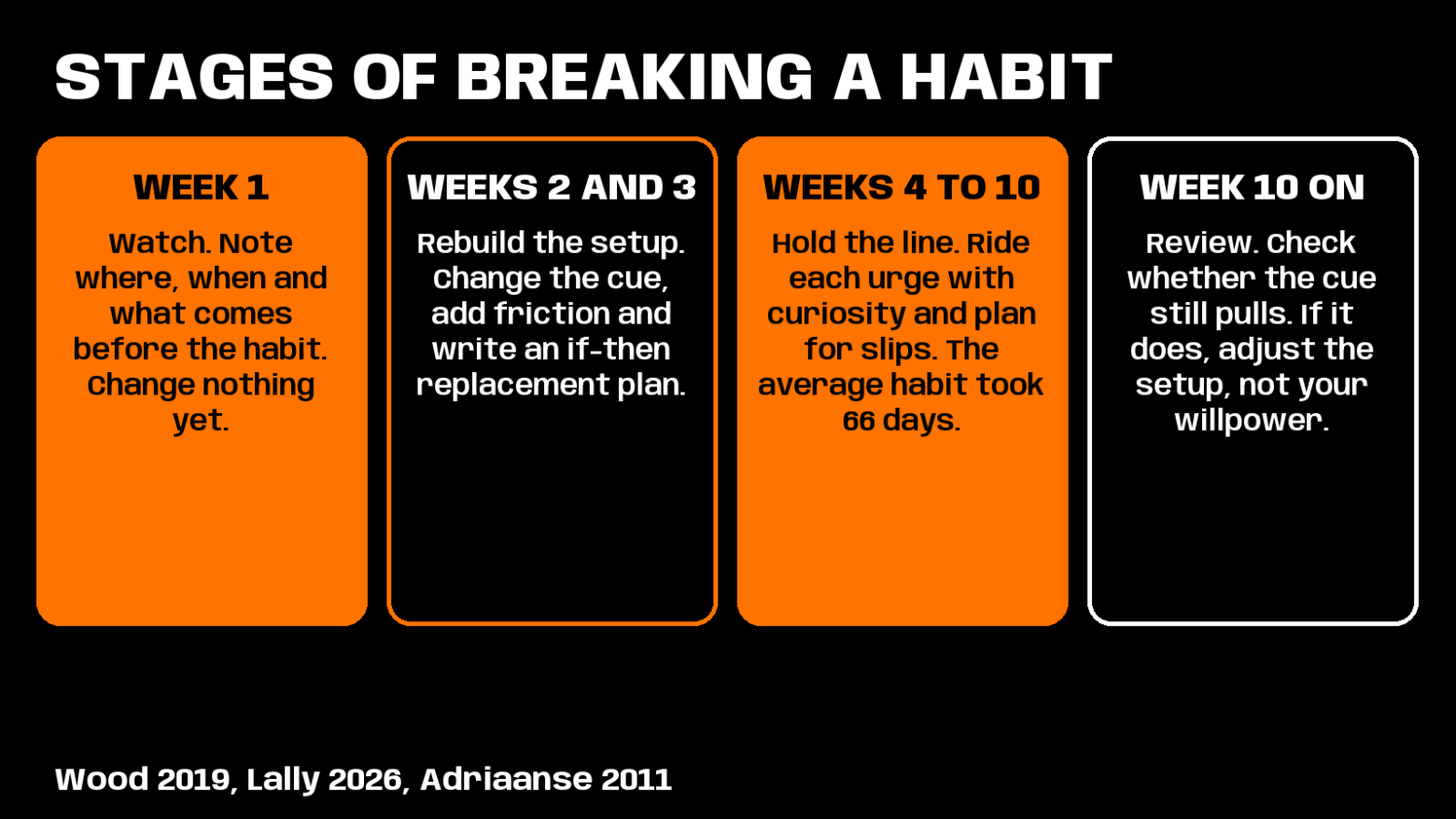
Watch first, rebuild the setup, hold the line, then review.
Options for Men to Take Action
Most men try to break a bad habit with a promise to themselves and nothing to check it against. Nobody notices the cue, nothing records the slip, and by week three the old pattern is back with no record of why.
The MenTools app runs habits as challenges across mindset, fitness, nutrition and money, with beginner to advanced levels, daily actions, reminders, progress tracking and an AI coach. For this method, you pick a challenge that matches your replacement action, log it each day and see at a glance whether the new habit is holding.
How you can do this today: write your cue and your if-then replacement on one line, pick the beginner level of a matching challenge, and log the replacement every day for the next ten weeks.
Wins on cost: one subscription covers mindset, fitness and nutrition habits together, instead of a tracker, a fitness app and a journal paid for separately.
Wins on time: the challenge levels are already built from easy to hard, so you do not have to design your own progression before you start.
Wins on practicality: logging a daily action takes seconds and fits around work, travel and family, which is where most new habits come unstuck.
Watch-out: the app tracks and reminds, but it cannot remove a cue for you. Moving the charger, clearing the cupboard and writing the if-then plan are still your job.
Habit change lands more easily when the basics underneath it are covered, and a one a day multivitamin can support the daily foundation. For more on routines and consistency, the MenTools habits hub collects it in one place. Change the setting, swap the habit, and give it ten weeks.
Last updated: 2026-10-28 v1.0
Disclaimer: This guide is for informational purposes only and does not constitute medical or psychological advice. Speak with a qualified professional before making significant changes if you have a medical or mental health condition.
References
- [1] Wood W, interviewed by Milkman K. How to form good habits (and break bad ones). Choiceology podcast excerpt, Wharton Magazine, 26 November 2019. Link
- [2] Lindson-Hawley N, Banting M, West R, Michie S, Shinkins B, Aveyard P. Gradual versus abrupt smoking cessation, a randomized, controlled noninferiority trial. Annals of Internal Medicine, 2016;164(9):585-592. Link
- [3] University of Surrey. Does it really take 66 days to form a habit? We asked the expert, Dr Pippa Lally. 21 January 2026. Link
- [4] Neal DT, Wood W, Wu M, Kurlander D. The pull of the past, when do habits persist despite conflict with motives? Personality and Social Psychology Bulletin, 2011;37(11):1428-1437. Link
- [5] Maas J, de Ridder DTD, de Vet E, de Wit JBF. Do distant foods decrease intake? The effect of food accessibility on consumption. Psychology and Health, 2012;27(sup2):59-73. Link
- [6] Adriaanse MA, van Oosten JM, de Ridder DT, de Wit JB, Evers C. Planning what not to eat, ironic effects of implementation intentions negating unhealthy habits. Personality and Social Psychology Bulletin, 2011;37(1):69-81. Link
- [7] Brewer JA, Mallik S, Babuscio TA, Nich C, Johnson HE, Deleone CM, et al. Mindfulness training for smoking cessation, results from a randomized controlled trial. Drug and Alcohol Dependence, 2011;119(1-2):72-80. Link
- [8] NPR Hidden Brain. Building better habits and breaking bad ones, with Wendy Wood. 30 December 2019. Based on Wood W, Quinn JM, Kashy DA, Habits in everyday life, Journal of Personality and Social Psychology, 2002;83(6):1281-1297. Link
- [9] Galla BM, Duckworth AL. More than resisting temptation, beneficial habits mediate the relationship between self-control and positive life outcomes. Journal of Personality and Social Psychology, 2015;109(3):508-525. Link
- [10] Adriaanse MA, Vinkers CD, De Ridder DT, Hox JJ, De Wit JB. Do implementation intentions help to eat a healthy diet? A systematic review and meta-analysis of the empirical evidence. Appetite, 2011;56(1):183-193. Link
- [11] NHS Better Health. Drink less. Link
- [12] NHS. Alcohol support. Link
- [13] Brewer JA, Ruf A, Beccia AL, Essien GI, Finn LM, van Lutterveld R, Mason AE. Can mindfulness address maladaptive eating behaviors? Why traditional diet plans fail and how new mechanistic insights may lead to novel interventions. Frontiers in Psychology, 2018;9:1418. Link
- [14] Verplanken B, Roy D. Empowering interventions to promote sustainable lifestyles, testing the habit discontinuity hypothesis in a field experiment. Journal of Environmental Psychology, 2016;45:127-134. Link
- [15] Gollwitzer PM, Sheeran P. Implementation intentions and goal achievement, a meta-analysis of effects and processes. Advances in Experimental Social Psychology, 2006;38:69-119. Figures as reported in De Vet E, Oenema A, Sheeran P, Brug J. International Journal of Behavioral Nutrition and Physical Activity, 2009;6:11. Link
- [16] Webb TL, Sheeran P. Does changing behavioral intentions engender behavior change? A meta-analysis of the experimental evidence. Psychological Bulletin, 2006;132(2):249-268. Link
- [17] Bate KS, Malouff JM, Thorsteinsson ET, Bhullar N. The efficacy of habit reversal therapy for tics, habit disorders, and stuttering, a meta-analytic review. Clinical Psychology Review, 2011;31(5):865-871. Link
- [18] Mason AE, Jhaveri K, Cohn M, Brewer JA. Testing a mobile mindful eating intervention targeting craving-related eating, feasibility and proof of concept. Journal of Behavioral Medicine, 2018;41(2):160-173. Link
- [19] Quinn JM, Pascoe A, Wood W, Neal DT. Can’t control yourself? Monitor those bad habits. Personality and Social Psychology Bulletin, 2010;36(4):499-511. Link