No products in the cart.
Return To Shop
MEN: Habit Stacking vs Starting Small: Which Builds Habits Faster?
Quick Answer
Starting small builds the habit faster, because simple actions become automatic sooner than demanding ones [9][15]. Habit stacking makes you more likely to remember to act, but in the only trial comparing a routine cue with a set time it was no faster [6]. The strongest plan uses both: a tiny action after an existing habit.
**Jump to:** The verdict | The evidence | FAQ | Options for men
Disclosure: MenTools publishes this article and may feature MenTools products.
How we evaluate: Each option is assessed on real-world use, evidence, cost and time, and how well it suits men. Every option including the MenTools option carries an honest limitation. Full sources are in the references below.
Habit Stacking vs Starting Small at a Glance
Habit stacking and starting small solve different problems, so they are not true rivals. Habit stacking decides when you act, by tying the new habit to one you already have. Starting small decides how much you do, by making the first version tiny. No study has tested one against the other directly, so the table compares each on the evidence that does exist [1][6][9].
| What matters | Habit stacking | Starting small | Edge |
|---|---|---|---|
| Best for | Men who mean to act but forget, with a fixed daily routine | Men whose big plans stall, and demanding habits like training | Depends on the problem |
| What it changes | When you act, straight after an existing habit | How much you do, a tiny first version | Different jobs |
| Best evidence | If-then plans had a medium to large effect on goals across 94 studies [4] | Simple actions became automatic faster than complex ones [9] | Both real |
| Speed to automatic | No faster than a set time in a 192 person trial [6] | Simpler habits peak sooner [7][9][15] | Starting small |
| Helps you remember | Yes, the old habit becomes the reminder [1][5] | Not on its own | Habit stacking |
| Survives a flat day | Only if the anchor still happens that day | Yes, it is too small to skip [2] | Starting small |
| Main watch-out | Vague or irregular anchors fail [1] | Small can stay small, and weight trial gains faded [12] | Neither works alone |
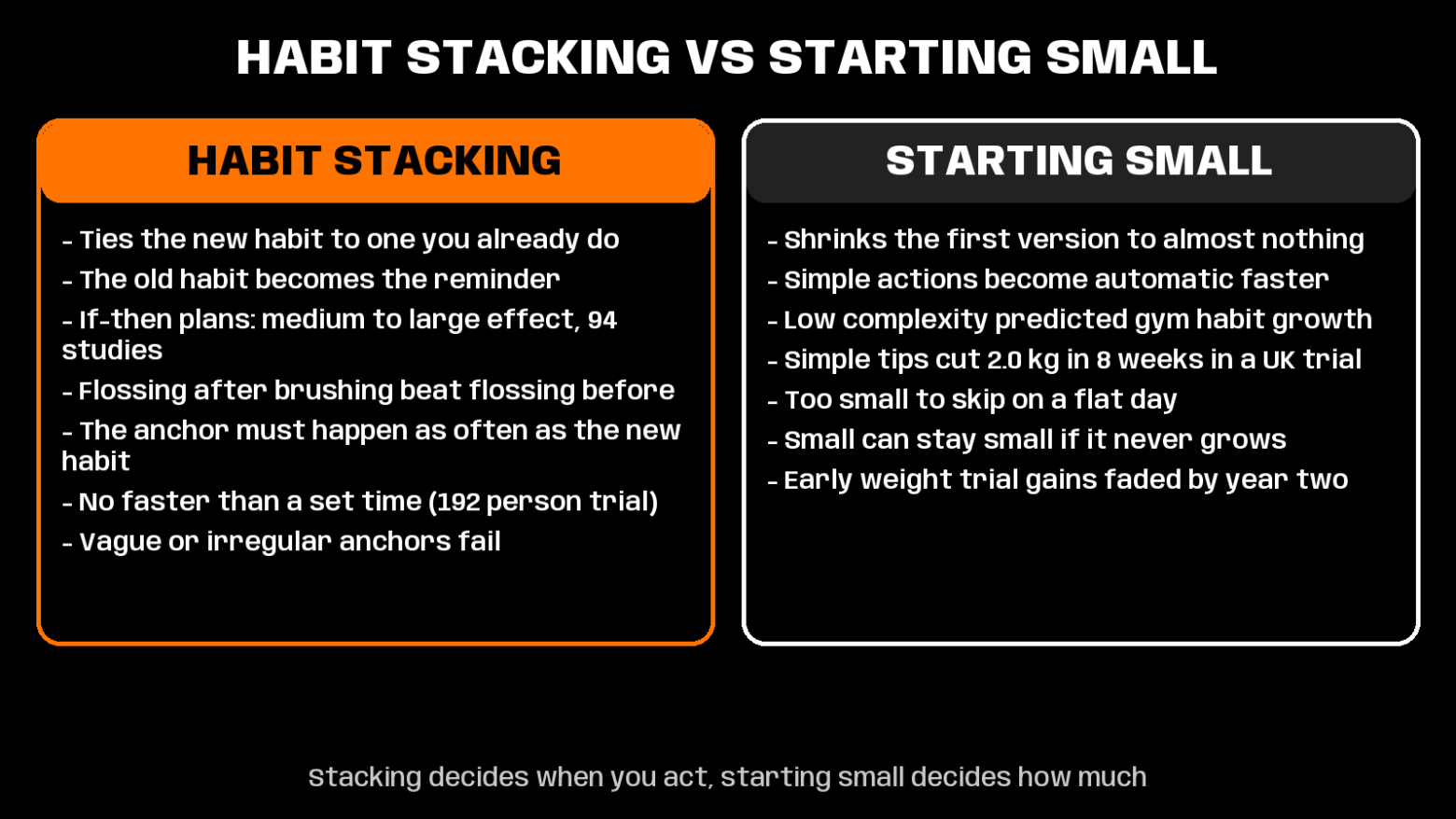
Stacking decides when you act, starting small decides how much.
How We Compared Them
We compared the two methods on peer-reviewed trials, cohort studies and the researchers’ own published guidance rather than on self-help claims. The outcomes were how quickly a habit became automatic, whether people remembered to act, and how well the habit held up. Where evidence is thin or comes from small samples, we say so plainly [6][7][20].
Three limits apply throughout. First, no trial has pitted habit stacking against starting small head to head, so any article naming a proven winner is overreaching. Second, most studies rate automaticity by self-report. Third, few samples were made up of working men in their thirties. The direction of the evidence is consistent enough to act on, but treat exact numbers as estimates [7][14].
1. Habit Stacking: What It Actually Is
Habit stacking means attaching a new habit to one you already do every day, using the line “After I do my current habit, I will do my new habit.” It suits men who keep forgetting a good intention rather than lacking the will. Its standout strength is that the old habit becomes the reminder, so you no longer rely on memory [1].
James Clear, who popularised the term in Atomic Habits in 2018, put it simply: “Habit stacking is a special form of an implementation intention” [1]. He credits the method to Stanford researcher BJ Fogg and the name to S.J. Scott’s 2014 book [1]. His own example is “After I pour my cup of coffee each morning, I will meditate for one minute” [1].
The science underneath it is the if-then plan. Peter Gollwitzer showed that a plan linked to a specific situation can make starting feel almost automatic, and he argued that planning in this way “is as effective in automatizing action initiation as the repeated and consistent practice implied in habits” [3]. A meta-analysis of 94 studies and 8,461 people found such plans had a medium to large effect on reaching goals (d = 0.65) [4].
Watch-out: the anchor has to be specific and happen as often as the new habit. Clear warns that “Many people select cues that are too vague” [1]. An anchor like “at lunch” fails on the days lunch is a sandwich at your desk. The 94 study figure is also about reaching goals, not about how fast a habit forms [4].
2. Starting Small: What It Actually Is
Starting small means making the first version of a new habit so easy that you cannot talk yourself out of it, such as two push-ups or one page of a book. It suits men who start strong in January and stall by February. Its standout strength is that simple actions become automatic faster than demanding ones, which is the clearest speed finding in the research [9].
BJ Fogg, who founded and directs a behaviour design lab at Stanford University, built his Tiny Habits method on this idea after noticing that willpower was not dependable. “My research showed that motivation could be unreliable, going up and down moment by moment,” he wrote [2]. So he cut his own flossing habit to the minimum: “floss just one tooth” [2].
UK researchers at UCL reached the same conclusion from a different direction. Benjamin Gardner, Phillippa Lally and Jane Wardle advised GPs that “Patients should be encouraged to aim for small and manageable behaviour changes, because failure can be discouraging” [9]. They added that “simpler actions become habitual more quickly” [9]. In an earlier UK trial, a leaflet of simple, repeatable tips helped 104 adults lose 2.0 kg in eight weeks, against 0.4 kg in the control group [10]. In a study of 111 new gym members, low complexity was one of the measured predictors of a growing exercise habit [15].
Watch-out: small can stay small. In a UK GP trial of simple habit tips, the weight loss edge over usual care had gone by 24 months [11]. A Canadian trial of a small change approach, adding 2,000 steps and cutting 100 calories a day, did not prevent weight gain compared with monitoring alone at two or three years [12].
Which One Makes a Habit Automatic Faster?
Starting small makes a habit automatic faster, while habit stacking on its own does not appear to speed it up. In Lally’s study, simple actions such as drinking water peaked in automaticity sooner than elaborate ones such as 50 sit-ups [9]. The only randomised trial comparing routine cues with a fixed time of day found no speed advantage for either [6].
That trial, led by Jan Keller with Phillippa Lally as a co-author, randomised 192 adults to tie a daily nutrition habit either to an existing routine or to a set time [6]. The finding was clear: “Linking one’s nutrition behaviour to a daily routine or a specific time was similarly effective for habit formation” [6]. Among those who formed the habit, “it took a median of 59 days” to reach peak automaticity [6].
The trial named what really mattered: “Repeated plan enactment was a key predictor for automaticity” [6]. In other words, doing it again and again in the same context drove the result, not the type of cue. Exercise research points the same way. In new gym members, consistency was the strongest predictor of habit growth and low complexity came next [15].
Which One Helps You Remember to Do It?
Habit stacking helps you remember far better, because the existing habit acts as a built-in alarm. A plan that names exactly when you will act is the most reliable way to stop a good intention slipping. Starting small makes the action easy, but on its own it gives you no cue, so a tiny habit can still be forgotten [1][4][9].
Lally herself makes the point in a 2026 interview: “we know that if you make a clear plan of when and where you will do something you are more likely to do it than if you have a vague intention” [8]. Wendy Wood, who has studied habits for decades, explains why context matters: “About 43 percent of everyday actions are done repeatedly almost every day in the same context” [16].
The order of the stack matters too. In a small study of 50 adults, people told to floss after brushing their teeth formed stronger flossing habits than those told to floss before [5]. The authors found that “Initiating flossing after rather than before tooth-brushing promoted stronger habits,” and at eight months that group also flossed more often [5]. Put the new habit after the anchor, not before it.
Which One Survives a Bad Week?
Starting small survives a bad week better, because a tiny action still fits on the worst day. A stacked habit only fires if the anchor happens, so travel, a late night or a broken routine can switch it off. The good news for both methods is that missing a single day does not undo the progress you have made [7][9].
Lally’s original study found that “Missing one opportunity to perform the behaviour did not materially affect the habit formation process” [7]. Her co-authors added that “automaticity gains soon resumed after one missed performance” [9]. The damage comes from the all or nothing thinking that follows a missed day, not from the miss itself.
Fogg’s reasoning for tiny actions is exactly this. “If it was small, I had no excuse not to do it,” he wrote [2]. Lally’s practical advice in 2024 was to “form a habit and have a backup plan for dealing with setbacks” [18]. A tiny version of the habit is the simplest backup plan there is, because it still works when the day goes wrong. Small wins also lift mood: in a diary study of 238 knowledge workers, progress happened on 76 percent of their best mood days [17].
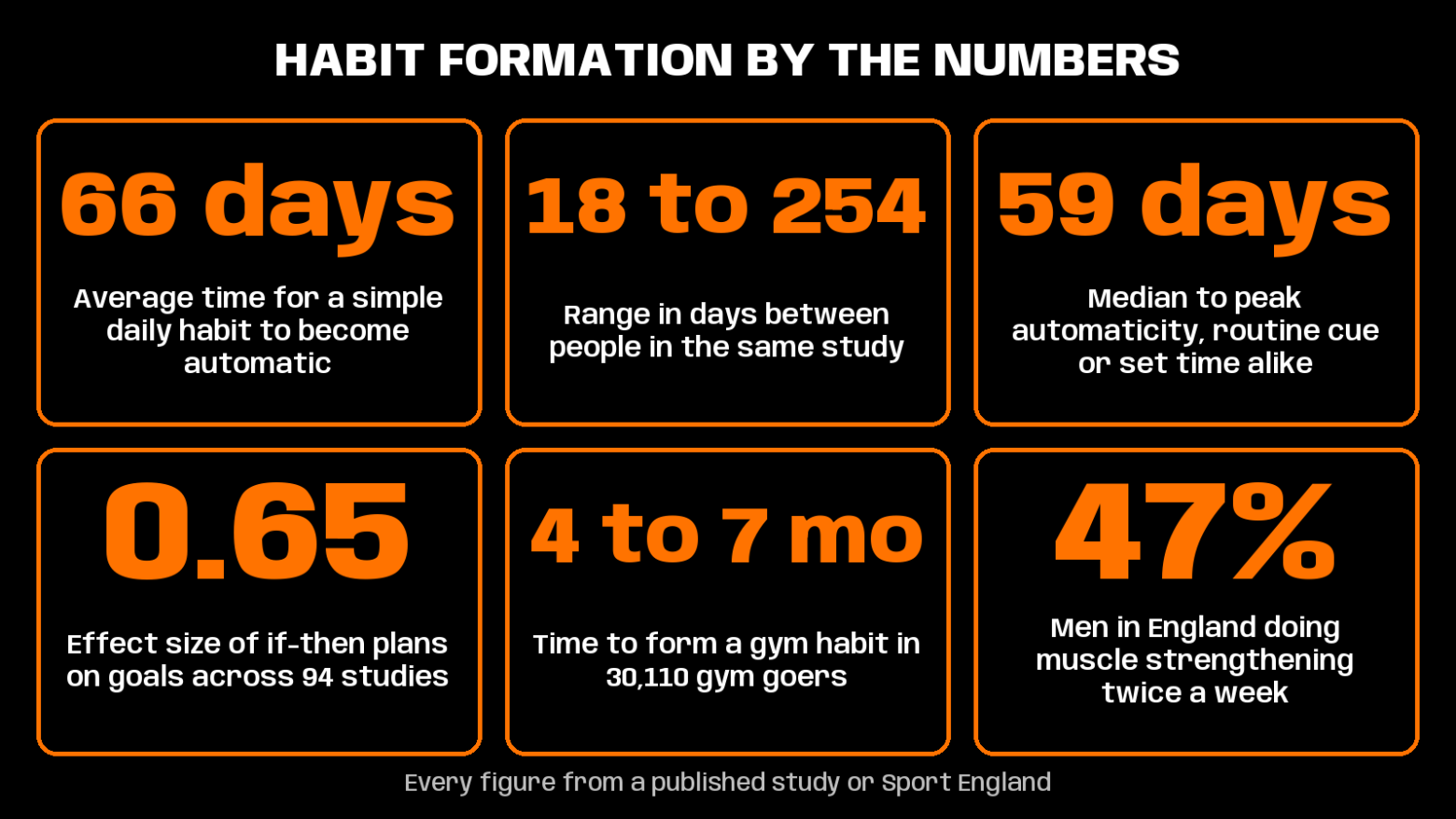
Simple daily habits take weeks, demanding ones take months.
How Long Does a New Habit Take Either Way?
A simple daily habit takes about 66 days on average to become automatic, but the range runs from 18 to 254 days [7][8]. A demanding habit such as regular gym visits takes months. Neither habit stacking nor starting small changes that reality much, which is why expecting ten weeks rather than three is the most useful mindset [9][14].
Lally is blunt about the famous 66 days. Asked whether it really takes that long, she said: “No. I mean for someone somewhere for one habit yes, but for most people most of the time, no” [8]. She added, “what we really showed was that how long habit formation takes is highly variable” [8]. The old 21 day rule traces back to a 1960 anecdote, not a study [9].
Big data confirms that harder habits take longer. A 2023 PNAS study of 30,110 gym goers found the gym habit took “about 4 to 7 mo” to form, while hospital handwashing formed in weeks [14]. The authors wrote that “Gym habits take months to form and handwashing habits take weeks to form” [14]. That gap is the strongest argument for making the first version of a hard habit small.
Where Each Method Falls Short
Each method has a real weakness. Habit stacking fails when the anchor is vague, irregular or already crowded with other new habits. Starting small fails when the tiny version never grows, so the habit forms but changes little. Both rely on repetition, and both can be overruled by tiredness, stress or a change of routine [1][12][18].
Gardner and Lally warned in 2024 that pop psychology tends to imply “that forming new habits will always lead to positive long-term change” [18]. Gardner described a habit as one impulse among many: “But the pushes from habits are just one of many feelings we might have at any time” [18]. A habit gives you a nudge, not a guarantee.
The evidence for Tiny Habits specifically is also thin. One randomised trial of 154 adults found that Fogg’s recipes raised gratitude scores over a month, though only 56 percent of that group gave one month data [13]. A 2025 scoping review found just six health studies using Fogg’s wider model, with little long-term follow-up [19]. That is promising, not proven.
Why the Researchers Use Both at Once
The researchers who study habits recommend both together: a small action tied to a cue in your existing routine. Fogg’s own recipe is “After I brush my teeth, I will floss one tooth,” which is habit stacking and starting small in one sentence [2]. Treating them as rivals misses the point, because each fixes the other’s weakness [2][9].
The UCL team’s advice to GPs combines them in the same way. “A cue located within an existing daily routine (for example, ‘when I go on my lunch break’) provides a convenient and stable starting point,” they wrote, alongside the advice to keep the action small [9]. Their core rule is to “repeat a chosen behaviour in the same context, until it becomes automatic and effortless” [9].
Fogg describes why the pairing works: “If you pair it well, the tiny behavior flows easily after the anchor” [2]. The anchor solves remembering and the tiny size solves motivation. Once the small version runs on its own, you grow it. Our guide to why habits fail after two weeks explains what usually breaks before that point.
Pick Habit Stacking If, Pick Starting Small If
Pick habit stacking if you already have the will but keep forgetting, and you have a daily routine that happens at the same point every day, such as the morning kettle. Choose an anchor that is specific and as frequent as the new habit, and put the new action straight after it, never before [1][5].
Pick starting small if you keep launching big plans that collapse within a fortnight, or if the habit is demanding, such as training. Simple actions become automatic sooner, and a version too small to skip keeps the streak alive on flat days [9][15]. In England, only 47 percent of men do muscle strengthening twice a week, which is exactly the gap a two push-up habit is built for [21].
Most men should use both. Start with one tiny action after one reliable anchor, repeat it daily for about ten weeks, then build on it. If you want a wider set of small habits to choose from, our list of daily habits for men covers eight that compound well over time.
FAQ
What is an example of habit stacking for men?
A good example is “After I switch the kettle on, I will do two push-ups.” The anchor happens every morning at the same point, and the new action is short enough to finish before the water boils. James Clear’s own example pairs one minute of meditation with the first cup of coffee [1].
Does habit stacking actually work?
Yes, as a way to remember to act. If-then plans had a medium to large effect on reaching goals across 94 studies [4], and flossing after brushing built stronger habits than flossing before [5]. In the one trial testing routine cues, though, it was no faster than picking a set time of day [6].
Is Tiny Habits the same as habit stacking?
Not quite. Tiny Habits, from Stanford’s BJ Fogg, combines an anchor, a tiny action and a moment of celebration [2]. Habit stacking is the anchor part, and James Clear credits Fogg for it [1]. Tiny Habits adds the rule that the first version must be very small.
How many habits can you stack at once?
There is no tested number, so start with one. The habit that forms is the one you repeat in the same context every day [6][7]. Adding several new links to one anchor at once makes the chain fragile, because one missed step can stop the rest. Add the next habit once the first runs without thought.
Do I have to start again if I miss a day?
No. Lally’s study found that missing one opportunity “did not materially affect the habit formation process” [7], and automaticity gains resumed soon after a single missed day [9]. The risk is giving up after a miss, not the miss itself. Do the tiny version the next day and carry on.
When should I make a tiny habit bigger?
Grow it once it happens without you having to think about it, which for a simple daily habit is often around ten weeks [9]. Keep the anchor the same and add a little at a time. Gym habits took four to seven months in a large study, so be patient with demanding ones [14].
Final Recommendation
Use starting small to build the habit faster and habit stacking to make sure you remember it. Simple actions become automatic sooner [9][15], and a specific anchor turns a vague intention into a plan you act on [1][4]. Repetition in the same context is what does the real work, whichever method you choose [6][7].
Pick one tiny action, place it straight after something you already do every day, and repeat it for ten weeks before judging the result. Expect variation, because the range in Lally’s study ran from 18 to 254 days [7][8]. For the full timeline and what affects it, see how long it takes to build a habit.
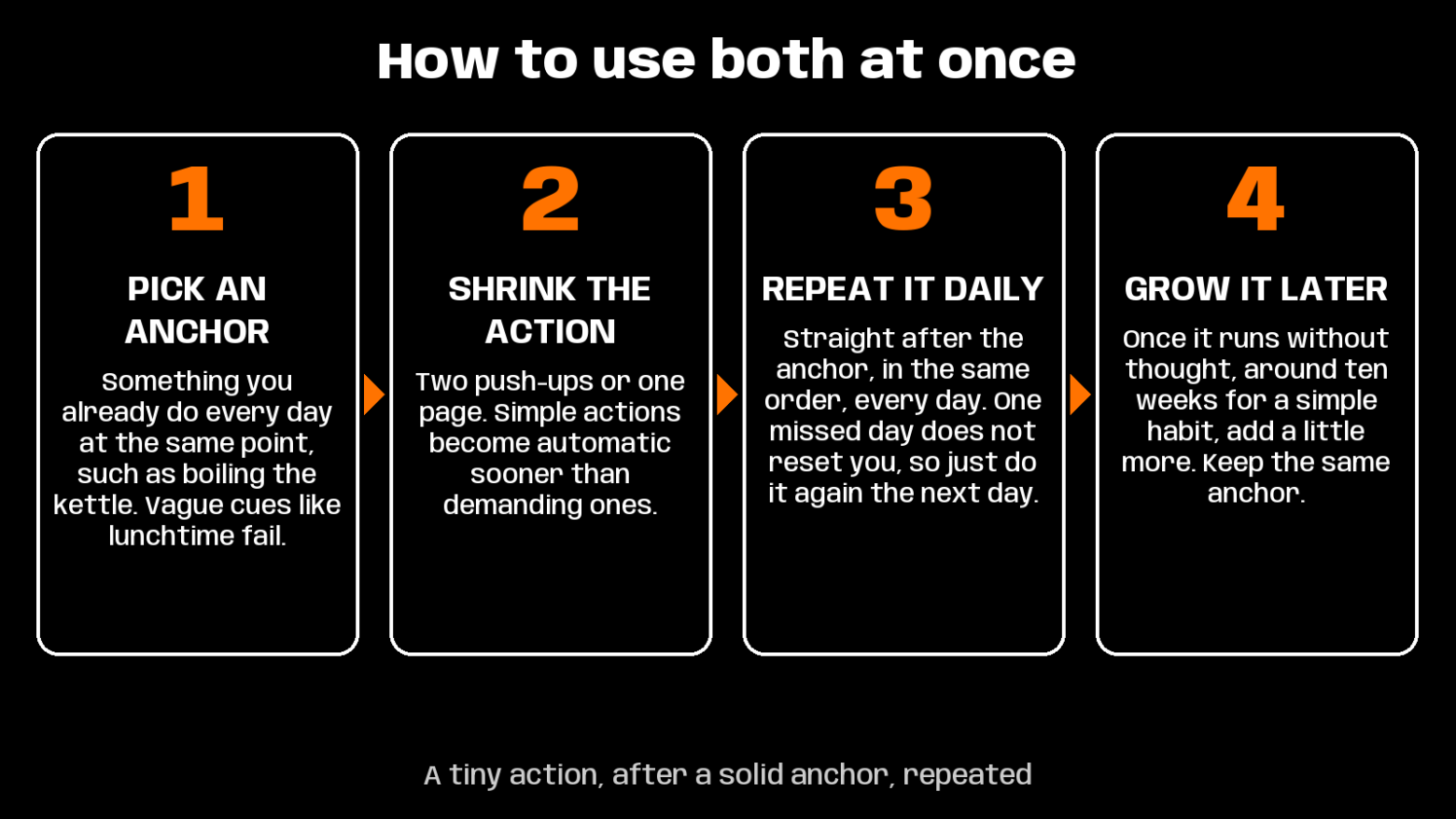
A tiny action, after a solid anchor, repeated until it runs on its own.
Options for Men to Take Action
Most men try to build a habit with a notes app, a vague plan and good intentions. Nothing reminds them, nothing records the streak, and by week three there is no way to tell whether the habit is growing or quietly fading.
The MenTools app runs habits as challenges across mindset, fitness, nutrition and money, with beginner to advanced levels, daily actions, reminders, progress tracking and an AI coach. For this method, it lets you start a challenge at the easiest level, log the tiny daily action after your anchor, and step up a level only once the habit holds.
How you can do this today: choose one anchor you already do every morning, pick the beginner level of a matching challenge, and log the action straight after the anchor each day for the next ten weeks.
Wins on cost: one subscription covers training, mindset and nutrition habits together, instead of a habit tracker, a fitness app and a journal paid for separately.
Wins on time: the challenge levels are already built from small to hard, so you do not have to design your own progression before you start.
Wins on practicality: logging a daily action takes seconds and fits around work, travel and family, which is where most new habits fall apart.
Watch-out: the app records and reminds, but it cannot choose a good anchor for you. If your anchor is vague or irregular, fix that first.
Habits stick more easily when the basics underneath them are covered, so a one a day multivitamin may help as a simple daily foundation, and it is an easy action to stack onto breakfast. For more built for men on routines and consistency, the MenTools habits hub collects it in one place. Start tiny, anchor it well, and let repetition do the rest.
Last updated: 2026-10-27 v1.0
Disclaimer: This guide is for informational purposes only and does not constitute medical or psychological advice. Speak with a qualified professional before making significant changes if you have a medical or mental health condition.
References
- [1] Clear J. How to build new habits by taking advantage of old ones (excerpt from Atomic Habits, chapter 4). Avery, 2018. Link
- [2] Fogg BJ. How I cracked the code for creating habits. ACE ProSource, Behavior Change Special Issue. Link
- [3] Gollwitzer PM. Implementation intentions, strong effects of simple plans. American Psychologist, 1999;54(7):493-503. Link
- [4] Gollwitzer PM, Sheeran P. Implementation intentions and goal achievement, a meta-analysis of effects and processes. Advances in Experimental Social Psychology, 2006;38:69-119. Figures as reported in De Vet E, Oenema A, Sheeran P, Brug J. International Journal of Behavioral Nutrition and Physical Activity, 2009;6:11. Link
- [5] Judah G, Gardner B, Aunger R. Forming a flossing habit, an exploratory study of the psychological determinants of habit formation. British Journal of Health Psychology, 2013;18(2):338-353. Link
- [6] Keller J, Kwasnicka D, Klaiber P, Sichert L, Lally P, Fleig L. Habit formation following routine-based versus time-based cue planning, a randomized controlled trial. British Journal of Health Psychology, 2021;26(3):807-824. Link
- [7] Lally P, van Jaarsveld CHM, Potts HWW, Wardle J. How are habits formed, modelling habit formation in the real world. European Journal of Social Psychology, 2010;40(6):998-1009. Link
- [8] University of Surrey. Does it really take 66 days to form a habit? We asked the expert, Dr Pippa Lally. 21 January 2026. Link
- [9] Gardner B, Lally P, Wardle J. Making health habitual, the psychology of habit-formation and general practice. British Journal of General Practice, 2012;62(605):664-666. Link
- [10] Lally P, Chipperfield A, Wardle J. Healthy habits, efficacy of simple advice on weight control based on a habit-formation model. International Journal of Obesity, 2008;32(4):700-707. Link
- [11] Beeken RJ, Leurent B, Vickerstaff V, et al. A brief intervention for weight control based on habit-formation theory delivered through primary care, results from a randomised controlled trial. International Journal of Obesity, 2017;41(2):246-254. Link
- [12] Ross R, Latimer-Cheung AE, Day AG, Brennan AM, Hill JO. A small change approach to prevent long-term weight gain in adults with overweight and obesity, a randomized controlled trial. CMAJ, 2022;194(9):E324-E331. Link
- [13] Hollingsworth JC, Redden DT. Tiny Habits for gratitude, implications for healthcare education stakeholders. Frontiers in Public Health, 2022;10:866992. Link
- [14] Buyalskaya A, Ho H, Milkman KL, Li X, Duckworth AL, Camerer C. What can machine learning teach us about habit formation? Evidence from exercise and hygiene. PNAS, 2023;120(17):e2216115120. Link
- [15] Kaushal N, Rhodes RE. Exercise habit formation in new gym members, a longitudinal study. Journal of Behavioral Medicine, 2015;38(4):652-663. Link
- [16] NPR. Creatures of habit, how habits shape who we are and who we become, with Wendy Wood. 11 December 2019. Based on Wood W, Quinn JM, Kashy DA, Habits in everyday life, Journal of Personality and Social Psychology, 2002;83(6):1281-1297. Link
- [17] Amabile TM, Kramer SJ. The power of small wins. Harvard Business Review, May 2011. Link
- [18] University of Surrey. Pop psychology myths about habits (Gardner B, Rebar AL, de Wit S, Lally P. What is habit and how can it be used to change real-world behaviour? Social and Personality Psychology Compass, 2024;18(6)). Via ScienceDaily, 7 June 2024. Link
- [19] Duarte-Anselmi G, Crane SM, Ruiz MA, Dintrans PV. Behavioral science meets public health, a scoping review of the Fogg behavior model in behavior change interventions. BMC Public Health, 2025;25:3468. Link
- [20] Gardner B, Arden MA, Brown D, et al. Developing habit-based health behaviour change interventions, twenty-one questions to guide future research. Psychology and Health, 2023;38(4):518-540. Link
- [21] Sport England. Active Lives Adult Survey, November 2023-24 report. April 2025. Report PDF read at. Link