No products in the cart.
Return To Shop
MEN: Why Do Habits Fail After Two Weeks?
Quick Answer
Most habits fail after two weeks because the motivation that started them fades before the behaviour becomes automatic. In one study, 71 percent of resolvers were still going at two weeks but only half at three months [1][2]. A simple habit took a median of 66 days to become automatic, and gym habits took four to seven months [5][6].
**Jump to:** Why habits fail at a glance | The two week mark | FAQ | Options for men
Disclosure: MenTools publishes this article and may feature MenTools products.
How we evaluate: Each reason is assessed on real-world use, evidence, cost and time, and how well it suits men. Every reason including the MenTools option carries an honest limitation. Full sources are in the references below.
Why Habits Fail at a Glance
Habits rarely fail for one reason. The research points to six common ones, and most of them are about how the habit was set up rather than how much a man wanted it. Each has a specific fix. The table shows what happens, what the evidence says and what to change, so you can match it to the habit that slipped [5][6][7][8][9][15].
| Reason | What happens | What the evidence shows | Fix |
|---|---|---|---|
| Motivation fades | Intention runs ahead of action | An intention change of 0.66 moved behaviour by only 0.36 [8] | Plan the when and where |
| No fixed cue | The habit relies on memory | If-then plans had an effect of 0.65 across 94 tests [9] | Tie it to an existing routine |
| Missed days stack up | One miss becomes a run | 76 percent of gym members grew less likely to go the longer since their last visit [6] | Never miss twice |
| Too big too soon | The plan needs a perfect week | Simpler routines were more likely to become habits [7] | Shrink the first version |
| Reward is too far away | Nothing feels good today | Enjoyment predicted persistence, delayed rewards did not [15] | Add a payoff you get now |
| Wrong timeline | You expect it to be easy by now | Median 66 days, range 18 to 254 [5] | Plan for ten weeks, not two |
What Happens Around the Two Week Mark?
Around the two week mark, the boost from starting something new has faded, but the habit is not yet automatic. Psychologists call the first part the intention to behaviour gap: wanting to change moves what you do only about half as far as it moves what you intend [8]. The second part is time. Most new habits need weeks or months of repetition before they run without effort [5][6].
A meta-analysis of 47 experiments found that “a medium-to-large change in intention (d = 0.66) leads to a small-to-medium change in behavior (d = 0.36)” [8]. In plain terms, the motivation you feel on day one is real, but only part of it turns into what you actually do.
Habits close that gap by taking the decision away. USC habit researcher Wendy Wood describes how they form: “When we repeat an action over and over again in a given context and then get a reward when you do that, you are learning very slowly and incrementally to associate that context with that behavior,” [20]. Slowly is the key word. Two weeks is long enough for the novelty to wear off and far too short for that link to form.
How Many People Quit in the First Two Weeks?
Roughly three in ten, if New Year’s resolutions are a guide. In a study of 159 resolvers, 71 percent were still succeeding at one and two weeks, 64 percent at three and four weeks, 50 percent at three months and 46 percent at six months [1][2]. More than half of all the drop-outs over six months had already happened by the end of week two.
An older study of 200 resolvers found the same shape. “Seventy-seven percent maintained their pledges for 1 week but only 19% for 2 years,” the authors reported [3]. A 2020 paper reporting that study gives the figures as 55 percent after one month, 43 percent after three months and 40 percent after six months [4].
Commitment still helps. In the 159 resolver study, “at six months, 46% of the resolvers were continuously successful compared to 4% of the nonresolvers” [1], meaning people who wanted the same change but never resolved to make it. A Swedish trial of 1,066 people found that 55 percent of those still responding rated themselves successful after a full year [4]. Change works. It just has a predictable weak point.
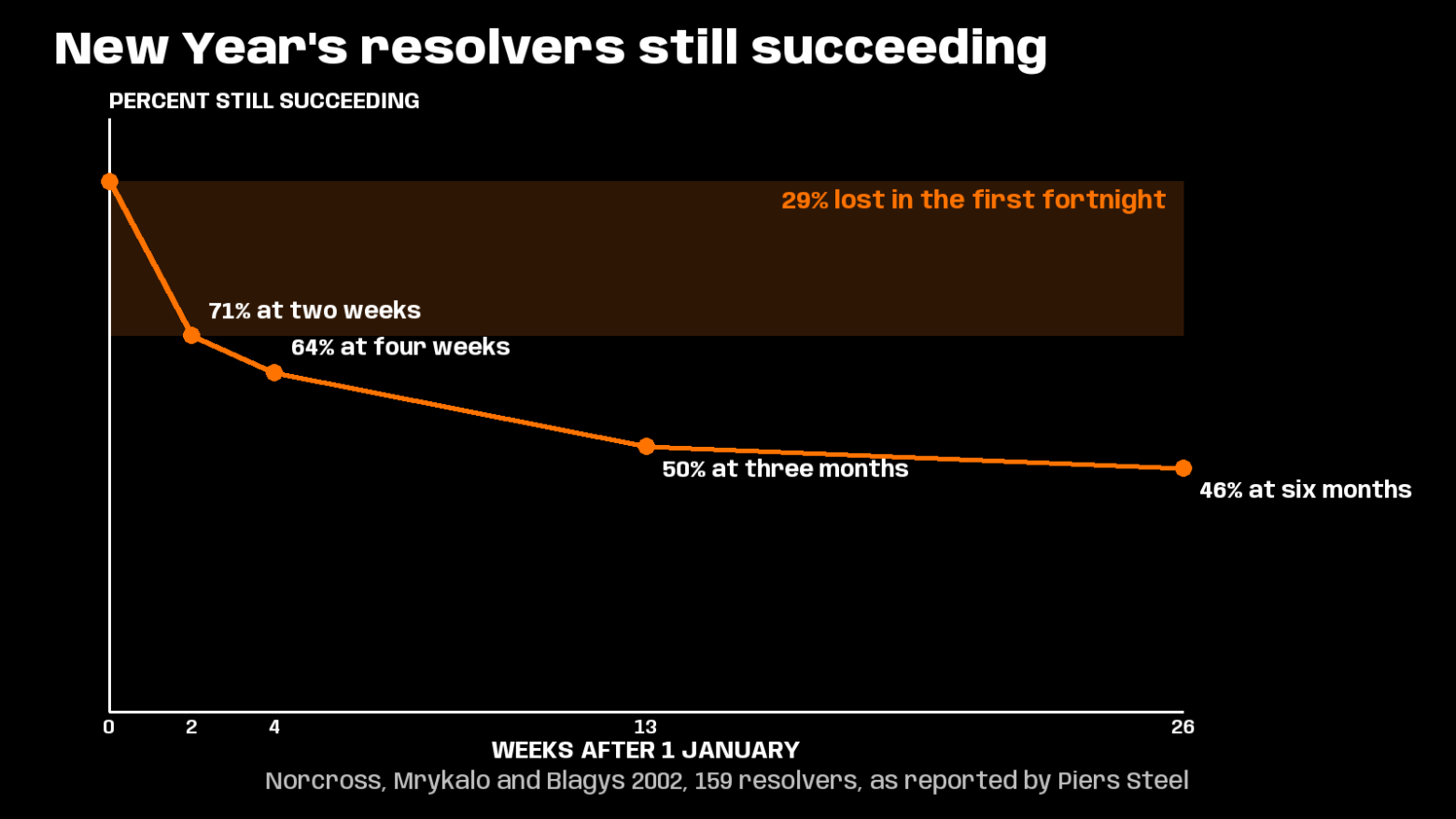
Most of the early drop-outs happen in the first fortnight.
Is It a Willpower Problem?
Mostly not. The research on habit suggests that failing to change is less about weak willpower and more about cues, context and repetition. Habit researchers Wendy Wood and Dennis Rünger wrote that difficulties in changing established behaviour “do not reflect people’s continuing desire to perform the old behavior or a failure of willpower” [12]. The old cues are still there, and they still trigger the old response.
The popular idea that willpower is a fuel tank that runs dry has also taken a hit. A preregistered replication across 23 labs and 2,141 people found the classic ego depletion effect was close to zero, at d = 0.04 [13]. That one test does not prove willpower never tires, but it is a weak foundation for a new habit.
Even people with strong self-control lean on it less than you might think. Across six studies with 2,274 people, Brian Galla and Angela Duckworth found that people with better self-control “rely on beneficial habits” rather than constant resisting [14]. Wood and Rünger put it plainly: they reach goals “through forming habits that allow them to achieve goals without experiencing unwanted temptations” [12].
Why Does Motivation Fade So Quickly?
Because motivation is often borrowed from a moment rather than built into a routine. People are far more likely to start on a fresh start date such as a Monday or New Year, and that energy belongs to the date, not the habit. When ordinary weeks return, the plan has to stand on its own, and most plans were never designed to.
A study of 11,912 student gym members found the chance of a gym visit rose by 33.4 percent at the start of a new week, 14.4 percent at the start of a month and 11.6 percent at the start of a year [10]. The researchers argue these dates help because they “relegate past imperfections to a previous period” [10]. That is useful for starting. It does nothing for week three.
Expectations make it worse. Psychologists Janet Polivy and Peter Herman described a false hope syndrome, “characterized by unrealistic expectations about the likely speed, amount, ease, and consequences of self-change attempts” [17]. If you expect a routine to feel easy by day ten, the normal difficulty of day fourteen feels like failure.
The gym industry shows the cost of that optimism. In a study of 7,752 members of three US health clubs, people paying a flat monthly fee of over $70 went “on average 4.3 times per month”, paying more than $17 a visit when a pass cost $10 a visit [19]. The authors’ leading explanation was “overconfidence about future self-control or about future efficiency” [19].
How Long Does It Take for a Habit to Stick?
Usually much longer than two weeks. In the best known real-world study, a simple daily behaviour took a median of 66 days to become automatic, with a range from 18 to 254 days [5]. A machine learning study of more than 30,000 gym members found gym habits took about four to seven months, while handwashing at work took a couple of weeks [6].
The 66 day study followed 96 volunteers, 30 of them men, who each picked one behaviour to repeat daily in the same context for 84 days [5]. Exercise was slower than eating or drinking habits. “It is notable that the exercise group took one and a half times longer to reach their asymptote than the other two groups,” the authors wrote [5].
The gym study, by researchers including Katy Milkman, Angela Duckworth and Colin Camerer, rejected the idea of a single magic number of days. “Gym habits take months to form and handwashing habits take weeks to form,” they concluded [6]. That is why UCL researchers advise GPs to tell patients that “within 10 weeks you should find you are doing it automatically without even having to think about it” [18].
Most of these samples skew young or female: the gym study was 62 percent women, and the 66 day volunteers were mostly postgraduate students [5][6]. Treat the numbers as a guide for men, not a rule. For the full timeline, see our guide on how long it takes to build a habit.
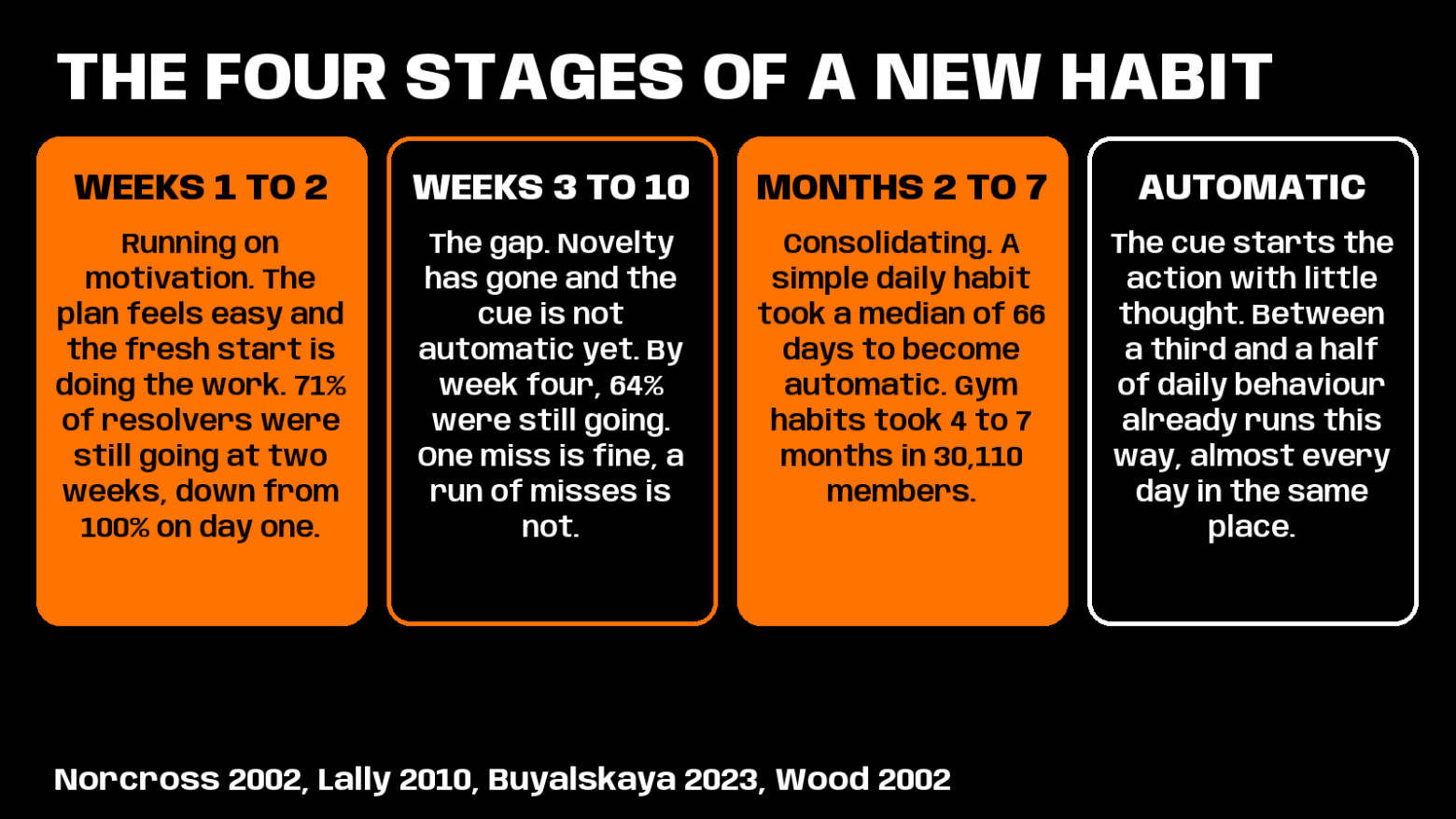
Two weeks sits at the start of the most fragile stretch, not the end of it.
What Happens When You Miss a Day?
One missed day does very little damage. A run of missed days is what ends most habits. In the 66 day study, “Missing one opportunity to perform the behaviour did not materially affect the habit formation process” [5]. The same paper points to earlier work where missing a week of exercise lowered the chance of carrying on and slowed the habit down [5].
Large datasets show the same pattern. For 76 percent of gym members in one study, “the longer it has been since they last visited the gym, the less likely they are to go on a given day” [6]. Each skipped session makes the next one less likely, so two misses turn into four very quickly.
That is why the most effective idea in a megastudy of 61,293 gym members targeted missed sessions. Of 53 programmes tested, “the top-performing intervention offered microrewards for returning to the gym after a missed workout”, lifting weekly visits by 27 percent [16]. The authors are honest about the limit: “Only 8% of interventions induced behaviour change that was significant and measurable after the four-week intervention” [16].
Slipping is normal, even for people who succeed. In the 200 resolver study, “Fifty-three percent of the successful group experienced at least one slip, and the mean number of slips over the 2-year interval was 14” [3]. The men who made it were not the ones who never slipped. They were the ones who came back.
Does Starting Too Big Make Habits Fail?
Often, yes. A plan that relies on a perfect week tends to break on the first normal one. In a study of 111 new gym members, consistency and simple routines both predicted who formed an exercise habit, and the researchers advised trainers to “keep exercises fun and simple for new clients and focus on consistency” [7]. Doing it regularly mattered more than doing it hard.
The same study found that “exercising for at least four bouts per week for 6 weeks was the minimum requirement to establish an exercise habit” [7]. Four short sessions you actually do will beat six long ones you plan and miss.
How you frame the goal matters too. In the Swedish resolution trial, “Participants with approach-oriented goals were significantly more successful than those with avoidance-oriented goals (58.9% vs. 47.1%)” [4]. Starting a ten minute walk after lunch gives your brain a clear action. Stopping late night scrolling only leaves a gap. Our breakdown of why push-up habits fail for men shows the same pattern in one exercise.
Does Enjoying It Make a Habit Last?
Yes, more than most men expect. Research by Kaitlin Woolley and Ayelet Fishbach found that “immediate rewards (e.g., enjoyment) predicted current persistence at New Year’s resolutions whereas delayed rewards did not” [15]. The long-term payoff is why you start. What you feel today is what keeps you going past the second week.
Their conclusion was that “immediate rewards are more strongly associated with actual persistence in a long-term goal” [15]. Enjoyment also predicted habit formation in the new gym member study, alongside consistency, simplicity and the right environment [7].
Pair the habit with something you already like: a podcast you only play on the run, training with a mate, or a proper coffee after the session. It sounds small. It is the part most plans leave out, and it is the part the evidence says carries you through the dip.
What Makes a Habit Stick Past Two Weeks?
Three things: a fixed cue, a version small enough to do on bad days, and a plan for misses. If-then plans, such as deciding that after you pour your coffee you do ten push-ups, had a medium to large effect on reaching goals across 94 tests [9]. Repeating the action in the same context then turns the cue into an automatic trigger [18].
The meta-analysis put it in one line: “Findings from 94 independent tests showed that implementation intentions had a positive effect of medium-to-large magnitude (d= .65) on goal attainment” [9]. The plan does the remembering for you.
Repetition does the rest. “Decades of psychological research consistently show that mere repetition of a simple action in a consistent context leads, through associative learning, to the action being activated upon subsequent exposure to those contextual cues,” wrote Benjamin Gardner, Phillippa Lally and Jane Wardle [18]. Once that happens, “habits are likely to persist even after conscious motivation or interest dissipates” [18].
That is the goal: to move the habit into the large share of life that already runs on autopilot. In two diary studies, between a third and a half of daily behaviours were habits, done almost every day in the same place [11]. The same rules apply to softer habits, as our piece on why gratitude habits fail for men shows, and self-discipline for men covers the wider system.
FAQ
Is the 21 day habit rule true?
There is no good evidence for it. The best known study found a median of 66 days for a simple daily habit, with a range from 18 to 254 days [5]. Gym habits took about four to seven months in a study of more than 30,000 members [6]. Plan for weeks to months, not three weeks.
Should I restart a habit on a Monday?
You can, and fresh starts do lift effort: gym visits were 33.4 percent more likely at the start of a week [10]. But do not wait for Monday after a miss. Coming back the next day matters more, because each extra day off makes the next session less likely [6].
How many days can I miss before a habit breaks?
No study gives an exact number. One missed day did not materially affect habit formation in the 66 day study, while missing a week of exercise lowered later performance in earlier work [5]. A simple, safe rule is never to miss twice in a row.
Why do habits stick for some men and not others?
Mostly because of setup, not character. Consistency, low complexity, the right environment and enjoyment all predicted which new gym members formed an exercise habit [7]. People with strong self-control also tend to rely on good habits rather than constant willpower [14].
Can an old habit come back after you break it?
Yes. Habit researchers note that “Even after new habits have been learned, old memory traces are not necessarily replaced” [12]. Old cues can still trigger old behaviour, especially under stress or in old settings. Changing or avoiding the cue gives you better protection than resisting it every time.
Does paying for a gym membership make you go more?
Not reliably. Members of three US clubs paying over $70 a month went 4.3 times a month on average, and on average gave up savings of about $600 compared with paying per visit [19]. The fee did not create the habit. A fixed time, a place and a plan for misses do more.
Final Recommendation
If your habit died around week two, nothing is wrong with you. That is the point where motivation has faded and the habit has not formed yet, and most people hit it [1][5]. The fix is to stop relying on how you feel and start relying on a cue, a small version of the habit and a rule for what happens after a miss.
Pick one habit. Tie it to something you already do every day, make it small enough to do on your worst day, and decide now that a miss means you go again the next day [5][9]. Then give it ten weeks before you judge it [18]. If low mood, drinking or poor sleep is behind the habits slipping, speak to your GP.
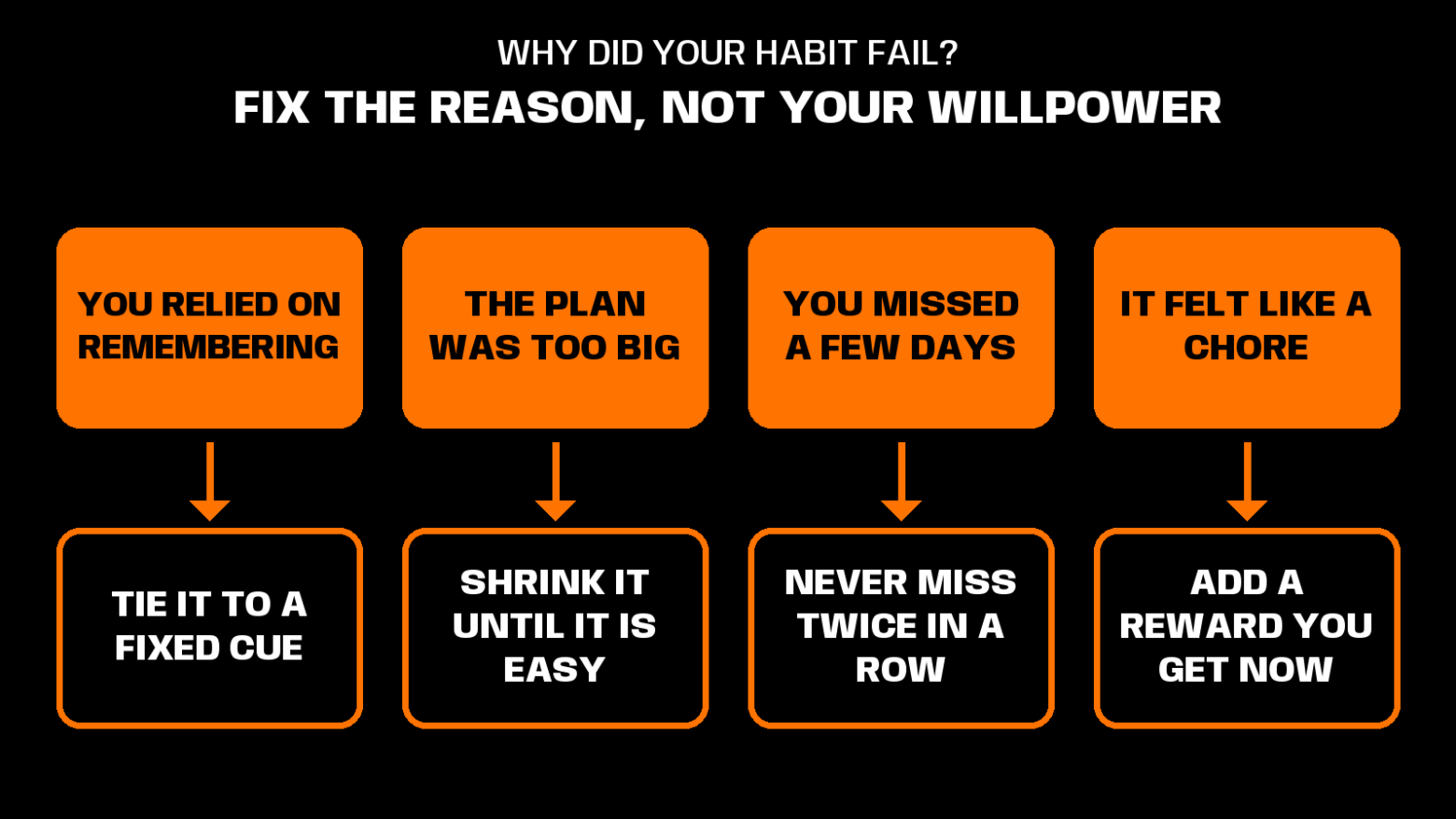
Find the reason yours slipped, then fix that one thing first.
Options for Men to Take Action
Most men do not drop a habit because they stop caring. They drop it because the plan lives in their head, a missed day goes unnoticed, and two weeks later nothing shows whether it is still happening.
The MenTools app runs challenges across mindset, fitness, nutrition and money, with levels you choose, daily actions, streak and progress tracking, journals and an AI coach. For a new habit its job is the stretch this guide is about: keeping one small daily action visible through weeks three to ten, after the motivation has gone and before the habit has formed.
How you can do this today: pick one habit from this guide, attach it to a cue you already have, and set it as a daily action at the easiest level.
Wins on cost: one subscription covers habit tracking, journals and coaching, instead of several apps or a gym contract you stop using.
Wins on time: the challenges are already built, so you spend your time doing the habit rather than designing the system.
Wins on practicality: each action takes minutes, and the streak makes a missed day obvious, so one miss does not quietly become five.
Watch-out: it tracks and prompts, but it cannot shrink the habit or fix the cue for you. That setup is still your job, and it is the part that matters most.
Habits also sit on basic energy and recovery, so a one a day multivitamin may help cover the simple daily foundation underneath the routine. For more on building routines that last, the MenTools habits hub collects everything in one place. Make it small, make it fixed, and come back after every miss.
Last updated: 2026-10-22 v1.0
Disclaimer: This guide is for informational purposes only and does not constitute medical or psychological advice. Speak with a qualified professional before making significant changes if you have a medical or mental health condition.
References
- [1] Norcross JC, Mrykalo MS, Blagys MD. Auld lang syne, success predictors, change processes, and self-reported outcomes of New Year’s resolvers and nonresolvers. Journal of Clinical Psychology, 2002;58(4):397-405. Link
- [2] Steel P. The two faces of the New Year. Psychology Today, 3 January 2013. Link
- [3] Norcross JC, Vangarelli DJ. The resolution solution, longitudinal examination of New Year’s change attempts. Journal of Substance Abuse, 1988;1(2):127-134. Link
- [4] Oscarsson M, Carlbring P, Andersson G, Rozental A. A large-scale experiment on New Year’s resolutions, approach-oriented goals are more successful than avoidance-oriented goals. PLoS One, 2020;15(12):e0234097. Link
- [5] Lally P, van Jaarsveld CHM, Potts HWW, Wardle J. How are habits formed, modelling habit formation in the real world. European Journal of Social Psychology, 2010;40(6):998-1009. Link
- [6] Buyalskaya A, Ho H, Milkman KL, Li X, Duckworth AL, Camerer C. What can machine learning teach us about habit formation? Evidence from exercise and hygiene. Proceedings of the National Academy of Sciences, 2023;120(17):e2216115120. Link
- [7] Kaushal N, Rhodes RE. Exercise habit formation in new gym members, a longitudinal study. Journal of Behavioral Medicine, 2015;38(4):652-663. Link
- [8] Webb TL, Sheeran P. Does changing behavioral intentions engender behavior change? A meta-analysis of the experimental evidence. Psychological Bulletin, 2006;132(2):249-268. Link
- [9] Gollwitzer PM, Sheeran P. Implementation intentions and goal achievement, a meta-analysis of effects and processes. Advances in Experimental Social Psychology, 2006;38:69-119. Link
- [10] Dai H, Milkman KL, Riis J. The fresh start effect, temporal landmarks motivate aspirational behavior. Management Science, 2014;60(10):2563-2582. Link
- [11] Wood W, Quinn JM, Kashy DA. Habits in everyday life, thought, emotion, and action. Journal of Personality and Social Psychology, 2002;83(6):1281-1297. Link
- [12] Wood W, Rünger D. Psychology of habit. Annual Review of Psychology, 2016;67:289-314. Link
- [13] Hagger MS, Chatzisarantis NLD, Alberts H, et al. A multilab preregistered replication of the ego-depletion effect. Perspectives on Psychological Science, 2016;11(4):546-573. Link
- [14] Galla BM, Duckworth AL. More than resisting temptation, beneficial habits mediate the relationship between self-control and positive life outcomes. Journal of Personality and Social Psychology, 2015;109(3):508-525. Link
- [15] Woolley K, Fishbach A. Immediate rewards predict adherence to long-term goals. Personality and Social Psychology Bulletin, 2017;43(2):151-162. Link
- [16] Milkman KL, Gromet D, Ho H, et al. Megastudies improve the impact of applied behavioural science. Nature, 2021;600(7889):478-483. Link
- [17] Polivy J, Herman CP. If at first you don’t succeed, false hopes of self-change. American Psychologist, 2002;57(9):677-689. Link
- [18] Gardner B, Lally P, Wardle J. Making health habitual, the psychology of habit-formation and general practice. British Journal of General Practice, 2012;62(605):664-666. Link
- [19] DellaVigna S, Malmendier U. Paying not to go to the gym. American Economic Review, 2006;96(3):694-719. Link
- [20] Vedantam S. Creatures of habit, how habits shape who we are and who we become. NPR Hidden Brain, December 2019. Link