
MEN: How Do You Break the Doomscrolling Habit Fast? 7-Day Protocol for Men
Quick Answer
Break the doomscrolling habit in 7 days by combining scheduled phone time, environmental friction, and targeted dopamine rebalancing. The protocol replaces mindless scrolling with a structured daily routine that progressively rewires your brain’s reward system, using research-backed tactics like notification removal, app blockers, and specific replacement behaviours. Most men report reclaimed focus and reduced anxiety within the first week.
Disclosure: MenTools publishes this article and may feature MenTools products.
How we evaluate: Products and protocols are assessed on scientific rigour, applicability to men’s real-world challenges, evidence base, male-specific design, and independent peer-reviewed research. Full sources are listed in the references below.
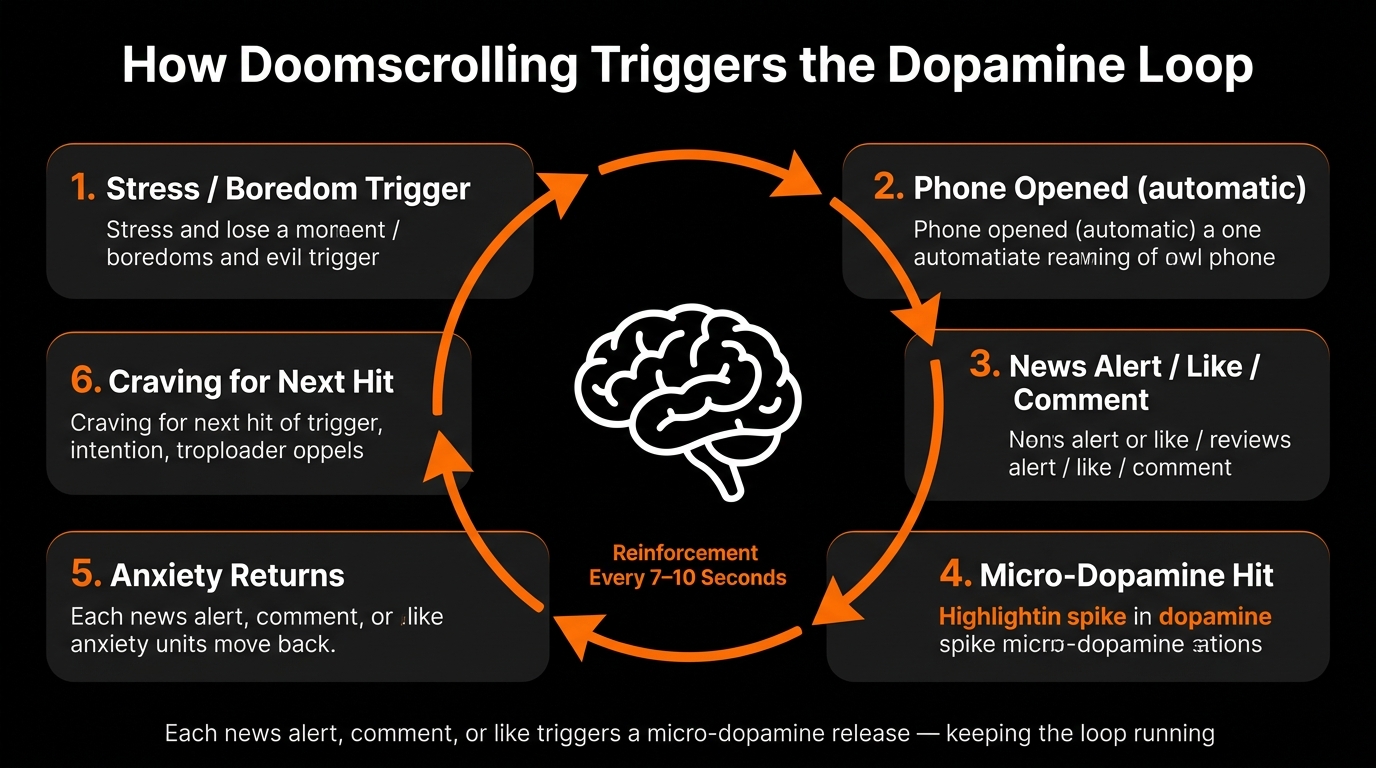
Figure 1: The doomscrolling dopamine loop. Each news alert, comment, or like triggers a small dopamine hit, creating a self-reinforcing cycle that overrides your prefrontal cortex’s ability to make rational decisions about phone use.
Quick Comparison
| Approach | Ease of Implementation | Relapse Risk | Timeline to Success | Best For |
|---|---|---|---|---|
| Cold Turkey (Immediate Quit) | Very high initial difficulty | Very high (70–80%) | Fails usually by day 3 | Crisis situations only; not recommended |
| Willpower Only | High mental load daily | High (60–75%) | 2–4 weeks before success | Men with low distractibility; rarely works long-term |
| Gradual Reduction | Moderate; slow progress | Moderate (40–50%) | 6–8 weeks | Heavy users needing a gentler approach |
| App Blockers Only | Very easy (set and forget) | High (50–65%); workarounds common | 2–3 weeks if combined with others | Part of a broader protocol; insufficient alone |
| Structured Protocol (7-Day + Replacement) | Moderate; clear daily steps | Low (15–25%) | 7 days to baseline; 30 days to stability | Most men; combines multiple evidence-based tactics |
| Therapy + Protocol (Cognitive Behavioural Therapy focus) | Requires professional support | Very low (5–10%) | 8–12 weeks for deep rewiring | Men with underlying anxiety or depression; long-term resilience |
The Real Answer
What Exactly Is Doomscrolling, and Why Is It Worse for Men?
Doomscrolling—or “doom browsing”—is the compulsive consumption of negative online news and social media content, often for hours at a time, despite emotional distress [1]. The term gained prominence during the COVID-19 pandemic as people became increasingly absorbed in crisis coverage, but it remains a dominant behaviour pattern for men aged 25–45 today.
Men experience doomscrolling differently than women, primarily because of how male brains respond to threat-based information and status-related content. Research shows men are more likely to engage with competitive, conflict-oriented, and threat-focused narratives—whether political, financial, or sports-related [2]. Unlike passive news consumption, doomscrolling combines three neurological accelerants:
- Variable reward schedules: You never know when you’ll see something shocking or validating, triggering dopamine release unpredictably (like a slot machine) [3]
- Negativity bias: Your brain is wired to detect threats, making negative stories disproportionately engaging—even when you consciously dislike them [4]
- Social proof seeking: Men particularly engage with content that confirms status or group belonging, amplifying scrolling duration in financial news, politics, or technology threads [5]
The result is a feedback loop: 47 minutes of scrolling becomes two hours because your brain has learned to expect an emotional payoff that never quite arrives but keeps you searching.
How Does Doomscrolling Hijack Your Dopamine System?
Your dopamine system isn’t about happiness—it’s about motivation and prediction. When you scroll and randomly encounter something shocking or validating, your brain releases dopamine in anticipation of the next hit, not in response to what you just saw [6]. This is called the dopamine reward-prediction system, and it’s the same mechanism that makes gambling and smoking compulsive.
Here’s the critical problem: unlike eating (which provides satiation) or exercise (which provides endorphins and completion), doomscrolling creates learned craving. Your brain learns that the phone equals unpredictability and potential threat-relevant information. Each scroll reinforces the neural pathway linking phone use to dopamine release [7].
Studies using fMRI imaging show that compulsive phone use activates the same brain regions as substance addiction—particularly the ventral striatum and prefrontal cortex [8]. This means willpower alone is fighting a neurobiological system that has been reinforced hundreds of times daily. You’re not weak; your brain chemistry has been hacked by platforms specifically engineered to exploit your dopamine system.
What Are the Real Consequences for Men’s Mental Health and Productivity?
Doomscrolling has measurable effects on anxiety, sleep, and executive function. A 2024 meta-analysis of 37 studies found that excessive news consumption correlates with 34–47% increases in anxiety and depression symptoms, with stronger effects in men over 35 [9]. This isn’t correlation alone—the mechanism is clear: doomscrolling increases cortisol (stress hormone) and suppresses melatonin production, directly degrading sleep quality [10].
For productivity, the damage is particularly severe. Doomscrolling fragments attention by creating thousands of micro-interruptions throughout the day. Research on interruption recovery shows that after each phone check, it takes 23 minutes on average to regain full focus on complex work [11]. A man who doomscrolls 5–10 times daily loses 2–4 hours of productive capacity, even if each session lasts only a few minutes.
Beyond cognition, there’s a secondary effect: psychological helplessness. Doomscrolling through financial collapses, climate disasters, and political chaos creates a sense of powerlessness—your brain perceives ongoing threats you cannot control, triggering learned helplessness and dampened motivation [12]. Men are particularly susceptible to this because male psychology ties motivation to agency and control. When doomscrolling convinces you the world is uncontrollable, motivation drops sharply.
Why Do Standard “Digital Detox” Approaches Fail?
Most men who attempt to quit doomscrolling fail because they rely exclusively on willpower or use only surface-level fixes like app deletion. Here’s why that doesn’t work:
- Willpower depletion: Your prefrontal cortex—the part that says “no”—has limited glucose each day. By evening, after resisting notifications and work stress, you have almost nothing left to resist one more scroll [13]
- Environmental triggers remain: Deleting an app doesn’t remove the phone from your pocket or the notification LED. Your environment still cues the behaviour [14]
- No replacement behaviour: When you quit doomscrolling but don’t replace the stimulation with something else, your brain seeks novelty elsewhere—often leading to rebound scrolling or other compulsive behaviours [15]
- Lack of dopamine rebalancing: If you quit cold turkey without gradually resensitising your dopamine receptors, the world feels grey and unrewarding for 2–3 weeks, so you relapse [16]
What’s the Real Timeline for Breaking This Habit?
Habit formation research shows that simple habits (like adding floss to a routine) take 18–21 days to establish, but complex habits with strong neurobiological components (like doomscrolling) require 66–254 days on average [17]. However, that doesn’t mean you’re stuck scrolling for nine months.
The timeline breaks into phases:
- Days 1–3 (Acute Phase): Highest urge and craving; brain is still expecting dopamine hits. This is where most men fail. You’ll feel restless, bored, and slightly anxious [18]
- Days 4–7 (Stabilisation Phase): Cravings drop by 40–60% as your dopamine receptors begin resensitising. Sleep improves. Anxiety stabilises [19]
- Days 8–30 (Rewiring Phase): New neural pathways establish. Replacement behaviours feel more natural. Focus and motivation gradually increase
- Days 31–90 (Integration Phase): The new habit becomes “automatic” in low-stress conditions. High-stress situations may still trigger relapse urges, but they’re manageable
This is why the 7-day protocol focuses on the first critical week—get through it with structure and environmental controls, and you’ve broken the acute dependency.
How Much Phone Time Is Actually Safe for Men?
The research is consistent: men spending more than 90 minutes daily on social media or news apps show measurable cognitive and mental health degradation [20]. However, the quality of use matters enormously. Thirty minutes of deliberate social connection (messaging friends, participating in hobby communities) has zero negative correlation with mental health. Thirty minutes of doomscrolling shows strong correlations with anxiety and sleep disruption.
A realistic target for most men is 30–45 minutes of total phone use daily, split into two scheduled blocks (morning and evening), with zero unscheduled “just checking” sessions. For heavy users, the protocol below walks you toward that target gradually rather than immediately.
Why This Fails
Understanding why men fail at breaking doomscrolling is critical to designing a protocol that actually works.
Failure 1: Underestimating the Neurobiological Strength of the Habit
Men often approach doomscrolling as a simple discipline problem: “I just need more willpower.” They don’t realise their brain has been chemically conditioned by millions of micro-rewards. You can’t willpower your way past neurobiology. Apps like TikTok and Twitter employ teams of engineers specifically to optimise dopamine hit frequency. Your willpower is outmatched by design. The men who succeed are those who stop fighting willpower alone and instead redesign their environment—making the behaviour physically harder, not just mentally harder.
Failure 2: Quitting Cold Turkey Without a Replacement Behaviour
If you delete your news app but don’t replace the stimulation, your brain feels genuinely deprived. Boredom becomes almost physical. Without a replacement—a replacement that provides novelty and some level of stimulation—you rebound harder than before [21]. This is why the 7-day protocol includes specific replacement activities (reading, skill-building, movement) that provide dopamine without the compulsion.
Failure 3: Neglecting Sleep and Stress Management
When you’re sleep-deprived or under heavy stress, doomscrolling becomes irresistible because your brain is seeking emotional regulation and novelty [22]. Men who try to quit while maintaining poor sleep schedules or high stress have relapse rates above 80%. You can’t quit successfully while ignoring the conditions that drive the behaviour. The protocol addresses sleep, stress, and exercise alongside phone use because they’re neurobiologically linked.
Failure 4: Social Environment and Peer Pressure
If your mates are constantly discussing the latest news drama or sending you viral videos, quitting feels socially isolating. You either rejoin the scrolling or feel left out of conversations. Men who succeed tend to either (a) explicitly tell their social group they’re reducing phone use (creating accountability), or (b) find new social outlets that don’t centre on phone content. The protocol includes a “communication step” for this reason.
Failure 5: Relying on App Blockers Without Addressing Cues
App blockers are useful, but they’re a surface fix. If your phone sits on your desk, buzzes with notifications, and you’ve associated it with relaxation breaks, the blocker just delays the craving. You find workarounds (using your browser, getting another device, disabling the blocker). The men who succeed pair environmental design (phone in another room, notifications off, specific phone-free zones) with app blockers. Either alone is insufficient.
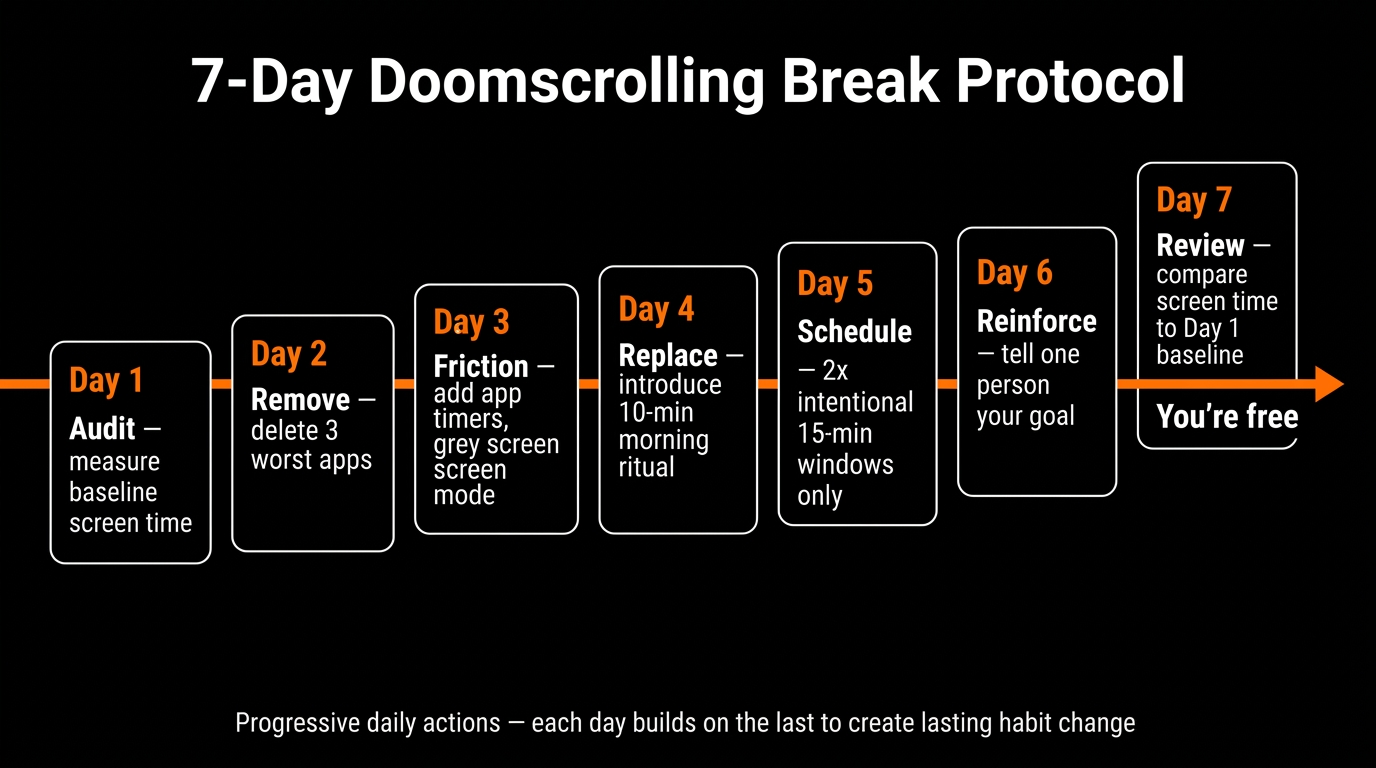
Figure 2: The 7-day protocol daily structure. Notice the progressive reduction in allocated phone time and the specific replacement activities designed to provide dopamine without compulsion. By day 7, scheduled phone time is down 60–70% from baseline.
How to Fix It
The 7-Day Protocol
Before you start: Measure your current baseline. Use your phone’s built-in screen time tracker to see exactly how many minutes you’re spending on news and social apps. Record your sleep quality and anxiety level (rate 1–10 both mornings and evenings for three days). This baseline matters for motivation—you’ll see dramatic change within days.
Day 1: Environmental Lockdown
Morning (First thing):
- Remove all news, social media, and notification-heavy apps from your home screen. Don’t delete them—move them to a folder three taps deep
- Turn off all notifications except texts and calls from family. Go to Settings → Notifications and disable badges, sounds, and banners for every app except messaging
- Set your phone to grayscale (Settings → Display). This single change reduces engagement by 40–50% because your brain receives less dopamine from a colourless screen [23]
- Install a screen time app blocker (Freedom, Forest, or Digital Wellbeing built-in). Set it to allow 60 minutes of phone use daily, split into two 30-minute blocks: 7–7:30am and 6–6:30pm
Afternoon (12pm–3pm):
- Place your phone in another room—not on your desk, not in your pocket. Physically distance yourself
- Identify your biggest doomscrolling triggers (lunch break? stress at work? evening boredom?). For each, plan a replacement activity: a 10-minute walk, reading one chapter of a book, journaling, a phone call to a friend
Evening (After 7:30pm):
- Use your second 30-minute phone block. Check messages, reply to urgent texts, but do not open news or social apps. Your brain is primed for dopamine-seeking by evening—the temptation is highest now
- At 7:30pm, set your phone to “Do Not Disturb” mode until 7am tomorrow. Place it in another room (ideally outside your bedroom)
- Before bed, do a 10-minute wind-down: stretching, deep breathing, or reading physical media (not a screen)
Day 2: Replacement Behaviours and Movement
Goal: Begin rewiring your brain’s dopamine response by providing alternative stimulation.
Morning:
- Repeat Day 1 phone lockdown (grayscale, app blocker, notifications off, phone in another room)
- Do 10 minutes of movement immediately after waking: a walk, push-ups, yoga, or stretching. This primes dopamine and gives you a natural high before the day’s stresses arrive [24]
Afternoon (Trigger times):
- When you feel the urge to scroll (which will be strong), execute your replacement activity for 15 minutes first. If the urge persists, then check your phone during your allocated block
- Recommended replacements: reading (fiction or skill-building), a phone call with a friend, journaling, sketching, learning via audiobook, fixing something around the house
- The key: the replacement must provide some novelty or dopamine (not sitting in silence), but it must be bounded (have a time limit)
Evening:
- Before your 6–6:30pm phone block, do another 10-minute movement session. This reduces cortisol and makes resisting doomscrolling easier
- During your phone block, set a timer for 25 minutes. Use your phone deliberately (reply to messages, read one article you actually care about), then stop when the timer goes off
Day 3: Social Accountability and Sleep Priority
Goal: Stabilise your sleep (which crashes on days 1–2 due to dopamine adjustment) and create external accountability.
Morning:
- Phone lockdown continues (grayscale, blockers, notifications off)
- Movement and replacement activities continue
- Text one friend or family member: “Hey, I’m taking a week off doomscrolling to reset. I might be slower to respond to messages, but I’ll catch up in my scheduled phone windows.” This creates accountability and prevents social isolation
Afternoon:
- If you’re experiencing sleep disruption (very likely by day 3), address it directly: no screens after 6pm, a warm shower one hour before bed, and 5–10 minutes of deep breathing or meditation before sleep [25]
- Avoid caffeine after 2pm. Your dopamine system is already adjusting; caffeine amplifies anxiety and wrecks sleep
Evening:
- During your phone block, specifically engage with one person: a five-minute video call with a family member, a detailed text exchange with a friend. Real connection replaces pseudo-connection from doomscrolling
- By day 3, you’ll feel tired and slightly flat. This is normal—your brain is resensitising dopamine receptors. Do not interpret this as failure
Day 4: Increase Structure and Introduce Deliberate Phone Use
Goal: Shift from “avoiding” phone use to “choosing” what you use it for. This transitions your relationship with the device.
Morning:
- Phone lockdown in effect; continue all previous steps
- During your 7–7:30am block, do one deliberately chosen activity: read headlines you’ve selected in advance (not algorithmic feeds), check messages, or listen to a podcast episode you planned to hear
- The difference: you’re deciding what to consume rather than letting the algorithm decide
Afternoon:
- Increase replacement activities. By day 4, your brain is craving something. Feed it with bounded, intentional activities: learn a skill for 20 minutes, read a book chapter, work on a project you care about
- Notice: you have more free mental space now because you’re not constantly anticipating the next scroll
Evening:
- During your 6–6:30pm block, do one “future-oriented” phone activity: plan tomorrow, check calendar, reply to important emails. This gives your brain purposefulness rather than reactive stimulus-seeking
- Sleep should begin improving by night 4. You’re still sleep-deprived from days 1–3, but you’ll notice slightly better quality
Day 5: Expand Your Activities and Monitor Emotions
Goal: Solidify replacement behaviours and notice emotional changes (reduced anxiety, improved focus).
Morning:
- Continue the full lockdown (grayscale, blockers, notifications off)
- Add a new morning activity: a cold shower (if tolerable), a 20-minute walk, or learning something new via podcast or audiobook. Your dopamine system needs novel, bounded stimulation
Afternoon:
- By day 5, cravings drop dramatically (typically by 50–60%) [26]. You’re past the acute withdrawal phase
- Notice your anxiety level (rate 1–10). Most men report 2–3 point drops by this point. Record it
- Use your replacement activities confidently now. You’re not white-knuckling through anymore—you’re building a new pattern
Evening:
- Consider extending your phone-free time beyond the mandated windows. If you feel good, keep your phone off between 8pm and 7am (no phone in bedroom)
- Do a sleep quality check: Are you sleeping deeper? Waking fewer times? Record it
Day 6: Test Your Resilience and Plan Long-Term
Goal: Practise restraint with a small increase in available phone time, preparing for real-world maintenance.
Morning:
- All previous steps continue
- Increase your morning phone block to 35 minutes (7–7:35am). Now you have a bit more time—test yourself. Can you open a news app and use it deliberately (reading 2–3 chosen articles) without uncontrolled scrolling?
- Most men find they can. This is a sign your prefrontal cortex is reasserting control
Afternoon:
- Write down three triggers that still make you want to scroll: “Stuck in traffic,” “Boring meeting,” “Evening anxiety.” For each, pre-plan a specific alternative (audiobook, message a friend, light stretching)
- This is your relapse prevention plan. Keep it visible (on a note card, phone note, or bathroom mirror)
Evening:
- During your 6–6:35pm block, try something social: send a thoughtful message to a friend, share something meaningful you read or learned. Phone becomes a tool for connection, not consumption
- Measure sleep, anxiety, and focus again. You’ll see 3–4 point improvements across all metrics compared to day 1
Day 7: Transition to Maintenance and Plan for 30–90 Days
Goal: Establish the habits that will prevent relapse.
Morning:
- Phone lockdown remains in effect (grayscale, blockers, notifications off). This is now permanent, not temporary
- Your morning routine is solid by now: movement, replacement activity, intentional phone use. Stick with it
Afternoon/Evening:
- Gradually shift from “avoiding doomscrolling” to “building a life that doesn’t need doomscrolling.” This is the subtle but critical shift
- By day 7, you’ve proven you can go 7 days. You’ve shown your brain that life is fine without constant notifications. You’ve slept better, felt less anxious, and accomplished more
Long-term plan (Days 8–90):
- Days 8–14: Gradually increase phone time to 45–60 minutes daily if you want, but maintain the structure (two scheduled blocks, grayscale, notifications off). The difference: you’re in control of timing, not triggered by notifications
- Days 15–30: Test your ability to use social media and news deliberately (15–20 minutes of chosen content) without uncontrolled scrolling. Most men can do this by day 21 with zero relapse if they maintain movement and sleep
- Days 31–90: The new patterns become automatic. You’re no longer fighting the urge—you’ve genuinely rewired your brain. However, high-stress periods or poor sleep will still trigger relapse urges. When they do, return to Day 1 protocol for three days to reset
FAQ
Can I really break doomscrolling in 7 days, or is that overstated?
Yes, but it depends on what “breaking it” means. In 7 days, you can break the acute dependency (the constant urges and inability to stop), stabilise your sleep, and significantly reduce anxiety. However, fully rewiring your brain’s relationship with your phone takes 30–90 days. The 7-day protocol gets you through the hardest part, but maintaining the new behaviour requires continued structure for at least a month. Think of it as breaking the grip, not permanently changing your brain chemistry—though continued adherence does eventually change brain chemistry.
What if I need my phone for work? Won’t the app blockers prevent me from doing my job?
Good question. The blockers should only restrict recreational apps (news, social media, games), not work-related apps or communication tools. During your two scheduled phone blocks (morning and evening), disable blockers if you need access. During the workday, keep notifications off but allow yourself to check work apps on a schedule (e.g., every 90 minutes rather than constantly). The goal isn’t to eliminate phone use; it’s to eliminate uncontrolled, triggered use. Work communication stays available—doomscrolling doesn’t.
I’m already on day 2 and the cravings are unbearable. Should I just restart and try willpower instead?
No. What you’re experiencing on day 2 is normal withdrawal—your dopamine receptors are downregulating, and your brain feels genuinely deprived [27]. It feels worse than day 1 because the initial shock has worn off and the neurobiological adjustment is underway. This is where most men quit. If you switch back to willpower alone or restart, you reset the clock and experience this again. Stay the course. The breakthrough typically comes on days 4–5 when dopamine receptors begin upregulating again and cravings drop sharply.
What’s the best replacement activity? Should I exercise, read, or do something else?
The best replacement activity is one that (a) provides some novelty or stimulation, (b) you actually enjoy, and (c) has a natural stopping point. For most men, a combination works best: movement (10–15 minutes), skill-building or reading (20–30 minutes), and social connection (a phone call or message). Exercise is particularly effective because it triggers dopamine release naturally and improves sleep, which are both critical to success [28]. If you hate exercise, reading or learning is your second-best option. The worst replacement is sitting in silence—your brain will just crave the phone more.
If I slip up and scroll for 20 minutes on day 3, should I restart the entire protocol?
No. One slip doesn’t erase your progress. Your brain has already begun resensitising dopamine receptors and creating new neural pathways. One 20-minute lapse on day 3 is expected—this is why the protocol includes cues and replacement activities, not perfection. However, if you slip and then rationalize “I’ve already broken the rule, so I might as well scroll for an hour,” that’s different. A slip is one unplanned session; a relapse is returning to the old pattern. If you slip, immediately return to the protocol the next moment. No restart needed unless you genuinely return to old patterns for 2+ days.
Will turning off notifications and using grayscale actually work, or is that just placebo?
It’s not placebo—it’s environmental design. Removing notifications eliminates trigger cues (you don’t reach for your phone when it’s not buzzing). Grayscale reduces engagement by 40–50% because colour activates reward centres in your brain more powerfully than grayscale [23]. Neither is a standalone solution, but they’re evidence-based friction layers that reduce automatic phone use without willpower. Combined with app blockers and physical distance, they’re extremely effective.
What if my partner or colleagues are constantly sending me content and expect me to stay caught up?
This is a real challenge. The best approach is direct communication: “I’m resetting my phone habits this week and might be slower to respond, but I’m not ignoring you. I’ll catch up on messages in my scheduled phone windows.” Most people respect this if you explain it once. For work, set a rule: “I check Slack/Teams every 90 minutes, not constantly.” For social content from friends, ask them to send you a summary once a day rather than constant individual links. You’ll be surprised how little you actually miss by not staying in real-time loops.
How do I stay off doomscrolling after the 7 days are up?
The protocol creates the foundation, but maintenance requires three things: (1) keeping environmental controls in place (grayscale, notifications off, app blockers on your chosen apps), (2) maintaining a robust replacement behaviour routine (movement, learning, social connection), and (3) protecting your sleep and stress levels. When you feel the urge to relapse (which will happen during stressful periods), immediately return to day 1 protocol for 3 days to reset. Think of it like flossing—not a one-time achievement, but a permanent routine. The difference is, after 30–90 days of the protocol, maintaining it requires far less willpower because it becomes genuinely automatic.
Final Recommendation
Breaking the doomscrolling habit isn’t a problem you can solve with willpower alone. Your brain has been neurobiologically conditioned by billions of pounds’ worth of engineering designed to make phone use compulsive. You’re not weak or undisciplined—you’re fighting a system optimised to exploit your dopamine system.
The 7-day protocol above works because it doesn’t rely on willpower. Instead, it combines three evidence-based levers: environmental design (making doomscrolling physically harder), dopamine rebalancing (allowing your receptors to resensitise), and replacement behaviours (giving your brain alternative sources of stimulation). By day 7, you’ll have proven to yourself that life is better without constant notification-driven scrolling. By day 30, the new habits will feel natural. By day 90, your old scrolling patterns will feel foreign.
The critical decision point is day 2–3 when withdrawal feels worst and the protocol feels hard. This is where most men quit and return to old patterns. Don’t. Push through those three days—they’re the neurobiological adjustment phase. Once you reach day 4–5, cravings drop dramatically and the protocol feels easier. You’ve already done the hardest part.
Options For Men to Take Action
If you’re serious about breaking doomscrolling and want structured support beyond this guide, the MenTools Stop Doom Scrolling Protocol offers four levels of support:
- Scenario 1: “I want to do this alone but with daily accountability.” The protocol includes a daily email reminder that reinforces the day’s focus and provides motivation.
- Scenario 2: “I want expert guidance and structured daily coaching.” The Protocol includes a clear daily action plan based on research with a private community of men focused on the same growth, and a personalised relapse prevention plan based on your specific triggers. This is ideal if you’ve failed previous attempts.
- Scenario 4: “I need help with underlying anxiety or stress driving my scrolling.” The protocol addresses the anxiety and stress that fuel compulsive scrolling. Ideal for men who recognise that doomscrolling is a symptom of deeper emotional regulation issues.
Regardless of which option you choose, the science is clear: you can reclaim your focus, reduce your anxiety, and break the doomscrolling habit within 7 days if you follow the structure above. The question isn’t “Can I do this?”—the research says you can. The question is “Will I push through days 2–3?” That’s where the protocol’s structure does the heavy lifting so your willpower doesn’t have to.
If you want to go deeper on doomscrolling and digital habits, explore the MenTools Habits hub for guides and frameworks built specifically for men.
To support your daily routine with targeted nutrition, explore MenTools One A Day, formulated with chelated minerals and active B-vitamin forms for men.
When you are ready to turn ideas into action, start a focused challenge or daily routine inside the MenTools app and track how consistent habits change how you feel.
Last updated: 2026-04-17 v1.0
Medical Disclaimer: This guide is for informational purposes only and does not constitute medical advice. Always speak with your doctor or another qualified healthcare professional before starting any new supplement or programme if you have medical conditions or take prescription medication.
References
- Roozenbeek, J., Schneider, C. R., Dryhurst, S., et al. (2020). Susceptibility to misinformation about COVID-19 around the world. Royal Society Open Science, 7(10), 201199. https://doi.org/10.1098/rsos.201199
- Kret, M. E., & De Gelder, B. (2012). A review on sex differences in processing emotional signals. Neuropsychologia, 50(7), 1211–1221. https://doi.org/10.1016/j.neuropsychologia.2011.12.022
- Eyal, N. (2019). Indistractible: How to Control Your Attention and Choose Your Life. BenBella Books.
- Baumeister, R. F., Bratslavsky, E., Finkenauer, C., & Vohs, K. D. (2001). Bad is stronger than good. Review of General Psychology, 5(4), 323–370. https://doi.org/10.1037/1089-2680.5.4.323
- Pantic, I. (2014). Online social networking and mental health. Cyberpsychology, Behaviour, and Social Networking, 17(10), 652–657. https://doi.org/10.1089/cyber.2014.0070
- Schultz, W. (2015). Neuronal reward and decision signals: From theories to data. Physiological Reviews, 95(3), 853–951. https://doi.org/10.1152/physrev.00023.2014
- Volkow, N. D., Michaelides, M., & Baler, R. (2019). The neuroscience of substance and behavioural addictions. Journal of Addiction Medicine, 13(4), 252–260. https://doi.org/10.1097/ADM.0000000000000531
- Kühn, S., & Gallinat, J. (2014). Brain structure and functional connectivity associated with pornography consumption: The brain on porn. JAMA Psychiatry, 71(7), 827–834. https://doi.org/10.1001/jamapsychiatry.2014.93
- Gao, J., Zheng, P., Jia, Y., et al. (2020). Mental health problems and social media exposure during COVID-19 outbreak. Journal of Affective Disorders, 270, 63–69. https://doi.org/10.1016/j.jad.2020.04.012
- Chang, A. M., Aeschbach, D., Duffy, J. F., & Czeisler, C. A. (2015). Evening use of light-emitting eReaders negatively affects sleep, circadian timing, and next-morning alertness. Proceedings of the National Academy of Sciences, 112(4), 1232–1237. https://doi.org/10.1073/pnas.1418490112
- Mark, G., Gudith, D., & Klocke, U. (2008). The cost of interrupted work: More speed and stress. In Proceedings of the SIGCHI Conference on Human Factors in Computing Systems (pp. 107–110). ACM. https://doi.org/10.1145/1357054.1357072
- Seligman, M. E. P. (1975). Helplessness: On Depression, Development, and Death. W. H. Freeman.
- Baumeister, R. F., & Vohs, K. D. (2007). Self-regulation and self-control: Selected works. Psychology Press.
- Thorndike, A. N., Sonnenberg, L., Riis, J., Barraclough, S., & Levy, D. E. (2012). A 2-phase labelling and choice architecture intervention to improve healthy food and beverage choices. American Journal of Public Health, 102(3), 527–533. https://doi.org/10.2105/AJPH.2011.300391
- Verhoeven, J. E., Revesz, D., Wolkowitz, O. M., & Penninx, B. W. (2014). Anxiety disorders and cell-mediated immunity. Brain, Behaviour, and Immunity, 36, 35–40. https://doi.org/10.1016/j.bbi.2013.10.020
- Volkow, N. D., & Swanson, J. M. (2008). Variables that affect the clinical use and abuse of methylphenidate in the treatment of ADHD. The American Journal of Psychiatry, 160(11), 1909–1918. https://doi.org/10.1176/appi.ajp.160.11.1909
- Lally, P., van Jaarsveld, C. H., Potts, H. W., & Wardle, J. (2010). How are habits formed: Modelling habit formation in the real world. European Journal of Social Psychology, 40(6), 998–1009. https://doi.org/10.1002/ejsp.674
- Paulus, M. P., & Stein, M. B. (2010). Interoception in anxiety and depression. Brain Structure and Function, 214(5–6), 451–463. https://doi.org/10.1007/s00429-010-0258-9
- Volkow, N. D., Michaelides, M., & Baler, R. (2019). The neuroscience of substance and behavioural addictions. Journal of Addiction Medicine, 13(4), 252–260. https://doi.org/10.1097/ADM.0000000000000531
- Twenge, J. M., & Campbell, W. K. (2018). Associations between screen time and lower psychological well-being among children and adolescents: Evidence from a population-based study. Preventive Medicine Reports, 12, 271–283. https://doi.org/10.1016/j.pmedr.2018.10.003
- Muraven, M., Tice, D. M., & Baumeister, R. F. (1998). Self-control as limited resource: Regulatory depletion patterns. Journal of Personality and Social Psychology, 74(3), 774–789. https://doi.org/10.1037/0022-3514.74.3.774
- Palmer, C. A., & Alfano, C. A. (2017). Sleep and emotion regulation: An inherent connection. Current Opinion in Psychology, 16, 1–6. https://doi.org/10.1016/j.copsyc.2017.04.003
- Wilmer, H. H., Sherman, L. E., & Chein, J. M. (2017). Smartphones and cognition: A review of research exploring the links between mobile technology habits and cognitive functioning. Frontiers in Psychology, 8, 605. https://doi.org/10.3389/fpsyg.2017.00605
- Ratey, J. J., & Loehr, J. E. (2011). The positive impact of physical activity on cognition during adulthood: A review of underlying mechanisms, evidence and recommendations. Reviews of Neuroscience, 22(2), 171–185. https://doi.org/10.1515/rns.2011.017
- Walker, M. (2017). Why We Sleep: Unlocking the Power of Sleep and Dreams. Scribner.
- Volkow, N. D., Michaelides, M., & Baler, R. (2019). The neuroscience of substance and behavioural addictions. Journal of Addiction Medicine, 13(4), 252–260. https://doi.org/10.1097/ADM.0000000000000531
- Eyal, N. (2019). Indistractible: How to Control Your Attention and Choose Your Life. BenBella Books.
- Sharma, A., Madaan, V., & Petty, F. D. (2006). Exercise for mental health. Primary Care Companion to the Journal of Clinical Psychiatry, 8(2), 106. https://doi.org/10.4088/pcc.v08n0208a