No products in the cart.
Return To Shop
MEN: How Do You Regulate Your Emotions as a Man?
Quick Answer
Regulating your emotions means changing how strongly you feel and act, not pretending you feel nothing. The steps with the best evidence are naming the feeling, slowing your breathing, stepping back, reframing the situation and choosing your response [1][3][5]. Bottling it up and venting both tend to make things worse [6][7].
**Jump to:** The seven steps | What regulation means | FAQ | Options for men
Disclosure: MenTools publishes this article and may feature MenTools products.
How we evaluate: Each step is assessed on real-world use, evidence, cost and time, and how well it suits men. Every step including the MenTools option carries an honest limitation. Full sources are in the references below.
How to Regulate Your Emotions at a Glance
The seven steps below run in the order you would use them when something hits you hard. The first three take seconds and work in the moment. The middle three change how you handle the situation and what you do next. The last one builds the base that makes all of them easier, because the same brain is harder to steer when it is tired [3][12][13].
| Step | What you do | Time it takes | What the evidence shows |
|---|---|---|---|
| 1. Name it | Put one word on the feeling | 5 seconds | Labelling reduced the amygdala response in 30 adults [3] |
| 2. Calm the body | Slow breathing with long exhales | 1 to 5 minutes | Calming activities cut anger, g = -0.63 [7] |
| 3. Step back | Talk to yourself by name | 30 seconds | Less distress across 7 studies, 585 people [10] |
| 4. Reframe it | Change how you read the situation | 1 to 2 minutes | Perspective taking had the largest effect, d = 0.45 [5] |
| 5. Choose the response | Decide what you will do, then do it | As long as it takes | Venting raised anger and aggression [9] |
| 6. Stop the replay | Interrupt the mental rerun | Ongoing | Replaying an event makes emotions last longer [16] |
| 7. Protect the base | Sleep and train regularly | Daily | Sleep loss made the brain over 60 percent more reactive [13] |
What Does Regulating Your Emotions Actually Mean?
Emotion regulation is the set of things you do to influence which emotions you have, when you have them and how you express them. Stanford psychologist James Gross, whose model the field runs on, defines it as the study of “how individuals influence which emotions they have, when they have them, and how they experience and express them” [1].
Gross’s model places those choices at five points: picking the situation, changing the situation, shifting your attention, changing how you think about it and adjusting your response [1][2]. In his words, “The first four of these are antecedent focused, the fifth is response focused” [2]. The earlier you act, the less work the later steps have to do.
That matters because emotions are not the problem. Gross is clear on this, saying “Although emotions are often functional, they’re not always functional” [17]. Anger can push you to fix something that is wrong. The aim is to keep the useful signal and drop the reaction you regret by Monday.
Why Is Holding It In Not the Same as Regulating It?
Holding it in usually means suppression, which hides the outward signs while the feeling carries on underneath. Gross defines suppression as “inhibiting the outward signs of inner feelings” [2]. In a set of five studies, people who relied on it reported more negative emotion, not less, and lower well-being than people who reframed situations instead [6].
That research also found something useful for men. Across four samples totalling 1,483 people, men reported using suppression more than women, a gap of about half a standard deviation [6]. There was no gender difference at all in reappraisal, the reframing skill that tracked with better outcomes [6]. This is a habit, not a ceiling.
The same team found no difference between men and women in how easily they could suppress on command or in what it cost them [6]. In plain terms, men are equally capable of the better strategy and simply reach for the other one first. Habits like that change with practice, which is what the seven steps below are for.
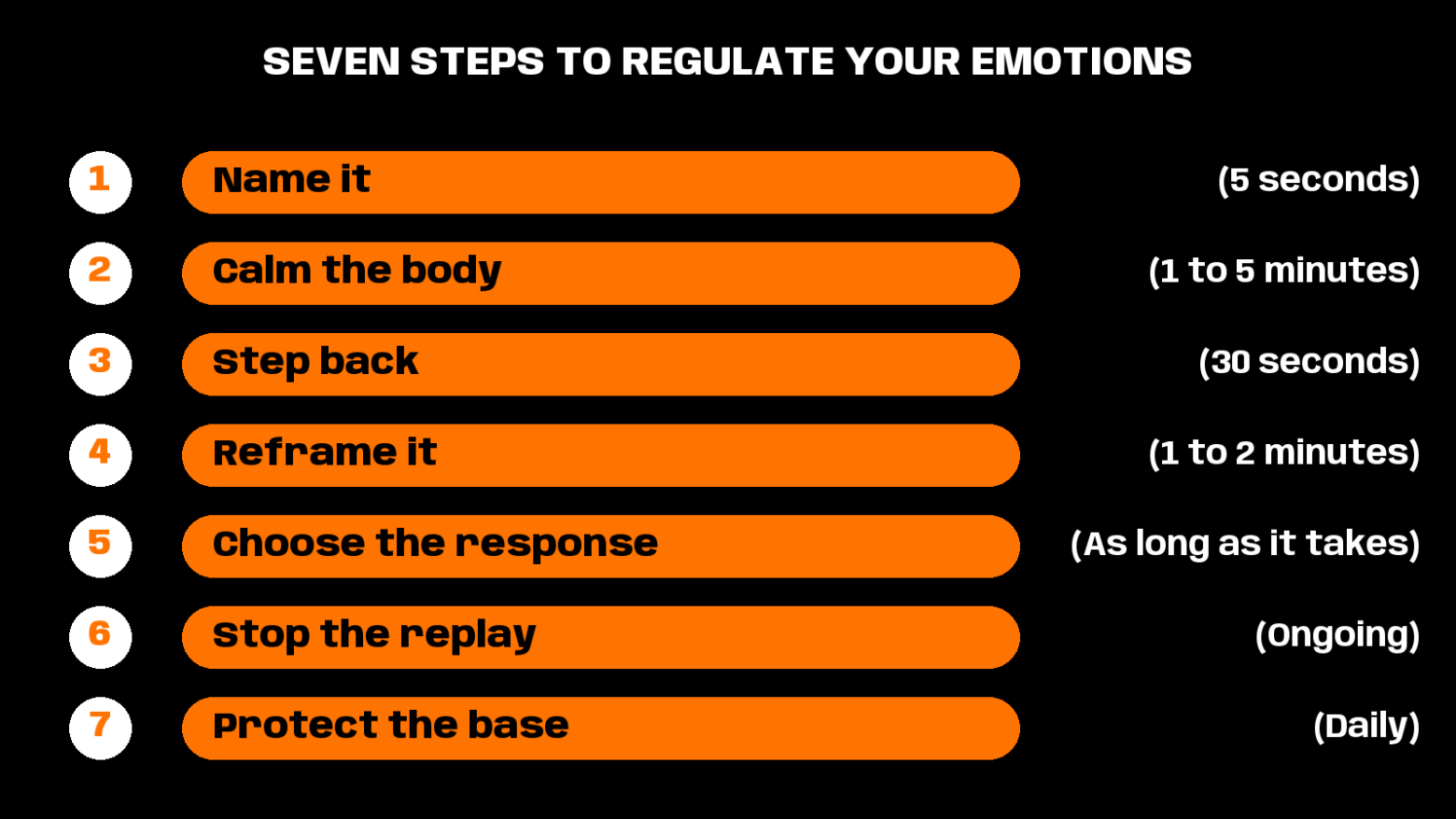
The first three steps take seconds. The last one is built every day.
1. Name What You Feel
Put a single, specific word on the emotion as soon as you notice it, such as angry, embarrassed or anxious. In a UCLA brain imaging study of 30 adults, choosing an emotion word for an image reduced activity in the amygdala, the brain’s threat detector, compared with other ways of processing the same image [3]. Naming is the fastest step on this list.
Lead author Matthew Lieberman described the effect simply: “When you attach the word ‘angry,’ you see a decreased response in the amygdala” [4]. He compared it with driving: “In the same way you hit the brake when you’re driving when you see a yellow light, when you put feelings into words, you seem to be hitting the brakes on your emotional responses” [4].
The surprise is that it works even when it does not feel like it. A later review by Lieberman’s group noted that labelling “may not even feel like a regulatory process as it occurs” [3]. You do not need to say it out loud or write a paragraph. One accurate word in your head is enough to start.
2. Calm Your Body Before You Act
Slow your body down before you decide anything, because a racing heart drives a fast reaction. A 2024 review of 154 studies with 10,189 participants found that activities which lower arousal, such as slow breathing, relaxation and taking a timeout, reduced anger and aggression with an effect of g = -0.63 [7]. Activities that raise arousal had no effect [7].
The breathing pattern with the best direct evidence is the cyclic sigh. In a Stanford trial that randomised 108 people to five minutes a day for a month, cyclic sighing improved positive mood more than mindfulness meditation and lowered breathing rate [12]. You take a slow breath in, add a second short breath in to fill the lungs completely, then exhale slowly and fully, and repeat [12].
You do not need five minutes in the moment. Two or three long exhales buy enough time to stop the first reaction becoming the only reaction. Brad Bushman, senior author of the 2024 review, put the principle plainly: “To reduce anger, it is better to engage in activities that decrease arousal levels” [8].
3. Step Back and Use Your Own Name
Talk to yourself in the third person, using your own name, for a few sentences. Across seven studies with 585 participants, people who used their name instead of “I” during a stressful task showed less distress, performed better according to outside raters and saw future stress as a challenge rather than a threat [10].
The effect shows up fast. A follow-up brain study found that third-person self-talk reduced a marker of emotional reactivity within the first second of viewing upsetting images [11]. Psychologist Ethan Kross at the University of Michigan said the data “suggest that third-person self-talk may constitute a relatively effortless form of emotion regulation” [11].
In practice it sounds like this: “James, you are angry because the meeting went badly. What do you actually need to do next?” It feels odd for about a day. The distance it creates is the same distance you have when a mate asks for advice, which is why advice for other people is usually easier.
4. Change How You Read the Situation
Reappraisal means changing the story you are telling yourself about what happened, so the emotion it produces changes too. A meta-analysis of 306 experiments found that reframing the situation had a small to medium effect, and taking someone else’s perspective had the largest effect of any strategy tested, at d = 0.45 [5].
The questions that do this are simple. What else could explain this? How will this look in a month? What would I tell a friend in the same spot? Gross gives a classic example of reappraisal before an exam, reminding yourself that “it’s only a test” [2]. The facts stay the same and the threat shrinks.
The same meta-analysis carries a warning. Concentrating on the feeling and turning it over made things worse, at d = -0.26, and trying to suppress the feeling itself had no effect [5]. Reappraising the situation itself, at d = 0.36, worked better than trying to reappraise the emotion you are already feeling, at d = 0.23 [5].
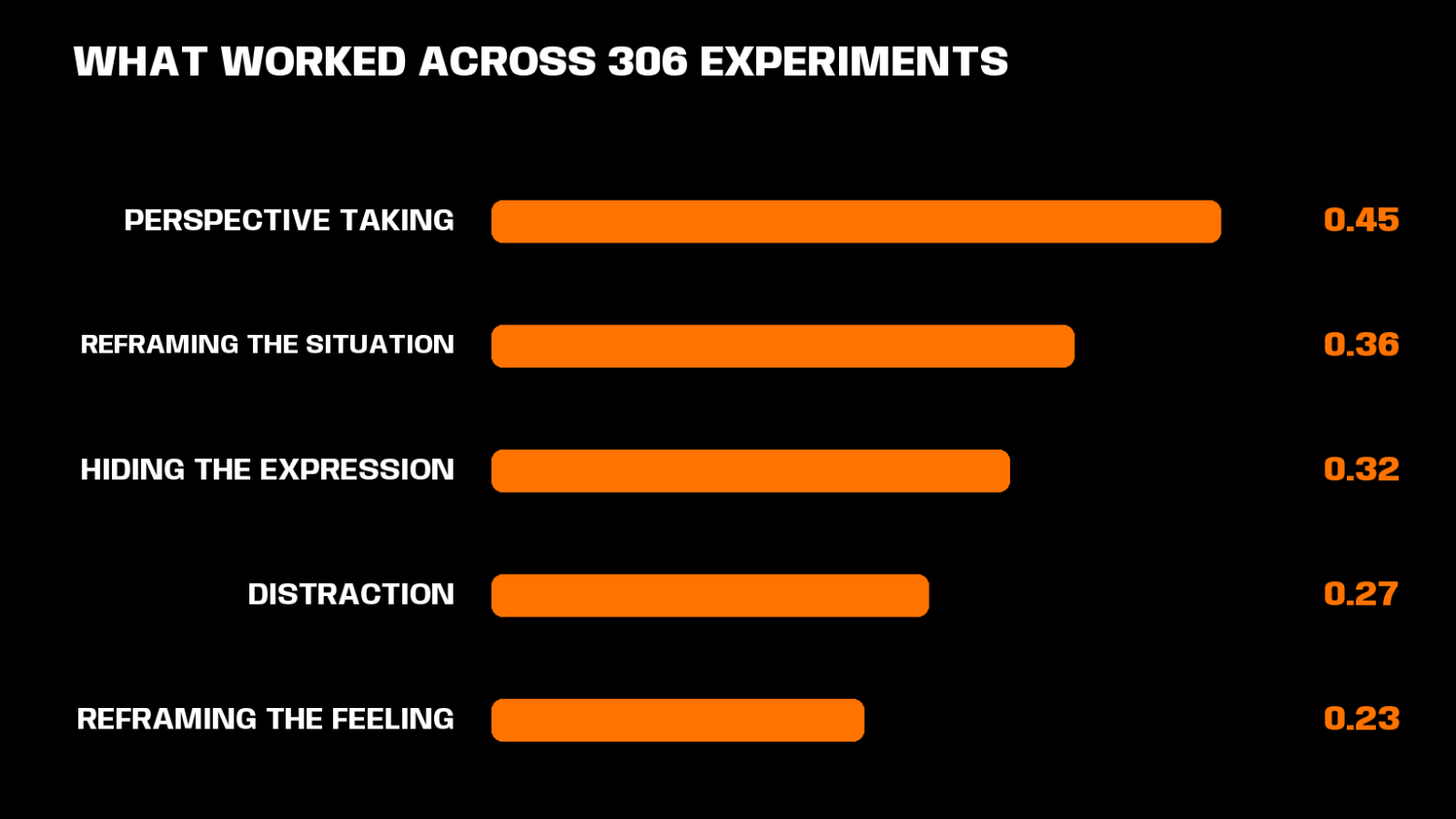
Effect sizes from 306 experiments. Suppressing the feeling itself and dwelling on it showed no benefit.
5. Choose the Response, Not the Reflex
Decide what you will actually do, then do that, instead of letting the first impulse act for you. This is where venting fails. In a classic experiment with 600 students, people who hit a punching bag while thinking about the person who angered them ended up angrier and more aggressive than people who simply sat quietly [9].
The author of that study did not soften it. “Doing nothing at all was more effective than venting anger,” Bushman wrote [9]. Twenty years later his team’s review reached the same place: “Venting anger might sound like a good idea, but there’s not a shred of scientific evidence to support catharsis theory” [8].
A useful model here comes from addiction research. In a trial with 123 smokers, a short mindfulness instruction did not reduce cravings, but people smoked significantly fewer cigarettes over the following week [15]. The urge stayed and the behaviour changed. Strong emotions work the same way, so let the urge peak and pass without obeying it.
6. Stop the Replay
Interrupt yourself when you notice you are rerunning the event in your head. In a study of 233 people and 27 emotions, the emotions that lasted longest were those linked to important events and high levels of rumination, meaning repeated replaying [16]. The replay is what keeps the feeling alive long after the event.
The punching bag study showed the same mechanism from another angle. The group told to think about their provoker while hitting the bag, which is rumination with exercise attached, felt angrier than the group thinking about getting fit [9]. Distraction was not perfect, but in the larger meta-analysis it still worked better than dwelling, at d = 0.27 against d = -0.26 [5].
The practical version is to catch the third replay, label it as a replay and give your attention a job. A walk, a task with your hands or a conversation about something else will all do. If the same event keeps coming back for days, writing down what you will actually do about it usually ends the loop faster than thinking.
7. Protect the Base With Sleep and Training
Sleep and regular exercise do not fix an emotion in the moment, but they decide how hard the first six steps are. In a UC Berkeley brain imaging study of 26 young adults, staying awake for about 35 hours made the brain’s emotional centres react to upsetting images far more strongly than after a normal night [13].
Sleep scientist Matthew Walker, the study’s senior author, said “The emotional centers of the brain were over 60 percent more reactive under conditions of sleep deprivation than in subjects who had obtained a normal night of sleep” [13]. He added, “Emotionally, you’re not on a level playing field” [13]. Most of the arguments a man regrets happen tired.
Training helps in a different way. In a randomised trial of 80 adults, 30 minutes of jogging before a sad film helped people who usually struggled to shake off low mood recover faster than stretching did [14]. A small study of 16 men with high trait anger found 30 minutes of aerobic exercise beforehand stopped an angry mood building [18]. Train regularly, and when you are already angry, calm down first.
What Mistakes Make Emotions Harder to Control?
The common mistakes are venting, bottling it up, deciding while tired and rerunning the event. Venting raised anger in the punching bag experiment [9], and suppressing the feeling did not help in 306 experiments [5]. Both feel like control and neither works well. The better route is to name it, calm the body and then decide [3][7].
A second mistake is treating running or the gym as an anger outlet. The 2024 review found that activities which raise arousal, including going for a run to burn off rage, were ineffective at reducing anger, with an effect of g = -0.02 [7]. Exercise is a base builder on normal days, not an emergency release valve.
A third mistake is waiting for a perfect calm before acting. Regulation does not mean feeling nothing. Gross argues that the skill is learnable for everyone, saying “We can all learn to better regulate our emotions, and doing so, I think, can help us change the world in ways that will make us, and our children and their children, healthier and more productive” [17].
FAQ
What is the fastest way to calm down when you are angry?
Slow your breathing with two or three long exhales and name the feeling in one word. A 2024 review of 154 studies found that calming activities such as slow breathing and taking a timeout reduced anger, while venting and arousing activities did not [7]. Naming the emotion reduced the brain’s threat response in a UCLA study [3].
Is it bad for men to suppress their emotions?
Habitually hiding emotions is linked to more negative feelings and lower well-being, not less [6]. Men report using suppression more often than women, but they are just as good at reframing, the strategy linked to better outcomes [6]. It is a habit you can swap, not a fixed trait.
Does hitting a punching bag help with anger?
Not while you think about the person who made you angry. In an experiment with 600 students, that group became angrier and more aggressive than people who sat quietly [9]. Doing nothing at all beat venting [9]. Boxing as regular training is fine, but it is not a way to burn off rage.
How long does an emotion usually last?
It varies widely by emotion and by what you do with it. In a study of 27 emotions, sadness lasted longest, and the emotions that lasted longest were tied to important events and repeated replaying [16]. Stopping the mental rerun is one of the most reliable ways to shorten an emotion.
Why do I lose my temper more when I am tired?
Sleep loss makes the brain’s emotional centres more reactive. Researchers at UC Berkeley reported those centres were over 60 percent more reactive after about 35 hours without sleep, compared with a normal night [13]. Protecting sleep is one of the simplest ways to make every other regulation step easier.
Does talking to yourself in the third person really work?
The evidence is promising. Across seven studies with 585 people, using your own name during stressful moments reduced distress and improved performance [10]. A brain study found the effect within one second [11]. Kross himself says more research is needed, but the cost of trying it is close to zero.
Can you get better at controlling your emotions?
Yes. Emotion regulation is a set of skills, not a personality type, and the strategies in this guide all improved outcomes in controlled studies [5][7][10]. Men already reappraise as well as women [6], so the work is mostly practising the better strategy until it becomes the default.
Final Recommendation
Use the steps in order when something hits you. Name the feeling, take two long exhales, step back with your own name and ask what else could explain what happened [3][7][10][5]. Then decide what you will do, and do not let venting or the replay make the choice for you [9][16].
On normal days, build the base. Sleep properly, train regularly and practise the first three steps on small irritations, so they are automatic when it matters [13][14]. If this sits inside a wider effort to train your head like your body, what mental fitness is and how men train it sets out the full picture, and why men feel wired but tired covers the stress pattern that makes everything feel louder. If strong emotions are affecting your work, relationships or sleep for weeks at a time, speak to your GP.

Both feel like control. Only one changes the feeling.
Options for Men to Take Action
Most men know they should handle pressure better and have no system for it. They read something useful, try it once in an argument, forget it by the next one and decide they are just wired that way.
The MenTools app runs mindset and awareness as daily challenges alongside fitness, nutrition and money, with levels you choose, reminders, streak and progress tracking, journals and an AI coach. Here its job is to turn one of these steps into a short daily rep, such as a nightly two-line note naming the strongest feeling of the day and what you did with it.
How you can do this today: pick the step you skip most, usually naming or the long exhale, and set it as your daily action for the next four weeks.
Wins on cost: one subscription covers mindset, sleep and training habits together, instead of a separate journal app, breathing app and habit tracker.
Wins on time: the challenge structure is already built, so you start practising tonight rather than designing a programme first.
Wins on practicality: each action takes a few minutes and fits around work, training and family, which is where good intentions usually fall away.
Watch-out: it is a habit and consistency tool, not therapy. It will not help in the heat of a crisis, and it is no substitute for professional support if anger or low mood is causing real harm.
Emotional control is harder on poor sleep and an irregular diet, so a one a day multivitamin may help cover the simple daily foundation that the rest of this work sits on. For more on noticing what drives your reactions, the MenTools awareness hub and how to become more self-aware as a man are the natural next reads. Practise the steps on small things and they will be there for the big ones.
Last updated: 2026-10-15 v1.0
Disclaimer: This guide is for informational purposes only and does not constitute medical or psychological advice. Speak with a qualified professional before making significant changes if you have a medical or mental health condition.
References
- [1] Gross JJ. The emerging field of emotion regulation, an integrative review. Review of General Psychology, 1998;2(3):271-299. Link
- [2] Gross JJ. Emotion regulation, affective, cognitive, and social consequences. Psychophysiology, 2002;39:281-291. Link
- [3] Lieberman MD, Eisenberger NI, Crockett MJ, Tom SM, Pfeifer JH, Way BM. Putting feelings into words, affect labeling disrupts amygdala activity in response to affective stimuli. Psychological Science, 2007;18(5):421-428. With Torre JB, Lieberman MD. Putting feelings into words, affect labeling as implicit emotion regulation. Emotion Review, 2018;10(2):116-124. Link
- [4] UCLA Health. Putting feelings into words produces therapeutic effects in the brain, UCLA neuroimaging study supports ancient Buddhist teachings. 21 June 2007. Link
- [5] Webb TL, Miles E, Sheeran P. Dealing with feeling, a meta-analysis of the effectiveness of strategies derived from the process model of emotion regulation. Psychological Bulletin, 2012;138(4):775-808. Link
- [6] Gross JJ, John OP. Individual differences in two emotion regulation processes, implications for affect, relationships, and well-being. Journal of Personality and Social Psychology, 2003;85(2):348-362. Link
- [7] Kjærvik SL, Bushman BJ. A meta-analytic review of anger management activities that increase or decrease arousal, what fuels or douses rage? Clinical Psychology Review, 2024;109:102414. Link
- [8] The Ohio State University. Breathe, don’t vent, turning down the heat is key to managing anger. 18 March 2024. Link
- [9] Bushman BJ. Does venting anger feed or extinguish the flame? Catharsis, rumination, distraction, anger, and aggressive responding. Personality and Social Psychology Bulletin, 2002;28(6):724-731. Link
- [10] Kross E, Bruehlman-Senecal E, Park J, et al. Self-talk as a regulatory mechanism, how you do it matters. Journal of Personality and Social Psychology, 2014;106(2):304-324. Link
- [11] Moser JS, Dougherty A, Mattson WI, et al. Third-person self-talk facilitates emotion regulation without engaging cognitive control. Scientific Reports, 2017;7(1):4519. Quotes via Michigan State University, reported by Futurity, 26 July 2017. Link
- [12] Balban MY, Neri E, Kogon MM, et al. Brief structured respiration practices enhance mood and reduce physiological arousal. Cell Reports Medicine, 2023;4(1):100895. Link
- [13] University of California, Berkeley. Sleep loss linked to psychiatric disorders, reporting Yoo SS, Gujar N, Hu P, Jolesz FA, Walker MP. Current Biology, 2007;17(20):R877-R878. 22 October 2007. Link
- [14] Bernstein EE, McNally RJ. Acute aerobic exercise helps overcome emotion regulation deficits. Cognition and Emotion, 2017;31(4):834-843. Link
- [15] Bowen S, Marlatt A. Surfing the urge, brief mindfulness-based intervention for college student smokers. Psychology of Addictive Behaviors, 2009;23(4):666-671. Link
- [16] Verduyn P, Lavrijsen S. Which emotions last longest and why, the role of event importance and rumination. Motivation and Emotion, 2015;39(1):119-127. Link
- [17] Jaffe E. Mastering our passions, with James J. Gross. APS Observer, Association for Psychological Science, 12 July 2013. Link
- [18] Thom NJ, O’Connor PJ, Clementz BA, Dishman RK. Acute exercise prevents angry mood induction but does not change angry emotions. Medicine and Science in Sports and Exercise, 2019;51(7):1451-1459. Link