No products in the cart.
Return To Shop
MEN: What Is Mental Fitness, and How Do Men Train It?
Quick Answer
Mental fitness is your trainable capacity to handle pressure, adapt and keep performing. Researchers define it as “the modifiable capacity to utilise resources and skills to flexibly adapt to challenges or advantages, enabling thriving” [2]. Men train it like the body, with regular reps in movement, sleep, breathing, attention, thinking and connection [11][13][16].
**Jump to:** The six areas | What it means | FAQ | Options for men
Disclosure: MenTools publishes this article and may feature MenTools products.
How we evaluate: Each area is assessed on real-world use, evidence, cost and time, and how well it suits men. Every area including the MenTools option carries an honest limitation. Full sources are in the references below.
Mental Fitness for Men at a Glance
Mental fitness for men comes down to six trainable areas, each with its own evidence base. Some have very large bodies of research behind them, such as exercise, with over a thousand trials. Others, like breathwork, rest on fewer and smaller studies. The table shows what you train in each area, a realistic daily rep and how strong the evidence is [11][13][15][16].
| Area | What you train | A realistic rep | Strength of evidence |
|---|---|---|---|
| Movement | Mood and stress tolerance | Most days, higher effort helps more | 97 reviews, 1,039 trials [11] |
| Sleep | Recovery and emotional control | A steady wake time every day | 65 trials, 8,608 people [16] |
| Breath | Fast control of your stress response | 5 minutes a day | 1 trial, 108 people [13] |
| Attention | Focus and calm under load | A short daily practice | 47 trials, 3,515 people [15] |
| Thinking | How you read setbacks | Reframe one problem a day | 306 experiments [17] |
| Connection | Talking before it builds up | Side by side, not face to face | Survey of 2,500 UK men [5] |
What Does Mental Fitness Actually Mean?
Mental fitness means the skills and habits that let you cope with stress, adapt to change and keep functioning well, and the fact that those skills can be improved. A 2015 expert consensus study agreed four principles, including that “mental fitness can be improved, in a similar way to physical fitness” [2]. It is a capacity you build, not a box you tick.
That definition sits close to how the World Health Organization describes mental health. The WHO calls it “a state of mental well-being that enables people to cope with the stresses of life, realize their abilities, learn and work well, and contribute to their community” [1]. Both put the weight on capability, not on the absence of problems.
The 25 experts behind the mental fitness definition were explicit about why the word fitness matters. They agreed that “fitness is a positive term without connotations of illness implied by mental health or mental illness” [2]. They also agreed it “could be understood by the wider community in a similar way to physical fitness” [2], which is exactly how most men already think about training.
Is Mental Fitness the Same as Mental Health?
They overlap, but mental fitness focuses on the trainable part of mental health. Mental health research shows that well-being runs on a scale, not a switch. In a US study of 3,032 adults, 17.2 percent were flourishing, 56.6 percent were moderately mentally healthy and 12.1 percent were languishing [3]. Most people sit in the middle and can move up.
Where you sit on that scale matters. The same study found that the risk of a major depressive episode was “nearly six times greater among languishing than flourishing adults” [3]. Moving from moderate to flourishing is not a luxury. It is the mental equivalent of moving from untrained to fit, and it changes how hard life hits.
The WHO makes the same point in plain terms, noting that “Mental health exists on a complex continuum, which is experienced differently from one person to the next” [1]. Mental fitness is the work you do to move along that continuum on purpose, before something forces the issue. It is not a replacement for professional support when you need it.
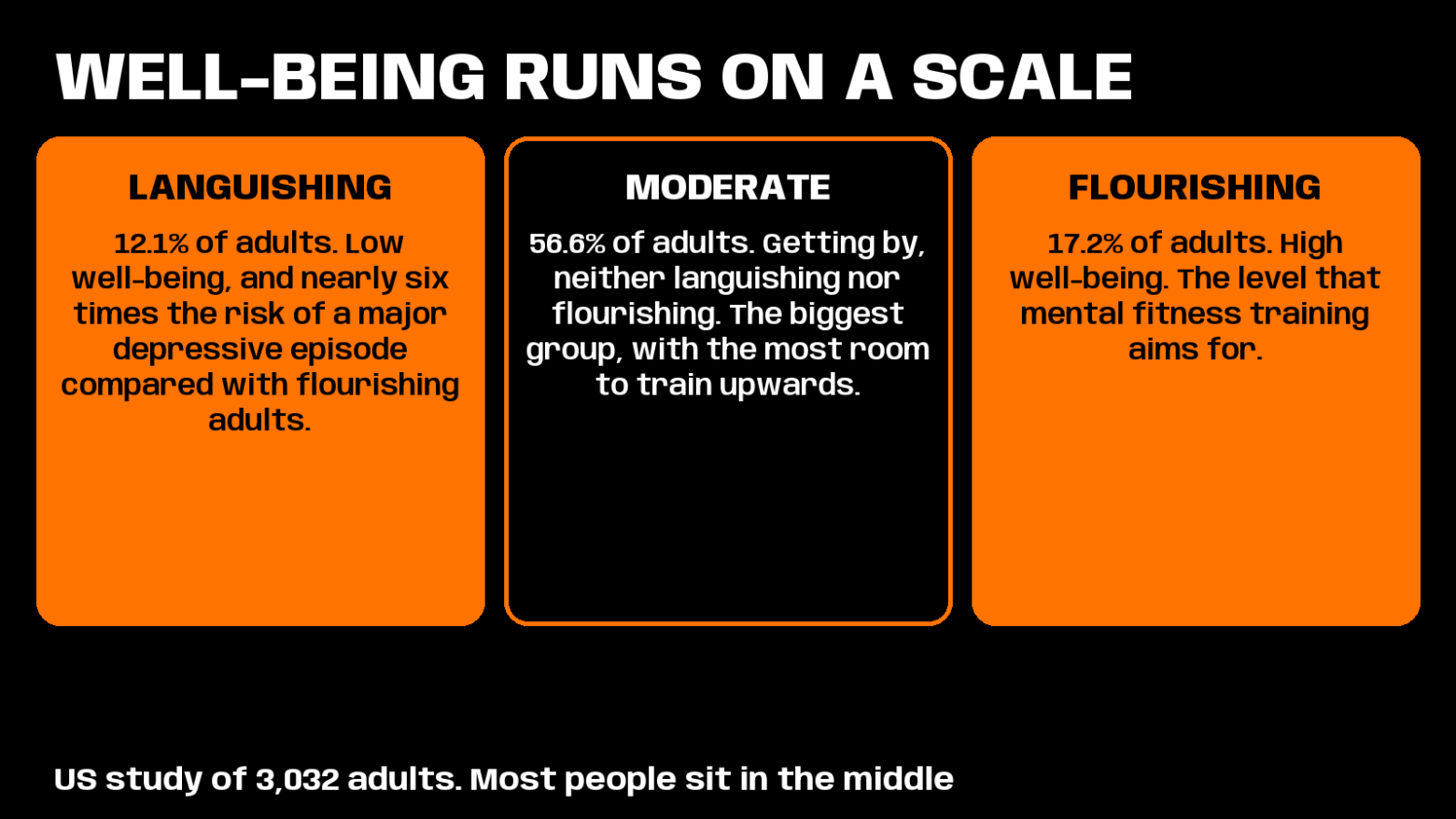
Most men sit in the middle of the scale, which means there is room to train upwards.
Why Do Men Respond to the Training Frame?
Men tend to engage with approaches that are practical, goal-focused and framed in terms they already use. A 2018 review of research on engaging men found the most effective styles were “collaborative, transparent, action-oriented, goal-focused”, and recommended language adapted with “male-oriented metaphors” [4]. Training is the most familiar of those metaphors for most men.
The current alternative is waiting until things break. In a 2026 survey of 2,500 UK men for the British Association for Counselling and Psychotherapy, 70 percent said they would only consider therapy once they reached breaking point, and 68 percent admitted hiding mental health struggles from others [5]. A fear of looking weak was the biggest single barrier, at 37 percent [5].
Yet the men who did get support described it as strength. Of the 32 percent who had accessed therapy, 71 percent said it had made them stronger [5]. Counsellor Rahi Popat put it simply: “Strength doesn’t come from avoiding struggles, it comes from seeking to overcome them” [5]. Mental fitness training and professional help sit on the same side.
Can You Really Train Your Mind Like a Muscle?
Yes, with honest limits on how big the effect is. The largest real-world test is the US Army’s Comprehensive Soldier Fitness programme, which set out to improve “resilience for all members of the Army” rather than wait for problems [6]. More than 22,000 soldiers across eight brigade combat teams were tracked to measure the impact [7].
Soldiers in units that received the resilience training reported significantly higher resilience and psychological health scores than those in units that did not [7]. A later report found lower rates of substance abuse diagnoses in trained soldiers, 1.16 percent against 2.85 percent [9]. The programme director said, “I believe this is something we’re going to have forever, similar to physical training” [8].
The fair caveats matter. Critics pointed out that the score differences were “little more than 1% to 2%” and that units were chosen rather than randomly assigned [10]. The Army’s own follow-up found “no significant direct effect on diagnoses for mental health problems” [9]. Training helps, steadily and modestly, which is how physical training works too.
How Do Men Train Mental Fitness?
Men train mental fitness through six areas: movement, sleep, breath, attention, thinking and connection. No single method covers everything, and the best evidence supports combining a few that you will actually keep doing. Resilience researcher Karen Reivich, who helped design the Army curriculum, put it plainly: “Resilience is not one size fits all” [18].
Her follow-up advice is the training mindset in one sentence: “When one strategy stops working, we need to pick a different one” [18]. That is how a good coach treats a plateau in the gym. You keep the principle, change the method and keep showing up. The sections below cover each area and what the research shows it can do.
The idea is catching on in the fitness world itself. The American College of Sports Medicine’s 2026 trends survey ranked exercise for mental health sixth worldwide, up from eighth in both 2024 and 2025 [20]. Professionals are increasingly treating the gym as a place to train the head as well as the body.
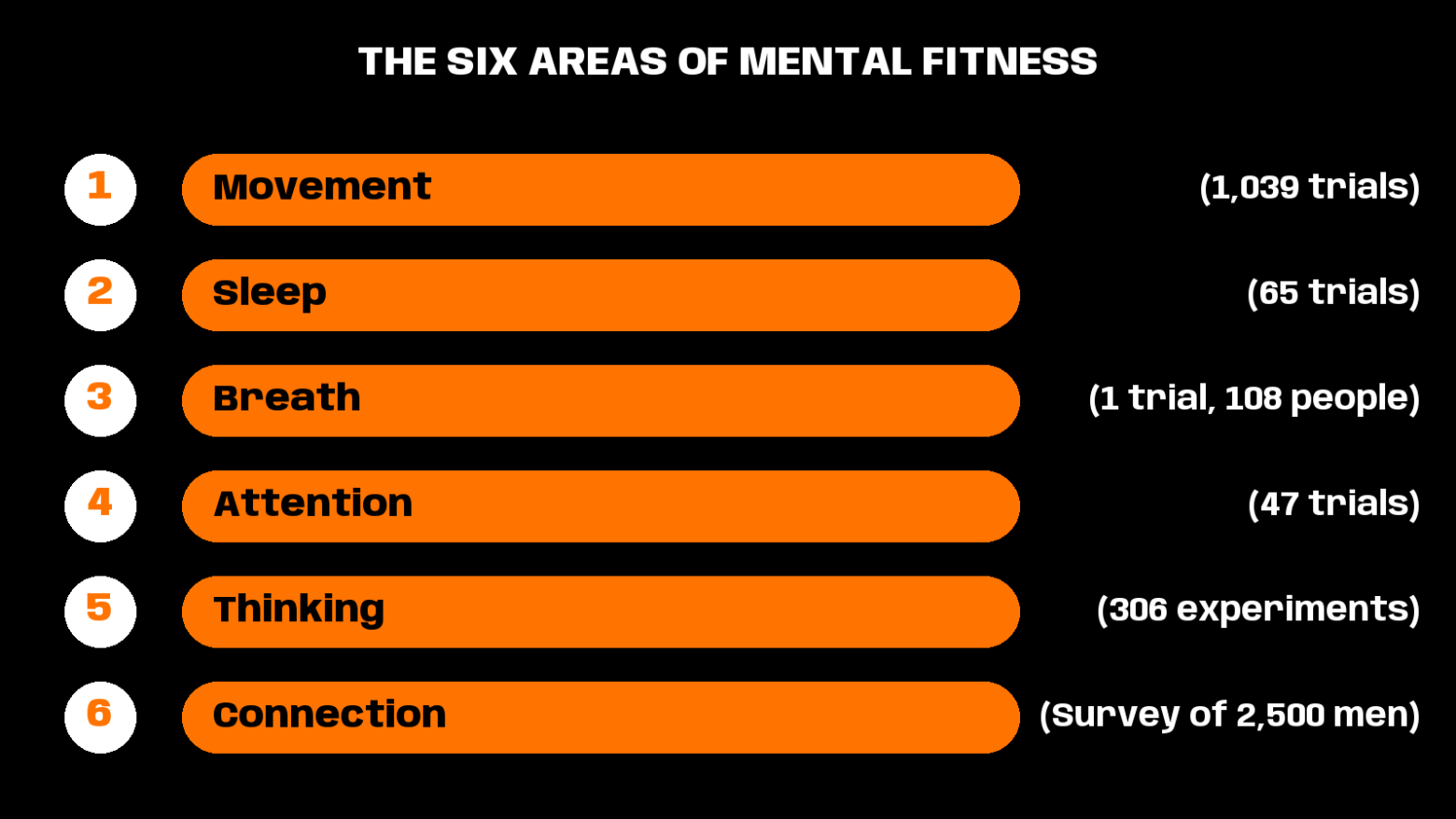
Six areas, very different amounts of evidence. Movement and sleep carry the most weight.
Does Exercise Count as Mental Training?
Yes, and it has the strongest evidence of any area. A 2023 umbrella review covered 97 reviews, 1,039 trials and 128,119 participants, and found physical activity had medium effects on depression, anxiety and psychological distress compared with usual care [11]. Higher intensity activity was linked to greater improvements [11].
The authors noted those effects were “comparable to or slightly greater than the effects observed for psychotherapy and pharmacotherapy” in other research [11]. Lead author Ben Singh said, “Importantly, the research shows that it doesn’t take much for exercise to make a positive change to your mental health” [12]. Shorter programmes actually showed larger effects than longer ones [11].
The honest limit is quality. Most of the reviews pooled were rated low quality, and exercise was compared with usual care, not run head to head against therapy [11]. That does not weaken the case for training. It means exercise is your foundation rep for mental fitness, not a cure for everything and not a reason to skip help if you need it.
Where Do Breathwork and Meditation Fit?
They train fast control of your stress response and your attention, and both have real but modest evidence. In a Stanford trial that randomised 108 people to five minutes a day for a month, exhale-focused cyclic sighing improved mood more than mindfulness meditation and lowered breathing rate [13]. It is the quickest rep in the whole programme.
Stanford psychiatrist David Spiegel, a co-author, explained the logic: “When we teach people to control the physical effects of a stressor on their body, it puts them in a better position to deal with the stressor itself” [14]. Our breakdown of whether breathwork actually lowers stress covers the wider evidence, and whether vagus nerve exercises work tests the claims behind them.
Meditation trains attention. A review of 47 trials with 3,515 participants found mindfulness programmes produced moderate improvements in anxiety, with an effect size of 0.38 at eight weeks [15]. The same review found “no evidence that meditation programs were better than any active treatment” such as exercise [15]. If you are choosing between the two, breathwork vs meditation compares them directly.
Why Is Sleep Part of the Training Plan?
Sleep is where mental training is consolidated, in the same way that muscle grows during recovery. A meta-analysis of 65 trials with 8,608 participants found that improving sleep quality had a medium effect on overall mental health, with an effect of g = -0.53, and reduced rumination and stress [16].
The finding that matters most for training is the dose response. The authors reported that “greater improvements in sleep quality led to greater improvements in mental health” [16]. That means sleep is not a nice extra. Every hour of better sleep makes the rest of your mental training work harder for you, the same way it does for your lifting.
The practical rep is the simplest one on this page. Fix one wake time, hold it every day including weekends and let the bedtime settle around it. Most of the interventions in that meta-analysis were structured sleep programmes, so this is a starting habit rather than a full treatment [16].
How Do You Train Your Thinking and Emotions?
You train them by practising how you read setbacks and how you respond to strong emotions, until the better response becomes the default. A meta-analysis of 306 experiments found that reframing a situation and taking another person’s perspective were among the most effective ways to change how you feel, with perspective taking showing the largest effect at d = 0.45 [17].
These are skills, not traits. The Army resilience curriculum was built around teaching exactly this kind of thinking to sergeants, so they could pass it on to their soldiers [6]. Our step-by-step guide on how to regulate your emotions as a man turns the research into seven steps you can use in the moment.
Mental toughness is part of this area too, and it overlaps with what most men already value. The difference is that mental fitness covers recovery as well as grit. Mental toughness for men covers the hard edge, while sleep, breath and connection cover the recovery that keeps it sustainable.
How Long Does Mental Fitness Training Take to Work?
Expect to feel early changes within weeks and to need around two months for the habits themselves to stick. The breathwork trial found mood improvements over a single month of daily practice [13], and the meditation review measured clear effects at eight weeks [15]. Exercise programmes of short and mid duration showed some of the largest effects [11].
The habit part takes longer than most men expect. In a real-world study of habit formation, a new daily behaviour took a median of 66 days to become automatic, with a range of 18 to 254 days [19]. That is why it helps to pick two areas, not six, and run them for a full two months before adding more.
Treat it like a training block. Measure something simple, such as how you slept or how quickly you recovered from a bad day, and review it every two weeks. Just as with physical training, consistency over months beats intensity over a weekend [11][19].
FAQ
What is an example of mental fitness?
A man who sleeps on a fixed schedule, trains three or four times a week and uses a few minutes of slow breathing before a hard conversation is practising mental fitness. Each habit has evidence behind it, from 1,039 exercise trials to a Stanford breathwork study [11][13]. It is a routine, not a feeling.
Is mental fitness only for people who are struggling?
No. Mental fitness is built for everyone, just as physical fitness is for everyone who wants to stay capable, not just people recovering from injury. The US Army designed its programme to be proactive, building resilience for every soldier rather than waiting for problems [6]. Most people sit in the middle of the well-being scale with room to improve [3].
What are the best mental fitness exercises for men?
Regular exercise, a steady sleep schedule, five minutes of slow breathing, a short attention practice and reframing setbacks have the clearest evidence [11][13][15][16][17]. Start with two you will actually do. Exercise has the largest research base, covering more than 128,000 participants [11].
Can mental fitness replace therapy?
No. Mental fitness is preventive training, and it works alongside professional support rather than instead of it. In a 2026 UK survey, 71 percent of men who had accessed therapy said it made them stronger [5]. If low mood, anxiety or anger is affecting your life for weeks, speak to your GP.
How do you measure mental fitness?
Researchers agree it is measurable [2], but you do not need a lab. Track sleep quality, how quickly you recover from a setback and how often you act on a plan rather than an impulse. Review the trend every two weeks, the way you would review training numbers.
Is mental fitness the same as resilience?
They are closely linked. Resilience is the ability to recover from pressure, and mental fitness is the wider set of habits that builds it, including sleep, exercise and thinking skills. The Army’s resilience training was delivered as part of a broader fitness programme for exactly that reason [6][7].
Final Recommendation
Treat your head the way you treat your body. Mental fitness is trainable, the effects are real and modest, and they build with consistency [2][7][11]. Start with movement and sleep, which carry the most evidence, then add one fast tool such as five minutes of breathwork [11][16][13].
Run it for two months before judging it, and expect it to feel like training rather than a breakthrough [19]. If you are struggling now rather than training ahead, speak to your GP or a registered counsellor, because the men who did reported that it made them stronger [5].
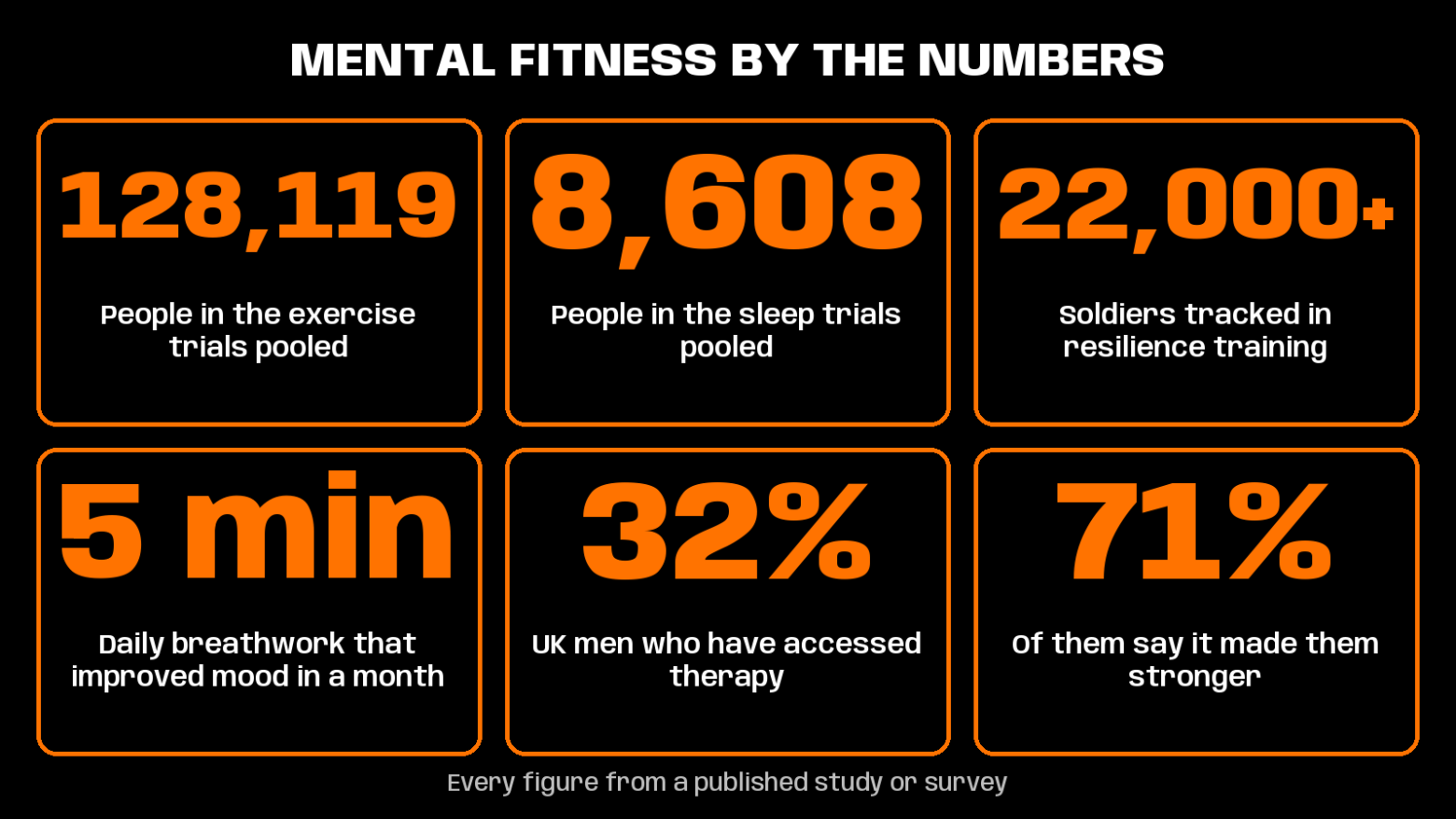
Every figure from a published study or survey cited in this guide.
Options for Men to Take Action
Most men already know the six areas matter. The problem is running them together, with the gym in one app, sleep in another, breathing in a third and nothing that shows whether any of it is sticking.
The MenTools app runs mindset as a challenge alongside fitness, nutrition and money, with levels you choose, daily actions, reminders, streak and progress tracking, journals and an AI coach. For mental fitness its job is to hold two or three daily reps in one place for the full two months it takes them to stick.
How you can do this today: choose two areas from the table, usually movement and sleep, and set one small daily action for each.
Wins on cost: one subscription covers training, sleep and mindset habits, instead of paying for separate fitness, meditation and habit apps.
Wins on time: the challenges are already built, so you start training this week rather than designing a programme first.
Wins on practicality: each action takes minutes and fits around work, family and the gym, which is where most plans fall apart.
Watch-out: it is a habit and consistency tool, not therapy or a clinical service. If you are struggling now, professional support comes first.
Training the mind runs on the same basics as training the body, so a one a day multivitamin may help cover the simple daily foundation underneath the work. For more on building the right mindset for it, the MenTools mindset hub collects everything in one place. Train the head like the body, and it responds the same way.
Last updated: 2026-10-14 v1.0
Disclaimer: This guide is for informational purposes only and does not constitute medical or psychological advice. Speak with a qualified professional before making significant changes if you have a medical or mental health condition.
References
- [1] World Health Organization. Mental health, strengthening our response. Fact sheet, 11 September 2026. Link
- [2] Robinson P, Oades LG, Caputi P. Conceptualising and measuring mental fitness, a Delphi study. International Journal of Wellbeing, 2015;5(1):53-73. Link
- [3] Keyes CLM. The mental health continuum, from languishing to flourishing in life. Journal of Health and Social Behavior, 2002;43(2):207-222. Link
- [4] Seidler ZE, Rice SM, Ogrodniczuk JS, Oliffe JL, Dhillon HM. Engaging men in psychological treatment, a scoping review. American Journal of Men’s Health, 2018;12(6):1882-1900. Link
- [5] British Association for Counselling and Psychotherapy. Campaign to tackle crisis point culture that prevents men from seeking support. Survey of 2,500 UK men by 3Gem, 29 April 2026. Link
- [6] Cornum R, Matthews MD, Seligman MEP. Comprehensive soldier fitness, building resilience in a challenging institutional context. American Psychologist, 2011;66(1):4-9. Link
- [7] Lester PB, Harms PD, Herian MN, Krasikova DV, Beal SJ. The Comprehensive Soldier Fitness Program Evaluation. Report 3, longitudinal analysis of the impact of Master Resilience Training on self-reported resilience and psychological health data. December 2011. Link
- [8] Vergun D. Study concludes Master Resilience Training effective. Army News Service, January 2012. Link
- [9] Harms PD, Herian MN, Krasikova DV, Vanhove A, Lester PB. The Comprehensive Soldier and Family Fitness Program Evaluation. Report 4, evaluation of resilience training and mental and behavioral health outcomes. April 2013. Link
- [10] Eidelson R, Soldz S. Does Comprehensive Soldier Fitness work? CSF research fails the test. Coalition for an Ethical Psychology, Working Paper 1, May 2012. Link
- [11] Singh B, Olds T, Curtis R, et al. Effectiveness of physical activity interventions for improving depression, anxiety and distress, an overview of systematic reviews. British Journal of Sports Medicine, 2023;57(18):1203-1209. Link
- [12] University of South Australia. Exercise more effective than medicines to manage mental health. Newswise, 23 February 2023. Link
- [13] Balban MY, Neri E, Kogon MM, et al. Brief structured respiration practices enhance mood and reduce physiological arousal. Cell Reports Medicine, 2023;4(1):100895. Link
- [14] Leggett H. Cyclic sighing can help breathe away anxiety. Stanford Medicine News Center, 9 February 2023. Link
- [15] Goyal M, Singh S, Sibinga EMS, et al. Meditation programs for psychological stress and well-being, a systematic review and meta-analysis. JAMA Internal Medicine, 2014;174(3):357-368. Link
- [16] Scott AJ, Webb TL, Martyn-St James M, Rowse G, Weich S. Improving sleep quality leads to better mental health, a meta-analysis of randomised controlled trials. Sleep Medicine Reviews, 2021;60:101556. Link
- [17] Webb TL, Miles E, Sheeran P. Dealing with feeling, a meta-analysis of the effectiveness of strategies derived from the process model of emotion regulation. Psychological Bulletin, 2012;138(4):775-808. Link
- [18] Penn Today. Six tips to stay calm, positive, and resilient in trying times, with Karen Reivich. University of Pennsylvania, 16 April 2020. Link
- [19] Lally P, van Jaarsveld CHM, Potts HWW, Wardle J. How are habits formed, modelling habit formation in the real world. European Journal of Social Psychology, 2010;40(6):998-1009. Link
- [20] American College of Sports Medicine. 2026 ACSM Worldwide Fitness Trends. ACSM’s Health and Fitness Journal. Link