

MEN: Why Can’t I Stop Watching Porn? Understanding Habit Loops, Triggers, and Brain Chemistry
Quick Answer
You can’t stop watching porn because your brain has learned a fast reward habit loop: trigger → craving → porn → relief. Break the loop by removing easy access, reducing triggers, and replacing the “reward” with a better routine for stress, boredom, and loneliness.
Jump to: Comparison Table | The Real Answer | Why This Fails | How to Fix It | FAQ
Disclosure: MenTools publishes this article and may feature MenTools products.

The Porn Habit Loop: Trigger → Craving → Porn → Relief → Reinforcement, with example triggers including stress, boredom, loneliness, and phone in bed.
Quick Comparison
| What’s happening | What it feels like | What’s driving it | What helps most | Best for |
|---|---|---|---|---|
| Habit loop is automated | “I opened it without thinking” | Cue-based learning in the basal ganglia [1] | Pre-commitment + friction + new routine | Guys who relapse on autopilot |
| Dopamine spike reinforces the behavior | “I need a hit” | Dopamine encodes learning and motivation, not just pleasure [2] | Reduce novelty, reduce access | Guys stuck in binge cycles |
| Variable reward makes it sticky | “One more video” | Unpredictable rewards increase repetition [3] | Time-boxing + blockers + exit plan | Scrollers and “edgers” |
| Stress relief becomes the reward | “It calms me down” | Stress increases craving for quick relief behaviors [4] | Stress skills + sleep + exercise | Stress, anxiety, overwhelm |
| Shame fuels secrecy and repeats the cycle | “I hate myself, so I do it again” | Self-criticism worsens coping and relapse risk [5] | Self-compassion + accountability | Guys stuck in guilt spirals |
| Easy availability lowers self-control | “It’s everywhere” | Convenience increases use and habits form faster [6] | Device rules + environment redesign | Phone-in-bed users |
| Triggers are mostly predictable | “Same time every night” | Habits are context-dependent [1] | Map triggers + if-then plans | Guys with consistent relapse windows |
| Escalation from novelty | “I need stronger stuff” | Novelty boosts dopamine and seeking [2] | Cut novelty, avoid high-stim feeds | Fetish escalation concerns |
The Real Answer
Is porn addiction real, or is it just low willpower?
For many men, it’s not about being weak. It’s about a learned behaviour loop that got reinforced thousands of times.
Compulsive sexual behaviour disorder is recognised in the ICD-11 (World Health Organization’s diagnostic manual), which reflects that some people lose control and keep using despite harm [7]. That does not mean every porn user is “addicted,” but it does mean loss of control is a real pattern for some men.
What is the habit loop that keeps me watching porn?
Most porn use that feels “compulsive” follows a predictable loop:
- Trigger (internal or external)
- Craving (urge, tension, restlessness)
- Response (porn + masturbation, often escalating content)
- Reward (relief, escape, numbness, sleepiness)
Habits are partly stored in brain systems involved in automatic behaviour, including the basal ganglia, which helps explain why you can relapse “without deciding” [1]. The more you repeat the loop in the same context (bed, bathroom, late-night phone), the more automatic it becomes.
Why do triggers feel so powerful, even when I know it’s a bad idea?
Triggers work because they predict relief.
Common porn triggers for men include:
- Boredom (low stimulation, you want a spike)
- Stress (you want down-regulation)
- Loneliness (you want soothing and connection)
- Rejection or conflict (you want escape)
- Fatigue + phone time (your guard is down)
Stress is a major amplifier of cravings for quick-relief behaviours, and high stress is linked to more impulsive decision-making [4]. If porn is your fastest stress tool, your brain will keep recommending it.

What to do when you feel an urge: branches by urge level (1–3, 4–7, 8–10) with specific actions to delay, change context, and prevent relapse.
What does dopamine have to do with porn cravings?
Dopamine is not just a “pleasure chemical.” It’s heavily involved in motivation, learning, and reinforcement. When your brain predicts a reward, dopamine helps drive seeking behaviour and stamps in the association between cue and behaviour [2].
Porn is especially reinforcing because it combines:
- Novelty (new content is a strong learning signal) [2]
- Variable reward (unpredictable “best video,” which increases repetition) [3]
- Fast access (no social risk, no waiting, no effort)
That combination teaches your brain: “This is the quickest route from discomfort to relief.”
Why do I keep escalating or spending longer than I planned?
Two big reasons show up repeatedly:
Variable reward: You do not know what the next scroll will deliver, and unpredictable rewards are known to drive repeated checking behaviours [3].
Tolerance to the same stimulus: Over time, what used to feel “enough” may feel flat, so the brain seeks novelty and intensity [2].
This does not mean you are doomed. It means your plan has to target novelty, access, and the scroll.
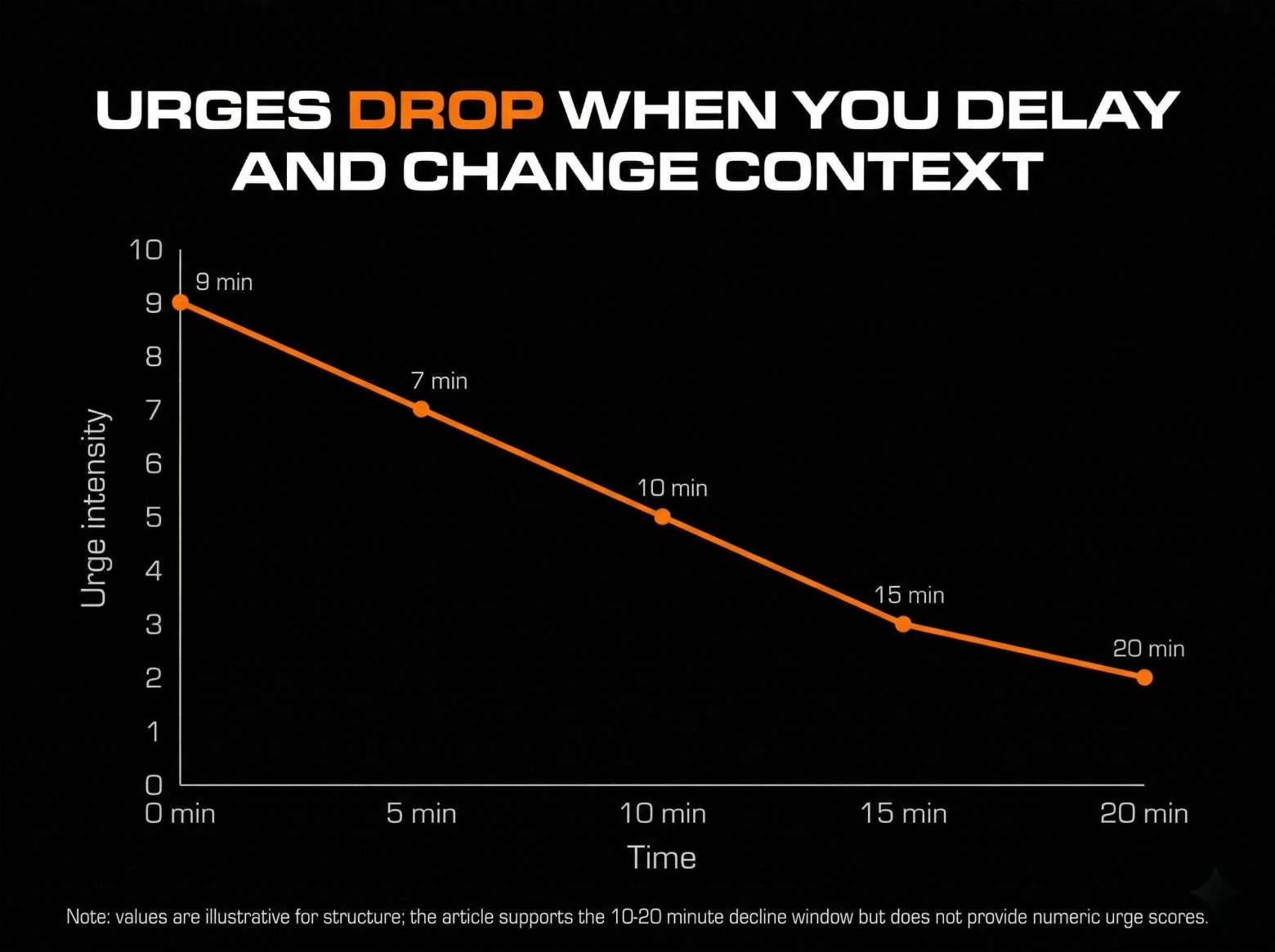
Urge intensity over time: without a delay plan, a quick spike leads to relapse. With a delay plan, the spike declines naturally after 10–20 minutes.
Why This Fails
Most men try to quit porn with one tool: willpower. That fails because:
- You fight urges at the peak, when self-control is lowest (late night, stressed, tired).
- You keep the same environment (phone in bed, private browsing, no friction).
- You do not replace the reward (stress relief, numbness, sleep aid).
- You rely on “never again” promises instead of systems and pre-commitments.
Also, shame backfires. Self-criticism is linked with worse coping and higher distress, which can increase relapse risk for avoidance habits [5].
How to Fix It
This is education, not medical advice. If porn use feels uncontrollable, is escalating, or is tied to depression/anxiety, consider speaking with a licensed therapist.
The Simple Framework
Reduce cues. Increase friction. Replace the reward. Add accountability. Track wins.
A 5-step plan you can start today
- Map your top 3 relapse windows
Write: time, place, device, emotion. Habits are strongly context-linked, so this matters [1]. - Add friction where it counts (devices and rooms)
No phone in bed. Charge it outside the bedroom. Remove private browsing shortcuts. Use app/website blockers during your relapse windows. Convenience is fuel: the easier it is, the more it happens [6]. - Kill the scroll with a hard stop rule
If you relapse, the goal is “no binge.” Set a strict limit (time or content) and exit immediately. This targets variable reward loops [3]. - Replace the reward with a real down-regulation routine
Pick one 10-minute routine that actually changes state: fast walk outside, push-ups + cold rinse, breathing (slow exhale focus), or short journaling: “What am I avoiding?” You are not just quitting porn. You are learning a better stress and boredom skillset [4]. - Add accountability and measurement
Tell one trusted person or use a structured programme. Track streaks and slips without drama. Shame increases the loop; data breaks it [5].
FAQ
How long does it take to stop craving porn?
Urges usually drop in intensity within 10 to 20 minutes if you delay and change context. Over weeks, cravings often reduce as new routines replace the old loop, but timelines vary by stress level, access, and consistency [1].
Is masturbation the problem, or porn?
For many men, porn is the bigger driver because novelty and variable reward make it more compulsive than masturbation alone [2][3]. Your best move is to remove the highest-trigger input first (porn) and stabilise your baseline.
Why do I relapse when I’m tired?
Sleep loss reduces self-control and increases impulsive choices, making late-night triggers harder to resist [8]. Fixing bedtime routines and removing the phone from the bedroom is one of the highest ROI changes.
What if porn is my only stress relief?
That is common. Stress pushes the brain toward fast relief behaviours, so you need a replacement routine that reliably changes your state (movement, cold water, breathing, social contact) [4].
Do porn blockers work?
They work best as friction, not as the only strategy. Blockers help you “buy time” so your pre-planned routine can kick in, especially during predictable relapse windows [6].
When should I seek professional help?
If porn use is causing significant harm, escalating, feels out of control, or is linked with depression, anxiety, trauma, or relationship breakdown, seek a licensed therapist. Compulsive sexual behaviour disorder is recognised in ICD-11, and help exists [7].
Final Recommendation
Treat this like habit engineering, not a character flaw. Identify your triggers, remove easy access during your relapse windows, replace porn with a real stress routine, and add accountability. If you keep the same environment and rely on willpower, the loop will keep winning.
Options For Men to Take Action
If you want a structured, practical plan (not theory), use the MenTools Quit Porn Toolkit.
Best use: set it up for your top relapse windows, implement the friction rules (devices, rooms, blockers), and follow the daily framework to build replacement routines and consistency.
If you want to go deeper on porn recovery and habit change, explore the MenTools Habits hub for guides and frameworks built specifically for men.
To support your daily routine with targeted nutrition, explore MenTools One A Day, formulated with chelated minerals and active B-vitamin forms for men.
When you are ready to turn ideas into action, start a focused challenge or daily routine inside the MenTools app and track how consistent habits change how you feel.
Last updated: 2026-03-04 v1.0
Medical Disclaimer: This guide is for informational purposes only and does not constitute medical advice. Always speak with your doctor or another qualified healthcare professional before starting any new supplement or programme if you have medical conditions or take prescription medication.
References
- National Institute on Drug Abuse (NIDA). “Drugs and the Brain.” https://nida.nih.gov/publications/drugs-brains-behavior-science-addiction/drugs-brain
- Schultz W. “Dopamine reward prediction error signalling.” Nature Reviews Neuroscience (2016). https://www.nature.com/articles/nrn.2015.26
- American Psychological Association. “What Is Operant Conditioning?” (variable reinforcement concepts). https://www.apa.org/education-career/k12/classroom-management/operant-conditioning
- American Psychological Association. “Stress effects on the body and behavior.” https://www.apa.org/topics/stress/body
- Neff KD. “Self-compassion: An alternative conceptualization of a healthy attitude toward oneself.” Self and Identity (2003). https://self-compassion.org/wp-content/uploads/publications/selfcompassion_concept.pdf
- Behavioral Insights Team. “EAST: Four simple ways to apply behavioural insights.” (friction/ease principles). https://www.bi.team/publications/east-four-simple-ways-to-apply-behavioural-insights/
- World Health Organization. ICD-11: Compulsive sexual behaviour disorder. https://icd.who.int/browse11/l-m/en#/http://id.who.int/icd/entity/1630268048
- Harvard Medical School, Division of Sleep Medicine. “Sleep and mental health / self-control impacts of sleep loss.” https://healthysleep.med.harvard.edu/healthy/matters/benefits-of-sleep/mental-health

