
MEN: 8 Simple Nutrition Habits for Busy Men
Quick Answer
The eight habits worth building are a protein floor at breakfast, vegetables served first, cooking at home five nights out of seven, one ultra processed swap a day, three fibre defaults changed once, drinking to a schedule, deciding the afternoon the night before, and one oily fish meal a week. Six of the eight take under ten minutes.
**Jump to:** The 8 at a glance | How we chose | FAQ | Options for men
Disclosure: MenTools publishes this article and may feature MenTools products.
How we evaluate: Each habit is assessed on real-world use, evidence, cost and time, and how well it suits men. Every habit including the MenTools option carries an honest limitation. Full sources are in the references below.
The 8 at a Glance
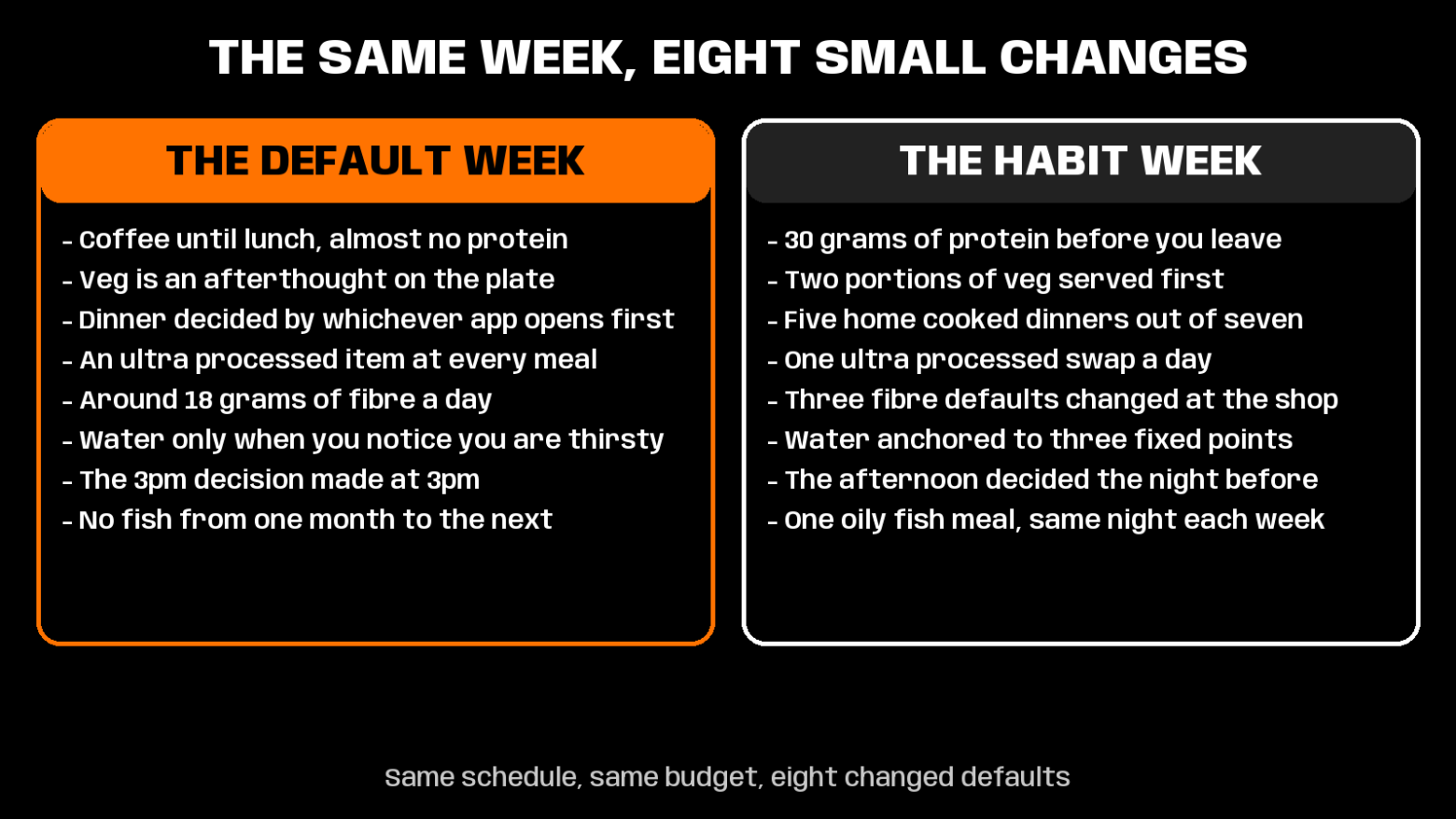
The same week, the same schedule, eight small changes.
| Habit | Best for | Time | Standout | Watch-out |
|---|---|---|---|---|
| 1. Put a protein floor on breakfast | Men who eat almost no protein until 1pm | 5 min | Spreads protein across the day instead of loading the evening | The evidence base is small and short term |
| 2. Serve the vegetables first | Men who mean to eat more veg and never do | 0 min | Uses order rather than willpower | Does nothing if the veg is not in the house |
| 3. Cook at home five nights out of seven | Men living on the app and the meal deal | 25 min a night | Home cooks eat measurably less fat and sugar | The evidence is observational, not causal |
| 4. Swap one ultra processed item a day | Men who eat well in theory and quickly in practice | 2 min | The only habit here tested in a locked in trial | One swap a day is slow by design |
| 5. Change three fibre defaults | Men nowhere near 30 grams of fibre | 5 min once | Fixes the gap by changing purchases, not meals | Ramp it up or your gut will complain |
| 6. Drink to a schedule, not to thirst | Men who hit 3pm foggy and blame the work | 1 min | Removes a cause of afternoon fog that is free to fix | Easy to overdo and just interrupt your day |
| 7. Decide the afternoon the night before | Men who eat out of the nearest shop | 5 min | Beats the decision before you are hungry | Requires you to actually carry the thing |
| 8. Put one oily fish meal in the week | Men who never eat fish at all | 10 min a week | Closes the largest single gap in the UK diet | It is one meal, not a strategy |
How We Chose These 8
Every habit here had to clear three tests. It had to survive a bad week rather than a good one, it had to cost under thirty minutes, and the evidence for it had to sit in real diet data or a controlled trial rather than in someone’s opinion. That removed most of what gets sold as a nutrition tip.
We also ranked them by the size of the gap they close. The National Diet and Nutrition Survey covering 2019 to 2023 found that only 17 percent of UK adults meet the five a day target, 82 percent exceed the saturated fat recommendation, and 96 percent fall short on fibre [1] [2]. Those are the holes worth patching first, in that order. Holly Cooper, research lead at the Food Foundation, put the scale of it plainly: “That so few in the UK are achieving the government’s basic dietary requirements for good health is an urgent call to action for our government” [1].
This article is general information about food habits and is not medical or dietary advice. It names no diet plan and promises no outcome. If you have a medical condition, are on medication, or are being treated by a dietitian, follow that advice over anything here. For the wider set of habits these sit inside, our daily habits guide for men covers the non food side.
1. Put a Protein Floor on Breakfast
Set a minimum of around 30 grams of protein at breakfast and hit it with the same two or three options every weekday. Most men eat almost nothing until lunch and then take on the bulk of their protein at dinner. Levelling that out is the single easiest structural change in the list.
What it is: a floor, not a target. You are not counting all day, you are refusing to leave the house under the number.
Best for: the man who trains, works long hours, and gets to one o’clock having eaten a coffee.
Standout: distribution appears to matter and not just the daily total. In a crossover feeding study, muscle protein synthesis over 24 hours was around 25 percent higher when protein was spread evenly at roughly 30 grams per meal than when the same amount was skewed towards the evening [3]. UK intake data shows the same skew in real life, with protein consumption peaking at the evening meal and low intakes in between [8].
Watch-out: that study followed only eight adults over 24 hours, so treat it as a reasonable steer rather than a settled law. The habit is still worth building because it costs nothing, but do not expect a visible change from breakfast alone.
2. Serve the Vegetables First
Put the vegetables on the plate before anything else, and put two portions on at dinner rather than one. This is a sequencing habit, not a diet. It works because the amount of veg you eat is decided at the moment you serve, not at the moment you eat.
What it is: a plating rule. Veg goes down first and takes up the space, then the protein, then the carbohydrate fills whatever is left.
Best for: the man who genuinely intends to eat more vegetables and finds the plate already full by the time he thinks about it.
Standout: the gap here is enormous and getting no better. Only 17 percent of UK adults reach five a day, and the survey found that even a large rise in household income shifted intake by no more than 0.3 of a portion per day [2] [10]. That tells you this is a habit problem rather than a money problem for most men.
Watch-out: the rule collapses if there are no vegetables in the house, which is really a shopping habit wearing a different hat. Frozen counts, and for a busy week it is the version that actually survives.
3. Cook at Home Five Nights Out of Seven
Aim for five home cooked dinners a week and let the other two be whatever they are. Not seven. Seven fails in the first week with a late meeting, and the failure takes the habit with it. Five out of seven has slack built in.
What it is: a weekly count rather than a daily rule, which means one bad night does not break it.
Best for: the man whose evening meal is currently decided by whichever app opens fastest.
Standout: frequency of home cooking tracks with what you actually eat. Analysing 9,569 adults, researchers found people who cooked dinner six or seven nights a week consumed less fat and notably less sugar than those cooking once a week or not at all, at 81 grams of fat and 119 grams of sugar a day against 86 grams and 135 grams [4]. Sixteen grams of sugar a day is a meaningful difference from a habit rather than a diet.
Watch-out: that is an association from survey data, not proof that cooking causes it, and men who cook often differ in other ways too. It also assumes some cooking ability, so if you have three meals you can make without thinking, that is enough to start.
4. Swap One Ultra Processed Item a Day
Pick one ultra processed item you eat daily and replace it with a whole food version. One. The crisps with the meal deal, the flavoured yoghurt, the cereal bar at eleven. This is the habit with the strongest evidence behind it and the smallest daily cost.
What it is: a substitution habit that changes the composition of your day without changing the shape of it.
Standout: this one has been tested under lock and key. In a residential randomised controlled trial, 20 adults ate roughly 508 calories more per day on an ultra processed diet than on an unprocessed one, even though the two diets were matched for calories presented, sugar, fat, salt and fibre, and they gained around a kilogram in two weeks against losing about a kilogram on the unprocessed diet [5] [6]. Kevin Hall, who led the study at the National Institutes of Health, offered one likely mechanism: “If you’re eating very quickly, perhaps you’re not giving your gastrointestinal tract enough time to signal to your brain that you’re full” [6].
Best for: the man who eats sensibly in theory and at speed in practice.
Watch-out: ultra processed food makes up around 57 percent of energy in the UK diet, so one swap a day is a slow lever [7]. It is deliberately slow. A man who tries to cut all of it in one week is back on it by the following Friday.
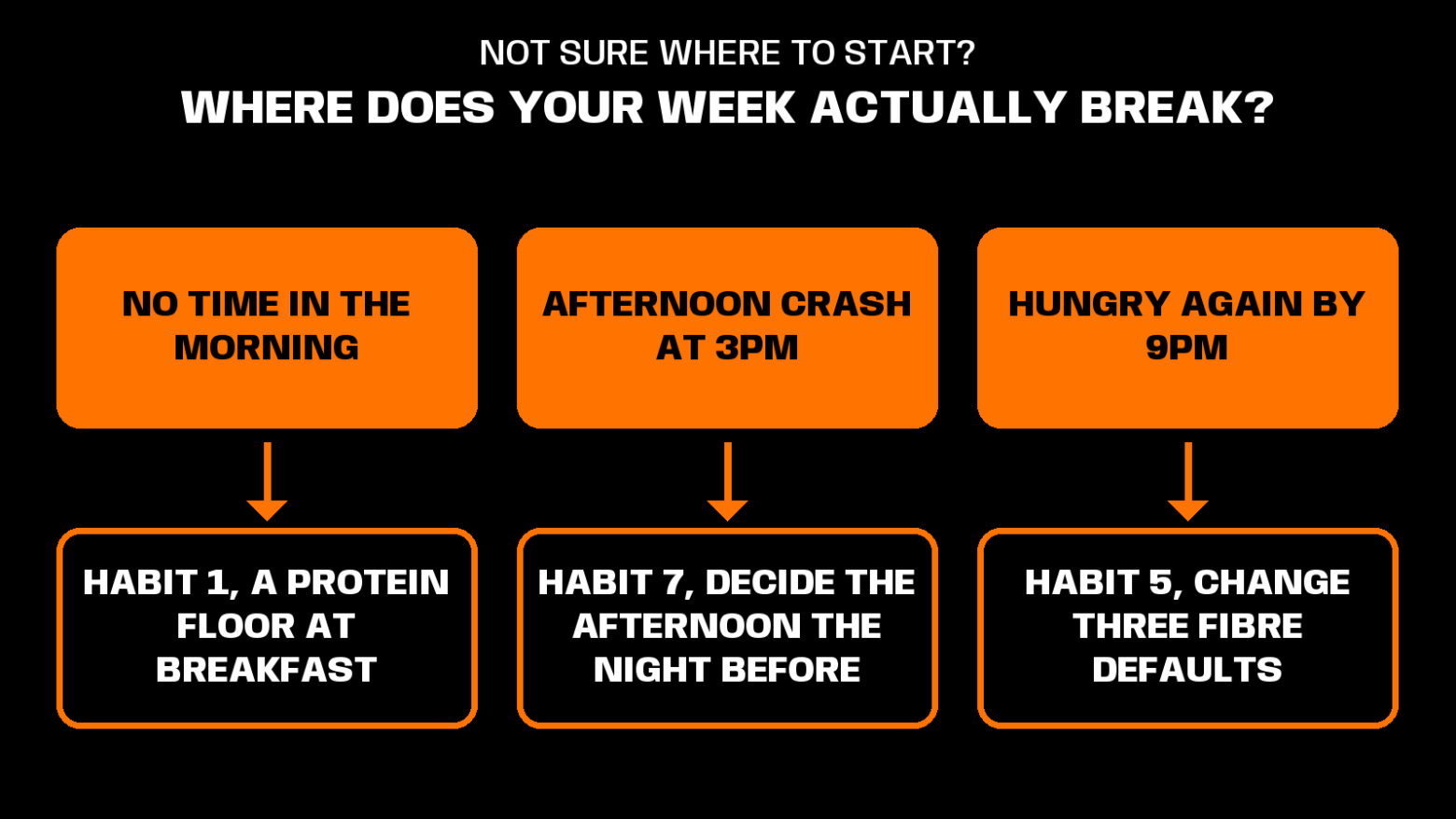
Start where your week actually breaks, not at habit one.
5. Change Three Fibre Defaults, Once
Change three things you buy on repeat rather than three things you cook. The bread, the breakfast base and the standard snack. Do it once at the shop and the habit runs itself for months without another decision.
What it is: a purchasing change rather than a cooking change, which is why it holds when the week gets busy.
Best for: the man who has never counted a gram of fibre and is almost certainly nowhere near the target.
Standout: this is the widest gap in the British diet. A 2026 analysis in the British Journal of Nutrition tracking 4,386 UK adults over a decade found average fibre intake rose from 17.4 grams to 18.4 grams a day, against a recommendation of 30 grams, leaving 96 percent of adults short [8]. Ten years of national attention moved the number by one gram, which tells you it will not be fixed by intention.
Watch-out: going from 18 grams to 30 grams in a weekend is uncomfortable and men usually abandon it for that reason. Add roughly five grams a week and drink more water alongside it.
6. Drink to a Schedule, Not to Thirst
Attach water to three fixed points in your day rather than waiting until you notice. On the desk before the first email, refilled at lunch, refilled mid afternoon. Thirst is a late signal, and by the time it arrives the effect on your concentration has usually already landed.
What it is: a cue based habit, not a litre target. The point is the schedule, because the volume looks after itself.
Best for: the man who hits three o’clock foggy and irritable and blames the workload.
Standout: the effect shows up at a level most men would not call dehydration. In a controlled study of young men, a body mass loss of about 1.59 percent produced measurable declines in vigilance and working memory alongside increased tension, anxiety and fatigue [9]. That is roughly what a warm office and a forgotten bottle will do to you by mid afternoon.
Watch-out: it is easy to overcorrect into drinking constantly and spending the afternoon walking to the toilet. Three anchored refills covers most men in most jobs, and more is needed only when training or working in heat.
7. Decide the Afternoon the Night Before
Make the three o’clock decision at nine o’clock the previous evening, when you are not hungry and not busy. Put the thing in the bag. The habit is not about willpower at three, it is about removing the decision from three entirely.
What it is: a pre commitment habit. You are moving one decision to a time of day when your judgement is better.
Best for: the man whose afternoon food comes from whichever shop is nearest the office.
Standout: out of home eating is where the British diet quietly comes apart. NDNS data shows 72 percent of participants eat out at least once a week and around 23 percent of total calorie intake now comes from eating occasions outside the home [10]. Deciding once, the night before, is what takes that number down without a rule about what you can and cannot buy.
You can run this with a note on the fridge, a repeating phone alarm, or a habit tracker such as the MenTools app if you want the prompt to arrive by itself at the right time in the evening. The prompt matters more than the tool.
Watch-out: it only works if you carry the thing, and a bag left in the hall is a habit that failed at the last step. Pair it with something you already pick up, like keys or a laptop, so it leaves the house on the back of an existing habit.
8. Put One Oily Fish Meal in the Week
Fix one meal a week as oily fish and stop thinking about it. Tinned mackerel or sardines on toast counts and takes about five minutes. This is the smallest habit in the list and it closes one of the largest gaps.
What it is: a fixed slot in the week rather than a food rule. Same night, same meal, no decision required.
Best for: the man who eats no fish at all and knows it.
Standout: the shortfall is stark. NHS advice is at least one portion of oily fish a week, around 140 grams, while NDNS found average adult consumption equivalent to only 30 to 60 grams a week [11] [1]. Most of the population is therefore covering roughly a third of a portion.
Watch-out: one meal a week is exactly what it says, and it does not offset the rest of the week. NHS advice also caps oily fish at four portions a week for most men, so this is a floor rather than something to escalate.
How Long Before Any of This Shows Up?
Give it a working month before you judge anything. The habits with a same day effect are hydration and the afternoon decision, both of which you should notice inside a week. The protein floor, the fibre defaults and the home cooking count are structural, and they show up as steadier energy and fewer late night raids on the cupboard over four to six weeks rather than in a mirror on day ten.
Judge them by whether the habit is still running, not by how you feel on any given Tuesday. A habit you have kept for a month at 70 percent will beat a perfect fortnight every time.
FAQ
How much protein does a man actually need in a day?
The UK reference intake is 0.75 grams per kilogram of body weight, roughly 56 grams for a 75 kilogram man, which is a minimum rather than a target. Men doing regular resistance training have a stronger case for more, with a meta analysis of 49 trials covering 1,863 people finding gains plateau at around 1.6 grams per kilogram a day [12].
Do I need to count calories for any of these habits?
No. None of the eight involve counting anything. They work by changing what is in the house, what order it goes on the plate and when the decision gets made, which is why they survive a week that counting would not.
Are meal delivery boxes a reasonable shortcut?
They can be, because they solve the shopping and the decision at once, which are the two failure points for most busy men. They cost more per meal than shopping yourself and they do not build any cooking skill, so treat them as scaffolding for a few months rather than the finished habit.
Is breakfast actually necessary?
Not for everyone, and skipping it is not a health problem by itself. If you do skip it, the protein floor moves to your first meal instead, because the point of habit one is spreading protein across the eating window rather than eating early.
What about supplements?
Supplements sit underneath food habits rather than replacing them. A one a day multivitamin may help cover the basics on the weeks the diet slips, but it does nothing about fibre, protein distribution or what time you decide your afternoon.
Which habit should I start with if I only pick one?
Habit four, the single ultra processed swap, because it has the strongest evidence and the lowest daily cost. If your problem is specifically the afternoon rather than the whole day, start with habit seven instead.
Do these work if I do shift work?
Yes, with one change. Anchor each habit to an event rather than a clock time, so the protein floor attaches to your first meal of a shift and the water schedule attaches to the start, middle and end of it.
Final Recommendation
Start with one habit and pick it by what breaks first in your week. If you eat well until three and badly after it, start with habit seven. If you eat quickly and out of packets, start with habit four. If you cannot remember the last vegetable you ate, start with habit two, because it costs nothing at all.
Add the next one after four weeks, not four days. Eight habits built over eight months will beat eight habits attempted in one week, and the difference shows up as habits you still have next year rather than a fortnight you can tell people about.
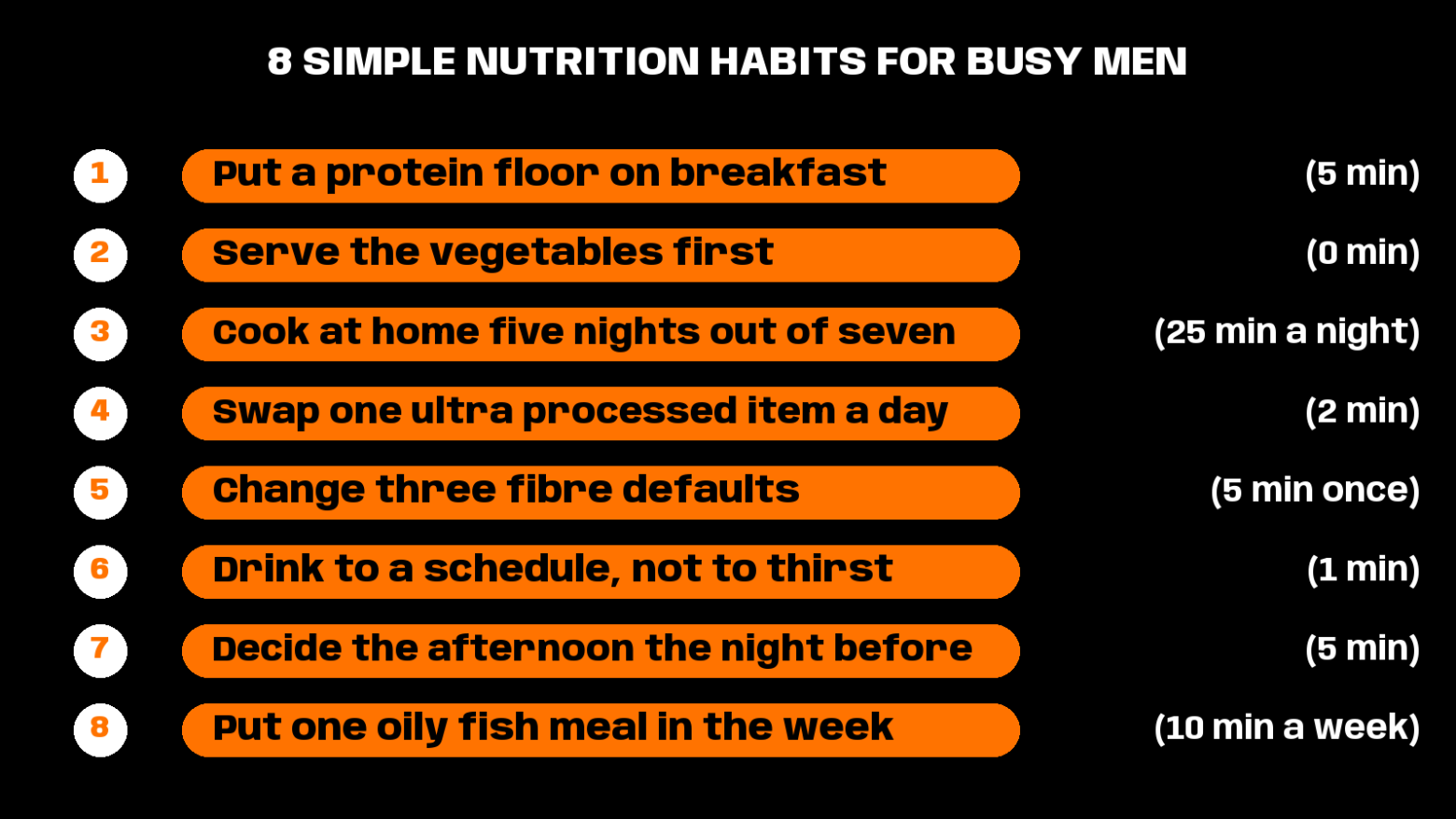
Eight habits and what each one actually costs you in time.
Options for Men to Build Better Nutrition Habits
Most men do not need another eating plan. They need the thing that makes habit five still be running in November when they set it up in September. Nutrition habits are unusually easy to lose because nothing hurts on the day you drop one, and the feedback arrives months later as low energy that gets blamed on work.
The MenTools app runs nutrition alongside mindset, fitness and money in one challenge system, with daily actions, chosen difficulty levels, reminders timed to when the habit should fire, streaks, progress tracking and an AI coach. The value is putting a prompt and a record against a habit that otherwise lives entirely in your intentions.
How you can do this today: set one habit as a recurring daily action, then do the first repetition tonight so the streak starts before your motivation does anything else.
Wins on cost: one subscription covers the habit side of food, training and mindset rather than three separate tools.
Wins on time: the structure, the levels and the tracking already exist, so there is nothing to design before you start.
Wins on practicality: it fits shift patterns, travel and family life, which is exactly where a rigid weekly food routine tends to break first.
Watch-out: it is a behaviour and consistency tool, not a meal planner, a calorie tracker or a source of dietary advice. If you need a personalised plan for a medical condition, this supports that work rather than replacing it.
On the weeks the food habits slip, and there will be some, a one a day multivitamin may help cover the simple daily foundation underneath the behaviour work. For more built for men, see the MenTools nutrition hub, and for the wider routine these sit inside, the morning routine guide covers the hour most of these habits live in. One habit, repeated for three months, will do more than another year of reading lists like this one.
Last updated: 2026-09-01 v1.0
Disclaimer: This guide is for informational purposes only and does not constitute medical or psychological advice. Speak with a qualified professional before making significant changes if you have a medical or mental health condition.
References
- [1] The Food Foundation. UK still failing to meet basic dietary guidelines. Food Foundation, 14 July 2025. Link
- [2] MRC Epidemiology Unit, University of Cambridge. National Diet and Nutrition Survey 2019 to 2023 highlights dietary deficiencies and inequalities. 12 June 2025. Link
- [3] Mamerow MM, Mettler JA, English KL, et al. Dietary protein distribution positively influences 24 hour muscle protein synthesis in healthy adults. Journal of Nutrition, 2014. Link
- [4] Wolfson JA, Bleich SN. Is cooking at home associated with better diet quality or weight loss intention. Public Health Nutrition, 2015. Link
- [5] Hall KD, Ayuketah A, Brychta R, et al. Ultra processed diets cause excess calorie intake and weight gain, an inpatient randomised controlled trial of ad libitum food intake. Cell Metabolism, 2019. Link
- [6] National Institutes of Health. NIH study finds heavily processed foods cause overeating and weight gain. EurekAlert, May 2019. Link
- [7] Rauber F, da Costa Louzada ML, Steele EM, et al. Ultra processed foods and excessive free sugar intake in the UK, a nationally representative cross sectional study. BMJ Open, 2019. Link
- [8] Papagiannaki M, et al. Changes in food patterns over a 10 year period in the UK adult population, findings from the National Diet and Nutrition Survey. British Journal of Nutrition, 2026, reported by NutraIngredients. Link
- [9] Ganio MS, Armstrong LE, Casa DJ, et al. Mild dehydration impairs cognitive performance and mood of men. British Journal of Nutrition, 2011. Link
- [10] Action on Salt. National Diet and Nutrition Survey 2019 to 2023. Action on Salt, 2025. Link
- [11] NHS. Fish and shellfish, eat well. NHS, reviewed 2025. Link
- [12] Morton RW, Murphy KT, McKellar SR, et al. A systematic review, meta analysis and meta regression of the effect of protein supplementation on resistance training induced gains in muscle mass and strength in healthy adults. British Journal of Sports Medicine, 2018. Link