MEN: Is Porn Ruining My Sex Life? Erectile Dysfunction, Performance Anxiety, and Intimacy (Evidence‑Based Guide)
Quick Answer
Treat problems as a habit‑and‑anxiety loop that competes with partner cues. Do a 14‑day reset with device blockers, add one weekly partner drill, and schedule sleep and workouts to stabilize arousal [1][5][6].
Jump to: Quick Comparison | The Real Answer | How to Fix It
This is education, not medical advice.
Disclosure: MenTools publishes this article and may feature MenTools products.
Quick Comparison
| Approach | Targets | Time | Cost | Best for |
|---|---|---|---|---|
| Blockers | Access | Now | $ | High risk |
| Reset | Arousal | 2–4 wks | $ | Recalibration |
| Sensate focus | Anxiety | 2–6 wks | $ | Couples |
| CBT skills | Worry | 4–8 wks | $ | Performance |
| Pelvic floor | Function | 4–12 wks | $ | Control |
| PDE5 meds | Vascular | On demand | $$ | Medical ED |
| Sleep, exercise | Stress | 2–4 wks | $ | Low energy |
| Sex therapy | Patterns | 6–12 wks | $$$ | Complex |
“Partner‑first reset” with four panels: block devices, 14‑day reset calendar, sensate focus steps, and sleep‑exercise anchors.
The Real Answer
Can porn contribute to erection or arousal issues?
For some men, heavy novelty and cue conditioning around screens can compete with partner cues, making arousal less reliable in real encounters [8]. Because 85 percent of U.S. adults carry smartphones, access is constant unless you add friction [1].
Erectile dysfunction is common with age, so do not assume porn is the only cause; about 52 percent of men 40 to 70 report some degree of ED in population data [2]. Treat porn as one modifiable factor among physiology, stress, and relationship context.
How does performance anxiety disrupt arousal?
Anxiety upshifts sympathetic tone and narrows attention, which can derail erection even when desire is present. Sleep loss worsens emotional reactivity and self‑control, increasing the odds of spirals during night sex or after a bad day [4][6].
CBT skills that target catastrophic thoughts and attention retraining can help you stay engaged with sensations rather than monitoring performance. Pair them with simple partner exercises to reduce pressure.
Will a reset improve partner sex and desire?
Often, yes, when the reset reduces competing cues and you add partner‑focused touch. A short reset also surfaces patterns that need work, like late‑night scrolling or private rituals that bypass intimacy.
Habit research suggests new routines need repetition over weeks, not days, before they feel automatic, with a median of about 66 days across behaviors [9]. Use the first 2 to 4 weeks to protect access and practice calm, not to chase perfection.
What medical factors should be checked first?
Rule in or out common contributors like cardiovascular risk factors, diabetes, certain medications, and low testosterone with a clinician, since ED can be linked to vascular health [7]. If morning or masturbation erections are intact but partner erections falter, psychogenic factors are more likely, and psychosexual approaches may help [7].
PDE5 inhibitors such as sildenafil help many men and can be combined with skills training; success rates are commonly reported around 60 to 70 percent in clinical practice settings [3]. Speak with a qualified clinician about safety and interactions.
How do intimacy and communication change outcomes?
Low‑pressure partner practices like sensate focus can reduce demand for immediate erections and rebuild confidence. Clear boundaries around devices and bedroom routines increase connection opportunities while reducing trigger exposure.
Because most lapses begin on phones, placing phones outside the bedroom shifts the environment toward intimacy rather than distraction [1]. Align on simple agreements so it feels like a team effort, not surveillance.
Why This Fails
- Streak chasing without partner skills.
- Unprotected phones at night and stress.
- No medical screen or relapse plan.
How to Fix It
The Simple Framework
- Reduce cues with blockers and phone‑free nights.
- Train calm with CBT and paced breathing.
- Build connection with structured partner touch.
- Check health for vascular or endocrine factors.
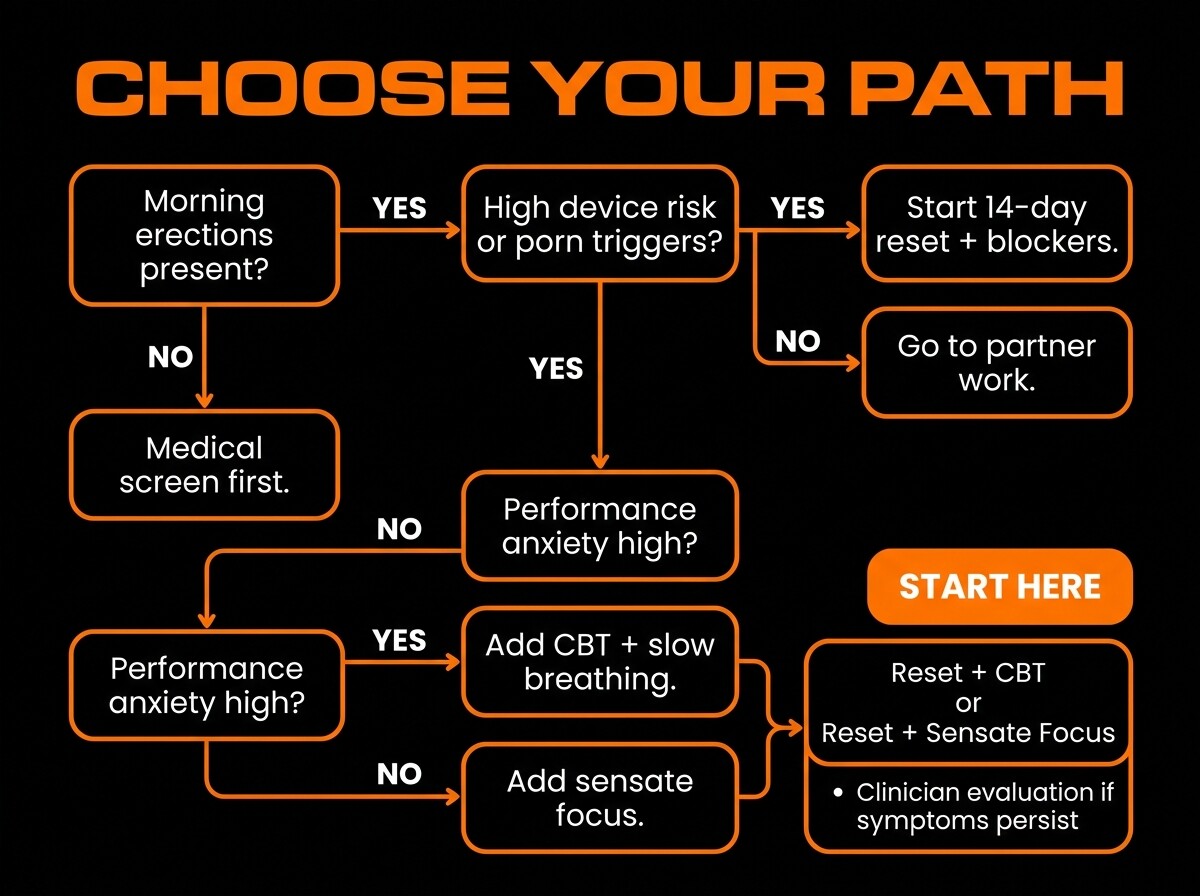
“Choose your path” flowchart: branches by morning erections present, device risk, and anxiety level to suggest reset plus CBT, reset plus sensate focus, or medical evaluation first.
5‑step plan
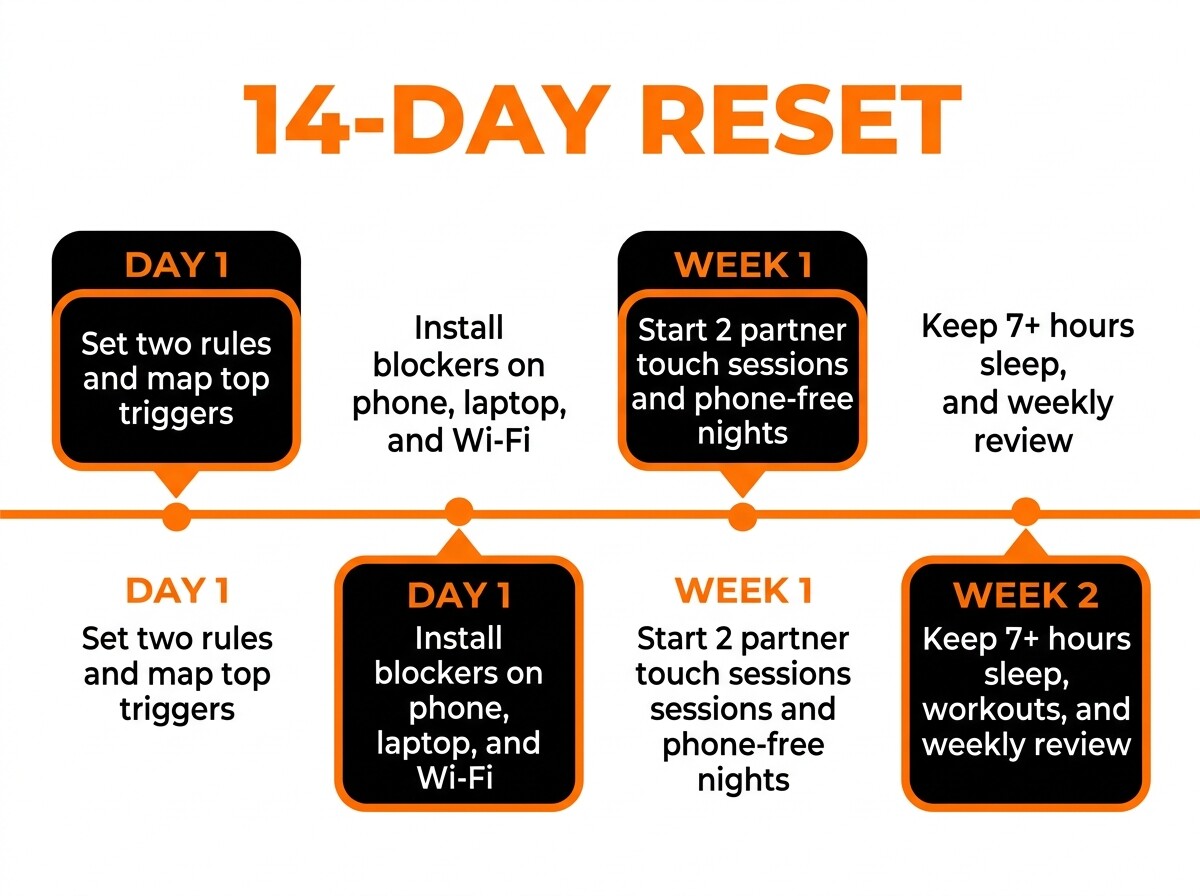
- Set two rules and map triggers.
Write one sentence on why this matters, then pick two rules, for example: no explicit content and no phone in the bedroom after 10 pm. Identify top three triggers by time and place. - Install blockers and filter DNS.
Lock down phone, laptop, and Wi‑Fi so explicit searches fail during the reset. Mobile access is the largest loophole for most men because smartphones are nearly universal [1]. - Add sensate focus and phone‑free nights.
Schedule 2 sessions per week of non‑goal touch that avoids genitals at first and slowly includes them as comfort rises. Keep devices out of the bedroom to make intimacy your default. - Train CBT and breathing for anxiety.
Write two if‑then plans for worry spirals, for example, “If I notice monitoring thoughts, then I return attention to three sensations and exhale slowly for a count of six.” Prioritize 7 or more hours of sleep to support regulation [6][4]. - Screen health and review weekly.
Ask a clinician about cardiovascular risks, medications, and whether pelvic floor work or PDE5 meds are appropriate [7][3]. Do a five‑minute weekly review to tweak blockers, rules, and partner plans.
Who this is for
- Men noticing performance anxiety or intimacy drift who want practical steps.
- Couples willing to try structured touch and device boundaries.
- Men without urgent safety risks who can access basic medical screening.
Who this is not for
- Anyone at risk of harm to self or others or in acute crisis.
- Severe depression, trauma, substance use without clinician support.
- Situations needing urgent cardiovascular or endocrine evaluation.
For medication or mental health questions, speak with a qualified clinician.
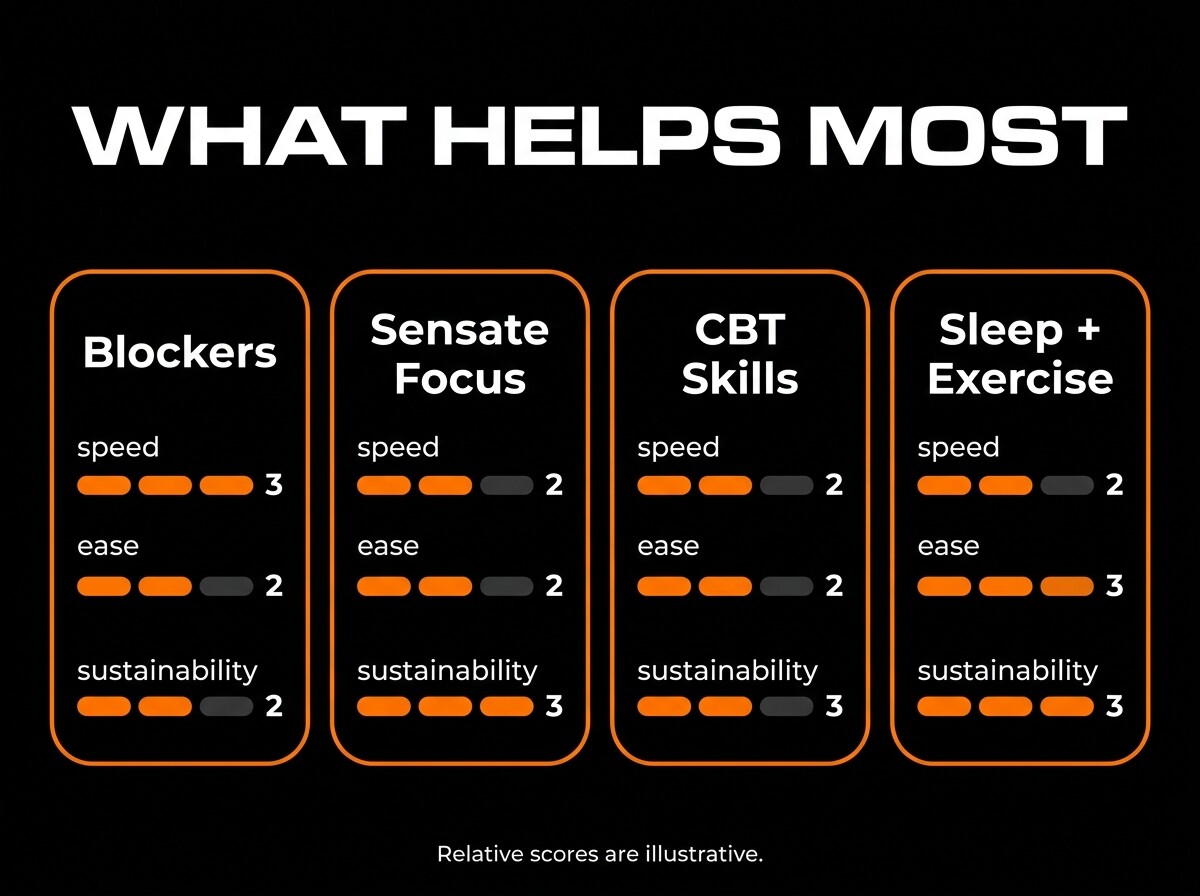
Comparison: blockers, sensate focus, CBT, and sleep‑exercise on speed, ease, and sustainability for sexual confidence.
FAQ
How long until anxiety eases after a reset?
Many men feel less pressure after 2 to 4 weeks as cues drop and partner touch increases. Building new routines usually takes longer to feel automatic, with a median around 66 days across behaviors [9].
Do ED meds help while rebuilding confidence?
Often. PDE5 inhibitors help many men achieve reliable erections and can be paired with skills and partner work; discuss safety and fit with a clinician [3].
Is masturbation without porn ok during recovery?
Some men keep it with clear rules to reduce pressure while decoupling arousal from screens. Others pause during the reset to speed cue recalibration; choose what supports partner goals.
What if erections are fine solo but not with a partner?
That pattern suggests psychogenic factors like anxiety, distraction, or cue competition. Emphasize sensate focus, CBT attention skills, and device boundaries, and consider sex therapy if needed [7].
When should I see a clinician or sex therapist?
If ED is persistent, painful, or accompanied by cardiovascular risk factors, see a clinician for screening [7]. If anxiety, avoidance, or intimacy conflicts dominate, a certified sex therapist can guide couple‑based work.
Can couples exercises restore desire and trust?
Yes, low‑pressure touch, clear communication, and consistent boundaries often improve comfort and desire over weeks. Keep sessions brief and predictable to reduce performance pressure.
Final Recommendation
Combine a short reset with device blockers, anxiety skills, and partner practice, plus a basic medical screen for common contributors [1][3][6][7][9]. Keep the focus on predictable routines and calm rather than perfect streaks.
Options For Men to Take Action
- Fast start: The quickest way to go take action is the Quit Porn Toolkit. An all‑in‑one, guided reset that helps you block devices, write rules and if‑then plans, and add accountability in under an hour, so you cut access fast and focus on partner connection.
- Cost‑savvy path: use built‑in device limits and a weekly partner session following sensate focus basics, then add exercise and earlier sleep for stability [5][6].
- Time‑efficient path: pick one change per week, like moving phones out of the bedroom or adding two 20‑minute walks, and compound small wins [5].
If you want to go deeper on porn recovery and habit change, explore the MenTools Habits hub for guides and frameworks built specifically for men.
To support your daily routine with targeted nutrition, explore MenTools One A Day, formulated with chelated minerals and active B-vitamin forms for men.
When you are ready to turn ideas into action, start a focused challenge or daily routine inside the MenTools app and track how consistent habits change how you feel.
Last updated: 2026-03-04 v1.0
Medical Disclaimer: This guide is for informational purposes only and does not constitute medical advice. Always speak with your doctor or another qualified healthcare professional before starting any new supplement or programme if you have medical conditions or take prescription medication.
References
- Pew Research Center. Mobile fact sheet. https://www.pewresearch.org/internet/fact-sheet/mobile/
- Harvard Health Publishing. Erectile dysfunction: A growing problem. https://www.health.harvard.edu/mens-health/erectile-dysfunction-a-growing-problem
- Cleveland Clinic. Erectile dysfunction medications and treatments. https://my.clevelandclinic.org/health/diseases/10036-erectile-dysfunction-ed#management-and-treatment
- Leproult R, Van Cauter E. Effect of one week of sleep restriction on testosterone levels in young healthy men. JAMA. 2011. https://jamanetwork.com/journals/jama/fullarticle/1104934
- Centers for Disease Control and Prevention. How much physical activity do adults need? https://www.cdc.gov/physicalactivity/basics/adults/index.htm
- Centers for Disease Control and Prevention. How much sleep do I need? https://www.cdc.gov/sleep/about_sleep/how_much_sleep.html
- National Health Service (NHS). Erectile dysfunction. https://www.nhs.uk/conditions/erection-problems-erectile-dysfunction/
- Voon V, Mole TB, Banca P, et al. Neural correlates of sexual cue reactivity in individuals with and without compulsive sexual behaviours. PLoS One. 2014. https://journals.plos.org/plosone/article?id=10.1371/journal.pone.0102419
- Lally P, van Jaarsveld CH, Potts HW, Wardle J. How are habits formed in the real world? European Journal of Social Psychology. 2009. https://onlinelibrary.wiley.com/doi/10.1002/ejsp.674