MEN: What Is Doomscrolling? The Science, Signs, and Fix for Men
Quick Answer
Doomscrolling is compulsive consumption of negative news through social media that hijacks your reward system, triggering anxiety, depression, and PTSD-like symptoms. The habit creates a dopamine feedback loop: you feel anxious, scroll for relief, get rewarded with new information, then crave more. Breaking it requires a daily protocol that replaces reactive scrolling with intentional content consumption and scheduled offline time.
Jump to: Quick Comparison | The Real Answer | How to Fix It
Disclosure: MenTools publishes this article and may feature MenTools products.
How we evaluate: Products are assessed on nutrient form quality, dose vs NRV, authorised health claims, male-specific design, and independent research. Full sources are listed in the references below.
Quick Comparison
| Behavior | Duration & Frequency | Emotional Impact | Recovery Time | Best For |
|---|---|---|---|---|
| Intentional News Check | 5-10 min, once daily | Informed, calm | Minutes (neutral mood) | Staying informed responsibly |
| Social Browsing | 15-20 min, 2-3x daily | Neutral to positive | Minutes to hours | Light connection, entertainment |
| Casual Scrolling | 20-45 min, unplanned | Mildly anxious, time-lost | 1-2 hours (regaining focus) | Boredom relief (not optimal) |
| Reactive Scrolling | 45+ min, multiple times | Anxious, compulsive, numb | Several hours (mood lag) | Anxiety avoidance (counterproductive) |
| Doomscrolling | 60+ min, multiple sessions | Highly anxious, depressed, overwhelmed | Hours to entire day disrupted | None (harmful to mental health) |
| Chronic Doomscrolling | 2+ hours daily, compulsive | Anxious, depressed, existential dread, numb | Days of mood disturbance | None (requires intervention) |
The Real Answer
What exactly is doomscrolling and why does it feel compulsive?
Doomscrolling is the habit of endlessly consuming negative news content through social media or news apps until it disrupts your mental health and emotional regulation. Unlike casual scrolling, doomscrolling is compulsive: you keep scrolling even when you feel worse, even when you want to stop, even when you recognize it’s harming you.
The compulsion exists because your brain’s reward center (the nucleus accumbens) releases dopamine every time you see new information, regardless of whether that information is good or bad. Researchers at UC San Diego found that the negativity bias built into human evolution means we naturally pay more attention to threatening or bad news. Your brain literally evolved to prioritize danger signals. Modern algorithms exploit this by feeding you endless negative stories because they generate engagement.
The dopamine hit you get from discovering new (even if upsetting) information creates a feedback loop: feel anxious about the state of the world, scroll for relief, feel momentarily rewarded by new data, then feel more anxious, then scroll again [1].
Why are men more susceptible to doomscrolling than other groups?
Research shows that men, younger adults, and politically engaged individuals engage in doomscrolling at higher rates [2]. Several factors explain this pattern. Men are more likely to seek out news content about conflict, competition, and threat scenarios, which aligns with traditional male threat-detection pathways. Additionally, men often have fewer emotional support networks than women and may use scrolling as a substitute for processing difficult feelings through conversation.
Younger men also tend to have higher levels of trait anxiety and lower emotional regulation skills. The combination of anxiety, limited coping strategies, and constant algorithmic exposure to conflict-heavy content creates a perfect storm for compulsive negative news consumption.
What does the research say about doomscrolling’s impact on mental health?
The evidence is clear: doomscrolling erodes mental health. An April 2023 review of 1,200 adults in the journal Applied Research in Quality of Life found that doomscrolling is linked to worse mental well-being, lower life satisfaction, and reduced harmony in life [3]. A 2024 study of 800 adults published in Computers in Human Behavior Reports found that doomscrolling evokes greater levels of existential anxiety—that feeling of dread or panic that arises when confronting life’s limitations [4].
Among Gen Z specifically, 78% report that lack of sleep drives them to doomscroll, while 55% scroll due to nervousness and 54% due to sadness [5]. Regular doomscrolling increases risk of depression, PTSD-like symptoms, insomnia, and psychological distress.
What are the specific warning signs that doomscrolling is damaging your health?
Warning signs include: checking news updates multiple times per hour, scrolling for far longer than intended, feeling emotionally drained or numb after sessions, experiencing headaches or neck pain during scrolling, noticing that scrolling increases your anxiety rather than relieving it, struggling with sleep after evening scrolling, losing interest in activities you normally enjoy, and feeling a compulsive pull toward your phone even when you don’t consciously want to check it.
The key distinction is that healthy news consumption leaves you informed and calm. Doomscrolling leaves you anxious, numb, and unable to stop.
How does doomscrolling fit into broader social media addiction patterns?
Doomscrolling is one expression of social media addiction, specifically the passive scrolling variant. Research shows that passive scrolling (consuming without interacting) has the strongest negative impact on mental health compared to active use [6]. When you passively scroll, you have no sense of control, no social connection, and no purpose—just endless stimulus-driven anxiety.
Social media algorithms are engineered to maximize engagement through variable reward schedules (the same mechanism used in slot machines and gambling addiction). Doomscrolling is what happens when algorithms combine unlimited negative content with the brain’s natural negativity bias and dopamine reward system.
Why This Fails
Most men try to stop doomscrolling by using willpower alone: deleting apps, turning off notifications, or “just avoiding” bad news. These tactics fail because they ignore the underlying psychology. Your brain isn’t choosing to doomscroll as a rational decision—it’s running an automatic reward-seeking program that evolved to keep you alive by monitoring threats.
Willpower-based approaches also create guilt and shame when you inevitably relapse, which then drives more scrolling as a coping mechanism. Telling yourself “just don’t check your phone” is like telling yourself “just don’t feel anxious”—the instruction ignores the actual problem.
Generic advice like “go outside” or “read a book” fails because it doesn’t replace the specific dopamine loop you’ve built. Your brain needs a new, equally accessible reward pathway that satisfies the information-seeking urge without triggering anxiety.
How to Fix It
The Simple Framework
The fix has three pillars: (1) replace reactive scrolling with scheduled intentional consumption, (2) rebuild your baseline dopamine through offline activities that engage your brain, and (3) create friction between you and triggering content while making alternatives frictionless. This isn’t about perfection or never checking news—it’s about moving from compulsive to conscious.
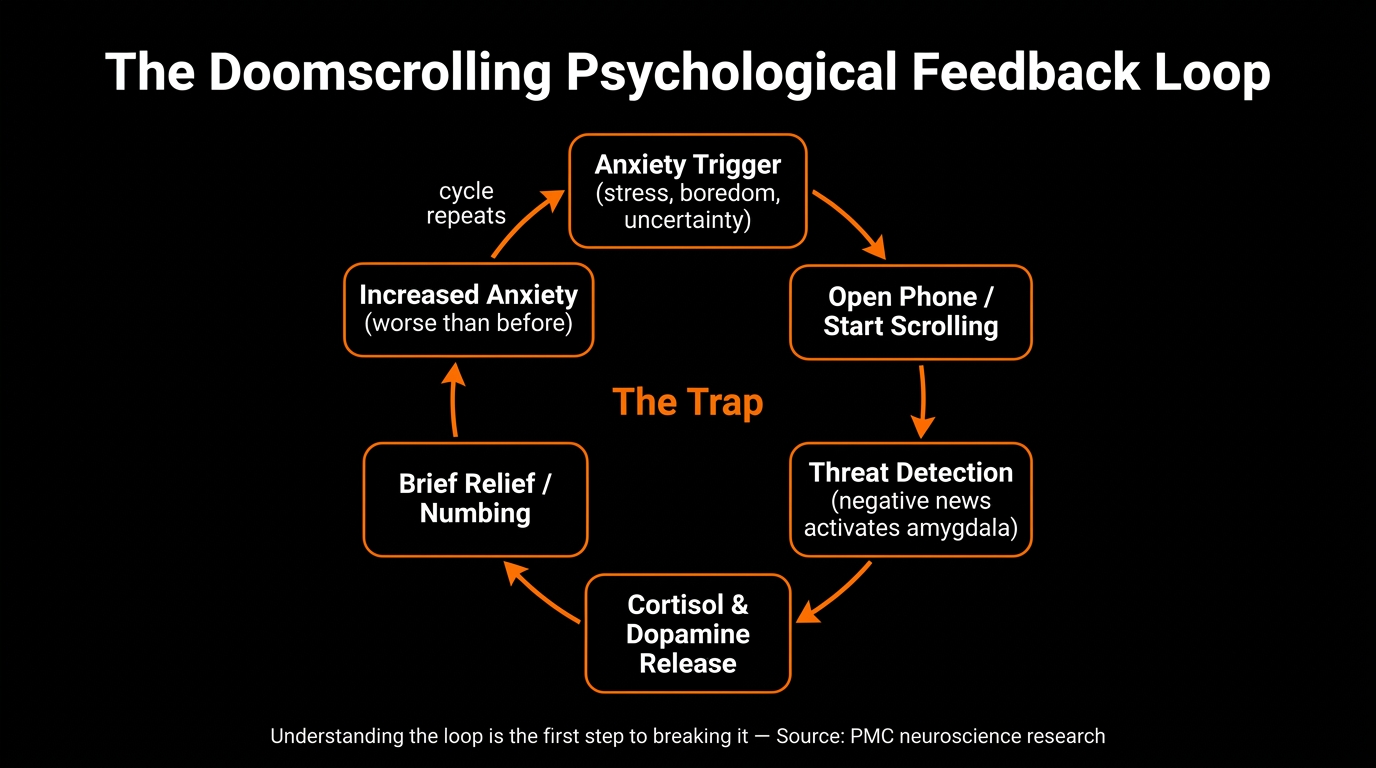
Visual: Doomscrolling Cycle Diagram — A flowchart showing the psychological feedback loop driving compulsive negative news consumption in men.
5-Step Plan to Stop Doomscrolling
- Establish a News Window: Schedule one 10-minute window per day (ideally morning, not evening) for intentional news consumption. Use a news app or specific website, not social media. Set a timer. When the timer ends, close the app. This satisfies your information-seeking drive without the algorithmic amplification that social media uses.
- Delete Social Media Apps from Your Phone (but not your account): You’ll still have access via web browser if needed, but the friction of opening a browser prevents reactive checking. Notifications stop. The algorithm-driven feed disappears. Most doomscrolling happens through apps because of notifications and algorithmic feeds designed for maximum engagement.
- Replace One Daily Scroll Session with a Specific Alternative: Identify your highest-risk doomscrolling time (often morning coffee, lunch break, or evening). Replace it with a concrete activity: 10 minutes reading a chapter of non-fiction, a short walk with a specific route, a focused work task, or a call to a friend. The activity must be specific enough that you can execute it on autopilot when the urge hits.
- Track Your Mood Before and After Phone Use: Use a simple 0-10 scale each time you check your phone. Rate your mood before and after. After two weeks, you’ll see the pattern clearly: intentional use improves or maintains mood, scrolling tanks it. This data becomes your own evidence for behavior change, stronger than any external rule.
- Build a Separate Notification System for News That Matters: Set up email alerts for news categories you actually need to know (work, health, family). Unsubscribe from everything else. Now when breaking news happens, you’ll find out through email during your scheduled check, not through algorithmic manipulation. You maintain awareness without compulsion.
FAQ
How much time do men spend doomscrolling daily?
According to 2024 research, about 31% of American adults engage in doomscrolling regularly, with rates higher among younger men (46% of millennials, 53% of Gen Z). Among those who doomscroll, sessions often exceed 60 minutes and occur multiple times per day, though exact averages vary by age and stress levels.
Is doomscrolling the same as social media addiction?
No. Social media addiction is broader—it includes all compulsive social media use. Doomscrolling is a specific subtype: compulsive consumption of negative news content. You can have social media addiction without doomscrolling (excessive posting, gaming apps, dating apps) and you can doomscroll without using social media (news app addiction). However, they share the same underlying psychological mechanisms.
Can doomscrolling actually cause PTSD or just PTSD-like symptoms?
Research shows doomscrolling causes PTSD-like symptoms in vulnerable populations, particularly those with previous trauma. Full clinical PTSD diagnosis requires exposure to actual threat, but the psychological distress from chronic negative news exposure mirrors PTSD symptoms (hypervigilance, intrusive thoughts, avoidance, emotional numbing). If you have a trauma history, doomscrolling is especially risky.
What if I need to stay informed about current events for work?
Use a scheduled approach: pick 1-2 specific news sources (not social media algorithms), read for a set time daily, then close completely. Your brain doesn’t actually need real-time updates—news from 12 hours ago is identical in value. Waiting until your scheduled window won’t cause you to miss anything important, but it will prevent compulsive checking. Many successful professionals use a morning briefing and nothing else.
Why doesn’t deleting the social media app work permanently?
Because the underlying anxiety and information-seeking drive remain. When you feel that urge to check (which usually intensifies for 3-7 days after deleting the app), you’ll be tempted to reinstall or open the mobile web version. Without replacing the scrolling with an equally accessible alternative, willpower alone typically fails. The app was a symptom, not the disease.
How long does it take to break the doomscrolling habit?
New behaviors typically require 21-66 days to feel automatic, depending on the person. Most men see noticeable mood improvements within 5-7 days of stopping reactive scrolling, but the psychological craving can persist for 2-3 weeks. By week 4, the urge usually feels manageable. Consistency matters more than perfection—one slip doesn’t erase progress.
Can I ever check social media again without relapsing into doomscrolling?
Yes, with conditions. After 4-6 weeks without the habit, most people can re-introduce limited, intentional use. The key is never allowing passive algorithmic feeds (where the algorithm chooses what you see). Only follow specific accounts you choose, set a timer before opening, and use only during non-stress times. If you notice the urge to scroll returning, delete the app again for another 3-4 weeks.
Final Recommendation
If you’re reading this because doomscrolling has become part of your daily routine, the single most important action is to admit that willpower alone won’t work. You’re not lazy or weak—you’re up against evolutionary psychology, algorithmic design, and dopamine reward systems that are far more sophisticated than your conscious intention.
The fix is simple but requires system design, not motivation. Delete the app today. Set your news window tomorrow. Pick one replacement activity and commit to one week. Track your mood. After 7 days, reassess. Most men find that 48-72 hours without compulsive scrolling produces noticeable improvements in sleep, anxiety, and focus.
Doomscrolling isn’t a character flaw. It’s a predictable outcome of psychology meeting algorithm. The fix is predictable too: swap the reward loop, build friction, create structure, and give your nervous system time to recalibrate.
Options For Men to Take Action
Most men struggle with doomscrolling because the solutions feel fragmented: some advice suggests apps, others suggest willpower, others suggest therapy, and none of it feels integrated or designed specifically for how men actually use information. The result is frustration, relapse, and deeper anxiety about failing to control your own behavior.
The MenTools Stop Doom Scrolling Protocol consolidates everything into a single, science-backed system. Instead of trying to piece together advice from articles, apps, and books, you get a day-by-day framework that walks you through the psychology, the implementation, the tracking, and the relapse prevention.
When you join, you get immediate access to the full protocol: the 5-step daily structure, the mood tracking system, the replacement action library (so you’re not guessing what to do instead of scrolling), and the weekly recalibration checks that keep you accountable.
Here’s how you can do this today: visit the MenTools Stop Doom Scrolling Protocol, review the first 7 days, and commit to one week. No long-term subscription required. Just one week of structured action.
Wins on cost: The protocol costs far less than therapy, medication trials, or the cumulative cost of doomscrolling-related anxiety, poor sleep, and lost productivity.
Wins on time: The daily protocol takes 15-20 minutes to execute, which you reclaim immediately through improved focus and reduced anxiety-driven tasks. Most men report 5+ hours of reclaimed focus per week.
Wins on practicality: Every step is designed for real life, not ideal life. The protocol doesn’t assume you have meditation skills, therapy access, or unlimited willpower—it works with how your brain actually functions.
Stop treating doomscrolling as a personal failure. It’s a system problem with a system solution.
If you want to go deeper on doomscrolling and digital habits, explore the MenTools Habits hub for guides and frameworks built specifically for men.
To support your daily routine with targeted nutrition, explore MenTools One A Day, formulated with chelated minerals and active B-vitamin forms for men.
When you are ready to turn ideas into action, start a focused challenge or daily routine inside the MenTools app and track how consistent habits change how you feel.
Last updated: 2026-03-13 v1.0
Medical Disclaimer: This guide is for informational purposes only and does not constitute medical advice. Always speak with your doctor or another qualified healthcare professional before starting any new supplement or programme if you have medical conditions or take prescription medication.
References
- Doomsurfing and doomscrolling mediate psychological distress in COVID-19 lockdown: Implications for awareness of cognitive biases. PMC, 2021. https://pmc.ncbi.nlm.nih.gov/articles/PMC8250995/
- Doomscrolling Scale: its Association with Personality Traits, Psychological Distress, Social Media Use, and Wellbeing. PMC National Center for Biotechnology Information, 2022. https://pmc.ncbi.nlm.nih.gov/articles/PMC9580444/
- Doomscrolling during COVID-19: The negative association between daily social and traditional media consumption and mental health symptoms during the COVID-19 pandemic. PMC, 2023. https://pmc.ncbi.nlm.nih.gov/articles/PMC10074257/
- Doomscrolling evokes existential anxiety and fosters pessimism about human nature? Evidence from Iran and the United States. ScienceDirect, 2024. https://www.sciencedirect.com/science/article/pii/S245195882400071X
- Pay Attention to What Your Fingers Scroll: The Roles of Doomscrolling and Psychological Adjustment Between Adolescents’ Problematic Social Media Use and Psychological Distress. The Journal of Genetic Psychology, 2025. https://www.tandfonline.com/doi/full/10.1080/00221325.2025.2584991
- Scrolling and Stress: The Link Between Social Media and Anxiety. Relief Mental Health, 2024. https://reliefmh.com/blog/scrolling-and-stress-the-link-between-social-media-and-anxiety/
- Doomscrolling dangers. Harvard Health, 2024. https://www.health.harvard.edu/mind-and-mood/doomscrolling-dangers
- What Is Doomscrolling? Why We Do It & How It Affects Us. Positive Psychology, 2024. https://positivepsychology.com/doomscrolling/