MEN: Best Stop Doomscrolling Influencers for Men to Follow (2026 List)
Quick Answer
The best influencers for men to follow when replacing doomscrolling are those focused on digital minimalism, mindset, and behaviour change. Top creators include Cal Newport (digital focus), Andrew Huberman (neuroscience), Ryan Holiday (stoicism), and Ali Abdaal (productivity). Each offers actionable frameworks to help you reclaim your time from passive scrolling and replace it with purposeful content that builds real skills and resilience.
Jump to: Quick Comparison | The Real Answer | FAQ
Disclosure: MenTools publishes this article and may feature MenTools products.
How we evaluate: Products are assessed on content quality, scientific grounding, male-specific relevance, and independent research. Full sources are listed in the references below.
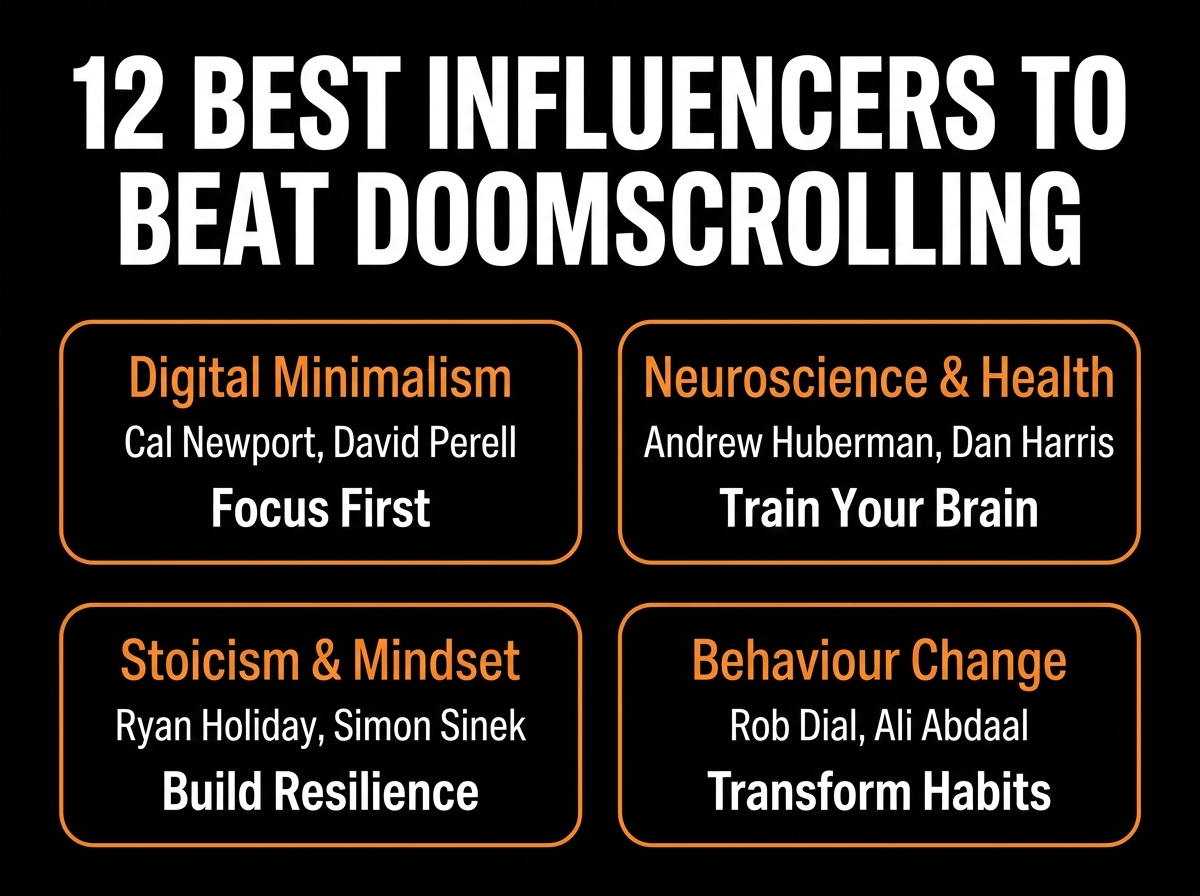
Figure 1: The 12 best influencers for men wanting to replace doomscrolling with purposeful content that builds real skills and mental resilience.
Quick Comparison
| Influencer/Creator | Platform Focus | Content Type | Best For Men Who… | Primary Message |
|---|---|---|---|---|
| Cal Newport | YouTube, Blog | Digital minimalism, Deep work | Want to reclaim focus and eliminate digital noise | Technology is optional; depth is rare |
| Andrew Huberman | YouTube, Podcast | Neuroscience, Science-based habits | Want to understand brain biology behind behaviour | Use neuroscience to optimise performance |
| Ryan Holiday | YouTube, Books, Newsletter | Stoicism, Ancient philosophy | Seek timeless principles for resilience and character | Virtue is the only true good |
| Ali Abdaal | YouTube, Podcast | Productivity, Money, Deep work | Want practical systems for time and attention | Make space for what matters |
| Steven Bartlett (DiaryOfACEO) | YouTube, Podcast, TikTok | Entrepreneurship, Psychology | Want to understand business and human behaviour | Curious and ambitious growth mindset |
| Dan Harris (10% Happier) | Podcast, App, Books | Meditation, Mindfulness, Mental health | Skeptical about wellness but want real tools | Meditation and mindfulness are practical |
| Rob Dial (The Mindset Mentor) | Podcast, YouTube | Daily mindset coaching | Need daily mental coaching and habit building | Your mindset determines your destiny |
| Rich Roll | Podcast, YouTube | Wellness, Mindfulness, Long-form interviews | Want deep conversations on health and purpose | Wholefood plant-based living for high performance |
| Chris Williamson (Modern Wisdom) | Podcast, YouTube | Neuroscience, Psychology, Long-form interviews | Want scientific depth without fluff or marketing | Science-backed information for life improvement |
| Simon Sinek | YouTube, TED Talks, Books | Leadership, Purpose, Motivation | Want to understand the “why” behind meaningful action | Start with why; lead with purpose |
| Mo Gawdat | YouTube, Podcast, Books | Happiness science, AI, Purpose | Seeking practical happiness algorithms and meaning | Happiness is a skill, not luck |
| Jay Shetty | Podcast, YouTube, TikTok | Monk wisdom, Life lessons, Happiness | Want ancient wisdom applied to modern life | Serve others; find purpose through service |
The Real Answer
Why Do Men Doomscroll in the First Place?
Doomscrolling is not a weakness; it is a feedback loop engineered by platforms to exploit how your brain is wired. The global average screen time now sits at 6 hours and 45 minutes per day, accounting for over 40% of your waking hours. For many men, passive scrolling has replaced active content creation, deep conversations, and real skill-building.
The distinction between active and passive social media use is crucial. Passive scrolling, which involves mindless browsing without engagement, is consistently linked to higher anxiety, depression, and loneliness. A 2024 research report found that passive social media use correlates to loneliness, while active engagement does not. In contrast, men who intentionally engage with content, create, and interact with others see improved mental health outcomes.
What Does the Science Say About Replacing Doomscrolling?
The research is clear and compelling. One randomised controlled trial of 220 university students found that limiting social media to one hour per day for three weeks significantly reduced symptoms of depression, anxiety, and fear of missing out. An additional 2024 study by the American Psychological Association reported that individuals who reduced screen time by just 90 minutes per day saw a 24% improvement in sleep quality and a 19% decrease in anxiety levels.
The key insight is this: it is not the time on screen that matters most, but what you do with that time. Following influencers focused on mindset, behaviour change, and digital minimalism creates a “replacement effect.” Instead of doomscrolling, you are consuming content that actually builds skills, knowledge, and mental resilience. Over time, your brain begins to crave depth rather than dopamine hits.
How Do You Pick the Right Influencers to Replace Doomscrolling?
The best influencers for men wanting to stop doomscrolling share three core traits: they produce long-form, substantive content that requires active engagement; they avoid algorithmic manipulation and emotional triggers; and they teach frameworks or skills that transfer to real life. Digital minimalism creators like Cal Newport focus on reclaiming your attention itself. Neuroscience creators like Andrew Huberman explain the biology of focus and behaviour change. Stoic and philosophical creators like Ryan Holiday provide timeless frameworks for resilience.
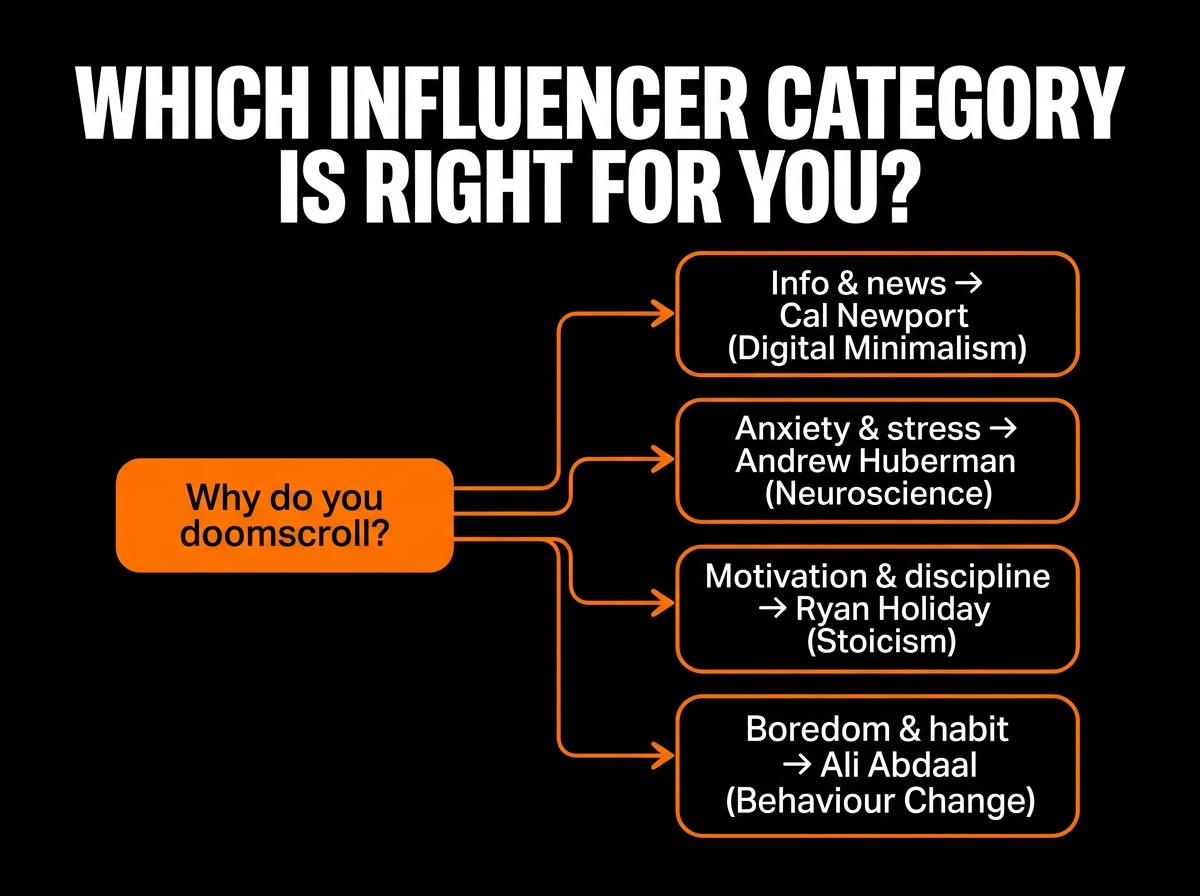
Figure 2: Decision flowchart for matching your doomscrolling trigger to the right influencer category. Identifying your primary reason for scrolling is the fastest route to finding a creator whose content will actually compete with the feed.
Which Platforms Should You Use?
YouTube and long-form podcasts are the primary platforms for these creators, not TikTok or Instagram Reels. YouTube and podcast platforms reward depth and series-based viewing. When you subscribe to a channel like Modern Wisdom (Chris Williamson) or The Mindset Mentor (Rob Dial), the algorithm begins to serve you long-form content. This shift alone can reduce doomscrolling because the friction increases (you cannot rapidly swipe through content) and the reward becomes cognitive, not dopamine-driven.
What About Specific Influencer Categories?
The 12 to 16 creators recommended below are divided into four categories: Digital Minimalism Creators (Cal Newport, Ali Abdaal) focus on reclaiming time and attention. Neuroscience and Performance Creators (Andrew Huberman, Peter Attia) teach the biology of focus, sleep, and behaviour change. Philosophical and Stoic Creators (Ryan Holiday, Simon Sinek) offer timeless frameworks for meaning and purpose. Behaviour Change and Mindset Creators (Rob Dial, Jay Shetty, Dan Harris) provide practical daily coaching and meditation practices. Each category addresses a different reason men doomscroll, and following creators from multiple categories creates a balanced intake of content.
Why This Fails
Many men try to replace doomscrolling by simply following self-help creators, but this approach fails for three practical reasons. First, they choose creators who are themselves designed for algorithmic engagement and emotional manipulation. A creator who builds their following on outrage, clickbait, or motivational hype will trigger the same addictive loop as doomscrolling. The only difference is the topic.
Second, they do not create friction around the platforms themselves. If you follow deep-work creators on TikTok or Instagram, the algorithm will still interrupt you with reels, notifications, and shorter content. You end up following a good creator through a bad platform. Third, they do not have a system for intentional consumption. They subscribe to creators and then passively consume, without any structure for application or reflection. This leads to “inspiration without action,” which actually increases frustration and anxiety over time.
How to Fix It
The Simple Framework
Replace doomscrolling by moving to platforms that reward depth, following creators focused on frameworks (not motivation), and building a weekly review routine to apply what you learn. This framework is called Intentional Substitution: you are replacing one behaviour (passive scrolling) with another (active, purposeful content consumption) in the same time slot. Your brain gets the dopamine hit of novelty, but it also builds real skills and resilience.
The 5-Step Plan
- Audit your current feeds. Open TikTok, Instagram, and Twitter and count how many accounts are purely entertainment, motivational, or designed for outrage. Unfollow or mute 80% of them. You should feel slight resistance and doubt; that is the algorithm losing its grip.
- Subscribe to three creators from each category. Choose digital minimalism creators (like Cal Newport or Ali Abdaal), neuroscience creators (Andrew Huberman or Peter Attia), and philosophical creators (Ryan Holiday or Simon Sinek). This provides balance and prevents the echo chamber effect of following only one type of creator.
- Move to YouTube and podcasts. Delete the TikTok app from your phone, or use app blockers to limit it to specific times. Subscribe to the creators on YouTube or your preferred podcast app (Apple Podcasts, Spotify, or a dedicated app like Pocket Casts). The friction of watching a 45-minute YouTube video instead of scrolling through Reels is the point; it breaks the habit loop.
- Create a weekly review habit. Every Sunday evening, spend 15 minutes writing down the key idea from one creator you watched that week. What was the core insight? How does it apply to your life right now? This simple ritual transforms passive consumption into active learning and creates the dopamine hit from progress, not novelty.
- Track your time for 21 days. Use a simple habit tracker or your phone’s screen time data to log how much time you spend consuming intentional content versus scrolling. After 21 days, your baseline will shift. The creators you follow will feel more rewarding than doomscrolling, because they are building something rather than depleting you.
FAQ
Will following better creators actually reduce my screen time?
Not on its own. The goal of intentional substitution is not to reduce screen time, but to change what you do during screen time. A 2024 study found that limiting social media to one hour per day reduces depression and anxiety by up to 24%. The creators recommended here are chosen because they teach frameworks for focus and behaviour change, so they compound the benefits over time. As you learn from them, you naturally develop the discipline to reduce screen time further.
Which platform should I use if I want to watch these creators?
YouTube is the best single platform for most of these creators. Cal Newport, Andrew Huberman, Ryan Holiday, Chris Williamson, Ali Abdaal, and Rob Dial all maintain active YouTube channels. For podcasts, Apple Podcasts, Spotify, and Pocket Casts all carry the major shows. Avoid Instagram, TikTok, and Twitter for these creators; the short-form format undermines the depth they are trying to offer. If a creator you like posts Reels or short clips, follow them on YouTube instead.
What if I only have 20 minutes per day for content?
Twenty minutes per day is enough to replace doomscrolling. Start with podcast clips or 15 to 20-minute YouTube videos focused on one specific skill or idea. Creators like Ali Abdaal and Andrew Huberman release short content alongside long-form material. The key is consistency over length. Consuming 20 minutes of intentional content daily will rewire your brain faster than 2 hours of passive scrolling once per week.
Do all of these creators have the same message?
No, and that is the point. Cal Newport focuses on digital minimalism and deep work. Andrew Huberman teaches neuroscience and performance. Ryan Holiday teaches stoicism. Mo Gawdat teaches happiness algorithms. By following creators with different focuses, you create a balanced intellectual diet and avoid the echo chamber effect. You also get different angles on the same problem, which leads to deeper understanding.
Is following self-help creators just another form of addiction?
It can be, if the creators are designed for emotional manipulation and if you consume without applying. The creators recommended here are chosen because they teach frameworks you can test and apply in real life. The weekly review habit (step 4 in the plan above) ensures you are learning, not just consuming. If you find yourself watching hours of motivation without taking action, you need to add more friction and accountability.
How do I know if a creator is actually helping or just another form of scrolling?
Ask yourself three questions after watching: (1) Did I learn a specific skill or principle I can test? (2) Did I take one action based on what I learned? (3) Do I feel energised or drained? If you answer yes to questions 1 and 2, and energised to question 3, the creator is serving you. If you feel inspired but do not take action, or feel drained by outrage, the creator is just another form of doomscrolling dressed up as improvement.
Should I follow all 12 of these creators?
No. Start with two or three: one from the digital minimalism category, one from neuroscience, and one from stoicism or philosophy. Follow them on YouTube and listen for one month. You will quickly discover which creators align with your learning style and values. Then add one more. Building your “creator portfolio” slowly ensures you are choosing based on real resonance, not FOMO. Quality always beats quantity.
Final Recommendation
Doomscrolling is not a problem with your willpower; it is a structural problem with how platforms are designed and how you use them. The research is clear: passive scrolling destroys mental health, while active, intentional consumption of depth-based content builds resilience, focus, and real skills.
The 12 creators in this guide have been selected because they consistently produce long-form, substantive content that requires active engagement and teaches frameworks you can apply to your life. They are not motivational hype machines; they are craftspeople of clarity. Following them on the right platforms (YouTube and podcasts) and building a simple weekly review habit creates a replacement behaviour that is more rewarding than scrolling and compounds over time.
The goal is not to become a creator obsessive or to spend more time consuming content. The goal is to intentionally substitute passive scrolling with content that actually builds something in you: focus, knowledge, resilience, and character. If you do that, your relationship with technology shifts from one of depletion to one of genuine growth.

Figure 3: Comparison of influencer categories by content depth, habit replacement effectiveness, and average content length. Neuroscience creators deliver the deepest content; Digital Minimalism creators show the strongest habit replacement outcomes for men specifically trying to escape doomscrolling.
Options For Men to Take Action
Most men who switch to following better creators still end up doomscrolling. Not because the creators are wrong — the ones on this list are genuinely excellent — but because the scroll habit is neurological, not a content problem. You can follow Cal Newport and Andrew Huberman and still reflexively open Instagram the moment you feel bored or stressed.
That is exactly what the MenTools Stop Doom Scrolling Protocol is designed to solve.
This is not another creator recommendation. It is a structured 30-day behaviour-change framework that pairs directly with intentional content consumption — giving you the trigger identification, the daily accountability, and the environmental design to make scrolling harder and purposeful watching the default.
What happens when you join:
- You identify the specific triggers that send you to the feed instead of the channels and podcasts you actually want.
- You redesign your phone environment so the right content is always one tap away and the doomscroll apps require friction to open.
- You follow a daily check-in structure for the first two weeks — the window where the new habit either roots or collapses.
- You track measurable progress: screen time, sleep quality, focus, and anxiety markers.
- You get community accountability from other men running the same framework at the same time.
How you can do this today:
Visit the MenTools Stop Doom Scrolling Protocol. You get immediate access to the full framework, the trigger system, and the first week’s daily structure. Most men see measurable scrolling reduction within 3–5 days and a full content habit shift within 30 days.
Wins on cost: Every creator on this list publishes free content on YouTube and podcasts. The protocol replaces every paid app, tracker, and accountability tool you have tried and abandoned. One complete system instead of the usual scattered approach that never quite sticks.
Wins on time: You are already spending the time on your phone. The protocol does not add time — it redirects the exact windows you currently scroll so you come out of each session having consumed content that actually builds something rather than depleting you.
Wins on practicality: The framework works around real men’s schedules — commutes, gym sessions, lunch breaks, evenings. No willpower required. Just clear structure that runs in the same time slots where doomscrolling currently lives.
The creators on this list will show you what intentional content looks like. The protocol makes sure you actually watch them instead of scrolling past.
If you want to go deeper on doomscrolling and digital habits, explore the MenTools Habits hub for guides and frameworks built specifically for men.
To support your daily routine with targeted nutrition, explore MenTools One A Day, formulated with chelated minerals and active B-vitamin forms for men.
When you are ready to turn ideas into action, start a focused challenge or daily routine inside the MenTools app and track how consistent habits change how you feel.
Last updated: 2026-04-20 v1.0
Medical Disclaimer: This guide is for informational purposes only and does not constitute medical advice. Always speak with your doctor or another qualified healthcare professional before starting any new supplement or programme if you have medical conditions or take prescription medication.
References
- Harvard Health. “Doomscrolling dangers.” Retrieved from https://www.health.harvard.edu/mind-and-mood/doomscrolling-dangers
- Doomscrolling Scale: its Association with Personality Traits, Psychological Distress, Social Media Use, and Wellbeing. PMC. Retrieved from https://pmc.ncbi.nlm.nih.gov/articles/PMC9580444/
- Doomscrolling during COVID-19: The negative association between daily social and traditional media consumption and mental health symptoms during the COVID-19 pandemic. PMC. Retrieved from https://pmc.ncbi.nlm.nih.gov/articles/PMC10074257/
- Doomscrolling evokes existential anxiety and fosters pessimism about human nature? Evidence from Iran and the United States. ScienceDirect. Retrieved from https://www.sciencedirect.com/science/article/pii/S245195882400071X
- The Double-Edged Scroll: Active vs. Passive Social Media Use and Stress. Information Matters. Retrieved from https://informationmatters.org/2025/02/the-double-edged-scroll-active-vs-passive-social-media-use-and-stress/
- How you scroll matters: passive social media use linked to loneliness. Joint Research Centre. Retrieved from https://joint-research-centre.ec.europa.eu/jrc-news-and-updates/how-you-scroll-matters-passive-social-media-use-linked-loneliness-2024-12-13_en
- Passive scrolling, active comparing: how social media use behaviours shape happiness through social comparison. Taylor & Francis Online. Retrieved from https://www.tandfonline.com/doi/full/10.1080/0144929X.2026.2654493
- Is It Just About Scrolling? The Correlation of Passive Social Media Use with College Students’ Subjective Well-Being Based on Social Comparison Experiences and Orientation Assessed Using a Two-Stage Hybrid Structural Equation Modeling–Artificial Neural Network Method. PMC. Retrieved from https://pmc.ncbi.nlm.nih.gov/articles/PMC11673610/
- The effect of digital detox through digital minimalism using the MinimalistPhone app on the behavior of young users and their emotional experience. ScienceDirect. Retrieved from https://www.sciencedirect.com/science/article/pii/S2451958825001149
- On Digital Minimalism. Cal Newport. Retrieved from https://calnewport.com/on-digital-minimalism/
- Average Screen Time Statistics 2026. DemandSage. Retrieved from https://www.demandsage.com/screen-time-statistics/
- U.S. adults on effect of social media on mental health by gender 2024. Statista. Retrieved from https://www.statista.com/statistics/1457452/effect-of-social-media-on-mental-health-gender/